
Authors:
Avinash Singh, Amit Patil
Download free PDF
Coffee Machines Market Size & Share 2026-2035
Report ID: GMI6072
|
Published Date: September 2026
|
Report Format: PDF/Excel/Dashboard/Platform
Download Free PDF
Explore Our Licensing Options:
Download Free PDF

Coffee Machines Market
Get a free sample of this report
What are you hoping to find?
Your PDF is on its way. Tell us little about your research goal, and we'll help you find the most relevant market insights.
Coffee Machines Market Size
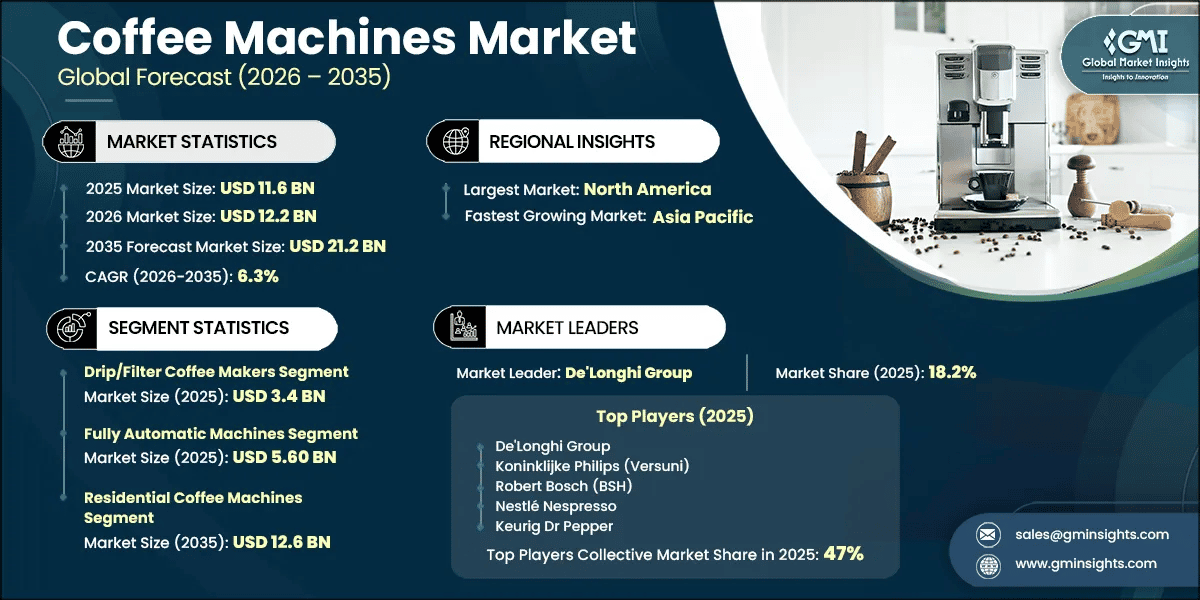
The Coffee Machines Market was valued at USD 11.6 billion in 2025, is valued at USD 12.2 billion in 2026, is projected to grow at a 6.3% CAGR (2026–2035), and is expected to reach USD 21.2 billion by 2035. The market covers manufacturer and brand-owner revenue from electrically powered, standalone coffee brewing appliances sold across residential and commercial settings.
Coffee Machines Market Key Takeaways
Market Leader: De'Longhi Group led with over 18.2% market share in 2025.
Leading Players: Top 5 players in this market include De'Longhi Group, Koninklijke Philips (Versuni), Robert Bosch (BSH), Nestlé Nespresso, Keurig Dr Pepper, which collectively held a market share of 47% in 2025.
Growth reflects a durable shift in the role of the home coffee appliance from a basic utility to a product that supports beverage quality, convenience, and personal customization. Premium residential upgrades, smart-home compatibility, and commercial buyers' need for dependable output with less labor are changing the revenue mix toward automated and feature-rich systems.
GMI Analyst View
Based on our analysis of manufacturer-level revenue data, the global coffee machines market generated USD 11.0 billion in 2024, establishing a strong runway into the current forecast cycle. We view this progression as evidence that residential premiumization and commercial automation are reinforcing one another, providing a more resilient growth base than a replacement-led appliance market alone.
Coffee Machines Market Trends, Growth Drivers & GMI Forecast Outlook
Coffee machine demand is increasingly shaped by a split between mature markets upgrading installed appliance bases and developing markets adding first-time users. The strongest value creation is occurring where convenience, café-style beverage quality, and automation converge, while low-price formats remain more exposed to replacement-cycle delays and input-cost pressure.
Key Drivers
*Evidence anchors use cited external data; demand implications and forecast conditions represent GMI analysis.*
Coffee consumption supports appliance demand not simply through volume, but through the frequency and setting of consumption. The National Coffee Association reported that daily coffee consumption and at-home consumption remain deeply embedded among U.S. adults, while specialty coffee has gained further traction since 2020. That shift raises the commercial value of appliances capable of delivering repeatable espresso, milk-based beverages, and customized drinks without a professional barista.
Commercial demand strengthens the same trend. Hotels, workplace programs, specialty cafés, and institutional foodservice operators are prioritizing fully automatic and super-automatic equipment because it standardizes beverage delivery while reducing dependence on skilled labor. For manufacturers, this expands the addressable market for higher-capital systems and places reliability, cleaning automation, and serviceability alongside beverage quality as purchasing criteria.
Key Restraints
*Evidence anchors use cited external data; demand implications and forecast conditions represent GMI analysis.*
Commodity-market disruption can affect machine demand indirectly by raising the cost of the coffee occasion itself. Arabica and robusta prices reached record levels during 2025, increasing the pressure on retailers and appliance suppliers serving value-conscious households [5]Food Navigator. “Why Coffee Prices Are Falling After Record Highs.” foodnavigator.com. When coffee expenditures rise alongside appliance prices, consumers may defer replacement purchases or remain with simpler brewing formats for longer.
Capsule-system manufacturers face an additional strategic challenge in Europe because machine hardware, proprietary consumables, and packaging design are commercially intertwined. Compliance can reward platform owners that can redesign at scale, but it may constrain smaller systems with limited sourcing flexibility or insufficient investment capacity.
GMI Analyst View
We believe the forecast is primarily a mix transformation rather than a uniform rise in demand across every appliance format. The market's value pool is moving toward systems that remove preparation complexity, improve beverage consistency, and support a more premium in-home experience; suppliers exposed to basic hardware will need clearer differentiation in design, price, or channel strategy.
Coffee Machines Market Segment Analysis
By Product Type
Drip/Filter Coffee Makers
Drip/filter coffee makers generated USD 3.4 billion in 2025 and are expected to account for 24.1% by 2035. The category remains important because of household familiarity, low operating complexity, and broad retail availability. Its competitive position is increasingly dependent on thermal performance, programmability, and design-led differentiation as consumers seeking café-style beverages consider alternative formats.
Single-Serve/Capsule Machines
Single-serve/capsule machines are projected to reach USD 5.7 billion by 2035 and are expected to expand at a 6.5% CAGR (2026–2035). Convenience, portion control, and beverage variety continue to underpin the category's appeal, particularly in multi-user households and time-constrained routines. Its outlook is nevertheless tied to the ability of platform owners to manage capsule sustainability requirements without eroding the ease-of-use proposition that differentiates the format.
Espresso Machines
Espresso machines generated USD 2.3 billion in 2025 and are expected to represent 15.1% by 2035. The segment spans entry-level appliances through professional equipment, creating sharply different purchase dynamics across price points. Demand remains defensible among enthusiasts and hospitality users, but fully automated alternatives are lowering the operational barrier for consumers who want espresso-based drinks without manual preparation.
Bean-to-Cup Machines
Bean-to-cup machines are projected to reach USD 5.9 billion by 2035 and are expected to grow at an 11.4% CAGR (2026–2035). Integrated grinding, brewing, and milk preparation position bean-to-cup systems at the center of residential premiumization and commercial automation. The format's proposition is especially strong where purchasers seek fresh-bean quality with predictable output and minimal labor, allowing it to capture upgrades from both drip and traditional espresso formats.
Others
Other product formats represented 7.8% in 2025 and are expected to account for 6.1% by 2035. Niche appliances retain relevance among specific user groups, but they face limited scale compared with mainstream brewing platforms. Their future depends on specialized functionality, distinctive design, or a compelling use case that prevents substitution by more versatile systems.
By Technology
Fully Automatic
Fully automatic machines generated USD 5.60 billion in 2025 and are expected to account for 42.9% by 2035. This technology remains the revenue anchor because it serves both premium households and commercial sites that value consistent results without specialist labor. Suppliers that combine dependable automation with intuitive maintenance features are likely to retain an advantage as buyers prioritize total operating convenience.
Manual/Semi-Automatic
Manual/semi-automatic machines generated USD 4.46 billion in 2025 and are expected to grow at a 2.5% CAGR (2026–2035). Hands-on extraction control continues to appeal to enthusiasts and trained operators, but the format has a narrower mainstream audience. Its slower trajectory reflects a structural preference for appliances that simplify grinding, dosing, milk preparation, and cleaning while preserving acceptable beverage quality.
Smart/Connected
Smart/connected machines generated USD 1.50 billion in 2025 and are projected to reach USD 6.4 billion by 2035. Connectivity is becoming a practical feature set rather than a novelty, enabling recipe management, remote scheduling, maintenance prompts, and closer engagement with brand ecosystems. The resulting installed base can strengthen loyalty and support premium positioning where the connected experience is reliable and clearly useful.
By End Use
Residential
Residential coffee machines generated USD 7.30 billion in 2025 and are projected to reach USD 12.6 billion by 2035. The residential market is shifting from basic brewing toward appliances that replicate a wider range of café beverages at home. Hybrid work patterns and greater familiarity with specialty formats support this transition, particularly among consumers willing to invest in automation, integrated grinding, and beverage personalization.
Commercial
Commercial applications accounted for 37.1% in 2025 and are expected to grow at a 7.2% CAGR (2026–2035). Commercial purchasers increasingly evaluate machines through labor efficiency, uptime, beverage consistency, and ease of cleaning. Hospitality, office, and foodservice operators therefore favor platforms that can serve variable demand without compromising drink quality or requiring dedicated barista staffing.
By Price Range
Medium ($200–$1,000)
The medium price range generated USD 5.80 billion in 2025 and is projected to reach USD 10.2 billion by 2035. This tier is the market's principal upgrade zone, where buyers can access meaningful improvements in automation, milk handling, and connected features without entering professional-equipment price points. Manufacturers able to make premium capabilities tangible at retail are best positioned to compete for this broad consumer base.
Low (Below $200)
The low price range represented 31.0% in 2025 and is expected to expand at a 4.7% CAGR (2026–2035). Entry-level machines remain essential for first-time purchasers and cost-sensitive replacement demand, especially in developing markets. However, constrained pricing power and commodity-linked cost pressure limit the room for product enhancement and make this tier more vulnerable to delayed purchase decisions.
High (Above $1,000)
The high price range generated USD 2.20 billion in 2025 and is expected to account for 25.0% by 2035. Premium demand is supported by consumers who equate appliance quality with beverage quality and are willing to pay for integrated grinders, advanced milk systems, and durable materials. Commercial installations also reinforce the tier, as professional-grade equipment commands a materially different value proposition from household appliances.
By Distribution Channel
Offline
Offline channels generated USD 6.96 billion in 2025 and are expected to account for 51.9% by 2035. Physical retail remains strategically important for higher-value machines because demonstrations, specialist advice, and direct comparison can reduce purchase risk. Offline channels also remain integral to contractual commercial sales, installation, and service-led relationships.
Online
Online channels represented 40.0% in 2025 and are expected to grow at an 8.2% CAGR (2026–2035). Digital channels widen access to premium brands in markets with less developed specialist retail networks. Brand-direct platforms are particularly valuable where machine sales connect consumers with a broader ecosystem of consumables, accessories, maintenance, and recurring engagement.
GMI Analyst View
We see the segment structure increasingly favoring suppliers that can turn technical complexity into an effortless customer experience. The strongest competitive positions will not necessarily belong to the brands with the broadest catalogues, but to those that can combine quality output, intuitive ownership, and credible sustainability credentials in the formats consumers are actively upgrading toward.
Coffee Machines Market Regional Analysis
North America Coffee Machines Market Analysis
North America generated USD 3.5 billion in 2025 and is projected to reach USD 5.3 billion by 2035. The Global Coffee Machines Market in North America is defined by a mature installed base and a strong premium-appliance retail environment. Incremental demand is concentrated in connected upgrades, bean-to-cup systems, and commercial applications rather than broad first-time household adoption.
U.S.
The U.S. represented 22.3% of total global revenue in 2025 and is expected to grow at a 4.3% CAGR (2026–2035). The U.S. market benefits from habitual at-home coffee consumption and a consumer base increasingly familiar with specialty formats [2]National Coffee Association. “More Americans Drink Coffee Each Day Than Any Other Beverage, Bottled Water Back in Second Place.” prnewswire.com. Growth is therefore more value-led than volume-led, with smart, single-serve, and automated systems competing for upgrades from traditional brewers.
Canada
Canada generated USD 0.90 billion in 2025 and is expected to grow at a 3.9% CAGR (2026–2035). Canadian demand reflects a mature appliance market with continued interest in convenient single-serve and premium espresso formats. Commercial and urban specialty-coffee demand provide additional opportunities beyond household replacement cycles.
Europe Coffee Machines Market Analysis
Europe generated USD 3.4 billion in 2025 and is expected to account for 24.1% by 2035. Europe combines deeply established espresso traditions with extensive capsule adoption. Market development is increasingly shaped by premiumization and the regulatory response required from proprietary single-serve ecosystems.
Germany
Germany generated USD 0.91 billion in 2025 and is expected to grow at a 4.4% CAGR (2026–2035). Germany's preference for engineered household appliances supports demand for fully automatic and bean-to-cup machines. Strong retail sophistication and established premium brands reinforce an upgrade market centered on integrated functionality and product durability.
UK
The UK is projected to reach USD 1.1 billion by 2035 and is expected to grow at a 4.6% CAGR (2026–2035). The UK's shift toward specialty and espresso-based consumption at home supports demand beyond conventional instant-coffee routines. Home-barista interest and commercial upgrades in hospitality and workplaces create room for premium and automated systems.
France
France represented 5.2% of the global market in 2025 and is expected to grow at a 4.2% CAGR (2026–2035). French demand spans traditional domestic brewing and well-established capsule consumption. The country's dense café and restaurant base also supports a recurring professional-equipment replacement market.
Italy
Italy generated USD 0.50 billion in 2025 and is expected to account for 3.3% by 2035. Italy's influence exceeds its revenue position because it remains central to espresso culture, professional machine design, and specialist manufacturing. Domestic demand retains a strong traditional espresso orientation, while automated platforms are expanding among younger and urban users.
Spain
Spain represented 3.4% of the global market in 2025 and is expected to grow at a 3.5% CAGR (2026–2035). Spain's commercial opportunity is supported by a large café and bar culture, while residential growth remains more measured. Capsule and premium automatic systems have room to expand as home consumption occasions become more differentiated.
Asia Pacific Coffee Machines Market Analysis
Asia Pacific generated USD 3.0 billion in 2025 and is expected to grow at a 9.5% CAGR (2026–2035). Asia Pacific is the fastest-growing regional market because coffee adoption is still creating new appliance households while urban consumers are often entering through premium formats. Specialty café expansion, rising purchasing power, and digital distribution together create a longer runway than in replacement-led markets.
China
China represented 9.2% of the global market in 2025 and is projected to reach USD 2.7 billion by 2035. China's opportunity reflects the rapid normalization of coffee consumption among urban consumers and the role of e-commerce in extending premium appliance access. Competition is likely to remain intense as global brands and domestic participants educate consumers across capsule and fully automatic categories.
India
India is expected to grow at a 9.6% CAGR (2026–2035) and is projected to reach USD 2.0 billion by 2035. India combines a low installed base with a growing urban professional class and existing regional coffee traditions. Demand is evolving from basic brewing formats toward convenient single-serve and entry-level automatic machines, with premium adoption concentrated in major cities.
Japan
Japan generated USD 0.40 billion in 2025 and is expected to grow at a 9.4% CAGR (2026–2035). Japan's technical consumer base favors feature-rich, precise, and compact appliances, supporting the adoption of connected and premium systems. Hospitality and foodservice demand complement a residential market that values product engineering and beverage consistency.
Latin America Coffee Machines Market Analysis
Latin America generated USD 1.0 billion in 2025 and is expected to grow at a 7.2% CAGR (2026–2035). The region offers a substantial first-time ownership opportunity despite its strong coffee-production heritage. Urban incomes, specialty-coffee culture, and wider distribution are creating demand for residential machines alongside commercial equipment for expanding café formats.
Brazil
Brazil generated USD 0.55 billion in 2025 and is projected to reach USD 1.0 billion by 2035. Brazil is transitioning from traditional preparation methods toward espresso and capsule formats among urban consumers. Income stratification and import conditions keep entry and mid-price products important, while premium systems lead value growth.
Mexico
Mexico represented 2.6% of the global market in 2025 and is expected to grow at a 7.4% CAGR (2026–2035). Mexico benefits from geographic and commercial links with North American coffee platforms, alongside a rising urban specialty-coffee culture. Hospitality and foodservice investment add a commercial layer to growing household appliance demand.
Middle East & Africa Coffee Machines Market Analysis
Middle East & Africa generated USD 0.7 billion in 2025 and is expected to grow at a 7.5% CAGR (2026–2035). The region combines premium demand in Gulf markets with broader first-time ownership potential elsewhere. This dual structure favors suppliers that can serve affluent consumers seeking high-end espresso systems while maintaining accessible formats for expanding urban households.
Saudi Arabia
Saudi Arabia generated USD 0.30 billion in 2025 and is expected to grow at a 7.6% CAGR (2026–2035). Specialty coffee culture, hospitality investment, and a young consumer base support premium household and commercial demand. The market's growth is reinforced by a preference for experience-oriented foodservice and higher-specification appliances.
UAE
The UAE represented 1.7% of the global market in 2025 and is projected to reach USD 0.5 billion by 2035. The UAE's international resident base, premium retail infrastructure, and hospitality footprint sustain demand for high-value coffee equipment. Digital and duty-free channels also improve brand visibility and access across consumer segments.
South Africa
South Africa represented 1.7% of the global market in 2025 and is expected to grow at a 7.1% CAGR (2026–2035). South Africa is a key appliance market and distribution gateway for the wider continent. Urban middle-class demand, specialty retail, and hospitality investment support a transition from basic household brewing toward more premium machine formats.
GMI Analyst View
We expect the regional balance of demand to become more diversified as Asia Pacific contributes both new users and premium buyers, while North America and Europe monetize upgrades from mature installed bases. In our view, the most attractive regional strategies will be differentiated rather than standardized: affordability and distribution matter most in emerging markets, whereas ownership experience, service, and sustainability will matter more in mature ones.
Coffee Machines Market Share & Competitive Landscape
The Coffee Machines Market share structure was moderately concentrated in 2025, with the five leading companies collectively holding 47.0% of revenue. Competition is shaped by platform ownership, brand equity, manufacturing and service capability, retail reach, and the ability to compete in high-value automated and connected formats.
De'Longhi Group held 18.2% of market share in 2025. Its broad portfolio provides exposure to consumer, prosumer, and professional demand, while its presence in bean-to-cup and fully automatic systems aligns with the market's premiumization trajectory.
Koninklijke Philips N.V. (Versuni) held 9.0% of market share in 2025. Its competitive position is concentrated in fully automatic, bean-to-cup, and capsule-oriented categories, where product usability and distribution execution are central to sustaining relevance.
Robert Bosch GmbH (BSH) held 8.5% of market share in 2025. Bosch, Siemens, and Gaggenau benefit from established consumer trust, premium kitchen-appliance positioning, and European retail relationships that support high-specification automated coffee systems.
Groupe SEB, Nestlé Nespresso, Keurig Dr Pepper, and Panasonic compete through distinct combinations of consumer-appliance scale, capsule-platform ownership, regional distribution, and brand architecture. Regional champions such as La Cimbali, Nuova Simonelli, Rancilio Group, JURA Elektroapparate, WMF Group, Hamilton Beach, and BUNN retain influence through professional expertise, local distribution, and category-specific credibility.
Niche and specialist competitors-including Rocket Espresso Milano, Victoria Arduino, Bezzera, Eversys, Thermoplan, Franke Coffee Systems, and Breville Group-remain important in prosumer and commercial segments where engineering quality, service support, and beverage performance can outweigh broad retail scale. Keurig Dr Pepper's proposed acquisition of JDE Peet's would deepen the strategic importance of machine platforms and consumables by combining North American single-serve strength with major international coffee brands.
Recent Industry Developments
Keurig Dr Pepper / JDE Peet's acquisition: Keurig Dr Pepper announced an agreement to acquire JDE Peet's, combining its North American machine and pod platform with JDE Peet's portfolio of international coffee brands. The proposed transaction underscores the value of controlling both consumer relationships and the broader coffee ecosystem across markets [6]Reuters. “Dr Pepper Takes a Shot at Nestlé with $18 Bln Takeover of Dutch Coffee Giant.” reuters.com.
illycaffè / Capitani acquisition: illycaffè acquired an 80% stake in Capitani, an Italian single-serve coffee machine manufacturer. The transaction signals an effort to extend vertical control from premium coffee into machine design and production, potentially strengthening coordination between proprietary coffee offerings and hardware [7]Comunicaffe. “illycaffè Acquires a Majority Stake in Italian Single-Serve Coffee Machine Manufacturer Capitani.” comunicaffe.com.
Need a specific section of this report?
Purchase regional analysis, country-level analysis, company profiles, or any other segment-level insights separately
based on your research needs.
Frequently Asked Questions (FAQs):
Research methodology, data sources & validation process
This report draws on a structured research process built around direct industry conversations, proprietary modelling, and rigorous cross-validation and not just desk research.
Our 6-step research process
1. Research design & analyst oversight
At GMI, our research methodology is built on a foundation of human expertise, rigorous validation, and complete transparency. Every insight, trend analysis, and forecast in our reports is developed by experienced analysts who understand the nuances of your market.
Our approach integrates extensive primary research through direct engagement with industry participants and experts, complemented by comprehensive secondary research from verified global sources. We apply quantified impact analysis to deliver dependable forecasts, while maintaining complete traceability from original data sources to final insights.
2. Primary research
Primary research forms the backbone of our methodology, contributing nearly 80% to overall insights. It involves direct engagement with industry participants to ensure accuracy and depth in analysis. Our structured interview program covers regional and global markets, with inputs from C-suite executives, directors, and subject matter experts. These interactions provide strategic, operational, and technical perspectives, enabling well-rounded insights and reliable market forecasts.
3. Data mining & market analysis
Data mining is a key part of our research process, contributing nearly 20% to the overall methodology. It involves analysing market structure, identifying industry trends, and assessing macroeconomic factors through revenue share analysis of major players. Relevant data is collected from both paid and unpaid sources to build a reliable database. This information is then integrated to support primary research and market sizing, with validation from key stakeholders such as distributors, manufacturers, and associations.
4. Market sizing
Our market sizing is built on a bottom-up approach, starting with company revenue data gathered directly through primary interviews, alongside production volume figures from manufacturers and installation or deployment statistics. These inputs are then pieced together across regional markets to arrive at a global estimate that stays grounded in actual industry activity.
5. Forecast model & key assumptions
Every forecast includes explicit documentation of:
✓ Key growth drivers and their assumed impact
✓ Restraining factors and mitigation scenarios
✓ Regulatory assumptions and policy change risk
✓ Technology adoption curve parameter
✓ Macroeconomic assumptions (GDP growth, inflation, currency)
✓ Competitive dynamics and market entry/exit expectations
6. Validation & quality assurance
The final stages involve human validation, where domain experts manually review filtered data to identify nuances and contextual errors that automated systems might miss. This expert review adds a critical layer of quality assurance, ensuring data aligns with research objectives and domain-specific standards.
Our triple-layer validation process ensures maximum data reliability:
✓ Statistical Validation
✓ Expert Validation
✓ Market Reality Check
Trust & credibility
Verified data sources
Trade publications
Industry journals, trade publications, and specialized media.
Industry databases
Proprietary and third-party market databases
Regulatory filings
Government procurement records and policy documents
Academic research
University studies and specialist institution reports
Company reports
Annual reports, investor presentations, and filings
Expert interviews
C-suite, procurement leads, and technical specialists
GMI archive
13,000+ published studies across 20+ industry verticals
Trade data
Import/export volumes, HS codes, and customs records
Parameters studied & evaluated
Every data point in this report is validated through primary interviews, true bottom-up modelling, and rigorous cross-checks. Read about our research process →