
Authors:
Suraj Gujar, Sandeep Ugale
Download free PDF
Photoelectric Sensor Market Size & Share 2026-2035
Report ID: GMI3353
|
Published Date: February 2026
|
Report Format: PDF/Excel/Dashboard/Platform
Download Free PDF
Explore Our Licensing Options:
Immediate Delivery Available
Jump to Content
Market Size
Market Trends
Market Analysis
Market Share
Market Companies
Industry News
Frequently Asked Questions
Research Methodology
Related Reports
Download Free PDF

Photoelectric Sensor Market
Get a free sample of this report
What are you hoping to find?
Your PDF is on its way. Tell us little about your research goal, and we'll help you find the most relevant market insights.
Photoelectric Sensor Market Size
The global photoelectric sensor market was valued at USD 2.4 billion in 2025. The market is expected to grow from USD 2.5 billion in 2026 to USD 5.1 billion in 2035, at a CAGR of 8.1% during the forecast period according to the latest report published by Global Market Insights Inc. The growth of the Photoelectric Sensors industry is being fueled by the increasing prevalence of process automation and smart manufacturing across all businesses. From manufacturing plants and their assembly lines to the manufacturing of packaging, photoelectric sensors are being utilized more frequently than ever before to detect, count, and inspect products accurately. Therefore, manufacturers have been able to lower their error rates and increase the number of finished products they produce. For instance, according to research published in Institute of Electrical and Electronics Engineers, it is estimated that in 2024 over 54 % of automotive assembly lines worldwide utilized photoelectric sensors for position verification and defect detection, underscoring their importance in advanced production environments.
Photoelectric Sensor Market Key Takeaways
Market Leader: OMRON Corporation led with over 12.4% market share in 2025.
Leading Players: Top 5 players in this market include OMRON Corporation, Panasonic Industry Co., Ltd., SICK AG, KEYENCE CORPORATION, Rockwell Automation, which collectively held a market share of 29.6% in 2025.
Another key growth driver is the integration of IoT and Industry 4.0 technologies, with intelligent sensor systems enabling real‑time monitoring, predictive maintenance, and data analytics in smart factories. Installation of IoT‑enabled photoelectric sensors to rise sharply between 2023 and 2024, allowing manufacturers to reduce operational errors and downtime while improving asset tracking and remote diagnostics.
Furthermore, with the increased demand for automated logistics and e-commerce, distribution centers are utilizing sensors for faster sorting/tracking & managing inventories. This is further emphasized by the increase in automated systems for online retail & will drive sensor usage making photoelectric solutions an essential part of the supply chain and solidifying their long-term market trend.
Photoelectric Sensor Market Trends
Photoelectric Sensor Market Analysis
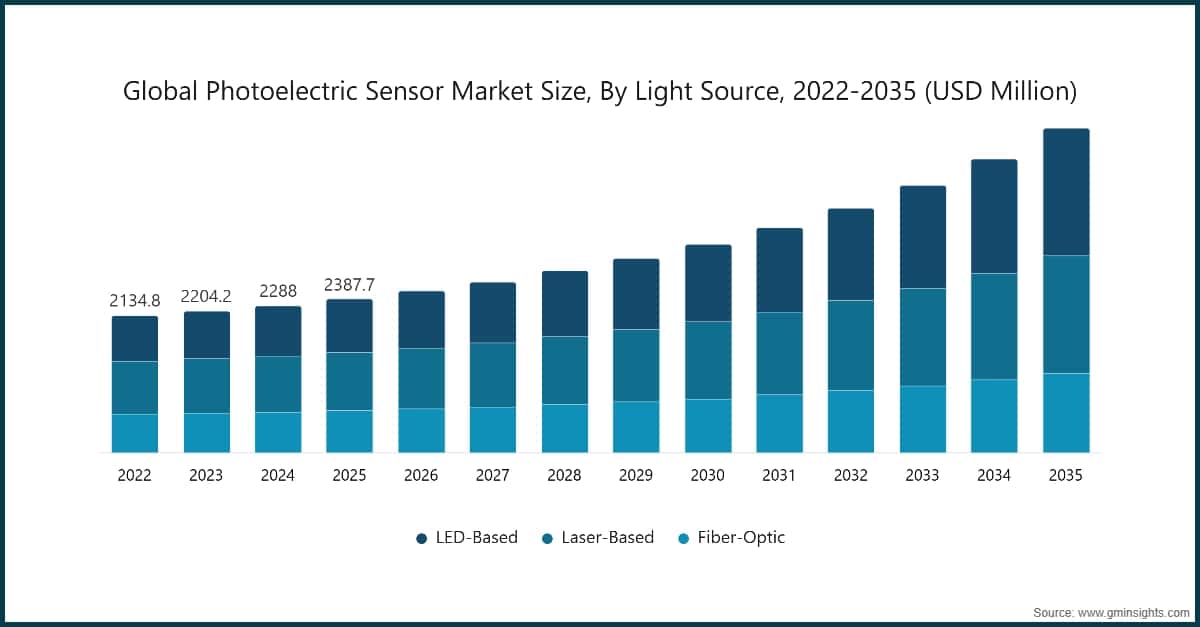
Basec on the light source, the market is segmented into LED-Based, Laser-Based, and Fiber-Optic.
On the basis of optical configuration, the photoelectric sensor market is divided into through-beam, retro-reflective, and diffuse.
On the basis of end-user industry, the photoelectric sensor market is segmented into industrial manufacturing, automotive & transportation, food & beverage processing, pharmaceuticals & medical devices, building automation & smart infrastructure, electronics & semiconductor manufacturing, energy, utilities & infrastructure, aerospace & defense, and others.
North America Photoelectric Sensor Market
The North America photoelectric sensor market holds a significant share of the 28.2% in 2025.
The U.S. photoelectric sensor market was valued at USD 486.8 million and USD 503.2 million in 2022 and 2023, respectively. The market size reached USD 546.3 million in 2025, growing from USD 522.9 million in 2024.
Europe Photoelectric Sensor Market
Europe photoelectric sensor industry accounted for USD 557.8 million in 2025 and is anticipated to show lucrative growth over the forecast period.
Asia Pacific Photoelectric Sensor Market
The Asia Pacific market is anticipated to hold significant share of 42.8% in 2025 and is expected to grow at the highest CAGR of 8.8 % during the forecast period.
Latin American Photoelectric Sensor Market
Middle East and Africa Photoelectric Sensor Market
Saudi Arabia photoelectric sensor industry to experience substantial growth in the Middle East and Africa.
Photoelectric Sensor Market Share
The global photoelectric sensor industry is moderately consolidated, with key players such as OMRON Corporation, Panasonic Industry Co., Ltd., SICK AG, KEYENCE CORPORATION, and Rockwell Automation collectively accounting for approximately 39% of the market. These companies capitalize on extensive expertise in industrial automation, sensing technologies, and factory integration, delivering high-precision, reliable sensors for applications across manufacturing, logistics, automotive, and robotics.
While these leading vendors dominate, the market remains partially fragmented, with numerous regional and specialized suppliers catering to niche segments such as smart factories, AI-driven production lines, and harsh-environment automation. Smaller players differentiate through tailored solutions, cost-efficient models, AI-enabled detection, and rapid deployment support. These competitive dynamic drives innovation in multi-mode sensing, long-range detection, compact designs, and seamless integration with industrial IoT and automated control systems, underpinning steady growth in the global market.
Photoelectric Sensor Market Companies
Prominent players operating in the photoelectric sensor indusyry are as mentioned below:
OMRON Corporation is a global leader in industrial automation and sensing solutions, leveraging its core “Sensing & Control + Think” technology to deliver advanced photoelectric sensors (including diffuse‑reflective, through‑beam, and retro‑reflective types) integrated with automation and IoT platforms. Its broad portfolio supports packaging, assembly, and material handling applications, with continuous R&D investments driving innovations in high‑precision detection and smart factory connectivity.
Panasonic Industry Co., Ltd. offers a comprehensive range of photoelectric and laser sensors as part of its factory automation portfolio, including compact, thru‑beam, retro‑reflective, and IO‑Link‑enabled models designed for object detection, positioning, and measurement tasks. By combining robust optical sensing with electronic control expertise, Panasonic’s sensors optimize production processes across automotive, packaging, and electronics industries while supporting integration with broader automation systems.
SICK AG is a leading German manufacturer of intelligent sensors and sensor solutions, with a strong footprint in industrial automation, logistics, and factory applications. Its photoelectric sensor portfolio delivers reliable object detection and advanced diagnostics under challenging conditions, supported by modular design and integration with sensor intelligence features. SICK’s global R&D and broad product range have reinforced its position as a preferred provider of precision sensing technologies.
~12.4% Market Share
Collective Market Share is ~29.6%
Photoelectric Sensor Industry News
In December 2025, SICK AG launched the W12 NextGen series of photoelectric sensors, expanding its industrial automation portfolio with high-performance, precision detection solutions. The new range enhances the capabilities of the established W12 series, offering improved reliability, versatility, and repeatability even under challenging operating conditions. With advanced sensing features and intelligent usability, the W12 NextGen supports complex manufacturing processes, reinforcing SICK’s position as a leader in industrial sensor innovation.
In January 2024, Panasonic Industrial Automation partnered with Mouser Electronics through a new distribution agreement to expand access to its industrial automation solutions. The collaboration enables Mouser to offer Panasonic’s portfolio, including EX-10 ultra-slim photoelectric sensors and FP0R programmable controllers, that are supporting automotive, semiconductor, packaging, and biomedical applications, while enhancing availability and support for design engineers in the IIoT and automation markets.
The Photoelectric Sensor market research report includes in-depth coverage of the industry with estimates and forecast in terms of revenue in USD Billion from 2022 – 2035 for the following segments:
Click here to Buy Section of this Report
Market, By Light Source
Market, By Optical Configuration
Market, By Sensing Range
Market, By Housing Geometry
Market, By End-User Industry
The above information is provided for the following regions and countries:
Frequently Asked Question(FAQ) :
Research methodology, data sources & validation process
This report draws on a structured research process built around direct industry conversations, proprietary modelling, and rigorous cross-validation and not just desk research.
Our 6-step research process
1. Research design & analyst oversight
At GMI, our research methodology is built on a foundation of human expertise, rigorous validation, and complete transparency. Every insight, trend analysis, and forecast in our reports is developed by experienced analysts who understand the nuances of your market.
Our approach integrates extensive primary research through direct engagement with industry participants and experts, complemented by comprehensive secondary research from verified global sources. We apply quantified impact analysis to deliver dependable forecasts, while maintaining complete traceability from original data sources to final insights.
2. Primary research
Primary research forms the backbone of our methodology, contributing nearly 80% to overall insights. It involves direct engagement with industry participants to ensure accuracy and depth in analysis. Our structured interview program covers regional and global markets, with inputs from C-suite executives, directors, and subject matter experts. These interactions provide strategic, operational, and technical perspectives, enabling well-rounded insights and reliable market forecasts.
3. Data mining & market analysis
Data mining is a key part of our research process, contributing nearly 20% to the overall methodology. It involves analysing market structure, identifying industry trends, and assessing macroeconomic factors through revenue share analysis of major players. Relevant data is collected from both paid and unpaid sources to build a reliable database. This information is then integrated to support primary research and market sizing, with validation from key stakeholders such as distributors, manufacturers, and associations.
4. Market sizing
Our market sizing is built on a bottom-up approach, starting with company revenue data gathered directly through primary interviews, alongside production volume figures from manufacturers and installation or deployment statistics. These inputs are then pieced together across regional markets to arrive at a global estimate that stays grounded in actual industry activity.
5. Forecast model & key assumptions
Every forecast includes explicit documentation of:
✓ Key growth drivers and their assumed impact
✓ Restraining factors and mitigation scenarios
✓ Regulatory assumptions and policy change risk
✓ Technology adoption curve parameter
✓ Macroeconomic assumptions (GDP growth, inflation, currency)
✓ Competitive dynamics and market entry/exit expectations
6. Validation & quality assurance
The final stages involve human validation, where domain experts manually review filtered data to identify nuances and contextual errors that automated systems might miss. This expert review adds a critical layer of quality assurance, ensuring data aligns with research objectives and domain-specific standards.
Our triple-layer validation process ensures maximum data reliability:
✓ Statistical Validation
✓ Expert Validation
✓ Market Reality Check
Trust & credibility
Verified data sources
Trade publications
Industry journals, trade publications, and specialized media.
Industry databases
Proprietary and third-party market databases
Regulatory filings
Government procurement records and policy documents
Academic research
University studies and specialist institution reports
Company reports
Annual reports, investor presentations, and filings
Expert interviews
C-suite, procurement leads, and technical specialists
GMI archive
13,000+ published studies across 20+ industry verticals
Trade data
Import/export volumes, HS codes, and customs records
Parameters studied & evaluated
Every data point in this report is validated through primary interviews, true bottom-up modelling, and rigorous cross-checks. Read about our research process →