
Authors:
Monali Tayade, Sampada Kulkarni
Download free PDF
Eubiotics Market Size & Share 2023 to 2032
Report ID: GMI457
|
Published Date: February 2023
|
Report Format: PDF/Excel/Dashboard/Platform
Download Free PDF
Explore Our Licensing Options:
Jump to Content
Market Size
Market Trends
Market Analysis
Market Share
Market Companies
Industry News
Frequently Asked Questions
Research Methodology
Related Reports
Download Free PDF

Eubiotics Market
Get a free sample of this report
What are you hoping to find?
Your PDF is on its way. Tell us little about your research goal, and we'll help you find the most relevant market insights.
Eubiotics Market Size
Eubiotics Market size valued at USD 5 billion in 2022 and is slated to grow at over 6.5% CAGR from 2023 to 2032. Driven by the increasing occurrence of livestock diseases in today’s domesticated animals.
Eubiotics Market Key Takeaways
Global animal husbandry sector has been observing a worrying trend of more frequent livestock disease outbreaks in recent years. The WHO currently identifies that there are over 200 known varieties of zoonoses in the world. With such high numbers, instances of animal to human disease transfer are becoming more common. The US CDC estimates that enteric diseases associated with animals, or their environments, cause over 450,000 illnesses every year in US alone. With the recent outbreak of Avian influenza fresh in mind and access to antibiotics limited or outright banned, the livestock rearing sector is becoming more vigilant towards controlling and curbing such disease outbreaks through natural means.
Meanwhile, stiff competition among manufacturers of plant-based meat substitutes is also creating a high impetus for the adoption of superior quality animal feed.
Standardization challenges may hamper the eubiotics market demand
Functional feed ingredients such as eubiotics come in direct contact with an animal’s gastrointestinal tract. The compatibility of these ingredients with the animal’s gastrointestinal environment and its ability to impart the desired action on an animal’s health is a major concern. Users need to take several criteria into account to when selecting eubiotics, especially probiotics, and prebiotics for the livestock, which poses a further challenge. Moreover, some antibiotics such as rifaximin possess the ability to induce eubiotic changes to the intestinal ecosystem, which can be a therapeutic advantage in some clinical settings, impeding its adoption.
Eubiotics Market Analysis
style="text-align:center">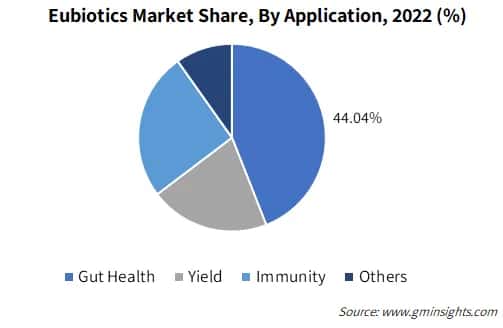
Based on application, the eubiotics market valuation from gut health segment is expected to surpass USD 4 billion by 2032, on account of the increasing number of R&D investments towards probiotic innovation. Back in February 2022, the UK government invested over £200 million (USD 240 million) to combat zoonotic diseases and enhance the UK’s veterinary capability. Meanwhile, rising adoption of enhanced animal husbandry strategies and favorable policy changes by food and drug watchdogs is also fostering the industry outlook.
More often, farmers tend to incur excessive treatment costs in animals suffering from gut infections. In this regard, eubiotics contribute to the animal’s microbiome modulation, improving gut health. They affect the microflora in the gastrointestinal tract and reduce coliforms and diarrhea.
Based on form, the eubiotics market share from the dry form segment is anticipated to expand at 6.5% CAGR through 2032, driven to the low storage and transportation costs associates. Dry eubiotics also ensure long shelf life of feed while maintaining its cultural stability as well. The form witnesses a particularly high demand in emerging economies owing to the aforementioned factors and supportive initiatives from various organizations to eliminate risks and keep the food chain from collapsing.
Back in December 2021, the Asian Development Bank invested over USD 10 million in Zenex Animal Health, a leading Indian animal health firm, to help it increase the production and distribution of quality animal healthcare products and mitigate livestock disease risk in the region.
The eubiotics market size from swine segment is poised to reach USD 720 million by 2032. Pigs are highly susceptible to livestock diseases, which makes them a high-risk investment for farmers. As such, pig farmers put more efforts into ensuring that their livestock lead a healthy life and improve the overall financial performance of the farm. Diseases such as classical swine fever, a highly contagious viral disease that affects pigs, and the infection caused by its less virulent isolates is hard to be examined in older pigs, which makes it pertinent that the animals have good immunity.
The dietary supplementation of probiotics helps improve gut health and nutrient digestibility to benefit the growth performance of pigs. Probiotics also impart diarrhea reduction and antitoxin effects, which favors their adoption.
The eubiotics market share from organic acid segment is estimated to observe around 4% growth rate during the forecast period, led by the product’s antimicrobial and preservative effects. Organic acid-based eubiotics also help enhance growth performance of animals and help achieve optimum gut health, making them highly preferred among farmers. The product helps manage the microflora in animals during stressful conditions as well, creating a strong impetus for segment growth. They further improve animal performance by reducing gastric pH while also enhancing pepsin activity.
On the regional front, the North America eubiotics market is predicted to exhibit a CAGR of 6% during 2023 to 2032, on account of increasing investments towards animal health in the region. Back in December 2021, the US Department of Agriculture’s (USDA) APHIS announced an investment of over USD 16.3 million in 64 projects geared towards animal health protection.
Meanwhile, regional growth can also be ascribed to favorable GRAS approval policies for eubiotics products. Rising consumption of dairy and meat-based food in the region, driven by improved economic scenarios and cost-effectiveness is further escalating the demand for eubiotics.
Eubiotics Market Share
Some of the leading companies involved in the eubiotics market include
Many of these companies are focusing on collaborations to reinforce their market position. For instance, in June 2020, DSM, a Dutch multinational health and nutrition company entered into a 10-year collaboration with North Carolina State University. This research partnership emphasizes three functional areas including precision nutrition, animal gut health, and data-driven decision-making for animal health.
This strategic move will help the company increase its market share, enhance its brand reputation, and diversify its product line.
Impact of the COVID-19 pandemic
The COVID-19 pandemic drastically affected the animal feed industry demand due to supply chain disruptions and closures. Due to the labor-intensive nature of this industry, prolonged lockdowns and constrained international transport severely hindered its ability to make money. However, spurred by the resumption of operations post-COVID-19 and favorable government support, the industry is recovering at a steady pace. In fact, back in September 2021, the USDA announced an investment of over USD 3 billion for animal health and nutrition, and agriculture, covering animal disease prevention as well.
This eubiotics market research report includes in-depth coverage of the industry with estimates & forecast in terms of volume in Kilo Tons, and revenue in USD Million from 2018 to 2032 for the following segments:
Click here to Buy Section of this Report
Market Size, By Product
Market Size, By Form
Market Size, By Application
Market Size, By Livestock
The above information has been provided for the following regions and countries:
Frequently Asked Question(FAQ) :
Research methodology, data sources & validation process
This report draws on a structured research process built around direct industry conversations, proprietary modelling, and rigorous cross-validation and not just desk research.
Our 6-step research process
1. Research design & analyst oversight
At GMI, our research methodology is built on a foundation of human expertise, rigorous validation, and complete transparency. Every insight, trend analysis, and forecast in our reports is developed by experienced analysts who understand the nuances of your market.
Our approach integrates extensive primary research through direct engagement with industry participants and experts, complemented by comprehensive secondary research from verified global sources. We apply quantified impact analysis to deliver dependable forecasts, while maintaining complete traceability from original data sources to final insights.
2. Primary research
Primary research forms the backbone of our methodology, contributing nearly 80% to overall insights. It involves direct engagement with industry participants to ensure accuracy and depth in analysis. Our structured interview program covers regional and global markets, with inputs from C-suite executives, directors, and subject matter experts. These interactions provide strategic, operational, and technical perspectives, enabling well-rounded insights and reliable market forecasts.
3. Data mining & market analysis
Data mining is a key part of our research process, contributing nearly 20% to the overall methodology. It involves analysing market structure, identifying industry trends, and assessing macroeconomic factors through revenue share analysis of major players. Relevant data is collected from both paid and unpaid sources to build a reliable database. This information is then integrated to support primary research and market sizing, with validation from key stakeholders such as distributors, manufacturers, and associations.
4. Market sizing
Our market sizing is built on a bottom-up approach, starting with company revenue data gathered directly through primary interviews, alongside production volume figures from manufacturers and installation or deployment statistics. These inputs are then pieced together across regional markets to arrive at a global estimate that stays grounded in actual industry activity.
5. Forecast model & key assumptions
Every forecast includes explicit documentation of:
✓ Key growth drivers and their assumed impact
✓ Restraining factors and mitigation scenarios
✓ Regulatory assumptions and policy change risk
✓ Technology adoption curve parameter
✓ Macroeconomic assumptions (GDP growth, inflation, currency)
✓ Competitive dynamics and market entry/exit expectations
6. Validation & quality assurance
The final stages involve human validation, where domain experts manually review filtered data to identify nuances and contextual errors that automated systems might miss. This expert review adds a critical layer of quality assurance, ensuring data aligns with research objectives and domain-specific standards.
Our triple-layer validation process ensures maximum data reliability:
✓ Statistical Validation
✓ Expert Validation
✓ Market Reality Check
Trust & credibility
Verified data sources
Trade publications
Industry journals, trade publications, and specialized media.
Industry databases
Proprietary and third-party market databases
Regulatory filings
Government procurement records and policy documents
Academic research
University studies and specialist institution reports
Company reports
Annual reports, investor presentations, and filings
Expert interviews
C-suite, procurement leads, and technical specialists
GMI archive
13,000+ published studies across 20+ industry verticals
Trade data
Import/export volumes, HS codes, and customs records
Parameters studied & evaluated
Every data point in this report is validated through primary interviews, true bottom-up modelling, and rigorous cross-checks. Read about our research process →