
Top 5 Challenges for the Automotive Sector in 2025: Sustainability, Tech, and Market Evolution
Published Date: August 29, 2025
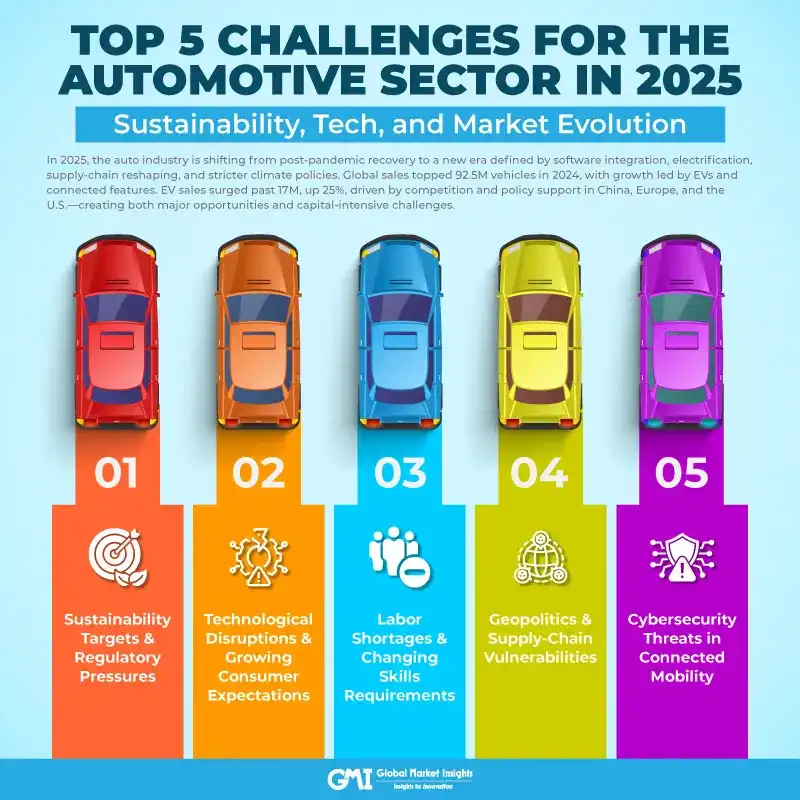
The automotive sector is at a critical juncture in 2025, marking the transition from pandemic aftermath recovery to an age characterized by software integration, acceleration of electrification, supply-chain remodeling, and tightening climate policy. This revolution is one of the greatest paradigm changes that the industry has ever seen since the onset of mass production.
Total vehicle sales surpassed 92.5 million units in 2024 (OICA), and 2025 should continue on a modest trajectory against a tight financing and mixed macro environment. Passenger-car sales have shown resilience with modest growth, but the real traction is in electrified powertrains and connected-vehicle features that are transforming consumer demand and competitive structures.
Electric car uptake keeps on its unrelenting upswing in markets around the world. The IEA's Global EV Outlook 2025 indicates global electric vehicle sales hit more than 17 million in 2024, rising more than 25%, supported by intense price competition and policy backing in China, Europe, and the U.S. The wave of electrification is opening up unprecedented opportunities at the same time as posing complicated challenges that need strategic guidance and considerable capital commitment.
2024–2025 Market Baseline: Interpreting Current Trends
Global demand indications
- Vehicle sales: >92.5 million units in 2024; 2025 outlook: low-single-digit growth. (OICA)
- Passenger cars (worldwide): ~74.6 million units in 2024 (+2.5% YoY). (ACEA)
- EV momentum: 2024 EV sales close to 17 million (>20% share); 2024/2025 growth focused in China and U.S. (IEA)
The acceleration of EV uptake has had ripple effects across the entire automotive value chain, from dedicated components such as EV tires to end-to-end charging infrastructure development.
Strategic Implications for Industry Stakeholders
-
Pricing power is asymmetric; incentives and terms of finance are more important.
-
Software, ADAS, and energy-efficient platforms are the differentiators.
-
Supply resilience and cybersecurity now take their place alongside cost and quality as board-level KPIs.
Challenge 1: Sustainability Targets & Regulatory Pressures
What's new in 2025
-
EU CO2 standards for LDVs commit to a 100% new car/van reduction target by 2035, with more stringent interim steps in 2025 and 2030. The Commission reaffirmed the trajectory in March 2025, even while introducing compliance flexibility for 2025–2027
-
The regulations suggest a steep climb in zero-emission models, battery supply, and charging points — and heavy penalties for non-compliance.
-
Several key markets, such as Germany and France, grew less in 2024, primarily because of subsidy cuts or eliminations.
-
Subsidies were totally phased out at the end of 2023 in Germany, while France has progressively lowered them annually. Starting from 2024, France further limited its environmental bonus by decreasing the quantum accessible to richer purchasers and limiting the number of qualifying cars.
Why it's hard
-
Fleet averages need to decline more quickly even when consumer credit is constricted and input prices are unstable.
-
Regional regulations vary (e.g., EU, North America, emerging markets), making product and sourcing plans more challenging.
Advances in battery technology continue to be imperative to cost-parity with internal combustion engines while delivering range and performance requirements. The transition to electric vehicle platforms involves significant engineering investment in flexible architectures capable of meeting multiple vehicle segments economically while optimizing placement and thermal management systems.
Strategic Response Framework
-
Sustainability Strategies: Flexible platform architectures and advanced battery technologies are being adopted by industry leaders.
-
Portfolio Electrification: Scalable skateboard platforms and cost-optimized battery chemistry for various vehicle segments.
-
Modularization & Standardization: Sophistication of pack standardization and cost curve optimization to achieve competitive benefits.
-
Circularity Initiatives: Transition to recycled aluminum/steel, bio-based polymers, and low-CO? cathode materials.
-
Design-for-Disassembly: Integrated in vehicle planning to facilitate end-of-life recycling and material recovery.
-
EV Insulation Technologies: Thermal efficiency and recyclability balanced by advancements.
-
Evidence-Based Roadmaps: Model-mix planning linked to regulatory milestones, residual value modeling, and corporate fleet demand to provide compliance in synchronization with commercial objectives
Challenge 2: Technological Disruptions & Growing Consumer Expectations
2025 Technology Reality Check
Consumer expectations have changed radically, with customers now demanding connected, software-defined cars with frequent over-the-air updates, robust driver assistance capabilities, and seamless app ecosystems. This transformation is a paradigm shift from hardware-driven to software-driven value propositions that incumbent automotive makers are yet to learn how to navigate successfully.
Original equipment manufacturer research and development spend is flowing more and more into autonomy software stacks, domain controllers, and power-efficient drivetrain technologies. BYD's multibillion-dollar investment in smart-car technology and driver assistance development during 2024 is a reflection of the scale of investment necessary to stay competitive in this new landscape.
The adoption of advanced driver assistance systems has become table stakes for premium and mass vehicles both, while connected car features provide the possibility of novel service models and recurring revenues that go beyond the core vehicle sale.
Technology Integration Challenges
Software complexity is a major integration challenge, as producers struggle to harmonize infotainment systems, driver-monitoring features, sensor clusters, and power management in legacy electrical and electronic architectures. Such integration challenges tend to stress existing supplier relationships and consume huge engineering resources in resolving compatibility issues.
Feature value against cost optimization is an ongoing critical tipping point. Although end users show robust demand for Level 2+ hands-off functionality, they balk at unlimited premium prices, placing pressure on cost-effective implementation strategies. The challenge becomes especially critical when combining autonomous driving software capabilities involving high-cost sensor suites and high-performance computing platforms.
Vehicle-to-everything communication standards are growing very fast to support improved traffic management, energy efficiency, and safety features. Yet, V2X deployments need to be carefully coordinated among vehicle makers, infrastructure companies, and regulatory agencies if they are to scale meaningfully and interoperate.
Execution Priorities for Technology Leadership
Modularity of software has become a necessity, allowing manufacturers to decouple hardware lifecycles from software roadmaps. Middleware with standardized zonal architectures allows flexibility for the rapid deployment of features and updates with minimized complexity and cost of development.
Data analytics functionality supports predictive maintenance, energy-conscious route planning, insurance telematics, and individualized user experience optimization. Such functionalities offer new business opportunities while increasing customer satisfaction and retention through vehicle performance and reliability improvement.
Improving user experience through charging addresses interoperability, integration of route planning with charging points, and payment harmonization to minimize friction in the EV ownership experience. Battery health diagnostics offer transparency and reassurance for EV owners while allowing early scheduling of proactive maintenance.
Challenge 3: Labor Shortages & Changing Skills Requirements
The Automotive Skills Gap Crisis
In January 2024, the AMS & ABB Automotive Manufacturing Outlook Survey 2023 indicated that increased labor expenses and skill deficiencies are the biggest issues in the automotive manufacturing sector this year. In the worldwide survey of industry professionals, more than a third of respondents (36%) named these problems as their biggest challenge, ranking them highest among the industry's biggest challenges today.
Electrification and software-defined vehicle development require specialized knowledge in battery diagnostics, high-voltage safety, functional safety methodologies, cybersecurity architectures, and artificial intelligence solutions. Established automotive education and training channels fail to deliver these new skill needs, and emerging workforce gaps risk compromising production scalability and innovation capability.
Although job projections differ by geography, most analyses of the industry are in agreement that replacement demand fueled by retirements and turnover will continue to be strong during the 2030s. At the same time, the skill mix is changing toward EV serviceability skills, power electronics experience, and software quality assurance skills that necessitate significant retraining expenditures.
The sophistication of contemporary electric vehicle battery systems calls for technicians with advanced training in high-voltage safety procedures, thermal management systems, and diagnostic routines quite different from the conventional internal combustion engine maintenance standards.
Workforce Outlook:
- Replacement demand high throughout 2030s (retirements/attrition)
- Skill mix turning toward EV service and power electronics
- Software quality assurance proficiency is key
- Commercial vehicle service tools are growing increasingly sophisticated
Effective Solutions:
-
Apprenticeships + micro-credentialing in high-voltage systems
-
SOTIF, ISO 26262, AUTOSAR training courses
-
University-supplier consortia for curriculum synchronization
-
Upskilling of the dealer service bay for EV diagnostics
-
Digital twin technology incorporation into training
Challenge 4: Geopolitics & Supply-Chain Vulnerabilities
Geopolitical Pressure Points and Supply Chain Impacts
Global conflicts and trade wars have radically transformed battery, rare earth, wiring harness, and semiconductor sourcing strategies. For instance, China's control over electric vehicle supply chains has increased geopolitical tensions, resulting in the United States and European Union raising import tariffs on Chinese EVs, escalating the risk of an impending trade war. These disruptions have compelled producers to rethink globalized supply chain frameworks that hitherto gave paramount importance to cost-cutting at the expense of resilience and geographical diversification.
Semiconductor supply cycles continue to be most vulnerable to geopolitical shocks, even with increased localized node capacity that remains unbalanced globally. The electronics-intensive feature of today's vehicles extends these vulnerabilities into multiple categories of components, from brake calipers with onboard sensors to fuel injection systems with sophisticated electronic control needs.
2025 Supply-Chain Adaptation Strategies
Dual-sourcing approaches to key subcomponents such as IGBTs/MOSFETs, microcontrollers, and sensor assemblies are becoming routine risk management practice. Nearshoring and friend-shoring programs target wire harnesses, castings, and e-axle assemblies to dampen the impact of geopolitical shocks while ensuring cost competitiveness.
Long-term offtake deals and materials hedging for lithium, graphite, and nickel offer supply security and price protection for battery production facilities. Such strategic procurement strategies insulate against raw material price fluctuations and guarantee sufficient supply volumes to accommodate planned production growth.
Climate control system parts, such as automotive condensers, have specific challenges in terms of cost, performance, and supply chain reliability demands that manufacturers must balance. The integration of heat pump systems into electric vehicles introduces further complexity to thermal management component sourcing and qualification activities.
Manufacturing Mix Impact Considerations
Electronics-intensive parts are at greater risk when semiconductor allocations become more constrained, influencing production scheduling and cost structures in various vehicle systems. Commercial vehicle power steering systems need advanced electronic control units that are exposed to the effects of chip shortages
Sophisticated safety systems, such as cabin monitoring functionalities, depend on several sensors and processing devices that have to be monitored with care to ensure they are not disrupted by supply chain disruptions. Such systems become increasingly necessary for regulatory purposes, making supply security a must for access to markets.
Challenge 5: Cybersecurity Threats in Connected Mobility
Rising Cyber Threat Landscape
Cybersecurity threats have strengthened exponentially as cars become more networked and software-intensive. Remote attacks are the majority of most current attacks, which take advantage of vulnerabilities in telematics systems, mobile apps, application programming interfaces, and backend services. Yearly security reviews always highlight the consistent surge in large-scale breaches as well as the dominance of remote attack channels aimed at automotive systems.
The growth of vehicle connectivity provides new attack surfaces that need to be supported by end-to-end security frameworks extending from vehicle hardware to cloud-based services. The communication channels support improved traffic management and safety features but also bring new cybersecurity requirements into play that need to be addressed over the entire vehicle lifecycle.
Operational Exposure Points
Over-the-air update pipelines are key vulnerability points, as are third-party infotainment integrations, EV charging backend systems, and fleet management portals. Multi-jurisdictional data privacy compliance, such as EU GDPR and numerous U.S. states' regulations, introduces governance complexity to the implementation of a cybersecurity framework.
EV charging infrastructure involves highly nuanced security issues, as charging networks are combined with utility infrastructure, payment processing systems, and vehicle communication protocols. Their combined nature necessitates combined security strategies beyond automotive cybersecurity norms.
Fleet electrification in business use brings further security considerations since fleet management systems are combined with logistics platforms and operational control systems that use varying security standards and update cycles.
Cybersecurity Excellence Framework
Strong vehicle cybersecurity measures adopt secure-by-design principles, complemented by threat modeling from design to deployment. In November 2023, the Ministry of Road Transport and Highways (MoRTH) put forward Cyber Security and Management Systems (CSMS) regulations for certain passenger and commercial four-wheelers to guard against cyberattacks.
The key measures are:
- Intrusion detection on CAN and Ethernet networks
- Code-signing, key rotation, and software bills of materials for supply chain security
- Conformity to ISO/SAE 21434 and UNECE R155/R156
- Penetration testing and red-teaming on an ongoing basis to counter emerging threats
- Protection of the charging ecosystem through PKI, certificate pinning, and anomaly detection
All these measures seek to optimize protection for strong protection, along with ease of use to enable EV uptake.
Commercial Opportunities and Strategic Positioning
Electrified Portfolio Extensions
Affordable electric vehicles with LFP/LMFP battery packs, de-contented interiors, and minimized option packages can release mass market adoption potential. Electrification is penetrating more than passenger vehicles into motorcycles and scooters is showing that greater consumer acceptance already exists for several mobility types.
The regional markets vary significantly, with three-wheeler electrification especially strong potential in Asia-Pacific markets, as they have larger long-distance transport roles. Specific to their markets, the strategies that manufacturers have can take advantage of regional growth opportunities while also navigating and managing local infrastructure, standards, and regulations.
Software Monetization at Scale
The service, a franchise for safety features, convenience functions, energy management, etc., provides additional sources of income on top of hardware revenue. Driver assistance calibrations services, activate features remotely, to smart grid charging optimization represent high-margin opportunities with recurring revenue opportunities.
Pricing structures with one-time fees and light subscription plans prevent feature fatigue while optimizing revenue potential. The adoption of software-based features among customers continues to expand, especially due to their unambiguous value in safety, convenience, or cost reduction.
The recreational vehicle market is willing to pay more for the ability to do more, and the accessories market for some power sports has experienced double-digit growth with the boom in connected solutions and electric powertrains in 2023.
Fleet and Commercial Electrification
Commercial vehicles such as vans, last-mile delivery vehicles, and municipal fleets provide quantifiable and predictable total cost of ownership benefits for electric powertrains. The commercial truck markets are poised for an accelerated rate of electrification shift as they seek to minimize operating expenses from fuel and fulfill their obligations to emissions standards.
Packages of charging, analytics solutions, and maintenance or service allow fleet operators to minimize friction with adopting new solutions while providing bundled revenue streams for manufacturers and service providers. End-to-end solutions can solve the myriad of issues related to electrification - from vehicle purchase to operational optimization.
Aftermarket and Service Transformation
As electric vehicles grow, so are potential opportunities for the aftermarket, while also fundamentally changing the service model. Powersports aftermarket expansion illustrates consumer willingness to spend on vehicle customization and performance optimization on electrified platforms.
Service transformation surpasses conventional maintenance to include software updates, battery optimization, and performance monitoring services that offer extended customer contact and revenue streams throughout the vehicle lifecycle.
Conclusion: Navigating the 2025 Automotive Landscape
In 2025, the automotive industry must navigate multifaceted technology transformation, regulation, talent development, supply chain resilience, and security challenges. But its history of proven adaptability puts it in a position for success beyond traditional production.
Achievement will be based on the ability to coordinate operating needs against prudent investment in sustainable technologies, enhanced capabilities, a capable workforce, and a robust security architecture. In other words, the electrification, connectivity, and autonomy will be the future of the industry, an industry that will reward action/change-makers and actionable visionaries.
Legrand Commercial Truck Companies or even organizations like Marine Aircraft, Electric Boat or other producers or service providers - and even small niches like luxury yachts - are all electrification waves pointing toward a new era of global mobility revolution. Leaders will be organizations that have embraced holistic sustainability, modern innovations, and coupled approaches across the entire value chain.