HOME > BLOGS > DATA CENTER OUTLOOK 2025: TRENDS, CHALLENGES & OPPORTUNITIES
Data Center Outlook 2025: Trends, Challenges & Opportunities
Published Date: October 3, 2025
Executive Summary
The global data center industry is at a pivotal point in 2025. With a shift to cloud computing, new workloads from AI, and growth in data traffic, it's a shifting landscape we have never experienced. The world of data centers is seeing hyperscale expansion, liquid cooling blooming, energy efficiency possibilities, and edge computing shifting providers redefining the core infrastructure for the digital economy.
The International Energy Agency (IEA) recently reported that investments in new data centers have spiked vertically in the last two years. A major driver has been rapid digitalization and the demand for new AI workloads. In 2023, total capital expenditures by the big three tech companies – Google, Microsoft, and Amazon, who account for the majority of AI and data center building, surpassed the entire U.S. oil and gas sector for market investments, or approximately 0.5% of GDP.
The focus of this blog will be the market outlook, technology trends, policy updates, and investment themes that are creating new data center strategies in 2025 and beyond.
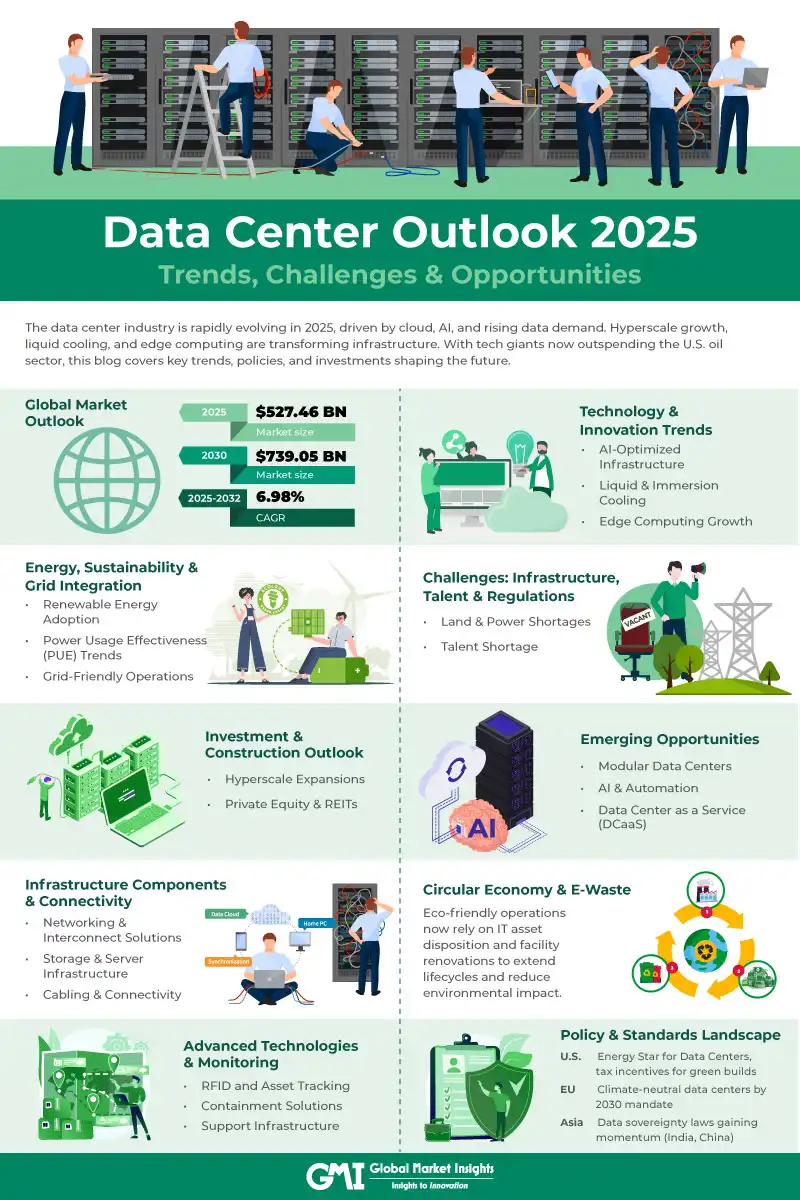
1. Global Market Outlook
1.1 Data Center Market Size (2025–2030)
Metric | Value |
|---|---|
Market size (2025) | USD 527.46 billion |
Forecast size (2030) | USD 739.05 billion |
CAGR (2025–2032) | 6.98% |
US market size (2025) | 171.9 billion |
Sources: Statista
The core data center infrastructure driving the growth included USD 62.5 billion in 2023 ecosystem that includes power systems, cooling systems, and networking devices that support contemporary digital operation. The market's further operations are anticipated to expand at a CAGR of 12.5% to reach USD 183 billion by 2032.
1.2 Regional Highlights
North America remains the biggest data center market, driven by the U.S., with expansion fueled by AI workloads and hyperscale data center expansion, as big cloud players are investing heavily. For example, in July 2025, OpenAI and Oracle announced they would work together to add 4.5 gigawatts (GW) of US data center capacity, which is a huge addition to their existing Stargate program. With this announcement, the total Stargate capacity is now beyond 5 GW and corresponds to OpenAI's stated goal of providing 10 GW of AI infrastructure in the US over the next four years.
The core data center infrastructure driving the growth included USD 62.5 billion in 2023 ecosystem that includes power systems, cooling systems, and networking devices that support contemporary digital operations. The market's further operations are anticipated to expand at a CAGR of 12.5% to reach USD 183 billion by 2032.
Asia-Pacific witnesses high growth, particularly in countries such as India, Singapore, South Korea, and Japan, which increasingly require region-specific cloud infrastructure. India's data center capacity is expected to grow exponentially, increasing from 1.4 gigawatts (GW) in 2024 to 9 GW by 2030, according to the Institute for Energy Economics and Financial Analysis. Edge data centers are spreading to power low-latency applications in these emerging economies.
Europe is keen on sustainability laws, as nations such as Germany, Sweden, and the Netherlands have stringent energy consumption and reuse of heat policies, which are promoting the use of green data center technologies at a rapid pace. There is legislation, including the EU Green Deal, the Code of Conduct (CoC), the Energy Efficiency Directive (EED), and the EN 50600, which aims to reduce greenhouse gas emissions by 55% below the level of 1990 by the year 2030, further augmenting the technology ecosystem.
There have been increases in greenfield investments taking place across the Middle East & Africa region as it accelerates greenfield investments, particularly in markets such as Saudi Arabia (NEOM) and UAE that have shown early traction for modular data center solutions that support fast deployment.
2. Technology & Innovation Trends
2.1 AI-Optimized Infrastructure
The advent of generative AI (GAI), large language models (LLMs), and autonomous systems has significantly increased demand for high-density computing:
•AI chips (NVIDIA H100, custom ASICs) require increased power and cooling solutions
•Hyperscalers are re-architecting data centers to deliver 10–50 kW per rack
•Google, AWS, and Meta are committing capital to AI-specific clusters of data centers
Next generation purpose-built data center GPU and data center accelerator hardware supporting these applications will require sophisticated rack power distribution architectures to safely support record power densities.
According to a McKinsey & Company report from October 2024, data center capacity ready for AI is expected to grow at an average annual rate of 33% from 2023 to 2030 in a midrange scenario. By around 2030, approximately 70% of overall demand for data center capacity will require data centers capable of running advanced AI workloads, approximately 40% of which will be driven by generative AI - the fastest growing use case today. Yet another February 2025 report by Goldman Sachs projects artificial intelligence to drive a 165% increase in data center power demand through 2030.
2.2 Liquid & Immersion Cooling
Liquid cooling is becoming a prime enabler to deal with increasing heat loads
Cooling Type | Status in 2025 |
|---|---|
Direct-to-chip | Early adoption (20% of new builds) |
Immersion | Niche use in HPC and AI clusters |
Hybrid cooling | Growing in colocation markets |
Liquid cooling will be deployed in more than 35% of AI-centric data centers in 2025, according to Uptime Institute. New immersion cooling technologies are taking off for the most demanding deployments.
Traditional cooling technologies keep advancing along with chiller technology, as specialist refrigerants enhance thermal management effectiveness.
2.3 Edge Computing Growth
Data centers at the edge are growing to minimize latency and accommodate real-time applications such as autonomous transport, intelligent factories, and telemedicine.
• More than 50% of data is today being processed outside of traditional data centers
• Cities and Tier 2/3 locations are experiencing deployments of micro data centers
• Telcos are incorporating edge clouds to improve 5G deployments
The trend of distributed computing is fueling the adoption of containerized data centers that can be easily deployed in complex environments and geographies.
3. Energy, Sustainability & Grid Integration
3.1 Renewable Energy Adoption
The push for clean energy is accelerating:
•Hyperscalers like Amazon and Microsoft have committed to 100% renewable energy by 2030
•In 2024, global purchases of new wind and solar capacity (for data centers) exceeded 70 GW (Statista)
Energy storage technologies and new battery technologies are growing importance to integrate renewables and provide grid stability.
3.2 Power Usage Effectiveness (PUE) Trends
As per the IEA, data centers today use roughly 2–4% of overall electricity in leading economies like the US, China, and the EU. Yet, because they are geographically concentrated, their localized effect can be substantial. Actually, data centers already consume over 10% of the electricity in at least five U.S. states. In Ireland, they represent more than 20% of the national electricity consumption. Improvements in airflow optimization, AI cooling management, and heat reuse are at the core of PUE reductions. Sophisticated data center power management systems and high-efficiency power infrastructure continue to drive these improvements.
3.3 Grid-Friendly Operations
In October 2023, the US Department of Energy announced $3.5 billion grant funding to support demand response integration and infrastructure replacement for data centers.
As an example, the Dubai Electricity and Water Authority (DEWA) intended to establish a smart grid program, including predictive load with the data centers in December 2024, for $1.9 billion.
Reliability is obtained by the backup power systems - generators, transformers, and UPS systems. Automatic transfer switches and switchgears for transferring power to grid also make integration seamless, a big plus too.
4. Challenges: Infrastructure, Talent & Regulations
4.1 Land & Power Shortages
Data center projects are increasingly hampered by:
• Little land in metro centers
• Delayed permits for power substations
• Rising costs for electricity (especially in Europe)
These challenges are forcing innovation in how buildings are constructed and in mechanical construction systems to maximize efficiencies when site space is limited.
4.2 Talent Shortage
The market is being confronted with an expanding skills shortage:
Role | Workers Needed by 2030 |
|---|---|
Data center technicians | 300,000+ |
Power and HVAC engineers | 150,000+ |
Cybersecurity professionals | 200,000+ |
Sources: AFCOM, Uptime Institute
Automation technologies and robotic systems are more commonly used to overcome workforce issues, while advanced infrastructure management systems simplify operations.
• EU Data Act and GDPR require data localization and privacy adherence
• Singapore and Amsterdam have implemented moratoriums on new constructions unless they are green certified
• In the United States, pending legislation in California can restrict power consumption per facility
Higher physical security standards and advanced fire alarm systems have become mandatory in most jurisdictions.
5. Investment & Construction Outlook
5.1 Hyperscale Expansions
Major cloud providers will spend more than $150 billion on data center infrastructure in 2025.
•Amazon Web Services (AWS): 80+ availability zones
•Google Cloud: Santiago, Paris, Dallas expansions
•Microsoft Azure: Sustainable campuses in Sweden, India
This enormous expansion is stimulating growth for all hyperscale infrastructure sectors and supporting technologies.
5.2 Private Equity & REITs
Data center funding is being increased by real estate investment trusts (REITs) and private equity companies:
•Digital Realty, Equinix, QTS Realty, and Switch are growing footprints
•Blackstone, Brookfield, and KKR are investing in green data center platforms
Colocation services and multi-tenant facilities are acquiring large amounts of investment capital due to increasing demand for flexible infrastructure.
6. Emerging Opportunities
6.1 Modular Data Centers
Prefab-based facilities in containers provide quicker deployment and scalability for remote areas and edge applications.
•Time of deployment: 4–6 months (compared to 18–24 months for conventional builds)
•Used in millions: mining, oil & gas, and defense industries
Modular strategies facilitate quick scaling, and containerized options offer flexibility of deployment across various environments and geographic locations
6.2 AI & Automation
AI is simplifying operations through:
•Predictive maintenance
•Energy optimization
•Automated load shifting and cooling
McKinsey reports that data centers embracing AI-based energy management see energy costs decline by 15–20%. This operational transformation is also paving the way for software-defined infrastructure sensitive to dynamic workload demands.
6.3 Data Center as a Service (DCaaS)
The DCaaS model is gaining acceptance in SMBs and fintechs.
Colocation and computing on a pay-per-use basis
Flexible scaling, built-in security and Integration with multi-cloud platforms
This transition to service-based models is changing the way organizations utilize data center capacity, with managed services and outsourcing rising in sophistication.
7. Infrastructure Components & Connectivity
7.1 Networking & Interconnect Solutions
High-speed networking infrastructure is essential for contemporary data centers:
•Network switching: Advanced switch technologies provide high-bandwidth, low-latency interconnect
•Interconnectivity: Cross-facility interconnect solutions allow distributed workloads
•Fabric architecture: Next-gen fabric technologies optimize east-west traffic patterns
7.2 Storage & Server Infrastructure
Storage and compute infrastructure evolve further:
• Storage systems: Data-intensive workloads are supported by high-performance storage solutions
• Server architecture: Rack servers are optimized for maximum compute density
• Physical infrastructure: Next-generation rack and enclosure systems ensure optimized airflow and cabling
7.3 Cabling & Connectivity
High-speed data transmission is supported by rugged cabling infrastructure, and end-to-end networking solutions provide seamless connectivity across hybrid cloud environments.
8. Circular Economy & E-Waste
With sustainability taking a central place in procurement and investor expectations, the emphasis is shifting toward hardware reuse and responsible e-waste management:
•Dell, Cisco, and HPE have take-back solutions for server hardware
•Strict WEEE compliance is enforced by Europe on all electronic devices
•Remanufactured equipment market to reach $20 billion by 2030
IT asset disposition services are becoming necessary for eco-friendly operations, whereas renovation work stretches facility lifecycles and minimizes environmental footprints.
9. Advanced Technologies & Monitoring
9.1 RFID and Asset Tracking
Real-time asset tracking systems based on RFID technology facilitate accurate inventory control and automated auditing of key infrastructure components.
9.2 Containment Solutions
Optimization of airflow management leads to adoption of containment solutions that maximize cooling efficiency and minimize energy use in high-density applications.
9.3 Support Infrastructure
Strategic support infrastructure systems provide fault-tolerant operations through integrated monitoring, management, and maintenance functions across all facility systems.
10. Policy & Standards Landscape
Region | Policy Trend |
|---|---|
U.S. | Energy Star for Data Centers, tax incentives for green builds |
EU | Climate-neutral data centers by 2030 mandate |
Asia | Data sovereignty laws gaining momentum (India, China) |
Global | ISO 30134, ISO/IEC 22237 standards shaping design & efficiency |
11. Future Prospects: 2030 and beyond
Data centers will be a different world by the time we get to 2030:
•Workloads will be over 60% AI and machine learning
•Carbon-neutral or carbon-negative data centers will be the normal
•Quantum computing labs and neural compute clusters may become a new facility type
Expectations will be around:
•Design for the lifecycle
•Energy-positive buildings
•Climate-resilient infrastructure
Conclusion & Key Takeaways
Data centers at the end of 2025 will be all about scale, speed, and sustainability. Between the unique competition between the hyperscalers serving the booming AI demand, the edge facilities driving the latency-tolerant applications, the opportunities exist, but the complexities of their operational practices abound.
Key Takeaways:
•AI workloads and various generative constructs can alter power and cooling expectations
•Sustainability is unavoidable—PUE, renewables, and the reuse of heat are now key metrics
•Strong capacity growth globally remains, but capacity is limited by land, power, and talent
•Scaling sustainably will require collaboration between the public and private sectors as well as balanced regulations
The data center industry as a whole - including all forms of infrastructure, technology, and service - offers unprecedented opportunity. Success depends on strategic development balance between emerging trends, traditional power, cooling, and operational efficiency performance.
Author: Global Market Insights, Inc.