Summary
Table of Content

Through-Silicon Via (TSV) Technology Market
Get a free sample of this report
Form submitted successfully!
Error submitting form. Please try again.
Thank you!
Your inquiry has been received. Our team will reach out to you with the required details via email. To ensure that you don't miss their response, kindly remember to check your spam folder as well!
Request Sectional Data
Thank you!
Your inquiry has been received. Our team will reach out to you with the required details via email. To ensure that you don't miss their response, kindly remember to check your spam folder as well!
Form submitted successfully!
Error submitting form. Please try again.
Through-Silicon Via (TSV) Technology Market Size
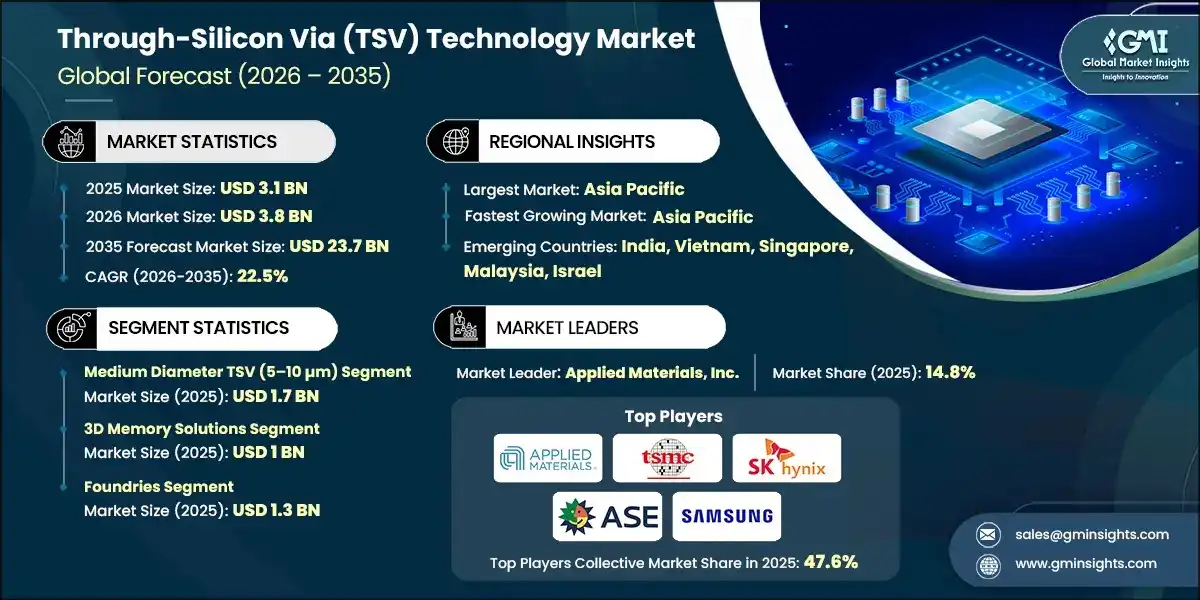
The global through-silicon via (TSV) technology market was estimated at USD 3.1 billion in 2025. The market is expected to grow from USD 3.8 billion in 2026 to USD 10.5 billion in 2031 and USD 23.7 billion by 2035, at a CAGR of 22.5% during the forecast period of 2026–2035.
To get key market trends
- The accelerating use of 5G is putting greater demands on smaller and more power-efficient modules in edge applications and smartphones. Vertical stacking of small form factors is made possible by TSV technology to reduce size and improve performance. The shipments of 5G devices are increasing at a high rate globally according to GSMA, and it is expected that 2 billion 5G connections will be achieved by the end of 2025 and these include coverage, networks, and devices.
- Governments across the world are focusing on the local semiconductor manufacturing to gain strategic autonomy, with a heavy focus on advanced packaging technologies such as TSV. For instance, the European Union announced its Chips Act, which has allocated USD 49.5 billion in public investment towards its semiconductor ecosystem. This initiative supports the development of new fabrication facilities, research and development and packaging infrastructure.
- Semiconductor capital equipment and packaging ecosystem is advancing rapidly supported by rising demand and policy driven support. According to SEMI, the global semiconductor equipment billings amounted to USD 117 billion in 2024, and a substantial part of it was contributed by advanced packaging and high-bandwidth memory applications. This investment is strengthening the supply chain for TSV-capable tools.
- Asia-Pacific dominated the global through-silicon via (TSV) technology market with a share of 72.3% market share in 2025. This dominance stems from the region's enormous semiconductor manufacturing capabilities, extensive military defense and electronics spending, the ongoing deployment of autonomous vehicles, ADAS, and electric vehicles, and the accelerating ADAS and electric vehicles deployment across China, Japan, South Korea, and Taiwan.
Through-Silicon Via (TSV) Technology Market Report Attributes
| Key Takeaway | Details |
|---|---|
| Market Size & Growth | |
| Base Year | 2025 |
| Market Size in 2025 | USD 3.1 Billion |
| Market Size in 2026 | USD 3.8 Billion |
| Forecast Period 2026-2035 CAGR | 22.5% |
| Market Size in 2035 | USD 23.7 Billion |
| Key Market Trends | |
| Drivers | Impact |
| Mobile & 5G / edge devices needing miniaturization | Drives TSV adoption for compact, high-performance logic-memory integration; contributes approximately 18% to market expansion by enabling low-power, high-bandwidth edge computing and 5G devices. |
| Regional fabs and government support | Accelerates TSV capacity expansion and R&D investment; adds nearly 12% to market growth, especially in emerging semiconductor hubs and government-backed AI/HPC initiatives. |
| AI / HPC demand for bandwidth & density | Boosts TSV deployment in HBM, chiplets, and 3D memory stacks; accounts for about 25% of market growth by enabling high-throughput, low-latency compute architectures. |
| Heterogeneous integration (chiplets, 2.5D/3D ICs) | Expands demand for TSV-based interposers and vertical stacking; contributes around 15% to growth by supporting complex multi-die integration for AI, networking, and HPC applications. |
| Manufacturing ecosystem maturation & equipment investment | Enhances TSV yield, reliability, and scalability; represents nearly 10% of market growth as improved process control, advanced tooling, and packaging lines drive adoption across foundries and OSATs. |
| Pitfalls & Challenges | Impact |
| Manufacturing cost, process complexity & yield loss | Restricts adoption in high-volume semiconductors and advanced packaging; contributes approximately 16% market restraint due to high equipment costs, complex TSV processes, and low yields in deep etching and stacking. |
| Thermo-mechanical reliability (CTE mismatch & stress) | Limits adoption in high-density 3D ICs and heterogeneous integration; results in around 11% market drag due to stress, warpage, and interconnect failures from thermal expansion mismatches. |
| Opportunities: | Impact |
| High-Performance Computing (HPC) & AI | Will drive sustained long-term demand for TSV technology, as AI/ML accelerators, GPUs, and HPC systems will require high-bandwidth, low-latency 3D memory and processor integration; it will contribute approximately 22% to market growth. |
| 3D Stacked Memory Integration | Will expand adoption in advanced memory solutions such as HBM, HBM2E/3D NAND, and logic-memory chiplets, opening new growth avenues across data centers, AI, and networking; it will represent around 18% of market potential. |
| Market Leaders (2025) | |
| Market Leaders |
14.8% |
| Top Players |
|
| Competitive Edge |
|
| Regional Insights | |
| Largest Market | Asia Pacific |
| Fastest Growing Market | Asia Pacific |
| Emerging Countries | India, Vietnam, Singapore, Malaysia, Israel |
| Future outlook |
|
What are the growth opportunities in this market?
Through-Silicon Via (TSV) Technology Market Trends
- The adoption of 3D integration at the rapid rate of replacement of the traditional 2D scaling is emerging as a characteristic manufacturer tendency within the TSV market. As shrinking nodes started experiencing cost performance constraints, the chipmakers started looking at 3D architectures and chiplet-based designs. This trend started gaining momentum starting in 2018, when early HBM stacks and 3D sensors were commercially gaining momentum. As of 2024, most IDMs had included the performance forecast of TSV enabled 3D IC. By the 2030, 3D stacking is anticipated to become the primary avenue for improvement in for the CPU, GPU, and AI accelerators.
- A strong move toward regionalized semiconductor ecosystems is reshaping TSV manufacturing strategies. As supply-chain vulnerabilities intensified, manufacturers started diversifying material and equipment sources around 2019, initiating localization efforts in Asia, North America, and Europe. By 2024, national semiconductor programs began actively funding TSV packaging lines, enabling closer supplier–manufacturer collaborations. This trend is expected to intensify through 2032, with chipmakers anticipating multi-regional TSV supply hubs that reduce dependence on single geographies and improve resilience for automotive, aerospace, and AI-driven applications
- High-yield, automation-induced TSV fabrication has become a key trend for manufacturers. Early TSV processes (2016-2020) faced challenges such as void-free copper filling, wafer thinning defects, and CMP variability. Defect void-free copper filling remained a challenge, as were wafer thinning defects and CMP variability. By 2023, manufacturers were implementing AI inspection and automated metrology tuning, along with advanced plating control to improve consistency and reduce scrap. Trends aimed at optimization in this manner are projected to extend to 2031. Manufacturers expect these advances to lead to fully autonomous TSV production lines with the ability to correct defects predictively and produce HBM, radar modules, and sensor fusion devices in high quantities.
Through-Silicon Via (TSV) Technology Market Analysis
Learn more about the key segments shaping this market
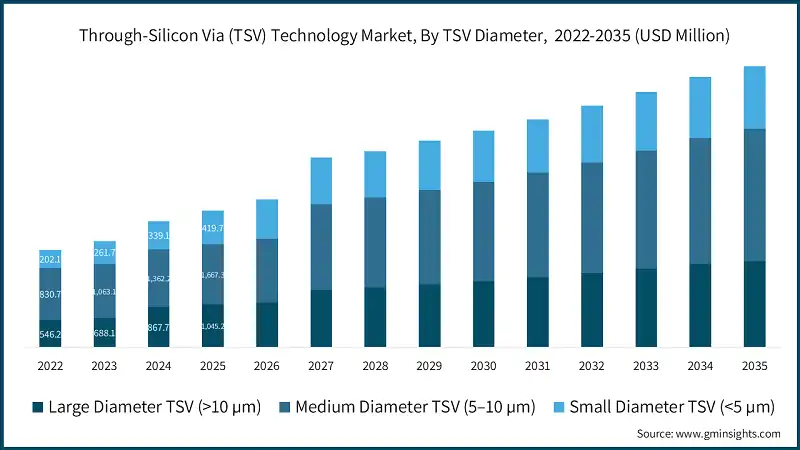
On the basis of TSV diameter, the market is divided into large diameter TSV (>10 µm), medium diameter TSV (5–10 µm) & small diameter TSV (<5 µm).
- The medium diameter TSV (5–10 µm) was the largest market and was valued at USD 1.7 billion in 2025. As demand for increased miniaturization, high-performance semiconductor devices, and the need for efficient power management and energy distribution increase, so too have manufacturers' considerations regarding the use of advanced 3D packaging technology.
- Medium diameter TSV (5-10 µm) manufacturers must improve their ability to manufacture with precision while also achieving optimal levels of energy efficiency, thermal management, and producing a scalable, cost-effective product that meets the growing demand for high-density, high-performance semiconductor devices.
- The small diameter TSV (<5 µm) is the fastest segment and is anticipated to grow with a CAGR of 24.2% during the forecast period of 2026-2035. The small diameter TSV (<5 µm) segment driven by the increasing number of advanced electronics requiring ultra-compact, high-performance semiconductor devices that can transfer data quickly, thereby enabling even more rapid advances in technology through continued miniaturization and greater integration of components.
- Manufacturers must continue to focus on producing highly precise components that are even smaller than ever before, as well as on optimising thermal management systems for these components and ensuring these components can deliver the high-performance characteristics necessary for advanced, compact semiconductor devices.
Learn more about the key segments shaping this market
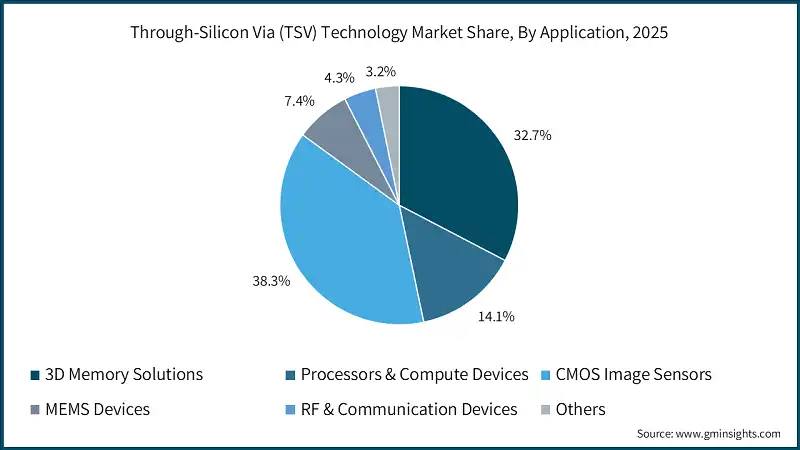
Based on the application, the through-silicon via (TSV) technology market is segmented into 3D memory solutions, processors & compute devices, CMOS image sensors, MEMS devices, RF & communication devices, and others.
- The 3D memory solutions segment was valued at USD 1 billion in 2025. The commercialization of the next generation HBM products has spurred the adoption of 3D memory with TSV. For instance, Samsung HBM3E, which was launched in 2024, with exceptionally large bandwidth and better thermals, and has consolidated numerous design wins in AI accelerator and GPUs. These kinds of products have encouraged companies in the market to seek placed TSV stacks to fulfil the high memory AI throughput.
- TSV-based 3D DRAM integration is rising as hyperscalers form strategic packaging partnerships. SK hynix’s collaboration with NVIDIA for advanced HBM supply in 2024 showcases the shift toward long-term memory-compute co-design. These alliances strengthen TSV deployment as AI servers demand vertically stacked memory with low-latency inter-die communication.
- Memory manufacturers need to improve thermo-mechanical reliability and improve copper fill technology in order to support higher-bandwidth HBM generations. The strategic collaborations with GPU vendors and cloud providers is useful in ensuring that the demand pipelines are stable as AI and HPC workloads are progressively relying on multi-tier 3D DRAM structures.
- The processors & compute devices segment is anticipated to grow with a CAGR of 25.8% during the forecast period of 2026-2035. National semiconductor investments under the U.S. CHIPS and Science Act of USD 52.7 billion are accelerating advanced packaging adoption for processors. TSV integration facilitates chiplet-based architectures with shorter interconnects and higher compute density for quicker communication between CPU, GPU, and NPU tiles in advanced AI and HPC systems.
- Companies focused on the computing sector should develop thermally optimized 3D architectures and enhance TSV pitch scaling to enable the design of more compact chiplet fabrics. Aligning with foundries for packaging co-design at this preliminary stage will mitigate integration risk and improve performance.
On the basis of end use industry, the through-silicon via (TSV) technology market is bifurcated into Integrated Device Manufacturers (IDMs), Foundries, OSATs (Outsourced Semiconductor Assembly & Test), Fabless Semiconductor Companies, and others.
- The foundries segment was the largest market and was valued at USD 1.3 billion in 2025. The global race towards exascale AI-optimized and HPC-grade chip architectures is driving the adoption of TSV 3D vertically stacked 3D, memory for logic memory integration. For instance, in 2024, U.S. Department of Energy distributed 2.3 billion USD for exascale HPC system; it increases the demand for high bandwidth, 3D vertically stacked memories and chiplet multiprocessors that can process in parallel efficiently.
- The high rate of growth in chiplet-based heterogeneous integration of processors, GPUs, and networking ICs is forcing foundries to scale TSV-enabled back-end operations. Foundries are responding with more advanced packaging lines to the request of cloud providers and hyperscalers to build customized 3D logic-memory designs to support low-latency, high-throughput computing workloads.
- Manufacturers need to prioritize high yielding TSV stacking along with efficient inter die signal management and thermal control. Establishing early collaborations with hyper-scalers and vendors of AI chips will ensure valuable designs and ongoing needs within the fast-growing AI and HPC compute infrastructures.
- The fabless semiconductor companies are anticipated to grow with a CAGR of 23.2% during the forecast period of 2026-2035. Demand for powerful, compact memory and processors is driven by smartphones, wearables, and AR/VR devices. Intel and Samsung are major players developing advanced 3D, stacked memory devices and processors for consumer smartphones and wearables. For instance, Samsung’s introduction of HBM3E in 2024 are tailored for real time, AI driven graphics and imaging with high ultra band widths.
- Manufacturers should focus on close collaboration with consumer electronics OEMs on co-design and testing ensures faster time-to-market and reliability for high-performance, feature-rich mobile and wearable products.
Looking for region specific data?
North America held 17.8% through-silicon via (TSV) technology market share in 2025. The region is seeing rapid expanding of its market of semiconductor due to investments in HPC, AI, and cloud computing.
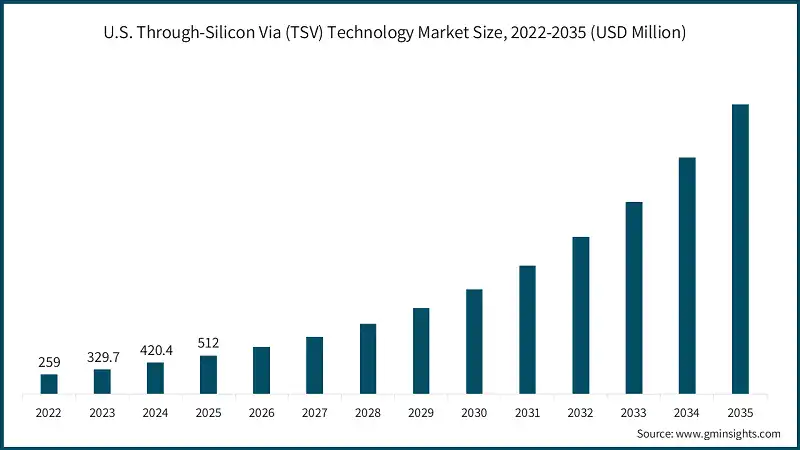
- The U.S. through-silicon via technology market was valued at USD 512 million in 2025 and is anticipated to grow with a CAGR of 22.3% during the forecast period of 2026 - 2035. The CHIPS Act with USD 52.7 billion funding for local fabs, OSATs and advanced packaging lines initiates TSV in memory, processors, and AI accelerators to support national technology and supply chain security. Adoption of AI accelerators, chiplets and high-density processors in the U.S. data centres provides a further impetus to TSV.
- Manufacturers need to invest in geographically concentrated TSV infrastructure and spending frameworks with foundries and cloud service operators. Utilizing government money along with co-development to incorporate market fastest advanced 3D high stacking and secure leading position for AI, HPC and advanced memory solutions.
- The through-silicon via technology market in Canada is anticipated to grow with a CAGR of 20.7% by 2035. Canada is emphasizing semiconductor R&D and packaging capacity to support AI, HPC, and automotive electronics. Government initiatives like Strategic Innovation Fund programs provide funding for advanced packaging facilities and TSV deployment, accelerating high-density memory and processor integration for research centres and regional OEMs.
- Manufacturers need to emphasize towards high reliability 3D integration and compact form-factor solutions to achieve congruence with funded programs to seize growing AI, HPC, and automotive compute demand in Canada.
The European through-silicon via (TSV) technology market was valued at USD 242.9 million in 2025. There is a strong presence of OEMs, automotive producers and industrial automation centres which positively influence the TSV based 3D integration. The European technological systems deploy more advanced processors and memory stacks to facilitate and improve the parameters of bandwidth, energy and heat at cloud computing, artificial intelligence research centres and edge devices.
- The through-silicon via technology market in Germany is anticipated to grow with a CAGR of 21.3% by 2035. Germany facilitates the adoption of TSV in Automotive AI and HPC through the Federal Ministry for Economic Affairs and Climate Action (BMWK) semiconductor initiatives. Germanys investment in semiconductor R&D and advanced packaging also aids the TSV adoption. 3D integration technology compatible with TSV provides a compact form factor with enhanced bandwidth and energy efficiency.
- Manufacturers need to concentrate their efforts on developing TSV solutions specific to automotive and industrial use cases. Partnering with German OEMs and utilizing government initiatives enables the adoption of 3D integration technologies while achieving strict reliability, thermal, and performance standards.
- The UK through-silicon via (TSV) technology market is anticipated to surpass USD 390.3 million by 2035. The integration of TSV technology is driven by high-performance computing clusters, AI research facilities, and telecommunication infrastructures in the UK. The vertical stacking of processors and memory modules supports AI inference, cloud computing, and industrial automation while improving bandwidth, energy efficiency, and thermal characteristics.
- Manufacturers need to concentrate on creating compact, dependable 3D integration and will accrue revenue from telecommunication, High Performance Computing (HPC), and Artificial Intelligence (AI) deployments along with government-sponsored funding projects.
The Asia Pacific through-silicon via (TSV) technology market is the largest & fastest growing market and is anticipated to grow with a CAGR of 22.7% during the forecast period of 2026-2035. Asia-Pacific dominates TSV adoption due to semiconductor manufacturing concentration and electronics demand. According to IFR 2024, the region accounted for 74% of global robot and semiconductor deployments, driving TSV use in HBM, AI accelerators, and processors for HPC, consumer electronics, and automotive applications.
- The through-silicon via technology market in China is anticipated to surpass USD 7.4 billion by 2035, growing with a CAGR of 23.5%. China is increasing its investments in the domestic production of semiconductors. For instance, the Chinese government, via the Ministry of Industry and Information Technology (MIIT) is heavily investing in the domestic packaging sector and has localized over 60% of its packaging toolchain for mainstream nodes by 2024, which prompts the use of TSV in High Bandwidth Memory (HBM), AI processors, and automotive ECUs (Electronic Control Units).
- Manufacturers must prioritize local TSV collaborations and co-design with their foundries. Since there is higher demand in the market, focus on improving yield, thermal reliability, and form-factor to work on the increasing demand.
- The through-silicon via technology market in Japan was valued at USD 488.2 million in 2025. The automation industry, robotics, and artificial intelligence research sectors propel the implementation of TSVs. Vertical stacking of the memory improves bandwidth and efficiency, which allows for the addition of a 3D memory module to the processor which optimizes effectiveness for the embedded systems in electric vehicles and AI streaming servers, as well as for industrial automation.
- The India through-silicon via technology market is anticipated to grow with a CAGR of 26.3% during the forecast period of 2026-2035. The semiconductor policy in the India improves advanced packaging in the country. For instance, In August 2025, the Government of India is visioning a USD 10 billion investment in semiconductor fabrication, as stated by PIB. This is expected to increase the adoption of TSV for AI processors, 3D memory, and automotive electronics. These are essentials for High-Performance Computing (HPC) and consumer electronic devices as well as for many new technologies in Electric Vehicles (EVs).
- Manufacturers should invest in localized TSV infrastructure and joint venture with Indian OEMs and startups. Thermal optimized 3D packaging solutions with high yield will win designs in AI, HPC, and EV electronics.
The through-silicon via (TSV) technology market in Latin America was valued at USD 36.9 million in 2025. Increasing demand for edge computing, IoT devices, and automotive electronics drives TSV integration. 3D memory and stacked processors improve bandwidth, reduce latency, and optimize power efficiency for data centres, industrial automation, and connected vehicles across LATAM.
The MEA through-silicon via technology market is projected to surpass USD 130 million by 2035. Adoption of AI, telecom infrastructure, and industrial automation is increasing TSV use. 3D stacking and chiplet integration in memory and processors enhance bandwidth, latency, and energy efficiency, supporting cloud services, smart grids, and AI-enabled industrial applications across MEA.
- The South Africa through-silicon via technology market was valued at USD 5.5 million in 2025. South Africa is growing its industrial automation and telecommunications fields. As stated in IDC 2023, the country had a smart device and industrial electronics market, growing 8% YoY which increases the need for TSV-enabled memory and processors for edge computing, industrial automation, and artificial intelligence.
- Manufacturers should invest in local TSV support and collaborate with industrial and automotive OEMs. Providing high-reliability, energy-efficient 3D packaging solutions will enable adoption in South Africa’s growing AI, HPC, and industrial electronics markets.
- The through-silicon via (TSV) technology market in Saudi Arabia is projected to grow with a CAGR of 17.7% during the forecast period of 2026-2035. The growth in this country is driven by the adoption of artificial intelligence, telecommunications, and edge computing through embedded TSV. 3D memories and stacked processors with improved bandwidth, lower latency, and power efficiency support the country’s smart infrastructure, the IoT in industries and cloud services.
- The through-silicon via technology market in UAE is anticipated to surpass USD 34.4 million by 2035. The growth of AI, telecom, and smart city projects drives TSV adoption. High-density memory and chiplet integration reduce latency, improve bandwidth, and optimize energy efficiency for data centres, edge computing, and industrial automation systems in the UAE.
Through-Silicon Via (TSV) Technology Market Share
The competitive landscape of the through-silicon via technology market is defined by rapid technological innovation and strategic collaborations among leading semiconductor manufacturers, advanced packaging providers, and specialized technology firms. Top players hold a combined market share of approximately 47.6% globally. These companies are heavily investing in research and development to enhance TSV integration, improve interconnect density, optimize signal integrity, and enable high-performance 3D IC packaging solutions. The market is also witnessing partnerships, joint ventures, and acquisitions aimed at accelerating product commercialization and expanding regional presence.
Additionally, smaller startups and niche technology providers are contributing by developing advanced TSV designs, high-precision fabrication techniques, and novel materials, fostering innovation and differentiation. This dynamic ecosystem is driving rapid technological progress, supporting overall growth, and enabling broader adoption of 3D semiconductor integration.
Through-Silicon Via (TSV) Technology Market Company
The top prominent companies operating in the through-silicon Via (TSV) technology industry include:
- Applied Materials, Inc.
- Okmetic Oyj
- Samsung
- Teledyne DALSA
- Taiwan Semiconductor Manufacturing Company Limited
- Amkor Technology
- Atomica Corp
- Nanosystems JP
- Japan Semiconductor Corporation
- SK Hynix (South Korea)
- Lam Research
- Powertech Technology
- Toshiba Corporation
- ASE Group
- Intel Corporation
- imec
Applied Materials held 14.8% market share in TSV market in 2025, due to its state of the art wafer fabrication equipment such as deep silicon etching, CMP and dielectric deposition equipment specially tuned to TSV formation. The high-yield TSV manufacturing can be achieved with the help of its high level of the process control technologies and its integration with the foundries and the IDMs. The size and installed base of Applied Materials as well as its unremitting innovation ensures its dominance in penetration and technological strength.
TSMC accounted for 10.2% of the TSV market in 2025, powered by its advanced 3D IC roadmap and CoWoS/SoIC packaging platforms. The manufacturing scale and ecosystem alliances of the company enable the quick deployment of the TSV-enabled chiplets, HBM stacks, and the HPC processors. Having solid customer interactions in AI, data center, and networking segments, TSMC is still a pillar in supporting next-generation 3D integration technologies.
SK Hynix has secured 8.4% of TSV market and has used the advantage of being at the forefront of the global leader in HBM (High Bandwidth Memory). Its HBM2E and HBM3 devices are built vertically and are highly dependent on TSV technology and hence SK Hynix is a major innovator of memory-logic integration. The company remains at the center of the TSV-based memory innovations through strong R&D investment and close association to AI accelerator vendors.
ASE Group held 7.2% of the TSV market share in 2025, which provides 3D packages, interposer assembly, and TSV-based stacking services. Its chiplet integration competence, wafer level packs and superior test solutions provide fabless customers with high-performance and low cost manufacturing. The leadership of ASE in heterogeneous integration and the increasing number of customers of AI/HPC makes it one of the leading OSATs that spearhead the commercialization of TSV.
Samsung accounted for 7% of the TSV market in 2025, which is backed with a rich set of TSV-based memory, 3D NAND, and enhanced logic-memory integration platforms. High throughput and low latency of AI and data center workloads can be achieved because of its leadership in HBM and 3D IC solutions. The scale of manufacturing, vertical integration and robust device roadmap of Samsung is a strong point of its next-generation TSV technology.
Through-Silicon Via (TSV) Technology Industry News
- In August 2025, ASE Group (Advanced Semiconductor Engineering), the world’s leading OSAT (Outsourced Semiconductor Assembly and Test) provider, has taken a bold step forward in meeting skyrocketing demand for advanced packaging by acquiring a facility from GaAs foundry WIN Semiconductors. The board approved the purchase, which includes a plant and associated facilities in the Southern Taiwan Science Park located in Kaohsiung, and costs USD 202.4 million.
- In March 2025, Taiwan Semiconductor Manufacturer Company (TSMC) announced the addition of CoWoS 3D-IC packaging platforms for AI accelerators. TSMC incorporates advanced Through-Silicon Via (TSV) technology. This technology achieves higher memory stacks and is therefore crucial for AI-related applications. This development is part of a great trend in the increasing of advanced packaging capacity.
This through-silicon via (TSV) technology market research report includes in-depth coverage of the industry with estimates & forecasts in terms of revenue (USD Billion) from 2022 to 2035, for the following segments:
Market, By TSV Process Type
- Via-First TSV
- Via-Middle TSV
- Via-Last TSV
Market, By TSV Diameter
- Large diameter TSV (>10 µm)
- Medium diameter TSV (5–10 µm)
- Small diameter TSV (<5 µm)
Market, By Application
- 3D memory solutions
- High bandwidth memory (HBM)
- Wide I/O Memory
- 3D NAND Flash Memory
- Processors & Compute devices
- CPUs
- GPUs
- AI accelerators
- FPGAs
- CMOS image sensors
- MEMS devices
- Inertial sensors
- Pressure sensors
- Microphones
- Others
- RF & communication devices
- Others
Market, By End Use Industry
- Integrated device manufacturers (IDMs)
- Foundries
- OSATs (Outsourced semiconductor assembly & test)
- Fabless semiconductor companies
- Others
The above information is provided for the following regions and countries:
- North America
- U.S.
- Canada
- Europe
- UK
- Germany
- France
- Italy
- Spain
- Russia
- Asia Pacific
- China
- India
- Japan
- South Korea
- ANZ
- Latin America
- Brazil
- Mexico
- MEA
- UAE
- Saudi Arabia
- South Africa
Frequently Asked Question(FAQ) :
Who are the key players in the through-silicon via (TSV) technology market?
Key players include Applied Materials, Taiwan Semiconductor Manufacturing Company Limited (TSMC), SK Hynix, ASE Group, Samsung, Intel Corporation, Lam Research, Toshiba Corporation, and imec. These companies are advancing TSV-enabled packaging, HBM integration, and next-generation 3D semiconductor solutions.
What are the key trends shaping the through-silicon via technology market?
Key trends include rising adoption of 3D IC architectures, AI-driven high-bandwidth memory integration, regional semiconductor manufacturing initiatives, and automation-enabled TSV fabrication for higher yield and reliability.
What market share did North America hold in the TSV technology market in 2025?
North America accounted for 17.8% of the global market in 2025, supported by strong investments in AI, high-performance computing, advanced packaging, and government-backed semiconductor manufacturing initiatives.
What is the growth outlook for the processors & compute devices segment?
The processors & compute devices segment is expected to grow at a CAGR of 25.8% from 2026 to 2035. Increasing investments in AI, HPC, and chiplet-based architectures are accelerating TSV integration in advanced processors.
How much revenue did the 3D memory solutions segment generate in 2025?
The 3D memory solutions segment was valued at USD 1 billion in 2025. Rising adoption of HBM2E and HBM3 memory stacks for AI accelerators and data center applications is driving strong demand.
Which TSV diameter segment generated the highest revenue in 2025?
The medium diameter TSV (5–10 µm) segment led the market in 2025, generating USD 1.7 billion in revenue. Its dominance is supported by balanced performance in miniaturization, thermal management, and manufacturing scalability.
What is the projected value of the TSV technology market by 2035?
The TSV technology market is projected to reach USD 23.7 billion by 2035, growing at a CAGR of 22.5% from 2026 to 2035. Growth is driven by AI/HPC demand, high-bandwidth memory (HBM) adoption, and heterogeneous semiconductor integration.
What is the through-silicon via (TSV) technology market size in 2025?
The market size for through-silicon via (TSV) technology is valued at USD 3.1 billion in 2025. Strong demand for advanced semiconductor packaging, 5G-enabled devices, and miniaturized high-performance electronics is supporting market growth.
What is the market size of the through-silicon via technology market in 2026?
The TSV technology market is expected to reach USD 3.8 billion in 2026, reflecting rapid adoption of 3D integration, chiplet architectures, and advanced logic-memory packaging.
Through-Silicon Via (TSV) Technology Market Scope
Related Reports