Summary
Table of Content

Residential Filters Market
Get a free sample of this report
Form submitted successfully!
Error submitting form. Please try again.
Thank you!
Your inquiry has been received. Our team will reach out to you with the required details via email. To ensure that you don't miss their response, kindly remember to check your spam folder as well!
Request Sectional Data
Thank you!
Your inquiry has been received. Our team will reach out to you with the required details via email. To ensure that you don't miss their response, kindly remember to check your spam folder as well!
Form submitted successfully!
Error submitting form. Please try again.
Residential Filters Market Size
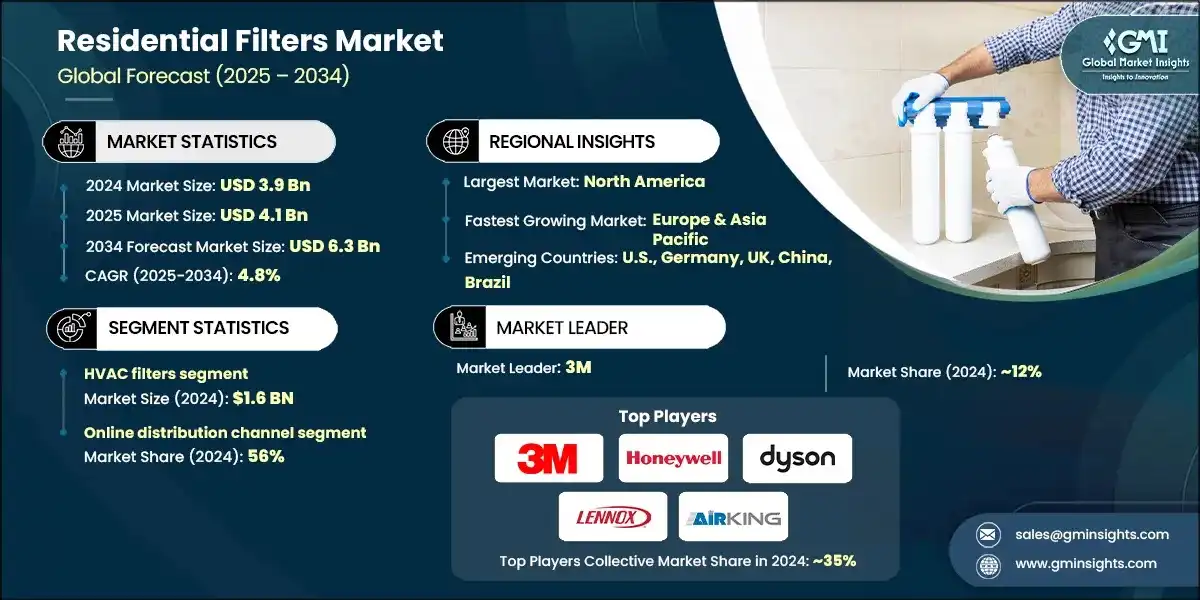
The global residential filters market size was estimated at USD 3.9 billion in 2024. The market is expected to grow from USD 4.1 billion in 2025 to USD 6.3 billion in 2034, at a CAGR of 4.8% according to latest report published by Global Market Insights Inc.
Residential Filters Market Key Takeaways
Market Size & Growth
- 2024 Market Size: USD 3.9 Billion
- 2025 Market Size: USD 4.1 Billion
- 2034 Forecast Market Size: USD 6.3 Billion
- CAGR (2025–2034): 4.8%
Regional Dominance
- Largest Market: North America
- Fastest Growing Region: Europe & Asia Pacific
Key Market Drivers
- Rising awareness of health and environmental concerns.
- Urbanization and population growth.
- Innovations in filtration technologies.
- Rising demand for smart home integration.
Challenges
- High initial cost of advanced filtration systems.
- Maintenance and replacement costs of filters.
Key Players
- Market Leader: 3M led with over 12% market share in 2024.
- Leading Players: Top 5 players in this market include 3M, Honeywell, Dyson, Lennox International, Air King, which collectively held a market share of 35% in 2024.
Get Market Insights & Growth Opportunities
Residential filters are witnessing significant growth because of growing consumer health and wellness awareness. With concerns regarding indoor air pollution and water pollution on the rise, consumers are willing to invest in state-of-the-art filtration systems to avoid risks related to respiratory diseases, allergies, and water-borne diseases. As per the Environmental Protection Agency (EPA), indoor air may be two to five times more contaminated than outdoor air, highlighting the importance of efficient air purification systems. This phenomenon is especially prevalent in metropolitan cities, where increased population and manufacturing activities enhance exposure to toxins. In addition, rigorous government policies, including the Clean Air Act in the United States, and public health campaigns are enforcing the imperative to have cleaner living conditions, further propelling the use of residential filters.
Advances in technology are shaping the market forces. Technological innovations in filter technologies, for example, High-Efficiency Particulate Air (HEPA) filters for air filtration and reverse osmosis (RO) or ultraviolet (UV) for water filtration is improving the performance and popularity of home filters. HEPA filters, for example, can trap 99.97% of particles suspended in the air as tiny as 0.3 microns and are effective in enhancing indoor air quality. In addition, the implementation of smart technology, such as Internet of Things (IoT)-based filters, is revolutionizing the user experience. Smart filters also come equipped with real-time monitoring, maintenance notifications, and even usage metrics, as consumers increasingly demand from tech-oriented consumers. Smart home growth is also providing opportunities for smart filtration systems connected directly to other home automation devices, making it convenient and efficient.
Environmental sustainability and consumer convenience are also key factors influencing market dynamics. Environmental focus is increasing with a shift towards the eco-friendly filter materials, such as biodegradable or recyclable elements or reusable designs that minimize waste and cut long-term expenses. Reusable water filters, for instance, can last up to six months, drastically cutting down on the replacement frequency. Subscription services and e-commerce platforms are making the buying process and maintenance easier, allowing consumers to access filtration systems with greater ease. In 2023, e-commerce sales in the United States increased by 7.8% as per a report from the U.S. Census Bureau, demonstrating the growing dependence on internet platforms for consumer products, including residential filters.
Moreover, the growing residential construction and renovation activities, particularly in emerging economies, are expected to fuel the demand for modern, efficient, and sustainable filtration solutions. For instance, the Indian real estate market is projected to grow at a compound annual growth rate (CAGR) of 9.2% during the forecast period of 2024-2029, according to the India Brand Equity Foundation (IBEF). This growth is likely to drive the adoption of advanced filtration systems in new and renovated homes. As consumers prioritize health, sustainability, and convenience, the residential filters market is poised for steady expansion, supported by technological innovations, regulatory frameworks, and evolving consumer preferences.
In addition, increased residential development and refurbishment operations, especially in developing economies, are likely to drive demand for efficient, modern, and sustainable filtration systems. As an example, the Indian real estate sector is expected to increase at a compound annual growth rate (CAGR) of 9.2% between the forecast period of 2024-2029, as indicated by the India Brand Equity Foundation (IBEF). This expansion is expected to propel the adoption of next-generation filtration systems in new constructions and remodeling. As consumers value health, sustainability, and convenience, the market for residential filters is set to sustainably grow, boosted by technological advancements, regulatory environments, and changing consumer tastes.
To get key market trends
Residential Filters Market Trends
The market is experiencing significant trends, driven by the integration of advanced smart technologies, rapid urbanization, and an increasing focus on sustainability.
- Consumers are increasingly opting for filtration systems equipped with digital features such as real-time monitoring, app-based controls, and automated maintenance notifications. These innovations align with the expanding adoption of smart home ecosystems, where interconnected devices enhance convenience, energy efficiency, and overall living standards. Additionally, the rising awareness of environmental sustainability is influencing consumer preferences, leading to a shift toward reusable, biodegradable, and energy-efficient filter designs. Manufacturers are responding to these demands by developing multi-functional filtration systems that incorporate advanced technologies, including activated carbon, ultraviolet (UV) sterilization, and reverse osmosis. These systems are designed to address both health-related concerns and environmental sustainability, offering comprehensive solutions for modern households.
- Health-conscious consumer behaviour and rapid urbanization are also playing a pivotal role in shaping the market landscape. As urban populations expand and concerns about air and water quality intensify, there is a growing demand for filtration solutions capable of mitigating allergens, pollutants, and harmful contaminants. High-performance air filters, such as HEPA (High-Efficiency Particulate Air) and MERV (Minimum Efficiency Reporting Value)-rated systems, are gaining traction due to their proven ability to improve indoor air quality by capturing fine particles, including dust, pollen, and airborne pathogens. Similarly, water filtration systems are being increasingly adopted to address issues such as chlorine, lead, microplastics, and other harmful substances commonly found in municipal water supplies. Advanced water filters now feature multi-stage purification processes, combining sediment filters, activated carbon, and reverse osmosis membranes to ensure optimal water quality.
Residential Filters Market Analysis
Learn more about the key segments shaping this market
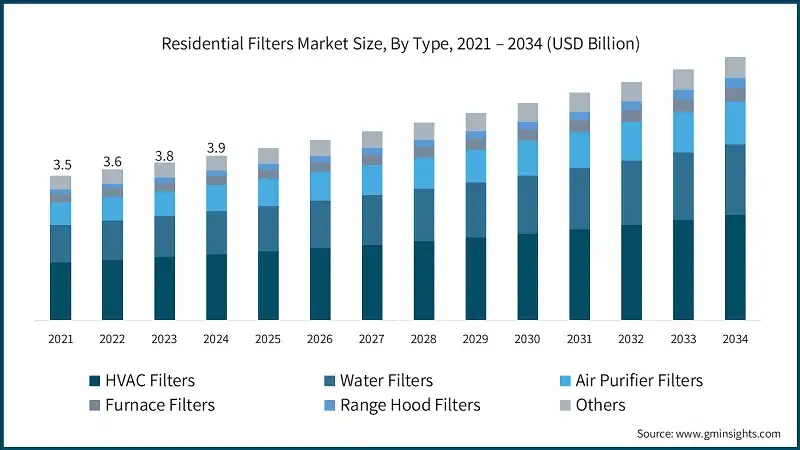
Based on type, the market can be segmented into HVAC filters, water filters, air purifier filters, furnace filters, range hood filters, and others. The HVAC filters accounted for revenue of around USD 1.6 billion in the year 2024 and is estimated to grow at a CAGR of 4.8% from 2025 to 2034.
- The growth of HVAC filters in the market is primarily driven by increasing concerns over indoor air quality and the rising prevalence of respiratory issues such as asthma and allergies. As homes become more tightly sealed for energy efficiency, the need for effective ventilation and filtration systems has intensified. HVAC filters play a crucial role in maintaining clean indoor air by capturing dust, pollen, pet dander, and other airborne particles.
- Additionally, the growing adoption of central heating and cooling systems in both new constructions and retrofits is boosting demand for high-efficiency HVAC filters. Technological advancements, such as smart filters with air quality sensors and automated alerts, are also enhancing consumer appeal and driving market expansion.
Learn more about the key segments shaping this market
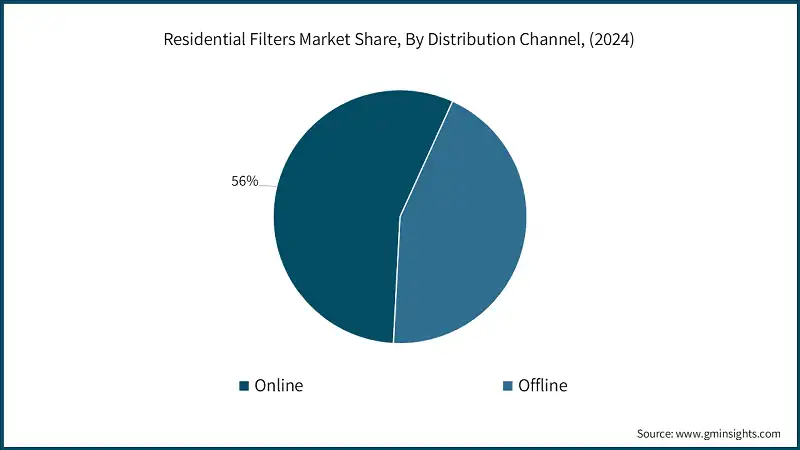
Based on distribution channel, the residential filters market is segmented into online and offline. The online distribution channel held around 56% of the total market share in 2024 and is anticipated to grow at a CAGR of 5% during the forecast period.
- The online distribution channel in the market is experiencing robust growth due to the increasing consumer preference for convenience, variety, and competitive pricing. E-commerce platforms offer easy access to a wide range of filter products, including HVAC, water, and air purifier filters, often accompanied by detailed specifications, customer reviews, and subscription-based replacement services. This digital shift is further supported by rising internet penetration, smartphone usage, and the expansion of logistics networks that ensure timely delivery even in remote areas.
- Additionally, manufacturers and brands are investing in direct-to-consumer models and digital marketing strategies, which are helping to build customer loyalty and drive repeat purchases. As consumers continue to prioritize ease of shopping and personalized experiences, the online channel is expected to maintain its upward trajectory throughout the forecast period.
Looking for region specific data?
North America Residential Filters Market
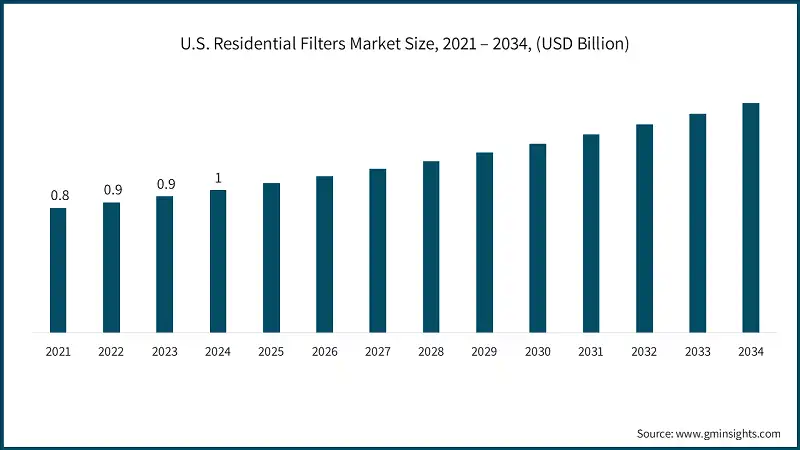
The U.S. dominates an overall North America market and valued at USD 1 billion in 2024 and is expected to grow at a CAGR of 4.9% during the forecast period from 2025 to 2034.
- The growth is due to a combination of factors including high consumer awareness, stringent environmental and health regulations, and widespread adoption of advanced home infrastructure. American households increasingly prioritize indoor air and water quality, driven by concerns over allergens, pollutants, and contaminants. This has led to strong demand for HVAC filters, water purifiers, and air filtration systems. Additionally, the U.S. market benefits from a mature e-commerce ecosystem and high penetration of smart home technologies, which support the growth of digitally integrated filtration solutions.
Europe Residential Filters Market
The market in Europe, Germany is expected to experience significant and promising growth from 2025 to 2034.
- The demand is driven by increasing environmental awareness, stringent air and water quality regulations, and a strong focus on health and wellness among consumers. The country’s commitment to sustainability and energy-efficient housing has led to greater adoption of advanced HVAC systems and filtration technologies. Additionally, rising concerns over urban pollution and indoor air contaminants are encouraging households to invest in high-performance air and water filters.
Asia Pacific Residential Filters Market
The Asia Pacific market, China held 34% market share in 2024 and is expected to grow at a CAGR of 5.3% during the forecast period from 2025 to 2034.
- Chinese households are increasingly investing in filtration systems to combat indoor air contaminants and ensure safe drinking water. Government initiatives aimed at improving environmental standards and public health, along with the expansion of middle-class income groups, are further fueling demand. Additionally, the rise of e-commerce and smart home technologies is making advanced filtration products more accessible, contributing to China's strong market position and growth outlook in the region.
Middle East and Africa Residential Filters Market
In the Middle East and Africa market, Saudi Arabia held 24.5% market share in 2024 and is expected to grow at a CAGR of 4.4% during the forecast period from 2025 to 2034.
- The country’s hot and arid climate, combined with frequent dust storms, has heightened the need for effective air filtration systems in homes. Additionally, concerns over water scarcity and quality are prompting households to adopt advanced water purification technologies. Government initiatives aimed at improving living standards and promoting sustainable housing are further supporting market expansion. The rise of e-commerce and smart home adoption is also making filtration products more accessible, contributing to Saudi Arabia’s strong growth outlook in the region.
Residential Filters Market Share
- In 2024, the prominent manufacturers in market are 3M, Honeywell, Lennox International, Air King and Dyson together these companies hold the market share of ~30-35%. These companies maintain their competitive edge through a combination of product innovation, strategic partnerships, and sustainability-driven initiatives.
- Dyson is popular for its design-driven innovations, offering multifunctional air purifiers that combine cooling, heating, and purification functionalities. Its products feature 360° HEPA filters, real-time air quality sensors, and app-based controls, delivering a seamless and user-friendly experience. Dyson’s sleek, futuristic designs and commitment to energy efficiency, with many models earning Energy Star certifications, set it apart in a competitive market and resonate with environmentally conscious consumers.
- Brita dominates the residential filtration industry with a diverse range of products, including pitchers, dispensers, faucet filters, and bottle filters. The brand’s strategy emphasizes affordability, ease of use, and fostering strong customer loyalty. Brita aligns with sustainability trends by introducing filter recycling programs, longer-lasting cartridges, and BPA-free materials. Its strong retail partnerships and growing presence in e-commerce channels further reinforce its leadership in the market.
Residential Filters Market Companies
Major players operating in the residential filters industry include:
- 3M
- AAF International
- Air King
- Blueair
- Brita
- Coway
- Dyson
- Filtrete
- Greenway
- Honeywell
- Lennox International
- Puronics
- Trane
- Vornado
- Whirlpool
3M, a global leader in filtration technology, is renowned for its Filtrete brand. The company secures its competitive edge by leveraging proprietary filtration media and investing significantly in advanced air purification systems. For example, the Filtrete Smart Air Purifier integrates sensors and app connectivity, offering real-time air quality monitoring and filter life tracking. Additionally, 3M collaborates with clean-tech innovators like Svante Technologies to develop innovative carbon capture materials, underscoring its dedication to sustainability and technological advancement.
Honeywell has established a prominent position in the air and water filtration markets, supported by its extensive product portfolio and focus on energy-efficient, high-performance solutions. The company incorporates HEPA and activates carbon filters into its air purifiers and HVAC systems, often enhanced with smart home features. Honeywell’s competitive strengths include its trusted brand reputation, expansive global distribution network, and ability to serve both premium and mid-range market segments. Moreover, the company is expanding into wearable and portable air purifiers, addressing the rising demand for personal air quality solutions.
Residential Filters Market Report Attributes
| Key Takeaway | Details |
|---|---|
| Market Size & Growth | |
| Base Year | 2024 |
| Market Size in 2024 | USD 3.9 Billion |
| Market Size in 2025 | USD 4.1 Billion |
| Forecast Period 2025 to 2034 CAGR | 4.8% |
| Market Size in 2034 | USD 6.3 Billion |
| Key Market Trends | |
| Drivers | Impact |
| Rising awareness of health and environmental concerns | Rising concerns over air and water quality are boosting demand for high-efficiency residential filters. |
| Urbanization and population growth | Dense urban living increases exposure to pollutants, driving filter adoption in growing cities. |
| Innovations in filtration technologies | Advanced multi-stage and smart filters enhance performance and attract tech-savvy consumers. |
| Rising demand for smart home integration | Filters with app control and real-time monitoring are gaining popularity in connected households. |
| Pitfalls & Challenges | Impact |
| High initial cost of advanced filtration systems | Premium filtration systems are expensive, limiting access in cost-sensitive markets. |
| Maintenance and replacement costs of filters | Ongoing upkeep can deter long-term use and affect customer satisfaction. |
| Market Leaders (2024) | |
| Market Leaders |
Market share of ~12% |
| Top Players |
Collective market share in 2024 ~35% |
| Competitive Edge |
|
| Regional Insights | |
| Largest Market | North America |
| Fastest growing market | Europe & Asia Pacific |
| Emerging countries | U.S., Germany, UK, China, Brazil |
| Future outlook |
|
What are the growth opportunities in this market?
Residential Filters Industry News
- In 2025, Carrier announced its first-ever Environmental Product Declaration (EPD) for North American residential HVAC systems. This EPD provides detailed insights into the lifecycle impacts, including CO2 emissions, energy consumption, and resource utilization, for the Comfort Fan Coil and Performance Compact Heat Pump product lines.
- In 2025, Dyson introduced the Dyson Purifier Big+Quiet Formaldehyde, engineered for large residential areas with advanced air purification technology and ultra-quiet performance. The company also launched the Dyson Submarine Wet Roller Head, entering the wet floor cleaning segment with features designed for effective hydration and debris removal.
- In 2024, 3M's Filtrete brand launched an advanced range of high CADR air purifier filters designed for larger living spaces. With ratings reaching up to CADR 450, these filters efficiently clean the air in rooms as large as 500 sq. ft.
- In 2023, 3M launched their new line of high-performance HVAC filters designed for improved indoor air quality. The filters use advanced electrostatic and HEPA technologies to capture 99.97% of airborne particles.
The residential filters market research report includes in-depth coverage of the industry, with estimates & forecasts in terms of revenue (USD Billion) and volume (Thousand Units) from 2021 to 2034, for the following segments:
Market, By Type
- HVAC filters
- Water filters
- Air purifier filters
- Furnace filters
- Range hood filters
- Others
Market, By Filter Media
- Fiberglass
- Activated carbon
- HEPA
- Electrostatic
- Pleated paper/polyester
- UV
- Ceramic
- Others (cotton, mesh, etc.)
Market, By Efficiency
- MERV 1-4
- MERV 6-10
- MERV 10-13
- MERV 14-16
- MERV 17-20
Market, By Application
- Air filtration
- Water filtration
- Others (refrigeration, washing machine, etc.)
Market, By Distribution Channel
- Online
- E-commerce website
- Company website
- Offline
- Supermarkets/ hypermarkets
- Specialty stores
- Others
The above information is provided for the following regions and countries:
- North America
- U.S.
- Canada
- Europe
- Germany
- UK
- France
- Italy
- Spain
- Asia Pacific
- China
- Japan
- India
- South Korea
- Australia
- Indonesia
- Malaysia
- Latin America
- Brazil
- Mexico
- Argentina
- MEA
- Saudi Arabia
- UAE
- South Africa
Frequently Asked Question(FAQ) :
What is the market size of the residential filters market in 2024?
The global market size for residential filters was valued at USD 3.9 billion in 2024, driven by rising health awareness, urbanization, and increasing concerns over air and water pollution.
What is the projected value of the residential filters industry by 2034?
The market is expected to reach USD 6.3 billion by 2034, growing at a CAGR of 4.8% from 2025 to 2034, supported by smart home integration, technological advancements, and sustainability-driven consumer preferences.
What is the market valuation for 2025?
The market is projected to reach USD 4.1 billion in 2025, reflecting strong consumer demand for air and water filtration systems in rapidly urbanizing regions.
Which type segment led the residential filters market in 2024?
The HVAC filters segment led the market with USD 1.6 billion in 2024, owing to increased adoption in modern homes for maintaining indoor air quality and mitigating respiratory health issues.
Which distribution channel dominated the market in 2024?
The online distribution channel held a 56% share in 2024, driven by the growing influence of e-commerce, convenience in product replacement, and subscription-based services.
Which region leads the residential filters market?
North America dominated the market in 2024, with the U.S. valued at USD 1 billion, supported by high consumer awareness, advanced home infrastructure, and strong regulatory standards.
Which region is expected to grow the fastest through 2034?
The Asia Pacific region is projected to grow at a CAGR of 5.3%, led by China’s expanding middle class, government clean air initiatives, and widespread adoption of smart filtration technologies.
Who are the leading companies in the residential filters market?
Key players include 3M, Honeywell, Dyson, Lennox International, Air King, Brita, and Blueair, focusing on smart, sustainable, and high-performance filter solutions for air and water purification.
Residential Filters Market Scope
Related Reports