
Authors:
Ankit Gupta, Shubham Chaudhary
Download free PDF
Hydropower Turbine Replacement Market Size & Share 2026-2035
Report ID: GMI16394
|
Published Date: July 2026
|
Report Format: PDF/Excel/Dashboard/Platform
Download Free PDF
Explore Our Licensing Options:
Jump to Content
Market Size
Market Trends
Market Analysis
Market Share
Market Companies
Industry News
Table of Contents
Frequently Asked Questions
Research Methodology
Related Reports
Download Free PDF

Hydropower Turbine Replacement Market
Get a free sample of this report
Get a free sample of this report Hydropower Turbine Replacement Market
Is your requirement urgent? Please give us your business email
for a speedy delivery!
Hydropower Turbine Replacement Market Size
The hydropower turbine replacement market was estimated at USD 5.2 billion in 2025. The market is expected to grow from USD 5.6 billion in 2026 to USD 10.1 billion by 2035, at a CAGR of 6.9%, according to a recent study by Global Market Insights Inc.
Hydropower Turbine Replacement Market Key Takeaways
Market Leader: ANDRITZ led with over 11.5% market share in 2025.
Leading Players: Top 5 players in this market include ANDRITZ, Dongfang Electric, Voith GmbH, GE Vernova, Harbin Electric, which collectively held a market share of 42.5% in 2025.
The estimate is based on a comprehensive bottom-up assessment of turbine replacement installations and project investments across more than 30 countries, validated through analysis of hydropower capacity additions, refurbishment activities, utility procurement trends, and company revenues.
The market for replacement of hydro-power turbines continues to grow owing to the need to modernize the aging hydroelectric plant to improve efficiency, reliability, and flexibility. Utilities increasingly replace outdated turbines with advanced designs that enhance energy generation, extend asset lifespan, and support compliance with evolving environmental regulations across global hydropower installations.
The market comprises the segment of the hydropower market that addresses the replacement of hydropower turbines that are outdated or inefficient with newer and more efficient turbine models to restore asset performance, enhance energy output, and prolong asset life. It covers all equipment supply, engineering, installation, commissioning and modernization services in relation to hydroelectric power plants.
For illustration, the International Energy Agency (IEA) projects that USD 127 billion will be invested in modernizing hydropower by 2030, of which nearly 45% will be on turbines, showing the increasing significance of refurbishment and lifespan extension for ageing hydropower plants globally.
Growing electricity demand and the need for reliable renewable energy are encouraging utilities to replace aging hydropower turbines. In many parts of the world, replacement projects are more economically viable than building new hydropower plants thanks to modern turbine technologies, which enable higher efficiency, lower maintenance needs and better performance.
Investments in turbine replacement projects are gaining momentum, thanks to government support for renewable energy modernization initiatives. Incentives, supportive regulatory policies and funding for infrastructure upgrades promote utilities to refurbish the existing plant to maximize electricity generation, minimize environmental impacts and extend its operational service life.
For citation, in 2025, the U.S. Federal Energy Regulatory Commission (FERC) added a new set of in-kind hydropower turbine replacements and maintenance upgrades, which eliminates the need to undergo further environmental review and shortens project approval timelines, thereby speeding up the modernization of existing hydroelectric facilities.
Technological progress in turbine engineering has provided much better replacement opportunities throughout the ageing hydropower plants. Better hydraulic design, corrosion resistant materials and precision manufacturing create more efficient energy conversion resulting in lower losses during operation and allowing the facilities to produce more power while maintaining their current assets.
The replacement of hydropower turbines has become linked with increasing digital monitoring systems with the ability to enhance predictive maintenance and operational efficiency. Operators can use advanced sensors, real-time performance analytics and remote diagnostics to maximize turbine performance, minimize downtime and maintenance costs across the equipment's life cycle.
Environmental regulations, which promote sustainable hydropower operations, are creating a demand for turbine replacement that results in better fish passage, less ecological disruption, and improved water management. Turbine technologies of today can assist operators in meeting the regulatory requirements while promoting the efficient generation of electricity and ecosystem conservation goals.
Investment in hydropower modernization in developing economies is aimed at enhancing the strength of the electricity infrastructure and energy security. The replacement of ageing turbines allows existing hydroelectric plants to boost their generating capacity, improve operational reliability and feed into the growing demand for electricity without major dam infrastructure expansion.
Hydropower Turbine Replacement Market Trends
The market receives a boost with growing refurbishment operations among the more mature hydropower facilities in North America and Europe. The turbine replacement projects have a lower capital investment, shorter project duration and can give utilities the opportunity to maximize the value of existing hydroelectric infrastructure investments.
Manufacturers are working on modular solutions for turbine replacement that will make installation easier and shorten plant downtime. Prefabricated components, cutting-edge engineering solutions and standardized designs simplify projects and help utilities deliver modernization initiatives with less operational interruption and lower implementation costs.
Increasing climate variability is encouraging utilities to adopt replacement turbines capable of operating efficiently under fluctuating water availability. Advanced turbine technologies will ensure a stable performance under different flow conditions, enhancing energy production, flexibility and resilience to different hydrological patterns impacting hydropower generation.
Private and public sector investments in renewable infrastructure are ongoing and continue to fund activities relating to the replacement of hydropower turbines. Strategic partnership programmes (SPP) between equipment manufacturers, engineering companies and water utilities enable technology transfer, project financing and modernization programs, which boost the long-term hydro power production potential in various regional markets.
Asia Pacific is a significant growth area as there are vast installed hydro power capacity and planned modernization projects in this region. These are all big opportunities for turbine replacement suppliers and engineering service providers as a result of growing electricity demand, government investments and ageing hydroelectric facilities.
For instance, China's installed pumped storage hydropower capacity reached 58.69 GW by the end of 2024, with plans for significant growth, and India is rapidly moving forward with multiple pumped storage power projects in order to meet its installed 51 GW PSH target by 2032, presenting great opportunities for turbine replacement and modernization.
The competitive landscape is characterized by continuous innovation in turbine design, manufacturing processes, and lifecycle services. Competitive companies stand out by means of engineering knowledge, customized retrofit solutions, long-term maintenance contracts, and strategic technologies that enable increased plant efficiency and reliability for the utility customer.
For reference, the U.S. Department of Energy's Section 242 Hydroelectric Production Incentive Program offers financial assistance to non-federal hydroelectric operators to rehabilitate aging hydropower plants and promote turbine replacement and modernization investments in hydroelectric facilities.
Lifecycle cost optimization is more and more a key consideration in replacement projects rather than the lowest equipment cost. For hydroelectric plants, utilities consider energy output gains, maintenance cost savings, operational reliability and asset extension when assessing turbine modernizations, and decide on renewals that will provide positive long-term returns on modernization investments.
The expansion of renewable energy targets, grid modernization, and modernization of aging hydropower assets will help fuel future market expansion. Replacement demand in established and new hydropower markets will continue to be bolstered by ongoing innovation in turbine technology, digital solutions and sustainable engineering practices.
The EU Renewable Energy Directive (RED III) and the Horizon Europe project ReHydro are promoting the modernization of hydropower, by increasing the share of renewable energy in the energy mix, developing innovative fish-friendly turbines and advanced environmental monitoring tools, facilitating sustainable replacement of turbines and optimization of existing hydroelectric installations.
Hydropower Turbine Replacement Market Analysis
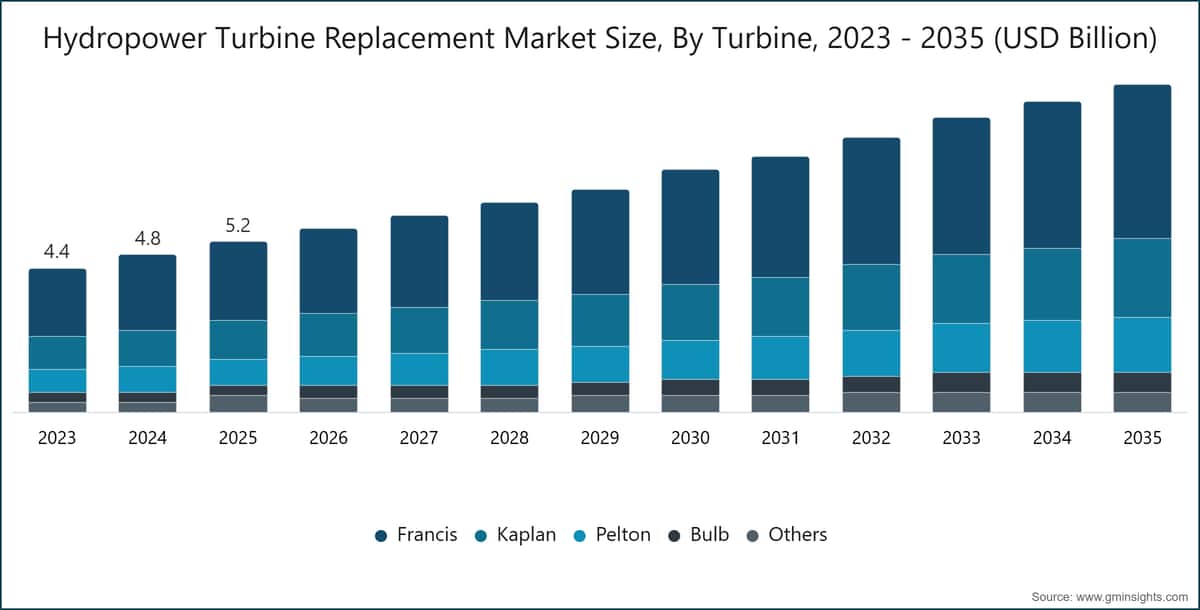
Based on turbine, the hydropower turbine replacement market is segmented into francis, kaplan, pelton, bulb and others. The francis market holds a share of about 45% in 2025 and is projected to grow at a growth rate of over 6.5% through 2035.
The modernization of mature medium- and high-head hydroelectric plants for better efficiency and reliability is driving the industry. The advanced designs of Francis turbines maximize energy production, minimize maintenance demands, and maximize the operational lifecycle, and make efficient use of existing civil structures and water resources.
The rising cost of renewable energy installations and hydropower refurbishment work are driving growth in demand for turbine replacement. Digital monitoring systems, enhanced hydraulic capabilities, and the design of environmentally-friendly runners help utilities to achieve long-term operational sustainability, meet regulatory requirements, and optimize plant productivity.
For instance, ANDRITZ's 2025 contract for the modernization of two 180 MW pump-turbine units and motor generators at the Srinagarind hydropower plant in Thailand illustrates the high capital investment demands of large-scale modernization projects, and therefore presents financing challenges for utilities pursuing multi-year turbine replacement programmes.
The kaplan market is set to exceed USD 2 billion by 2035. The industry continues to grow as operators upgrade their low-head hydroelectric facilities to become more efficient, reliable and flexible to operate. These sophisticated turbine designs are more efficient, provide greater flow control and maintenance savings and increase the service life of existing power plants.
Renewable energy modernization and aging hydropower infrastructure projects are increasingly replacing turbines. New blade designs, digital monitoring systems and environmentally optimized configuration help to deliver greater performance across a range of water flows, helping to optimize generation efficiency in line with changing environmental and regulatory expectations.
The pelton segment was valued at over USD 844 million in 2025. The market is expanding with operators making investments to upgrade their older hydroelectric plants to more efficient, reliable, and productive generating units. These modern turbine designs take advantage of and optimize existing hydropower plants to optimize hydraulic performance, decrease maintenance requirements and increase the lifespan of the turbine.
The demand for turbine replacement is growing in mountainous areas due to refurbishment spending and renewable energy modernization projects. These advanced materials, precisely engineered runners, and digital condition monitoring systems optimize operational efficiency, reduce downtime, and allow utilities to produce more energy with varying water flows.
For instance, ANDRITZ optimized the oil-free Kaplan runner design for Unit 11 at the hydropower plant Vamma in Norway, where the capacity was raised from 100 MW to 122 MW through replacement of the Kaplan runner alone, without any significant changes to the civil infrastructure.
The market for replacement of bulb type hydropower turbine is expanding due to the aging of the low-head hydroelectric stations and modernization to improve operational reliability and efficiency. Advanced bulb turbine technologies maximize the performance of existing waterway infrastructure, minimize maintenance and increase equipment life, while improving energy conversion.
Investments in hydropower refurbishment and sustainable energy infrastructure are accelerating the replacement of bulb turbines around the world. These systems include enhanced hydraulic designs and materials that are resistant to corrosion, alongside digital monitoring and control systems, all of which help utilities ensure generation efficiency, reduce downtime during operation, and meet increasingly strict environmental and performance standards.
Based on capacity, the hydropower turbine replacement market is divided into small (≤ 10 MW), medium (> 10 - 100 MW) and large (> 100 MW). The large capacity market holds a share of 44.4% in 2025 and is set to reach over USD 4 billion by 2035.
Modernization of old high-capacity hydro schemes by utilities to enhance efficiency, reliability and generation performance has led to a growing industry. The advanced replacement turbines boost power production, lower maintenance expenses and allows for a longer period of plant operation while maintaining minimum change in major civil plant infrastructure.
Large-scale hydropower facilities are seeing an increasing need for turbine replacements, driven by grid modernization and renewable energy investments. Digital monitoring, hydraulic designs and improved material characteristics provide an operational flexibility, boost energy production and ensure compliance with the ever-changing environmental regulations, while maintaining the reliability of assets over time.
The medium capacity segment was estimated at USD 2 billion in 2025. The market is witnessing steady growth as operators upgrade aging hydroelectric plants to improve efficiency and reliability. Modern turbine technologies boost energy production, minimize maintenance needs, and maximize equipment life cycles while maximizing the value of current assets.
The growth of investments in renewable energy modernization and hydropower refurbishment initiatives is spurring medium turbine replacement market growth. The benefits of these improvements in hydraulic performance, digital monitoring systems, and long-lasting materials for plants include improved plant efficiency, improved power grid reliability, and greater long-term operational efficiency.
For instance, ANDRITZ's 2025 refurbishment of the Statkraft hydropower plant at Svartisen features the new ANDRITZ digital turbine governors, incorporating advanced ceramic-coated Francis turbine runners, which are designed to optimize turbine performance in real-time, while ensuring superior wear resistance for long-term operation.
The small market is set to grow at a rate of 7.5% from 2026 to 2035. The industry continues to expand, with operators investing in the modernization of their old mini and small hydro plants for enhanced efficiency, reliability and operational performance. These advanced replacement turbines provide improved power production, lower maintenance needs and longer service life for existing plants.
Small hydropower turbine replacement is being driven by rural electrification projects and investments in renewable energy around the world. Compact turbine designs, enhanced hydraulic efficiency, and digital monitoring technologies allow operators to maximize energy yield, reduce operating costs and maintain power generation availability and reliability in remote areas.
Based on plant, the hydropower turbine replacement market is bifurcated into run-of-river, reservoir, pumped storage. The pumped storage hydropower turbine replacement industry will witness a CAGR of 7% by 2035.
The market is growing with the modernization of aging facilities to improve efficiencies, reliability, and grid flexibility. The performance of advanced reversible pump-turbines enhances the energy storage capability, lowers maintenance needs, and enhances integration of variable renewable energy sources into electricity networks, escalating the business outlook.
Federal funding for clean energy infrastructure, grid resilience programs and hydropower modernization is speeding up turbine replacement projects throughout the United States. Operators can fine-tune the performance of their turbines and ensure adherence to the high standards for environmental and operational performance by using digital monitoring systems, optimized turbine designs, and sustainable engineering solutions.
The U.S. dominated the hydropower turbine replacement market in North America with around 76% share in 2025 and generated USD 563.8 million in revenue. GE Vernova's aerating turbine technology, used at Dominion Energy's Saluda hydropower plant in South Carolina, is intended to comply with dissolved oxygen requirements in the U.S. Clean Water Act and illustrates how increasingly stringent environmental regulations will shape hydropower turbine replacement and modernization projects.
Federal support for clean energy infrastructure, grid resilience initiatives, and hydropower modernization is accelerating turbine replacement projects across the United States. Digital monitoring systems, high-efficiency turbine designs, and sustainable engineering solutions enable operators to optimize performance while meeting stringent environmental and operational standards.
For instance, GE Vernova's aerating turbine technology, deployed at Dominion Energy's Saluda hydropower plant in South Carolina, is designed to meet dissolved oxygen requirements under the U.S. Clean Water Act, demonstrating how environmental regulations are increasingly influencing hydropower turbine replacement and modernization projects.
The North America hydropower turbine replacement industry is projected to surge USD 1.2 billion by 2035. With no new dams being built, utilities are switching the old turbines to high efficiency systems to boost their generating capacity, enhance their flexibility, and lower their life cycle maintenance costs.
Investment in asset modernization, grid decarbonization and reliability in renewable energy is surging the investment potential for the business. The advanced designs of turbines, automation components and predictive maintenance solutions help plant operators generate maximum electricity output while minimising downtime, meeting environmental and operational performance standards.
The Europe hydropower turbine replacement market accounts for about 35% of the market in 2025. Aging hydroelectric assets in countries with a well-established hydropower portfolio are being refurbished, which is fueling the europe market. To meet the regional decarbonization and energy security goals, utilities are upgrading to old turbines to high-efficiency equipment to boost generation capacity, provide operational reliability and increase plant flexibility.
For illustration, the EU Water Framework Directive and Renewable Energy Directive (RED III) are broadening the modernization rules for hydropower by incorporating ecological flow requirements, fish friendly turbine designs and biodiversity monitoring into the process of turbine renewal projects at hydroelectric plants throughout Europe.
Stringent environmental regulations and rising investments in the modernization of renewable energy will have positive influence on business development. Advanced hydraulic designs, digital asset management systems and eco-friendly turbine technologies enable operators to maximize plant performance, extend plant equipment life and better integrate hydropower with changing electricity markets.
The Asia Pacific industry is set to grow at a rate of over 8% by 2035. The hydropower turbine replacement market is growing at a fast pace as a result of the huge installed hydropower capacity and ageing power stations due for refurbishment in the region. In the rapidly evolving economies, utilities are investing in turbines to maximize generation efficiency, reliability, and to meet the increasing demand for electricity.
The demand for hydropower turbine replacement projects accelerates with increasing government investments in the infrastructure of renewable energy and upgrading the electricity grid. Turbine technologies, automation systems, and condition monitoring solutions at the advanced level give operators the means to maximize plant output, lower maintenance costs and increase long-term energy security and sustainability.
For illustration, GE Vernova has delivered India's first variable-speed pumped storage (VSPST) plant at the Tehri hydropower complex, and is making nine 150 MW reversible Francis turbine-generator units to the 1.35 GW Upper Sileru project, as the market demands advanced hydropower turbine replacement technologies.
The Middle East & Africa hydropower turbine replacement marketis witnessing slow growth due to utilities' efforts to modernize their existing hydroelectric plants to increase efficiency and reliability of operations. Replacement initiatives target the extension of plant life, addition of electricity generation capacity and the national renewable energy and infrastructure strategies..
Hydropower rehabilitation and rural electrification projects, as well as regional grid expansion, are boosting turbine replacement investment. New turbine technologies, digital monitoring systems, and long-lasting materials boost plant performance, reduce maintenance needs, and promote long-term sustainability.
Modernization of the aging hydroelectric power plant is driving the growth of Latin America market as countries are upgrading their old hydroelectric plants for improved generation rates and improved operational reliability. To expand plant capacity, improve maintenance efficiency and ensure maximum utilization of existing hydropower assets, utilities are opting to replace traditional turbines with more modern models.
Renewable energy modernization and power system resilience investments are driving hydropower turbine replacement projects to accelerate. Operators can improve electricity generation, prolong equipment lifespan, and bolster long-term energy security through high-efficiency turbine technology, digital asset management systems, and other innovative engineering solutions.
For citation, the modernization project for COPEL's Governador Parigot de Souza hydropower plant in Brazil for ANDRITZ, which involves replacing Pelton turbines, generators, protection valves and automation systems, is just one example of the kind of complete refurbishment solutions that boost the efficiency, reliability and lifespan of ageing hydroelectric sites..
Hydropower Turbine Replacement Market Share
The top 5 players in hydropower turbine replacement industry are ANDRITZ, Dongfang Electric, Voith GmbH, GE Vernova and Harbin Electric contribute around 42.5% of the market share in 2025.
The market for hydropower turbine replacement is well established with steady growth, largely due to replacement projects for the modernization of existing hydro plant assets, rather than new plant projects. Demand is backed by efficiency improvements, digitalization, regulatory compliance and lifecycle extension projects, providing a relatively solid replacement-motivated market with a recurring long-term investment opportunity.
ANDRITZ provides full range of hydropower turbine replacement project solutions which covers Francis, Kaplan, Pelton and Bulb turbines, runner upgrade, generator upgrade, automation system, digital monitoring system, retro engineering, plant modernization, installation and commissioning, turbine and generator maintenance services, etc. for the extension of hydropower asset performance.
Dongfang Electric provides replacement turbines for large and medium hydropower plants, including Francis, Kaplan, and Pelton configurations, along with generators, excitation systems, governors, digital control technologies, refurbishment engineering, installation support, and lifecycle maintenance solutions to improve plant efficiency.
Voith GmbH offers advanced hydropower modernization solutions including Francis, Kaplan and Pelton and Bulb turbine replacements, high efficiency runners, digital asset management, automation solutions, retrofit engineering, condition monitoring, commissioning and comprehensive maintenance services to optimize plant operation.
GE Vernova offers hydro turbine and generator replacements, digital plant controls automation platforms, high-efficiency runners, refurbishment services, predictive maintenance solutions, engineering upgrades, commissioning, and modernization technologies that enhance the reliability, flexibility and long-term performance of a hydro power plant.
Harbin Electric provides a range of products for the replacement of hydroelectric turbines (Francis, Kaplan, Pelton and tubular turbine solutions), generators, governors, control systems, refurbishment engineering, plant modernization, installation, testing and commissioning services, and hydroelectric maintenance to improve efficiency and extend the operating life of hydroelectric plants.
Hydropower Turbine Replacement Market Companies
Major players operating in the hydropower turbine replacement industry are:
ANDRITZ
ALSTOM
Bharat Heavy Electricals Limited
Canadian Hydro Components
Canyon Hydro
Dongfang Electric
GE Vernova
Gilbert Gilkes & Gordon Ltd.
Global Hydro
Harbin Electric Machinery Company
Hitachi Energy
HNAC Technology Co.
IMPSA
INTPOW
LITOSTROJ POWER
Mavel
MITSUBISHI HEAVY INDUSTRIES, LTD.
Natel Energy
Scotta
Toshiba Corporation
Voith GmbH & Co. KGaA
WWS Wasserkraft
Hitachi Energy offers solutions for hydropower plant modernization, such as digital automation systems, excitation and protection systems, generators, control platforms and grid integration technologies, condition monitoring, retrofit engineering, plant optimization, commissioning and lifecycle service solutions for efficient turbine replacement and hydropower asset modernization.
Mitsubishi Heavy Industries provides replacement Francis, Kaplan and Pelton turbines, generators, governors, automation systems, plant refurbishment services, digital monitoring technologies, retrofit engineering, installation, commissioning and long-term maintenance solutions to enhance the efficiency, reliability and operational life of hydropower plants.
Toshiba Corporation offers replacement solutions for hydropower turbines, such as Francis, Kaplan and Pelton turbines, generators, excitation systems, digital control technologies, plant automation, refurbishment engineering, condition monitoring, commissioning and maintenance services that improve the efficiency of hydropower generation and extend the lifecycle of hydroelectric plants.
Market Share of 11.5%
Collective Market Share of 42.5%
Hydropower Turbine Replacement Industry News
In December 2025, ANDRITZ secured a contract from Statkraft to refurbish the 350 MW and 250 MW Francis turbines at Norway's Svartisen hydropower plant. The project features high-performance ceramic runner coatings, as well as new digital turbine governors and has a value of approximately in the lower double-digit millions of euros.
In September 2025, ANDRITZ has been awarded a contract for the rehabilitation of the hydropower plant Valpelline in Aosta Valley (Italy) for a mid double-digit million euro project. Four Pelton runners and two 87 MVA synchronous generators are to be replaced in the project, increasing the capacity by 15% and fully meeting European grid codes.
In June 2025, Voith and HeiTech won a contract for the modernization of the hydropower plants Temengor, Bersia and Kenering in the north of Malaysia with TNB Power Generation. The project comprises the turbine generator rehabilitation and automation improvements of the 592 MW plants in TNB's Life Extension Program.
In April 2025, GE Vernova was awarded a contract to provide 150 MW reversible Francis turbine-generator units for the 1.35 GW Upper Sileru pumped storage project in Andhra Pradesh, India. The project is scheduled for completion by the end of year 2030.
The hydropower turbine replacement market research report includes in-depth coverage of the industry with estimates & forecast in terms of revenue (USD Million) from 2022 to 2035, for the following segments:
Click here to Buy Section of this Report
Market, By Turbine
Francis
Kaplan
Pelton
Bulb
Others
Market, By Replacement
Complete
Partial
Component
Market, By Capacity
Small (≤ 10 MW)
Medium (> 10 - 100 MW)
Large (> 100 MW)
Market, By Plant
Run-of-River
Reservoir
Pumped Storage
The above information has been provided for the following regions & countries:
North America
U.S.
Canada
Mexico
Europe
Germany
France
UK
Italy
Spain
Norway
Sweden
Switzerland
Austria
Asia Pacific
China
India
Japan
Australia
South Korea
Vietnam
Indonesia
Malaysia
Philippines
New Zealand
Middle East & Africa
Saudi Arabia
UAE
South Africa
Egypt
Turkey
Ghana
Morocco
Kenya
Latin America
Brazil
Chile
Argentina
Peru
Table of Contents
Chapter 1 Methodology & Scope
Chapter 2 Executive Summary
Chapter 3 Industry Insights
Chapter 4 Competitive Landscape, 2026
Chapter 5 Market Size and Forecast, By Turbine, 2022 - 2035 (USD Million)
Chapter 6 Market Size and Forecast, By Replacement, 2022 - 2035 (USD Million)
Chapter 7 Market Size and Forecast, By Capacity, 2022 - 2035 (USD Million)
Chapter 8 Market Size and Forecast, By Plant, 2022 - 2035 (USD Million)
Chapter 9 Market Size and Forecast, By Region, 2022 - 2035 (USD Million)
Chapter 10 Company Profiles
Don't see your key competitors?
The companies listed in this report are a curated selection - not the full competitive universe.
Our market revenue calculations use a bottom-up methodology that accounts for all players across all regions - including manufacturers, distributors, and specialists not individually profiled. The profiles section spotlights strategically significant players; it does not define the scope of our market sizing.
Your competitive landscape may also include
Free customization - up to 20% of report value
Need specific data? Request customization and get the insights tailored to your exact requirements.
Research methodology, data sources & validation process
This report draws on a structured research process built around direct industry conversations, proprietary modelling, and rigorous cross-validation and not just desk research.
Our 6-step research process
1. Research design & analyst oversight
At GMI, our research methodology is built on a foundation of human expertise, rigorous validation, and complete transparency. Every insight, trend analysis, and forecast in our reports is developed by experienced analysts who understand the nuances of your market.
Our approach integrates extensive primary research through direct engagement with industry participants and experts, complemented by comprehensive secondary research from verified global sources. We apply quantified impact analysis to deliver dependable forecasts, while maintaining complete traceability from original data sources to final insights.
2. Primary research
Primary research forms the backbone of our methodology, contributing nearly 80% to overall insights. It involves direct engagement with industry participants to ensure accuracy and depth in analysis. Our structured interview program covers regional and global markets, with inputs from C-suite executives, directors, and subject matter experts. These interactions provide strategic, operational, and technical perspectives, enabling well-rounded insights and reliable market forecasts.
3. Data mining & market analysis
Data mining is a key part of our research process, contributing nearly 20% to the overall methodology. It involves analysing market structure, identifying industry trends, and assessing macroeconomic factors through revenue share analysis of major players. Relevant data is collected from both paid and unpaid sources to build a reliable database. This information is then integrated to support primary research and market sizing, with validation from key stakeholders such as distributors, manufacturers, and associations.
4. Market sizing
Our market sizing is built on a bottom-up approach, starting with company revenue data gathered directly through primary interviews, alongside production volume figures from manufacturers and installation or deployment statistics. These inputs are then pieced together across regional markets to arrive at a global estimate that stays grounded in actual industry activity.
5. Forecast model & key assumptions
Every forecast includes explicit documentation of:
✓ Key growth drivers and their assumed impact
✓ Restraining factors and mitigation scenarios
✓ Regulatory assumptions and policy change risk
✓ Technology adoption curve parameter
✓ Macroeconomic assumptions (GDP growth, inflation, currency)
✓ Competitive dynamics and market entry/exit expectations
6. Validation & quality assurance
The final stages involve human validation, where domain experts manually review filtered data to identify nuances and contextual errors that automated systems might miss. This expert review adds a critical layer of quality assurance, ensuring data aligns with research objectives and domain-specific standards.
Our triple-layer validation process ensures maximum data reliability:
✓ Statistical Validation
✓ Expert Validation
✓ Market Reality Check
Trust & credibility
Verified data sources
Trade publications
Security & defense sector journals and trade press
Industry databases
Proprietary and third-party market databases
Regulatory filings
Government procurement records and policy documents
Academic research
University studies and specialist institution reports
Company reports
Annual reports, investor presentations, and filings
Expert interviews
C-suite, procurement leads, and technical specialists
GMI archive
13,000+ published studies across 30+ industry verticals
Trade data
Import/export volumes, HS codes, and customs records
Parameters studied & evaluated
Every data point in this report is validated through primary interviews, true bottom-up modelling, and rigorous cross-checks. Read about our research process →