Summary
Table of Content

Halal-Certified Protein Hydrolysates Market
Get a free sample of this report
Form submitted successfully!
Error submitting form. Please try again.
Thank you!
Your inquiry has been received. Our team will reach out to you with the required details via email. To ensure that you don't miss their response, kindly remember to check your spam folder as well!
Request Sectional Data
Thank you!
Your inquiry has been received. Our team will reach out to you with the required details via email. To ensure that you don't miss their response, kindly remember to check your spam folder as well!
Form submitted successfully!
Error submitting form. Please try again.
Halal-Certified Protein Hydrolysates Market Size
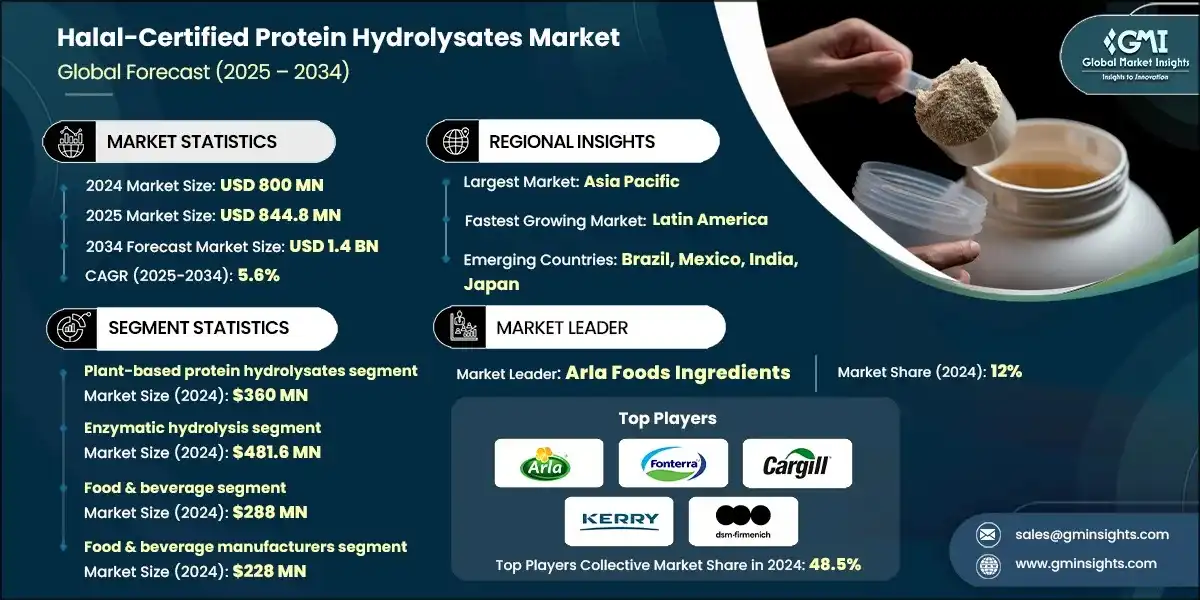
The global halal-certified protein hydrolysates market size was estimated at USD 800 million in 2024. It is expected to grow from USD 844.8 million in 2025 to USD 1.4 billion by 2034, at a CAGR of 5.6%, according to latest report published by Global Market Insights Inc.
Halal-Certified Protein Hydrolysates Market Key Takeaways
Market Size & Growth
- 2024 Market Size: USD 800 Million
- 2025 Market Size: USD 844.8 Million
- 2034 Forecast Market Size: USD 1.4 Billion
- CAGR (2025–2034): 5.6%
Regional Dominance
- Largest Market: Asia Pacific
- Fastest Growing Region: Latin America
Key Market Drivers
- Rising health consciousness & clean label demand.
- Technological advancements in enzymatic hydrolysis.
- Expanding applications in infant & clinical nutrition.
Challenges
- Higher production costs & price premiums.
- Limited availability of halal-certified raw materials.
Opportunity
- Plant-based protein hydrolysates growth potential.
- Digital traceability & blockchain integration.
Key Players
- Leading Players: Top 5 players in this market include Arla Foods Ingredients, Fonterra Co-operative Group, Cargill Incorporated, Kerry Group, DSM-Firmenich, which collectively held a market share of 48.5% in 2024.
Get Market Insights & Growth Opportunities
- The market of halal certified protein hydrolysates is experiencing high growth, particularly because of the increasing health awareness, and the changing preference of consumers to clean-label and functional ingredients. Raising the level of consciousness about the digestibility of proteins, muscle repair, and gut health is driving demand in the sports nutrition, diet supplements, and clinical nutrition sectors.
- The U.S. Department of Agriculture and FDA reports indicate that demand of functional and ethical proteins has increased more than 20 % in past three years and the expansion of certified protein hydrolysates is a growing trend that is gaining broader applications in the developed markets.
- The enzymatic hydrolysis developments are also changing market dynamics by increasing the efficiency of the process and quality of the product. Controlled breakdown of peptides can be achieved using modern enzyme-based systems which yield hydrolysates of better bioavailability and reduced off-flavor characteristics. To address the halal-compliant recipes, the global food ingredient producers have expanded their enzymatic hydrolysis functionality to facilitate the precision nutrition and cleaner production in the food and nutraceutical industries.
- The growing application of the halal-certified protein hydrolysates in infant and clinical nutrition is also causing growth in the market. Hydrolysates are also being used to a great extent by infant formula manufacturers to make the formulas less allergenic and more able to absorb nutrients. An example is that hydrolyzed protein formulations have demonstrated improved tolerance in infants with milk sensitivities, which has increased product integration by the world brands in halal-certified markets in Asia and the Middle East.
- The increasing use of preventive healthcare and the increased need fortified, and high protein diets is also favorable to the market. According to the World Health Organization, there has been a sharp rise in the demand of protein-based therapeutic nutrition especially in the areas with aging population and rising lifestyle diseases. It has led to the adoption of halal certified hydrolysates in clinical supplements by both healthcare and nutraceutical companies where they are being promoted as important components in the support of metabolic and immune health.
To get key market trends
Halal-Certified Protein Hydrolysates Market Trends
- The emergence of customized nutrition is shifting the demand pattern of halal-certified hydrolysates, particularly in the sports and clinical nutrition field. Ingredient formulators are crafting custom hydrolysate mixes that are optimized to digestive tolerance, energy recovery or immune enhancement depending on the genetic and metabolic profile of the consumer. This trend in customization is in line with the greater precision nutrition movement, and it is transforming the B2B relationships between nutrition brands and ingredient suppliers.
- The use of AI and data-driven optimization of bioprocess in enzymatic hydrolysis is another trend that has been shaping the market of halal-certified protein hydrolysates. Manufacturers are using AI-based process modeling to manage reaction kinetics, peptide yield and sensory performance so that production efficiency can be increased without compromising halal compliance. As an illustration, DSM-Firmenich and Kerry Group have put money in digital fermentation platforms to predict enzyme activity more precisely and minimize batch difference.
- As the world shifts to more plant-based diets, the producers of halal-certified products are moving toward soy and pea-based hydrolysates and rice-based hydrolysates to embrace sustainability and size-inclusiveness trends. The nexus between plant-based nutrition and halal integrity is developing a high-profit niche, particularly in such markets as southeast Asia and North America. Organizations are introducing dual-certified products (halal and vegan) to appeal to a wider consumer base, which is ethical and environmental. This change enhances the stability in the long term because it will serve both Muslim and flexitarian markets, which solidifies brand diversification.
- The consumers are also urging transparency in the whole protein ingredient supply chain, which is compelling manufacturers to include blockchain and digital traceability. This trend helps to maintain visibility in sourcing raw materials up to halal certification and ultimate packaging. Several global ingredient companies are converting to digital halal traceability which logs enzyme source, processing procedures and certification audit. The implication of this trend is that there is greater confidence by consumers, less certification risk, and the capacity to support higher prices by certified ethical sourcing.
Halal-Certified Protein Hydrolysates Market Analysis
Learn more about the key segments shaping this market
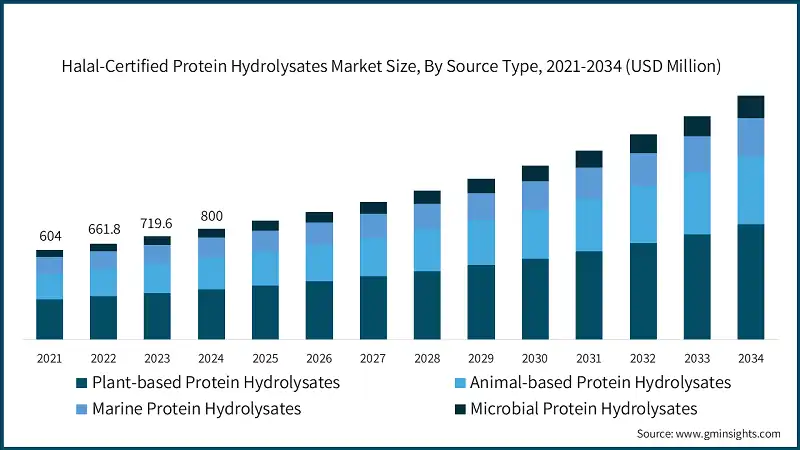
Based on source type, the halal-certified protein hydrolysates market is segmented into plant-based protein hydrolysates, animal-based protein hydrolysates, marine protein hydrolysates, and microbial protein hydrolysates. Plant-based protein hydrolysates hold a significant share at a valuation of USD 360 million in 2024.
- Plant-based protein hydrolysates have taken the leading position in the market of halal-certified protein hydrolysates due to the increasing interest of the population in the use of sustainable, ethical, and allergen-free protein sources. The growing popularity of lactose intolerance, veganism, and environmental consciousness has promoted the replacement of animal-based proteins by manufacturers of food and nutraceuticals with soy, pea, and rice hydrolysates. Their accessibility to be certified as halal and reduced complexities of production as well as increased sources of raw material have made plant-based hydrolysates as the ingredient of choice in beverages, sports nutrition, and functional food applications.
- The transition to plant-based formulations is also justified by continuous product innovation and clean-label craze, which increases digestibility, amino acid ratio, and sensory characteristics. Even though animal and marine-based hydrolysates have found their way into clinical and specialty nutrition, their proportion is slowly decreasing because of the tougher sustainability controls and the demand by consumers to have alternatives that are free of cruelty. Manufacturers are also paying attention to the optimization of the enzymatic hydrolysis process to enhance the flavor and bioavailability of plant-based proteins to ensure a favorable competitive performance, without compromising on halal value and environmental standards.
Based on process technology, the halal-certified protein hydrolysates market is segmented into enzymatic hydrolysis, acid hydrolysis, alkaline hydrolysis, and others. Enzymatic hydrolysis holds a significant share at a valuation of USD 481.6 million in 2024.
- The largest market share is enzymatic hydrolysis due to its specificity and capability to generate high quality and bioactive protein hydrolysates which do not compromise nutritional integrity. It also enables manufacturers to regulate the length and composition of peptide chains leading to enhanced digestibility and functionality which is paramount in the application of the product in dietary supplements, sports nutrition and clinical foods. The fact that the method meets the halal standards, that is, it does not use chemical catalysts, is yet another positive aspect in terms of its use in halal-appointed production lines.
- In addition, the global ingredient suppliers are making massive investments in enzymatic hydrolysis because it is sustainable and has clean-label attributes. The increase in the yield is being increased by technological advancements in enzyme specificity and reactor design which is lowering the cost of processing. This enzymatic over acid/alkaline hydrolysis shift highlights a larger industry trend that has seen the trend of environmentally friendly and halal compliant production processes to promote high value protein innovation.
Based on application, the halal-certified protein hydrolysates market is segmented into infant nutrition, sports nutrition, dietary supplements & nutraceuticals, clinical/medical nutrition, food & beverage ingredients, and cosmetics & personal care. Food & beverage ingredients holds a significant share at a valuation of USD 288 million in 2024.
- The most promising application segment is dietary supplements and nutraceuticals, with consumer demand triggered by the need of natural and functional protein to maintain health, fitness, and recovery. Market expansion is being encouraged by the increasing awareness of preventive healthcare and the growing popularity of adding proteins in capsules, powders and ready-to-drink beverages. Halal certified hydrolysates have an advantage because it is both performance and ethical consumption choice applicable to both the Muslim and non-Muslim population.
- Moreover, hydrolyzed proteins are gaining popularity among nutraceutical companies because of their high absorption rate and amino acid composition which makes them the best factors to use when making premium health products. The growing retail presence via e-commerce and specialty stores and growing marketing of halal nutrition as a global wellness strategy are all reinforcing the use of protein hydrolysates in this segment.
Learn more about the key segments shaping this market
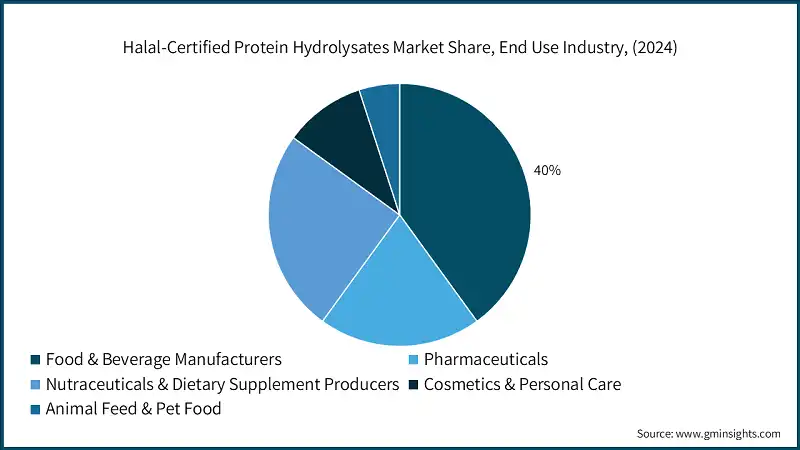
Based on end use industry, the halal-certified protein hydrolysates market is segmented into food & beverage manufacturers, pharmaceuticals, nutraceuticals & dietary supplement producers, cosmetics & personal care, and animal feed & pet food. Food & beverage manufacturers is estimated to grasp a value of USD 228 million in 2024 and is expected to grow at 5.3% of CAGR during the forecast period.
- The halal-certified protein hydrolysates market is dominated by food and beverage manufacturers in the end use industry segment who use these ingredients to fortify the nutritional and functional characteristics of different consumer products. The use of hydrolysates in fortified beverages, dairy substitutes, and protein-enhanced snacks is more of a trend that satisfies the increasing demand of clean-label, high-protein formulations. The large-scale integration capabilities and the acceptability of halal-certified, functional food innovations by consumers to end-users favor this end-use industry.
- Moreover, the segment has been facilitated by the manufacturer’s differentiation orientation, i.e., ingredient innovation and ethical branding. The addition of hydrolysates contributes to the enhancement of solubility, taste, and texture without compromising the nutritional content, which is in accordance with the trends of wellness-focused and halal-certified convenience foods. The evolution of strategic alliances between world ingredient providers and the brands of F&B is also making innovation and increasing product penetration into major markets.
Looking for region specific data?
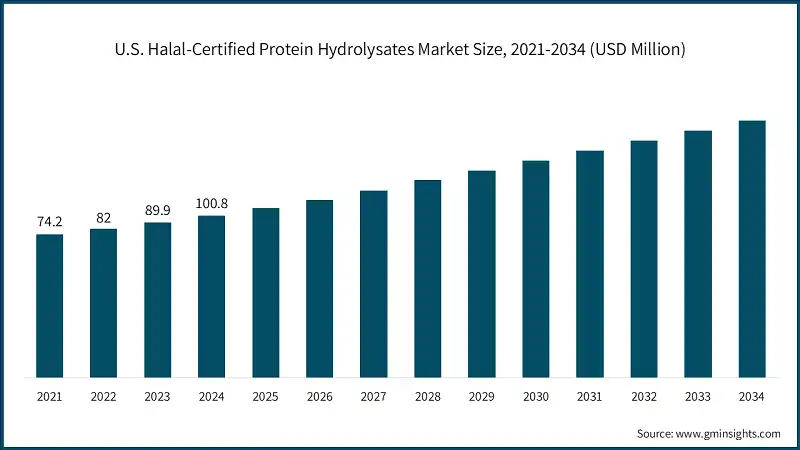
North America halal-certified protein hydrolysates market accounted for USD 120 million in 2024 and is anticipated to show lucrative growth over the forecast period with US occupying a market of USD 100.8 million in 2024.
- North America holds 15% market share of the halal-certified protein hydrolysates market in year 2024, with the U.S. representing the leading market share because of its developed food processing markets and high demand of clean-label and functional ingredients. The area enjoys the expansion of Muslim population and rising awareness of nutritional supplements of halal certification among the consumers who are interested in fitness. The U.S. market is a leader due to the strong infrastructure of halal certification, strong retail push of protein-based beverages and technological advancement in its enzyme-based hydrolysis processes.
- Market in this region is growing at a high pace with producers working towards sustainability, traceability, and sourcing of products ethically to match the taste of the consumers. The increasing application of protein hydrolysates in sports nutrition, infant feeding and in the clinical area is driving the consistent uptake of the products. Moreover, the growth of R&D to produce lactose-free and plant-based halal options as well as strategic partnership with local certification agencies is bolstering the regional competitiveness and providing good positioning in the market until the forecast period.
Europe halal-certified protein hydrolysates market accounted for USD 96 million in 2024 and is anticipated to show lucrative growth over the forecast period.
- Europe holds about 12 % market share in halal-certified protein hydrolysates in year 2024, with the major countries, including Germany, France and the UK, leading the market since they have sophisticated ingredient processing facilities and on nutrition market. Such markets enjoy good production of dairy and plant-based proteins, high regulatory standards, and full-fledged demand in functional nutrition. A large portion is pushed by infant and clinical nutrition application, in which hydrolysates are designed to provide allergen-depleting, high-bioavailability, proteins that are applicable to halal formulations in the Muslim-minority settings and markets to which they are exported.
- The consumer demand of premium and clean label ingredients and implementation of halal-certified nutrition formulations in food and beverage, infant nutrition and dietary supplements is driving growth in Europe. Existing regulatory frameworks like the Novel Food Regulation in the EU and strict regulations on health claims are allowing innovation and on the other hand the consideration of sustainability, traceability and ethical source ensures supply chains of halal-certified ingredients.
Asia Pacific market accounted for USD 360 million in 2024 and is anticipated to show lucrative growth over the forecast period.
- The Asia-Pacific region which holds about 45% market share in the halal certified protein hydrolysates market in year 2024 evidently the dominant growth geography. The most effective growth has been in the specific countries like in China or India where the increasing disposable incomes, the rise of a middle class, and the rising demand of functional, halal-certified nutrition solutions (infant formulas, clinical nutrition, sports nutrition), are driving a large market pull.
- In addition, the development of the region is augmented due to the changing lifestyles in diet and the regulatory conditions towards specialty nutrition. With the increase in health and ethical awareness in consumers in the Asia-Pacific region, there is growing demand on clean-label and easily digestible protein hydrolysates that are halal certified.
Latin America halal-certified protein hydrolysates market accounted for 3% market share in 2024 and is anticipated to show steady growth over the forecast period.
- Latin America is recording consistent increase in the supply of halal-certified protein hydrolysates owing to the growing health consciousness, rising middle-class nutrition requirements and the intake of hypoallergenic and functional food. Brazil is on the forefront accompanied by robust infant-nutrition and sports-nutrition industry and the bettering regulatory environment which identifies certified ingredients. The sub-segment of halal-certified hydrolysate is also backed by the growing demand of local consumers to find clean-label and ethically sourced proteins. Sales to the Muslim-majority countries also create additional export opportunities, which encourages the production and certification of halal to the region.
Middle East and Africa market accounted for 25% market share in 2024 and is anticipated to show steady growth over the forecast period.
- The Middle East and Africa accounted for approximately 25 % market share in the halal-certified protein hydrolysates market in 2024, which is indicative of high cultural and regulatory fit of the region with halal requirements. Saudi Arabia, the UAE, South Africa are some of the biggest contributors since they are increasing their investments in food technology, fortified nutrition and protein-based dietary solutions. High Muslim population, increased awareness of functional and clinical nutrition and the eventual consistent demand of halal-certified hydrolysates in food, beverage and healthcare formulations is being supported by these factors.
- The expansion in the MEA region is constant with the help of the diversification of domestic certification organizations, governmentally organized halal efforts, and the development of strategic partnerships with foreign ingredient suppliers. Dependence on imports is slowly decreasing with increasing local manufacturing capacity in the Gulf states and North Africa as well as a move towards value-added protein ingredients. Additionally, the strategic trade location will enable the region to be used as an export center to South Asia and Europe, which will strengthen MEA as a stationery in the world halal-certified protein hydrolysates environment.
Halal-Certified Protein Hydrolysates Market Share
The halal-certified protein hydrolysates industry is moderately consolidated with top five companies in the market including Arla Foods Ingredients, Fonterra Co-operative Group, Cargill Incorporated, Kerry Group and DSM-Firmenich controlling approximately 48.5% market share in the market. They control the market with the large chain of suppliers all over the world, with the technologies of hydrolysis and with the production plants that are halal and certified.
They have a wide range of applications in their portfolios, which include infant nutrition, clinical formulations, sports nutrition, and functional food industries. Their presence in such high demand markets as southeast Asia, the Middle East, and Europe is also a strong competitive presence that is backed by the continued investments in innovation and localized production strengths.
In the pursuit of competitiveness, major players are concentrating on research and development that will add value to the functionality of their products, their digestibility, and their nutritional effectiveness of protein hydrolysates. They are increasing production facilities, harmonizing activities with regional halal certification requirements and establishing strategic partnership with regional distributors to enhance market penetration.
Halal-Certified Protein Hydrolysates Market Companies
Major players operating in halal-certified protein hydrolysates industry are:
- Arla Foods Ingredients
- Fonterra Co-operative Group
- Cargill Incorporated
- Kerry Group
- DSM-Firmenich
- ADM (Archer Daniels Midland)
- Actus Nutrition
- FrieslandCampina
- Agropur Cooperative
- Roquette Frères
- Abbott Laboratories
- Glanbia PLC
Arla Foods Ingredients is a whey-based protein hydrolysate company operating all over the world in infant food, sports, and medical food. It has a wide range of brands of dairy proteins and peptides which are certified as halal with these brands being Lacprodan and Peptigen. Its plants in Denmark and Argentina are run on accepted standards of halal, which provides traceability and meeting standards. The innovation of enzymatic hydrolysis and clinical nutrition by Arla is in line with the increased demand of high-protein ingredients that are halal-approved in the MENA and Asia-Pacific markets.
Fonterra manufactures extensive dairy-based protein hydrolysates and functional ingredients with halal-certified New Zealand by the FIANZ standards. The firm provides whey and casein hydrolysates to be used in infant feeding, beverages and performance products. Its manufacturing plants that have been certified as halal serve the markets in Southeast Asia and Middle East well. The product strategy of Fonterra focuses on product purity, traceability, and sustainability to address the halal and clean-label customers.
Cargill has a wide range of ingredients and provides plant- and animal-based protein hydrolysates, which contributes to the halal certification in various markets in the region. The halal-compliant food and beverage manufacturers of the company can be found in their plants located in Malaysia, Indonesia and Turkey, which produce food and beverages that are certified as halal. Cargill also combines enzyme hydrolysis and fermentation methods to form personalized hydrolysates to be applied in nutrition, bakery, and beverage industries. Its ethical sourcing activities and compliance with regulations make it a reliable worldwide supplier of halal ingredients.
Kerry Group is a leading manufacturer of hydrolyzed proteins and taste modifying components to the nutrition and food sector wherein many of their products have been halal certified. Facilities of the company in Malaysia, South Africa, and the UAE are accredited by recognized halal authorities to keep supply constant to the markets with Muslim majority. Kerry also dominates the halal nutrition market by concentrating on clean-label, functional, and sustainable protein hydrolysates. Ongoing research and development as well as local production reinforce its competitive advantage in certified protein industry.
DSM-Firmenich is a joint venture between DSM, a global leader in nutritional science, and Firmenich, a global leader in flavors, which produces high-value protein hydrolysates and bioactive peptides with a halal certification. The company provides dietary supplements, early-life nutrition and functional food industries with halal compliant formulations. Its plants are also subject to high standards of halal practices, meaning that there is integrity of ingredients throughout the supply chain. Having a highly concentrated biotechnology, sustainability and precise fermentation, DSM-Firmenich is spreading its presence in the halal-certified protein hydrolysates industry across the globe.
Halal-Certified Protein Hydrolysates Market Report Attributes
| Key Takeaway | Details |
|---|---|
| Market Size & Growth | |
| Base Year | 2024 |
| Market Size in 2024 | USD 800 Million |
| Market Size in 2025 | USD 844.8 Million |
| Forecast Period 2025 - 2034 CAGR | 5.6% |
| Market Size in 2034 | USD 1.4 Billion |
| Key Market Trends | |
| Drivers | Impact |
| Rising health consciousness & clean label demand | Boosts consumer preference for natural, transparent, and certified products, driving strong adoption in food, beverage, and nutraceutical sectors |
| Technological advancements in enzymatic hydrolysis | Improves efficiency, functionality, and taste profiles, enabling cost-effective production and expanding product applications |
| Expanding applications in infant & clinical nutrition | Creates high-value opportunities as demand for safe, certified, and functional proteins grows in sensitive health segments |
| Pitfalls & Challenges | Impact |
| Higher production costs & price premiums | Limits affordability and adoption in price-sensitive markets, creating barriers for mass-market penetration. |
| Limited availability of halal-certified raw materials | Constricts supply chain flexibility and scalability, impacting production capacity and market expansion |
| Opportunities: | Impact |
| Plant-based protein hydrolysates growth potential | Aligns with global vegan and sustainability trends, opening new product lines and attracting health-conscious consumers |
| Digital traceability & blockchain integration | Enhances transparency and trust in halal certification, differentiating brands and meeting regulatory compliance efficiently |
| Market Leaders (2024) | |
| Market Leaders |
12 % |
| Top Players |
Collective market share in 2024 is 48.5% |
| Competitive Edge |
|
| Regional Insights | |
| Largest Market | Asia Pacific |
| Fastest growing market | Latin America |
| Emerging countries | Brazil, Mexico, India, Japan |
| Future outlook |
|
What are the growth opportunities in this market?
Halal-Certified Protein Hydrolysates Industry News
- In July 2024, Arla Foods Ingredients obtained regulatory permission of its whey protein hydrolysates in infant formula in the EU and the U.S. market. Lac prodan DI-3092 medical nutrition hydrolysate is also made by the company, which is halal certified, to meet the increasing demands of nutritional ingredients that are compliant.
- In May 2024, Roquette extended its NUTRALYS protein pea product line by launching better solubility and taste selections. These novel grades permit the company to have a higher potential of manufacturing halal-suitable hydrolyzed plant proteins which are utilized in beverages, meal replacement, and fortified foods.
- In May 2022, Kerry Group opened a plant (Hammarsdale, KwaZulu-Natal) in South Africa that manufactures nutrition and flavor products. Its enhanced location will be geared towards enhancing the manufacture of specialized nutritional components like protein hydrolysates, which will allow the formulation of halal certified products in both the African and Middle Eastern markets.
- In December 2021 Roquette opened the largest pea protein plant in the world in La Madeleine in France, enabling it to increase its capacity of plant-based protein ingredients. The new plant enhances the upstream supply of the company in terms of protein hydrolysates and assists in the establishment of the development of halal-compliant protein solutions in the nutrition and clinical industries.
The halal-certified protein hydrolysates market research report includes in-depth coverage of the industry with estimates & forecast in terms of revenue (USD Million) & volume (Kilo Tons) from 2021 to 2034, for the following segments:
Market, By Source Type
- Plant-based protein hydrolysates
- Pea protein hydrolysates
- Soy protein hydrolysates
- Rice protein hydrolysates
- Hemp protein hydrolysates
- Other plant sources
- Animal-based protein hydrolysates
- Whey protein hydrolysates
- Casein hydrolysates
- Bovine protein hydrolysates
- Poultry protein hydrolysates
- Marine protein hydrolysates
- Fish protein hydrolysates
- Shrimp & crustacean hydrolysates
- Other marine sources
- Microbial protein hydrolysates
Market, By Processing Technology
- Enzymatic hydrolysis
- Microbial enzyme systems
- Plant-derived enzyme systems
- Immobilized enzyme technology
- Acid hydrolysis
- Alkaline hydrolysis
- Others
Market, By Application
- Infant nutrition
- Extensively hydrolyzed formulas
- Partially hydrolyzed formulas
- Hypoallergenic products
- Sports nutrition
- Pre-workout supplements
- Post-workout recovery products
- Protein powders & shakes
- Clinical/medical nutrition
- Enteral nutrition products
- Medical foods
- Specialized dietary management
- Dietary supplements & nutraceuticals
- Capsules & tablets
- Powder supplements
- Functional foods
- Food & beverage ingredients
- Flavor enhancers
- Protein fortification
- Emulsifiers & stabilizers
- Cosmetics & personal care
- Anti-aging products
- Hair care products
- Skin care applications
Market, By End Use Industry
- Food & Beverage manufacturers
- Pharmaceuticals
- Nutraceuticals & Dietary supplement producers
- Cosmetics & Personal care
- Animal feed & Pet food
The above information is provided for the following regions and countries:
- North America
- U.S.
- Canada
- Europe
- UK
- Germany
- France
- Italy
- Spain
- Rest of Europe
- Asia Pacific
- China
- India
- Japan
- South Korea
- Australia
- Rest of Asia Pacific
- Latin America
- Brazil
- Mexico
- Argentina
- Rest of Latin America
- MEA
- UAE
- Saudi Arabia
- South Africa
- Rest of Middle East and Africa
Frequently Asked Question(FAQ) :
What is the market size of the halal-certified protein hydrolysates in 2024?
The market size was estimated at USD 800 million in 2024, with a CAGR of 5.6% expected through 2034. Increasing health awareness and a shift towards clean-label and functional ingredients are driving market growth.
What is the projected value of the halal-certified protein hydrolysates market by 2034?
The market is poised to reach USD 1.4 billion by 2034, driven by demand for sustainable, ethical, and functional protein sources.
What is the expected size of the halal-certified protein hydrolysates industry in 2025?
The market size is projected to reach USD 844.8 million in 2025.
How much revenue did plant-based protein hydrolysates generate in 2024?
Plant-based protein hydrolysates generated approximately USD 360 million in 2024, led by the growing preference for sustainable and allergen-free protein sources.
What was the valuation of enzymatic hydrolysis in 2024?
Enzymatic hydrolysis accounted for USD 481.6 million in 2024, owing to its precision in producing high-quality, bioactive protein hydrolysates while maintaining halal compliance.
What is the growth outlook for the food and beverage manufacturers segment?
The food and beverage manufacturers segment is expected to witness over 5.3% CAGR till 2034, with a valuation of USD 228 million in 2024.
Which region leads the halal-certified protein hydrolysates sector?
North America leads the market, with a valuation of USD 120 million in 2024. The U.S. alone accounted for USD 100.8 million, propelled by increasing demand for plant-based and functional protein products.
What are the upcoming trends in the halal-certified protein hydrolysates market?
Key trends include personalized nutrition, AI-optimized hydrolysis, plant-based formulations, blockchain transparency, and dual-certified products.
Who are the key players in the halal-certified protein hydrolysates industry?
Key players include Arla Foods Ingredients, Fonterra Co-operative Group, Cargill Incorporated, Kerry Group, DSM-Firmenich, ADM (Archer Daniels Midland), Actus Nutrition, FrieslandCampina, Agropur Cooperative, and Glanbia PLC.
Halal-Certified Protein Hydrolysates Market Scope
Related Reports