Summary
Table of Content

Europe Hair Straightener Market
Get a free sample of this report
Form submitted successfully!
Error submitting form. Please try again.
Thank you!
Your inquiry has been received. Our team will reach out to you with the required details via email. To ensure that you don't miss their response, kindly remember to check your spam folder as well!
Request Sectional Data
Thank you!
Your inquiry has been received. Our team will reach out to you with the required details via email. To ensure that you don't miss their response, kindly remember to check your spam folder as well!
Form submitted successfully!
Error submitting form. Please try again.
Europe Hair Straightener Market Size
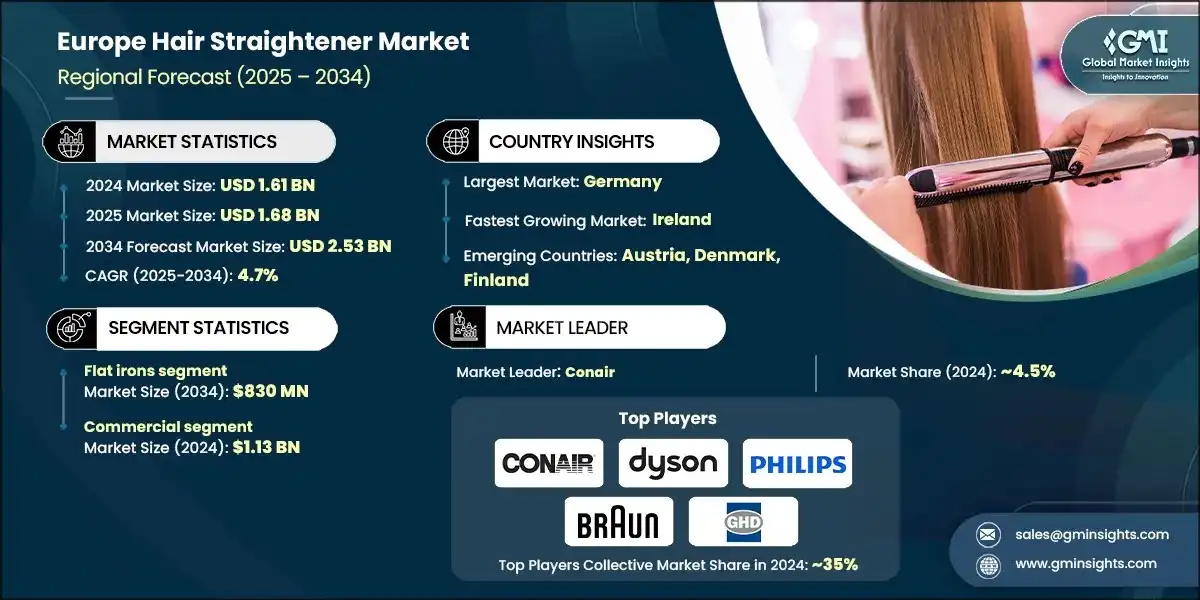
The Europe hair straightener market was estimated at USD 1.61 billion in 2024. The market is expected to grow from USD 1.68 billion in 2025 to USD 2.53 billion in 2034 at a CAGR of 4.7% according to latest report published by Global Market Insights Inc.
Europe Hair Straightener Market Key Takeaways
Market Size & Growth
- 2024 Market Size: USD 1.61 Billion
- 2025 Market Size: USD 1.68 Billion
- 2034 Forecast Market Size: USD 2.53 Billion
- CAGR (2025–2034): 4.7%
Key Market Drivers
- Growing Consumer Focus on Personal Grooming and Styling.
- EU Sustainability and Energy Efficiency Regulations.
- Enhanced Safety Standards and Consumer Protection.
Challenges
- Rising Energy and Cost Pressures.
- Safety Risks and Compliance Complexity.
Opportunity
- Integration of Smart and Connected Features.
- Expansion into Sustainable and Eco-Friendly Product Lines.
Key Players
- Market Leader: Conair led with over 4.5% market share in 2024.
- Leading Players: Top 5 players in this market include Conair, Dyson, Philips, Braun GmbH, GHD, which collectively held a market share of 35% in 2024.
Get Market Insights & Growth Opportunities
According to the European Commission's Consumer Conditions Scoreboard, many EU consumers trust that their grooming products are safe to use so there is no need to worry about what happens to a person's body after using a product that they do not feel comfortable with and thus don't consider safe for themselves or their families when using them. There are also many factors contributing to the amount of grooming and hygiene habits in Europe, including changing lifestyles, increased media attention on the importance of grooming and hygiene and increased socialization as a result of social networking. Also contributing to the demand for hair care equipment in Europe, women have been participating in more professional and social events, leading to higher levels of grooming, and women of Italian descent and Southern European countries maintain one of the highest levels of daily grooming (as high as 95%) than any other country in Europe. Because of this, there will continue to be a strong demand for home appliances that enable users to create salon-quality results in their homes; subsequently, hair straighteners have become a staple household appliance for European consumers.
The European Union has introduced new rules related to the Ecodesign Regulation (ESPR) that are going to affect how consumer electronic products are designed. The Ecodesign for Sustainable Products Regulation (the ESPR) establishes new design rules for consumer electronic products related to how durable they are, how many times they can be repaired, and what their level of energy efficiency will be. These changes are tied to the EU's objectives regarding climate change to decrease greenhouse gas emissions by 55% by 2030. Manufacturers of consumer electronics and personal care appliances such as hair straighteners are designing new products that will meet these objectives. Features often found on hair straighteners, such as automatic shut-off and low standby power consumption, are a result of this new regulation. According to the revised rules under the Ecodesign for Sustainable Products Regulation, energy usage (TWh) by consumer electronics will decrease by 4 TWh per year by 2030, which would power over 1 million electric cars. Furthermore, the CO2 emissions associated with electricity use by these products will decrease by 1.4 million tons. The reduction in the environmental impact from the new Ecodesign for Sustainable Products Regulation and the assurance provided to consumers through these energy-efficient products will make these products more appealing to the European consumer.
European Union (EU) regulations, particularly the General Product Safety Regulation (EU) 2023/988, identify product safety as a vital component of safe products. In addition, a collection of applicable standards has been developed through the EU's harmonized standards process, including environmentally friendly standards like EN IEC 60335-2-23 relating to hair dryer and hair care products. Manufacturers must comply with these regulations and standards in accordance with defined safety requirements, including those related to electrical safety, thermal damage prevention, and user safety, thereby providing consumers with a level of confidence regarding product reliability. The regulations and standards apply to hair straighteners that have an operating voltage of no greater than 250 volts and provide guidance on how to calculate the potential for fire and electric shock hazards.
To get key market trends
Europe Hair Straightener Market Trends
As a result of the demand from consumers and regulatory requirements, the hair straightener market in Europe is undergoing a significant transformation towards smart, sustainable and multifunctional styling tools, this is caused by changing consumer preferences for devices that incorporate sophisticated technologies, for example: temperature sensors, ionic conditioning, Bluetooth connectivity; in addition to this, they desire welfare within the devices with eco-friendly elements such as energy conservation and recyclable materials complying with the European Union's Green Deal and Ecodesign regulations. In addition to the growing demand from consumers for devices that can be used to enhance their DIY style at home due to social media influencers and online beauty tutorials, an increase in health awareness along with the increased demands for compliance with the European Union's health and safety regulations are fuelling the development of heat protection technologies and assurance of compliance with the rigorous European Union safety standards as an assurance of product performance.
- In Europe, the introduction of smart technology use in hair straightening products has altered how consumers feel about their hair straighteners and what they will expect in regard to their use of hair straighteners in the future. Today's new models of hair straighteners include Bluetooth technology, mobile app interfaces for temperature adjustments, and Artificial Intelligence (AI) that can detect and calibrate the amount of heat applied to the user's hair based on the type and texture of hair being used. As more hair straightening devices are becoming connected devices, manufacturers also have the capability to provide their users with predictive maintenance capabilities, as well as usage analytics, for usage data regarding hair straightener products. In doing this, manufacturers will create new opportunities for themselves to offer subscription services and loyalty programs for their users. The result is that hair straighteners are being elevated from basic styling tools to a premium lifestyle product that has the potential to appeal to an increasingly tech-savvy and younger consumer population that has grown up in a digital world. Europe has one of the highest rates of internet users in the world, with more than 89% of those aged 16-24 using at least one social media site. Since brands now have access to this demographic via smart devices, they can engage with them via interactive mobile apps and influencer-led marketing campaigns. As such, smart straighteners are anticipated to be among the top segments of the cosmetic industry that will contribute to innovation and premiumization within that industry in the future.
- The sustainability trend is a central issue in Europe’s Beauty Appliance industry, as driven by the EU’s Green Deal, the Ecodesign for Sustainable Products Regulation, and the new EU Directive on Ecodesign for Sustainable Products. The trend is influencing hair straightener manufacturers to implement recyclable materials, energy efficient heating elements and low carbon manufacturing processes, which comply with the EU directives. Surveys indicate that more than 60% of Europeans use Environmental considerations when purchasing hair straighteners, which suggests that consumers want eco-friendly products. Additionally, while there are many products manufactured from recyclable materials, numerous brands are developing product features that allow for Auto-Shut Off and low standby power consumption, thus reducing energy waste. Thus, Sustainability will serve as both an enhancer of a brand’s reputation, due to regulatory compliance, and as a Discriminator in the marketplace, allowing brands to charge a Premium Price. Ultimately, as the EU is attempting to achieve a 55% Reduction in Greenhouse Gas Emissions by 2030, eco-friendly hair straighteners will likely appeal to Eco-Conscious Consumers, further supporting Long-Term Growth. Brands that are at the forefront of sustainability can capitalize on their position as both an Innovative Brand with new Technology and a Brand Committed to Environmental Responsibility.
- Increased interest in the versatility of different types of styling tools and their use to achieve salon-quality results from home has led to the rise of DIY beauty as well as the influence of social media. Multifunctional hair straighteners combine straightening, curling, and sometimes wet/dry styling capabilities into one tool. As a result, higher-end versions typically incorporate features such as ceramic or titanium plates and ionic technology for smoother finishes with reduced heat damage. This trend is being driven by the increasing popularity of cordless hair straighteners and the ease of use they provide to those who are constantly on the go. In addition, the multifunctionality of a hair straightener allows it to have an expanded value proposition for a consumer's flexibility and efficiency, thus creating increased demand for such tools. As beauty-related content continues to dominate social media outlets like Instagram and TikTok, so too, the demand for tools that can produce a range of hairstyles quickly and safely. According to Eurostat statistics, 65% of European consumers reported that social media influences their beauty purchases; therefore, digital engagement is a significant catalyst in driving this trend. Manufacturers benefit from the introduction of multifunctional styling tools by being able to offer premium-priced products and cross-sell other complementary products, thus enhancing their brand ecosystem. In addition, the increasing acceptance of DIY-style hairstyling will provide additional opportunities for brands to capture more market share by innovating in product versatility and ergonomic design.
Europe Hair Straightener Market Analysis

Learn more about the key segments shaping this market
Based on the product type, the market is segmented into hot air brushes, curling irons, flat irons, straightening brushes, others (multi-functional stylers, etc.). The flat irons segment leads the market and was valued at USD 550 million in 2024 and is projected to reach USD 830 million by 2034.
- Flat irons are the most popular tools on the market because they provide an exact straightening/styling experience for many kinds of hair. Because hot air brushes or curling irons do not create any type of uniform heating, as flat irons do through ceramic, titanium, or tourmaline plate technology, they produce smooth finished looks with fewer problems (e.g., frizz). Consumers seeking a single multifunctional appliance can create both perfectly straight styles and soft waves with this one product; therefore, flat irons are ideal for Europeans looking for professional style results at home and provide a direct link to the growing popularity of these products.
- Flat irons are popularized by a number of different social media networks, greeting cards, etc., but most notably Instagram and TikTok. Through the promotion of straight hair through these channels as well as education via influencers on how to achieve sleek looks, flat irons are quickly becoming ingrained in everyday beauty habits among people throughout Europe. Eurostat data shows that more than 65% of European consumers have stated that social media impacts the purchasing of beauty items, and flat irons are often shown as a styling tool forming part of the social media content. Therefore, for consumers looking for aesthetic value and convenience, flat irons represent an ideal solution.
Learn more about the key segments shaping this market
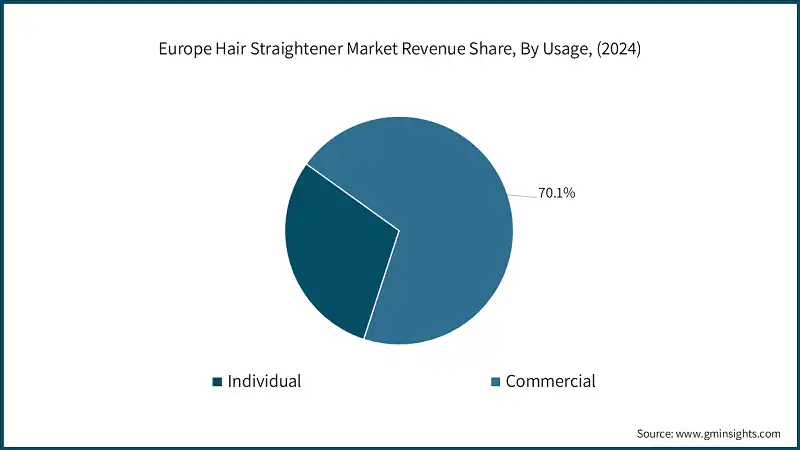
The hair straightener market by usage is segmented into individual and commercial. The commercial segment held around 70.1% market share in 2024 with USD 1.13 billion in 2024.
- The commercial segment (salons, beauty parlors, professional stylists) dominates the market because of the high levels of use and demand for premium-quality styling tools. Because of the requirement for hair straighteners to consistently perform at a high level and provide durability and advanced features to accommodate different types of hair, even the busiest salon environments require styling tools that perform above and beyond the average consumer's needs. Unlike individual consumers, many salons utilize multiple hair styling tools at the same time which leads to larger volume purchases and, therefore, increased revenue contribution. The consistent demand for hair styling tools used in commercial environments is a key driver of commercial market share.
- Because the fashion and beauty industries in Europe are thriving, there is a great deal of commercial business generated within the commercial market. For example, there is a need for high-quality hair styles to be created and worn at events such as fashion shows, weddings, and photo shoots. The growing use of professional hair treatment and hair styling has helped solidify this trend. High-end salons make purchases of premium hair straighteners that include technology such as ionic conditioning and temperature control to meet the high expectations of their customers, further growing commercial usage. Manufacturers also typically target the commercial market with premium hair styling products and exclusive relationships, resulting in products that have been designed to withstand the rigors of heavy use and have superior performance. These premium products usually have much higher price points than are typically paid by a consumer and, as a result, greatly influence the revenue generated by the commercial market vs. the revenue generated by the individual consumer market.
Looking for region specific data?
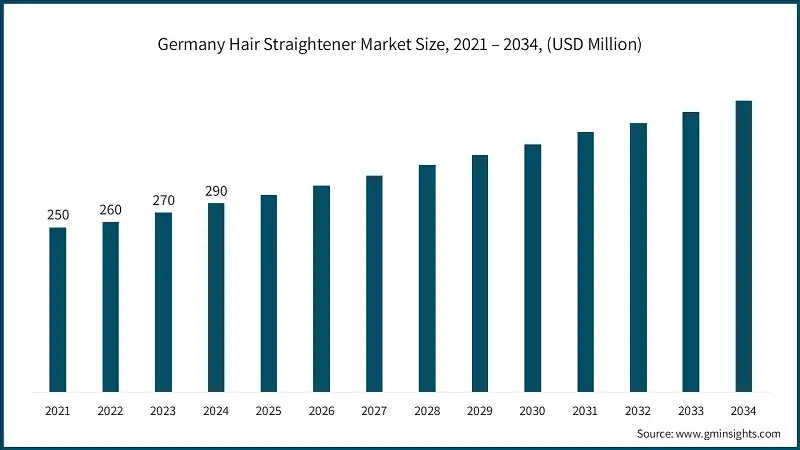
The Europe hair straightener market shows diverse dynamics across countries, shaped by economic development, and sustainability trends. The Germany hair straightener market was valued at around USD 290 million in 2024 and is anticipated to register a CAGR of 4.4% between 2025 and 2034.
- The fact that Germany is Europe’s largest economy fosters a large size market for consumer spending on premium products for grooming. In 2022, Household Final Consumption Expenditure is recorded at an increase of 10.7%. Private consumption will continue to remain strong despite inflation. This means consumers will have more disposable income due to their economic position and therefore will spend money on high-tech hair-styling appliances including flat irons and multifunctional straighteners. As well, Germany's urban population and culturally trendy nature drive up demand for grooming appliances that are of high quality and keep Germany at the forefront on a regional basis.
- In addition to being Europe's largest economy, Germany is a leader in innovation and sustainability in consumer goods and wants to produce high-tech products that are energy efficient. By complying proactively with the Electrical and Electronic Equipment Act (ElektroG) and EU Ecodesign regulations, the manufacturers will produce appliances that use less energy and are recyclable and enhance the eco-friendly image of German brands to environmentally conscious consumers across Europe. In addition to this, the manufacturers will be able to incorporate advanced engineering into the production of hair styling appliances, including smart technology devices such as temperature sensors and auto shut-off features, which both enhance safety and reduce energy consumption.
Europe Hair Straightener Market Share
- The top 5 companies in the hair straightener industry, such as Conair, Dyson, Philips, Braun GmbH, and GHD, hold a market share of 35%.
- Conair differentiates itself from competing brands by employing both worldwide distribution capabilities as well as a continuous product innovation strategy. The wide variety of products that Conair sells includes hair stylers (hair straighteners, curling wands, and multi-functional hair stylers) which are designed to meet the needs of both consumers and stylists. In addition to being affordable, Conair promotes its products as 'premiumization,' by providing consumers with the latest/current technology, such as ceramic and ionic conditioning materials, while providing consumers with a price point within their reach. As a result of the strong working relationships that Conair has established with its retail customers and online retailing partners, it has become a significant player in the European marketplace. Additionally, through continuous updates of its product offerings, Conair now offers a wide variety of cordless and travel-friendly options that enable it to compete effectively with several niche luxury brands while providing value to consumers.
- The strategy of Dyson is centered on establishing itself as the premier player in both technology and premium branding. Dyson has a long history of excellence in engineering and has invested substantially in the development and application of state-of-the-art technologies (including smart heat controls and airflow optimization) in all of their products, with the goal of minimizing damage caused to hair, while providing the highest possible performance. Dyson is also very active in digital marketing, creating engaging consumer experiences by offering products that can be demonstrated using virtual reality and partnering with social media influencers for greater consumer engagement. Moreover, Dyson utilizes environmentally sustainable business practices that align with the European Union's commitment to promoting energy efficiency, which has allowed Dyson to establish itself as an innovative and leading-edge company. Dyson's continued emphasis on research and development and its established brand equity have allowed Dyson to distinguish itself from competitors in the hair styling tool category, appealing to both tech-savvy consumers and environmentally conscious consumers.
- Philips is committed to providing quality products that meet the consumer’s need for personal grooming while being environmentally friendly through both health and consumer electronics. Philips offers hair straighteners as part of its Health & Sustainability strategy in the health & wellness space and, therefore, can provide consumers with the best products available for personal grooming. Philips will continue to elevate its premiumization strategy by adding digital technology that allows for the personalization of consumers' hair styling experiences directly through application integration with their current product offerings. As a company dedicated to innovation and compliance, supported by its extensive multichannel distribution network, Philips will be well positioned to compete in the marketplace and attract and retain customers looking for safe, sustainable, and technological advancements in personal grooming products.
Europe Hair Straightener Market Companies
Major players operating in the Europe hair straightener industry are:
- BaByliss
- Braun GmbH
- CHI
- Conair
- Drybar Products LLC
- Dyson
- GHD
- Hot Tools Professional
- HSI Professional
- Moehair USA Inc.
- Panasonic
- Philips
- Remington
- Revlon
- RUSK PRO
Braun has a history in the engineering of quality products that are of good craftsmanship and durable. Braun is a German company with a strong background in precision engineering and design excellence. Braun is now using Advanced Technology and AI to develop products that enhance the user's experience while also creating a safer experience for the user. Braun's strategy for entering new markets is through partnerships with professional salons and premium retailers, and its focus on branding as well as adherence to EU Safety Regulations. Additionally, Braun will promote the introduction of new products by leveraging their current portfolio of internationally recognized brands across different categories in the grooming and wellness industry, thus creating a strong product ecosystem. Through the combination of product innovation, regulatory compliance, and branding integrity, Braun has successfully sustained resilience against new competitors and the risk of counterfeit products.
GHD has maintained its leadership position by utilizing an emphasis on premium product placement and utilizing influential marketing techniques. They were the first brands to develop and bring to market 'ceramic plate technology'. GHD has continued to lead the way in innovation, most recently with its introduction of 'dual-zone heating technology' and the implementation of 'AI tools' on its website that provide customers with a customized profile based on what was received in an online form. The multi-channel distribution model of GHD combines luxury retailers, professional salons, and promotes a strong eCommerce presence. Additionally, GHD partners with over 10,000 influencers; this partnership, along with their 'AI' consumer engagement initiatives such as personalized styling quizzes, provides additional measures to build brand loyalty, as well as expanding their digital reach. By combining technology/innovation with an aspirational brand image, GHD can continue to compete effectively and remain the premier styling brand in Europe today.
Europe Hair Straightener Market Report Attributes
| Key Takeaway | Details |
|---|---|
| Market Size & Growth | |
| Base Year | 2024 |
| Market Size in 2024 | USD 1.61 Billion |
| Market Size in 2025 | USD 1.68 Billion |
| Forecast Period 2025 - 2034 CAGR | 4.7% |
| Market Size in 2034 | USD 2.53 Billion |
| Key Market Trends | |
| Drivers | Impact |
| Growing Consumer Focus on Personal Grooming and Styling | This trend is fueling worldwide demand for advanced hair care appliances, creating opportunities for premium and multifunctional product innovations. |
| EU Sustainability and Energy Efficiency Regulations | These regulations are setting benchmarks that influence global manufacturing standards, accelerating the adoption of eco-friendly and energy-efficient hair styling tools. |
| Enhanced Safety Standards and Consumer Protection | Stricter safety norms in Europe are driving global compliance, pushing brands to prioritize user safety features and quality assurance across all markets. |
| Pitfalls & Challenges | Impact |
| Rising Energy and Cost Pressures | Higher electricity prices and inflation are reducing consumer spending on non-essential grooming appliances, slowing premium product adoption globally. |
| Safety Risks and Compliance Complexity | Stringent safety regulations and costly compliance requirements are increasing production expenses and limiting market entry for smaller manufacturers. |
| Opportunities: | Impact |
| Integration of Smart and Connected Features | Incorporating IoT-enabled technology, such as Bluetooth connectivity, temperature control via mobile apps, and usage analytics, can transform hair straighteners into smart devices. This aligns with the growing trend of connected home ecosystems and personalized beauty solutions. |
| Expansion into Sustainable and Eco-Friendly Product Lines | Developing hair straighteners with recyclable materials, energy-efficient heating elements, and low-carbon manufacturing processes aligns with EU sustainability regulations and global consumer demand for eco-conscious products. |
| Market Leaders (2024) | |
| Market Leaders |
Market share of ~4.5% |
| Top Players |
Collective market share in 2024 ~35% |
| Competitive Edge |
|
| Regional Insights | |
| Largest Market | Germany |
| Fastest Growing Market | Ireland |
| Emerging Country | Austria, Denmark, Finland |
| Future Outlook |
|
What are the growth opportunities in this market?
Europe Hair Straightener Industry News
- In April 2025, GHD introduced the Chronos Max straightener with 42mm wide plates offering 3× faster styling across European markets. This launch helps GHD target professional users and consumers with long/thick hair requiring faster styling solutions.
- In January 2025, Remington introduced the AIRvive collection featuring Ionic Air Technology across five SKUs including the Slim Straightener in Europe. This launch enables Remington to compete in the anti-frizz technology segment and expand its mid-premium product portfolio.
- In January 2025, Remington launched the S8598 model with patented intelligent heat sensor detecting hair moisture 8× per second in Europe. This innovation positions Remington as a technology leader in hair protection and personalized styling solutions.
- In February 2024, Dyson launched the Airstrait straightener in UK, France, and Germany markets. This expansion helps Dyson strengthen its premium positioning and capture market share in Europe's high-value hair-styling segment.
The Europe hair straightener market research report includes in-depth coverage of the industry, with estimates & forecasts in terms of revenue (USD Billion) and volume (Million Units) from 2021 to 2034, for the following segments:
Market, By Product Type
- Hot air brushes
- Curling irons
- Flat irons
- Narrow plates flat irons (<1 inch)
- Standard plates flat irons (1-1.5 inch)
- Wide plates flat irons (>1.5 inch)
- Straightening brushes
- Others (multi-functional stylers, etc.)
Market, By Power Source
- Cordless
- Standard (<3000mAh)
- Extended (3000-5000mAh)
- Professional (>5000mAh)
- Corded
Market, By Technology
- Ceramic
- Titanium
- Tourmaline
- Ionic
- Steam
- Infrared
Market, By Price Range
- Economy (
- Mid-Range (USD 30 - USD 80)
- Premium (USD 80- USD 200)
- Ultra-Premium (> USD 200)
Market, By Consumer Group
- Men
- Women
Market, By Usage
- Individual
- Commercial
- Beauty centers
- Salons
- Other (dermatological center, etc.)
Market, By Distribution Channel
- Online
- E-Commerce marketplace
- Company websites
- Offline
- Hypermarkets & supermarkets
- Specialty stores
- Others (beauty shops, retail stores, etc.)
The above information is provided for the following countries:
- Germany
- U.K.
- France
- Italy
- Spain
- Netherlands
- Poland
- Sweden
- Belgium
- Austria
- Norway
- Denmark
- Finland
- Switzerland
- Ireland
Frequently Asked Question(FAQ) :
What is the market size of the Europe hair straightener in 2024?
The market size was USD 1.61 billion in 2024, with a CAGR of 4.7% expected through 2034 driven by rising demand for advanced, premium, and multifunctional hair care appliances.
What is the projected value of the Europe hair straightener market by 2034?
The Europe hair straightener market is expected to reach USD 2.53 billion by 2034, propelled by smart technology integration, sustainability regulations, and DIY beauty trends.
What is the current Europe hair straightener market size in 2025?
The market size is projected to reach USD 1.68 billion in 2025.
How much revenue did the flat irons segment generate in 2024?
Flat irons generated USD 550 million in 2024 and are projected to reach USD 830 million by 2034, leading the product type segment.
What was the valuation of the commercial usage segment in 2024?
The commercial segment held 70.1% market share and generated USD 1.13 billion in 2024, driven by salon demand for premium styling tools.
What is the growth outlook for Germany hair straightener market from 2025 to 2034?
Germany hair straightener market is projected to grow at a 4.4% CAGR till 2034, supported by strong consumer spending on premium grooming products and sustainability leadership.
What are the upcoming trends in the Europe hair straightener market?
Key trends include integration of smart technology with Bluetooth connectivity and AI-powered heat calibration, adoption of sustainable and eco-friendly materials, and growing demand for multifunctional styling tools influenced by social media.
Who are the key players in the Europe hair straightener market?
Key players include BaByliss, Braun GmbH, CHI, Conair, Drybar Products LLC, Dyson, GHD, Hot Tools Professional, HSI Professional, Moehair USA Inc., Panasonic, Philips, Remington, Revlon, and RUSK PRO.
Europe Hair Straightener Market Scope
Related Reports