Summary
Table of Content

Watercolor Market
Get a free sample of this report
Form submitted successfully!
Error submitting form. Please try again.
Thank you!
Your inquiry has been received. Our team will reach out to you with the required details via email. To ensure that you don't miss their response, kindly remember to check your spam folder as well!
Request Sectional Data
Thank you!
Your inquiry has been received. Our team will reach out to you with the required details via email. To ensure that you don't miss their response, kindly remember to check your spam folder as well!
Form submitted successfully!
Error submitting form. Please try again.
Watercolor Market Size
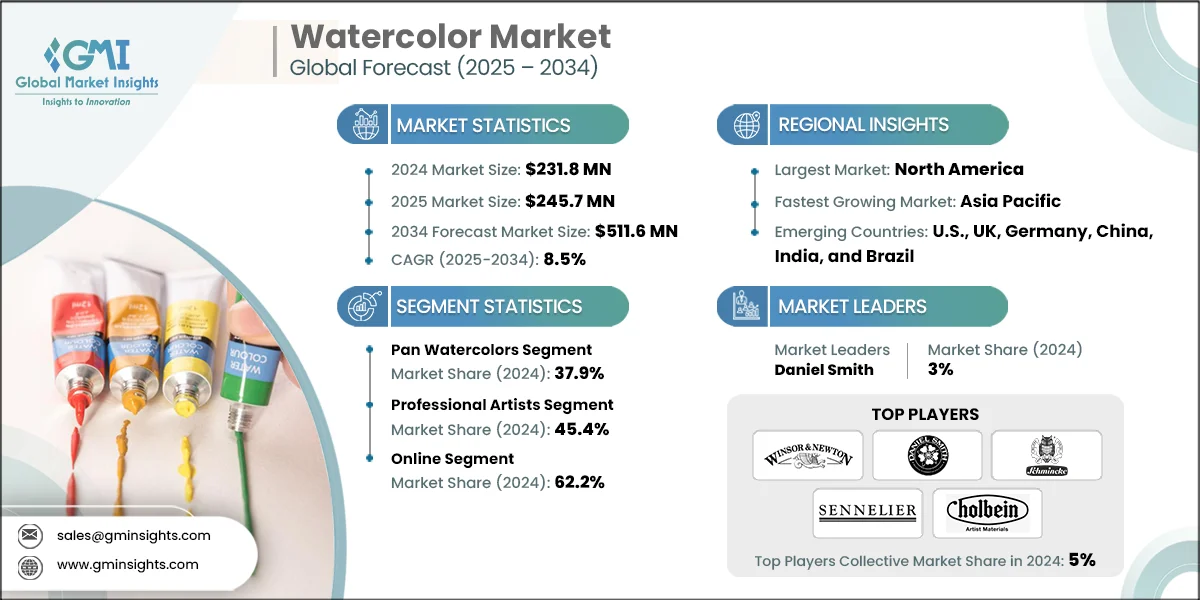
The global watercolor market was valued at USD 231.8 million in 2024 and is projected to grow from USD 245.7 million in 2025 to USD 511.6 million by 2034, registering a CAGR of 8.5%, according to Global Market Insights Inc.
Watercolor Market Key Takeaways
Market Size & Growth
- 2024 Market Size: USD 231.8 Million
- 2034 Forecast Market Size: USD 511.6 Million
- CAGR (2025–2034): 8.5%
Regional Dominance
- Largest Market: North America
- Fastest Growing Region: Asia Pacific
Key Market Drivers
- Growing interest in art and DIY culture.
- Rise of online art education and social media influence.
- Demand for eco-friendly and non-toxic art supplies.
Challenges
- High cost of premium watercolor products.
- Market fragmentation and brand loyalty.
Opportunity
- Integration with digital platforms.
- Innovation in product formats and delivery.
Key Players
- Market Leader: Daniel Smith led with over 3% market share in 2024.
- Leading Players: Top 5 players in this market include Winsor & Newton, Daniel Smith, Schmincke, Sennelier, Holbein, which collectively held a market share of 5% in 2024.
Get Market Insights & Growth Opportunities
- Watercolors are becoming popular again with the increased interest in creative hobbies, artists, and learning art programs. They are an important part of the art supplies market because they provide dynamic, flexible and accessible media to consumers who want to watercolor, whether people are new to watercolor or have been using watercolors for a long time.
- An important driver of the market growth is in the development of new formats of watercolors such as liquid watercolors, watercolor sticks, and hybridizations-Inker products and digital tools in particular which help to provide an easy and fun process of painting. In 2024, watercolor manufacturers are developing more eco-friendly, non-toxic products, accurate AI-driven color systems, and assisted on-line platforms for learning to enhance the user experience.
- The watercolor market continues with multi-dimensional product innovations and sustainability development cover the future of performance, value, and sustainability. Brands desire to meet consumer expectations by becoming storytellers through advanced packaging solutions, digital engagement, as well as educational materials for creativity and loyalty.
- According to Zauba, Sri Lanka was the largest importer of watercolor accounting for 37.73% of the total exports of watercolor. Bangladesh was the second largest importer of watercolor accounting for 11.96% of the total exports of watercolor.
- The watercolor market has grown from USD 195.6 million in 2021, fueled by the rising interest among consumers in creativity hobbies, the growth of art education, and gaining access to art products through e-commerce. The new product innovation with things like liquid watercolors, sticks, new ways of digitally learning or combining, and supporting both novice and expert users.
- In the market, the pan watercolors segment is the dominant segment, which is primarily due to its unparalleled convenience, versatility, and long shelf life, making it suitable for artists at all skill levels. Pan sets have the added benefit of portability and compact size. They are easy to transport and quick setup which appeals to hobbyists, students, and professional artists. The advantage of using pans is they enable better control for the artist on the degree of pigment by allowing the artist to build the pigment on the page, enabling many techniques including light washes or bold detailing.
- The North America region is the leading region in watercolors market as it has developed an intricate art education system and young people in the region spend more money on creative hobbies than in other regions. The abundance of significant art supply brands helps the region retain its supremacy in the watercolor market. The easy availability of watercolor products through retail stores and e-commerce is a major sales momentum in North America in addition to the rising demand for high-quality and eco-friendly products, in addition to the emergence of 'DIY' art culture.
- The Asia-Pacific region is fastest growing region in watercolors market, as there are increasing levels of disposable income, an ever-growing interest in creative hobbies and art education. Countries like China, India, Japan, and South Korea have seen an increase in demand for inexpensive and easy-to-use beginner art supplies from its population who seem to be compelled by the creativity of DIY culture. E-commerce growth, increasing interest of potential consumers in art supply and education, along with government interest in promoting creative education and the use of art supplies really help fuel the region's growth.
To get key market trends
Watercolor Market Trends
- Environmental impact is increasingly valued by consumers; therefore, safe and sustainable watercolor products are changing the market. The manufacturers are innovating and making paints with natural pigments and biodegradable packaging, while industry formal regulations are making chemicals much safer for consumers, hence the above association.
- Demand for safe and sustainable watercolors have taken off since around 2018 and is expected to continue being a primary preference of the market until 2030 and beyond because of the current drive toward consumers prioritizing health and minimizing damage to our environment. This provides brands in the watercolor market a great opportunity to foster loyalty and distinguish from retailers like color and creativity inspired by the growth in activity on social media platforms, home décor using product as enabler for working and play and absolutely killing it as influencer promotes all forms of green ideology.
- Consumers are also shifting towards versatile and quick-to-use watercolor paints in formats such as liquid paint, watercolor sticks, and smart palettes to mix colors quickly, easy setup, compact, portable to paint in motion. The nuance of consuming smaller amounts of paint supply is providing consumers with the relief they need in convenience production around their busy lives and being shared on social media for other portable options for creativity and the foray of portable supplies that amateurs work off.
- Manufacturers are putting justification into R&D for developing a new presentation that allows manufacturers to develop intuitively simple delivery methods innovation to the painting process for casual artists, students and travelers. Casual consumption of watercolors by amateur artists and artisans' formats has picked up swiftly since around 2017 and will continue to grow strongly throughout the 2020s as artists continue prioritizing convenience.
- As more people take up watercolor painting either as a hobby or in an educational context, the demand for inexpensive, yet reasonably good products is substantial. Cheap starter kits and sets allow for watercolor art to be accessible to a wider audience, generate early brand loyalty, and encourage use of the medium. Reasons are the DIY art movement, increased online tutorials, and young generations have part time jobs, resulting in a little more disposable income.
- Additionally, more e-commerce sites have improved global accessibility to relatively inexpensive supplies. This trend has developed since 2015 and will continue to grow in the next 10 years as creative pastimes continue to be popular. According to Statista, online art sales exceeded 10 billion USD, accounting for almost one-fifth of the global art market value in 2024.
Watercolor Market Analysis

Learn more about the key segments shaping this market
Based on type, the watercolor market is segmented into pan watercolors, tube watercolors, liquid watercolors, watercolor pencils, watercolor sticks and others. In 2024, the pan watercolors segment dominates the market with 37.9% market share, and the segment is expected to grow at a CAGR of over 8.2% from 2025 to 2034.
- Pan watercolors dominate the marketplace due to their portability, durability, and convenience of use making them a popular choice, especially for novice and student, as well as professional artists, and help account for the success of pan usage across the education, recreational, and professional domains. Additionally, their physical compactness allows for easy travel and set up quickly, which contributes to their popularity.
- Pan watercolors provide less mess and more control than tube or liquid watercolors. Tube and liquid styles are also becoming more popular but do not combine durability or accessibility of pan formats compared to pans. Watercolor pencils appeal to very niche demographic users, whereas pan watercolor offers the most versatility and usability. The liquid watercolors segment accounts for 14.6% of the market share and is to grow at CAGR 9.5%.
Learn more about the key segments shaping this market
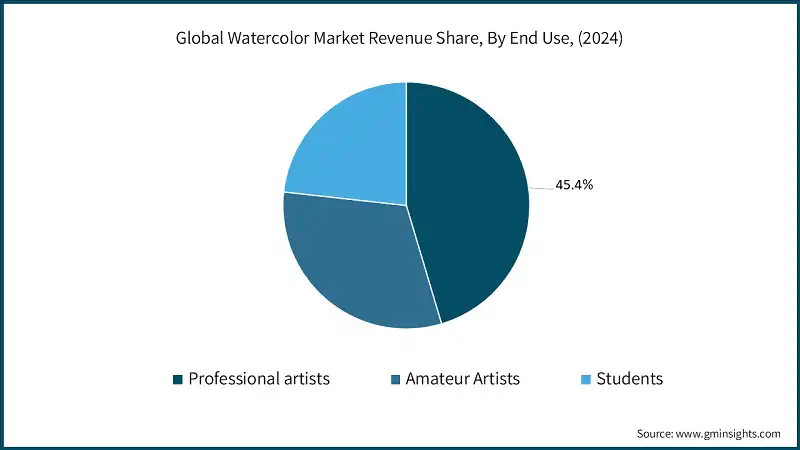
Based on end use, the watercolor market is segmented into professional artists, amateur artists and students. In 2024, the professional artists segment dominates the market with 45.4% market share, and the segment is expected to grow at a CAGR of over 8.8% from 2025 to 2034.
- Professional artists are the watercolor market leaders due to their need for consistency, durability, and superior quality pigments. For their work they typically use pan watercolors demanding their precision and consistency. Consistency is crucial as watercolor is often used for detailed work where the finished result must last. The contributions of this segment drive premium sales in the watercolor and set the standard for the industry.
- Amateur artists and students by comparison purchase inexpensive beginner sets where the pigment is diluted. Most sales in volume focus on this segment but professionals represent the maximum revenue and innovation, therefore, are valued in the market for their significant contribution to revenue and products available.
- In this market, amateur artists segment accounts for 31.4% of the market share and is to grow at CAGR 8.7%.
Based on the distribution channel, the watercolor market is segmented as online and offline. In 2024, the online segment dominates the market with 62.2% market share, and the segment is expected to grow at a CAGR of over 9% from 2025 to 2034.
- The online segment dominates the market due in part the breadth of products, ease of research/ordering from the convenience of home and general ease of use with global brands, reviews, and doorstep delivery. More people not only grew up engaged in online experiences but rely on and communicate through digital mediums very comfortably drawing references both digitally and physically from other artists. For amateurs, professionals, and students alike, online shopping is established as the primary buying channel.
- Offline stores do provide a tactile experience that is immediate for individuals that want or prefer to buy in person, but do not have the same range or convenience as online and other e-commerce channels. Offline retail is also dwindling fast with market needs shifting until they primarily serve local retail markets and those that want to experience products hands-on. These offline purchasing experiences have already lost most of their retail market share simply to the ease of e-commerce channels.
Looking for region specific data?
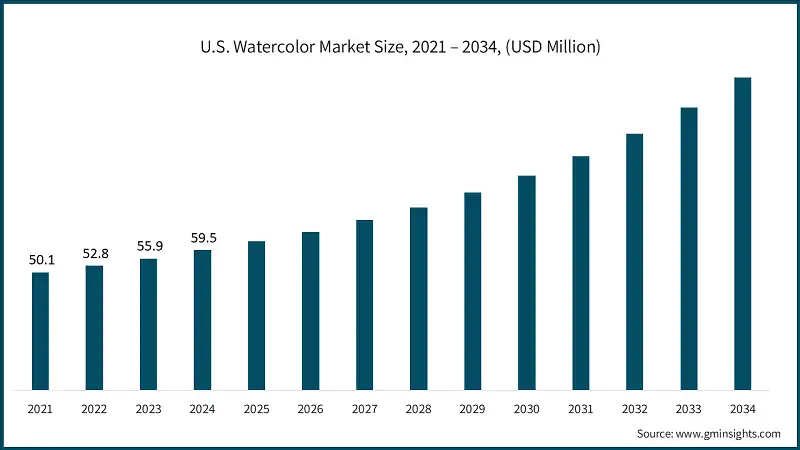
The U.S. dominated the watercolor market with around 80.1% market share and estimated to reach revenue of USD 132.5 million by 2034.
- The U.S. has been a leader in the watercolor sector due to the intersection of many cultural, economic, and lifestyle aspects. Watercolor art is deeply rooted in American education and continues to be a central practice in K–12 art curricula, as well as in professional art training. Moreover, online teaching platforms, social media trends, and Do It Yourself (DIY) culture resulted in continuous popularity of watercolors as a creative medium.
- The arts also qualify watercolor paint for both therapeutic and eco-friendly qualities, helping this category gain traction in wellness and sustainability markets. Strong domestic brands and wealthier creative consumer bases continue to establish the US as a global leader in the market.
In Asia Pacific, India watercolor market is expected to experience significant growth and promising growth from 2025 to 2034.
- The market in India is expected to grow substantially during 2025-2034 due to a large and growing young population interested in arts and crafts. The Indian government is increasingly focusing on promoting creative education in schools. In addition, the rising disposable income of consumers is expanding the population of followers interested in watercolor products via e-commerce and retail outlets.
- The increasing popularity of digital art, along with influence from social media are driving more art hobbyists, emerging artists and creativity seekers to watercolor painting. Also, local manufacturers are producing affordable, good-quality products designed specifically for Indian consumers, leading to further penetration and growth of the watercolor products across urban and semi-urban areas.
In Europe, the UK watercolor market is expected to experience significant growth and promising growth from 2025 to 2034.
- With a thriving art culture and established creative industries, the UK watercolor market is predicted to enjoy significant growth. The demand for watercolor materials is driven by strong governmental support for arts education which positively influences the increase in arts content for educational institutions, rising participation in art workshops, and the growing consumer interest in sustainable art materials and higher quality art materials.
- An increase in digital platforms for art content and DIY creative reflects the increased engagement with the watercolor across all age groups. The strong retail and e-commerce in the senior market ensures accessibility to a wide range of products and further secure position for the UK as the largest market in Europe.
In MEA, the South Africa watercolor market is expected to experience significant growth and promising growth from 2025 to 2034.
- The watercolor market in South Africa is well-positioned for considerable growth, being driven by increased interest in arts and crafts both for education and recreation. Increasing disposable incomes and continuing urban middle classes will make a huge difference in many South Africans buying products for creative hobbies. The growth in art education and availability of community workshops also promotes watercolor usage among students and hobbyists.
- In addition to this cultural shift toward better use of leisure time, e-commerce is becoming a greater platform for watercolor sales, while even local and international manufacturers are making quality and affordable watercolor products accessible to more people. All these factors will lend themselves to a developing market across the country.
Watercolor Market Share
- Daniel Smith leads with 3% market share due to their high-quality pigments and wide range of unique, artist-preferred colors. The top 5 companies are Winsor & Newton, Daniel Smith, Schmincke, Sennelier, and Holbein, collectively hold 5% of the market, indicating fragmented market concentration.
- Smith Daniel supply high-quality watercolors, but they want to separate themselves by inventing and using fresh, new colors. Smith Daniel also provides some uncommon pigments, with very good lightfastness ratings. They would like to suggest that they explore pigment innovations, and that they are firmly rooted in creativity.
- Winsor & Newton is renowned for excellent quality pigments and suppliers of a vast range of colors. Their watercolors are intended for professional use and are richly pigmented watercolors with very good transparencies and brilliance. They provide durable and consistent products intended for professionals or students.
- Schmincke provides high-quality professional watercolor products that are very intensely pigmented and very smooth. They take their time ensuring that they make pigment choices that are accurate, as well as ethically made when possible. They combine old-school techniques with modern technology, so they should provide the best watercolors volume for their price point.
- Sennelier is recognized for their rich and creamy watercolor products and used by artists. Their watercolors are noted for having an extreme amount of pigment and have smooth and blending properties. The brand is proud of its natural raw materials used and the artisan nature of traditional French manufacturing.
- Holbein names their watercolors as a new generation watercolor and offers a wide multi-choice palette known for applying smoothly and bright colors. Holbein aims to provide versatility and quality for artists in the worldwide artist community with unique stable vibrant colors that apply smoothly, invite creativity.
Watercolor Market Companies
Major players operating in the watercolor industry are:
- Arteza
- Blockx
- Daler Rowney
- Daniel Smith
- Grumbacher
- Holbein
- Kuretake
- Lefranc & Bourgeois
- Lukas
- M. Graham
- Maimeri
- Schmincke
- Sennelier
- Van Gogh (Royal Talens)
- Winsor & Newton
- Winsor & Newton is gaining share with a strategy that incorporates accessibility and innovation in packaging. Their watercolor sets are small and light-weight - conducive to artists that want to take their art supplies with them. Key competitive factors are the nice packaging, competitive prices, and a long-standing and reputable brand.
- Daniel Smith is focused on wide selection of watercolor sets to appeal to beginners and professional artists. Their package design emphasizes the special quality of each pigment and emphasizes rare and granulating colors as well. Key competitive factors are offerings of unique product, educational content, and market presence.
- Schmincke has taken share with a combination of traditional craftsmanship and modern packaging solutions. Their watercolor sets are carefully manufactured, and their pans are filled in more than one step to emphasize quality. Their packaging usually incorporates the lid as a palette to complete the experience. Key competitive factors are artisanal manufacturing, quality management, and packaging design.
Watercolor Market Report Attributes
| Key Takeaway | Details |
|---|---|
| Market Size & Growth | |
| Base Year | 2024 |
| Market Size in 2024 | USD 231.8 Million |
| Forecast Period 2025 - 2034 CAGR | 8.5% |
| Market Size in 2034 | USD 511.6 Million |
| Key Market Trends | |
| Drivers | Impact |
| Growing interest in art and DIY culture | Expands the customer base and boosts overall watercolor product sales. |
| Rise of online art education and social media influence | Encourages new users to adopt watercolor painting, increasing demand. |
| Demand for eco-friendly and non-toxic art supplies | Pushes manufacturers to develop safer products, attracting health-conscious buyers. |
| Pitfalls & Challenges | Impact |
| High cost of premium watercolor products | Limits accessibility for casual or budget-conscious consumers. |
| Market fragmentation and brand loyalty | Makes customer retention difficult, leading to fluctuating sales. |
| Opportunities: | Impact |
| Integration with digital platforms | Enhances customer engagement and education, driving purchases. |
| Innovation in product formats and delivery | Attracts diverse user groups with varied preferences and convenience. |
| Market Leaders (2024) | |
| Market Leaders |
3% market share |
| Top Players |
Collective market share in 2024 is 5% |
| Competitive Edge |
|
| Regional Insights | |
| Largest Market | North America |
| Fastest growing market | Asia Pacific |
| Emerging countries | U.S., UK, Germany, China, India, and Brazil |
| Future outlook |
|
What are the growth opportunities in this market?
Watercolor Industry News
- In 2025, Kuretake, a Japan-based leader in calligraphy supplies, entered the cosmetics and art realms with new products like their "Okesho Fudepen" eyeliner and solid watercolors. Their expansion into cosmetics and other art markets is good for the watercolor industry as it positions pigment, brush, quality and brand visibility to improve while also attracting new customers to the watercolor space. This sort of innovation improves the market and can also help with some overall advancements to the watercolor industry.
- In June 2025, Daler-Rowney’s System3 Fluid Acrylics entered the watercolor category with a strong influence through a leading mural project at the Cheltenham People Paint Festival. In a mural entitled "Isolation", South African artist Stefan Smit led the creation of a three-story mural at the United Social Club on High Street. They noted the System3 Fluid Acrylics as having a high pigment load and application ease which were perfectly suited to support a large outdoor mural project.
- In April 2024, Holbein Art Materials president Yoshio Kawami discussed the desire from the company to focus on innovations that meet customer needs so they could continue to compete in the watercolor market. While they have been around for more than 120 years, Holbein Art Materials sees the ability for innovation as a distinct opportunity to differentiate themselves against established European Brands that have been around for a long time. Holbein intends to demonstrate their new developments at the Creativeworld Exhibition to show they are positioned for future growth worldwide.
- In November 2022, Arteza launched a free online platform where Williamsburg can provide watercolor tutorials that help to inspire and educate artists across all skill levels. This reflects the company's goal to help make art accessible while developing creativity within their community. By providing educational materials, Arteza also strengthens relationships with customers and builds brand devotion and repeats purchasing behavior.
The watercolor market research report includes in-depth coverage of the industry with estimates & forecasts in terms of revenue (USD Million) and volume (Thousand Units) from 2021 to 2034, for the following segments:
Market, By Product Type
- Pan watercolors
- Tube watercolors
- Liquid watercolors
- Watercolor pencils
- Watercolor sticks
- Others
Market, By Transparency
- Pure transparent watercolors
- Semi-transparent watercolors
- Opaque watercolors
Market By Texture
- Solid
- Semi moist
- Fluid
Market, By Price
- Less than USD 20
- USD 20 - USD 100
- More than USD 100
Market By Application
- Education
- Crafts
- Fine art
Market, By End Use
- Professional artists
- Amateur artists
- Students
Market, By Distribution Channel
- Online
- Company websites
- Online retailers
- Offline
- Specialty stores
- Stationery stores
- Supermarket/hypermarket
The above information is provided for the following regions and countries:
- North America
- U.S.
- Canada
- Europe
- Germany
- UK
- France
- Italy
- Spain
- Asia Pacific
- China
- India
- Japan
- South Korea
- Australia
- Latin America
- Brazil
- Mexico
- Argentina
- MEA
- South Africa
- Saudi Arabia
- UAE
Frequently Asked Question(FAQ) :
What is the market size of the watercolor in 2024?
The market size was USD 231.8 million in 2024, with a CAGR of 8.5% expected through 2034, driven by increasing demand for safe and sustainable watercolor products.
What is the projected value of the watercolor market by 2034?
The market is expected to reach USD 511.6 million by 2034, fueled by innovations in natural pigments, biodegradable packaging, and growing consumer focus on environmental impact.
What is the projected size of the watercolor market in 2025?
The watercolor is expected to reach USD 245.7 million in 2025.
What was the market share of the pan watercolors segment in 2024?
The pan watercolors segment held a 37.9% market share in 2024 and is projected to grow at a CAGR of over 8.2% from 2025 to 2034.
What was the market share of the professional artists segment in 2024?
The professional artists segment accounted for 45.4% of the market share in 2024 and is expected to grow at a CAGR of over 8.8% from 2025 to 2034.
Which region leads the watercolor market?
The U.S. dominated the watercolor industry with an 80.1% market share in 2024 and is estimated to generate USD 132.5 million in revenue by 2034.
What are the upcoming trends in the watercolor industry?
Key trends include the rising demand for sustainable products, the use of natural pigments, biodegradable packaging, and the influence of social media on creativity and home décor.
Who are the key players in the watercolor market?
Key players include Arteza, Blockx, Daler Rowney, Daniel Smith, Grumbacher, Holbein, Kuretake, Lefranc & Bourgeois, and Lukas.
Watercolor Market Scope
Related Reports