Summary
Table of Content

Traumatic Brain Injuries Assessment Market
Get a free sample of this report
Form submitted successfully!
Error submitting form. Please try again.
Thank you!
Your inquiry has been received. Our team will reach out to you with the required details via email. To ensure that you don't miss their response, kindly remember to check your spam folder as well!
Request Sectional Data
Thank you!
Your inquiry has been received. Our team will reach out to you with the required details via email. To ensure that you don't miss their response, kindly remember to check your spam folder as well!
Form submitted successfully!
Error submitting form. Please try again.
Traumatic Brain Injuries Assessment Market Size
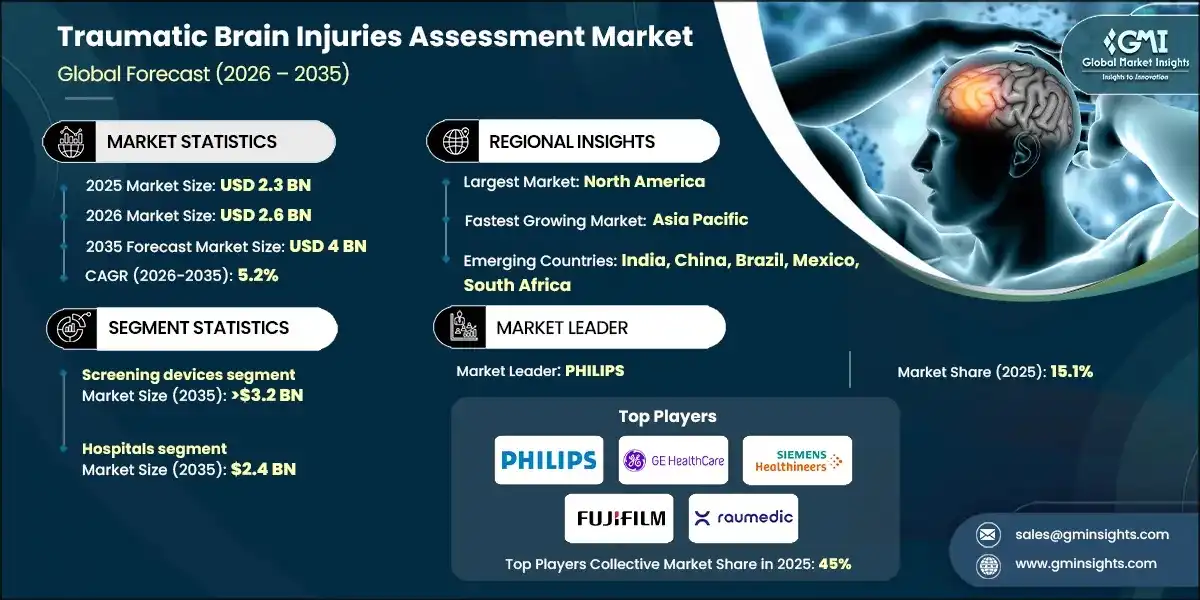
The global traumatic brain injuries assessment market size was valued at USD 2.3 billion in 2025. The market is expected to reach from USD 2.6 billion in 2026 to USD 4 billion in 2035, growing at a CAGR of 5.2% during the forecast period, according to the latest report published by Global Market Insights Inc. The high market growth is attributed to the rising incidence of road traffic accidents, growing sports-related and military-associated TBIs, and advancements in neuroimaging and diagnostic technologies, among other contributing factors.
To get key market trends
Traumatic brain injuries (TBI) assessment is the detailed clinical, neurological, and diagnostic evaluation that establishes the occurrence, intensity, and the functional changes of brain injury after a physical blow to the head. It comprises neurological examinations, cognitive and behavioural assessments, imaging methods, and biomarker analysis to deliver prompt diagnosis, treatment planning, and prognosis.
The leading companies in the global traumatic brain injuries assessment market are PHILIPS, GE Healthcare, SIEMENS Healthineers, FUJIFILM, and RAUMEDIC. These companies maintain their competitive position through continuous product innovation, global market presence, and substantial investment in research and development.
The market has increased from USD 1.8 billion in 2022 and reached USD 2.1 billion in 2024, with the historic growth rate of 6.1%. The market growth was largely attributable to various factors such as the increasing number of road traffic accidents and sports-related injuries, the higher awareness and diagnosis of mild and moderate TBIs, the technological advancements in neuroimaging and point of care testing tools, and the widespread implementation of the standardized concussion assessment protocols in the departments of emergency and sports medicine.
Moreover, as urbanization intensifies and vehicle density rises, the prevalence of traumatic brain injuries (TBIs) has surged, largely due to a spike in road traffic accidents, workplace injuries, and fall-related incidents, particularly among the elderly. For instance, according to the World Health Organization (WHO), road traffic accidents accounted for approximately 1.2 million deaths globally in 2023, with a significant portion involving TBIs.
Additionally, the Centers for Disease Control and Prevention (CDC) reported that in 2022, falls were the leading cause of TBIs among older adults in the U.S., contributing to over 800,000 hospitalizations annually. This uptick underscores the growing demand for swift and precise assessment tools in emergency and trauma care.
Furthermore, technological progress in CT, MRI, EEG, and advanced biomarker-based diagnostics has improved the accuracy and speed of TBI assessment. These innovations enable earlier detection of mild and moderate TBIs that were previously underdiagnosed. Enhanced diagnostic confidence supports broader clinical adoption.
Traumatic Brain Injuries Assessment Market Report Attributes
| Key Takeaway | Details |
|---|---|
| Market Size & Growth | |
| Base Year | 2025 |
| Market Size in 2025 | USD 2.3 Billion |
| Market Size in 2026 | USD 2.6 Billion |
| Forecast Period 2026-2035 CAGR | 5.2% |
| Market Size in 2035 | USD 4 Billion |
| Key Market Trends | |
| Drivers | Impact |
| Growing incidence of traumatic brain injuries | The increasing number of road accidents, falls, sports injuries, and violence-related trauma is directly expanding the demand for timely and accurate TBI assessment across emergency and acute care settings. |
| Technological advancements in traumatic brain injuries assessment | Innovations such as advanced neuroimaging, portable diagnostic tools, and AI-assisted assessment platforms are improving diagnostic accuracy and speeding clinical decision-making, supporting wider adoption. |
| Increasing demand for non-invasive devices for TBI assessment | Clinicians are increasingly preferring non-invasive, rapid, and patient-friendly diagnostic solutions, which is accelerating uptake of wearable sensors, imaging alternatives, and biomarker-based tools. |
| Rising awareness regarding traumatic brain injury | Greater awareness among healthcare providers, athletes, and the general population is leading to earlier diagnosis and higher screening rates, positively influencing market growth. |
| Pitfalls & Challenges | Impact |
| Dearth of skilled professionals | Limited availability of trained neurologists and neuroradiologists restricts optimal utilization of advanced assessment technologies, particularly in developing and rural healthcare settings. |
| High cost of assessment devices | The high capital and maintenance costs of advanced imaging and diagnostic systems limit adoption among smaller hospitals and clinics, constraining market penetration in cost-sensitive regions. |
| Opportunities: | Impact |
| Development of portable and point-of-care assessment tools | Advancements in compact, rapid, and point-of-care TBI assessment technologies are expected to enable faster diagnosis in emergency, sports, military, and remote settings, significantly expanding market reach and adoption. |
| Emerging markets with untapped demand | Improving healthcare infrastructure, rising trauma incidence, and increasing awareness in emerging economies are likely to create substantial new demand for affordable TBI assessment solutions, driving long-term market growth. |
| Market Leaders (2025) | |
| Market Leaders |
15.1% |
| Top Players |
|
| Competitive Edge |
|
| Regional Insights | |
| Largest Market | North America |
| Fastest Growing Market | Asia Pacific |
| Emerging Country | India, China, Brazil, Mexico, South Africa |
| Future Outlook |
|
What are the growth opportunities in this market?
Traumatic Brain Injuries Assessment Market Trends
The market is growing considerably with the growing adoption of objective diagnostic tools, rising use of blood-based biomarkers for rapid screening, and integration of AI and advanced analytics in neuroimaging, among other factors collectively driving industry growth.
- There is a clear shift from symptom-based evaluations toward objective assessment tools such as imaging analytics, EEG, and biomarker tests. These technologies improve diagnostic accuracy and reduce variability in clinical decision-making. Objective tools are increasingly preferred in emergency and sports medicine settings.
- Healthcare providers are placing greater emphasis on identifying mild TBIs that often go undiagnosed. This trend is driven by awareness of long-term neurological impacts and rising sports-related injuries. It is fuelling demand for sensitive and portable assessment solutions.
- Moreover, clinicians are increasingly combining imaging, biomarkers, cognitive testing, and clinical scores for comprehensive TBI assessment. This multimodal approach improves diagnostic accuracy and patient stratification. It is becoming standard practice in complex trauma cases, thereby sustaining market growth.
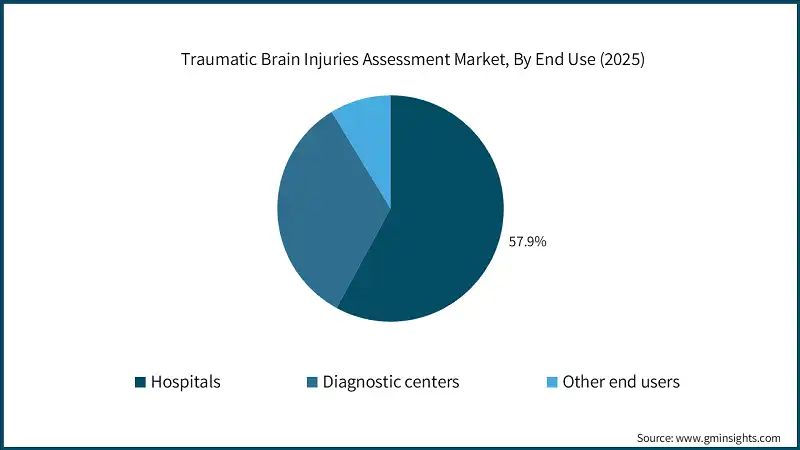
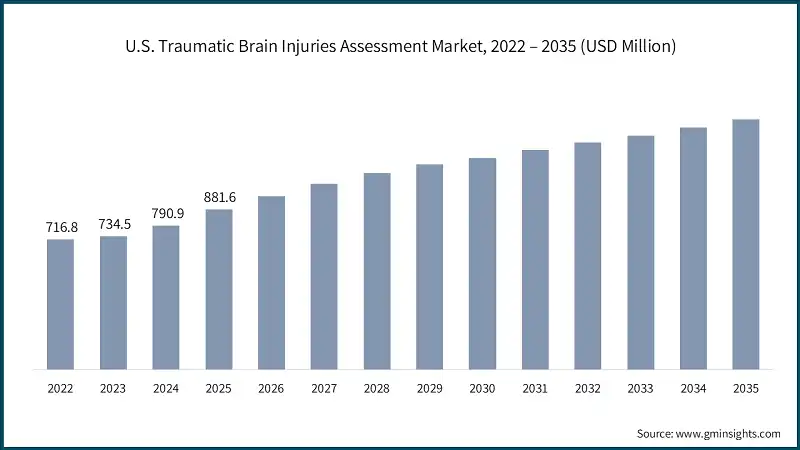
Traumatic Brain Injuries Assessment Market Analysis The global market was valued at USD 1.8 billion in 2022. The market size reached USD 2.1 billion in 2024, from USD 1.9 billion in 2023. Based on the product, the market is segmented into screening devices and monitoring devices. The screening devices segment has asserted its dominance in the market by securing a significant market share of 80.1% in 2025 owing to their rapid assessment capability, non-invasive nature, cost-effectiveness, and widespread adoption in emergency, sports, and pre-hospital settings for early detection and triage of traumatic brain injuries. The segment is expected to exceed USD 3.2 billion by 2035, growing at a CAGR of 5% during the forecast period. On the other hand, the monitoring devices segment is expected to grow with a CAGR of 6.1%. The growth of this segment is driven by the increasing need for continuous neurological monitoring in critical care settings, rising adoption of advanced intracranial pressure and brain function monitoring technologies, and growing focus on early detection of secondary brain injuries to improve patient outcomes. Based on end use, the traumatic brain injuries assessment market is classified into hospitals, diagnostic centers, and other end users. The hospitals segment dominated the market with a revenue share of 57.9% in 2025 and is expected to reach USD 2.4 billion within the forecast period. North America Traumatic Brain Injuries Assessment Market North America dominated the global market with the highest market share of 40.1% in 2025. Europe Traumatic Brain Injuries Assessment Market Europe market accounted for USD 664.1 million in 2025 and is anticipated to show lucrative growth over the forecast period. Asia Pacific Traumatic Brain Injuries Assessment Market The Asia Pacific market is anticipated to grow at the highest CAGR of 6.7% during the analysis timeframe. Latin America Traumatic Brain Injuries Assessment Market The Latin America market is experiencing robust growth over the analysis timeframe. Middle East & Africa Traumatic Brain Injuries Assessment Market The Middle East & Africa (MEA) market is experiencing robust growth over the analysis timeframe. The global market is characterized by the presence of a mix of global medical device giants, specialized diagnostic solution providers, and emerging players focusing on innovative technologies. Companies are increasingly emphasizing research and development to introduce advanced screening devices, AI-powered neuroimaging tools, and portable point-of-care solutions to enhance diagnostic accuracy and speed. Key players include PHILIPS, GE Healthcare, SIEMENS Healthineers, FUJIFILM, and RAUMEDIC, collectively accounting for 45% of the total market share. Strategic collaborations, mergers, and acquisitions are common as companies aim to strengthen their product portfolios and expand geographic reach. The market is also witnessing differentiation through product innovation, regulatory approvals, and tailored solutions for hospitals, sports medicine, military, and emergency care settings. Regional players in Europe, Asia Pacific, and MEA are gaining traction by offering cost-effective and portable TBI assessment solutions to meet local healthcare demands. Companies are increasingly investing in digital platforms, AI integration, and biomarker-based technologies to maintain a competitive edge and address the growing need for rapid, accurate, and standardized TBI assessment globally. A few of the prominent players operating in the traumatic brain injuries assessment industry include: Philips offers integrated neuroimaging platforms paired with AI-driven analytics that enhance detection accuracy and streamline clinical workflows for TBI assessment. Its strong global service network and interoperability with healthcare IT systems improve adoption across acute and emergency care settings. GE Healthcare delivers high-resolution CT and MRI solutions with advanced software for precise visualization of brain injuries, supporting faster and more reliable diagnosis. Its robust digital health ecosystem and clinician training programs help deepen market penetration in hospitals and trauma centres. Siemens Healthineers provides cutting-edge imaging modalities with real-time quantitative analysis and sophisticated neuro assessment tools that improve early TBI detection and monitoring. The company’s focus on innovation, such as AI-assisted diagnostics and comprehensive care pathways, strengthens its competitive position globally.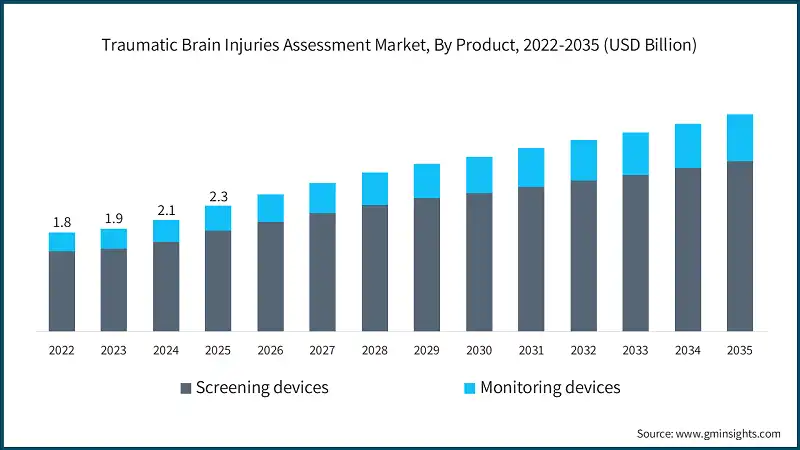 Learn more about the key segments shaping this market
 Learn more about the key segments shaping this market
 Looking for region specific data?
Traumatic Brain Injuries Assessment Market Share
Traumatic Brain Injuries Assessment Market Companies
Traumatic Brain Injuries Assessment Industry News:
The traumatic brain injuries assessment market research report includes an in-depth coverage of the industry with estimates and forecast in terms of revenue in USD Million from 2022 – 2035 for the following segments:
Market, By Product
- Screening devices
- Computerized tomography (CT) scan
- Magnetic resonance imaging (MRI)
- Other screening devices
- Monitoring devices
- Intracranial pressure (ICP) monitoring
- Partial pressure of oxygen in brain tissue (pBrO2)
Market, By End Use
- Hospitals
- Diagnostic centers
- Other end use
The above information is provided for the following regions and countries:
- North America
- U.S.
- Canada
- Europe
- Germany
- UK
- France
- Spain
- Italy
- Netherlands
- Asia Pacific
- China
- Japan
- India
- Australia
- South Korea
- Latin America
- Brazil
- Mexico
- Argentina
- Middle East and Africa
- South Africa
- Saudi Arabia
- UAE
Frequently Asked Question(FAQ) :
How much revenue did the monitoring devices segment generate in 2025?
The monitoring devices segment generated USD 465.1 million in revenue in 2025, driven by increasing need for continuous neurological monitoring in intensive care.
Which end-use segment leads the traumatic brain injuries assessment industry?
Hospitals led the market with a 57.9% share in 2025, supported by high patient inflow from accidents, falls, and trauma cases requiring immediate neurological evaluation.
Which region leads the traumatic brain injuries assessment market?
North America dominated the market with a 40.1% share in 2025, driven by advanced trauma care infrastructure, high adoption of imaging technologies, and strong regulatory and reimbursement frameworks.
Who are the key players in the traumatic brain injuries assessment market?
Major players include PHILIPS, GE Healthcare, SIEMENS Healthineers, FUJIFILM, RAUMEDIC, BrainScope, bioMérieux, InfraScan, Natus Medical, NIHON KOHDEN, and ZOLL Medical.
What will be the market value of the traumatic brain injuries assessment industry in 2026?
The market is projected to reach USD 2.6 billion in 2026, reflecting steady growth driven by rising emergency care demand.
Which product segment generated the highest revenue in 2025?
The screening devices segment dominated the market with an 80.1% share in 2025, owing to rapid assessment capability.
What is the market size of the traumatic brain injuries assessment market in 2025?
The global market for traumatic brain injuries assessment was valued at USD 2.3 billion in 2025, driven by the rising incidence of road traffic accidents.
What is the projected value of the traumatic brain injuries assessment market by 2035?
The market is expected to reach USD 4 billion by 2035, growing at a CAGR of 5.2% from 2026 to 2035, supported by advancements in neuroimaging.
Traumatic Brain Injuries Assessment Market Scope
Related Reports