Summary
Table of Content

Telehealth Market
Get a free sample of this report
Form submitted successfully!
Error submitting form. Please try again.
Thank you!
Your inquiry has been received. Our team will reach out to you with the required details via email. To ensure that you don't miss their response, kindly remember to check your spam folder as well!
Request Sectional Data
Thank you!
Your inquiry has been received. Our team will reach out to you with the required details via email. To ensure that you don't miss their response, kindly remember to check your spam folder as well!
Form submitted successfully!
Error submitting form. Please try again.
Telehealth Market Size
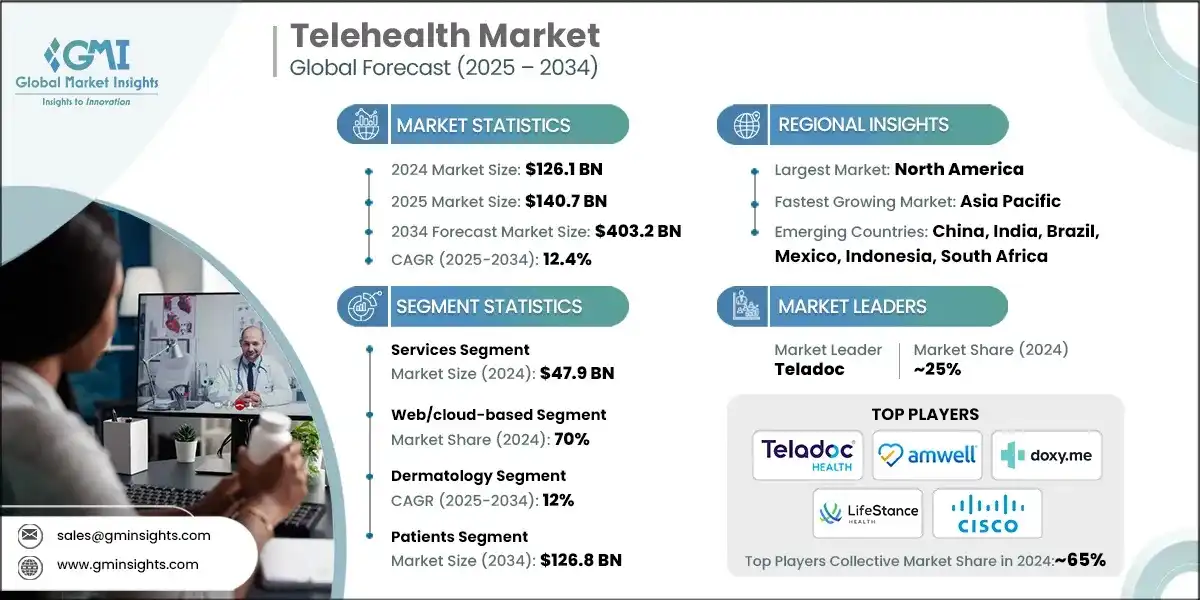
The global telehealth market size was valued at USD 126.1 billion in 2024. The market is anticipated to grow from USD 140.7 billion in 2025 to USD 403.2 billion in 2034, growing at a CAGR of 12.4% during the forecast period, according to the latest report published by Global Market Insights Inc. The market trajectory growth is primarily driven by the increasing demand for remote healthcare solutions, particularly in developed or urban areas. As patients increasingly seek convenient access to virtual care, telehealth adoption continues to rise. Additionally, innovation in mobile health (mHealth) applications and wearable technologies facilitates remote monitoring and patient engagement are accelerating the market growth.
Telehealth Market Key Takeaways
Market Size & Growth
- 2024 Market Size: USD 126.1 Billion
- 2025 Market Size: USD 140.7 Billion
- 2034 Forecast Market Size: USD 403.2 Billion
- CAGR (2025–2034): 12.4%
Key Market Drivers
- Rising prevalence of chronic disease and geriatric population drives demand for remote healthcare.
- Growing advancement in digital health technology.
- Rising adoption of wearable and connected devices.
- Government initiatives and reimbursement policies.
Challenges
- Data privacy and security concerns.
- Limited internet connectivity in rural areas.
Opportunity
- Expanding digital health access in emerging markets.
- Penetration of hybrid healthcare models.
Key Players
- Market Leader: Teladoc led with over 25% market share in 2024.
- Leading Players: Top 5 players in this market include Teladoc, Amwell, Doxy.me, LifeStance Health, Cisco Systems, which collectively held a market share of 65% in 2024.
Get Market Insights & Growth Opportunities
The rising burden of chronic diseases urges the need for continuous monitoring and virtual consultations. For instance, according to a study published in NCBI, during the COVID-19 pandemic, the virtual healthcare practices significantly expanded the telehealth services, particularly during lockdown and recurrent surge periods of the viral infection. This has significantly boosted the telehealth demand in the industry.
For instance, FAIRHealth, a non-profit organization that maintains large databases of private healthcare and Medicare claims, reported a significant rise in telehealth claims that grew from 0.1% to approximately 5% from 2019 to 2021. This spike highlighted the intensified use of telehealth solutions, reflecting its continued rise in the coming years. Moreover, the inclination for virtual consultations in the post-pandemic period, coupled with the integration of telemedicine into healthcare systems, coupled with the growing internet penetration, are expected to further accelerate the adoption of telehealth worldwide.
Telehealth refers to the delivery of healthcare solutions and services through telecommunication technologies, enabling remote consultation, remote monitoring, and patient engagement. The market encompasses various components like hardware, software, and solutions. The key players in the industry include Teladoc, Amwell, Doxy.me, LifeStance Health, and Cisco Systems. These companies compete through technology innovations, service integration, and regulatory compliance. Further, strategic partnerships, AI integration, and scalability are key discriminators as companies strive to expand their reach and enhance the virtual care experience across the diverse healthcare system.
Further, growing government initiatives and favorable policies, coupled with the supportive reimbursement coverage, are major factors fueling the market growth. For instance, FAIRHealth supports large databases of private and Medicare claims, noting that telehealth claims grew from 0.1% in 2019 to approximately 5% by the close of 2021. This spike highlighted the intensified use of telehealth, which is expected to continue to rise in the coming years.
To get key market trends
Telehealth Market Trends
- The telehealth industry is experiencing a significant revolution driven by several key trends such as the integration of artificial intelligence (AI) and machine learning (ML) that enhance diagnostics and enable personalized virtual care.
- As AI mechanisms enable telehealth systems to examine symptoms and identify disease risk factors with supported jobs burnout, they reinforce potential opportunities in the market.
- For instance, according to MIT Research, 75% of healthcare facilities are using AI, citing that it improved their disease treatment capacity. Additionally, virtual assistance conducts preliminary assessments, streamlines the workflow, and decreases healthcare personnel's burdens.
- ML models analyze patient data such as blood sugar levels and respiratory patterns to identify early signs of health issues. These tools serve as clinical decision-support systems rather than substitutes for physicians. For instance, the L.A. County Department of Health Services observed a reduction in patient visits by approximately 14,000 visits through AI in screening processes. These findings highlighted that the AI tool is expected to reduce the operational burden and expand access to healthcare quality improving the care delivery process.
- Thus, ML combined with telehealth recognized an advanced healthcare efficiency benchmark through which it delivers speed, scalability, and personalized care that traditional systems struggle to attain.
- The market growth is further driven by improved penetration of the internet and 5G infrastructure, enabling high-quality video, audio, and seamless data sharing, crucial for virtual consultations. This enhances the experience for both patients and providers by minimizing technical disruptions.
- Additionally, telepsychiatry services are rapidly expanding, especially among tech-savvy youth and working individuals who prefer flexible, private sessions. These platforms also offer 24/7 support personalized to conditions like anxiety and trauma.
- As convenience becomes a foremost priority, telehealth is likely to meet the end users expectations by offering a responsive experience, further fueling market growth.
Telehealth Market Analysis
Learn more about the key segments shaping this market
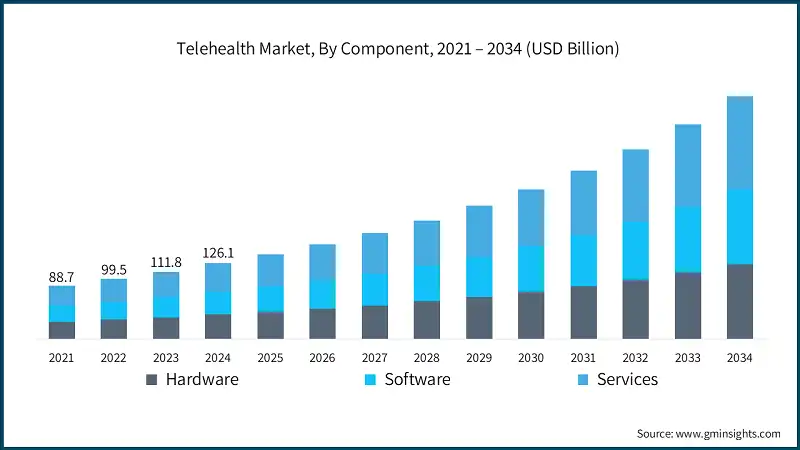
The global market was valued at USD 88.7 billion in 2021. The market size reached USD 111.8 billion in 2023, from USD 99.5 billion in 2022.
Based on component, the telehealth industry is segmented into hardware, software, and services. The services segment accounted for the largest revenue of USD 47.9 billion in 2024 and is expected to continue this trend throughout the forecast period. The services segment is further classified into remote patient monitoring, real-time interactions, store and forward, video/ audio consultations, and other service types.
- The increasing demand for virtual consultation, remote patient monitoring, and real-time interaction, particularly in rural and developing areas, drives the demand for remote healthcare services, strengthening segment prominence.
- These services offer convenience, cost-effectiveness, and scalability, making them vital for healthcare providers and patients.
- As telehealth becomes more integrated into routine care, the services segment remains the primary driver of market revenue and growth.
- On the other hand, the software segment is poised for significant growth at a CAGR of 12.7% due to rising demand for integrated platforms, enhanced data analytics, and scalable virtual care solutions that improve clinical efficiency and patient engagement.
Learn more about the key segments shaping this market
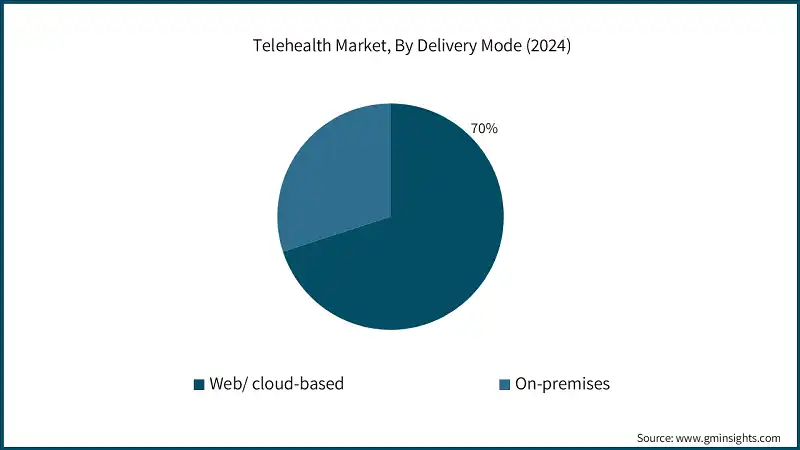
Based on the delivery mode, the global telehealth market is categorized into web/cloud-based and on-premises. The web/cloud-based segment dominated the market with a 70% market share in 2024 due to its scalability, cost-effectiveness, and ease of deployment.
- The web/ cloud-based platforms allow healthcare providers to deliver virtual care without a multifaceted infrastructure, making them ideal for rapid adoption across diverse regions.
- Cloud-based solutions support real-time data sharing, remote monitoring, and integration with electronic health records (EHRs), enhancing care coordination and patient outcomes. Their flexibility enables updates and feature enhancements without disrupting service, making them a preferred choice over on-premises.
- Additionally, web/cloud-based platforms offer robust security and compliance features, which are critical for handling sensitive health data, reinforcing its fundamental to innovation and accessibility.
- On the other hand, the on-premises segment is projected to grow at a CAGR of 12.2% due to growing demand for secure, personalized telehealth solutions that comply with stringent data privacy regulations, specifically among large healthcare institutions and government facilities.
By specialty, the telehealth market is segmented into dermatology, mental health, cardiology, neurology, orthopedics, gynecology, and other specialties. The dermatology segment dominated the market in 2024 and is expected to continue this trend throughout the forecast period with a CAGR of 12%.
- Dermatology segment growth is driven by the growing incidence of skin conditions like acne, eczema, and psoriasis, coupled with its suitability for remote consultation and driven by the rising demand for skin care.
- Dermatology telehealth platforms allow patients to share images and receive a diagnosis without in-person visits, making care more accessible and efficient.
- Additionally, expanding integration of teledermatology across healthcare settings, fueled by growing advancements including AI-powered diagnostics and mhealth apps, has further enhanced service delivery.
- For instance, in May 2025, MedX Health entered into a strategic partnership with Vitamed Biomedical and Medispa to expand its teledermatology platform across Italy. This collaboration aimed to expand the deployment of MedX’s SIAscope on the DermaSecure system throughout Medispa’s network of pharmacies, wellness centers, and medical facilities. This strategic expansion highlighted teledermatology growing role in accessible, decentralized care, reinforcing telehealth’s momentum in specialized services, and contributing to global market growth.
- Moreover, increasing internet penetration and smartphone usage, particularly in underserved regions, dermatology telehealth is expected to continue its strong growth trajectory globally.
- On the other hand, the mental health segment is poised to grow at a significant rate at a CAGR of 13.3% due to rising mental health awareness, increased demand for accessible therapy, and the convenience of virtual consultations, exclusively among younger, tech-savvy populations.
Based on the end use, the global telehealth market is classified into healthcare providers, patients, and payers. In 2024, the patients segment held the highest market share and is expected to showcase significant growth over the analysis period to reach USD 126.8 billion by 2034.
- The rising demand for accessible, convenient, and affordable healthcare services strengthens the prominence of the patient segment in the market
- With increasing smartphone penetration, digital health awareness, and awareness of virtual care options, patients are actively engaging with telehealth platforms for consultations, prescriptions, and chronic disease management.
- The flexibility to receive convenient healthcare services at home has significantly boosted adoption.
- Additionally, the integration of user-friendly apps, wearable devices, and personalized health tracking tools has empowered patients to manage their health actively, making them the most influential stakeholders in the market.
- On the other hand, the payers segment is poised to grow at a significant rate of 13% as insurers increasingly adopt virtual care models to reduce costs, improve access, and enhance patient outcomes through value-based care strategies.
Looking for region specific data?
North America dominated the global telehealth market with the highest market share of 48% in 2024.
- North America's prominence was driven due to its advanced healthcare infrastructure, extensive internet penetration, and wide acceptance of remote healthcare technologies.
- Supportive government policies, an upsurge in digital health investment, and the presence of major telehealth companies further fuel the growth.
- Additionally, rising chronic disease prevalence and demand for remote patient monitoring contributed to market expansion.
- Thus, the region’s strong regulatory framework and emphasis on healthcare innovation positioned it as a leader in telehealth services, making it the largest contributor to global market share.
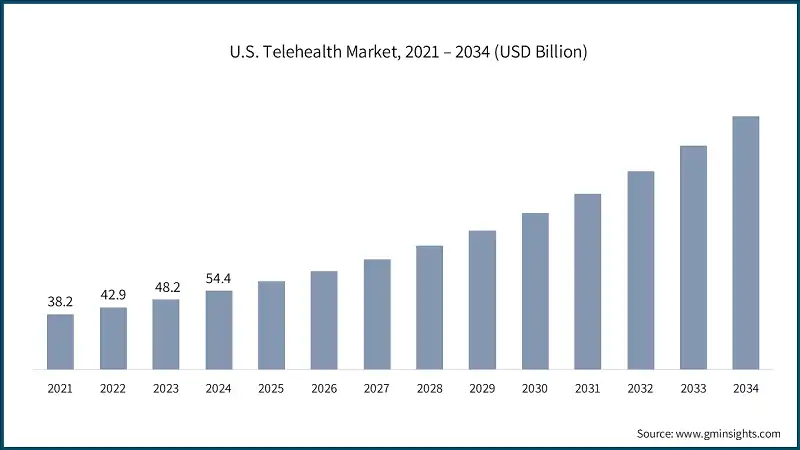
In 2024, the U.S. telehealth market accounted for USD 54.4 billion in revenue from USD 48.2 billion in 2023 and is anticipated to grow at a CAGR of 12.4% between 2025 and 2034.
- The U.S. holds a prominent position owing to its robust healthcare infrastructure, high healthcare spending, and proactive regulatory support.
- The U.S. virtual care industry saw rapid expansion during the COVID-19 pandemic, driven by relaxed telehealth regulations and expanded reimbursement policies. These changes accelerated adoption and reshaped healthcare delivery across the country.
- Major players in the telehealth industry are headquartered in the U.S., contributing to innovation and market growth.
- These factors positioned the U.S. as the dominant force driving North America's telehealth landscape.
The Europe telehealth market accounted for USD 36 billion in 2024 and is anticipated to show lucrative growth over the forecast period.
- The European market is growing gradually due to the surging demand for cost-effective care, an aging population, and reforming healthcare systems.
- Government initiatives and increased funding in digital health are accelerating telehealth adoption. Services like teleconsultation, remote monitoring, and e-prescriptions are becoming routine, improving care accessibility and efficiency across healthcare systems.
- Additionally, EU initiatives like the European Health Data Space support cross-border digital health and innovation, further stimulating its accessibility.
- Countries such as Germany, France, and the UK are advancing national telehealth policies backed by favorable legislation and reimbursement models.
- Further, rising investments in AI, wearables, and platform integration are positioning Europe as a global telehealth leader.
Germany is poised to achieve significant growth in the European telehealth market.
- The market growth is driven by strong government support, including the Digital Healthcare Act and related reforms, which have expanded digital infrastructure and reimbursement for telehealth services.
- Additionally, a growing aging population and increasing demand for remote care are accelerating adoption across the country.
- Further, growing investments in AI wearable tech and cloud-based platforms are transforming service delivery.
- With robust public-private partnerships and innovation in mental health and chronic care, Germany is emerging as a telehealth leader in Europe.
The Asia Pacific telehealth market is anticipated to witness significant growth over the analysis timeframe.
- The Asia-Pacific region is witnessing exponential growth driven by rising healthcare costs, a growing elderly population, and increasing prevalence of chronic disease.
- Countries like China, India, Japan, and Australia are leading the adoption, supported by favorable policies and expanding internet penetration.
- Further, growing government investment in digital health infrastructure and remote patient monitoring, while mHealth apps and cloud-based platforms are gaining traction in the market.
China is anticipated to grow significantly within the Asia Pacific telehealth market.
- The expansion is fueled by government support, including the ‘Internet Plus Healthcare’ initiative, and the rapid rise of internet hospitals has fueled the country’s growth.
- China’s telehealth ecosystem is uniquely shaped by public-private partnerships where doctors from public hospitals offer services via private platforms.
- Further, increasing smartphone penetration, AI integration, and digital infrastructure investments are further accelerating adoption, positioning China as region regional healthcare sector.
Brazil is projected to witness significant growth in the Latin America telehealth industry in the coming years.
- Brazil’s growth is driven by widespread smartphone and internet adoption, government-led digital health initiatives and increasing demand for accessible health services.
- For example, the enactment of Law No. 14,510/2022 has provided a solid legal foundation for telehealth services, encouraging innovation and investment.
- Brazil’s focus on digital health transformation, including AI integration and remote care platforms, is accelerating adoption across both urban and rural areas.
- These factors position Brazil as a key player in shaping the future of telehealth in the Latin American region.
Saudi Arabia is anticipated to grow in the Middle East and African telehealth market.
- Saudi Arabia is poised for significant growth driven by its ambitious Vision 2030 initiative, which prioritizes healthcare digitization.
- The country is investing heavily in digital infrastructure, mHealth platforms, and AI-powered solutions to expand access and improve care delivery.
- For example, the Saudi Telehealth Network (STN) and regulatory frameworks established by the National Health Information Center (NHIC) ensure quality, safety, and compliance across telehealth services.
- With a tech-savvy population, high smartphone penetration, and growing demand for remote care, Saudi Arabia is emerging as a regional leader in telehealth innovation.
Telehealth Market Share
Telehealth presents a dynamic and competitive landscape driven by innovation, strategic partnerships, and expanding consumer demand. Leading players like Teladoc, Amwell, Doxy.me, LifeStance Health and Cisco Systems collectively account for a significant portion of the market share, estimated at around ~65%. These companies provide differentiated offerings across general medicine, behavioral health, and chronic care management. These companies leverage scalable platforms, AI-integration, and a hybrid care model to enhance patient engagement and provide efficiency.
Furthermore, emerging companies such as Sesame, Omnia TeleHealth, and Apollo Telehealth are gaining traction by targeting niche segments and underserved regions. Additionally, tech giants like Cisco Systems and Philips contribute through infrastructure and device integration. The market is also shaped by increasing adoption in tier 2 and tier 3 cities, regulatory support, and growing demand for mental health services. Thus, overall competition is intensifying with innovation and accessibility being key differentiated in sustaining market leadership.
Telehealth Market Companies
A few of the prominent players operating in the telehealth industry include:
- Access TeleCare
- AMD
- Amwell
- Apollo TeleHealth
- Athenahealth
- Capsa Healthcare
- Cisco Systems
- Doxy.me
- Doximity
- Eagle Telemedicine
- Health Catalyst
- Henry Schein
- Koninklijke Philips
- LifeStance Health
- McKesson Medical-Surgical
- Medtronic
- Omnia TeleHealth
- Sesame
- Siemens
- Teladoc Health
- Tellihealth
- Veradigm (Allscripts)
Teladoc Health offers whole-person virtual care solutions through primary, mental, and chronic health services. Its global reach, strategic acquisitions like Livongo, and dual B2B/D2C model enable scalable, personalized care. In addition, strategic partnerships with Walmart and Apple further enhance their accessibility and brand strength
Amwell provides a HIPAA-compliant, SaaS-based telehealth platform that integrates seamlessly with existing healthcare systems. It supports urgent care, behavioral health, and chronic disease management, enabling branded experiences for hospitals, insurers, and employers. Its flexible, scalable model empowers hybrid healthcare delivery.
Doxy.me is a browser-based telemedicine platform requiring no downloads or setup. It offers free and premium versions, supports over 240 languages, and is widely used by independent providers and nonprofits. Its simplicity, security, and global accessibility make it ideal for small practices.
LifeStance Health specializes in mental health services through a hybrid model of in-person and virtual care. With over 7,500 clinicians across 33 states, it offers personalized therapy and psychiatry. Its insurance-friendly approach and broad service range make it a leader in behavioral healthcare.
Telehealth Market Report Attributes
| Key Takeaway | Details |
|---|---|
| Market Size & Growth | |
| Base Year | 2024 |
| Market Size in 2024 | USD 126.1 Billion |
| Market Size in 2025 | USD 140.7 Billion |
| Forecast Period 2025 - 2034 CAGR | 12.4% |
| Market Size in 2034 | USD 403.2 Billion |
| Key Market Trends | |
| Drivers | Impact |
| Rising prevalence of chronic disease and geriatric population drives demand for remote healthcare | As chronic diseases and the aging population increase globally, theres a growing need for continuous, accessible healthcare solutions, which telehealth efficiently delivers through remote consultations and monitoring. |
| Growing advancement in digital health technology | Innovations in AI, cloud computing, and mobile platforms are enhancing the quality, speed, and reach of telehealth services, making them more reliable and scalable for providers and patients. |
| Rising adoption of wearable and connected devices | Wearables like fitness trackers and smartwatches enable real-time health monitoring, allowing telehealth platforms to offer proactive care and better chronic disease management. |
| Government initiatives and reimbursement policies | Supportive policies, funding, and insurance coverage for virtual care are encouraging healthcare systems to integrate telehealth into mainstream services, accelerating market growth. |
| Pitfalls & Challenges | Impact |
| Data privacy and security concerns | Handling sensitive patient data over digital platforms raises concerns about breaches and misuse, making cybersecurity and compliance with privacy laws a critical challenge. |
| Limited internet connectivity in rural areas | Inadequate broadband infrastructure in remote regions restricts access to telehealth services, limiting their reach and effectiveness in underserved populations. |
| Opportunities: | Impact |
| Expanding digital health access in emerging markets | Rapid digital transformation and increasing smartphone penetration in developing countries would present a significant opportunity to scale telehealth and improve healthcare access. |
| Penetration of hybrid healthcare models | Combining in-person and virtual care offers flexibility and efficiency, particularly for follow-ups, mental health, and chronic care, creating new service delivery models. |
| Market Leaders (2024) | |
| Market Leaders |
~25% market share |
| Top Players |
Collective market share in 2024 is ~65% |
| Competitive Edge |
|
| Regional Insights | |
| Largest Market | North America |
| Fastest Growing Market | Asia Pacific |
| Emerging Country | China, India, Brazil, Mexico, Indonesia, South Africa |
| Future Outlook |
|
What are the growth opportunities in this market?
Telehealth Industry News
- In July 2025, Ayush Wellness launched Aayush Health, a digital platform offering remote doctor consultations and digital health records, aiming to improve healthcare access to India’s Tier 2 and Tier 3 cities. This launch highlights telehealth’s expanding reach into developing countries, reinforcing its role in bridging healthcare gaps and driving inclusive growth across the Indian market.
- In May 2025, Wisp unveiled 360-degree telehealth capabilities by introducing a diagnostic vertical Wisp At-home Testing and Follow-up Care service. This service provides patients with convenient at-home test kits for assessing various health conditions, enabling them to collect samples and receive results without visiting the clinic. This expansion into diagnostics strengthens telehealth’s role in personalized and accessible healthcare, highlighting continued innovation and growth potential in the women’s health sector.
- In November 2024, MedAdvisor introduced a new telehealth feature to its existing MedAdvisor app, enabling patients to schedule a virtual consultation with providers and eScripts following the consultation. This seamless feature introduction reflects the increasing integration of telehealth in pharmacy services, reinforcing its role in streamlining patient care.
- In August 2024, Pfizer introduced the PfizerforAll platform, a user-friendly digital platform. This direct-to-consumer service enables patients to schedule telehealth services, fill prescriptions, and access savings programs for the company’s migraine, COVID-19, and flu medications. This initiative reflects the growing trend towards integration of telehealth into patient care.
- In January 2024, Eli Lilly revealed LillyDirect, a digital platform facilitating access to medications by connecting patients with an independent telehealth provider and other disease management resources. This move highlights the growing pharmaceutical industry’s emphasis on telehealth, reinforcing the sector’s expansion and its potential to transform patient access and engagement in the digital health ecosystem.
The telehealth market research report includes in-depth coverage of the industry with estimates and forecast in terms of revenue in USD Million from 2021 - 2034 for the following segments:
Market, By Component
- Hardware
- Software
- Services
- Remote patient monitoring
- Real-time interactions
- Store and forward
- Video/ audio consultations
- Other service types
Market, By Delivery Mode
- Web/ cloud-based
- On-premises
Market, By Specialty
- Dermatology
- Mental health
- Cardiology
- Neurology
- Orthopedics
- Gynecology
- Other specialties
Market, By End Use
- Healthcare providers
- Hospitals and clinics
- Long-term care centers
- Other healthcare providers
- Payers
- Patients
The above information is provided for the following regions and countries:
- North America
- U.S.
- Canada
- Europe
- Germany
- UK
- France
- Spain
- Italy
- Netherlands
- Asia Pacific
- China
- Japan
- India
- Australia
- South Korea
- Latin America
- Brazil
- Mexico
- Argentina
- Middle East and Africa
- Saudi Arabia
- South Africa
- UAE
Frequently Asked Question(FAQ) :
What is the market size of the telehealth in 2024?
The market size was USD 126.1 billion in 2024, supported by rising demand for remote healthcare solutions and chronic disease management.
What is the telehealth market size in 2025?
The global market is projected to reach USD 140.7 billion in 2025, reflecting continued adoption of virtual care platforms and government-backed digital health initiatives.
What is the projected value of the telehealth market by 2034?
The market is expected to reach USD 403.2 billion by 2034, growing at a CAGR of 12.4% driven by AI integration, wearable adoption, and supportive reimbursement policies.
What was the revenue of the services segment in 2024?
The services segment generated USD 47.9 billion in 2024, making it the largest revenue contributor due to demand for virtual consultation and remote patient monitoring.
What was the market share of web/cloud-based delivery in 2024?
The web/cloud-based segment dominated with 70% market share in 2024, driven by scalability, cost efficiency, and integration with EHR systems.
What is the growth outlook for the software segment from 2025 to 2034?
The software segment is projected to grow at a CAGR of 12.7% through 2034, fueled by rising adoption of integrated platforms, AI analytics, and scalable telehealth solutions.
Which region leads the telehealth market?
North America held 48% share with USD 60.5 billion in 2024, led by advanced healthcare infrastructure, widespread internet penetration, and presence of major telehealth providers.
Who are the key players in the telehealth market?
Key players include Teladoc Health, Amwell, Doxy.me, LifeStance Health, Cisco Systems, Philips, Omnia TeleHealth, Apollo TeleHealth, Athenahealth, and Siemens.
Telehealth Market Scope
Related Reports