Summary
Table of Content

Spirulina Powder Market
Get a free sample of this report
Form submitted successfully!
Error submitting form. Please try again.
Thank you!
Your inquiry has been received. Our team will reach out to you with the required details via email. To ensure that you don't miss their response, kindly remember to check your spam folder as well!
Request Sectional Data
Thank you!
Your inquiry has been received. Our team will reach out to you with the required details via email. To ensure that you don't miss their response, kindly remember to check your spam folder as well!
Form submitted successfully!
Error submitting form. Please try again.
Spirulina Powder Market Size
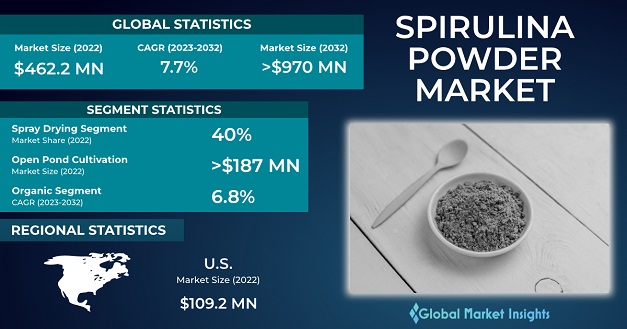
Spirulina Powder Market size was valued at USD 462.2 million in 2022 and is estimated to expand at a CAGR of 7.7% between 2023 and 2032. Spirulina powder is a highly nutritious superfood rich in protein, essential amino acids, vitamins (B-complex, vitamin E), minerals (iron, magnesium, potassium), and antioxidants. Consumers seeking natural and nutrient-dense food options have contributed to the demand for spirulina powder as a dietary supplement.
Spirulina Powder Market Key Takeaways
Market Size & Growth
- 2018 Market Size: USD 462.2 Million
- 2032 Forecast Market Size: USD 970.2 Million
- CAGR (2023–2032): 7.7%
Key Market Drivers
- Growing Demand for Plant-Based Protein.
- Growing consumer awareness on health benefits.
- Expansion in Food and Beverage Applications.
Challenges
- Quality Control and Contamination.
- Price volatility of products.
- Competition with Alternative Protein Sources.
Get Market Insights & Growth Opportunities
The increasing focus on health and wellness has led consumers to seek functional foods that can support their overall well-being. Spirulina powder's potential health benefits, including immune system support, detoxification properties, and potential anti-inflammatory effects, align with the growing health-conscious consumer base.
Maintaining consistent quality and purity of spirulina powder can be challenging. Contamination with toxins or heavy metals, improper processing, or inadequate storage can affect the safety and quality of the product. The production of spirulina powder can be influenced by various factors, including weather conditions, spirulina powder market demand, and production costs. Spirulina powder competes with other protein sources, such as pea protein, soy protein, and hemp protein.
COVID-19 Impact
The pandemic resulted in economic uncertainties and reduced consumer spending on non-essential items. As a result, the demand for certain dietary supplements, including spirulina powder, may have been affected during the initial phases of the pandemic. Thus, the reduced number of COVID-19 cases and implementation of subsequent strategies by government and non-government organizations is set to drive the market growth.
To get key market trends
Spirulina Powder Market Trends
The trend of adopting plant-based diets and seeking alternative protein sources drove the demand for spirulina powder as it is a nutrient-dense and sustainable plant-based protein. Spirulina powder gained popularity as a superfood due to its rich nutritional profile, including vitamins, minerals, antioxidants, and essential amino acids, making it appealing to health-conscious consumers. Spirulina powder found applications in a wide range of food and beverage products, such as smoothies, energy bars, snacks, and health drinks, due to its natural color, nutritional benefits, and potential health claims.
Spirulina Powder Market Analysis

Learn more about the key segments shaping this market
The spirulina powder market from open pond cultivation segment held over USD 187.2 million revenue in 2022. Open pond cultivation is a widely used method that allows for large-scale production of spirulina, meeting the demand for commercial applications. This method is relatively cost-effective compared to closed-system alternatives, making it attractive for manufacturers aiming to offer competitively priced spirulina products.

Learn more about the key segments shaping this market
Spray drying segment accounted for 40% of the spirulina powder market share in 2022. Spray drying is a gentle method that helps preserve the nutritional content of spirulina, retaining essential vitamins, minerals, and proteins. Spray-dried spirulina powder has good shelf stability, making it ideal for products with longer shelf lives.
The spirulina powder market organic segment is anticipated to grow at 6.8% CAGR through 2032. Organic certification assures consumers that the spirulina powder is produced without the use of synthetic pesticides, herbicides, or genetically modified organisms, meeting organic farming standards.
Dietary supplements segment is poised to witness a lucrative growth till 2032. Spirulina powder is rich in protein, vitamins, minerals, and antioxidants, making it a popular ingredient in dietary supplements to support overall health and well-being.
Based on application the spirulina powder market from online retailing segment will gain remarkable momentum during the forecast timeline. E-commerce platforms enable spirulina powder manufacturers to reach consumers worldwide, expanding market access and international sales.

Looking for region specific data?
U.S. spirulina powder market size reached USD 109.2 million in 2022. North American consumers have a strong focus on health and wellness, leading to increased interest in nutrient-rich superfoods like spirulina powder that offer a wide range of vitamins, minerals, and antioxidants.
Spirulina Powder Market Share
Some of the major companies operating in the spirulina powder industry are
- Cyanotech Corporation
- DIC Corporation (Earthrise Nutritionals LLC)
- Parry Nutraceuticals (E.I.D. Parry India Ltd.)
- NOW Foods
- Prolgae Spirulina Supplies Pvt. Ltd.
- Dongtai City Spirulina Bio
- Engineering Co., Ltd.
- Tianjin Norland Biotech Co., Ltd.
- Earthrise Spirulina
- Algene Biotech
- Hydrolina Biotech
- Sensient Technologies Corporationm
- DIC Lifetec Co., Ltd.
- Chenghai Fufa Food Co., Ltd.
- Jiangxi Alga Biotech Co., Ltd.
- Roquette Klötze GmbH & Co. KG
These companies focus on strategic partnerships, new product launch & commercialization for market expansion. Furthermore, these companies are heavily investing in research that allows them to introduce innovative products and garner maximum revenue in the market.
Spirulina Powder Market Report Attributes
| Key Takeaway | Details |
|---|---|
| Market Size & Growth | |
| Base Year | 2018 |
| Market Size in 2018 | USD 462.2 Million |
| Forecast Period 2023 to 2032 CAGR | 7.7% |
| Market Size in 2032 | USD 970.2 Million |
| Key Market Trends | |
| Growth Drivers |
|
| Pitfalls & Challenges |
|
What are the growth opportunities in this market?
Spirulina Powder Industry News:
- In 2021, Cyanotech Corporation announced the launch of BioAstin Hawaiian Astaxanthin, a new delivery form, water-dispersible powder, available in both 1% and 2% concentrations. BioAstin Hawaiian Astaxanthin is a potent antioxidant derived from natural Haematococcus pluvialis microalgae grown on Hawaii's Kona Coast
This spirulina powder market research report includes an in-depth coverage of the industry with estimates & forecast in terms of revenue in USD Million & Units from 2018 to 2032, for the following segments:
Market, By Cultivation Method
- Open pond cultivation
- Closed photobioreactor systems
- Hybrid systems
Market, By Processing Method
- Spray drying
- Freeze drying
- Sun drying
Market, By Certification
- Organic
- Non-GMO
- Vegan
- Gluten free
Market, By Application
- Dietary supplements
- Functional foods
- Beverages
- Cosmetics
- Animal feed
- Pharmaceuticals
Market, By Distribution Channel
- Online retailing
- Specialty stores
- Supermarkets
- Health food stores
- Pharmacies
The above information has been provided for the following regions and countries:
- North America
- U.S.
- Canada
- Europe
- Germany
- UK
- France
- Spain
- Italy
- Asia Pacific
- China
- Japan
- India
- Australia
- South Korea
- Indonesia
- Malaysia
- Latin America
- Brazil
- Mexico
- Argentina
- Middle East & Africa
- South Africa
- Saudi Arabia
- UAE
- Egypt
Frequently Asked Question(FAQ) :
What is the market for spirulina powder?
Spirulina powder market recorded USD 462.2 million in 2022 and is estimated to reach USD 970.2 million by the end of 2032, due to increasing demand for nutritious superfoods rich in protein and other supplements.
How is open pond cultivation driving the spirulina powder industry growth?
The open pond cultivation method segment reached USD 187.2 million in 2022 and will accumulate strong revenue share through 2032, owing to growing adoption for large-scale spirulina production.
What is the spray drying spirulina powder market worth?
The spray drying application segment held over 40% market share in 2022 and is expected to witness significant growth by 2032, driven by the increasing demand for products with longer shelf lives.
What is the size of the U.S. spirulina powder industry?
U.S. market size dominated around USD 109.2 million in 2022 and will see significant growth through 2032, attributed to the increasing focus on health and wellness, and high demand for super nutrient foods in the region.
Spirulina Powder Market Scope
Related Reports