Summary
Table of Content

Smart Orthopedic Implants Market
Get a free sample of this report
Form submitted successfully!
Error submitting form. Please try again.
Thank you!
Your inquiry has been received. Our team will reach out to you with the required details via email. To ensure that you don't miss their response, kindly remember to check your spam folder as well!
Request Sectional Data
Thank you!
Your inquiry has been received. Our team will reach out to you with the required details via email. To ensure that you don't miss their response, kindly remember to check your spam folder as well!
Form submitted successfully!
Error submitting form. Please try again.
Smart Orthopedic Implants Market Size
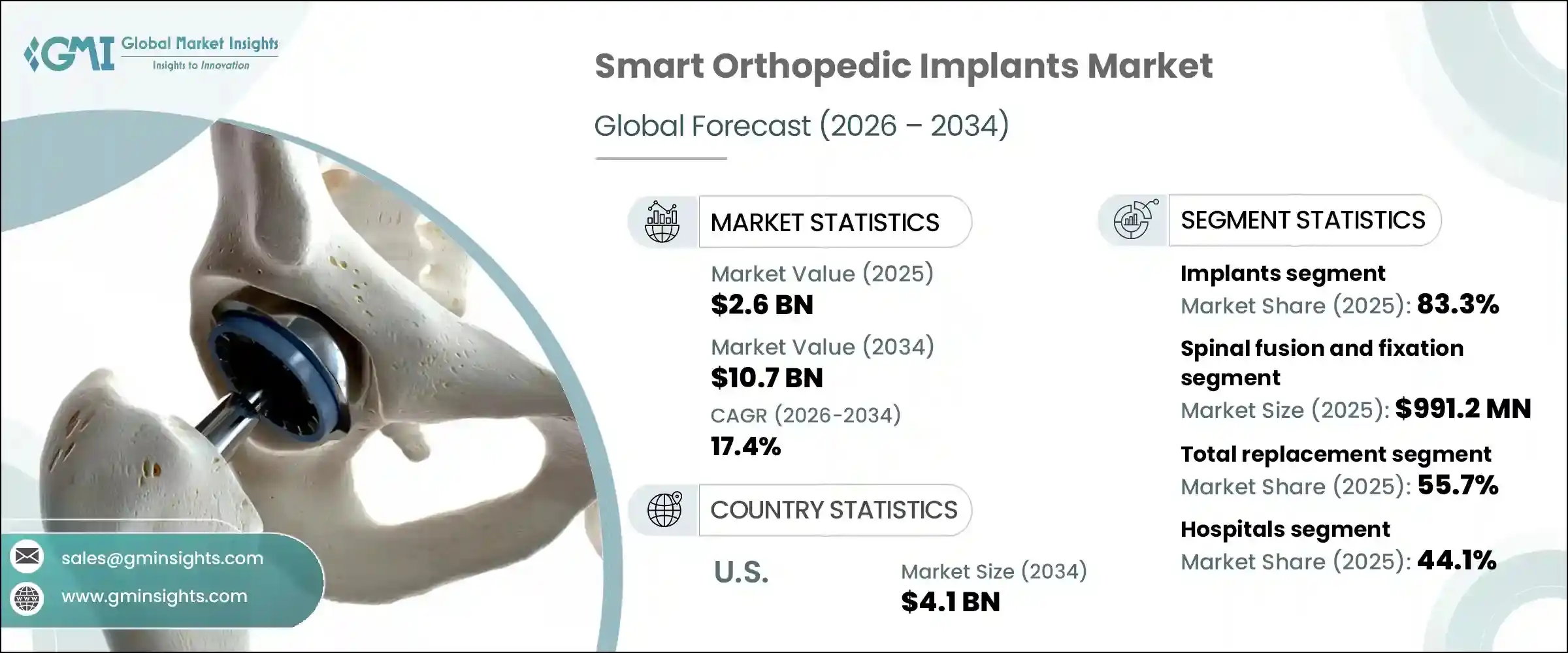
The global smart orthopedic implants market was valued at USD 2.6 billion in 2025. It is projected to grow from USD 3 billion in 2026 to USD 10.7 billion by 2034, representing a 17.4% CAGR from 2026 to 2034, according to the latest report published by Global Market Insights Inc.
To get key market trends
Smart orthopedic implants are advanced medical devices equipped with sensors and connectivity features to monitor, diagnose, and enhance treatment outcomes for musculoskeletal conditions.
Smart Orthopedic Implants Market Report Attributes
| Key Takeaway | Details |
|---|---|
| Market Size & Growth | |
| Base Year | 2024 |
| Market Size in 2024 | USD 2.2 Billion |
| Forecast Period 2025 – 2034 CAGR | 17.3% |
| Market Size in 2034 | USD 10.7 Billion |
| Key Market Trends | |
| Growth Drivers |
|
| Pitfalls & Challenges |
|
What are the growth opportunities in this market?
These implants provide real-time data on metrics such as load, alignment, or healing progress, enabling personalized patient care. Growing demand for personalized healthcare and advancements in technology drive their adoption, supporting strong market growth. The global market for orthopedic implants is experiencing significant growth, driven by the growing prevalence of musculoskeletal disorders and the rising geriatric population. Musculoskeletal disorders, including osteoarthritis, osteoporosis, and fractures, are increasingly prevalent due to factors such as aging, sedentary lifestyles, and increasing obesity rates.
For instance, in the U.S., over 33 million adults have osteoarthritis, according to the Centers for Disease Control and Prevention (CDC). The rising prevalence of these conditions drives demand for orthopedic implants such as joint replacements and spine implants to improve patient mobility and quality of life.
Smart Orthopedic Implants Market Trends
The smart orthopedic implants market is increasingly shaped by the shift toward personalized medicine and patient-centric care models. Healthcare providers are placing greater emphasis on customized treatment approaches, driving demand for orthopedic implants tailored to individual anatomical structures and clinical requirements. Personalized implant solutions, developed using patient-specific imaging and digital modeling, are improving surgical accuracy, minimizing post-operative complications, and enhancing long-term functional outcomes.
Technological innovation remains a key trend in the orthopedic implant industry. The integration of real-time data monitoring systems, embedded sensors, and AI-enabled imaging tools is transforming orthopedic procedures and post-surgical care. Advanced orthopedic imaging technologies, projected to reach USD 7.2 billion by 2032, are enabling more precise diagnostics and treatment planning, while smart implants support continuous recovery tracking and early detection of potential complications.
Advancements in materials science and manufacturing processes, particularly 3D printing and additive manufacturing, are further strengthening market growth. These technologies enable the production of highly durable, lightweight, and anatomically precise bone implants, improving patient comfort and implant longevity. At the same time, rising awareness of bone health, supported by global initiatives such as Osteoporosis Awareness Month, is encouraging early diagnosis and timely surgical intervention.
Smart Orthopedic Implants Market Analysis

Learn more about the key segments shaping this market
The smart orthopedic implants market is primarily segmented by component into implants and electronic components. Among these, implants accounted for the largest revenue share of 83.3% in 2025 and are projected to reach approximately USD 8.9 billion by 2034. This dominance reflects the growing demand for advanced orthopedic solutions within the global orthopedic implant market, particularly in joint reconstruction and trauma care.
- Implants used in knee and hip replacement procedures represent a major share of market adoption, driven by the rising prevalence of musculoskeletal disorders, osteoporosis, and age-related degenerative bone conditions. As the global population ages, the demand for reliable and long-lasting bone implant solutions continues to increase, strengthening the position of smart orthopedic implants in clinical practice.
- Technological integration is further transforming the orthopedic implant industry. The incorporation of embedded sensors, real-time monitoring systems, and AI-enabled analytics has improved implant precision, post-surgical tracking, and long-term patient outcomes. These innovations support early complication detection, personalized treatment planning, and enhanced rehabilitation, making smart implants a preferred choice among healthcare providers.

Learn more about the key segments shaping this market
Based on application, the smart orthopedic implants market is segmented into spinal fusion and fixation, VCF treatment, motion preservation/non-fusion, and spinal decompression. Among these, the spinal fusion and fixation segment dominated the market, generating revenue of USD 991.2 million in 2025.
- Spinal fusion and fixation procedures are widely adopted for treating conditions such as herniated discs, scoliosis, and spinal stenosis. The rising incidence of these disorders, particularly among the aging population, drives the dominance of this segment.
- Moreover, sensors for real-time monitoring and improved fixation techniques enhance procedural outcomes, contributing to the growth of this segment.
Thus, the increasing need for effective treatment of spinal conditions, combined with technological advancements, ensures the continued leadership of spinal fusion and fixation in the market.

Looking for region specific data?
The smart orthopedic implants market in the U.S is expected to grow significantly, reaching USD 4.1 billion by 2034.
- The country’s emphasis on healthcare innovation has enabled the rapid adoption of advanced technologies, including smart orthopedic implants with integrated sensors and AI capabilities, supporting market growth.
- Furthermore, the robust healthcare infrastructure, widespread insurance coverage, and increasing patient awareness of cutting-edge orthopedic solutions drive demand for these implants across diverse patient demographics.
Europe: The smart orthopedic implants market in the UK is projected to experience steady growth between 2025 and 2034.
- The prevalence of musculoskeletal (MSK) conditions in the UK continues to rise, particularly among older populations. For instance, according to the Office for Health Improvement & Disparities, only 2.3% of adults aged 16 to 24 report a long-term MSK condition, compared to 50.3% among those aged 85 years and older.
- Additionally, the National Health Service (NHS) in the UK has outlined a comprehensive plan to integrate artificial intelligence (AI) into healthcare to improve patient outcomes and operational efficiency.
- Thus, with the increased prevalence of MSK conditions an aging population, and the government initiatives, the market for smart orthopedic implants is projected to grow significantly.
Asia Pacific: Japan smart orthopedic implants market is anticipated to witness lucrative growth between 2025 – 2034.
- Japan has a rapidly aging population, with over 29% of individuals aged 65 and older, fostering demand for advanced orthopedic solutions, including smart implants, to address age-related conditions such as osteoarthritis and fractures.
- Moreover, Japan’s strong focus on technological advancements, including the integration of AI and IoT in healthcare devices, enhances the development and adoption of smart implants designed to improve surgical outcomes and patient recovery.
- Thus, the government’s initiatives to promote innovative healthcare technologies, coupled with widespread healthcare coverage through Japan’s universal insurance system, are further accelerating market expansion.
Middle East and Africa: The smart orthopedic implants market in Saudi Arabia is expected to experience significant and promising growth from 2025 to 2034.
- The Vision 2030 initiative emphasizes developing advanced healthcare infrastructure and increasing access to cutting-edge medical technologies, driving the adoption of smart implants in orthopedics.
- Additionally, Saudi Arabia’s strategic investments in digital healthcare and the adoption of smart medical devices are enhancing patient care and surgical outcomes, contributing to the market’s promising growth trajectory.
Smart Orthopedic Implants Market Share
The market is highly competitive, with major medical device companies, technology innovators, and healthcare providers competing for market share. The top 4 players including Medtronic, Smith & Nephew, Stryker, and Zimmer Biomet are accounting for approximately 40% of the market share. Key players are investing in the development of advanced solutions, such as AI-integrated implants and connected orthopedic systems, to improve patient outcomes and enhance surgical precision.
In addition, regulatory advancements, such as expedited approvals for innovative devices and support for remote monitoring solutions, are enabling companies to strengthen their market position. These initiatives align with the growing demand for efficient, patient-centric orthopedic care, consolidating the leadership of key players in this expanding market.
Smart Orthopedic Implants Market Companies
Some of the eminent market participants operating in the smart orthopedic implants industry include:
- Canary Medical
- Exactech
- Medtronic
- Smith & Nephew
- SpineGuard
- Stryker
- Zimmer Biomet
- Companies such as Zimmer Biomet, Canary Medical are integrating advanced technologies, such as AI, sensors, and IoT, into their implantable devices to optimize surgical outcomes, enhance patient monitoring, and accelerate recovery times.
- These companies are focusing on personalized, data-driven solutions to address the increasing demand for tailored care and to improve surgical precision. They are also navigating business challenges such as cost-effectiveness and accessibility by expanding their product offerings to cater to diverse patient needs.
Smart Orthopedic Implants Industry News:
- In February 2024, Exactech announced an exclusive partnership with Statera Medical to co-develop the world’s first smart reverse shoulder implant. This collaboration will combine Exactech’s expertise in joint replacement technology with Statera’s innovative medical device capabilities, aiming to introduce a cutting-edge implant that enhances surgical outcomes and patient recovery. The partnership is expected to expand Exactech’s product portfolio to meet evolving market demands.
- Zimmer Biomet Holdings, Inc. announced in July 2025 that it had entered into a definitive agreement to acquire Monogram Technologies for approximately USD 177 million, including an upfront payment of USD 4.04 per share and contingent value rights of up to USD 12.37 per share.
- This acquisition was aimed at strengthening the company’s AI-driven orthopedic robotics capabilities and supporting long-term revenue growth from 2027 onward. Subsequently, in October 2025, Zimmer Biomet completed the acquisition, further expanding its robotics portfolio with semi- and fully autonomous surgical solutions designed to enhance precision and efficiency in orthopedic implant procedures.
The smart orthopedic implants market research report includes an in-depth coverage of the industry with estimates and forecast in terms of revenue in USD Million from 2021 – 2034 for the following segments:
Market, By Component
- Implants
- Knee arthroplasty
- Hip arthroplasty
- Spine fusion
- Fracture fixation
- Other implants
- Electronic components
Market, By Application
- Spinal fusion and fixation
- VCF treatment
- Motion preservation/ non-fusion
- Spinal decompression
By Procedure Type
- Total replacement
- Partial replacement
- Other procedure types
Market, By End Use
- Hospitals
- Ambulatory surgical centers
- Specialty clinics
- Other end users
The above information is provided for the following regions and countries:
- North America
- U.S.
- Canada
- Europe
- Germany
- UK
- France
- Spain
- Italy
- Netherlands
- Asia Pacific
- China
- Japan
- India
- Australia
- South Korea
- Latin America
- Brazil
- Mexico
- Argentina
- Middle East and Africa
- South Africa
- Saudi Arabia
- UAE
Frequently Asked Question(FAQ) :
What is the projected size of the smart orthopedic implants market in 2026?
The market is expected to grow to USD 3 billion in 2026, supported by rising demand for customized orthopedic solutions and technological advancements.
How much revenue did the implants segment generate in 2025?
The implants segment accounted for 83.3% of the market share in 2025, generating significant revenue and reflecting the growing demand for advanced orthopedic solutions.
What is the projected value of the smart orthopedic implants market by 2034?
The market is expected to reach USD 10.7 billion by 2034, fueled by the integration of AI-enabled imaging tools, real-time data monitoring systems, and advancements in materials science and manufacturing processes.
What was the market size of the smart orthopedic implants market in 2025?
The market size was valued at USD 2.6 billion in 2025, with a projected CAGR of 17.4% from 2026 to 2034, driven by advancements in personalized medicine, technological innovations, and increasing awareness of bone health.
Smart Orthopedic Implants Market Scope
Related Reports