Summary
Table of Content

Smart Luggage Market
Get a free sample of this report
Form submitted successfully!
Error submitting form. Please try again.
Thank you!
Your inquiry has been received. Our team will reach out to you with the required details via email. To ensure that you don't miss their response, kindly remember to check your spam folder as well!
Request Sectional Data
Thank you!
Your inquiry has been received. Our team will reach out to you with the required details via email. To ensure that you don't miss their response, kindly remember to check your spam folder as well!
Form submitted successfully!
Error submitting form. Please try again.
Smart Luggage Market Size
Innovations in communication technology as well as the growing international travel sector have been major contributing factors to the rapid growth of the intelligent luggage industry. GPS tracking & built in charging ports, & Bluetooth connections, as well as remote locking systems are the main reason why people are buying smart luggage, are the features most people are looking for when they choose luggage.
In addition to supporting the smart luggage industry, The IoT continue to influence the smart luggage marketplace by providing the ability for consumers to connect to their smart luggage via a mobile application. This technology provides users the ability to track their luggage's location & also monitor their luggage's battery level. According to IATA, the number of passengers will increase from 4.6 billion in 2024, thus resulting in a significant increase in demand for smart luggage.
In addition to supporting the smart Luggage Industry, E-commerce has played a key role in helping to fuel the growth of smart luggage by providing consumers with easy access to smart luggage from retailers around the world. Retailers such as Amazon & Alibaba have made it easy for consumers to compare several options at competitive prices, therefore making it easier for them to switch to using online shopping as their main source of purchasing smart luggage. Additionally, by switching from a brick & mortar retail distribution model to an e-commerce model, manufacturers will have expanded their ability to reach consumers all around the globe.
The government is supporting the implementation of smart luggage through the rollout of new wireless networks (5G) in addition to other technology investments to improve the availability of smart luggage at retail locations. In addition, according to the Global System for Mobile Communications (GSMA), the global smartphone penetration is 85% or higher, which allows for an increased use of smart luggage and, therefore, increases in demand for smart luggage.
Manufacturers are embracing a direct-to-consumer strategy in order to reduce operating expenses and improve customer relations. Manufacturers are also positioning themselves to take advantage of the anticipated increases in consumer demand for smart luggage through the use of enhanced technology and connection capabilities.
Smart Luggage Market Key Takeaways
Market Size & Growth
- 2025 Market Size: USD 2.1 Billion
- 2026 Market Size: USD 2.3 Billion
- 2035 Forecast Market Size: USD 7.3 Billion
- CAGR (2026–2035): 13.6%
Regional Dominance
- Largest Market: North America
- Fastest Growing Region: Asia Pacific
Key Market Drivers
- Rising consumer demand for convenience and security.
- Technological advancements.
- Increased disposable income.
Challenges
- Rising demand for advanced, tech‑enabled luggage.
- Growth driven by post‑pandemic travel recovery & e‑commerce expansion.
Opportunity
- High cost of smart luggage limiting mass adoption.
- Security, privacy, and airline regulation risks.
Key Players
- Market Leader: Samsonite led with over 17.1% market share in 2025.
- Leading Players: Top 5 players in this market include Samsonite, Rimowa, Tumi, Away Travel, Delsey, which collectively held a market share of 39.6% in 2025.
Get Market Insights & Growth Opportunities
The smart luggage market was valued at USD 2.1 billion in 2025. The market is expected to grow from USD 2.3 billion in 2026 to USD 7.3 billion in 2035, at a CAGR of 13.6%, according to latest report published by Global Market Insights Inc.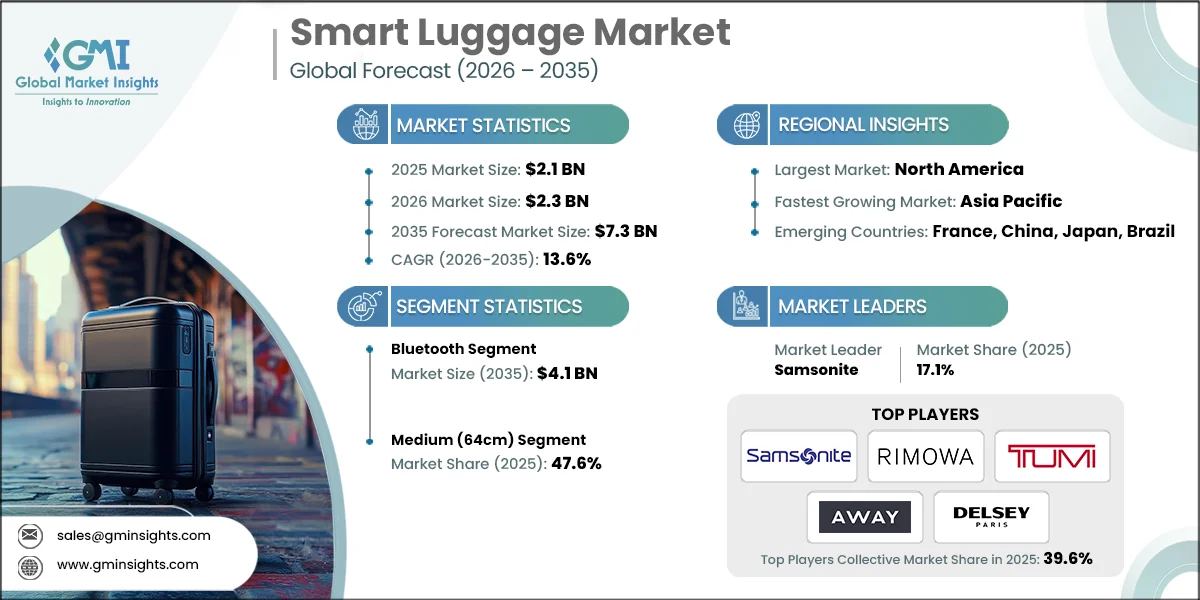
To get key market trends
Smart Luggage Market Trends
Changing innovation and technology transformation are important for the growth of the global smart luggage industry.
- The smart luggage industry has been seeing strong growth due to advances in technology as well as changing consumer preferences. One of the most popular trends within this market currently is real-time luggage tracking, made possible via GPS and Bluetooth-enabled devices that enable travellers to track their luggage using mobile applications. As per recent government statistics, there were more than 25 million bags lost globally in 2023.
- There has also been significant growth within the smart luggage category with respect to the demand for luggage with built-in USB charging ports so that travellers can charge their mobile devices while traveling. Because of the increased number of business travellers and digital nomads who rely on technology while on the road, smart luggage manufacturers such as Samsonite and Away have developed models with larger capacity built-in power banks.
- Manufacturers are using technology designed specifically to help combat theft of luggage and add additional layers of security to their products. Examples of anti-theft features include tamper-resistant zippers, alarm systems and built-in GPS tracking that provide 24/7 real-time monitoring of the state of a traveller’s luggage both in and out of a traveller’s possession. The International Air Transport Association has also indicated that technology innovations such as these have a positive impact on the overall travel experience for passengers.
- Moreover, smart luggage also has sound recognition capabilities along with weight sensors for more convenience & to People who travel regularly in accordance with airline requirements. One example of this would be the Delsey Pluggage series. This model has built-in scales and fingerprint lock technologies which are setting new standards in today's marketplace.
- As technology continues to change, the smart luggage industry will grow rapidly throughout the predicted period of time. As IoT and artificial intelligence become more prominent in today's world, manufacturers are striving to create innovative solutions that will satisfy consumer demand whilst addressing concerns regarding consumer security and functionality.
Smart Luggage Market Analysis
Learn more about the key segments shaping this market
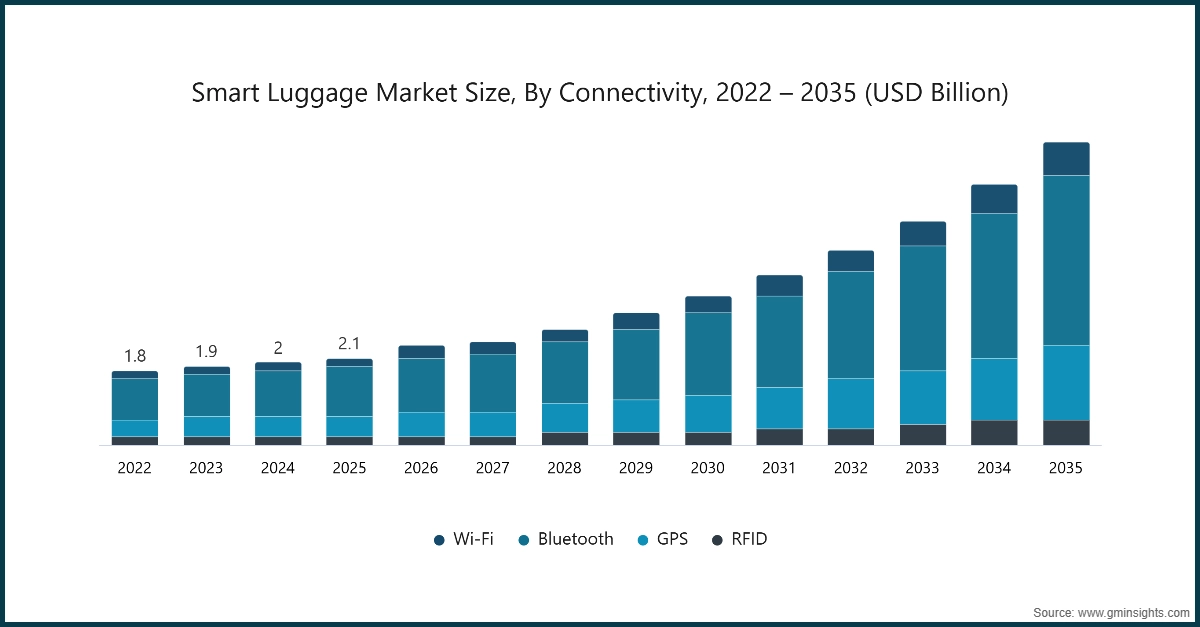
Based on connectivity, the industry is segmented into Wi-Fi, Bluetooth, GPS and RFID. The Bluetooth segment accounts for revenue of around USD 1.2 billion in the year 2025 and is expected to reach USD 4.1 billion by 2035.
- The growth of the smart luggage market is increasing mainly to the vast number of things that you can do using the Bluetooth feature found on most smart luggage items, and because Bluetooth is an easy way for users to change their luggage settings to suit the user's individual needs. According to the International Air Transport Association (IATA), there were over 42% of all smart luggage sales made with the use of Bluetooth technology in 2023.
- Bluetooth also provides real-time tracking capabilities for luggage over a defined distance, many people who frequently travel appreciate the benefits of using Bluetooth-enabled luggage because of the convenience and safety associated with being able to locate their bag from a distance instead of having to get to the bag first and then trying to figure out where the bag has gone missing from the luggage carousel or other luggage area.
- Besides luggage tracking and multiple-functionality, Bluetooth also includes several other useful features such as built-in luggage scales and tamper alert features within the luggage. A good example of this is the Delsey Pluggage line of luggage that integrates the Bluetooth feature to allow each user to weigh their bag and remotely lock the bag.
- According to US Department of Transportation Statistics, there was a 17% decrease in reported instances of mishandled baggage due to the increased use of smart luggage equipped with Bluetooth technology in the year 2023. The introduction of this technology indicates that Bluetooth will play an even greater role in enhancing travel experiences.
- Within the ever-changing market, the segment of Bluetooth technology has been able to stay ahead of the competition and will be expected to continue to do so throughout the forecast period. Manufacturers are anticipated to keep innovating by combining Bluetooth with both internet of things (IoT) and artificial intelligence (AI) technologies, creating additional product features to meet the increasing demands of consumers.
Learn more about the key segments shaping this market
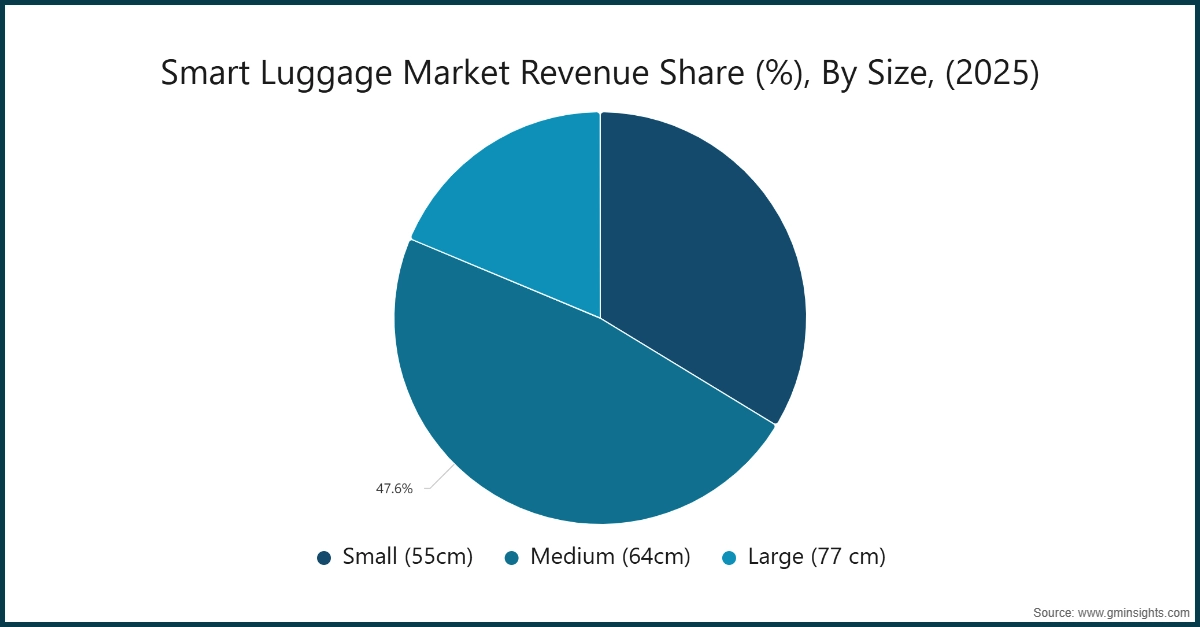
Based on the size, the market is bifurcated into small (55cm), medium (64cm) and large (77 cm). The medium segments held the largest share, accounting for 47.6% of the smart luggage market in 2025.
- The smartest luggage segment is dominated by its medium-sized category of bags. This type of luggage remains to be the most appealing to travelers as it has enough storage space for them to bring their belongings without being too bulky or cumbersome. According to IATA, global air travel grew by 22% between 2022 and 2023, creating an increased need for innovative and practical travel solutions, including smart luggage.
- Medium-sized smart luggage features innovative components such as GPS tracking, automatic locks, and built-in rechargeable batteries. These elements fulfill the growing consumer desire to have both convenience and security in the luggage they choose. A host of companies - including Samsonite and Away - produce smart luggage that can connect to an app on your mobile device. The app allows you to monitor your bags as well as control the charges on the battery.
- The growth of the medium-sized smart luggage segment is also driven by government programs designed to promote the use of smart travel technologies. One example of this type of program is the European Union's Smart Borders initiative, which encourages the use of new technologies for travel, ultimately helping to increase the demand for smart luggage. Thus, smart luggage medium is expected to continue growing throughout the forecast period.
- RFID protection is included in a lot of medium smart luggage to help protect your documents/cards that could be stolen while you are travelling; therefore, this feature is also helping to increase consumers’ desire for this product category as more people are concerned about data theft while travelling.
- As disposable incomes continue to increase and travel convenience becomes more important, the medium smart luggage category is projected to experience some of the highest growth rates in the next five years. Based on the number of smart luggage units sold, the study period shows a steady increase in smart luggage adoption, primarily driven by technological innovation and shifting consumer preferences.
North America Smart Luggage Market
Looking for region specific data?
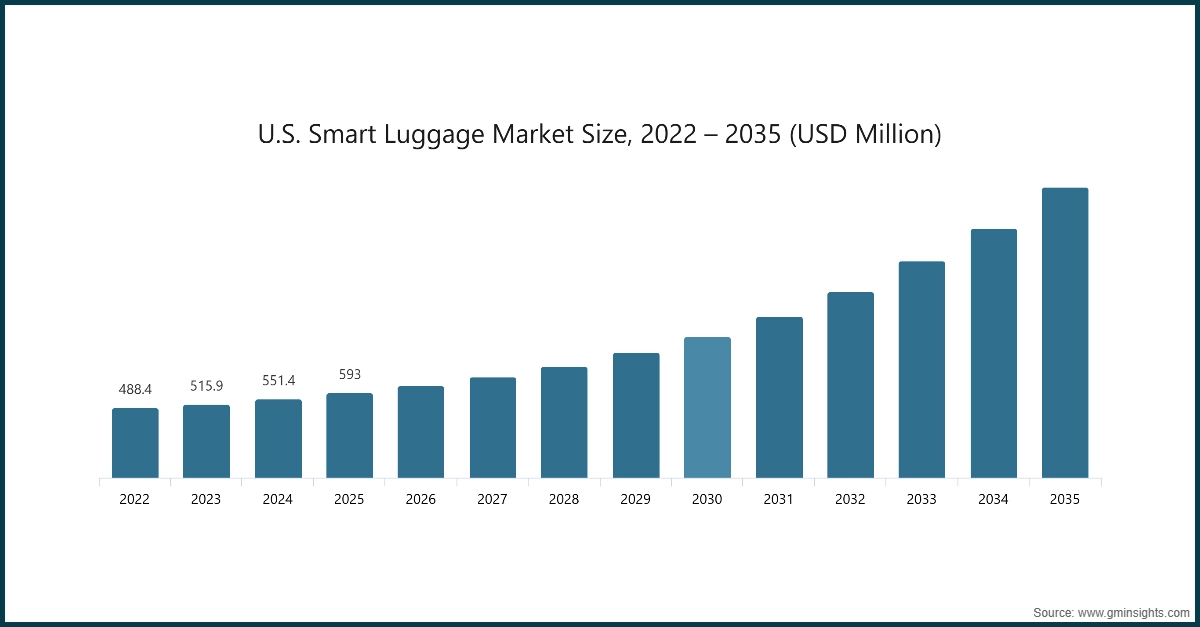
In 2025, the U.S. dominated the smart luggage market growth in North America, accounting for 75.7% of the share in the region.
- North America’s market growth is strongly driven by early adoption of embedded tracking systems, biometric locks, and app‑synced features, making the region one of the first to embrace technologically enhanced travel gear. Travelers in the U.S. have shown rapid uptake of innovations such as GPS-enabled modules and USB charging docks, especially as leading brands like Samsonite continue integrating advanced digital components into premium luggage.
- Additionally, strong consumer demand for convenience, security, and connectivity during travel has accelerated market expansion as smart luggage offers solutions such as self‑weighing bags, remote locking, and Bluetooth-based controls. The rebound of the travel industry, coupled with high frequency of business and leisure travel in the U.S., continues to reinforce the region’s dominant position in global smart luggage adoption.
Asia Pacific Smart Luggage Market
Asia Pacific smart luggage industry is expected to grow at 14.2% during the forecast period.
- Asia Pacific’s rapid smart luggage industry growth is fueled by expanding travel activity, rising disposable income, and tech-driven consumer preferences, making it the fastest-growing region globally. The region benefits from increasing demand for smart backpacks and duffle bags, supported by strong adoption of innovative features like GPS, Wi-Fi, and Bluetooth. Organized retail expansion and rising brand visibility further stimulate adoption.
Europe Smart Luggage Market
Europe smart luggage industry is expected to grow at 13.3% during the forecast period.
- Europe’s smart luggage industry grows due to strong consumer demand for convenience, advanced travel security, and premium travel accessories, supported by high disposable incomes. Technological innovation remains a key driver as manufacturers expand GPS-enabled, remote-lock, and smart-charging features. Regulatory emphasis on travel safety and baggage handling compliance promotes widespread adoption.
Middle East and Africa Smart Luggage Market
Middle East and Africa smart luggage industry is expected to grow at 12.6% during the forecast period.
- The Middle East and Africa smart luggage industry is expanding due to growing air travel, rising security concerns, and increasing interest in digitally connected travel gear. Consumers in the region value GPS-enabled and USB-charging features that enhance travel safety and convenience. Strong adoption in countries like Egypt and South Africa reflects growing tech-savviness and modernization of travel habits.
Smart Luggage Market Share
The top companies in the smart luggage industry include Samsonite, Rimowa, Tumi, Away Travel and Delsey and collectively hold a share of 39.6% of the market in 2025. These prominent players are proactively involved in strategic endeavors, such as mergers & acquisitions, facility expansions & collaborations, to expand their product portfolios, extend their reach to a broad customer base, and strengthen their market position.
- Samsonite operates in the global smart luggage market as a leading innovator, integrating GPS modules, USB charging docks, and biometric‑enabled features into its premium luggage lines, especially in North America and Western Europe. The company leverages a multi‑brand portfolio including Samsonite, Tumi, American Tourister, and Gregory, enabling it to address diverse traveler segments while expanding omnichannel retail and travel‑retail penetration worldwide.
- Rimowa participates in the global smart luggage market as a luxury, design‑driven brand, emphasizing its iconic grooved aluminum aesthetic and precision German engineering that appeal to premium travelers seeking technologically advanced luggage. Under LVMH, the company has expanded digital commerce, strengthened flagship stores, and maintained strict distribution control while integrating innovative materials, premium finishes, and selective collaborations that elevate its luxury positioning.
- Tumi competes in the smart luggage market by offering high‑performance travel gear crafted with FXT ballistic nylon, smart organization systems, and TSA‑integrated security features, appealing to frequent flyers seeking durability and utility. Its products incorporate dual‑access designs, AirTag pockets, USB‑friendly layouts, and advanced mobility systems that align with tech‑enabled travel expectations.
Smart Luggage Market Companies
Major players operating in the smart luggage industry are:
- Airwheel Holding
- Arista Vault
- Away Travel
- Briggs & Riley Travelware
- Delsey
- ForwardX Robotics (Ovis)
- Horizn Studios
- July
- Level8
- Rimowa
- Samsara Luggage
- Samsonite
- Travelpro International
- Tumi
- Victorinox
Away operates in the smart luggage market as a direct‑to‑consumer premium brand known for sleek polycarbonate designs, built‑in USB chargers, and modern aesthetics tailored to tech‑savvy travelers. Its market presence is strengthened through content‑led storytelling, omnichannel expansion, and high‑engagement digital platforms, enabling Away to scale across North America, Europe, and Asia.
Delsey Paris participates in the smart luggage market through feature‑rich hardside collections integrating TSA‑accepted smart locks, 360° spinner systems, SECURITECH anti‑theft zippers, removable linings, and lightweight polycarbonate engineering. Its product strategy highlights expandable designs, recycled materials, smart bands, dual‑density wheels, and long‑term warranties, aligning with evolving consumer expectations for connected, sustainable travel solutions.
Smart Luggage Market Report Attributes
| Key Takeaway | Details |
|---|---|
| Market Size & Growth | |
| Base Year | 2025 |
| Market Size in 2025 | USD 2.1 Billion |
| Market Size in 2026 | USD 2.3 Billion |
| Forecast Period 2026-2035 CAGR | 13.6% |
| Market Size in 2035 | USD 7.3 Billion |
| Key Market Trends | |
| Drivers | Impact |
| Rising consumer demand for convenience and security | Growing traveler expectations for features such as GPS tracking, USB charging, remote locking, and anti‑theft systems continue to push brands toward smarter, more secure luggage designs. This shift directly accelerates market adoption as tech‑savvy consumers increasingly seek seamless, device‑supported travel experiences. |
| Technological advancements | Advances in IoT, Bluetooth, biometric authentication, and mobile‑app integration have transformed luggage from passive storage to active travel companions. These innovations enhance functionality and user experience, driving premiumization and supporting the market’s long‑term growth trajectory |
| Increased disposable income | Rising disposable incomes globally allow more consumers to invest in higher‑end, feature‑rich luggage solutions instead of traditional low‑tech options. This fuels the demand for premium smart luggage, particularly in regions with rapid travel growth and expanding middle‑class populations |
| Pitfalls & Challenges | Impact |
| Rising demand for advanced, tech‑enabled luggage | Ironically, increasing demand for advanced features raises consumer expectations, putting pressure on brands to continuously innovate. This escalates R&D costs and intensifies competition, making it harder for smaller players to keep pace. |
| Growth driven by post‑pandemic travel recovery & e‑commerce expansion | Although travel resurgence and online availability boost demand, brands face operational challenges in scaling production, managing supply chains, and navigating fluctuating global travel patterns. These factors can restrict consistent product availability and margin stability. |
| Opportunities: | Impact |
| High cost of smart luggage limiting mass adoption | The current high pricing leaves a large untapped market of mid‑range consumers, opening opportunities for affordable smart‑luggage segments. Brands that can offer cost‑optimized yet feature‑rich products stand to capture significant volume growth. |
| Security, privacy, and airline regulation risks | Addressing battery‑safety standards, privacy concerns, and compliance requirements presents opportunities for brands to differentiate with safer, regulation‑aligned designs. Companies that proactively integrate compliant battery modules, secure data encryption, and airline‑friendly technology gain consumer trust and regulatory advantage. |
| Market Leaders (2025) | |
| Market Leader |
17.1% market share |
| Top Players |
Collective market share in 2025 is 39.6% |
| Competitive Edge |
|
| Regional Insights | |
| Largest Market | North America |
| Fastest growing market | Asia Pacific |
| Emerging countries | France, China, Japan, Brazil |
| Future outlook |
|
What are the growth opportunities in this market?
Smart Luggage Industry News
- In January 2026, Airwheel achieved a significant milestone in innovation with the debut of its Q7 Modular Smart Suitcase. The Q7 featured interchangeable outer panels, modular power units, an intelligent energy-node architecture, and IATA-certified BLE gateways. These advancements facilitated automated airport check-ins and provided real-time travel alerts.
- In January 2026, Airwheel expanded into airline‑integrated smart‑mobility by embedding ONE Record API–compatible BLE gateways across 68% of its premium models. This integration reduced manual bag‑tag reprocessing by 22% across partner airlines and marked Airwheel’s diversification beyond hardware toward an aviation‑connected ecosystem.
- In January 2026, Away accelerated its expansion scaling international retail stores and broadening its smart‑luggage portfolio with polycarbonate GPS‑enabled and USB‑integrated suitcases. Rising travel demand and strong DTC execution made this the brand’s largest multi‑region expansion phase.
- In 2025, Under LVMH, Rimowa continued its multi‑year expansion by upgrading digital commerce, expanding flagship retail, and driving visibility through high‑profile collaborations such as Supreme and Dior, strengthening its premium global presence through the period.
- In May 2024, Samsonite announced the ongoing rollout of advanced features in its premium smart luggage lines. These include GPS tracking, biometric locks, and USB charging integrations. This initiative reinforces Samsonite's position as a leading innovator. The move aligns with the growing global adoption of smart luggage solutions.
The smart luggage market research report includes in-depth coverage of the industry, with estimates & forecasts in terms of revenue (USD Billion) volume (Thousand Units) (from 2022 to 2035), for the following segments:
Market, By Technology
- Sensors
- SIM cards
- USB charging
Market, By Size
- Small (55cm)
- Medium (64cm)
- Large (77 cm)
Market, By Connectivity
- Wi-Fi
- Bluetooth
- GPS
- RFID
Market, By Shell Type
- Hard shell
- Soft shell
Market, By Material
- Canvas
- Plastic
- Nylon
- Polyester
- Others (polycarbonate etc.)
Market, By Application
- Real-time tracking
- Proximity alerts
- Remote locking
- Digital scaling
- Others (smart packing assistants etc.)
Market, By Price
- Low
- Medium
- High
Market, By Distribution Channel
- Online
- E-Commerce
- Company website
- Offline
- Supermarkets/Hypermarkets
- Specialty Stores
- Others (Individual stores, Departmental stores, etc.)
The above information is provided for the following regions and countries:
- North America
- U.S.
- Canada
- Europe
- Germany
- France
- UK
- Italy
- Spain
- Asia Pacific
- China
- Japan
- India
- Australia
- South Korea
- Latin America
- Brazil
- Mexico
- Argentina
- MEA
- Saudi Arabia
- UAE
- South Africa
Frequently Asked Question(FAQ) :
What was the market size of the smart luggage in 2025?
The market was valued at USD 2.1 billion in 2025, with a CAGR of 13.6% expected through 2035. Innovations in communication technology and the growing international travel sector are driving market growth.
What is the projected value of the smart luggage market by 2035?
The market is poised to reach USD 7.3 billion by 2035, driven by advancements in GPS tracking, Bluetooth connectivity, and integrated charging solutions.
What is the expected size of the smart luggage industry in 2026?
The market size is projected to reach USD 2.3 billion in 2026.
How much revenue did the Bluetooth segment generate in 2025?
The Bluetooth segment generated approximately USD 1.2 billion in 2025 and is expected to reach USD 4.1 billion by 2035.
What was the market share of medium-sized luggage in 2025?
Medium-sized luggage accounted for 47.6% of the market in 2025, as it offers travelers a balance of storage capacity and portability.
Which region dominated the smart luggage sector in 2025?
The U.S. dominated the market in North America, accounting for 75.7% of the regional share in 2025. Early adoption of embedded tracking systems, biometric locks, and app-synced features contributed to this growth.
What are the upcoming trends in the smart luggage market?
Key trends include GPS and Bluetooth luggage tracking, USB charging ports, anti-theft features, sound recognition, weight sensors, and IoT- and AI-enabled smart functionality and security.
Who are the key players in the smart luggage industry?
Key players include Airwheel Holding, Arista Vault, Away Travel, Briggs & Riley Travelware, Delsey, ForwardX Robotics (Ovis), Horizn Studios, July, Level8, Rimowa, Samsara Luggage, and Samsonite.
Smart Luggage Market Scope
Related Reports