Summary
Table of Content

Sleep Apnea Implants Market
Get a free sample of this report
Form submitted successfully!
Error submitting form. Please try again.
Thank you!
Your inquiry has been received. Our team will reach out to you with the required details via email. To ensure that you don't miss their response, kindly remember to check your spam folder as well!
Request Sectional Data
Thank you!
Your inquiry has been received. Our team will reach out to you with the required details via email. To ensure that you don't miss their response, kindly remember to check your spam folder as well!
Form submitted successfully!
Error submitting form. Please try again.
Sleep Apnea Implants Market Size
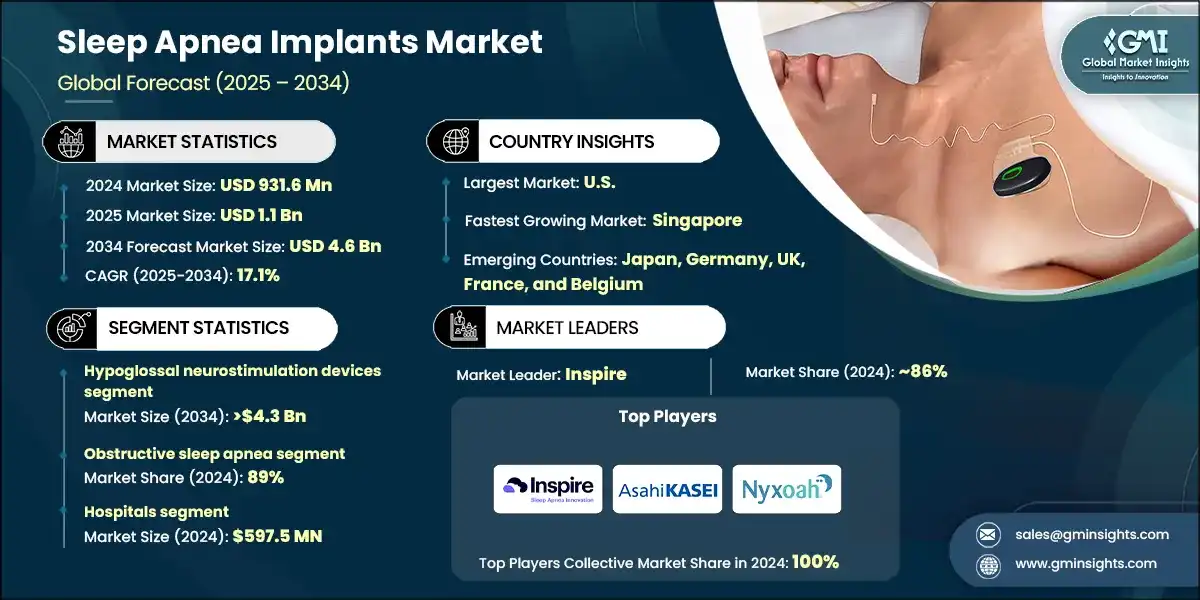
The global sleep apnea implants market size was valued at USD 931.6 million in 2024. The market is expected to grow from USD 1.1 billion in 2025 to USD 4.6 billion in 2034, at a CAGR of 17.1% during the forecast period, according to the latest report published by Global Market Insights Inc. This high growth is attributed to the increasing prevalence of obstructive sleep apnea, low compliance and adherence towards CPAP, and rising awareness regarding sleep apnea.
Sleep Apnea Implants Market Key Takeaways
Market Size & Growth
- 2024 Market Size: USD 931.6 Million
- 2025 Market Size: USD 1.1 Billion
- 2034 Forecast Market Size: USD 4.6 Billion
- CAGR (2025–2034): 17.1%
Regional Dominance
- Largest Market: U.S.
- Fastest Growing Region: Singapore
Key Market Drivers
- Increasing prevalence of obstructive sleep apnea.
- Low compliance and adherence towards CPAP.
- Technological advancements.
- Rising awareness regarding sleep apnea.
Challenges
- High costs of sleep apnea implants.
- Complications associated with sleep apnea implants.
Opportunity
- Increasing number of diagnosed OSA patients.
- Expansion into emerging markets.
Key Players
- Market Leader: Inspire led with over 86% market share in 2024.
- Leading Players: Top 3 players in this market include Inspire, Asahi Kasei, Nyxoah, which collectively held a market share of 100% in 2024.
Get Market Insights & Growth Opportunities
Sleep apnea implants provide mask-free, minimally invasive treatment continuously stimulating airway muscles to prevent airway collapse during sleep. Inspire dominates the industry with its global presence and extensive portfolio of products. Smaller companies such as Nyxoah and Asahi Kasei are slowly gaining market share with niche innovations, regional growth plans, and focused clinical trials.
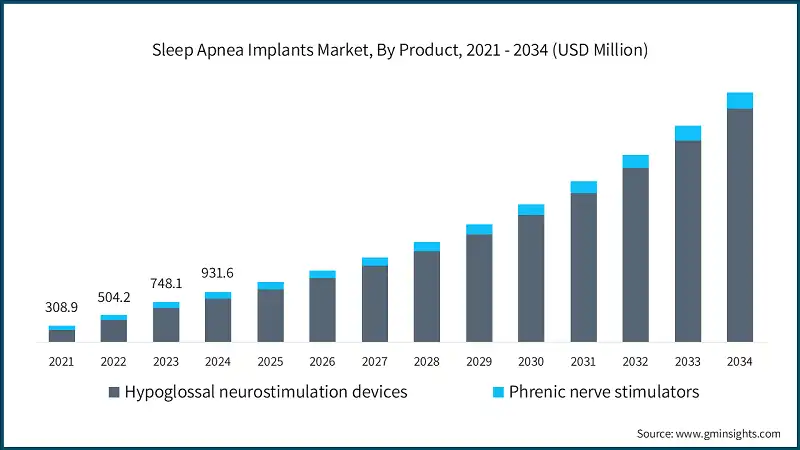
The market has increased from USD 308.9 million in 2021 and reached USD 748.1 million in 2023, with a historic growth rate of 55.8%. This growth was primarily driven by the rising global prevalence of obstructive sleep apnea (OSA), along with increasing demand for user-friendly and discreet sleep apnea devices. Technological advancements are enhancing therapy customization by introducing AI-driven neuromodulation, remote patient monitoring, and miniaturized, MRI-compatible implants, making treatments more effective, personalized, and patient-friendly.
The increasing prevalence of OSA is emerging as a major driver for the sleep apnea implants market. According to a study published by ScienceDirect in 2024, approximately 425 million adults worldwide were estimated to have moderate-to-severe OSA. This surge in cases is fueling demand for advanced, minimally invasive treatment options, prompting innovation and investment in implantable devices that offer long-term therapeutic benefits.
Additionally, continuous positive airway pressure (CPAP) therapy has traditionally been the standard treatment for OSA, yet poor compliance remains a critical challenge. Many patients struggle with these oral sleep apnea devices due to discomfort, mask intolerance, claustrophobia, noise, and inconvenience, particularly during travel. According to a study published in BMC Pulmonary Medicine, long-term adherence rates can be as low as 50%, leaving a vast population inadequately treated. This widespread non-compliance is fueling the demand for alternative treatment options, particularly implantable solutions like hypoglossal nerve stimulators (HGNS).
Sleep apnea implants are medical devices implanted in a patient's body to restore normal breathing by managing airway obstruction and ensuring proper oxygen flow to the lungs.
To get key market trends
Sleep Apnea Implants Market Trends
Technological advancements are playing a pivotal role in driving growth in the sleep apnea implants industry.
- One of the most significant developments is the integration of AI-driven neuromodulation, which allows devices to adapt stimulation patterns based on individual patient needs and sleep behavior. This level of customization improves therapeutic outcomes and enhances patient satisfaction. For instance, the Inspire Upper Airway Stimulation (UAS) system by Inspire Medical Systems has revolutionized treatment by using advanced algorithms to detect a patient’s breathing patterns and deliver electrical impulses to the hypoglossal nerve, ensuring the airway remains open during sleep.
- Additionally, remote patient monitoring capabilities are transforming post-implant care by enabling clinicians to track device performance and patient progress in real time, reducing the need for frequent in-person visits and allowing for timely interventions.
- Furthermore, the Genio implantable hypoglossal nerve stimulator by Nyxoah is designed to offer a minimally invasive treatment option for patients who are intolerant to CPAP therapy. The Genio system distinguishes itself by using a novel, simplified approach with an easy-to-implant system that improves both ease of use and patient adherence. This launch comes at a critical time when the market is increasingly demanding patient-friendly alternatives to traditional CPAP treatments.
- Moreover, companies are focusing on interoperability and digital health integration, allowing sleep apnea implants to sync with mobile apps and cloud platforms. This empowers patients with greater control over their therapy and fosters engagement through data-driven insights, thereby fueling market adoption of sleep apnea implants.
Sleep Apnea Implants Market Analysis
Learn more about the key segments shaping this market
The sleep apnea implants market was valued at USD 308.9 million in 2021. The market size reached USD 748.1 million in 2023, from USD 504.2 million in 2022.
Based on product, the market is segmented into hypoglossal neurostimulation devices and phrenic nerve stimulators. The hypoglossal neurostimulation devices segment accounted for approximately 86.7% of the market in 2024, primarily due to its established clinical efficacy, growing physician adoption, and strong performance in treating OSA. The segment is expected to exceed USD 4.3 billion by 2034, growing at a CAGR of 17.9% during the forecast period.
On the other hand, the phrenic nerve stimulators segment held a market share of 13.3% in 2024. The growth of this segment can be attributed to the rising prevalence of central sleep apnea, especially among heart failure patients, along with advancements in device technology, improved patient outcomes, and increasing adoption in aging populations.
- Many patients with moderate to severe OSA struggle with continuous positive airway pressure (CPAP) therapy due to discomfort, noise, and poor long-term adherence. A recent study published by BMC Pulmonary Medicine highlights that only about 30% of patients remain compliant with CPAP therapy long-term. This non-adherence opens the door for alternative treatments like hypoglossal neurostimulation (HGNS) devices, which offer a more patient-friendly solution. These devices address airway obstruction in a way that is non-disruptive and effective, making them an increasingly popular option among both patients and healthcare providers. This shift contributes to the segment’s growth.
- Moreover, regulatory agencies have been proactive in expanding the indications for HGNS devices, making them accessible to a broader range of patients. For instance, on June 8, 2023, the FDA expanded the Apnea-Hypopnea Index (AHI) range for HGNS devices, now allowing them for patients with an AHI as high as 100 (previously restricted to those with an AHI of 15-65). This expanded approval opens doors for patients with mild-to-moderate OSA to benefit from these innovative treatments, further driving market growth.
Based on the indication, the sleep apnea implants market is segmented into obstructive sleep apnea and central sleep apnea. The obstructive sleep apnea segment accounted for 89% of the market in 2024.
- The dominance of the obstructive sleep apnea (OSA) segment is driven by the increasing prevalence of OSA and the limitations of traditional therapies. An estimated 30 million Americans suffer from OSA, yet many cases remain undiagnosed, leading to severe health and economic consequences.
- According to the American Academy of Sleep Medicine, untreated OSA costs the U.S. USD 149.6 billion annually, including lost productivity, motor vehicle accidents, and higher healthcare expenditures. The growing recognition of OSA’s link to cardiovascular disease, diabetes, and cognitive decline has intensified demand for effective, long-term treatment options, particularly implant-based solutions for CPAP-intolerant patients.
- The central sleep apnea (CSA) segment held a market share of 11% in 2024, driven by the rising prevalence of sleep-related breathing disorders among aging and heart failure populations, increased awareness and diagnosis of CSA, and advancements in therapeutic technologies such as phrenic nerve stimulators devices.
Learn more about the key segments shaping this market
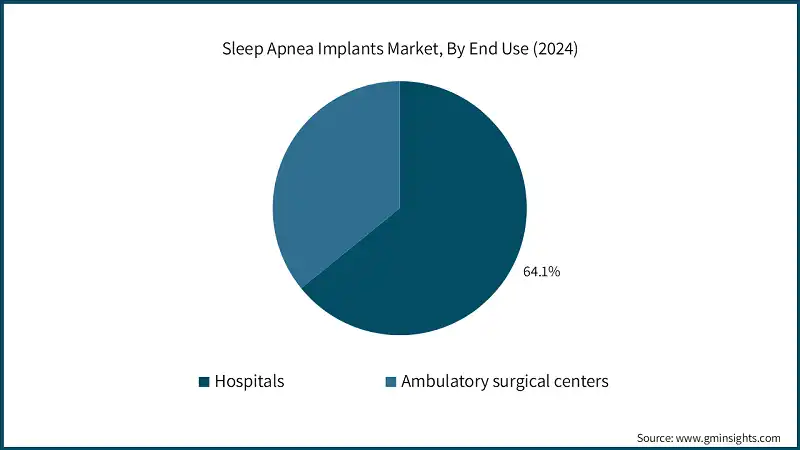
Based on end use, the sleep apnea implants market is segmented into hospitals and ambulatory surgical centers. The hospitals segment accounted for USD 597.5 million in 2024 and is set to witness notable growth in the coming years. This significant share is mainly attributed to the advanced infrastructure, availability of specialized surgeons, and the ability to manage complex cases requiring multidisciplinary care and post-operative monitoring.
- Hospitals, equipped with advanced diagnostic tools and treatment options, remain the preferred setting for the implantation of sleep apnea devices like hypoglossal nerve stimulators, phrenic nerve stimulators, and bone screw systems.
- Additionally, post-implantation care, including regular monitoring and adjustments, is efficiently provided in hospital settings, ensuring better long-term patient outcomes.
- The ambulatory surgical centers segment accounted for a substantial share in 2024 and is expected to record higher growth with a 17.7% CAGR over the projected timeframe. These centers offer cost-effective procedures, shorter recovery times, and increased patient preference for minimally invasive treatments in outpatient settings.
Looking for region specific data?
U.S. Sleep Apnea Implants Market
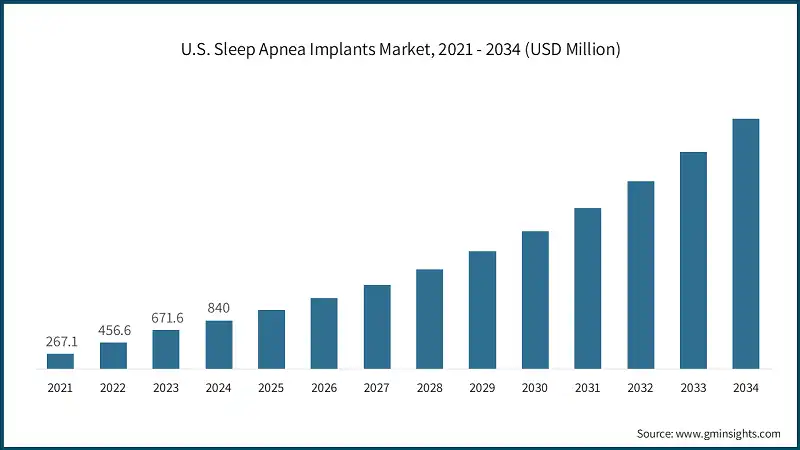
The U.S. sleep apnea implants industry was valued at USD 267.1 million and USD 456.6 million in 2021 and 2022, respectively. In 2024, the market size grew to USD 840 million from USD 671.6 million in 2023.
- Growth in the U.S. market is driven by the high prevalence of obstructive sleep apnea (OSA), widespread adoption of hypoglossal neurostimulation devices, and favorable reimbursement policies.
- The region benefits from a well-established healthcare infrastructure, strong clinical research, and early adoption of innovative implant technologies such as Inspire V.
- Additionally, the presence of leading companies like Inspire Medical Systems and Asahi Kasei, along with government support for advanced therapies, continues to fuel market expansion.
Europe Sleep Apnea Implants Market
Europe sleep apnea implants industry accounted for USD 89.7 million in 2024.
- This growth in Europe is supported by high awareness levels among healthcare professionals and patients, as well as strong advocacy from medical societies, non-profit organizations, and sleep research institutions. These groups have played a pivotal role in promoting early diagnosis and alternative therapies for sleep apnea, especially for patients who are intolerant to conventional CPAP treatment.
- Countries such as Germany, France, the UK, Switzerland, Spain, Italy, the Netherlands, Belgium, Austria, and Finland are actively contributing to the expansion of the sleep apnea implants market. Germany and the UK lead the region in terms of adoption, driven by robust reimbursement frameworks, aging populations, and advanced hospital infrastructure that supports the use of hypoglossal nerve stimulation devices. France and Switzerland are also seeing increased uptake due to innovative healthcare models, early screening programs, and the integration of sleep medicine into primary care.
Japan Sleep Apnea Implants Market
The Japan sleep apnea implants industry is anticipated to grow at a notable CAGR of 19.9% during the analysis timeframe.
- The country has been proactive in implementing healthcare policies that facilitate the diagnosis and treatment of sleep apnea, which is increasingly recognized as a major health concern. As the incidence of OSA rises, particularly among older adults, the demand for innovative treatment options, including implants, is steadily increasing.
- The availability of advanced devices, such as the Inspire therapy system, which provides an alternative to traditional CPAP therapy, has further fueled market growth.
- Moreover, Japan's robust healthcare infrastructure and emphasis on research and development have fostered a conducive environment for the emergence of novel therapeutic solutions.
Singapore Sleep Apnea Implants Market
Singapore sleep apnea implants industry is anticipated to record robust growth throughout the forecast period.
- Singapore faces a rising burden of sleep apnea, largely driven by rapid urbanization, increasing obesity rates, and lifestyle changes that contribute to poor sleep hygiene and respiratory complications.
- As the population ages and chronic conditions become more prevalent, the demand for effective and minimally invasive treatments is accelerating.
- Additionally, investments in healthcare infrastructure, international collaborations, and training programs are enabling broader access to implantable therapies.
- Furthermore, hospitals and outpatient centers are beginning to integrate neurostimulation implants into routine care, replacing traditional CPAP therapy for eligible patients.
Sleep Apnea Implants Market Share
The sleep apnea implants industry is consolidated, with leading players like Inspire, Nyxoah, and Asahi Kasei together holding 100% share in the global market. These companies maintain their leadership through innovation in neurostimulation technology, integration with digital health platforms, and patient-centric design.
Inspire continues to lead with its hypoglossal nerve stimulation system, offering a mask-free, implantable solution for obstructive sleep apnea. Its focus on automation, remote monitoring, and global expansion reinforces its dominance in the market.
Similarly, Nyxoah is making advancements in its Genio system, a battery-free, bilateral hypoglossal nerve stimulator that uses an external wearable component. The company’s emphasis on simplified therapy, reduced surgical complexity, and strong clinical outcomes positions it as a rising competitor in both European and U.S. markets.
Further, Asahi Kasei, through its Respicardia division, is focusing on central sleep apnea treatment with its Remede System, a phrenic nerve stimulator. By targeting a segment underserved by CPAP therapy and investing in device miniaturization and connectivity, Asahi Kasei is expanding its reach and diversifying the sleep apnea implants landscape.
Sleep Apnea Implants Market Companies
A few of the prominent players operating in the sleep apnea implants industry include:
- Asahi Kasei
- Inspire
- Nyxoah
- Asahi Kasei
Asahi Kasei, through its Respicardia division, stands out in the sleep apnea implants market by focusing on central sleep apnea (CSA), a segment often underserved by traditional therapies. Its flagship product, the Remed System, is a phrenic nerve stimulator that restores natural breathing patterns during sleep. The company’s USP lies in its ability to address CSA in patients with heart failure, offering a clinically validated alternative to CPAP.
Inspire Medical Systems is the market leader in hypoglossal nerve stimulation (HGNS) for obstructive sleep apnea (OSA). Its USP is the mask-free, fully implantable Inspire system, which monitors breathing and stimulates airway muscles to prevent obstruction during sleep. Inspire’s strength lies in its patient-friendly design, remote therapy management, and broad insurance coverage, making it a preferred choice for patients who are CPAP-intolerant.
Nyxoah differentiates itself with its Genio system, a battery-free, bilateral hypoglossal nerve stimulator that uses an external wearable power source, reducing surgical complexity and enhancing patient comfort. Its USP is the minimal invasiveness and flexibility of therapy, making it suitable for a wider range of patients.
Sleep Apnea Implants Market Report Attributes
| Key Takeaway | Details |
|---|---|
| Market Size & Growth | |
| Base Year | 2024 |
| Market Size in 2024 | USD 931.6 Million |
| Market Size in 2025 | USD 1.1 Billion |
| Forecast Period 2025 - 2034 CAGR | 17.1% |
| Market Size in 2034 | USD 4.6 Billion |
| Key Market Trends | |
| Drivers | Impact |
| Increasing prevalence of obstructive sleep apnea | Drives demand for effective and long-term treatment solutions. |
| Low compliance and adherence towards CPAP | Encourages adoption of alternative therapies like implants. |
| Technological advancements | Boosts innovation and improve treatment outcomes and patient comfort. |
| Rising awareness regarding sleep apnea | Expands the patient pool and accelerates diagnosis rates. |
| Pitfalls & Challenges | Impact |
| High costs of sleep apnea implants | Limits accessibility, especially in low-income regions. |
| Complications associated with sleep apnea implants | Raises concerns about safety and long-term efficacy. |
| Opportunities: | Impact |
| Increasing number of diagnosed OSA patients | Expands the addressable market for implantable solutions. |
| Expansion into emerging markets | Opens new revenue streams and growth potential for manufacturers. |
| Market Leaders (2024) | |
| Market Leaders |
~86% market share |
| Top Players |
Collective Market Share is 100% |
| Competitive Edge |
|
| Regional Insights | |
| Largest Market | U.S. |
| Fastest Growing Market | Singapore |
| Emerging Countries | Japan, Germany, UK, France, and Belgium |
| Future outlook |
|
What are the growth opportunities in this market?
Sleep Apnea Implants Industry News:
- In December 2023, the FDA approved the Inspire V therapy system by Inspire Medical Systems Inc. for treating moderate to severe obstructive sleep apnea (OSA). This advanced system includes an updated neurostimulator and Bluetooth-enabled patient remote and physician programmer, offering a more effective and patient-friendly solution. This approval is expected to enhance Inspire's market position and drive revenue growth by attracting a broader patient population seeking innovative and user-friendly treatment options.
- In May 2023, the FDA approved the remed System by Zoll, an Asahi Kasei company, for conditional use with MRI, expanding treatment options for adults with moderate to severe central sleep apnea (CSA) who require regular MRI scans. This approval, applicable to all models of the remed System, allows for safe full-body MRI scans, enhancing the device's versatility and making it a significant advancement for CSA patients needing MRI-compatible therapy.
The sleep apnea implants market research report includes an in-depth coverage of the industry with estimates and forecast in terms of revenue in USD Million and from 2021 - 2034 for the following segments:
Market, By Product
- Hypoglossal neurostimulation devices
- Phrenic nerve stimulators
Market, By Indication
- Obstructive sleep apnea
- Central sleep apnea
Market, By End Use
- Hospitals
- Ambulatory surgical centers
The above information is provided for the following regions and countries:
- U.S.
- Europe
- Germany
- UK
- Switzerland
- France
- Spain
- Italy
- Netherlands
- Belgium
- Austria
- Finland
- Japan
- Singapore
Frequently Asked Question(FAQ) :
What is the market size of the sleep apnea implants in 2024?
The market size was valued at USD 931.6 million in 2024, with a CAGR of 17.1% expected through 2034. The market growth is driven by the increasing prevalence of obstructive sleep apnea, low compliance with CPAP therapy.
What is the projected value of the sleep apnea implants market by 2034?
The market is projected to reach USD 4.6 billion by 2034, fueled by technological advancements, patient-friendly alternatives to CPAP, and digital health integration.
What is the expected size of the sleep apnea implants market in 2025?
The market size is projected to reach USD 1.1 billion in 2025.
How much revenue did the hypoglossal neurostimulation devices segment generate in 2024?
The hypoglossal neurostimulation devices segment generated significant revenue and is expected to exceed USD 4.3 billion by 2034, growing at a CAGR of 17.9% till 2034.
What was the valuation of the obstructive sleep apnea segment in 2024?
The obstructive sleep apnea segment accounted for 89% of the market in 2024, led by the increasing prevalence of OSA and the limitations of traditional therapies.
What is the growth outlook for the hospitals segment?
The hospitals segment was valued at USD 597.5 million in 2024, due to advanced infrastructure, specialized surgeons, and the ability to manage complex cases requiring multidisciplinary care.
Which region leads the sleep apnea implants sector?
The U.S. leads the market, valued at USD 840 million in 2024, propelled by the high prevalence of obstructive sleep apnea, widespread adoption of hypoglossal neurostimulation devices.
What are the upcoming trends in the sleep apnea implants market?
Key trends include AI-driven neuromodulation, remote monitoring, minimally invasive implants, digital health integration, and CPAP alternatives.
Who are the key players in the sleep apnea implants industry?
Prominent players include Asahi Kasei, Inspire, and Nyxoah.
Sleep Apnea Implants Market Scope
Related Reports