Summary
Table of Content

Satellite IoT Market
Get a free sample of this report
Form submitted successfully!
Error submitting form. Please try again.
Thank you!
Your inquiry has been received. Our team will reach out to you with the required details via email. To ensure that you don't miss their response, kindly remember to check your spam folder as well!
Request Sectional Data
Thank you!
Your inquiry has been received. Our team will reach out to you with the required details via email. To ensure that you don't miss their response, kindly remember to check your spam folder as well!
Form submitted successfully!
Error submitting form. Please try again.
Satellite IoT Market Size
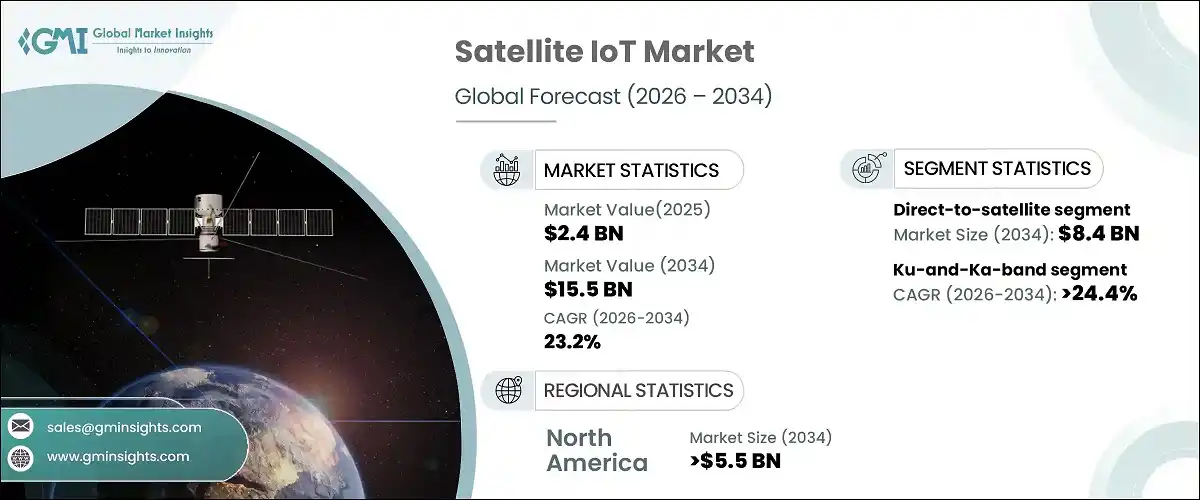
The global satellite IoT market was valued at USD 2.4 billion in 2025 and is estimated to grow at a CAGR of 23.2% from 2026 to 2034.
The market is expanding rapidly as enterprises seek reliable connectivity in remote, offshore, and infrastructure-poor regions where terrestrial networks are unavailable or unreliable. Industries such as logistics, agriculture, energy, mining, and utilities increasingly deploy satellite-enabled IoT to support real-time asset tracking, predictive maintenance, environmental monitoring, and operational automation. This demand is directly reflected in rising interest around satellite IoT market size in 2024 and 2025, as organizations evaluate long-term connectivity investments.
Satellite IoT Market Key Takeaways
Market Size & Growth
- 2024 Market Size: USD 2.4 Billion
- 2034 Forecast Market Size: USD 15.5 Billion
- CAGR (2025–2034): 23.2%
Key Market Drivers
- Expansion of Low Earth Orbit (LEO) satellite networks.
- Integration of satellite IoT with terrestrial networks enables seamless connectivity.
- Increasing demand for global connectivity.
- Growing incorporation of AI and edge computing into satellite IoT systems.
- Rise in IoT device penetration.
Challenges
- Data security concerns.
- High cost of maintenance.
Get Market Insights & Growth Opportunities
Market growth is further supported by advances in low-power wide-area networks (LPWAN), standardized non-terrestrial network protocols, and declining launch costs. A notable industry milestone occurred in November 2024, when Eseye and Sateliot partnered to deliver global 5G IoT connectivity from space using 3GPP Release 17-compliant LPWAN satellite technology, enabling seamless device connectivity via a single SIM card even in areas without cellular coverage.
Technological progress is also being driven by the transition from geostationary satellites to low Earth orbit (LEO) constellations, which significantly reduces latency and improves cost efficiency for real-time applications. The integration of nanosatellites, edge computing, and AI-driven analytics enhancing data processing at the network edge, while hybrid terrestrial-satellite architectures ensure continuous coverage across global operations. As investments in satellite infrastructure and IoT platforms accelerate, the satellite IoT market is positioned to become a foundational layer for next-generation industrial digitalization and sustainable resource management worldwide.
Growth Drivers
Expansion of Low Earth Orbit (LEO) Satellite Networks
The rapid expansion of Low Earth Orbit (LEO) satellite networks is a primary growth driver of the satellite IoT market, as enterprises increasingly demand low-latency, cost-efficient, and globally available connectivity. Unlike traditional geostationary satellites, LEO constellations operate closer to Earth, significantly reducing signal latency while improving data transmission reliability key advantages for time-sensitive satellite IoT applications such as asset tracking, fleet management, environmental monitoring, and critical infrastructure supervision.
Increasing Demand for Global Connectivity in the Satellite IoT Market
The market is being strongly driven by the rising demand for uninterrupted global connectivity as enterprises expand operations across remote, offshore, and infrastructure-limited regions. Traditional terrestrial networks often fail to deliver reliable coverage in such environments, pushing organizations to adopt advanced satellite IoT solutions that ensure continuous data transmission regardless of location. This demand is especially pronounced across logistics, maritime, agriculture, energy, mining, and environmental monitoring, where real-time visibility and operational continuity are business-critical.
Rise in IoT Device Penetration
The rapid rise in global IoT device penetration is a key growth driver accelerating the satellite IoT market, as enterprises increasingly deploy connected assets across geographically dispersed and infrastructure-limited environments. As IoT adoption expands in sectors such as logistics, agriculture, energy, mining, maritime, and utilities, the limitations of terrestrial networks are becoming more apparent. This gap is driving strong demand for scalable satellite IoT solutions that ensure uninterrupted connectivity beyond the reach of cellular and fiber networks.
Opportunity
Rising Technological Advancements in Satellite IoT
Rising technological advancements are significantly strengthening the satellite IoT market, as next-generation satellite architectures deliver higher performance, scalability, and cost efficiency. The adoption of advanced spectrum bands such as Ka-band and V-band in newer low Earth orbit (LEO) satellites is enabling higher data rates, enhanced security, and more focused beam coverage using smaller, energy-efficient antennas. These improvements are increasing per-satellite throughput and overall constellation capacity, directly supporting data-intensive satellite IoT applications across logistics, maritime, defense, energy, and environmental monitoring.
Challenges
Data security concerns
Data security concerns remain a critical challenge shaping adoption in the satellite IoT market, particularly as enterprises deploy connected devices across remote, cross-border, and mission-critical environments. Satellite-based networks transmit large volumes of sensitive operational data, making them potential targets for cyber threats such as signal interception, data breaches, spoofing, and unauthorized device access.
High cost of maintenance
High maintenance costs remain a key challenge restraining the growth of the satellite IoT market, particularly for large-scale and long-term deployments. Operating satellite-based networks requires continuous investment in satellite health monitoring, ground station infrastructure, software upgrades, and skilled technical personnel, all of which increase total cost of ownership for enterprises adopting satellite IoT solutions.
To get key market trends
Satellite IoT Market Trends
Satellite IoT Technology: Market Evolution and Enterprise Use Cases
The satellite IoT ecosystem is advancing rapidly as enterprises demand reliable, real-time connectivity beyond the reach of terrestrial networks. Modern IoT satellite technology, led by Low Earth Orbit (LEO) constellations, delivers lower latency, faster data transmission, and significantly lower operating costs than traditional geostationary systems making large-scale, real-time IoT deployments commercially viable. As a result, organizations are increasingly adopting integrated satellite IoT solutions designed for low-power, low-bandwidth devices that operate efficiently in remote and infrastructure-constrained environments.
A major industry shift is the emergence of hybrid architectures that combine satellite and cellular networks, accelerating growth in the hybrid satellite cellular terminal market and enabling seamless connectivity across global operations. This convergence supports mission-critical satellite IoT communication market use cases such as asset tracking, pipeline monitoring, smart agriculture, maritime logistics, and grid management. At the software layer, the expanding satellite enabled IoT software market is enhancing device orchestration, security, and analytics at scale.
Additionally, the integration of edge computing and artificial intelligence is transforming how data is processed and acted upon, reducing latency and bandwidth consumption while enabling predictive insights directly at the network edge. These capabilities are driving broader adoption of advanced satellite IoT applications across agriculture, transportation, energy, and environmental monitoring positioning satellite IoT as a foundational technology for resilient, globally distributed digital infrastructure.
The satellite IoT market continues to evolve amid a mix of structural challenges and emerging growth opportunities. High upfront infrastructure costs, spectrum constraints, and complex regulatory and licensing requirements for satellite deployment can slow adoption, particularly across developing regions. In some geographies, limited bandwidth availability also affects the scalability of satellite IoT communication market deployments. Despite these constraints, demand for always-on connectivity in remote, offshore, and infrastructure-poor environments is accelerating adoption of advanced satellite IoT solutions across industries.
The rapid maturation of IoT satellite technology, especially low Earth orbit (LEO) constellations, is significantly lowering deployment and operating costs while improving latency and network efficiency. This shift is enabling a broader range of satellite IoT applications, including asset tracking, environmental monitoring, precision agriculture, energy infrastructure management, and disaster response.
Satellite IoT Market Analysis
By Services Type

Learn more about the key segments shaping this market
Based on services type, the satellite IoT market is segmented into satellite IoT backhaul, and direct-to-satellite. The direct-to-satellite segment is poised to reach USD 8.4 billion by 2034.
- Low Earth Orbit (LEO) satellite constellations are a major growth engine for the direct-to-satellite segment of the satellite IoT market, enabling low-latency, seamless connectivity to IoT devices without relying on terrestrial infrastructure. This capability is especially valuable for enterprises operating in remote, offshore, and underserved regions, where conventional networks are unreliable or unavailable. As a result, leading satellite IoT companies and emerging IoT satellite companies are accelerating investments in LEO deployments to expand global coverage and improve data transmission performance. These advancements directly support high-value satellite IoT applications such as asset and fleet tracking, environmental and climate monitoring, critical infrastructure surveillance, and disaster response systems.
- The integration of 5G and standardized protocols such as 3GPP Release 17 is further strengthening direct-to-satellite connectivity by enabling higher throughput, lower power consumption, and secure device-to-satellite communication. This evolution is reshaping the satellite IoT communication market and making next-generation satellite IoT solutions commercially viable for data-intensive sectors including agriculture, logistics, utilities, and energy. At the software layer, growth in the satellite enabled IoT software market is improving device management, network orchestration, and real-time analytics, allowing enterprises to deploy and scale connected assets with greater operational visibility and reliability. Together, these developments position direct-to-satellite technology as a foundational component of enterprise-grade global IoT connectivity strategies.
By Frequency Band

Learn more about the key segments shaping this market
Based on frequency band, the satellite IoT market is segmented into L-band, Ku-and-Ka-band, S-band, and others. The Ku-and-Ka-band segment is expected to grow at a CAGR of over 24.4% from 2026 to 2034.
- Ku- and Ka-band frequencies are increasingly critical to the performance of the satellite IoT market, as they enable the high-throughput transmission required for data-intensive and time-sensitive operations. These bands support real-time monitoring, video telemetry, and continuous equipment diagnostics across maritime fleets, commercial aviation, and oil and gas facilities sectors that depend on stable connectivity in remote and harsh environments. To address this demand, leading satellite IoT companies and emerging IoT satellite companies are integrating Ku- and Ka-band capabilities into next-generation satellite IoT solutions, improving bandwidth efficiency and network reliability for enterprise deployments.
- Market adoption is accelerating due to the availability of compact and cost-efficient ground terminals optimized for Ku- and Ka-band operations. These terminals lower deployment barriers for small and mid-sized enterprises, smart agriculture projects, and remote healthcare providers, expanding the practical scope of satellite IoT applications. At the same time, innovations in beamforming and phased-array antenna technology are strengthening signal quality, minimizing latency, and enabling dynamic bandwidth allocation across moving assets.
Regional Insights

Looking for region specific data?
North America dominated the satellite IoT market and is expected to reach a value of over USD 5.5 billion by 2034. The market is expanding steadily across major economies as enterprises prioritize resilient, low-latency connectivity for distributed operations. In the United States, leading satellite IoT companies and emerging IoT satellite companies are accelerating the development of low Earth orbit (LEO) constellations to reduce latency and operating costs while improving network reliability. This progress is driving widespread adoption of hybrid connectivity models that combine satellite and terrestrial networks, strengthening the satellite IoT communication market for remote energy assets, logistics corridors, and infrastructure monitoring.
Germany is advancing rapidly as part of its Industry 4.0 agenda, with manufacturers and logistics providers deploying enterprise-grade satellite IoT solutions to bridge connectivity gaps in rural and cross-border operations. The satellite IoT market gained momentum in May 2024 when Exolaunch partnered with Sateliot to support launch and deployment services for Europe’s first 5G NB-IoT LEO constellation, reinforcing the region’s role in next-generation satellite IoT applications.
China continues to scale aggressively through state-backed investments in LEO infrastructure. Tianqi satellite program aims to deliver near real-time data services to agriculture, transportation, energy, and environmental monitoring sectors, accelerating demand for integrated platforms within the satellite enabled IoT software market.
In Asia-Pacific, Japan and South Korea are leveraging advanced 5G ecosystems, AI, and satellite integration to support smart cities, disaster management, and precision agriculture. Together, these regional developments underline the strategic shift toward software-driven, globally connected IoT architectures powered by next-generation satellite networks.
Satellite IoT Market Share

The satellite IoT industry is shaped by established aerospace leaders and a growing group of specialized connectivity providers that design satellite constellations, upgrade communication infrastructure, and deliver integrated IoT platforms for enterprise customers. Key satellite IoT companies such as RTX, Thales Alenia Space, Maxar Technologies, and OHB continue to invest heavily in low-latency and high-throughput satellite systems to support large-scale industrial deployments. Alongside them, innovative IoT satellite companies are strengthening the ecosystem with software-centric solutions focused on device management, data security, and real-time analytics.
Competition increasingly extends beyond hardware performance to the software layer, where vendors seek to capture a larger satellite enabled IoT software market share by offering scalable platforms that simplify network orchestration and application integration across thousands of connected assets. For enterprise buyers, this software capability is becoming as critical as satellite coverage and bandwidth, particularly for use cases such as asset tracking, smart utilities, energy infrastructure monitoring, and maritime operations.
To accelerate market penetration and broaden service portfolios, providers frequently engage in strategic partnerships, technology alliances, and co-development initiatives. These collaborations help expand geographic reach, reduce deployment costs, and ensure compatibility with emerging non-terrestrial network standards. Overall, the competitive environment is evolving toward vertically integrated, hardware-software ecosystems designed to deliver reliable, cost-efficient, and globally available IoT connectivity for industrial and government organizations.
Satellite IoT Market Companies
Major players operating in the satellite IoT industry are:
- AAC Clyde Space
- Airbus
- BAE Systems
- Blue Origin
- China Aerospace Science and Technology Corporation
- Exolaunch
- GomSpace
- Lockheed Martin
- Maxar Technologies
- Millennium Space Systems
- Mitsubishi Electric
- Northrop Grumman
- OHB
- OneWeb
- RTX
- Sierra Nevada
- SpaceX
- Thales Alenia Space
Satellite IoT Market Report Attributes
| Key Takeaway | Details |
|---|---|
| Market Size & Growth | |
| Base Year | 2024 |
| Market Size in 2024 | USD 2.4 Billion |
| Forecast Period 2026 – 2034 CAGR | 23.2% |
| Market Size in 2034 | USD 15.5 Billion |
| Key Market Trends | |
| Growth Drivers |
|
| Pitfalls & Challenges |
|
What are the growth opportunities in this market?
Satellite IoT Industry News
- Completed the acquisition of Intelsat for $3.1 billion, creating a global multi-orbit satellite operator with combined revenue projected at €3.7 billion and a contract backlog of ~€8 billion. The combined entity will serve high-growth markets including IoT connectivity.
- Soracom announced the general availability of its integrated Satellite IoT connectivity solution with Skylo, enabling hybrid cellular + satellite IoT deployment for customers across multiple regions.
- Advanced its LEO satellite constellation by manufacturing 5 new satellites with Alén Space, scheduled for launch in 2026, holding contracted commitments worth ~€270 million with customers in 50+ countries.
- The Satellite-as-a-Service market is projected to grow from $4.76 billion in 2025 to $5.56 billion in 2026, driven by IoT and other satellite data services.
- Announced plans for national coverage in early 2026 using its next-gen satellites with operators across 50+ mobile networks (news reported as business launch details impacting satellite IoT-related connectivity).
This satellite IoT market research report includes in-depth coverage of the industry with estimates & forecast in terms of revenue (USD million) from 2021 to 2034, for the following segments:
Market, By Services Type
- Satellite IoT backhaul
- Direct-to-satellite
Market, By Frequency Band
- L-Band
- Ku-and-ka-band
- S-band
- Others
Market, By Organization Size
- Large enterprises
- SMEs
Market, By Application
- Maritime
- Oil & gas
- Energy & utilities
- Transportation & logistics
- Healthcare
- Agriculture
- Military & defense
- Others
The above information is provided for the following regions and countries:
- North America
- U.S.
- Canada
- Europe
- UK
- Germany
- France
- Italy
- Spain
- Russia
- Asia Pacific
- China
- India
- Japan
- South Korea
- Australia
- Latin America
- Brazil
- Mexico
- MEA
- UAE
- Saudi Arabia
- South Africa
Frequently Asked Question(FAQ) :
What is the market size of the satellite IoT in 2025?
The market size was valued at USD 2.4 billion in 2025, with a CAGR of 23.2% expected from 2026 to 2034. The growth is driven by the need for reliable connectivity in remote and infrastructure-poor regions.
What is the projected value of the satellite IoT market by 2034?
The market is poised to reach USD 15.5 billion by 2034, fueled by advancements in Low Earth Orbit (LEO) constellations and increasing adoption of direct-to-satellite connectivity.
How much revenue will the Ku-and-Ka-band segment generate by 2034?
The Ku-and-Ka-band segment is set to expand at a CAGR of over 24.4% till 2034, led by demand for high-throughput transmission in data-intensive operations.
What is the growth outlook for the direct-to-satellite segment?
The direct-to-satellite segment is poised to cross USD 8.4 billion by 2034, supported by the deployment of LEO satellite constellations that enable low-latency, seamless connectivity in remote regions.
Which region leads the satellite IoT sector?
North America leads the market and is expected to surpass USD 5.5 billion by 2034. The U.S. is driving growth through the development of LEO constellations and hybrid connectivity models.
What are the upcoming trends in the satellite IoT market?
Trends include hybrid satellite-cellular connectivity, AI- and edge-enabled data processing, advances in Ku- and Ka-band technologies, and growing use of satellite-enabled IoT software for analytics and security.
Who are the key players in the satellite IoT industry?
Key players include AAC Clyde Space, Airbus, BAE Systems, Blue Origin, Exolaunch, GomSpace, Lockheed Martin, Maxar Technologies, Millennium Space Systems, and Mitsubishi Electric.
Satellite IoT Market Scope
Related Reports