Summary
Table of Content

Protein Hydrolysates for Wound Healing Market
Get a free sample of this report
Form submitted successfully!
Error submitting form. Please try again.
Thank you!
Your inquiry has been received. Our team will reach out to you with the required details via email. To ensure that you don't miss their response, kindly remember to check your spam folder as well!
Request Sectional Data
Thank you!
Your inquiry has been received. Our team will reach out to you with the required details via email. To ensure that you don't miss their response, kindly remember to check your spam folder as well!
Form submitted successfully!
Error submitting form. Please try again.
Protein Hydrolysates for Wound Healing Market Size
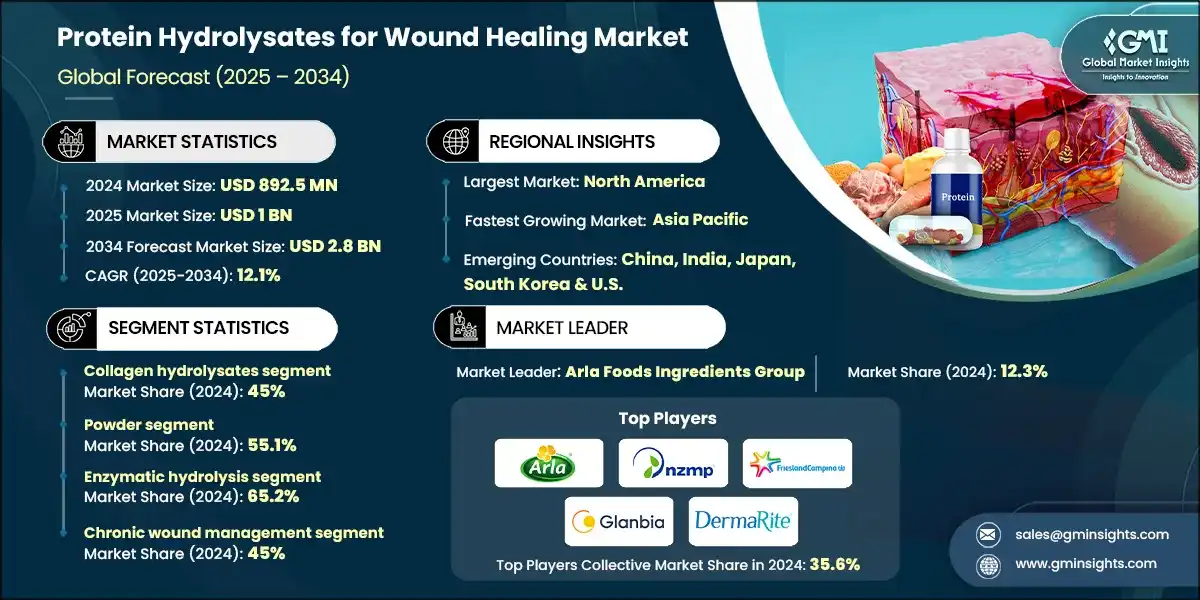
The global protein hydrolysates for wound healing market size was estimated at USD 892.5 million in 2024. The market is expected to grow from USD 1 billion in 2025 to USD 2.8 billion in 2034, at a CAGR of 12.1% according to latest report published by Global Market Insights Inc.
Protein Hydrolysates for Wound Healing Market Key Takeaways
Market Size & Growth
- 2024 Market Size: USD 892.5 Million
- 2025 Market Size: USD 1 Billion
- 2034 Forecast Market Size: USD 2.8 Billion
- CAGR (2025–2034): 12.1%
Regional Dominance
- Largest Market: North America
- Fastest Growing Region: Asia Pacific
Key Market Drivers
- Rising incidence of chronic wounds.
- Innovations in wound care technologies.
- Growing aging population.
Challenges
- High cost of production.
- Regulatory challenges.
Opportunity
- Increasing adoption in advanced wound care products.
- Technological advancements.
- Rising focus on natural and biocompatible materials.
Key Players
- Market Leader: Arla Foods Ingredients Group led with over 12.3% market share in 2024.
- Leading Players: Top 5 players in this market include Arla Foods Ingredients Group, Fonterra NZMP, FrieslandCampina Ingredients, Glanbia plc, DermaRite, which collectively held a market share of 35.6% in 2024.
Get Market Insights & Growth Opportunities
- The market for protein hydrolysates for wound healing continues to make growth due to increased awareness of advanced wound care solutions as well as the rising burden of chronic wounds. This means that these protein hydrolysates which result from the enzymatic breakdown of proteins induced from collagen, keratin, and gelatin play a very important role in accelerating the wound healing process. They provide key amino acids and bioactive peptides, which induce tissue regeneration, reduce inflammation, and enhance collagen synthesis, and thus lead to faster recovery.
- The protein hydrolysates that speed up the healing process bring benefits such as improved wound closure and lowered scarring, and thus their biocompatibility is adapted for medical applications. These are used extensively in wound dressings, topical formulations & regenerative medicine because of their qualities that stimulate cellular activity and enhance the healing environment.
- There are great opportunities for venturing into this vast market, considering the rising incidences of diabetic foot ulcers, pressure ulcers, and surgical wounds across nations. Further, the expanding aged population is positively contributing to the demand in advanced wound care products. Besides, the development of innovative formulations with protein hydrolysates will create new opportunities for growth. The booming healthcare infrastructure in emergent economies, coupled with increasing R&D activities undertaken by key market players to develop bioactive and functional wound healing products, is expected to propel the market forward.
- North America is the largest market for protein hydrolysates for wound healing due to advancement in technology and research facilities in U.S. & Canada.
- Asia Pacific is the fastest growing region for protein hydrolysates for wound healing market, due to increasing need from medical industry, also the region can enhance its performance in this market in the coming years.
To get key market trends
Protein Hydrolysates for Wound Healing Market Trends
- The protein hydrolysates for wound healing industry exhibits dynamic growth due to technological changes, changing regulations, and innovations in product development. Technological advances in enzymatic hydrolysis, peptide purification, and delivery systems have increased the bioavailability, efficacy, and targeted action of the protein hydrolysates. This ultimately aids in developing tailor-made formulations that can accelerate tissue regeneration and reduce healing time, thus catering to the increasing demand for advanced wound care solutions.
- Regulations in different parts of the world influence dynamism in their respective markets, strict protocols for medical-grade products require exhaustive safety and efficacy testing. There is a balancing act between the different countries with an attempt to create an international standard. Companies thus invest heavily in compliance and clinical validation to render their products acceptable to said standards, which can be seen as both an extraneous barrier and an opportunity for differentiation.
- Another major driving force lies in product innovation, ongoing research focuses on bioactive peptides derived from dairy, plant, and marine sources. These peptides are formulated to foster cell proliferation, promote the resolution of inflammation and support collagen synthesis in relation to improving healing outcomes.
Protein Hydrolysates for Wound Healing Market Analysis

Learn more about the key segments shaping this market
Based on product type, the market is segmented into collagen hydrolysates, marine protein hydrolysates, whey protein hydrolysates, and specialized amino acid formulations.
- Collagen hydrolysates lead the protein hydrolysates for wound healing market with a share of 45% in 2024 which indicates established clinical efficacy, regulatory acceptance as well as various formulations for use. Bovine, porcine, equine, avian, and marine sources make up various origins of collagen hydrolysates, among which animal-derived sources stand commercially dominant, despite increasing activity towards marine and recombinant alternatives.
- Marine protein hydrolysates accounted for 25.1% of the market share in 2024 with the CAGR of 12.3% till 2034, owing to sustainability issues, new sourcing paradigms, and specific bioactive-peptide profiles. Marine protein hydrolysates are produced from fish skin, bones, scales, cartilage, and by-products of processing (e.g. salmon, tuna, sea bass, tilapia, mackerel, and multiple other species).
- Whey protein hydrolysates occupied 19.9% of the market in 2024 with a CAGR of 12% up to 2034. Such proteins are byproducts of cheese manufacturing and contain large proportions of essential amino acids, branched-chain amino acids and bioactive peptides having antioxidants, antimicrobial, immunomodulatory, and mineral binding properties relevant to wound healing.
Learn more about the key segments shaping this market
Based on physical form, the protein hydrolysates for wound healing market is segmented into powder and liquid.
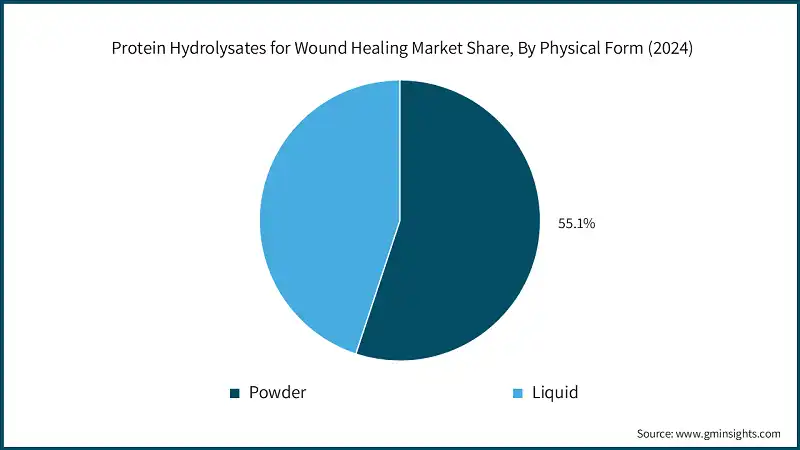
- Powder formulations accounted for a market share of 55.1% in 2024. They offer high protein concentration, long shelf life, possibility of convenience in storage and transport, application for various purposes, and affordability. The protein hydrolysate powders are obtained from spray-drying, freeze-drying, or vacuum-drying methods after enzymatic hydrolysis and purification. The flexibility of powder products is user-friendly to both healthcare providers and patients.
- Liquid formulations currently account for a 44.9% market share providing the immediacy of use, better bioavailability, and applicability of delivery systems such as sprays, and injections. Liquid protein hydrolysates are produced by enzymatic hydrolysis followed by centrifugation or filtration to separate the liquid extracts from the solid matrices. Thus, liquid formulations are suitable for clinical applications requiring immediate use without reconstitution accurately dosing, and uniform distribution over wounds.
Based on processing methods, the protein hydrolysates for wound healing market is segmented into enzymatic hydrolysis, acid hydrolysis, alkaline hydrolysis, and combined processing methods.
- Enzymatic hydrolysis has a 65.2% share in the market in 2024, its merits are mild reaction conditions, preservation of bioactivity, minimal formation of by-products, environment-friendly, and easy enzyme inactivation.
- Acid hydrolysis commands a market share of 19.8% in 2024, with advantages including fast reaction rates, total breakdown of proteins, and lower costs compared to the enzymatic process. Acid hydrolysis is still very valid as far as collagen extraction from animal tissues, amino acid mixes for nutritional supplementation, and cost-sensitive markets where poor processing methods are economically acceptable.
- Alkaline hydrolysis accounts for a 10% market share, which uses bases like sodium hydroxide (NaOH) or potassium hydroxide (KOH) to cleave peptide bonds at elevated temperatures. Alkaline hydrolysis can be coupled with enzymatic treatment to assist in the efficient extraction and hydrolysis of proteins.
Based on application, the protein hydrolysates for wound healing market is segmented into chronic wound management, acute wound care, post-surgical recovery, and preventive wound care.
- Chronic wound management resembles large market share of 45% in 2024 and has shown it to be growing at an impressive 12.1% CAGR till 2034. This kind of management would involve introducing meaningful changes to the management of wounds that never seem to heal within three months of their normal healing stages. Development of products would involve combining all possibilities of therapies such as using protein hydrolysates with antimicrobials, growth factors, and advanced delivery systems to address the complex pathophysiology among chronic wounds.
- Acute wound management constitutes 30.2% market share in 2024. The importances of acute wound care address traumatic injuries, surgery and burn wounds, which are expected to heal through natural physiological processes generally within a predictable time frame. The use of protein hydrolysates hastens healing in acute wounds that include reduced complication occurrences associated with these wounds and aesthetically superior results.
- Post-surgical recuperation comprises 19.9% market share in 2024. It includes nutritional support and wound-healing enhancement following surgery. This section involves oral protein hydrolysate supplements, formulations for enteral nutrition, and topical applications targeting surgical site management.
- Preventative wound care focuses on preventing the occurrence of wounds in at-risk groups, diabetic patients, individuals with vascular disease, and older persons with thinning skin. This segment includes using protein hydrolysate-containing products for skin care prophylactically, nutritional supplementation to contribute to maintaining skin integrity, and protective dressings for pressure points.
Looking for region specific data?
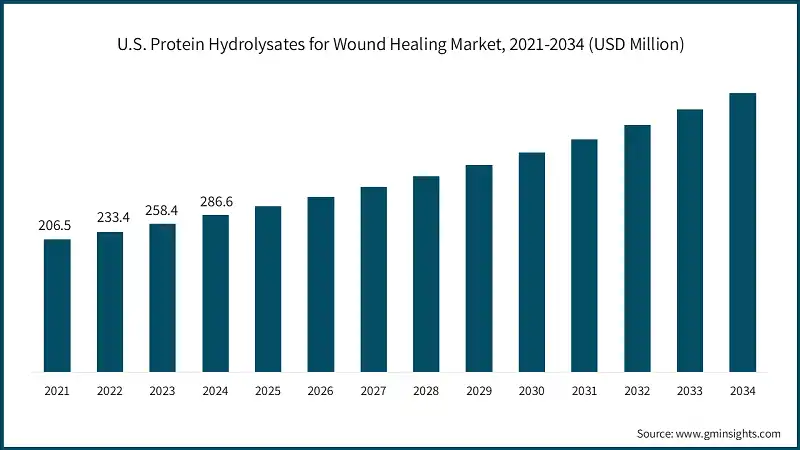
North America accounted for the largest share of the protein hydrolysates for wound healing market with 40.1% of the revenue share in 2024 and 12.3% CAGR through 2034.
- The North American market for protein hydrolysates for wound healing is experiencing growth due to the improved healthcare infrastructure of North America and its increased incidence of chronic wounds. Further, the market is expanded due to rising awareness about innovative wound care solutions and the presence of major market players. Also, the acceptance of minimally invasive treatments and increased R&D activities bolster growth further. Its increased focus on personalized medicine and advanced wound management products is expected to maintain the upward trend, making North America one of the significant contributors to the global market.
Europe protein hydrolysates for wound healing market accounted for USD 268.2 million in 2024 and is anticipated to show steady growth over the forecast period.
- Europe has a trend toward the adoption of protein hydrolysates for wound healing, associated with stringent regulatory measures and a sound healthcare system. The number of older people is increasing, accompanied by a sharp rise in diseases such as diabetes, which have increased incidences of chronic wounds. Countries in Europe have invested heavily in research and development, together creating new formulations and therapies. Consumers increasingly prefer sustainable and biocompatible products, further boosting the market growth in Europe.
The Asia Pacific protein hydrolysates for wound healing market is anticipated to grow at the CAGR of 12.4% during the analysis timeframe.
- Rapid growth is observed in the Asia Pacific region regarding protein hydrolysates for wound healing. The infrastructural development in healthcare and pharmaceutical investments in developing countries like India and China are driving this market. From another angle, the looming challenges posed by the aging population factor into the increasing demand for diabetic ulcers. Moreover, local manufacturing and the initiatives from governments aimed at improved access to healthcare are all serving to further elevate the flourishing market landscape.
Latin America protein hydrolysates for wound healing market accounted for 6% revenue share in 2024 and is anticipated to show steady growth over the forecast period.
- Moderate growth prospects are shown for Latin America in the trend of the market toward protein hydrolysates in wound healing. Advanced wound care facilities are growing along with increased awareness regarding them. The increasing burden of chronic diseases combined with increasing attention being given to post-surgical recovery helps to push forward these developments in the market. However, economic constraints, as well as limited access to the latest therapies available in certain parts, have somewhat hampered market growth. However, continuous reforms in healthcare systems are expected to promote increased market development.
Middle East & Africa protein hydrolysates for wound healing market accounted for 3.8% revenue share in 2024 and is anticipated to show lucrative growth over the forecast period.
- In the MEA, the market for protein hydrolysates in wound healing is growing along with the advancement of the healthcare sector and improved accessibility. The trend indicates an increasing demand for innovative wound solutions with a high rate of chronic wounds and infections. Slowly but steadily the market is becoming dynamic due to economic diversification and investments made into healthcare but still relatively low for market growth mainly due to unavailability of resources and awareness. Strategic collaborations and government initiatives facilitate faster adoption of new advanced wound healing therapies in the region.
Protein Hydrolysates for Wound Healing Market Share
The top 5 companies in the protein hydrolysates for wound healing industry include Arla Foods Ingredients Group, Fonterra NZMP, FrieslandCampina Ingredients, Glanbia plc, DermaRite. These are prominent companies operating in their respective regions covering 35.6% market share. These companies hold strong positions globally due to their experience in protein hydrolysates for wound healing market. Their diverse product portfolios, backed by robust production capabilities and distribution networks, enable them to meet the rising demand across various regions.
- Arla Foods Ingredients is a prominent player known for its innovative dairy-based ingredients, including high-quality protein hydrolysates. The company's focus on research and development enables it to develop specialized products for wound healing applications, leveraging its strong dairy expertise. Its extensive distribution network and strategic partnerships help maintain a competitive edge in the global market.
- Fonterra NZMP division is a key player of dairy ingredients, including protein hydrolysates used in wound healing. With its large-scale dairy operations and global supply chain, Fonterra offers reliable and consistent products. Its emphasis on sustainability and quality assurance provides a competitive advantage in meeting the stringent requirements of healthcare markets.
- FrieslandCampina Ingredients is known for its diverse portfolio, including bioactive peptides and hydrolysates for wound healing. The company's strong innovation pipeline and focus on nutritional science position it well in this niche market. Its global presence and emphasis on sustainable practices bolster its competitive standing.
- Glanbia Nutritionals is a well-recognized player with quite diverse businesses and strong dairy and nutritional ingredients. With a thrust at innovation from big investments in R&D, it earned a great reputation positioned for whey protein isolate. Glanbia offers production capabilities of scale efficiency by its manufacturing footprint and key strategic alliances to yield upon timely deliverability of those high-quality ingredients customized.
- DermaRite makes a market for the wound healing hydrolysate segment with ProHeal liquid protein focusing on clinical nutrition and recovery from pressure ulcers. Its strength is in U.S. healthcare distribution and cost-efficient formulations.
Protein Hydrolysates for Wound Healing Market Companies
Major players operating in the protein hydrolysates for wound healing industry include:
- Arla Foods Ingredients
- Davisco Foods International
- DermaRite
- Fonterra NZMP
- FrieslandCampina
- Glanbia plc
- Hilmar Ingredients
- Hymed
- Ingredia SA
- Medtrition
- Nutriform
Protein Hydrolysates for Wound Healing Market Report Attributes
| Key Takeaway | Details |
|---|---|
| Market Size & Growth | |
| Base Year | 2024 |
| Market Size in 2024 | USD 892.5 Million |
| Market Size in 2025 | USD 1 Billion |
| Forecast Period 2025 - 2034 CAGR | 12.1% |
| Market Size in 2034 | USD 2.8 Billion |
| Key Market Trends | |
| Drivers | Impact |
| Rising incidence of chronic wounds | Increasing cases of diabetic foot ulcers, pressure ulcers, and surgical wounds globally drive demand for effective healing agents. |
| Innovations in wound care technologies | Continuous R&D efforts leading to new formulations incorporating protein hydrolysates that accelerate tissue regeneration. |
| Growing aging population | The aged demographic is more prone to wounds and slow healing, boosting the need for advanced therapeutic solutions. |
| Pitfalls & Challenges | Impact |
| High cost of production | The complex extraction and purification processes of protein hydrolysates can lead to high manufacturing costs, limiting affordability. |
| Regulatory challenges | Stringent regulatory approval processes for medical and wound care products containing bioactive ingredients can delay market entry. |
| Opportunities: | Impact |
| Increasing adoption in advanced wound care products | Growing use of protein hydrolysates in innovative wound dressings and regenerative formulations to enhance healing efficacy. |
| Technological advancements | Development of nano and micro-encapsulated protein hydrolysates to improve bioavailability and targeted delivery in wound management. |
| Rising focus on natural and biocompatible materials | Preference for bio-based, biodegradable, and biocompatible ingredients like protein hydrolysates in medical applications. |
| Market Leaders (2024) | |
| Market Leaders |
12.3% |
| Top Players |
Collective market share in 2024 is 35.6% |
| Competitive Edge |
|
| Regional Insights | |
| Largest Market | North America |
| Fastest growing market | Asia Pacific |
| Emerging countries | China, India, Japan, South Korea & U.S. |
| Future outlook |
|
What are the growth opportunities in this market?
Protein Hydrolysates for Wound Healing Industry News
- In April 2025, FrieslandCampina Ingredients released its new performance and active nutrition ingredient called Nutri Whey ProHeat. The heat-stable whey protein is designed to meet the needs of performance and active nutrition products. This is not a highly specific antimicrobial hydrolysate product, but its novelty in protein processing (especially hydrolysis/heat-stability) is an indicator of a rising ability to customize peptide/protein systems, which are needed to develop antimicrobial-functioning hydrolysates.
- In November 2024, Arla Foods Ingredients launched Lacprodan DI-3092, a hydrolyzed whey protein for medical nutrition. It improves digestibility and absorption of amino acids, both of which have posed key challenges in medical nutrition applications.
- In May 2024, FrieslandCampina Ingredients launched its new concept, Biotis DHA Flex Powders and Biotis Fermentis, to adult nutrition with algae-based and fermented peptides+ prebiotics systems, at Vitafoods Europe. This trend has indicated growing interest in multifunctional peptide solutions (antimicrobial potential) and growing versatility of hydrolysate use in non-nutritional uses.
This protein hydrolysates for wound healing market research report includes in-depth coverage of the industry, with estimates & forecasts in terms of revenue (USD Million) and volume (Kilo Tons) from 2025 to 2034, for the following segments:
Market, By Product Type
- Collagen hydrolysates
- Bovine collagen hydrolysates
- Porcine collagen hydrolysates
- Marine collagen hydrolysates
- Avian collagen hydrolysates
- Marine protein hydrolysates
- Fish-derived bioactive peptides
- Shellfish-derived hydrolysates
- Algae-based protein hydrolysates
- Jellyfish collagen peptides
- Whey protein hydrolysates
- Specialized amino acid formulations
- Arginine-enriched hydrolysates
- Glutamine-enhanced formulations
- Branched-chain amino acid complexes
Market, By Physical Form
- Powder
- Liquid
Market, By Processing Method
- Enzymatic hydrolysis
- Acid hydrolysis
- Alkaline hydrolysis
- Combined processing methods
Market, By Application
- Chronic wound management
- Diabetic foot ulcers
- Pressure injuries/ulcers
- Venous leg ulcers
- Arterial ulcers
- Acute wound care
- Surgical wounds
- Traumatic injuries
- Burn treatment
- Emergency wound care
- Post-surgical recovery
- Orthopedic surgery recovery
- Cardiovascular surgery support
- General surgery applications
- Plastic & reconstructive surgery
- Preventive wound care
- High-risk patient nutritional support
- Pre-surgical conditioning
- Immunocompromised patient care
- Geriatric wound prevention
The above information is provided for the following regions and countries:
- North America
- U.S.
- Canada
- Europe
- Germany
- UK
- France
- Spain
- Italy
- Rest of Europe
- Asia Pacific
- China
- India
- Japan
- Australia
- South Korea
- Rest of Asia Pacific
- Latin America
- Brazil
- Mexico
- Argentina
- Rest of Latin America
- Middle East and Africa
- Saudi Arabia
- South Africa
- UAE
- Rest of Middle East and Africa
Frequently Asked Question(FAQ) :
What is the market size of the protein hydrolysates for wound healing in 2024?
The market size was USD 892.5 million in 2024, with a CAGR of 12.1% expected through 2034. The growth is driven by increased awareness of advanced wound care solutions and the rising prevalence of chronic wounds.
What is the projected value of the protein hydrolysates for wound healing market by 2034?
The market is poised to reach USD 2.8 billion by 2034, fueled by advancements in enzymatic hydrolysis, peptide purification, and delivery systems.
What is the expected size of the protein hydrolysates for wound healing industry in 2025?
The market size is projected to reach USD 1 billion in 2025.
What was the market share of marine protein hydrolysates in 2024?
Marine protein hydrolysates accounted for 25.1% of the market share in 2024, with a CAGR of 12.3% projected through 2034.
What was the market share of powder formulations in 2024?
Powder formulations held a 55.1% market share in 2024, led by their high protein concentration, long shelf life, ease of storage and transport, and cost-effectiveness.
What was the market share of enzymatic hydrolysis in 2024?
Enzymatic hydrolysis dominated the market with a 65.2% share in 2024, owing to its mild reaction conditions, preservation of bioactivity, minimal by-product formation, and eco-friendliness.
Which region leads the protein hydrolysates for wound healing sector?
North America leads the market with a 40.1% revenue share in 2024 and a projected CAGR of 12.3% through 2034. Growth is driven by advanced healthcare infrastructure, rising chronic wound cases, and increased adoption of innovative wound care solutions.
What are the upcoming trends in the protein hydrolysates for wound healing market?
Trends include advanced enzymatic hydrolysis, bioactive peptides from diverse sources, and customized formulations to improve tissue regeneration and healing.
Who are the key players in the protein hydrolysates for wound healing industry?
Key players include Arla Foods Ingredients, Davisco Foods International, DermaRite, Fonterra NZMP, FrieslandCampina, Glanbia plc, Hilmar Ingredients, Hymed, Ingredia SA, Medtrition, and Nutriform.
Protein Hydrolysates for Wound Healing Market Scope
Related Reports