Summary
Table of Content

Precision Fermentation-Based Protein Hydrolysates Market
Get a free sample of this report
Form submitted successfully!
Error submitting form. Please try again.
Thank you!
Your inquiry has been received. Our team will reach out to you with the required details via email. To ensure that you don't miss their response, kindly remember to check your spam folder as well!
Request Sectional Data
Thank you!
Your inquiry has been received. Our team will reach out to you with the required details via email. To ensure that you don't miss their response, kindly remember to check your spam folder as well!
Form submitted successfully!
Error submitting form. Please try again.
Precision Fermentation-Based Protein Hydrolysates Market Size
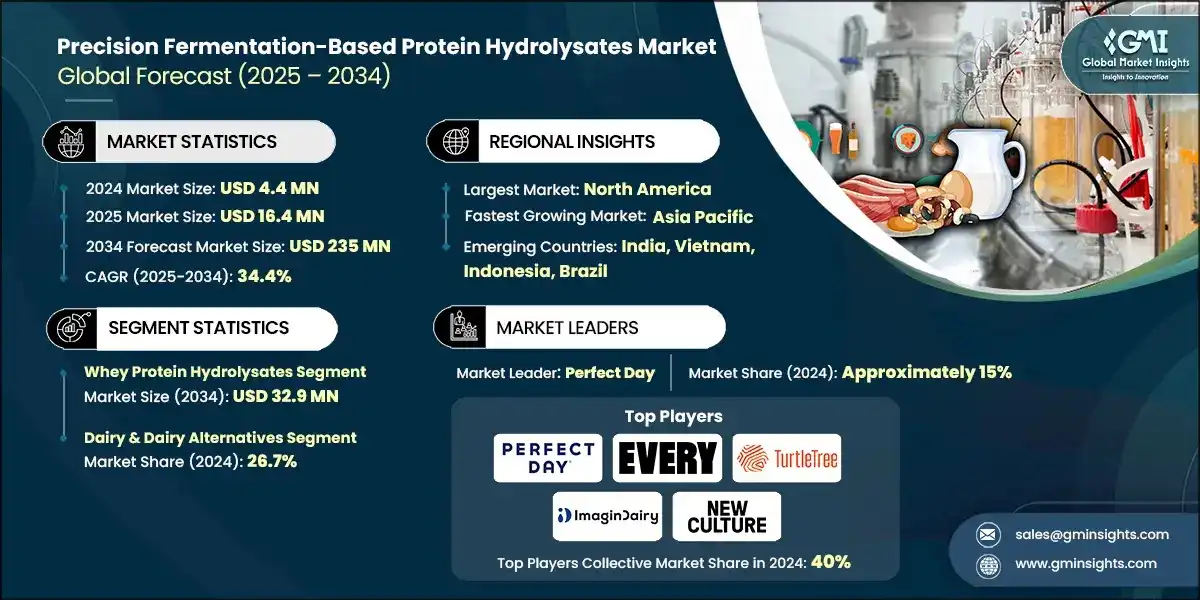
The global precision fermentation-based protein hydrolysates market size was valued at USD 4.4 million in 2024. The market is expected to grow from USD 16.4 million in 2025 to USD 235 million in 2034, at a CAGR of 34.4% according to latest report published by Global Market Insights Inc.
Precision Fermentation-Based Protein Hydrolysates Market Key Takeaways
Market Size & Growth
- 2024 Market Size: USD 4.4 Million
- 2025 Market Size: USD 16.4 Million
- 2034 Forecast Market Size: USD 235 Million
- CAGR (2025–2034): 34.4%
Key Market Drivers
- Rising Demand for Allergy-Free, Hypoallergenic Protein Sources.
- Regulatory Greenlights (GRAS, Novel Food Approval).
- Sustainable and Label-Friendly Ingredient Sourcing.
Challenges
- High Cost of Production and Downstream Processing.
- Regulatory Complexity Across Geographies.
- Strain IP and Tech Barrier from Leading Players.
Opportunity
- Functional Personal Care & “Beauty-from-Within” Products.
- Market Expansion in Asia Pacific & GCC via Infrastructure Investment.
- Pharma-Grade Growth Factor Hydrolysates & Therapeutic Peptides.
Key Players
- Market Leader: Perfect Day led with over 15% market share in 2024.
- Leading Players: Top 5 players in this market include Perfect Day, The EVERY Company, TurtleTree, Imagindairy, New Culture, which collectively held a market share of 40% in 2024.
Get Market Insights & Growth Opportunities
Several converging factors have led the market to project a substantial CAGR owing to regulatory approvals that clear the path to market entry for foundational precision-fermented proteins that will be used as feedstocks for the production of hydrolysates; commissioning of large-scale fermentation facilities that have capacities which exceed 100,000 liters that will vastly increase the supply of protein; production costs that will decline as process optimization and economies of scale brings unit economics nearer parity with that of conventional proteins; and application development that is expanding as food, nutrition and pharmaceutical companies develop products using precision fermented protein hydrolysates.
The hydrolysates has several streams of revenue including premium-priced ingredients for infant formula, medical nutrition products, sports performance supplements, functional food ingredients, cosmeceuticals actives, and animal feed additives; each creating challenges and value propositions for higher-priced products than those that are commodity protein ingredients.
Protein hydrolysates derived from precision fermentation are increasingly engineered to also release bioactive peptides that have been shown to provide health benefits through clinical research, such as antihypertensive, antioxidant, anti-microbial, immunomodulatory, or mineral-binding activities. The best part about designing peptide sequences via strategic upstream genomic design and downstream enzymatic hydrolysis means that manufacturers can produce hydrolysates fortified with distinct bioactive motifs like the cardiovascular health-focused VPP and IPP dia, or specialized leucine-rich peptides aimed at muscle protein synthesis.
These designer hydrolysates will be employed in functional food formulations, clinical nutrition products developed for sarcopenia and metabolic disorders, and in infant formula with human milk protein replacements, which have both superior bioavailability and low levels of immunogenicity when compared to these products made from bovine-sourced proteins.
Investment in manufacturing infrastructure is gaining momentum in market development, with cumulative capital investments in precision fermentation infrastructure projected to exceed USD 250 billion by 2050. Upcoming capacity expansions include Perfect Day's facility in Gujarat and Liberation Labs' Indiana facility, with an annual production capacity of 600-1,200 tones over a 600,000-liter batch amount.
Other companies are entering into contract manufacturing agreements that allow for the scaling of production without fully investing in facility construction or scaling. The supply of precision-fermented protein hydrolysates will experience exponential growth as manufacturing facilities build capacity and companies build hydrolysis capacity downstream. When processed and hydrolyzed, the food grade supply of precision fermented protein hydrolysates will become more accessible, supporting category penetration across applications and geography.
To get key market trends
Precision Fermentation-Based Protein Hydrolysates Market Trends
- The accelerated utilization of artificial intelligence (AI), machine learning, and high-throughput automation has converged within the process of precision fermentation workflows to advance strain development and optimization for protein hydrolysate production. Organizations utilize AI-infused design-build-test-learning (DBTL) cycles to reduce strain engineering timelines from months to weeks, such as Helaina, who has said they could test ~300 genetic variations over five weeks, relying on ~170 million lines of machine-readable fermentation data to train 11 predictive models.
- Predictive computational tools, in silico, for economically optimizing gene expression cassettes, discovering metabolic pathway configurations, and determining fermentation conditions can all occur before testing physical experimentations on large-scale engineered strains, cutting R&D costs, and fostering quicker time-to-market for new protein hydrolysates.
- Additionally, industry applications of Bayesian optimization algorithms and reinforcement learning algorithms to real-time control of bioreactors will lead to adaptive management initiating bioprocess optimization for maximum protein titers, substantial reductions in metabolic burden, and consistent product quality across production batches. Overall, convergence will lead to continual improvements in production economics: industry predictions indicate 50% reductions could be achieved in the next five years employing process intensification and yield optimization.
- The sector is shifting from conventional fed-batch fermentation to both continuous and "hyper-fermentation" methods that markedly improve productivity and capital efficiency. Continuous fermentation systems can maintain active cultures for long periods of time; there are reports of production runs lasting over eight months at 10,000 liter scale while producing consistently stable cultures. Continuous systems also avoid the downtime associated with batch-based system turnover, cleaning, and inoculation. Utilizing continuous fermentation can increase productivity from a given fermentation asset annually by 3-5 times versus batch processing, increasing the return on capital investment and reducing per unit costs of production.
- Companies are looking to convert aerobic fermentations to anaerobic fermentations for some protein products as this avoids energy-intensive aeration requirements and also allows for lower-cost substrates in the fermentation resulting in improved overall economic metrics for the process.
- The adoption of contamination-resistant strains, implementation of state-of-the-art process analytical technology to monitor and manage fermentation in real-time, and new systems for automatizing the control systems are allowing for extended production campaigns while meeting product quality and biosafety requirements. As continuous fermentation becomes a more normalized methodology, the industry is anticipated to provide consistent, high volume protein supply necessary to create large-scale hydrolysate for widespread food use.
- The production of precision-fermented proteins with human-like or optimized structures to produce hydrolysates with better quality is becoming more popular because of advanced glycoengineering and post-translational modification (PTM) techniques and technologies. Bacterial expression system produce yield, while lacking many of the cell machinery needed to make complex PTMs such as glycosylation, phosphorylation, and disulfide bonds which are vital for protein functionality and bioactivity.
- Companies are increasingly utilizing yeast systems such as both Komagataella phaffii (Pichia pastoris) and filamentous fungi which allow for mammalian-like PTMs, culminating in a recent release of OPENPichia, a license-free K. phaffii chassis and toolkit which helps to democratize access to high-performing expression systems.
- Glycoengineered strains are also being developed to produce proteins that have a human identical glycosylation pattern which is an important application for infant formula, where human milk protein equivalents are shown to have better immunological compatibility and less allergenicity in infants than bovine sources.
Precision Fermentation-Based Protein Hydrolysates Market Analysis
Learn more about the key segments shaping this market
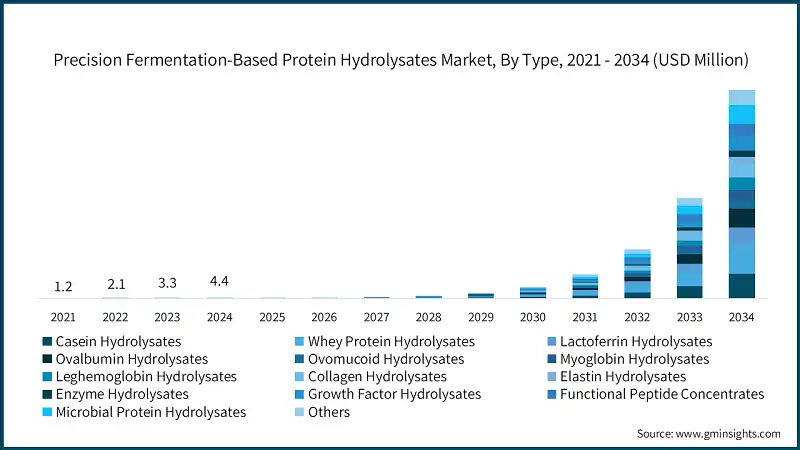
Based on type, the precision fermentation-based protein hydrolysates market is divided into casein hydrolysates, whey protein hydrolysates, lactoferrin hydrolysates, ovalbumin hydrolysates, ovomucoid hydrolysates, myoglobin hydrolysates, leghemoglobin hydrolysates, collagen hydrolysates, elastin hydrolysates, enzyme hydrolysates, growth factor hydrolysates, functional peptide concentrates, microbial protein hydrolysates, and others. Whey protein hydrolysates segment generated a revenue of USD 800 thousand in 2024 and is expected to generate revenue of USD 32.9 million in 2034 at a CAGR of 30.3% in the forecasted period.
- The market for protein hydrolysates derived from precision fermentation includes several protein types, each sporting unique functional properties, bioactive peptide profiles and applications that generate market-specific growth points and commercialization pathways.
- Whey Protein Hydrolysates is the most advanced substrate of all protein sources and built on decades of established application areas in sports nutrition products, infant formula and functional foods. Beta-lactoglobulin is approximately 50% of whey protein and possesses outstanding foaming, emulsification and gelation capabilities that are maintained or improved with specificity through controlled hydrolysis.
- Casein Hydrolysates is the second segment showing signs of growth as production capabilities are developed from precision fermentation companies generating unique functional properties with slow-digestion amino acid delivery capabilities. The proteins from casein are approximately 80% of all milk protein and valued highly in infant formula, medical nutrition for elderly populations and for food applications that require prolonged timing of amino-acid delivery.
Learn more about the key segments shaping this market
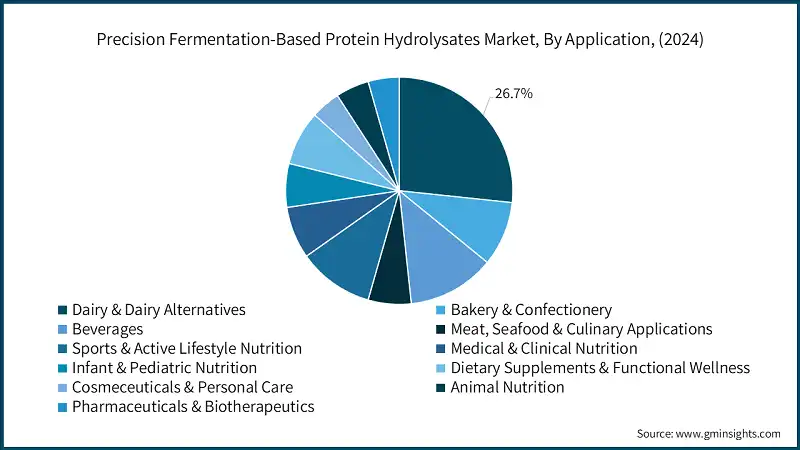
Based on application, the precision fermentation-based protein hydrolysates market is divided into dairy & dairy alternatives, bakery & confectionery, beverages, meat, seafood & culinary applications, sports & active lifestyle nutrition, medical & clinical nutrition, infant & pediatric nutrition, dietary supplements & functional wellness, cosmeceuticals & personal care, animal nutrition, pharmaceuticals & biotherapeutics. In 2024, dairy & dairy alternatives segment held major revenue which accounted for 26.7% market share and is forecasted to hold a 29.2% CAGR from 2025 to 2034.
- Dairy & dairy alternatives is the largest application segment driven by consumer acceptance of dairy proteins, and the functional application of whey and casein in dairy products such as milk, yogurt, cheese and ice cream, as well as protein beverages.
- Commercial partnerships for Perfect Day with Unilever to manufacture Breyers lactose-free frozen dessert, Mars CO2COA chocolate and Nestlé Cowabunga beverages and Orgain Better Whey make dairy the first major grocery category to launch a product with a mainstream brand. Strauss Group launched cow-free drinks and cream cheese in Israel using Imagindairy's precision-fermented whey protein under the Yotvata and Symphony brands, the first dairy cooperative to commercialization precision fermentation dairy proteins.
- Meat, Seafood & Culinary Applications is the fastest growing application segment driven by the demand for heme proteins, collagen, myoglobin, and functional peptides that enhance flavor, texture and nutrition of plant-based and cultivated meats. Precision fermentation protein hydrolysates can be used as both ingredients in scale-up cultured meat production and as functional ingredients in plant-based meat products.
Looking for region specific data?
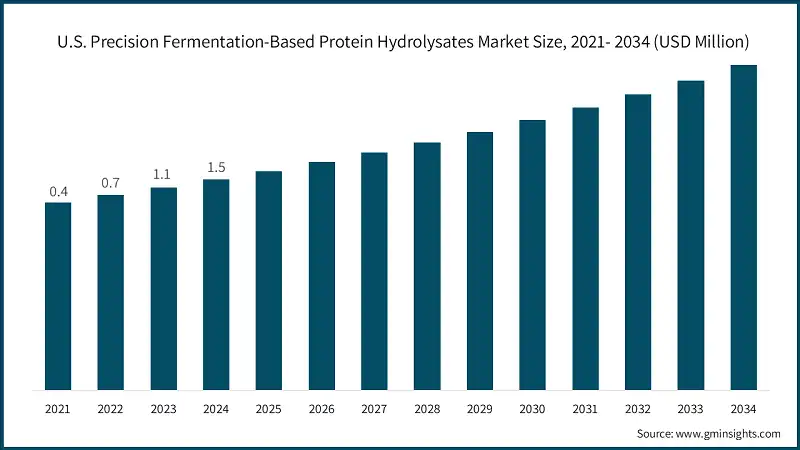
- In 2024, North America held the largest regional share of approximately 41.9% of the precision fermentation-based protein hydrolysates market share mainly attributed to its developed biotechnology ecosystem, regulatory support, with associated concentration of precision fermentation market leaders. In the United States (U.S.), GRAS notification pathways provide a more streamlined way to market, allowing for processing times of ~10-12 months from completion of applications while the average time to regulatory approval is ~2.5 years in Europe.
- Multiple precision-fermented proteins were granted FDA "no questions" letters including Perfect Day, Remilk, Imagindairy, Vivici, TurtleTree, New Culture, and Verley. The region has also seen significant venture capital investment, with more than USD 4 billion in precision fermentation investment in the U.S. expected to be allocated to manufacturing infrastructure before 2024.
- In 2024, Europe held the second highest market share at 25.7% but it is expected to have short term headwinds to growth largely attributed to European Novel Foods regulatory barriers and overall market access constraints from lack of approved precision-fermented proteins to the market. There are only two likely eligible applications of beta-lactoglobulin protein submitted to EFSA for post-market approval.
- In 2024, Asia Pacific is the fastest region of growth fueled by government incentives for alternative proteins, an emerging middle class demanding premium nutrition products, and company investments in strategic and significant manufacturing facilities. India is becoming a significant production hub with Perfect Day and Zydus Lifesciences building a new, 27-acre precision fermentation facility in Bharuch, Gujarat.
- Latin America is emerging as a growth region, driven by increased consumer awareness for sustainable proteins, increasing disposable income, and company partnerships with precision fermentation and food manufacturing companies.
- Middle East & Africa represents the emergent market, driven by concern for food security for a growing population, as well as extreme climatic conditions limiting conventional agriculture, and government support on biotechnology and alternative proteins. The UAE is positioned to be a regional hub for alternative protein production. The Abu Dhabi Investment Office (ADIO) is partnering with The EVERY Company and Vivici to explore tenancy in a proposed 4-million-liter precision fermentation facility to serve local and global markets.
Precision Fermentation-Based Protein Hydrolysates Market Share
In 2024, the market for protein hydrolysates derived from precision fermentation has moderate concentration, as the top five firms account for almost 40% of the total market share. This represents a relatively young marketplace, where first-mover advantages, successful regulatory approvals, and increased scale of manufacturing provide degrees of competitive differentiation, but there remain significant opportunities for new entrants and new contenders associated with emerging technologies to capture viable market share.
There are many well-capitalized start-up companies in the market alongside moderate concentration which indicate a plausible level of competitive dynamism and significant innovation potential. Share of market is expected to remain fluid as firms gain successful regulatory approval, bring manufacturing facilities online, procure strategic partnerships, and implement successful commercial operations. In terms of maturity, there may be consolidation of firms through acquisition, mergers, and partnerships as the market matures and established food industry/ingredient firms look to more strategically add precision fermentation companies to their product portfolios to take advantage of novel protein production and technology.
The potential growth and maturity of the food ingredient market dynamic combined with technological complexity provides room for additional specialized independent player(s) to enter and focus on specific protein types, specific applications, and potentially specific geographic markets. Large biotechnology and pharmaceutical companies may also look to enter the food market with fermentation expertise and the ability to invest in food-grade infrastructure production.
Precision Fermentation-Based Protein Hydrolysates Market Companies
Major players operating in the precision fermentation-based protein hydrolysates industry are:
- Change Foods
- Clara Foods
- Cubiq Foods
- Formo
- Fybraworks Foods
- Geltor
- Helaina
- Imagindairy
- Jellatech
- Modern Meadow
- Motif FoodWorks
- New Culture
- Onego Bio
- Perfect Day
- Provectus Algae
- Remilk
- Spiber
- The EVERY Company
- TurtleTree
- Vivici
Perfect Day: Perfect Day is the first commercial application of precision fermentation for dairy proteins and has built the largest market share with widespread collaboration with influential food manufacturers. Its ProFerm whey protein ingredient was announced in commercial products for Unilever (Breyers), Mars (CO2COA), Nestlé (Cowabunga, Orgain), and Myprotein, proving its commercial viability across several product types and cities.
The EVERY Company: The company is adjusting to rapidly scaling production of precision fermented egg proteins, creating metric-ton production capacity and commercial products entering distribution at retailers nationwide. EVERY has developed two products, OvoPro and OvoBoost which are shelf-stable functional replacements for eggs to use in baked goods and other industrial applications, with some customers achieving pricing parity versus conventional eggs.
Helaina: The company is commercializing bioactive proteins starting with its effera human lactoferrin that achieved a metric-ton scale of production and market launch in Q3 2024. The company has developed its own machine learning models to reduce strain development time from 15 weeks to 5 weeks and has accumulated over 170 million lines of fermentation data.
Imagindairy: The company received regulatory approvals from the FDA in the US, December 2023, and the Israeli Ministry of Health, November 2024, for its precision-fermented beta-lactoglobulin. The company invested in 100,000-liter fermentation capacity and downstream processing in early 2024. This allows for vertical integration and reduced R&D cycles.
TurtleTree: The company is the producer of vegan lactoferrin product LF++, has gained vegan certification and is partnering with Strive and Cadence Performance Coffee in adult nutrition applications. The company aims to sell precision fermented lactoferrin for the sports nutrition category, functional foods, and possibly infant formula.
Precision Fermentation-Based Protein Hydrolysates Market Report Attributes
| Key Takeaway | Details |
|---|---|
| Market Size & Growth | |
| Base Year | 2024 |
| Market Size in 2024 | USD 4.4 Million |
| Market Size in 2025 | USD 16.4 Million |
| Forecast Period 2025 - 2034 CAGR | 34.4% |
| Market Size in 2034 | USD 235 Million |
| Key Market Trends | |
| Drivers | Impact |
| Rising Demand for Allergy-Free, Hypoallergenic Protein Sources | Fuelling adoption in infant formula, FSMPs, and dietary supplements. |
| Regulatory Greenlights (GRAS, Novel Food Approval) | Unlocking new geographies and accelerating commercialization. |
| Sustainable and Label-Friendly Ingredient Sourcing | Aligning with consumer clean-label and ESG purchasing behaviour. |
| Pitfalls & Challenges | Impact |
| High Cost of Production and Downstream Processing | Limits price competitiveness compared to whey, soy, or animal protein hydrolysates. |
| Regulatory Complexity Across Geographies | Slows global expansion and compliance with food, pharma, and supplement laws. |
| Strain IP and Tech Barrier from Leading Players | Limits scalability for new entrants; creates a concentrated innovation ecosystem. |
| Opportunities: | Impact |
| Functional Personal Care & “Beauty-from-Within” Products | Expands total addressable market beyond food into cosmeceuticals and nutricosmetics. |
| Market Expansion in Asia Pacific & GCC via Infrastructure Investment | Unlocks exponential growth potential in high-population, protein-deficient markets. |
| Pharma-Grade Growth Factor Hydrolysates & Therapeutic Peptides | Taps high-value use cases in biopharma, wound care, and metabolic disease recovery. |
| Market Leaders (2024) | |
| Market Leaders |
Approximately 15% market share in 2024 |
| Top Players |
Collectively 40% market share in 2024 |
| Competitive Edge |
|
| Regional Insights | |
| Largest Market | North America |
| Fastest Growing Market | Asia Pacific |
| Emerging Country | India, Vietnam, Indonesia, Brazil |
| Future Outlook |
|
What are the growth opportunities in this market?
Precision Fermentation-Based Protein Hydrolysates Industry News:
- In November 2025, EVERY Company announced the first close of a USD 55 million Series D funding round, led by McWin Capital Partners, where cumulative funding reached a total of USD 294 million; the company is manufacturing at metric ton scale and confirmed a deal with Walmart for products in every store nationwide, while looking for partners for a facility in the UAE with a 4 million liter capacity.
- In May 2025, Nestlé declared plans to increase its investment in its precision fermentation capabilities to make animal free dairy ingredients. This commitment was part of Nestlé's R&D push into alternative-protein.
- In March 2025, the UK government invested USD 1.4 million to increase the Food Standards Agency’s expertise through a Regulatory Innovation Office for risk assessment on precision fermented products and clarity on safety regulations.
- In February 2025, Vivici received an FDA GRAS "no questions" letter for its precision fermented beta-lactoglobulin, which allowed for entry into the U.S. market for a clear, neutral-flavored whey protein made for ready-to-drink beverages and protein powders.
- In November 2024, Imagindairy obtained regulatory approval by the Israeli Ministry of Health to sell their animal-free dairy proteins in Israel, which allows them to begin selling whey proteins developed for milk, cheese, yogurt, and ice cream applications.
- In March 2024, Imagindairy and Ginkgo Bioworks announced a collaboration to make animal free non-whey dairy proteins, which was partially funded by the Israel-U.S. BIRD Foundation.
The precision fermentation-based protein hydrolysates market research report includes in-depth coverage of the industry, with estimates & forecast in terms of revenue (USD Million) & volume (Tons) from 2021 to 2034, for the following segments:
Market, By Type
- Casein Hydrolysates
- Whey Protein Hydrolysates
- Lactoferrin Hydrolysates
- Ovalbumin Hydrolysates
- Ovomucoid Hydrolysates
- Myoglobin Hydrolysates
- Leghemoglobin Hydrolysates
- Collagen Hydrolysates
- Elastin Hydrolysates
- Enzyme Hydrolysates
- Growth Factor Hydrolysates
- Functional Peptide Concentrates
- Microbial Protein Hydrolysates
- Others
Market, By Application
- Dairy & Dairy Alternatives
- Fluid Milk & Milk Alternatives
- Whole Milk Analogues
- Skim & Low-Fat Milk Analogues
- Flavored Milk Alternatives
- Barista-Grade Milk Alternatives
- Cheese Analogues
- Mozzarella (Pizza, Food Service)
- Cheddar & Hard Cheeses
- Cream Cheese & Soft Cheeses
- Processed Cheese Products
- Fluid Milk & Milk Alternatives
- Yogurt & Fermented Alternatives
- Greek-Style Yogurt
- Drinkable Yogurt
- Probiotic Formulations
- Ice Cream & Frozen Desserts
- Premium Ice Cream
- Frozen Yogurt
- Novelties & Bars
- Cream, Butter & Spread Alternatives
- Dairy Ingredient Replacers
- Whey Protein Replacers
- Caseinate Replacers
- Milk Protein Isolate Replacers
- Bakery & Confectionery
- Bread & Rolls
- Sandwich Bread
- Artisan Breads
- Buns & Rolls
- Cakes & Pastries
- Layer Cakes
- Muffins & Cupcakes
- Danish & Croissants
- Cookies & Biscuits
- Egg Wash Replacers
- Confectionery & Sweet Applications
- Marshmallows & Nougat (Aerators, Texture)
- Gummies & Jellies (Collagen, Fortification)
- Chocolate & Coatings (Milk Protein Replacers)
- Bread & Rolls
- Beverages
- Protein Waters
- Clear Protein Waters
- Electrolyte & Functional Waters
- Sports & Energy Drinks
- Isotonic Drinks
- Protein-Enriched Energy Drinks
- Pre-Workout/Intra-Workout Drinks
- RTD Protein Shakes
- Plant-Based Protein Shakes
- Clear RTD Protein Shakes
- Meal Replacements
- Juice & Low pH Beverages
- Juice Blends
- Carbonated Beverages
- Acidic Functionals
- Alcoholic Applications
- Beer (Stabilizers)
- Wine (Fining Agents)
- Protein-Fortified Alcoholic Beverages
- Protein Waters
- Meat, Seafood & Culinary Applications
- Plant-Based Meat Applications
- Burgers & Patties
- Whole Cuts (Steaks, Chicken Analogues)
- Structured Meat Alternatives
- Myoglobin/Heme for Flavor & Aroma
- Cultivated Meat Media & Inputs
- Growth Factors (IGF, FGF, TGF-β)
- Serum & Amino Acid Replacers
- Scaffold Proteins (Collagen, ECM analogues)
- Seafood Analogues
- Finfish (Tuna, Salmon analogues)
- Crustaceans (Shrimp, Crab)
- Culinary Applications (General Savory)
- Soups & Broths (Dairy/Meat analogues)
- Sauces, Gravies & Emulsions
- Dressings and Condiments
- Instant Meals, RTE, Convenience Foods
- Plant-Based Meat Applications
- Sports & Active Lifestyle Nutrition
- Protein Powders
- Fermented Whey Analogues
- Fermented Casein & Egg Analogues
- Multi-Source Blends
- Functional Protein Bars & Snacks
- Recovery & Endurance Products
- BCAA-Focused Products
- Muscle/Joint/Immune Benefits
- Post-Workout Drink Mixes
- Clean Label & Performance Hydrosolubles
- Protein Powders
- Medical & Clinical Nutrition
- Peptide-Based Enteral Formulas
- Semi-Elemental
- Elemental
- Oral Medical Nutrition
- Cancer, COPD, Geriatric
- Therapeutic Applications
- Hepatic/renal diets
- Immune support
- Post-surgical recovery
- Peptide-Based Enteral Formulas
- Pharmacological Peptides
- Fischer Ratio Oligopeptides
- Immune-modulating Hydrolysates
- Infant & Pediatric Nutrition
- Infant Formula (0–6 months)
- Partially Hydrolyzed
- Extensively Hydrolyzed
- Amino Acid-Based
- Follow-On & Toddler Formula (6–24 months)
- Hydrolyzed Follow-On
- Growing-Up Milk
- CMP-Allergy and Hypoallergenic Products
- Lactoferrin & Bioactive Peptides
- Immune and Gut Function Support
- Infant Formula (0–6 months)
- Dietary Supplements & Functional Wellness
- Dietary Protein Supplements
- Powders, Capsules
- Protein Shots
- Functional Gummies & Beverages
- Bioactive Peptides by Function
- Cardiovascular Support (ACE inhibitors)
- Antioxidants
- Antimicrobials
- Immune-Modulators
- Cognitive / Stress Support Peptides
- Dietary Protein Supplements
- Cosmeceuticals & Personal Care
- Skincare Products
- Collagen-Boosting Creams
- Anti-Aging Serums
- Moisturizers & Eye Creams
- Hair & Scalp Products
- Hydrosoluble Keratin-style Proteins
- Hair Repair Peptides
- Oral & Dental Care
- Peptide Mouthwashes
- Oral Hygiene Supplements
- Skincare Products
- Animal Nutrition
- Pet Food (Dogs & Cats)
- Protein-Enhanced Kibble, Wet Food, Treats
- Aquaculture Feed
- Salmon, Shrimp, Trout — Digestibility-enhancing Peptides
- Livestock Feed Additives
- Swine, Poultry, Ruminant Performance
- Immune & Gut Health Peptides
- Pet Food (Dogs & Cats)
- Pharmaceuticals & Biotherapeutics
- Therapeutic Peptides (e.g., GLP-1 analogues)
- Biosimilar Peptides
- Peptide-based APIs
- Drug Delivery Peptide Scaffolds
- Wound Healing & Regenerative Therapies
- Antimicrobial & Topical Therapeutics
The above information is provided for the following regions and countries:
- North America
- U.S.
- Canada
- Europe
- Germany
- UK
- France
- Spain
- Italy
- Rest of Europe
- Asia Pacific
- China
- India
- Japan
- Australia
- South Korea
- Rest of Asia Pacific
- Latin America
- Brazil
- Mexico
- Argentina
- Rest of Latin America
- Middle East and Africa
- Saudi Arabia
- South Africa
- UAE
- Rest of Middle East and Africa
Frequently Asked Question(FAQ) :
What is the market size of the precision fermentation-based protein hydrolysates in 2024?
The market size was valued at USD 4.4 million in 2024, with a CAGR of 34.4% expected through 2034. Regulatory approvals, large-scale fermentation facilities, and declining production costs are driving market growth.
What is the projected value of the precision fermentation-based protein hydrolysates market by 2034?
The market is poised to reach USD 235 million by 2034, driven by advancements in fermentation technologies, application development, and economies of scale.
What is the expected size of the precision fermentation-based protein hydrolysates industry in 2025?
The market size is projected to reach USD 16.4 million in 2025.
How much revenue did the whey protein hydrolysates segment generate in 2024?
The whey protein hydrolysates segment generated approximately USD 800 thousand in 2024.
What was the market share of the dairy & dairy alternatives segment in 2024?
The dairy & dairy alternatives segment held a 26.7% market share in 2024 and is forecasted to grow at a CAGR of 29.2% from 2025 to 2034.
Which region leads the precision fermentation-based protein hydrolysates sector?
North America leads with a 41.9% regional share in 2024, led by a developed biotechnology ecosystem, regulatory support, and significant venture capital investments.
What are the upcoming trends in the precision fermentation-based protein hydrolysates market?
Trends include AI-driven strain optimization, continuous and anaerobic fermentation for efficiency, advanced glycoengineering, and broader access to high-performance expression systems like OPENPichia.
Who are the key players in the precision fermentation-based protein hydrolysates industry?
Key players include Change Foods, Clara Foods, Cubiq Foods, Formo, Fybraworks Foods, Geltor, Helaina, Imagindairy, Jellatech, Modern Meadow, Motif FoodWorks, New Culture, and Onego Bio.
Precision Fermentation-Based Protein Hydrolysates Market Scope
Related Reports