Summary
Table of Content

Plush Toys Market
Get a free sample of this report
Form submitted successfully!
Error submitting form. Please try again.
Thank you!
Your inquiry has been received. Our team will reach out to you with the required details via email. To ensure that you don't miss their response, kindly remember to check your spam folder as well!
Request Sectional Data
Thank you!
Your inquiry has been received. Our team will reach out to you with the required details via email. To ensure that you don't miss their response, kindly remember to check your spam folder as well!
Form submitted successfully!
Error submitting form. Please try again.
Plush Toys Market Size
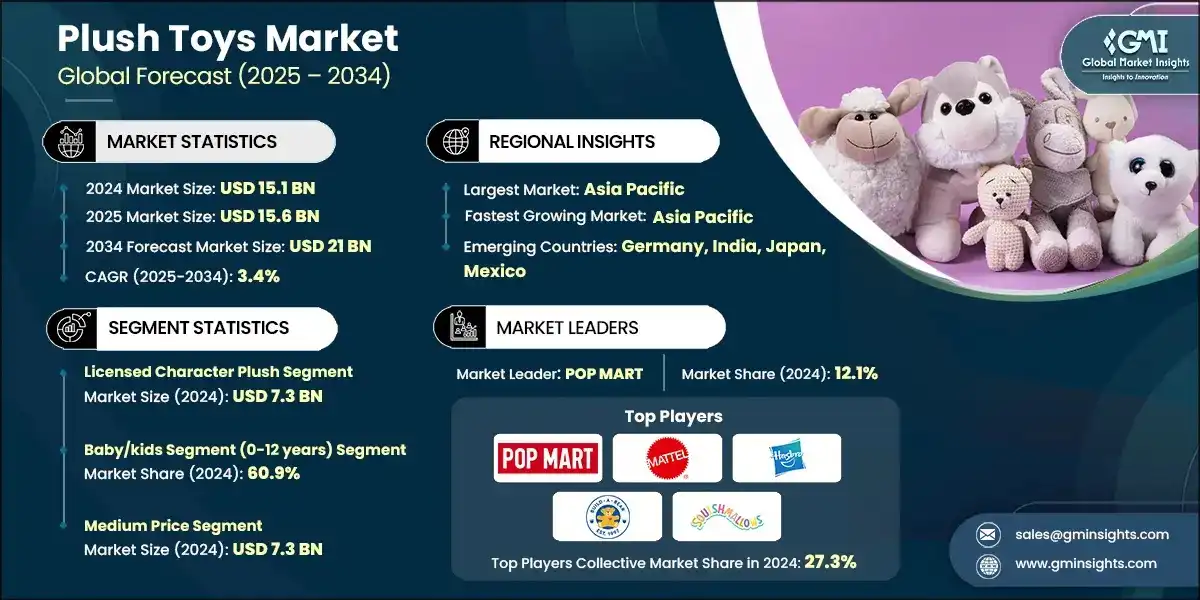
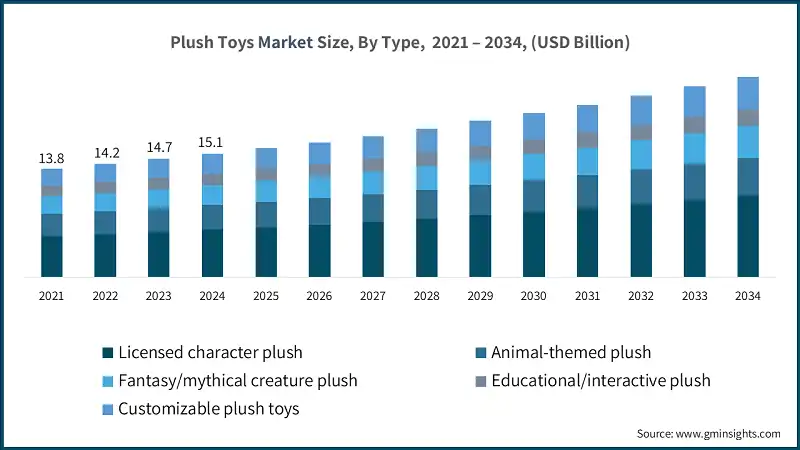
The global plush toys market was valued at USD 15.1 billion in 2024. The market is expected to grow from USD 15.6 billion in 2025 to USD 21 billion in 2034, at a CAGR of 3.4%, according to latest report published by Global Market Insights Inc.
Plush Toys Market Key Takeaways
Market Size & Growth
- 2024 Market Size: USD 15.1 Billion
- 2025 Market Size: USD 15.6 Billion
- 2034 Forecast Market Size: USD 21 Billion
- CAGR (2025–2034): 3.4%
Key Market Drivers
- Rising Disposable Incomes.
- Expansion of Online Retail.
- Demand for Interactive Toys.
Challenges
- Intense competition.
- Fluctuating raw material costs.
Opportunity
- Technological enhancements & personalization.
- Integration with preventive & medical wellness.
Key Players
- Market Leader: POP MART led with over 12.1% market share in 2024.
- Leading Players: Top 5 players in this market include POP MART, Mattel, Hasbro, Build-A-Bear, Squishmallows, which collectively held a market share of 27.3% in 2024.
Get Market Insights & Growth Opportunities
Branded items are an essential part of the larger soft toy industry, which holds a 34% share in the total global market for toys and is expected to grow by 8% in 2024 compared to the previous year. The craze for collectible toys released in limited quantities continues to be fueled by viral trends on social media platforms like TikTok and Reddit. For example, Jazwares' Squishmallows was ranked as the second largest global toy manufacturer in the H1 2024 results, while Mattel Barbie plush has seen increasing demand with Barbie film success; also, Pokémon and Marvel stuffed line toys continue to perform well in this sector.
The U.S. toy market has relied heavily on China to drive its growth. According to The Toy Association, 85% of toys are sourced from China, however, alternative suppliers continue to make an impact. For instance, Vietnam's toy exports increased by 29% between June 2018 and June 2019. Also, companies such as LEGO and Hasbro have been searching for Southeast Asian countries where they could find contract production facilities outside China.
Sustainability is still affecting production for plush toys due to public policy changes. Pennsylvania recently updated the PA Stuffed Toy Manufacturing Act in 2024 revisions so that recycled materials can be used in plush toy manufacturing. GUND and Jellycat have begun using recycled polyester in their lines of plush products. In addition to what has been mentioned above, Extended Producer Responsibility (EPR) legislation has recently come up as a public policy effort in various states concerning adjusting product design requirements with demands for sustainability regarding plush toys.
The toy industry is experiencing significant growth, creating further opportunities for plush manufacturers. The Toy Association reports that 73% of parents report buying toys for themselves, 61% buy toys to connect with their child, and 49% buy toys for nostalgia. The trend of "newstalgia" has created more demand for re-issues of previously loved toys, most recently with Hasbro’s My Little Pony plush line-up, along with other premium collectibles including the limited-edition Steiff bear line. These serve the needs of both collectors and cross-generational portion of the audience, while fueling growth in the industry.
Businesses are reacting to these drivers with innovation and renewed efforts for market engagement. Spin Master has recently released the eco-friendly plush line as an innovative response to the high interest in sustainability. Funko's Pop! Plush collectibles are quite appealing for both nostalgia and fandom. The desire for aesthetic value combined with functional purpose and wide acceptance of spontaneous buying attitudes is driving growth within the industry.
To get key market trends
Plush Toys Market Trends
The changing innovation and technology transformation are important for the growth of the market.
- The plush toy market is undergoing a major transformation in terms of sustainability due to consumer demands for environmentally friendly products. The Environmental Protection Agency (EPA) estimates that at least 12 million tons of textile waste is generated in the United States each year, which has encouraged brands to utilize sustainable practices. For example, Jellycat had launched a line of plush toys made out of recycled polyester to meet the needs of environmentally conscious buyers.
- Technology in plush toys are attracting tech-focused consumers. Interactive plush toys that include sound and movement, such as Hasbro's "FurReal Friends" pets, have gained immense popularity. The Toy Association reported a 15% rise in sales of tech-integrated toys in 2023, indicating a growing consumer demand for innovative products.
- Collectible plush toys, usually based upon entertainment franchises, are having a positive impact on the growth of the plush toy market. An example would be Squishmallows, which have become an instant worldwide phenomenon in stores, and sold over 100 million units in 2023. The NPD Group reported that the toys category in collectibles specifically gained 9% growth for 2023 sales, and much of this growth was attributed to the fact that consumers were wanting limited-edition toys or toys related to their favorite entertainment based on the media connection.
- Plush toys with customizable features are gaining traction. Consumers' desire for a personalized product has allowed Build-A-Bear Workshop to flourish as the most recognized name in customizable plush toys. In 2023, Build-A-Bear experienced 12% revenue growth, partly due to customizable features. The National Retail Federation (NRF) observed that customization still serves as a primary motivator for consumer spending within the toy sector and strengthens its position as a competitive differentiator.
Plush Toys Market Analysis
Learn more about the key segments shaping this market
Based on type, the plush toys market is classified into licensed character plush, animal-themed plush, fantasy/mythical creature plush, educational/interactive plush and customizable plush toy. In 2024, licensed character plushies continue to be the most popular item in the general market, with an estimated value of USD 7.3 billion, and are expected to expand at a CAGR of 3.3% from the years 2025 to 2034.
- With continued popularity from consumers, licensed character, including Disney, Marvel and Star Wars are the best sellers in the plush industry as they are popular for kids but also for Adults. Firms such as Funko and Build-A-Bear Workshop have capitalised on this-offering a variety of licensed plushies, from characters like Baby Yoda to Spider-Man.
- Licensed plush toys have the added draw of appealing to adult collectors, helping support ongoing demand. A 2023 report by the Toy Association found that adult collectibles, which include plush toys, were up 12% year-over-year in 2023. Taking over the adult market is Squishmallows, a brand part of kid-focused company Jazwares that has been taking adults by storm thanks to its plushies based on trending characters and classic categories like Pokémon and Hello Kitty.
- Strong licensed plush sales has prompted more manufacturers to obtain licenses. For example, Hasbro’s collaboration with Disney to release Star Wars soft lines accounted for more than USD 500 million in global sales in 2023. The government trade data also shows that licensed toys made up a big part of the USD 4.5 billion in U.S. toy exports last year, demonstrating their economic power as well.
- Nostalgia-based marketing has also driven the demand for licensed plush animals, especially for adults. Mattel, incidentally, debuted limited-edition plush toys based on well-loved characters such as Barbie and He-Man sold out within weeks of release. This is reflective of the National Retail Federation, which found a 15% percent uptick in sales of nostalgic toys in 2023 - reaffirming their overall popularity.
Learn more about the key segments shaping this market
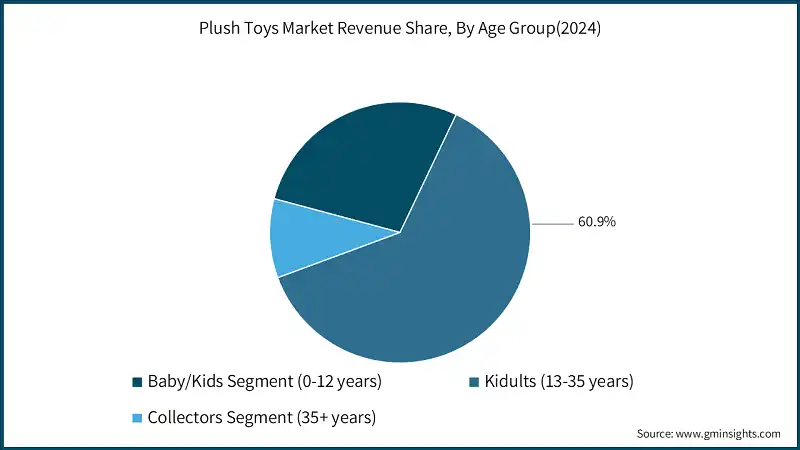
Based on the facility type the market is bifurcated baby/kids segment (0-12 years), kidults (13-35 years) and collectors segment (35+ years). The baby/kids segment (0-12 years) segments held the largest share, accounting for 60.9% of the global plush toys market in 2024.
- Parents are now moving towards favoring, non-toxic, and cruelty-free toys for their children. This preference explains the strong position of certain plush toy brands in the market. Popular items such as Jellycat's Bashful Bunny and GUND's Flappy the Elephant highlight this shift. These toys stand out because of their soft textures and interactive elements that appeal to young users.
- Government rules play a crucial role in how toy companies run their businesses. In the United States, the Consumer Product Safety Improvement Act sets high standards for making toys. Over in the European Union, the Toy Safety Directive puts similar rules in place for all the countries involved. These setups require companies to follow tough safety steps during production. They also push for using materials that are not toxic, and that fits with larger goals for the environment. Aurora Worlds Eco Nation line of stuffed animals, for instance. It uses only recycled parts in everything.
- Lately, more people seem drawn to plush toys that help with learning and playing together with their babies, helping the market grow. Products like LeapFrog's My Pal Scout or Fisher-Price's Smart Stages Puppy mix in songs, voice cues, and ways to interact that support kids early on. Data from the Toy Association shows educational toys made up about 25 percent of the total toy sales in 2023.
- Licensed plush toys such as Disney's Frozen, Marvel Superheroes and Pokémon plush toys are further enhancing market growth. These toys not only appeal to children, but also appeal to collectors as well, which expands the market. For example, Pokémon Company saw a 15% increase in sales in 2023. The segment is expected to contribute to continued market growth during the forecasted period as well given the innovation, regulatory and consumer trends.
Based on price, the plush toys market is segmented into low, medium and high. The medium price segment held the largest share, generating a revenue of USD 7.3 billion of the global market in 2024.
- This category caters to mass-market consumers by balancing price and quality. Demand for plush toys that are durable and affordable is being driven by middle-income households benefiting from increased disposable income and are conscious of not giving up value for decreased investment in safety or design.
- According to the US Bureau of Labor Statistics data of toy-related expenditure per household. There has been a steady increase as household income has increased, however, continued price sensitivity results in more spending on mid-market options versus highly priced collectibles. The Toy Association responded to the mid-market positioning, according to parents the highest priority for toys sold is emotional and developmentally based on price accessibility. For example, mid-priced plush toys are commonly purchased for special gifting occasions and seasonal purchases which solidifies demand through varied socioeconomic demographic segments.
- Mid-priced and priced plush toys dominate retail and e-commerce space, particularly the licensed character and themed collections. Character-based plush toys tied to movie and television genres have increased volume sales while providing price relief for selling value. In addition, the online retail platform and promotional bundling of mid-priced plush toys have generated stronger impulsive purchases and gifting, further strengthening mid-priced plush toys as a market leader.
Looking for region specific data?
North America Plush Toys Market
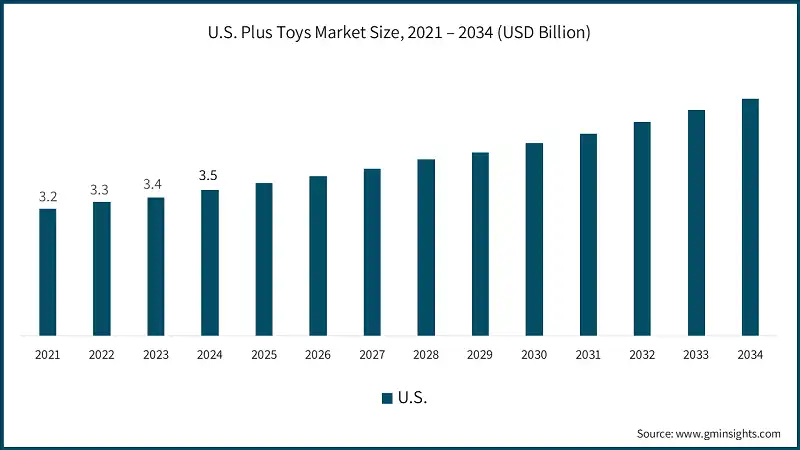
In 2024, the U.S. dominated the market growth in North America, accounting for 85% of the share in the region.
- The U.S. is a dominant player in North America's market, primarily due to strong consumer preferences for licensed character plush toys made by large entertainment companies such as Disney and Marvel. Data from the U.S. Census Bureau shows that the toy and game industry generated over $25 billion in revenue in the U.S. in 2022, demonstrating a large potential for market growth. The U.S. has an established retail channel and growth in e-commerce enables broad distribution of these plush toy product categories.
- Manufacturers such as Build-A-Bear and GUND are at the forefront of industry innovation while accommodating evolving consumer preferences. For example, Build-A-Bear gives consumers the option to create customized plush toys, while GUND highlights high-quality, eco-friendly designs. In the U.S., a growing number of children and adults have an interest in collectible plush toys with an eco-friendly element, as sustainability and innovation become increasingly prominent themes in the industry..
Asia Pacific Plush Toys Market
Asia Pacific market is the fastest growing region and is expected to grow at 4.1% during the forecast period.
- The Asia-Pacific market is the fastest-growing region, supported by government initiatives promoting domestic manufacturing and exports. For instance, India’s Production Linked Incentive (PLI) scheme for the toy sector, launched in 2021, aims to boost local production and reduce imports. Similarly, China’s government-backed e-commerce policies have enhanced market accessibility, driving demand for plush toys. These measures, combined with rising disposable incomes, are propelling market growth in the region.
Europe Plush Toys Market
Europe market is the largest market and is expected to grow at 2.7% during the forecast period.
- Europe's market is growing, driven by increasing consumer preference for sustainable and high-quality toys. Government initiatives promoting eco-friendly manufacturing practices and stringent regulations on toy safety standards further support this growth. Additionally, rising awareness of climate change and the demand for educational toys contribute significantly to the market's expansion. Germany, as a key player, exemplifies this trend with its focus on innovation and quality production.
Middle East and Africa Plush Toys Market
Middle East and Africa market is expected to grow at 2.6% during the forecast period.
- The Middle East and Africa market is driven by increasing disposable incomes and a growing young population. Governments in the region are also investing in initiatives to boost local manufacturing and retail sectors, further supporting market expansion. Additionally, the rising influence of Western culture and the popularity of licensed character-based toys are contributing to the market's growth. These factors position the region as a promising area for plush toy manufacturers and retailers.
Plush Toys Market Shares
The top companies in the market include POP MART, Mattel, Hasbro, Build-A-Bear, and Squishmallows and collectively hold a share of 27.3% of the market. These prominent players are proactively involved in strategic endeavors, such as mergers & acquisitions, facility expansions & collaborations, to expand their service portfolios, extend their reach to a broad customer base, and strengthen their market position.
- POP MART has transformed plush toys into collectible art through its blind-box concept and designer collaborations. The brand focuses on limited-edition releases that blend pop culture with creative aesthetics, appealing to a growing community of collectors. Its strategy emphasizes exclusivity and emotional engagement, making plush toys a lifestyle-driven category.
- Mattel leverages its iconic brands to deliver plush toys that combine comfort with imaginative play. Through franchises like Barbie and Fisher-Price, the company creates products that resonate across generations. Mattel’s approach integrates storytelling and quality craftsmanship, reinforcing its position as a leader in character-based plush offerings.
- Hasbro brings its globally recognized IPs into the plush segment, offering designs that reflect authenticity and brand heritage. Plush toys featuring Peppa Pig, My Little Pony, and other franchises strengthen Hasbro’s multi-platform engagement strategy. The company focuses on expanding licensing and experiential play to enhance consumer connection..
Plush Toys Market Companies
Major players operating in the plush toys industry are:
- Aurora World
- Build-A-Bear Workshop
- Douglas Company
- Fiesta Toy
- Gund
- Hasbro
- Jellycat
- Mattel
- Melissa & Doug
- POP MART
- Spin Master
- Squishmallows
- Steiff
- Tokidoki
- Ty
Build-A-Bear creates an immersive plush experience by allowing customers to personalize every aspect of their toy- from stuffing and scent to clothing and accessories. Its retail concept blends emotional engagement with experiential shopping, making plush toys a memorable part of life events. The brand continues to innovate with wellness-inspired products like weighted plush and themed collections, reinforcing its position as a leader in customized plush offerings.
Squishmallows has redefined the plush category with ultra-soft, huggable designs that combine comfort and collectability. Known for its diverse character lineup and seasonal drops, the brand has built a strong community of fans through social media and influencer-driven campaigns. Its strategy focuses on emotional appeal, affordability, and continuous innovation, making Squishmallows a dominant force in the global plush market.
Plush Toys Market Report Attributes
| Key Takeaway | Details |
|---|---|
| Market Size & Growth | |
| Base Year | 2024 |
| Market Size in 2024 | USD 15.1 Billion |
| Market Size in 2025 | USD 15.6 Billion |
| Forecast Period 2025 - 2034 CAGR | 3.4% |
| Market Size in 2034 | USD 21 Billion |
| Key Market Trends | |
| Drivers | Impact |
| Rising Disposable Incomes | Higher consumer spending power enables greater demand for premium and collectible plush toys. Families are more willing to invest in branded and customized products, driving growth in mid-to-high-end segments. |
| Expansion of Online Retail | E-commerce platforms have broadened market access, allowing plush brands to reach global audiences. Online channels also support personalization and limited-edition drops, fueling impulse purchases and collector trends. |
| Demand for Interactive Toys | Consumers increasingly seek plush toys with added features such as sound, movement, or tech integration. This trend creates opportunities for hybrid products that combine tactile comfort with digital engagement. |
| Pitfalls & Challenges | Impact |
| Intense competition | The market is saturated with global and regional players, making differentiation critical. Price wars and frequent product launches can erode margins and brand loyalty. |
| Fluctuating raw material costs | Volatility in fabric and stuffing material prices impacts production costs. Brands relying on premium or sustainable materials face additional pressure to maintain profitability without compromising quality. |
| Opportunities: | Impact |
| Technological enhancements & personalization | Integration of AR, AI, and customization options can elevate plush toys from simple playthings to interactive experiences. Personalized designs strengthen emotional connections and justify premium pricing. |
| Integration with preventive & medical wellness | Weighted plush toys and sensory designs are gaining traction for stress relief and emotional well-being. Positioning plush products as wellness aids opens new revenue streams in health-conscious consumer segments. |
| Market Leaders (2024) | |
| Market Leaders |
12.1% market share |
| Top Players |
The collective market share in 2024 is 27.3% |
| Competitive Edge |
|
| Regional Insights | |
| Largest Market | Asia Pacific |
| Fastest Growing Market | Asia Pacific |
| Emerging Country | Germany, India, Japan, Mexico |
| Future Outlook |
|
What are the growth opportunities in this market?
Plush Toys Industry News
- In June 2025 Mattel announced a strategic alliance with OpenAI to integrate artificial intelligence into its toy portfolio, paving the way for interactive and smart play experiences. While primarily tech-focused, this initiative creates opportunities for AI-enabled plush toys under brands like Barbie and American Girl. The partnership signals Mattel’s commitment to innovation and digital transformation.
- In February 2025, Aurora World entered a licensing partnership with Hasbro to produce Peppa Pig plush toys for the North American market. The collection, launching in mid-2025, emphasizes eco-friendly materials, aligning with Aurora’s sustainability objectives. This move strengthens Aurora’s position in character-based plush toys and expands its portfolio through a globally recognized IP.
- In February 2025, Hasbro unveiled its “Playing to Win” strategy at Toy Fair 2025, prioritizing IP-driven growth, digital gaming, and global licensing expansion. Plush-related brands such as Peppa Pig will benefit from broader distribution and enhanced merchandising under this plan. The strategy underscores Hasbro’s commitment to leveraging iconic franchises for multi-platform engagement.
- In February 2025 Spin Master introduced its 2025 “Innovation Unlocked” portfolio, featuring tech-enhanced toys and sensory-rich playsets aimed at immersive experiences. The lineup includes Melissa & Doug plush-based playsets and AR-integrated products, blending traditional play with digital interactivity. This strategy reinforces Spin Master’s focus on hybrid play and global market leadership.
- In January 2025, Build-A-Bear introduced Heartwarming Hugs, a new line of weighted plush toys designed for stress relief and emotional comfort. Featuring customizable options and a removable warming heart, the product launch coincided with National Hug Day in January 2025. This innovation reflects the company’s focus on experiential retail and wellness-driven product categories.
The plush toys market research report includes in-depth coverage of the industry, with estimates & forecasts in terms of revenue (USD Billion) and volume (Thousand Units) from 2021 to 2034, for the following segments:
Market, By Product Type
- Standard Plush Figures
- Plush Dolls & Dress-Up
- Plush Puppets
- Plush Playsets
- Accessory Plush toys
- Charms
- Collectible Designer Figures
- Others (Keychains plush toys, etc.)
- Others (plush puzzles, etc.)
Market, By Type
- Licensed character plush
- Traditional Licensed Characters (Disney, Marvel, etc.)
- Artist-Designed Characters
- Gaming & Digital Characters
- Animal-themed plush
- Fantasy/mythical creature plush
- Educational/interactive plush
- Customizable plush toys
Market, By Material
- Synthetic
- Natural
Market, By Age Group
- Baby/Kids Segment (0-12 years)
- Infants and Toddlers (0-3 years)
- Preschoolers (4-6 years)
- School Age (7-12 years)
- Kidults (13-35 years)
- Teenagers (13-17 years)
- Young Adults (18-25 years)
- Millennials (26-35 years)
- Collectors Segment (35+ years)
- Mature Collectors (35-50 years)
- Senior Collectors (50+ years)
Market, By Price
- Low
- Medium
- High
Market, By Distribution Channel
- Online
- E-commerce websites
- Company owned websites
- Offline
- Retail stores
- Specialty toy stores
- Others (home improvement stores, etc.)
The above information is provided for the following regions and countries:
- North America
- U.S.
- Canada
- Europe
- Germany
- France
- UK
- Italy
- Spain
- Russia
- Asia Pacific
- China
- Japan
- India
- Australia
- South Korea
- Latin America
- Brazil
- Mexico
- MEA
- Saudi Arabia
- UAE
- South Africa
Frequently Asked Question(FAQ) :
What is the market size of the plush toys market in 2024?
The market size was valued at USD 15.1 billion in 2024, with a CAGR of 3.4% expected through 2034, driven by sustainability trends, technological advancements, and the popularity of collectible plush toys.
What is the projected value of the plush toys market by 2034?
The market is expected to reach USD 21 billion by 2034, fueled by increasing demand for eco-friendly products, tech-integrated toys, and franchise-based collectibles.
What is the projected size of the plush toys market in 2025?
The market is expected to reach USD 15.6 billion in 2025.
How much revenue did the licensed character plush segment generate?
The licensed character plush segment generated USD 7.3 billion in 2024, maintaining its position as the most popular category and is projected to grow at a CAGR of 3.3% from 2025 to 2034.
What was the valuation of the medium price segment?
The medium price segment held the largest share, generating USD 7.3 billion in revenue in 2024.
Which region leads the plush toys market?
The United States dominated the North American market in 2024, accounting for 85% of the regional share, driven by strong consumer demand and innovation in product offerings.
What are the upcoming trends in the plush toys industry?
Key trends include the shift towards sustainable materials, the rise of tech-integrated plush toys, and the growing popularity of collectible plush toys tied to entertainment franchises.
Who are the key players in the plush toys market?
Key players include Aurora World, Build-A-Bear Workshop, Douglas Company, Fiesta Toy, Gund, Hasbro, Jellycat, Mattel, Melissa & Doug, POP MART, Spin Master, and Squishmallows.
Plush Toys Market Scope
Related Reports