Summary
Table of Content

Plate Heat Exchanger Market
Get a free sample of this report
Form submitted successfully!
Error submitting form. Please try again.
Thank you!
Your inquiry has been received. Our team will reach out to you with the required details via email. To ensure that you don't miss their response, kindly remember to check your spam folder as well!
Request Sectional Data
Thank you!
Your inquiry has been received. Our team will reach out to you with the required details via email. To ensure that you don't miss their response, kindly remember to check your spam folder as well!
Form submitted successfully!
Error submitting form. Please try again.
Plate Heat Exchanger Market Size
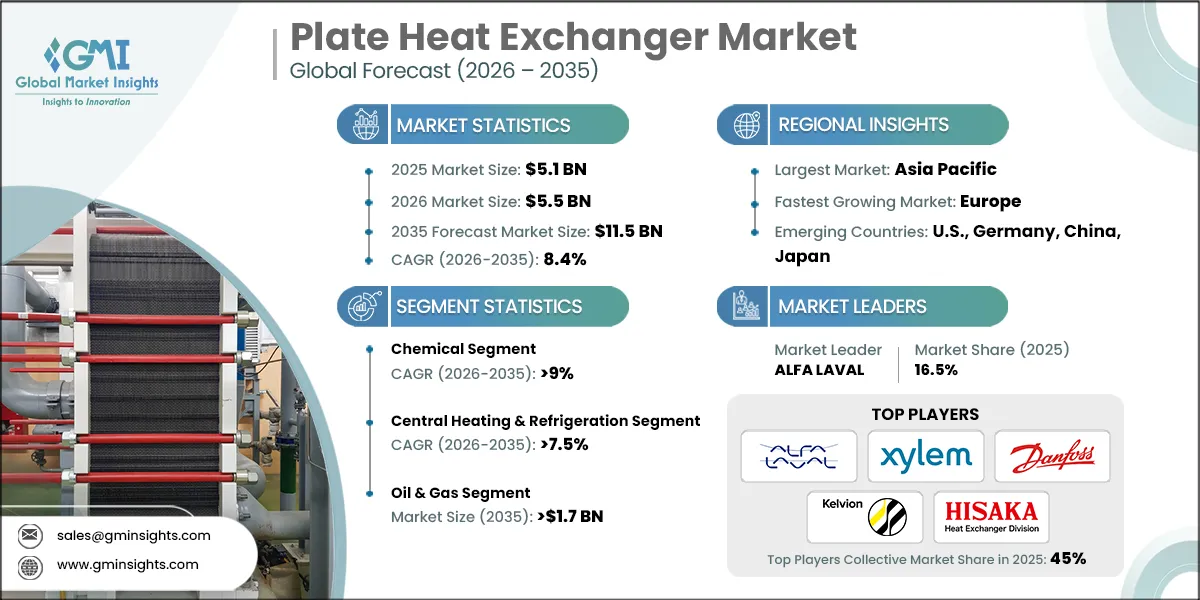
According to a recent study by Global Market Insights Inc., the plate heat exchanger market was estimated at USD 5.1 billion in 2025. The market is expected to grow from USD 5.5 billion in 2026 to USD 11.5 billion in 2035, at a CAGR of 8.4%.
Plate Heat Exchanger Market Key Takeaways
Market Size & Growth
- 2025 Market Size: USD 5.1 Billion
- 2026 Market Size: USD 5.5 Billion
- 2035 Forecast Market Size: USD 11.5 Billion
- CAGR (2026–2035): 8.4%
Regional Dominance
- Largest Market: Asia Pacific
- Fastest Growing Region: Europe
Key Market Drivers
- Rising adoption of energy efficient technologies.
- Stringent mandates to limit carbon footprint.
- Flourishing investments across industrial infrastructure.
Challenges
- Significant maintenance requirements and associated operational expenses.
Opportunity
- Innovation in material technology.
- Stringent energy efficiency regulations.
- Digital integration and monitoring.
- Growing industrial infrastructure development.
Key Players
- Market Leader: ALFA LAVAL led with over market share of 16.5% in 2025.
- Leading Players: Top 5 players in this market include ALFA LAVAL, Xylem, Danfoss, Kelvion Holding, HISAKA Works, which collectively held a market share of 45% in 2025.
Get Market Insights & Growth Opportunities
Rising investments in heavy‑duty industrial activities, coupled with increasing demand for advanced heating and cooling systems across industrial processes, are complementing business landscape. Stringent regulatory mandates aimed at reducing carbon emissions along with increasing adoption of high‑efficiency equipment, integration of digital monitoring technologies, and paradigm shift toward sustainable, low‑emission energy solutions, is contributing to industry growth.
For instance, in January 2026, the Indian government issued detailed operational guidelines for the Shipbuilding Development Scheme along with the Shipbuilding Financial Assistance Scheme to strengthen India’s shipbuilding ecosystem. The programs aim to boost domestic manufacturing capacity, attract global participation, and enhance technological capabilities with a finance allocation of USD 4.9 billion.
Growing emphasis on energy‑efficient technologies, along with rising demand for compact and space‑optimized heat exchanger designs to improve thermal management, is significantly supporting industry expansion. Manufacturers are increasingly focusing on lightweight, high‑performance configurations along with integration of advanced materials, adoption of modular designs, and development of smart, sensor‑enabled systems that enhance operational efficiency is accelerating product demand.
For instance, in July 2024, Alfa Laval’s Hygienic WideGap heat exchanger introduced a modern alternative to conventional systems, enabling substantial emission reductions and improving processing efficiency for fibre‑rich liquid foods. Its compact design minimizes space, transport, and installation requirements, while the modular plate configuration offers flexible capacity adjustments.
The enforcement of emission‑reduction mandates along with paradigm shift toward energy‑efficient operations and continuous improvements in industrial infrastructure, is driving industry growth. Growing inclination to minimize energy consumption, along with adoption of low‑carbon technologies and rising integration of heat‑recovery systems for advanced thermal management, will positively influence industry outlook.
For instance, in June 2025, the European Commission authorized a 476.5 million initiative for Spain aimed at accelerating the decarbonization of the manufacturing sector, aligned with the goals of the Clean Industrial Deal. The program, financed through the Recovery and Resilience Facility (RRF), supports nation’s transition toward a net‑zero industrial economy.
Asia Pacific leads the plate heat exchanger market owing to strong industrial base, rapid modernization of existing industries, and government policies promoting energy efficiency and reducing carbon emissions. Rising energy consumption driven by expanding population, growing sectors including chemicals, petrochemicals, power generation, HVAC, food processing, and large‑scale industrialization across developed and developing economies further contributing to industry growth.
For instance, in September 2025, the Sino‑German energy partnership launched its demonstration measures for enhancing energy efficiency at the Beijing Germany‑China industrial park. The initiative designates the China‑German Intelligent Manufacturing Center located in Shunyi as the pilot site, supported by BMWK (Federal Ministry for Economic Affairs and Energy Germany) and China's National Development and Reform Commission. The event facilitated collaboration among government authorities, industry leaders, financial institutions, and energy service providers to advance integrated energy planning and reduce emissions.
Europe is one of the emerging markets in plate heat exchanger market owing to increasing demand for energy efficiency and sustainable solutions across industries, increasing infrastructure development and retrofitting of existing processes. Ongoing push for industrial modernization including digitalization and automation technologies, stringent mandates toward reducing emissions and enhancing energy efficiency across industrial establishments will contribute to industry growth.
For instance, in May 2024, European Commission authorised USD 4.6 billion for French programme dedicated to lowering greenhouse‑gas emissions in the manufacturing sector and supporting its shift toward a net‑zero economy under the Green Deal Industrial Plan. The scheme provides direct grants covering up to 30% of project costs for industrial electrification and energy‑efficiency upgrades, requiring substantial reductions in emissions and energy use in France.
To get key market trends
Plate Heat Exchanger Market Trends
Plate heat exchanger industry is anticipated to grow owing to focus on energy‑efficient industrial processes, growing demand for compact thermal solutions, and continuous innovation in advanced materials. Growing demand for efficient heating and cooling in industrial operations, along with shifting focus toward recovering and utilizing waste heat, will further complement industry landscape.
For instance, in May 2025, the European Commission initiated an integrated strategy to place energy efficiency at the center of EU economic and energy policies. During the general assembly, coalition members reaffirmed plans to scale private investment and advance the 2025 programme. Energy efficiency is recognized as vital for energy security, delivering lower consumption, reduced reliance on Russian gas, decreased grid investment needs, and significant future savings on fossil‑fuel imports.
Supportive regulatory measures toward enhancing energy efficiency of industries along with strict mandates toward energy consumption and environmental compliance requirements, are influencing industry growth. Industries are increasingly adopting plate heat exchangers owing to their high thermal performance, compact design, and ability to operate efficiently with minimal energy consumption which is accelerating product penetration.
For instance, in August 2025, the Vietnam government authorities introduced Resolution 70‑NQ/TW (2025) which covers plan to maintain energy security through 2030 with a long‑term vision to 2045, targeting 8–10% reduction in final energy use versus business‑as‑usual. It ensures importance of a balanced energy transition, development of modern and integrated infrastructure, and a transparent, efficient, and competitive energy market aligned with progress goals.
Increasing R&D investments aimed at expanding application capabilities and enhancing product reliability along with ongoing technological advancements including space‑efficient designs, higher thermal efficiency, and materials with stronger corrosion resistance is augmenting product demand. Increasing renewable energy installations, manufacturing capacity additions, thermal waste recovery and expanding industrial infrastructure in developing regions are further complementing industry landscape.
For instance, in November 2025, Southwest Research Institute has expanded its heat‑exchanger assessment capabilities with the large‑scale heat exchanger test facility, built to industry standards and capable of handling heat loads up to five megawatts. The facility now enables testing of coolant distribution units, secondary pumps, and real‑world failure scenarios. Its flexible configuration supports evaluation of systems for data centers, energy storage, power generation, and defense applications.
Plate Heat Exchanger Market Analysis
Learn more about the key segments shaping this market
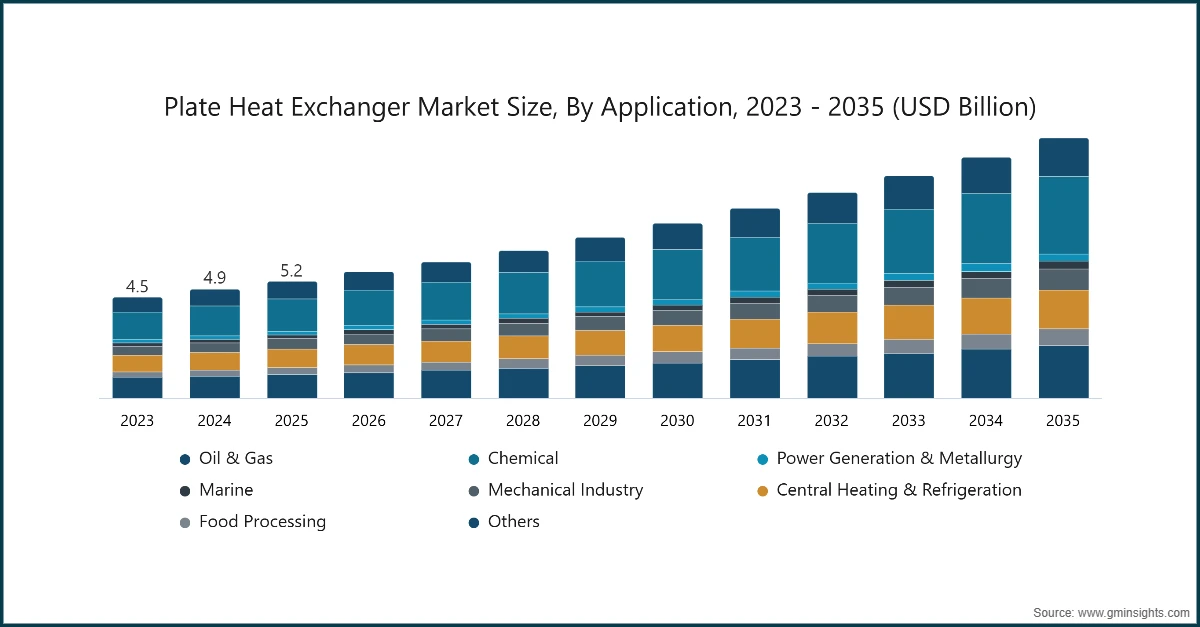
Based on application, the industry is segmented into oil & gas, chemical, power generation & metallurgy, marine, mechanical industry, central heating & refrigeration, food processing and others. The chemical segment accounted for approximately 27% market share in 2025 and is anticipated to grow at a CAGR of over 9% from 2026 to 2035.
The chemical application is anticipated to grow driven by increasing chemical production along with rising need for compact, energy-efficient, and versatile heat exchange solutions that can handle corrosive and high-temperature fluids. Plate heat exchangers offer superior heat transfer efficiency, easy maintenance, and customization options, which are suitable for chemical processes including acid treatment, polymer production, and refining, further augmenting product deployment.
For instance, in March 2025, Kaori introduced all‑stainless steel S Series plate heat exchanger, engineered for high‑purity processes and demanding industrial environments. With exceptional corrosion resistance, this unit is suitable for fuel cell cooling, semiconductor applications and electrolytic hydrogen production, requiring ultrapure water and reliable operation under chemically aggressive conditions.
Central heating & refrigeration segment across plate heat exchanger market is set to grow at a CAGR of over 7.5% by 2035. Increasing demand for energy-efficient and compact thermal solutions, rising adoption of low‑carbon heating and cooling technologies across industrial operations and stringent mandates toward reducing environmental impact will augment industry landscape. In central heating systems, plate heat exchangers improve heat transfer efficiency, reduce energy consumption, and enable better temperature control, further accelerating product deployment.
For instance, in July 2024, SWEP International introduced the 190 series of brazed plate heat exchangers, engineered for systems using low‑GWP and natural refrigerants. The D190, FI190, and PI190 models offer single‑ and dual‑circuit configurations for 60–150 kW applications. Designed for refrigerants such as R32, R454B, and R290, the units feature integrated distribution technology to ensure stable, efficient operation across modern HVACR systems.
The oil & gas application across plate heat exchanger market is set to reach over USD 1.7 billion by 2035. Increasing exploration and production activities, especially in deepwater and unconventional reservoirs, along with rising need for efficient thermal management and process optimization require advanced heat exchange solutions to handle high pressures and corrosive fluids. Ongoing expansion of the oil and gas infrastructure, shifting focus toward improving energy efficiency, reducing operational costs and stringent mandates to reduce emissions will augment industry landscape.
For instance, in July 2024, Tranter secured a major order for six stainless‑steel and 254 SMO plate‑and‑frame heat exchangers with EPDM gaskets for a post‑combustion carbon‑capture project. These units will support heat recovery and vent condensation within a continuous CO₂ absorption process using regenerable solvents. The equipment was procured by a leading EPC contractor, with engineering led from India and final approval from Germany, for a blue hydrogen facility in Texas.
Learn more about the key segments shaping this market
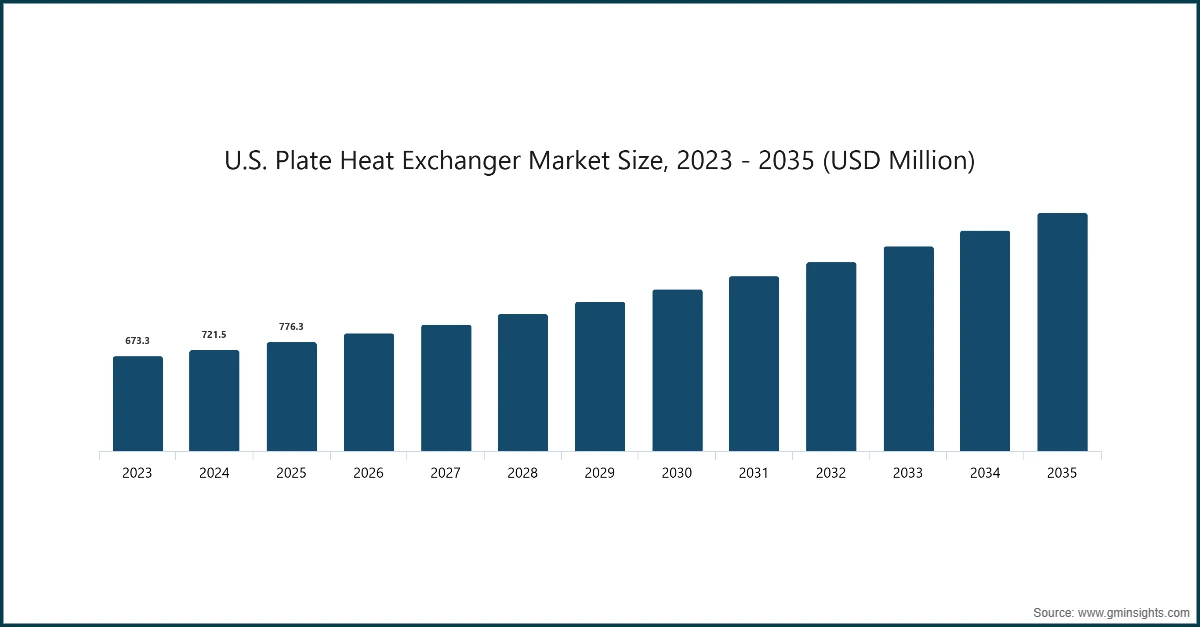
U.S. dominated the plate heat exchanger market in North America with around 83.3% share in 2025 and generated around USD 776.3 million in revenue. Rising demand for reliable and efficient heat transfer solutions across industries, government authorities focusing on emission reduction is encouraging the adoption of eco-friendly technologies. Ongoing industrial sector expansion and modernization, along with the increasing renewable energy projects, adoption of smart monitoring systems, increasing automation is positively influencing industry dynamics.
For instance, in November 2025, the U.S. Department of Energy announced USD 355 million in new funding opportunities to boost domestic production of critical materials vital to the nation’s energy, manufacturing, transportation, and defense sectors. From this, USD 275 million will support facilities extracting minerals from industrial and coal byproducts, while USD 80 million will fund Mine of the Future test sites to advance next‑generation mining technologies, aligning with federal priorities to strengthen U.S. mineral supply chains.
North America plate heat exchanger market is anticipated to grow owing to flourishing investment in energy‑intensive industries along with continuous development of new production facilities and retrofitting of existing manufacturing units. Moreover, accelerating industrialization and urban development are driving construction activity, increasing demand for energy‑efficient heating and cooling systems across sectors including chemicals & petrochemicals, energy, and manufacturing is augmenting industry outlook.
For instance, in December 2025, Canada introduced new regulations to significantly curb methane emissions from the oil and gas industry. Effective in 2028, these rules aim for a 75% reduction from 2014 levels by 2035, restricting routine venting and requiring regular leak detection and repair. Operators may implement customized methane‑control methods provided they meet the prescribed methane‑intensity performance standards.
Europe plate heat exchanger market is set to grow over USD 4.1 billion by 2035. Ongoing focus towards circular economy initiatives, encouraging industries to adopt sustainable thermal management solutions to reduce waste and improve resource efficiency along with stringent measures to reduce emissions will complement business dynamics. Implementation of strict mandates to reduce energy consumption are encouraging industries to upgrade to more efficient heat exchange systems coupled with focus on digitalization and modernization of manufacturing processes are contributing to Europe plate heat exchanger industry growth.
For instance, in December 2025, the European Commission introduced a set of measures to streamline environmental legislation covering industrial emissions, circular economy processes, environmental assessments, and geospatial data. The reforms aim to reduce administrative responsibilities while maintaining strong environmental and public‑health protection, the initiative supports EU’s clean and digital transition. The Commission estimates annual business savings of USD 1.17 billion, contributing to its broader cost‑reduction target for 2029.
Asia Pacific plate heat exchanger market is anticipated to grow at a CAGR of over 9% from 2026 to 2035. Growing investment in industrial development, expansion of manufacturing operations, and increasing energy requirements across sectors including oil & gas, petrochemicals, chemicals food & beverage and power generation is complementing business landscape. Paradigm shift toward adoption of energy‑efficient technologies, various governments are taking proactive measures aimed at reducing emissions and encouraging cleaner industrial processes is contributing to deployment of advanced heat transfer solutions.
For instance, in March 2025, Australia introduced its updated Foreign Investment Policy, enhancing oversight of investments in sectors critical to national interests. Strict reviews now apply to critical infrastructure, advanced and dual‑use technologies, sensitive data assets, and locations near defence facilities. The policy also reforms tax compliance by replacing standard conditions with customised requirements and imposing broader disclosure obligations on foreign investors.
Middle East & Africa plate heat exchanger market was evaluated at above USD 275 million in 2025. Expanding petrochemical and oil & gas sectors, which require highly efficient thermal management solutions to optimize processes and reduce operational costs along with rapid urbanization and infrastructure development, is contributing to industry growth. Ongoing investments in renewable energy projects, waste-to-energy facilities and manufacturers expand their regional operations coupled with governmental initiatives aimed at reducing carbon emissions and promoting energy efficiency will augment business dynamics.
For instance, in November 2024, Alfa Laval Arabia for Maintenance completed the assembly of its initial plate heat exchanger units following the approval of its industrial license, marking a significant step in advancing local production capabilities. The first set comprised four AHRI‑certified AQ10T‑BFM units for a district cooling HVAC project. This localized assembly approach reduces delivery times, lowers carbon emissions, and aligns with Saudi Arabia’s long‑term sustainability ambitions, including the 2060 net‑zero target.
Plate Heat Exchanger Market Share
Major 5 players operating across the plate heat exchanger industry include ALFA LAVAL, Danfoss, Kelvion Holding GmbH, Xylem and HISAKA WORKS contribute around 45% of the market share in 2025.
Leading manufacturers operating in the plate heat exchanger industry are increasingly integrating IoT‑enabled sensors and advanced data analytics to deliver smart, condition‑based monitoring and optimized system performance. Continuous innovation and sustained R&D investment are key vital parameters to enhance efficiency and product capability. Companies are also engaged in mergers, acquisitions, strategic partnerships and joint ventures to expand their product portfolios and strengthen industry leadership.
Over the last three years, the plate heat exchanger market witnessed significant momentum despite economic and process modernization challenges. By 2023 and 2024, expanding global supply chains and shifting focus on minimizing energy consumption across industrial facilities augmented product deployment. In 2025, industrial modernization initiatives, introduction of emission‑reduction policies, and rising demand for high‑efficiency thermal solutions has positively influence business dynamics.
Xylem offers Bell & Gossett range of plate heat exchangers which are engineered to deliver high thermal efficiency within compact installation spaces. Both the brazed plate and gasketed plate models are available in multiple sizes and capacities to ensure optimal heat‑transfer performance across diverse operating conditions. Additionally, the company’s steam and water‑powered heat exchangers provide rapid, reliable, and instantaneous heat transfer for various industrial applications.
ALFA LAVAL offers brazed and fusion‑bonded plate heat exchangers which are compact, durable, and maintenance‑free thermal solutions through its advanced technologies. The company’s gasketed plate‑and‑frame heat exchangers deliver high performance, deliver enhanced energy efficiency, operational reliability, and ease of service.
Danfoss offers SONDEX standard plate heat exchangers that provide an effective thermal‑management solution for a wide range of industrial applications. The company’s brazed plate heat exchangers deliver compact, adaptable performance for high‑pressure and extreme‑temperature conditions, while the Micro Plate CO₂ heat exchanger offers a compact, high‑performance solution specifically engineered for heat‑pump systems and challenging transcritical refrigeration.
Kelvion Holding offers brazed plate heat exchangers that deliver compact, customized solutions for various industrial applications, while gasketed plate heat exchanger designs support more demanding processes. They effectively handle fibre‑rich and viscous media, enable chemical cooling, support potable‑water treatment, ensure reliable plant cooling with river or seawater, and provide high‑performance climate control for facilities including data centres.
Plate Heat Exchanger Market Companies
Major players operating in the plate heat exchanger industry are:
Accessen Group
ALFA LAVAL
API Heat Transfer
BARRIQUAND Group
Danfoss
Dry Coolers
FUNKE Waermeaustauscher Apparatebau
HFM
HISAKA WORKS
HRS Heat Exchangers
Kelvion Holding
Kinam Engineering Industries
SonFlow
SPX FLOW
SWEP International
TENEZ
Thermofin
UNITED HEAT EXCHANGERS
Wessels
Xylem
Xylem offers GPX heat exchangers feature a gasketed plate‑pack configuration designed to deliver efficient thermal performance across varying operating conditions. This design provides notable advantages, including a compact footprint, reduced weight, and high heat‑transfer effectiveness, whether handling large or minimal temperature differentials between fluids. The company’s reported half yearly revenues of USD 4.3 billion for 2025 and whole year revenues for 2024 was evaluated at USD 8.6 billion.
ALFA LAVAL offers Compabloc series of plate heat exchangers that delivers compact, highly efficient, and dependable heat‑transfer performance across a wide range of process applications. These units are deployed across diverse industrial operations, offering thermal efficiencies up to five times greater than those of conventional heat‑exchange designs. The company reported approximately USD 3.6 billion of revenue for the first six months of 2025.
Danfoss offers semi‑welded plate heat exchangers that are designed to meet the rigorous demands of industrial operations and incorporate advanced features suitable for high‑performance refrigeration systems. The company also offers SONDEX Free Flow plate heat exchangers for highly viscous processes and its hygienic gasketed plate heat exchangers are designed to meet stringent standards within the food and beverage sector. The company’s sales revenue for the first 6 months of 2025 was reported at around USD 5.5 billion in 2025 and sales revenues of USD 11.37 billion for the whole year 2024.
HISAKA WORKS reported revenue of USD 139.6 million for the first 6 months of 2025 and complete year revenue of USD 244.6 million for 2024. The company’s semi‑welded plate heat exchangers are widely utilized across industrial applications including sulfuric acid production, BTX recovery, and various other chemical processing operations. These units are engineered to withstand harsh operating environments, the HISAKA WX series features a specialized welded construction enhances durability, reliability, and thermal performance under process conditions.
Plate Heat Exchanger Market Report Attributes
| Key Takeaway | Details |
|---|---|
| Market Size & Growth | |
| Base Year | 2025 |
| Market Size in 2025 | USD 5.1 Billion |
| Market Size in 2026 | USD 5.5 Billion |
| Forecast Period 2026-2035 CAGR | 8.4% |
| Market Size in 2035 | USD 11.5 Billion |
| Key Market Trends | |
| Drivers | Impact |
| Rising adoption of energy efficient technologies | Increasing adoption of energy-efficient heat exchanger technologies, driving innovation, reduce operational costs, and support sustainable development across industrial sectors. |
| Stringent mandates to limit carbon footprint | Stringent mandates to limit carbon footprint, led industries to adopt clean and efficient heat exchanger solutions, aligning with environmental regulations further shaping industry dynamics. |
| Flourishing investments across industrial infrastructure | Accelerating investments will increase demand for advanced plate heat exchanger systems, enabling modernization, enhancing operational efficiency, and supporting industry growth. |
| Pitfalls & Challenges | Impact |
| Significant maintenance requirements and associated operational expenses | High maintenance requirements and operational expenses increase total cost of ownership, potentially reducing profit margins and impacting industry dynamics |
| Opportunities: | Impact |
| Innovation in material technology | Advancements in corrosion-resistant and lightweight materials enhance heat exchanger lifespan and efficiency, opening new applications and increasing market competitiveness. |
| Stringent energy efficiency regulations | Stringent energy standards drive demand for high-performance and energy efficient plate heat exchangers, through compliance-driven upgrades further augmenting industry growth. |
| Digital integration and monitoring | Incorporating IoT and smart monitoring systems improves operational performance and maintenance efficiency, leading to reduced downtime and driving adoption across various sectors. |
| Growing industrial infrastructure development | Increasing investments in industrial infrastructure and urbanization projects will boost demand for efficient heat exchange solutions. |
| Market Leaders (2025) | |
| Market Leader |
Market Share of 16.5% |
| Top Players |
Collective Market Share of 45% |
| Competitive Edge |
|
| Regional Insights | |
| Largest Market | Asia Pacific |
| Fastest growing market | Europe |
| Emerging countries | U.S., Germany, China, Japan |
| Future outlook |
|
What are the growth opportunities in this market?
Plate Heat Exchanger Industry News
In December 2025, SWEP introduced two new brazed plate heat exchanger models, the B327 and B224, to address rising demand in data‑center cooling and district‑energy systems. Designed for single‑phase operation, both units feature large ports for high flow capacity, low pressure drop, and strong thermal efficiency. Their compact configuration suits the restricted layouts of data centers using CDUs, while the B327 additionally supports heat‑recovery applications of up to 1000 kW.
In November 2025, SonFlow A/S expanded its brazed heat exchanger portfolio by introducing four additional models, increasing the range to eleven sizes and offering greater application flexibility. These copper‑brazed units provide high thermal efficiency, compact installation, and maintenance‑free operation, supported by a durable construction suitable for HVAC, refrigeration and industrial establishments. Their robust design ensures consistent performance under elevated pressure and temperature conditions, meet the requirements of modern process environments.
In October 2025, JSC HS‑Science participated in the Heat&Power International Exhibition, held in Moscow, Russia, at Crocus Expo IEC. The company showcased its brazed plate heat exchangers, featuring capacities of several megawatts and up to 45 bar operating pressures. Production is fully localized, supported by certified quality systems, rigorous testing, proprietary plate‑stamping technology, and advanced copper and nickel‑brazing processes introduced under an import‑substitution initiative backed by the industrial development fund.
In April 2025, Alfa Laval expanded its semi‑welded plate heat exchanger portfolio with the introduction of the TS25, designed for processes where pressure‑drop limitations are critical. The unit is built on long‑established semi‑welded technology and is suitable for electrolyzer cooling, sulphuric‑acid operations, industrial heat pumps, and other demanding applications. Its compact, high‑capacity design, advanced sealing system, and enhanced durability, support efficient cooling and heat recovery, reduce lifecycle costs, and improve performance in sectors including clean‑hydrogen production and heavy process industries.
The plate heat exchanger market research report includes in-depth coverage of the industry with estimates & forecast in terms of revenue “USD Million” from 2026 to 2035, for the following segments:
Market, By Application
Oil & gas
Chemical
Power generation & metallurgy
Marine
Mechanical industry
Central heating & refrigeration
Food processing
Others
The above information has been provided for the following regions and countries:
North America
U.S.
Canada
Mexico
Europe
Germany
UK
France
Russia
Italy
Spain
Poland
Turkey
Asia Pacific
China
Japan
South Korea
India
Indonesia
Malaysia
Thailand
Vietnam
Philippines
Australia
Middle East & Africa
Saudi Arabia
UAE
Egypt
South Africa
Nigeria
Latin America
Brazil
Argentina
Colombia
Chile
Frequently Asked Question(FAQ) :
What is the market size of the plate heat exchanger in 2025?
The market size was USD 5.1 billion in 2025, with a CAGR of 8.4% expected through 2035 driven by rising adoption of energy-efficient technologies, stringent carbon footprint mandates, and flourishing investments across industrial infrastructure.
What is the projected value of the plate heat exchanger market by 2035?
The plate heat exchanger market is expected to reach USD 11.5 billion by 2035, propelled by innovation in material technology, stringent energy efficiency regulations, and growing industrial infrastructure development.
What is the current plate heat exchanger market size in 2026?
The market size is projected to reach USD 5.5 billion in 2026.
What was the market share of the chemical application segment in 2025?
The chemical segment held approximately 27% market share in 2025 and is anticipated to grow at a CAGR of over 9% from 2026 to 2035.
What is the projected value of the central heating & refrigeration segment by 2035?
The central heating & refrigeration segment is set to grow at a CAGR of over 7.5% by 2035, driven by demand for energy-efficient thermal solutions and low-carbon heating technologies.
Which region leads the plate heat exchanger market?
The U.S. dominated with around 83.3% North American market share in 2025, generating approximately USD 776.3 million in revenue.
What are the upcoming trends in the plate heat exchanger market?
Key trends include integration of IoT-enabled sensors and advanced data analytics for smart monitoring, development of modular and scalable designs, adoption of advanced corrosion-resistant materials, and increasing focus on waste heat recovery systems.
Who are the key players in the plate heat exchanger market?
Key players include ALFA LAVAL, Xylem, Danfoss, Kelvion Holding, HISAKA WORKS, Accessen Group, API Heat Transfer, BARRIQUAND Group, Dry Coolers, FUNKE, HFM, HRS Heat Exchangers, Kinam Engineering, SonFlow, SPX FLOW, SWEP International, TENEZ, Thermofin, UNITED HEAT EXCHANGERS, and Wessels.
Plate Heat Exchanger Market Scope
Related Reports