Summary
Table of Content

Plant Based Texturizers Market
Get a free sample of this report
Form submitted successfully!
Error submitting form. Please try again.
Thank you!
Your inquiry has been received. Our team will reach out to you with the required details via email. To ensure that you don't miss their response, kindly remember to check your spam folder as well!
Request Sectional Data
Thank you!
Your inquiry has been received. Our team will reach out to you with the required details via email. To ensure that you don't miss their response, kindly remember to check your spam folder as well!
Form submitted successfully!
Error submitting form. Please try again.
Plant Based Texturizers Market Size
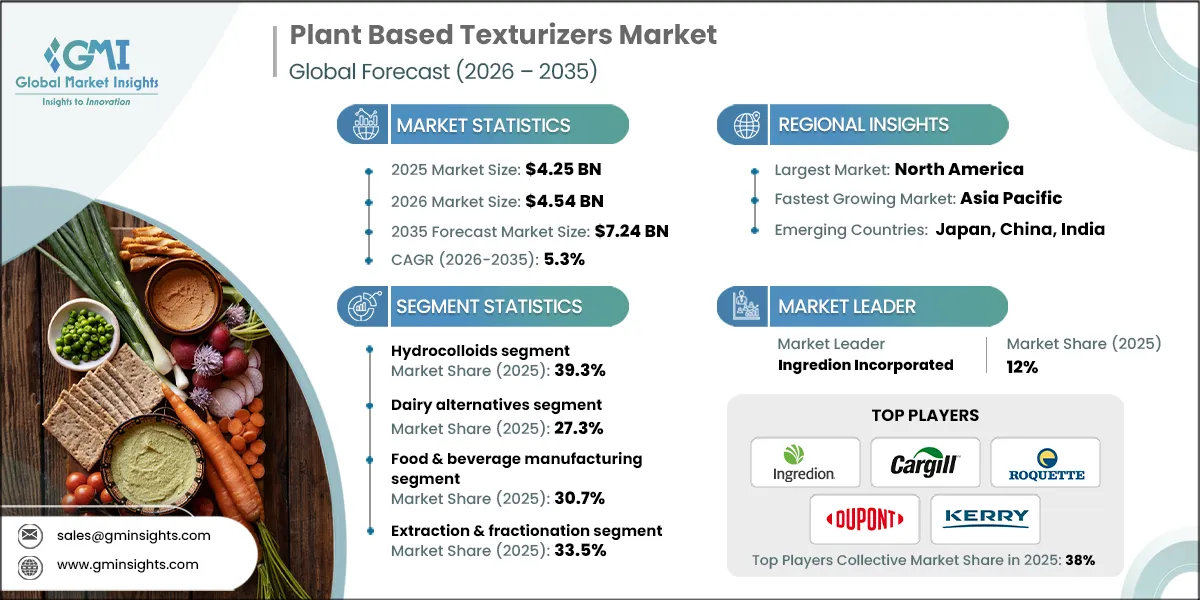
The global plant based texturizers market was valued at USD 4.25 billion in 2025. The market is expected to grow from USD 4.54 billion in 2026 to USD 7.24 billion in 2035, at a CAGR of 5.3%, according to latest report published by Global Market Insights Inc.
Plant Based Texturizers Market Key Takeaways
Market Size & Growth
- 2025 Market Size: USD 4.25 Billion
- 2026 Market Size: USD 4.54 Billion
- 2035 Forecast Market Size: USD 7.24 Billion
- CAGR (2026–2035): 5.3%
Regional Dominance
- Largest Market: North America
- Fastest Growing Region: Asia Pacific
Key Market Drivers
- Rising consumer demand for plant-based foods.
- Clean label & natural ingredient trends.
- Regulatory support for plant-based alternatives.
Challenges
- High production costs vs conventional texturizers.
- Sensory & flavor challenges (off-notes, bitterness).
Opportunity
- Emerging protein sources (algae, fungi, novel legumes).
- Functional blends & customized texturizer systems.
Key Players
- Market Leader: Ingredion Incorporated led with over 12% market share in 2025.
- Leading Players: Top 5 players in this market include Ingredion Incorporated, Cargill, Incorporated, Roquette Frères, DuPont/IFF, Kerry Group plc, which collectively held a market share of 38% in 2025.
Get Market Insights & Growth Opportunities
- The Plant-Based Texturizers Market serves as essential component which underpins modern formulation science for food nutraceutical personal care and industrial product development. Plant-derived texturizing agents which manufacturers previously considered niche input materials now function as essential elements in product development processes. Manufacturers use these texturizers because their importance has grown for natural ingredient products which consumers expect to see in plant-based product development processes. The market needs to drive innovation so companies can develop new products. Plant-based texturizers now deliver superior performance because processing technologies and bio-engineering and ingredient optimization have improved their capabilities.
- Advanced formulas provide better thermal stability and dispersibility and enhanced compatibility with complex product systems. The new innovations enable manufacturers to shift from traditional synthetic materials while meeting regulatory standards and transitioning to safer and transparent and environmentally responsible product formulations. The competitive landscape is increasingly influenced by global sustainability mandates and the corporate transition toward greener value chains. Companies use plant-based texturizers to develop their sustainability strategies which help them reduce reliance on petrochemical and resource-intensive materials.
- The industry has increased its commitment to better product lifecycles through this approach which improves ethical sourcing and renewable input usage and reduces environmental damage. Plant-based texturizers have emerged as vital components which enable companies to maintain ecological balance while sustaining their business operations because sustainability now functions as a procurement requirement in various industries.
To get key market trends
Plant Based Texturizers Market Trends
- The core performance standards of ingredient systems used in modern product formulation have been changed through plant-based texturizers. The materials which were first developed as natural substitutes for synthetic stabilizers have transformed into next-generation functional materials that provide users with multiple benefits which support sustainability requirements. The industry now shows increasing interest in these materials because they follow a global movement which replaces traditional resource-intensive additives with sustainable renewable materials that comply with environmental regulations and corporate decarbonization plans.
- The emergence of adaptive viscosity modulators and responsive gelling mechanisms and precision-targeted structuring agents creates new product development pathways which improve both performance and product consistency. The next-generation texturizers use digital formulation tools with advanced quality-monitoring platforms to achieve predictive performance control while giving their users added strategic value in products which need high innovation.
- The use of plant-based texturizers has evolved from commodity inputs into high-value strategic ingredients which support structural enhancement and sensory optimization and regulatory compliance and sustainability leadership. Renewable production models and future-ready product architectures now depend on their growing compatibility which establishes their significance for every industry which wants to create safer cleaner and more resilient formulation pathways.
Plant Based Texturizers Market Analysis

Learn more about the key segments shaping this market
Based on product type, the plant based texturizers market is segmented into hydrocolloids, plant proteins (texturized), starches, cellulose derivatives, other plant-based texturizers. Hydrocolloids dominated the market with an approximate market share of 39.3% in 2025 and is expected to grow with a CAGR of 4.7% by 2035.
- Hydrocolloids function as the main structural element in plant‑based products because they maintain steady texture and moisture preservation and product stability throughout various fields. Manufacturers use their versatile properties to create specific viscosity and mouthfeel characteristics which makes them essential for traditional products and new product types that want natural dependable performance.
- The texturized form of plant proteins has evolved from basic meat‑analogue products into versatile substances that modern food products use to create effective binding and elastic properties and enhanced taste experiences. The growing importance of plant proteins shows that the industry now prefers protein‑based products which combine functional benefits with clean label requirements and customer recognition.
Learn more about the key segments shaping this market
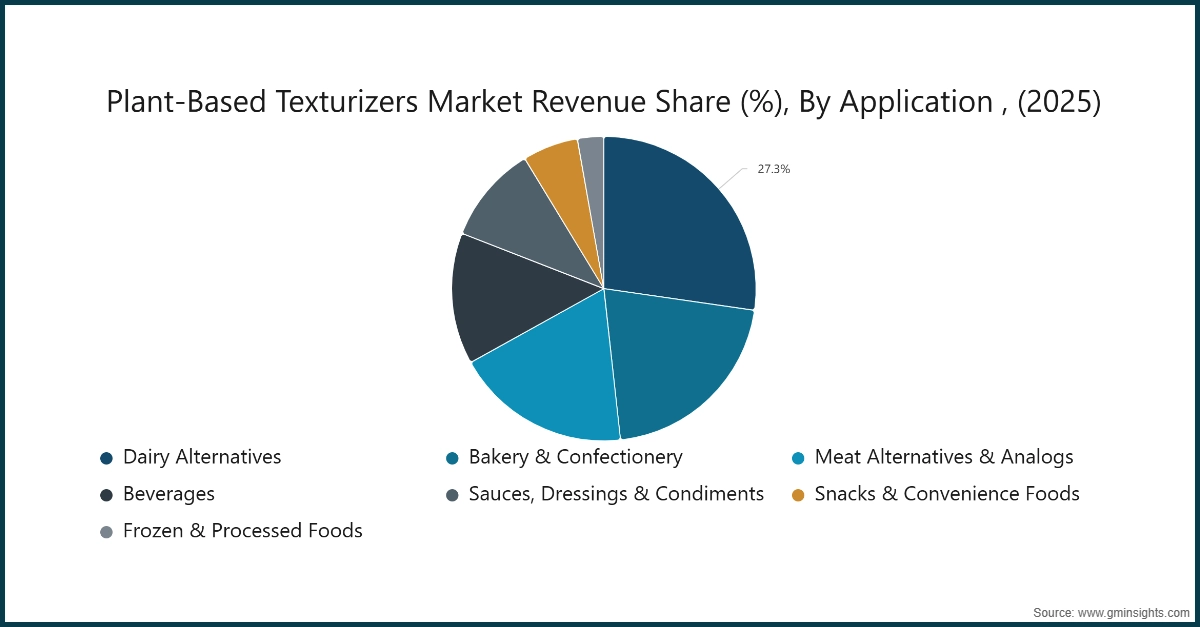
Based on application, the plant based texturizers market is segmented into dairy alternatives, bakery & confectionery, meat alternatives & analogs, beverages, sauces, dressings & condiments, snacks & convenience foods, frozen & processed foods. Dairy alternatives joints held the largest market share of 27.3% in 2025 and is expected to grow at a CAGR of 6.9% during 2026-2035.
- The plant-based texturizers in dairy alternatives function as necessary agents who create structural elements which produce creamy texture and controlled viscosity and permanent emulsification needed for clean-label plant-based products that mimic traditional dairy products. The ingredients function as essential elements which maintain product quality throughout all stages of processing and storage and distribution making them essential for successful product formulation.
- The texturizers from plants deliver essential characteristics which bakeries and confectioneries need to develop dough and manage moisture and create optimal crumb structure. The functionality of these products enables softer results with better stretch capacity and improved product life, which helps producers create high-quality sensory results, while customers demand more natural ingredients.
Based on end-user, the plant based texturizers market is segmented into food & beverage manufacturing, grain & oilseed processing, dairy alternative manufacturers, bakery & confectionery, foodservice & institutional, retail & consumer packaged goods. Food & beverage manufacturing segment dominated the market with an approximate market share of 30.7% in 2025 and is expected to grow with the CAGR of 3.8% by 2035.
- Plant-based texturizers serve multiple purposes in grain and oilseed processing by enabling the development of functional ingredients and enhancing operational efficiency while improving the results obtained from flour and protein and concentrate products. The texturizers support processors who enter value-added markets by providing them with tools to manage product texture and moisture content and processing traits which helps their products stand out in the ingredient marketplace.
- Plant-based texturizers create traditional dairy product textures for dairy alternative manufacturers who use these ingredients to produce dairy-free products. The ingredients play a critical role because they establish the structural foundation which enables plant-based milks and yogurts and cheeses and desserts to achieve smooth and stable sensory profiles that consumers recognize.
Based on technology method, the plant based texturizers market is segmented into extrusion technology, fermentation-based production, extraction & fractionation, novel texturization technologies, chemical/physical modification. Extraction & fractionation segment dominated the market with an approximate market share of 33.5% in 2025 and is expected to grow with the CAGR of 2.3% by 2035.
- The extraction and fractionation method has emerged as the leading platform because it produces functional components which maintain consistent performance throughout various applications. Extrusion technology drives the progress of plant-based systems which need advanced textural features to achieve their highest performance levels. Fermentation-based production systems use bio-engineered precision to produce texturizers which have superior purity and stable properties and refined sensory qualities. The new texturization technologies develop advanced functional architectures which feature flexible structural systems and unique sensory properties to support high-end product development.
Looking for region specific data?
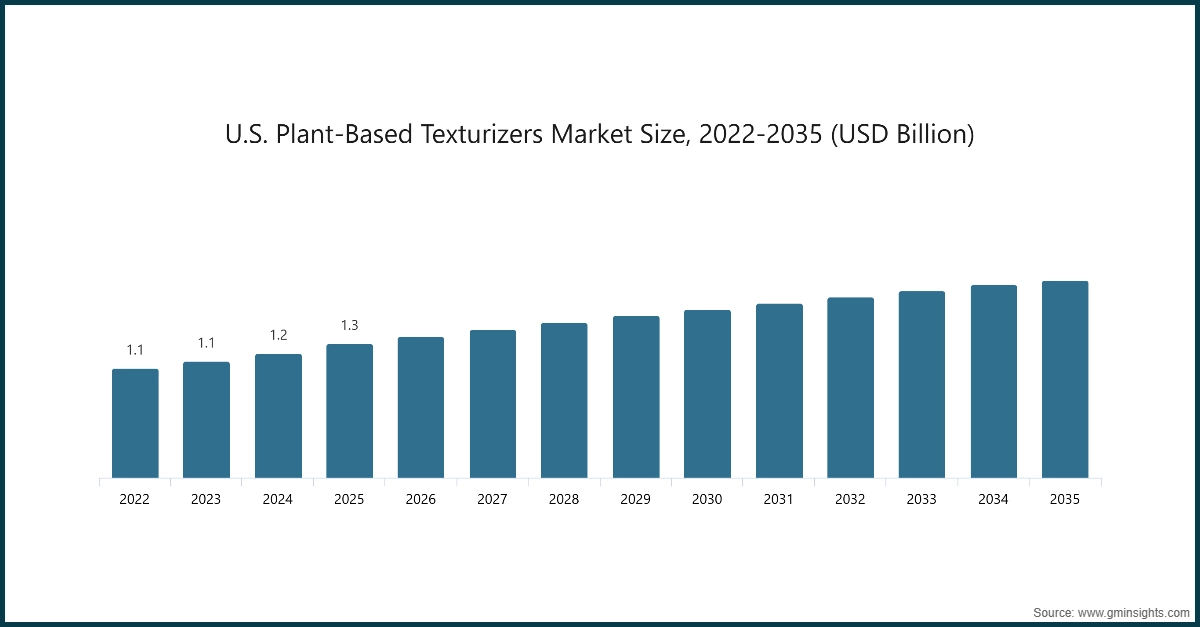
The North America plant based texturizers market dominates the market and is growing rapidly on the global level with a market share of 37% in 2025.
- The North America Plant‑Based Texturizers Market has established itself as a pivotal innovation and growth hub because the region has both advanced food manufacturing facilities and developed consumer markets which support clean-label sustainable formulation practices.
Europe PlantBased Texturizers Market is growing in the industry with revenue of USD 1.26 billion in 2025 and is anticipated to show lucrative growth over the forecast period.
- The Europe Plant‑Based Texturizers Market is seeing increased expansion because the region strengthens its dedication to natural product development and clean label requirements and nature‑friendly ingredient selection techniques.
The Asia Pacific plant based texturizers market is anticipated to grow at a CAGR of 8.6% during the analysis timeframe.
- The region's manufacturers now use plant-based texturizers to enhance product quality and sensory characteristics and to fulfill increasing market demand for natural clean-label products. The region's agricultural resources enable constant development of plant-based ingredients, while its advanced processing technologies allow for the creation of multi-functional texturizer systems.
Latin America plant based texturizers market accounted for 5.4% market share in 2025 and is anticipated to show highest growth over the forecast period.
- The Latin America Plant‑Based Texturizers Market is gaining strategic importance as the region intensifies its focus on natural ingredient innovation, sustainable production practices, and modernization of its food manufacturing landscape. Manufacturers are using advanced plant-derived texturizers which enhance texture and stability and sensory performance to meet increasing demand for clean-label products and plant-forward diets.
Middle East & Africa plant based texturizers market accounted for 4.1% market share in 2025 and is anticipated to show lucrative growth over the forecast period.
- The Middle East & Africa Market experiences growth because the region progresses toward cleaner ingredient usage and contemporary food production methods and diverse consumer taste preferences. The rising demand for natural plant-based solutions leads manufacturers to implement texturizers which improve product stability and texture and sensory characteristics while meeting the growing demand for transparent sustainable practices.
Plant Based Texturizers Market Share
The top 5 companies in PlantBased Texturizers industry include Ingredion Incorporated, Cargill, Incorporated, Roquette Frères, DuPont/IFF, Kerry Group plc. These are prominent companies operating in their respective regions covering approximately 38% of the market share in 2025. These companies hold strong positions due to their extensive experience in PlantBased Texturizers market. Their diverse product portfolios, backed by robust production capabilities and distribution networks, enable them to meet the rising demand across various regions.
- Ingredion Incorporated operates worldwide as a provider of ingredient solutions which focus on developing plant-based starches and sweeteners and texturizers and value-added functional systems. The company assists manufacturers who operate in food and beverage and industrial sectors by providing help with their formulation needs which include texture optimization and stability enhancement and clean-label development.
- Cargill, Incorporated functions as a diversified enterprise that operates within the food and agriculture industries by providing plant-based ingredients and functional systems and formulation components to manufacturers throughout the world. The company provides texturizers which include plant-based starches and hydrocolloids and proteins as essential components to achieve the required technical performance standards in processed foods and beverages and other product categories.
- Roquette Frères operates internationally to supply plant-based ingredients which it produces from corn and wheat and potatoes and peas. The company offers texturizers and plant proteins and functional carbohydrates which serve the needs of food and nutrition and industrial markets.
- The merger of DuPont's Nutrition & Biosciences business with IFF created a new company that offers a complete range of functional ingredients and enzymes and cultures and texturizing systems. The company offers plant-based texturizers which include hydrocolloids and proteins and specialty blends to enhance food and beverage products through better formulation performance and improved processing efficiency and enhanced sensory qualities.
- Kerry Group plc operates as an international organization which delivers solutions for taste and nutrition and functional ingredients. The company offers plant-based texturizers which support dairy alternatives and meat analogs and beverages and bakery and prepared foods through its stabilization and sensory experience and consistency functions.
Plant Based Texturizers Market Companies
Major players operating in the plant based texturizers industry include:
Ingredion Incorporated
- Cargill, Incorporated
- Roquette Frères
- ICL Food Specialties (ICL Group)
- DuPont Nutrition & Biosciences
- Kerry Group plc
- Ashland Global Holdings Inc.
- PURIS Holdings LLC
- Marine Hydrocolloids
- TIC Gums
- Palsgaard A/S
- Fiberstar Inc
- CP Kelco
- Socius Ingredients
- Burcon NutraScience Corporation
Plant Based Texturizers Market Report Attributes
| Key Takeaway | Details |
|---|---|
| Market Size & Growth | |
| Base Year | 2025 |
| Market Size in 2025 | USD 4.25 Billion |
| Market Size in 2026 | USD 4.54 Billion |
| Forecast Period 2026-2035 CAGR | 5.3% |
| Market Size in 2035 | USD 7.24 Billion |
| Key Market Trends | |
| Drivers | Impact |
| Rising consumer demand for plant-based foods | The process of plant-based texturizer adoption accelerates because manufacturers choose to change their product lines to match the new dietary needs of their customers |
| Clean label & natural ingredient trends | Brands now give more importance to transparent ingredient lists because they want to use plant-based texturizers to create products with clean labels |
| Regulatory support for plant-based alternatives | The regulatory framework supports plant-based markets by providing plant-based texturizers with easier market access while pushing manufacturers to switch from synthetic materials |
| Pitfalls & Challenges | Impact |
| High production costs vs conventional texturizers | The higher expenses of sourcing and processing limit price competition for products designed for budget-sensitive markets |
| Sensory & flavor challenges (off-notes, bitterness) | Formulation processes become complicated because plant-derived components create taste or aroma problems which lead to difficulties |
| Opportunities: | Impact |
| Emerging protein sources (algae, fungi, novel legumes) | The development of new biological sources enables companies to produce high-functionality texturizers which have better nutritional benefits and sustainable features |
| Functional blends & customized texturizer systems | The design of multi-component systems enables brands to create specific textures and stability characteristics and sensory outcomes for different products |
| Market Leaders (2025) | |
| Market Leader |
12% Market Share |
| Top Players |
Collective Market Share of 38% in 2025 |
| Competitive Edge |
|
| Regional Insights | |
| Largest Market | North America |
| Fastest growing market | Asia Pacific |
| Emerging countries | Japan, China, India |
| Future outlook |
|
| Companies covered: | 15 |
| Tables, Charts & Figures: | 205 |
| Countries covered: | 18 |
| No of Pages: | 190 |
What are the growth opportunities in this market?
Plant Based Texturizers Industry News
- In December 2025, Bakery solutions specialist Lasenor Emul, S.L. crafted delicious muffins using 50-100% less egg. Introducing LASENOR VP-100, a clean, texturizing protein from peas, these hybrid baked treats were showcased at Fi Europe 2025, as part of the product's official launch.
- In June 2025, Plant-based food technology company Meala partnered with dsm-firmenich to launch Vertis PB Pea, a texturizing pea protein, in Europe.
These plant based texturizers market research report includes in-depth coverage of the industry, with estimates & forecasts in terms of revenue (USD Billion) and volume (Kilo Tons) from 2022 to 2035, for the following segments:
Market, By Product Type
- Hydrocolloids
- Plant proteins (texturized)
- Starches
- Cellulose derivatives
- Other plant-based texturizers
Market, By Application
- Dairy alternatives
- Bakery & confectionery
- Meat alternatives & analogs
- Beverages
- Sauces, dressings & condiments
- Snacks & convenience foods
- Frozen & processed foods
Market, By End-User
- Food & beverage manufacturing
- Grain & oilseed processing
- Dairy alternative manufacturers
- Bakery & confectionery
- Foodservice & institutional
- Retail & consumer packaged goods
Market, By Technology Method
- Extrusion technology
- Fermentation-based production
- Extraction & fractionation
- Novel texturization technologies
- Chemical/physical modification
The above information is provided for the following regions and countries:
- North America
- U.S.
- Canada
- Europe
- Germany
- UK
- France
- Spain
- Italy
- Rest of Europe
- Asia Pacific
- China
- India
- Japan
- Australia
- South Korea
- Rest of Asia Pacific
- Latin America
- Brazil
- Mexico
- Argentina
- Rest of Latin America
- Middle East and Africa
- Saudi Arabia
- South Africa
- UAE
- Rest of Middle East and Africa
Frequently Asked Question(FAQ) :
What was the market size of the plant-based texturizers market in 2025?
The market size was USD 4.25 billion in 2025, with a CAGR of 5.3% projected through 2035, driven by the shift towards sustainable, renewable materials and advancements in functional ingredient systems.
What is the projected value of the plant-based texturizers industry by 2035?
The market is expected to reach USD 7.24 billion by 2035, fueled by innovations such as adaptive viscosity modulators, responsive gelling mechanisms, and precision-targeted structuring agents.
What is the projected size of the plant-based texturizers market in 2026?
The market is expected to grow to USD 4.54 billion in 2026.
What was the market share of the hydrocolloids segment in 2025?
The hydrocolloids segment held the largest share, accounting for 39.3% of the market in 2025, and is projected to grow at a CAGR of 4.7% through 2035.
What was the market share of the dairy alternatives application segment in 2025?
The dairy alternatives segment held a significant market share of 27.3% in 2025 and is expected to grow at a CAGR of 6.9% during the forecast period of 2026-2035.
Which end-user segment dominated the market in 2025?
The food & beverage manufacturing segment led the market with a 30.7% share in 2025, reflecting its extensive use of plant-based texturizers in product formulations.
Which region leads the plant-based texturizers market?
North America was the largest market in 2025, with an estimated share of 37%. The region is projected to grow rapidly, driven by strong demand for sustainable and innovative food ingredients.
Who are the key players in the plant-based texturizers market?
Major players include Ingredion Incorporated, Cargill, Incorporated, Roquette Frères, ICL Food Specialties (ICL Group), DuPont Nutrition & Biosciences, Kerry Group plc, Ashland Global Holdings Inc., and PURIS Holdings LLC.
Plant Based Texturizers Market Scope
Related Reports