Summary
Table of Content

Oil & Gas Heat Exchanger Market
Get a free sample of this report
Form submitted successfully!
Error submitting form. Please try again.
Thank you!
Your inquiry has been received. Our team will reach out to you with the required details via email. To ensure that you don't miss their response, kindly remember to check your spam folder as well!
Request Sectional Data
Thank you!
Your inquiry has been received. Our team will reach out to you with the required details via email. To ensure that you don't miss their response, kindly remember to check your spam folder as well!
Form submitted successfully!
Error submitting form. Please try again.
Oil & Gas Heat Exchanger Market Size
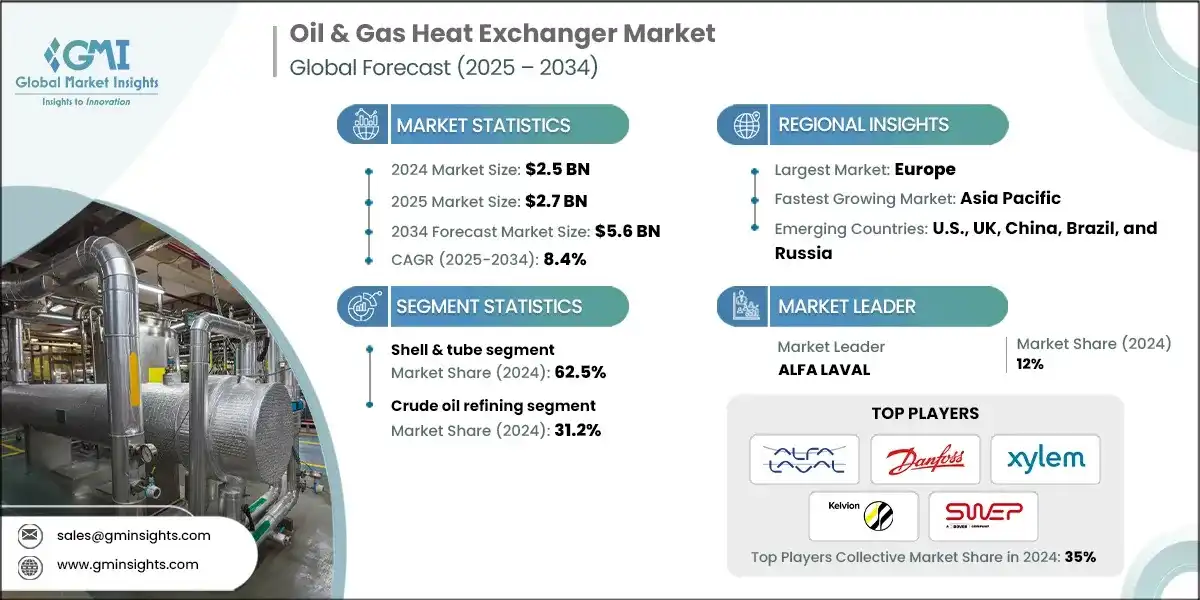
According to a recent study by Global Market Insights Inc., the oil & gas heat exchanger market was estimated at USD 2.5 billion in 2024. The market is expected to grow from USD 2.7 billion in 2025 to USD 5.6 billion in 2034, at a CAGR of 8.4%.
Oil & Gas Heat Exchanger Market Key Takeaways
Market Size & Growth
- 2024 Market Size: USD 2.5 Billion
- 2025 Market Size: USD 2.7 Billion
- 2034 Forecast Market Size: USD 5.6 Billion
- CAGR (2025–2034): 8.4%
Regional Dominance
- Largest Market: Europe
- Fastest Growing Region: Asia Pacific
Key Market Drivers
- Influx of new investments across oil and gas infrastructure.
- Ongoing exploration of hydrocarbons.
- Initiatives to keep a check on the rising carbon footprint.
Challenges
- High maintenance requirement.
Opportunity
- Expansion of LNG infrastructure.
- Carbon capture and storage integration.
- Hydrogen production and processing.
- Offshore oil & gas development.
Key Players
- Market Leader: ALFA LAVAL led with over 12% market share in 2024.
- Leading Players: Top 5 players in this market include ALFA LAVAL, Danfoss, Xylem, Kelvion Holding, SWEP International, which collectively held a market share of 35% in 2024.
Get Market Insights & Growth Opportunities
- Flourishing investments in oil & gas operations along with increasing demand for reliable heating and cooling systems will positively influence the industry outlook. Heat exchangers are critical components in oil and gas operations, facilitating efficient thermal energy transfer between fluid streams to optimize performance and reduce operational costs further complementing the business landscape.
- Rising demand for reliable and energy efficient thermal management solutions across oil and gas facilities including refining, processing and exploration along with increasing technological advancements in heat exchangers is positively influencing industry growth. Increasing deployment of customized technologies according to the project requirements across exploration sites to ensure enhanced performance and temperature maintenance will augment boost industry scenario.
- For instance, September 2025, Sino Mechanical Equipment successfully delivered shell and tube heat exchangers for a Middle East project. Featuring high-conductivity copper tubes with spiral-finned surfaces and optimized deflector design, the units ensure efficient and stable thermal performance. Suitable for low-viscosity oil-based fluids, these exchangers support both industrial and comfort applications with reliable heating and cooling capabilities.
- The oil and gas heat exchanger market is set to witness robust growth, driven by rising demand for energy-efficient solutions in refineries and gas processing facilities. The rising preference for compact and adaptable heat exchangers, capable of operating in space-constrained or complex environments, is further accelerating product adoption. Shifting preference toward prioritizing cost-effective thermal management technologies to enhance operational performance and sustainability is shaping the business dynamics.
- For instance, in February 2025, Jebel Ali Free Zone came into partnership with Allied Heat Exchange AG, based in Germany to build the GCC’s largest heat exchanger production facility. Operated by Güntner, the 1.2 million sq. ft. site will support growing demand for energy-efficient cooling, especially in data centers. The facility will enhance regional supply chain efficiency across GCC, India, China, Africa, and Asia.
- Asia Pacific holds a dominant share in the oil & gas heat exchanger industry driven by rapid industrial growth along with expanding oil and gas operations requiring scalable and durable heat exchanger solutions. Increasing complexity of oil and gas extraction and processing is creating demand for advanced heat exchanger technologies capable of handling high thermal loads and extreme operating conditions.
- For instance, in August 2025, Oil and Natural Gas Corporation launched a campaign to enhance oil and gas production through well optimization and fast-tracking new discoveries. With domestic output covering only 15% of demand, ONGC’s nine new finds and 15 exploration blocks aim to reduce import dependence and support India’s energy security.
- Europe is the fastest growing market in oil & gas heat exchanger industry and is anticipated to grow owing to industrial modernization and energy diversification are driving demand for advanced heat exchanger technologies. Facilities are adopting compact and efficient systems to meet performance goals and reduce energy consumption further shaping industry landscape.
- For instance, Vitherm has secured an order to supply two welded plate heat exchangers to a leading Italian oil and gas company. These exchangers will enhance glycol regeneration efficiency, offering superior mechanical strength, full cleanability, and reliable heat recovery. Vitherm’s advanced technology ensures long-term performance and reduced maintenance, reinforcing its competitive edge in industrial heat transfer solutions.
To get key market trends
Oil & Gas Heat Exchanger Market Trends
- The oil & gas heat exchanger industry is set to grow owing to expansion of oil and gas infrastructure along with increased demand for thermal management systems. Expansion of facilities, growing complexity production initiatives and increasing integration across both new installations and retrofit projects, supporting enhanced energy utilization and process stability will augment industry outlook.
- For instance, in September 2025, Global OTEC has been selected for a DeepStar research initiative, supported by major energy firms including Chevron, ExxonMobil, and bp. The project will assess Ocean Thermal Energy Conversion (OTEC) as a renewable baseload power source for offshore operations. This marks OTEC’s first inclusion in DeepStar’s portfolio, exploring its potential to replace conventional offshore energy systems.
- Exploration activities in unconventional reserves, including shale formations and deepwater fields, have accelerated the deployment of heat exchangers that can operate under extreme pressure and temperature conditions. Rising demand for robust designs and materials that can withstand corrosive fluids and fluctuating loads is positively influencing business landscape.
- For instance, in September 2025, Baker Hughes has signed an agreement with Halfaya Gas Company to implement a flare gas recovery system at the Bin Umar plant in Iraq. The project will recover up to 300 MMSCFD of flared gas, converting it into dry gas, LPG, and condensate. The collaboration also includes upstream field development and local service capabilities to support Iraq’s energy transition.
- The rise of liquefied natural gas (LNG) and hydrogen as alternative energy sources is along with rising demand for thermal management solutions across liquefaction, regasification, and purification processes is complementing industry growth. The ability of these systems to manage precise temperature differentials and maintain system integrity will stimulate product penetration.
- For instance, in July 2024, Chart Industries provided its modular mid-scale liquefaction solution for Argent LNG’s 20 MTPA facility in Louisiana. The project features Chart’s IPSMR technology and proprietary heat exchangers, enabling scalable and efficient LNG production. Argent LNG’s choice highlights Chart’s proven expertise in delivering adaptable, high-performance solutions for modern energy infrastructure.
Oil & Gas Heat Exchanger Market Analysis
Learn more about the key segments shaping this market
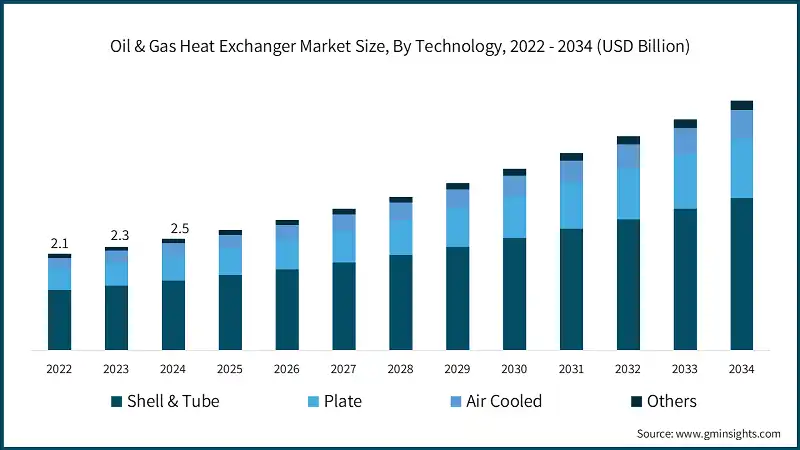
Based on technology, the market is segregated into air cooled, plate, shell & tube, and others. The shell & tube segment accounted for around 62.5% of market share in 2024 and is set to grow at a CAGR of above 8% through 2034.
- Shell & tube heat exchanger segment is anticipated to grow owing to widely utilization across crude oil refining and gas processing driven by their durability and ability to handle high pressures and temperatures. Increasing investments in upstream and downstream infrastructure and the need for reliable thermal performance is augmenting product deployment. Rising use of corrosion-resistant materials, enhanced tube designs for better heat transfer, and integration with digital monitoring systems to improve efficiency and maintenance is positively influencing business outlook.
- For instance, in September 2025, GNEE completed the delivery of advanced shell-and-tube heat exchangers for a Nigerian oil and gas project, passing all performance tests under client supervision. Designed for the harsh conditions of the Niger Delta, including high temperatures, humidity, and sulfur content, the units will improve processing efficiency.
- Plate heat exchanger technology is set to grow at a CAGR of over 9% from 2025 to 2034. Growing inclination toward adoption of push for energy-efficient and space-saving solutions along with rising demand for modular designs, improved gasket materials for longer life, and growing adoption in offshore platforms to enhance performance will boost product deployment. These units are deployed across oil and gas applications owing to their compact size, high thermal efficiency and are useful in low to medium pressure applications including cooling and heating fluids further shaping plate heat exchanger business dynamics.
- For instance, in June 2025, Shanghai Heat Transfer delivered advanced plate heat exchanger skids for a large offshore platform that launched from Qingdao Port. Shanghai Heat Transfer applied its advanced modular skid-mounted design and engineering expertise to deliver high-performance thermal solutions. These heat exchanger skids are built to withstand the harsh offshore environment, including high salinity and space constraints.
- Air cooled segment was evaluated at a revenue of above USD 275 million in 2024. Air-cooled heat exchangers are gaining significant momentum in oil and gas applications owing to their water-free operation, compact footprint, and low maintenance needs. Their ability to perform under high temperature and pressure conditions is driving product deployment across demanding environments for efficient and sustainable thermal solutions.
- For instance, in August 2025, Inpex will replace all heat exchangers across its Ichthys LNG facility and shit its facility for six weeks owing to production issue caused by a fault in one unit. Despite restoring operations, Inpex chose full replacement to ensure long-term reliability. The company prioritizes uninterrupted performance and aims to eliminate any potential risks to future LNG production.
- Increasing exploration in dry regions and stringent environmental regulations along with enhanced designs for better airflow, noise reduction technologies, and smart control systems for optimizing performance under varying load conditions is shaping business dynamics.
Learn more about the key segments shaping this market
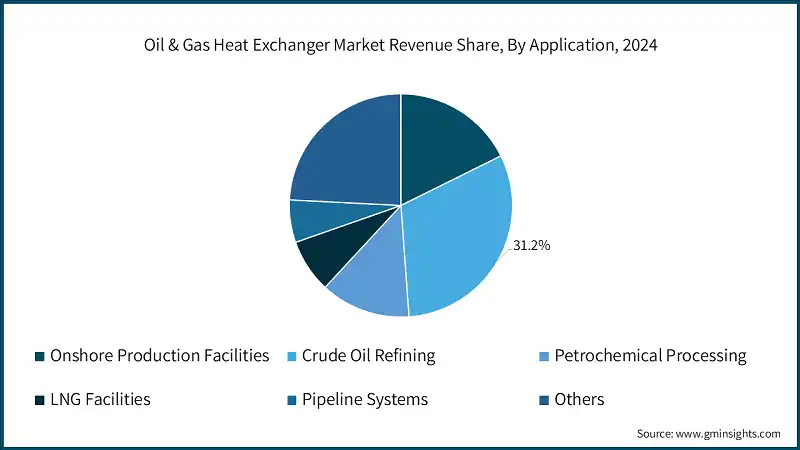
Based on application, the market is classified into onshore production facilities, crude oil refining, petrochemical processing, LNG facilities, pipeline systems and others. The crude oil refining segment holds the largest share of oil & gas heat exchanger market accounting for around 31.2% of revenue share in 2024 and is set to grow at a CAGR of over 7.5% through 2034.
- Refining capacity additions globally and rising need for operational optimization along with stringent environmental regulations that demand lower emissions and improved energy utilization is complementing industry landscape. Ongoing integration of digital monitoring, predictive maintenance technologies to enhance equipment reliability and lifecycle performance along with increasing adoption of advanced heat exchangers for their high thermal efficiency will shape business dynamics.
- For instance, in February 2024, ADNOC initiated a retubing project at the Samsung Abu Dhabi Refinery to resolve critical heat exchanger issues like pressure drops and leaks. Starting February 26, the one-month turnaround aimed to restore efficiency and safety. Such maintenance during scheduled shutdowns helps reduce downtime and ensures reliable plant operations through targeted repairs or retubing.
- Onshore product facilities application segment was valued at over USD 440 million in 2024. Rising energy demand, expansion of oilfields, and increasing investments in infrastructure modernization across onshore production facilities will positively influence the business outlook. Ongoing adoption of advanced heat exchanger technologies, including compact and corrosion-resistant designs, and their ability to withstand harsh operating conditions and reduce maintenance costs will augment industry landscape.
- For instance, in May 2025, Godrej Enterprises’ Process Equipment division successfully delivered high-pressure heat exchangers and a separator to a major blue ammonia facility in the Middle East. Built with low alloy steel, the equipment includes exchangers weighing up to 250 metric tonnes and measuring 26 meters in length. Engineered for extreme conditions, these units enhance energy recovery and efficiency in ammonia production, supporting sustainable operations.
- LNG facilities segment is set to observe a CAGR of above 9.5% from 2025 to 2034. Rising LNG exports, offshore FLNG developments, and government initiatives promoting low-carbon energy will complement business landscape. Ongoing transition to cleaner energy sources along with the surge in LNG infrastructure projects requiring advanced heat exchanger technologies will positively influence industry outlook.
- For instance, in October 2025, Chart Industries secured a contract from Bechtel to supply advanced heat exchangers and cold boxes for Phase 2 of Sempra Infrastructure’s Port Arthur LNG project in Texas. Building on its Phase 1 contributions, Chart will deliver critical technology to support the facility’s expansion and ensure efficient, dependable LNG operations.
- Petrochemical processing segment is anticipated to grow at a CAGR of over 8.5% through 2034. Continuous industrial expansion across emerging economies, increased investment in downstream facilities, and the shift toward integrated refinery-petrochemical complexes is complementing industry growth. Rising global demand for polymers, plastics, and specialty chemicals and petrochemical processing facilities adopting heat exchangers for temperature regulation in chemical reactions, separation processes, and energy recovery systems, will augment business scenario.
Looking for region specific data?
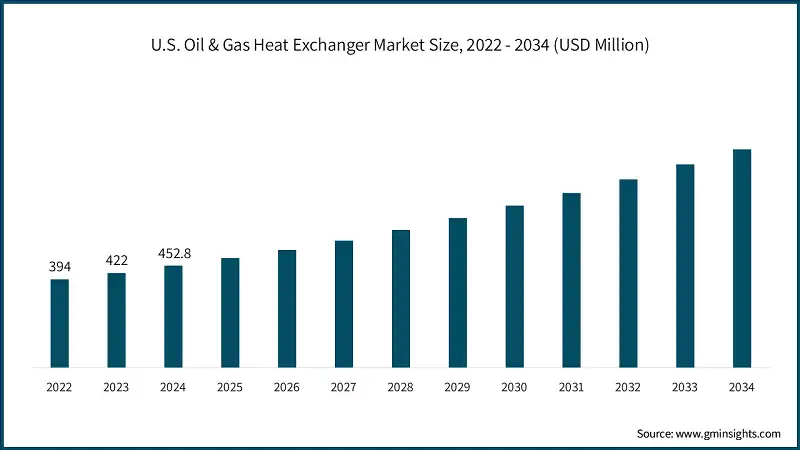
U.S. dominated the oil & gas heat exchanger market in North America with around 78% share in 2024 and generated USD 452.8 million in revenue. The U.S. oil and gas sector is increasingly turning to energy-efficient thermal solutions in response to net-zero goals, evolving environmental regulations, and the need for infrastructure modernization further augmenting industry landscape.
- U.S. oil & gas heat exchanger market is anticipated to grow owing to robust oil and gas infrastructure, growing shale oil and gas extraction, along with increasing investments in refining and processing facilities. The integration of digital technologies and IoT to enhance the performance and maintenance of facilities and processing plants will play a pivotal role in shaping the business landscape.
- For instance, in October 2024, Tranter has been selected to provide heat exchangers for a carbon capture application at a blue hydrogen facility in Texas. Ordered by a leading EPC contractor, with engineering managed from India and procurement from Germany, the plant will supply hydrogen and nitrogen for blue ammonia production, supporting decarbonization efforts across the U.S. Gulf Coast.
- The North America oil & gas heat exchanger market is anticipated to cross over USD 1.2 billion by 2034. Increasing demand for energy-efficient technologies and components driven by expanding hydrocarbon exploration activities throughout the region is complementing the business landscape. Oil & gas sector is striving to reduce energy consumption and operational expenses, while complying with stricter environmental standards, have accelerated the adoption of advanced heat exchanger solutions.
- Europe oil & gas heat exchanger market is set to witness a CAGR of above 7% from 2025 to 2034. Growing inclination toward energy efficiency, sustainability, and operational flexibility, along with increased importance on energy conservation and effective heat transfer processes across refining, chemical production, and natural gas treatment. Regulatory bodies are increasingly implementing policies designed to enhance energy efficiency, aiming to address climate change and cut down carbon emissions align with broader international sustainability objectives is shaping business dynamics.
- For instance, in January 2025, Alleima confirmed to provide Preem’s Lysekil refinery with heat exchanger tubes for conversion to renewable fuels. The revamped IsoCracker plant will produce renewable fuels volume of 1.2 million cubic meters per year, including HVO and SAF, reducing fossil CO2 emissions by up to 3 million tons. This investment supports Sweden’s green energy goals and marks a shift from fossil to renewable raw materials.
- Asia Pacific accounted for over 23% of the market share in 2024. Rising energy demand and the need for efficient thermal management in refining, petrochemical, and natural gas processing. Shifting focus on energy conservation, cost reduction, and compliance with environmental regulations is driving the adoption of advanced heat exchange technologies.
- Increasing focus on exploration of hydrocarbons is further contributing to expansion and modernization initiatives, coupled with rising demand for innovative and high-performance heat exchange technologies to meet evolving operational requirements augmenting industry landscape.
- For instance, in October 2025, China announced to add 11 new crude oil reserve sites through 2025 & 2026 to strengthen energy security. With a total capacity of 169 million barrels equivalent to two weeks of imports the new facilities span inland and coastal regions. This expansion follows the addition of nearly 190 million barrels between 2020 and 2024, reinforcing China’s strategic stockpiling efforts.
- The Middle East & Africa oil & gas heat exchanger market is set to grow at over 8.8% CAGR from 2025 to 2034. Increasing investments in high-energy infrastructure and the rising need for dependable thermal management systems is complementing the industry landscape. The presence of substantial oil reserves, along with efforts to modernize and expand processing capacity, is fueling product demand. Emerging technologies offering compact, efficient, and durable heat exchange solutions to support operational efficiency and environmental compliance, is augmenting industry outlook.
- For instance, in September 2025, OSSO launched a new heat exchanger service line in the Middle East, offering inspection, cleaning, testing, and part supply from its Abu Dhabi base. The service includes thermographic imaging for fault detection and both workshop and onsite maintenance. This initiative enhances OSSO’s support capabilities for oil and gas clients, ensuring reliable heat exchanger performance with minimal operational disruption.
- Latin America oil & gas heat exchanger market is anticipated to witness significant momentum owing to strong oil and sector with increased exploration and production activity, particularly in Brazil and Argentina. Offshore developments and enhanced oil recovery projects have accelerated the demand for reliable heat exchangers along with gas processing units and refining complexes are also increasing deployment to support operational efficiency and thermal control further shaping business dynamics.
- For instance, in October 2023, Tranter received an order for 38 titanium plate heat exchangers for offshore FPSOs in Brazil. The Singapore-based contractor will oversee fabrication in China and Brazil, aligning with module integration sites. Thirty-six units will be built in Beijing, and four in São Paulo. This project showcases Tranter’s manufacturing capabilities and expertise in delivering customized, high-performance solutions for offshore oil and gas applications.
Oil & Gas Heat Exchanger Market Share
- The top 5 oil & gas heat exchanger companies operating across the industry are ALFA LAVAL, Xylem, Danfoss, SWEP International and Kelvion Holding. These companies contribute a market share of approximately 35% in 2024.
- The oil and gas heat exchanger industry is highly competitive, driven by rapid technological progress and strategic innovation. Companies are increasingly investing in research and development to improve energy efficiency, enhance performance, and diversify product offerings to strengthen market positioning and meet evolving industrial demands for advanced thermal solutions.
- Companies operating in the oil and heat exchanger sector are driving growth through innovation, strategic alliances, M&A and global expansion. To strengthen their market presence, they offer comprehensive lifecycle services, enter long-term agreements, and embrace digital technologies to enhance competitiveness and establish a stronger footprint in emerging markets.
- For instance, in October 2025, Chart Industries shareholders confirmed the acquisition by Baker Hughes in an all-cash deal valued at USD 210 per share. With 98.87% voting in favor, the transaction is expected to close by mid-2026, pending regulatory approvals. The acquisition strengthens Baker Hughes’ position in biogas, hydrogen, LNG, and carbon capture technologies. Chart’s global footprint, including 65 manufacturing sites and 50 service centers, will enhance Baker Hughes’ energy transition capabilities.
- Alfa Laval provides a broad selection of finned tube heat exchangers, ranging from models for drilling operations to custom-built units for high-temperature downstream processes. Each system is configured to meet specific operational needs, delivering reliable performance, thermal efficiency, and reduced operating costs.
- Danfoss offers compact brazed plate heat exchangers designed for high-pressure and extreme-temperature conditions. With customizable materials and plate patterns, these units deliver efficient thermal performance tailored to specific operational needs. Their flexible design supports various connection configurations, ensuring optimal integration and reliability across diverse oil and gas applications.
- Kelvion Holding offers advance heat transfer solutions, combined with deep process expertise, enable refineries to enhance energy efficiency and reduce emissions. In atmospheric distillation unit (ADU) crude preheat trains, Kelvion’s K°Bloc welded plate heat exchangers significantly raise crude oil temperatures before reaching the fired heater, leading to major operational cost savings and improved overall process performance.
Oil & Gas Heat Exchanger Market Companies
Key participants operating in the oil & gas heat exchanger industry are:
- ALFA LAVAL
- API Heat Transfer
- BARRIQUAND Heat Exchanger
- Bronswerk
- Danfoss
- Funke Warmeaustauscher Apparatebau GmbH
- HFM
- HISAKA WORKS LTD.
- HRS Heat Exchangers
- KAM Thermal Equipment, LTD
- Kelvion Holding GmbH
- Mersen
- Metalforms, LLC
- Nexson Group
- SPX Flow
- SWEP International
- Thermofin
- TITAN Metal Fabricators
- Tranter
- Turnbull & Scott Group
- Xylem
- ALFA LAVAL finned tube air heat exchangers are engineered for long-term durability and high thermal performance. Designed for diverse sectors including oil and gas, hydrogen, RNG, and data centers, these systems offer both standard and custom configurations. Their adaptable design ensures compatibility with varied operating conditions, delivering reliable cooling, reduced operational costs, and optimized efficiency. The company’s revenue of net sales for 6 months of 2025 was evaluated at USD 3.5 billion.
- Danfoss offers SONDEX standard plate heat exchangers offer reliable thermal performance across oil and gas industry. With one of the largest plate selections, each unit is customized for specific operational needs. Their efficient design and adaptability make them a dependable solution for a broad range of thermal applications. The company reported USD 5.6 billion in revenue for the first half of 2025, following USD 11.37 billion in total revenue for 2024
- Xylem offers shell and tube heat exchangers that are engineered for demanding oil and gas applications, offering robust thermal performance under high pressure and temperature. Designed to TEMA, ASME, and API standards, they ensure reliability, corrosion resistance, and efficient heat transfer. Custom and pre-engineered options suit upstream to downstream operations. The company revenue for 6 months of 2025 was reported at USD 4.3 billion.
Oil & Gas Heat Exchanger Market Report Attributes
| Key Takeaway | Details |
|---|---|
| Market Size & Growth | |
| Base Year | 2024 |
| Market Size in 2024 | USD 2.5 Billion |
| Market Size in 2025 | USD 2.7 Billion |
| Forecast Period 2025 – 2034 CAGR | 8.4% |
| Market Size in 2034 | USD 5.6 Billion |
| Key Market Trends | |
| Drivers | Impact |
| Influx of new investments across oil and gas infrastructure | Increased capital flow boosts demand for advanced heat exchangers, driving innovation, capacity expansion, and modernization across upstream, midstream, and downstream operations. |
| Ongoing exploration of hydrocarbons | Continued hydrocarbon exploration necessitates robust heat exchanger systems for efficient thermal management in harsh environments, enhancing reliability and operational performance. |
| Initiatives to keep a check on the rising carbon footprint | Carbon reduction efforts accelerate adoption of energy-efficient heat exchangers, supporting decarbonization goals through improved heat recovery and reduced emissions in processing systems |
| Pitfalls & Challenges | Impact |
| High maintenance requirement | Frequent servicing and operational downtime increase lifecycle costs, reduce system efficiency, and challenge adoption of complex heat exchanger technologies in cost-sensitive oil and gas environments. |
| Opportunities: | Impact |
| Expansion of LNG infrastructure | Growing LNG investments create demand for high-efficiency heat exchangers, supporting liquefaction, regasification, and thermal management across modular and large-scale LNG facilities. |
| Carbon capture and storage integration | Carbon reduction initiatives drive adoption of advanced heat exchangers for solvent regeneration and heat recovery in post-combustion and pre-combustion CCS systems. |
| Hydrogen production and processing | Hydrogen-focused projects require specialized heat exchangers for gas purification, cooling, and compression, opening new avenues for innovation and market penetration. |
| Offshore oil & gas development | Ongoing offshore exploration boosts demand for compact, corrosion-resistant heat exchangers capable of operating under extreme pressure and temperature conditions in FPSO and subsea systems. |
| Market Leaders (2024) | |
| Market Leaders |
12% market share |
| Top Players |
Collective market share in 2024 is 35% |
| Competitive Edge |
|
| Regional Insights | |
| Largest Market | Europe |
| Fastest growing market | Asia Pacific |
| Emerging countries | U.S., UK, China, Brazil, and Russia |
| Future outlook |
|
What are the growth opportunities in this market?
Oil & Gas Heat Exchanger Market News
- In August 2025, Kobe Steel has secured a contract from Saipem to supply Printed Circuit Heat Exchangers for TotalEnergies’ Kaminho FPSO in Angola. Designed for high-pressure durability and compactness, the PCHE units will be installed on the FPSO topside in 2025. Supporting low-emission operations and full gas reinjection, this project marks a key milestone in Kobe Steel’s commitment to sustainable offshore energy solutions and stakeholder-focused transformation.
- In February 2025, Argent LNG has selected Baker Hughes to provide liquefaction technology and services for its planned LNG export facility in Port Fourchon, Louisiana. The project will deliver 24 MTPA of LNG using Baker Hughes’ modular NMBL solution powered by LM9000 gas turbines. Modules, including brazed aluminum heat exchangers, will be fully assembled and tested in Italy before site delivery.
- In October 2024, Tranter has been awarded a major contract for heat exchangers on two FPSOs destined for offshore Brazil. Thirty-six units will be manufactured in Beijing, China, and four in São Paulo, Brazil, supporting crude oil stabilization and process cooling. Designed for demanding conditions, Tranter’s plate heat exchangers will manage heating, cooling, and seawater-based thermal regulation across topside modules, reinforcing Tranter’s role in advanced offshore energy solutions.
- In October 2024, Honeywell announced acquisition of Air Products’ LNG process technology and equipment division for USD 1.81 billion in cash. This strategic acquisition enhances the company's energy transition portfolio by integrating advanced liquefaction and pre-treatment technologies with its Forge and Experion platforms. The inclusion of coil-wound heat exchangers boosts its ability to deliver compact, high-capacity LNG systems for both onshore and offshore applications.
- In September 2024, TransTech Group, a Bridge Industries portfolio company, has acquired Koch Heat Transfer’s North American business through its subsidiary, Metalforms. The newly branded Metalforms Heat Transfer will continue production in Beaumont, Texas, integrating KHT’s legacy brands to deliver advanced heat transfer solutions. This strategic move strengthens Metalforms’ market position and enhances service capabilities across the energy and industrial sectors.
The oil & gas heat exchanger market research report includes in-depth coverage of the industry with estimates & forecasts in terms of revenue (USD Million) from 2021 to 2034, for the following segments:
Market, By Technology
- Shell & Tube
- Plate
- Air Cooled
- Others
Market, By Application
- Onshore Production Facilities
- Crude Oil Refining
- Petrochemical Processing
- LNG Facilities
- Pipeline Systems
- Others
The above information is provided for the following regions and countries:
- North America
- U.S.
- Canada
- Mexico
- Europe
- Germany
- UK
- France
- Russia
- Italy
- Spain
- Poland
- Asia Pacific
- China
- Japan
- South Korea
- India
- Indonesia
- Malaysia
- Thailand
- Vietnam
- Philippines
- Australia
- Middle East & Africa
- Saudi Arabia
- UAE
- Egypt
- South Africa
- Latin America
- Brazil
- Argentina
- Colombia
- Chile
Frequently Asked Question(FAQ) :
What is the market size of the oil & gas heat exchanger in 2024?
The market size was USD 2.5 billion in 2024, with a CAGR of 8.4% expected through 2034 driven by rising investments in oil & gas operations and demand for efficient thermal systems.
What is the projected value of the oil & gas heat exchanger market by 2034?
The oil & gas heat exchanger market is expected to reach USD 5.6 billion by 2034, propelled by expansion of LNG infrastructure, carbon capture integration, and hydrogen production projects.
What is the current oil & gas heat exchanger market size in 2025?
The market size is projected to reach USD 2.7 billion in 2025.
How much revenue did the shell & tube segment generate in 2024?
Shell & tube heat exchangers accounted for approximately 62.5% of market share in 2024, driven by their durability and ability to handle high pressures and temperatures in crude oil refining and gas processing.
What was the valuation of crude oil refining application segment in 2024?
Crude oil refining held the largest share accounting for around 31.2% of revenue in 2024, driven by refining capacity additions and operational optimization needs.
What is the growth outlook for plate heat exchangers from 2025 to 2034?
Plate heat exchanger technology is set to grow at a CAGR of over 9% through 2034, due to demand for energy-efficient and space-saving solutions with improved gasket materials and modular designs.
Which region leads the oil & gas heat exchanger market?
U.S. dominated the oil & gas heat exchanger market in North America with around 78% share in 2024 and generated USD 452.8 million in revenue.
What are the upcoming trends in the oil & gas heat exchanger market?
Key trends include smart sensors and IoT integration for predictive maintenance, development of low-emission energy-efficient designs, adoption of compact high-performance systems for offshore installations, and critical roles in hydrogen production and carbon capture applications.
Who are the key players in the oil & gas heat exchanger market?
Key players include ALFA LAVAL, API Heat Transfer, BARRIQUAND Heat Exchanger, Bronswerk, Danfoss, Funke Warmeaustauscher Apparatebau GmbH, HFM, HISAKA WORKS LTD., HRS Heat Exchangers, KAM Thermal Equipment LTD, Kelvion Holding GmbH, Mersen, Metalforms LLC, Nexson Group, SPX Flow, SWEP International, Thermofin, TITAN Metal Fabricators, Tranter, Turnbull & Scott Group, and Xylem.
Oil & Gas Heat Exchanger Market Scope
Related Reports