Summary
Table of Content

Motorcycle Airbag Jacket Market
Get a free sample of this report
Form submitted successfully!
Error submitting form. Please try again.
Thank you!
Your inquiry has been received. Our team will reach out to you with the required details via email. To ensure that you don't miss their response, kindly remember to check your spam folder as well!
Request Sectional Data
Thank you!
Your inquiry has been received. Our team will reach out to you with the required details via email. To ensure that you don't miss their response, kindly remember to check your spam folder as well!
Form submitted successfully!
Error submitting form. Please try again.
Motorcycle Airbag Jacket Market Size
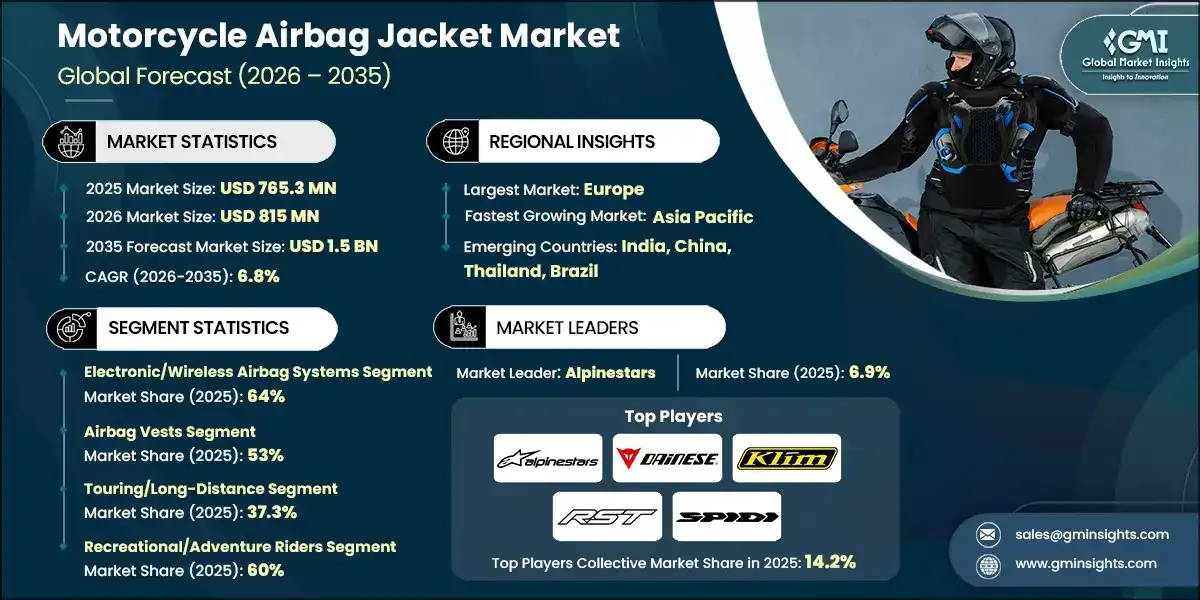
The global motorcycle airbag jacket market size was estimated at USD 765.3 million in 2025. The market is expected to grow from USD 815 million in 2026 to USD 1.5 billion in 2035, at a CAGR of 6.8% according to latest report published by Global Market Insights Inc.
Motorcycle Airbag Jacket Market Key Takeaways
Market Size & Growth
- 2025 Market Size: USD 765.3 Million
- 2026 Market Size: USD 815 Million
- 2035 Forecast Market Size: USD 1.5 Billion
- CAGR (2026–2035): 6.8%
Regional Dominance
- Largest Market: Europe
- Fastest Growing Region: Asia Pacific
Key Market Drivers
- Rising motorcycle accident rates.
- Growing demand for premium safety gear.
- Expansion of urban commuting on two wheelers.
- Technology upgrades in sensing and inflation systems.
Challenges
- High product cost and limited affordability.
- Low consumer awareness in developing regions.
Opportunity
- Rising integration of electronic airbag systems with connected platforms.
- Growth of motorcycle tourism and adventure sports.
- Expansion of rider training programs.
Key Players
- Market Leader: Alpinestars led with over 6.9% market share in 2025.
- Leading Players: Top 4 players in this market include RST, Klim, Dainese, Alpinestars, which collectively held a market share of 14.2% in 2025.
Get Market Insights & Growth Opportunities
Globally, growing accident rates and increasing emphasis on rider protection are driving growth in the Motorcycle Airbag Jacket Market. According to the World Health Organization, roughly 350,000 motorcyclists die each year, representing about 30% of all road traffic deaths worldwide, which has increased demand for advanced wearable safety products.
The increase in premium motorcycle adoption is driving the integration of electronic airbag systems into motorcycles. In 2024 more than 8 million motorcycles will be sold with engines larger than 500cc and therefore providing a wider audience of potential customers seeking more reliable and faster-inflating airbag jacket technology to enhance their riding experience.
The increasing willingness of consumers to invest in safety gear is driving quicker market penetration. With estimates indicating that over 30% of urban-based riders in developed markets will buy advanced safety apparel (including airbag jackets that provide better impact absorption than standard gear) on a regular basis in 2024.
Lower prices for technology upgrades, along with the decrease in cost associated with sensors used for airbag systems, provide consumers with an opportunity to obtain quality gear at a lower cost. Estimates provided by the industry state that the average price for electronic sensors decreased by 14.7% during the year 2024, allowing companies to accommodate more customers by offering less costly airbag jackets and thereby increasing the number of spectators, as well as their respective riders and fleet operators who purchase these products.
To get key market trends
Motorcycle Airbag Jacket Market Trends
Electronic sensors enable improved accuracy in determining the performance of Airbag Dependent motorcyclist protecting systems. Industry reports indicate a decline of approximately 15% in electronic sensor prices (2024), which provides a foundation for the future of Electronic monitoring systems to integrate multiple axis accelerometers and Inflation Modules that will initiate airbag inflation in milliseconds, producing repeatable results for crash detection when implemented into a product.
Regulatory Agencies of Europe and Asia Pacific are the lead users within their respective regions as a result of being heavily regulated and having higher levels of motorcycle usage. The number of Advanced Protective Gear Laws in Europe has increased; as an example, there will be mandated enforcement of laws and regulations that protect motorcyclists. It has been reported that over 1/3 of the global motorcycle market is located within Asia Pacific Region. Airbag jacket usage will continue to grow with Motorcycle sales in Asia Pacific causing airbag jacket growth.
Data based connected safety systems are emerging as Manufacturers introduce Data Based Monitoring Systems to the products. Manufacturers will be able to provide users with real-time notifications and alerts prompting service and alerts to improve reliability. Initial trials conducted at training centers show an increase of greater than 20% in engagement and product accountability for Airbag jackets.
The credibility of a product is being strengthened through the development of standardized testing methods. Certain organizations within industries are creating unified guidelines for testing products regarding impact absorption and the reliability of deployment. In 2024, the number of service providers participating in these initiatives increased by over 30 percent; therefore, there is an increase in confidence from the users of these products and a greater potential for market growth internationally.
Motorcycle Airbag Jacket Market Analysis
Learn more about the key segments shaping this market
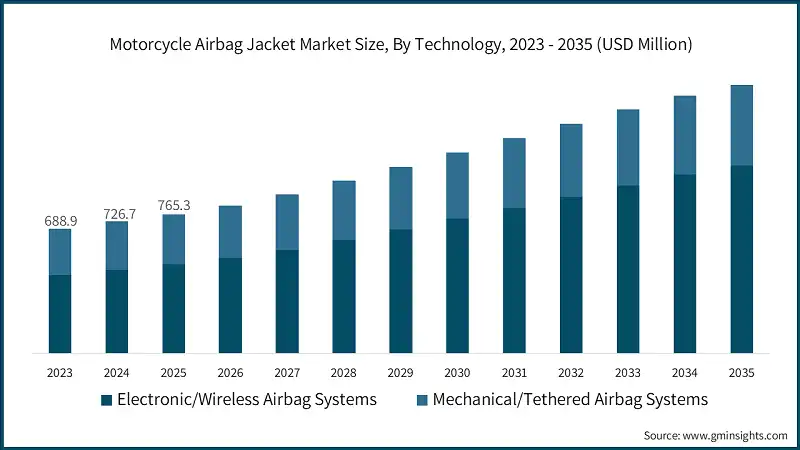
Based on technology, the motorcycle airbag jacket market is segmented into electronic/wireless airbag systems and mechanical/tethered airbag systems. The electronic/wireless airbag systems segment dominates the market with 64% share in 2025, and the segment is expected to grow at a CAGR of 7.8% from 2026 to 2035.
- Two-thirds of airbag systems are electronic, offering several advantages, such as quicker action (less than 60 milliseconds for activation in the year 2024), and improved accuracy from multiple sensors. Because of these benefits, electronic systems are expected to be adopted by many additional premium and commuter users, as well as improve rider safety, thereby increasing demand for electronic airbag systems.
- In addition to the benefits mentioned above, the electronic segment is benefiting from a decline in the cost of airbag sensors, and increased integration with advanced motorcycle riding platforms. Average prices per electronic sensing module were almost 15% lower in 2024 than in the previous year, which makes airbag systems more affordable and encourages manufacturers to develop and market newer models of airbag systems that are more reliable.
- Cost-conscious riders will likely continue to prefer mechanical systems due to their lower purchase prices per unit. For example, basic tethered jackets generally sell for less than $450, which further enhances access to urban commuters in the Asia and Latin America regions, where motorcycle sales remain on an upward trend.
- While mechanical systems cannot achieve the fine-tuned accuracy of electronic systems, they continue to serve a purpose as training devices and when used in low-speed riding environments. In regions that are in the process of developing electronic airbag systems or have not yet developed the necessary infrastructure and/or awareness to implement them, there will continue to be stable demand for tethered/mechanical airbag systems.
Learn more about the key segments shaping this market
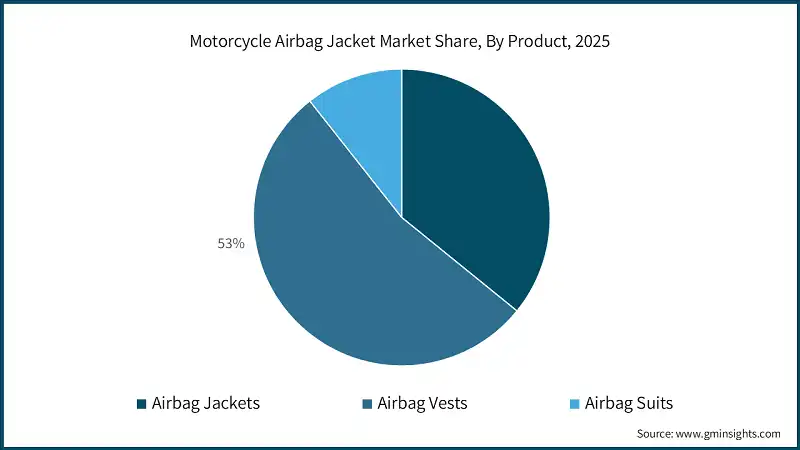
Based on product, the motorcycle airbag jacket market is divided into airbag jackets, airbag vests and airbag suits. The airbag vests segment dominates with 53% market share in 2025 and is growing at a CAGR of 7.4% from 2026 to 2035.
- Airbag vests are being adopted globally because they enable riders to wear their standard jackets while providing them with an additional layer of protection. In 2024, global sales of over 2.3 million units were supported by the growing number of commuters and training organizations who have opted for low-cost options for safety equipment.
- The affordability of the segment (most models priced between USD 250 & USD 500) works towards enhancing the accessibility of airbag vests in both APAC and LATAM, as these are both world regions with high levels of daily transportation being conducted by motorcycle.
- Airbag jackets represent the second largest segment and are preferred for use in premium/touring applications as they provide complete upper body coverage. Their growing use is driven by the increasing interest in long-distance motorcycle travel. In 2024, the number of organized touring events grew more than 20%.
- Airbag jackets are also supported by the increasing availability of product in retail outlets as well as improved electronic sensing platforms that provide better accuracy during deployment and therefore improve a rider's confidence to use these products while traveling long distances.
- Airbag suits represent a much smaller but still important portion of the overall segment and are primarily used in settings related to competitive racing or for high-performance riding where there are strict parameters regarding safety in racing events and a requirement that the full body be protected at the same time that very high speeds are attained.
Based on application, the motorcycle airbag jacket market is segmented into on-road/street riding, off-road/adventure riding, racing/track use and touring/long-distance. The touring/long-distance segment dominates with 37.3% market share in 2025.
- Users who ride motorcycles for touring purposes want consistent protection across different types of terrain and long distances. According to industry reports, in 2024 motorcycle touring in organized group events increased by over 20% which created an increased demand for advanced airbag systems that can accommodate hours of riding conditions.
- Touring is benefiting from increased interest in premium touring motorcycles as well as more people taking part in cross-country travel. Many areas in Europe and North America are seeing a continued increase in the number of registered riders using touring motorcycles as indicated by increasing registrations in that market which will result in the increased use of airbag-based safety equipment.
- Street riding (also considered as on-road or urban riding) is the next largest segment due to the high numbers of motorcycles being used daily by commuters in urban areas. In fact, in Asia Pacific, more than 50% of all motorcycle trips are made on city streets which shows a corresponding increase in the demand for airbag jackets and vests that are lighter and more affordable.
- As street riders have higher exposure to accidents while riding in heavy traffic environments, they are increasingly using smaller airbag systems. There have been reports from several countries of many new riders wearing body armor when taking motorcycle training and as a result, they are becoming more willing to wear them when they ride.
- Adventure riding (or off-road riding) is a rapidly growing segment and continues to gain participants and interest as the numbers of riders interested in recreational trail riding rise every year. Adventure motorcycle sales in 2024 increased significantly over previous years which will result in a higher use of impact absorbing protective equipment.
Based on end use, the motorcycle airbag jacket market is divided into professional motorcyclists, recreational/adventure riders and daily commuters. Recreational/adventure riders dominate with 60% market share in 2025.
- Adventure riding communities have increased significantly with over 20% growth in the sales of adventure motorcycles in 2024. As a result, there are more riders that require protective gear for riding on diverse terrain and in unpredictable conditions.
- The adventure segment also has greater willingness to purchase advanced airbag systems which allows more riders to invest in premium products priced between $400 and $900. This product type also supports the greater adoption of electronically controlled inflation technology designed for multi-surface utilization.
- The next major group of users is daily commuters. Rising dependence on motorcycles for transportation in urban areas has resulted in an increase of over 100 million daily motorcycle trips throughout Asia-Pacific alone in 2024. This also encourages the use of basic to mid-level airbag systems for improved safety while riding on public streets.
- The commuter base increasingly desires to use lighter valves of safety equipment that look good and pair well with typical clothing. Training facilities across several nations have noted continuous growth in the number of new motorcycle riders using personal protective equipment; as a result, the potential of the market to expand gradually appears high.
- Professional motorcycle riders (motorcycle racers, police officers and fleet operations) make up a focused, specialized market; their motivation is to comply with strict regulatory requirements and meet a need for the rapid and precise inflation of airbag systems when riding at high speeds and/or under greater risk levels.
Looking for region specific data?
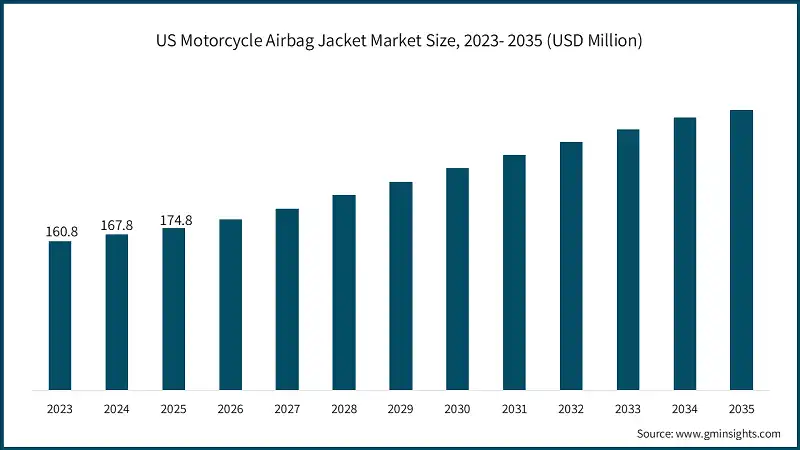
US dominates the North America motorcycle airbag jacket market accounting for 86.2% and generating USD 174.8 million in 2025.
- Increasing awareness regarding crash protection along with rising motorcycle use for long distance recreation across America is driving adoption of motorcycle airbag jackets amongst adventure and touring motorcyclists in the US Professional racers and stunt riders are showing increasing interest in using well developed technology that incorporates electronic airbag systems since a large number of racing sanctioning bodies are now requiring racers to wear gear that meets their own defined safety standards. The success of motorsports events within a national market will positively influence premium product penetration.
- The largest user population for motorcycle airbag jackets in the US are recreational and adventure riders, made possible due to the elevated demand for off-road touring. Airbags reduce the risk of death by as much as 25% in cases of high-speed crash impacts and therefore raise consumer acceptance levels.
- As a result of increasing congestion in urban environments as well as more motorcycles being used for commuting shorter distances, urban commuters are experiencing accelerated growth in interest. Cost-effective tethered airbags will support wider acceptance among cost-sensitive riders, especially in large metropolitan areas.
- Upgraded technologies such as faster deployment sensors and integration of the technology with smart helmets represent new consumer confidence levels. Greater partnerships between insurance providers and motorcycle apparel manufacturers will ultimately encourage more riders in the U.S. to shift away from traditional motorcycle jackets towards motorcycle apparel that is equipped with airbag technology.
Germany dominates Europe motorcycle airbag jacket market growing with a CAGR of 6.5% from 2026 to 2035.
- Strong tourism culture and high safety awareness drive the growth of the airbag jacket market in Germany as more long-distance riders purchase premium protective gear.
- Track racers and other professional motorcyclists use electronic airbag systems because racing organizations are now enforcing safety regulations and allowing only certified protective clothing, such as airbag jackets, at competitive racing events.
- The primary users are the recreational/adventure riding community; they are heavily involved in cross-country touring. Riders are becoming more aware of the growing volume of accident statistics, and many are selecting jackets that provide the greatest reduction in injury severity in high-speed crashes.
- As motorcycles are becoming a popular and effective means of transportation in urban areas, there has been an increase in the number of people who commute by motorcycle on a daily basis. The availability of entry-level mechanically triggered airbag hardware has encouraged many price-sensitive riders to enhance their safety on the road.
- Improvements in the accuracy of sensors, as well as improvements in the electronics of the airbag systems, have contributed to the growing acceptance of airbag jackets in Germany. Increasing the distribution of airbag jackets through the development of specialty motorcycle shops and online retailers has also contributed to the increase in access to both premium airbag jackets and mid-range airbag jackets for consumers in Germany.
China dominates the Asia Pacific motorcycle airbag jacket market, showcasing strong growth potential, with a CAGR of 8.5% from 2026 to 2035.
- In China, there is an upsurge in the demand for airbag jackets as China's expanding urban motorization, stricter enforcement of road traffic laws and increased acceptance of higher priced protective gear encourages more motorcyclists to seek increased levels of protection in high-density urban motoring environments.
- There is a notable increase in the number of airbag jacket adopters among professional riders, such as those working for delivery services, as the industry has now placed greater emphasis on protections for workers. Pilot initiatives conducted by large metropolitan areas are driving additional adoption of sophisticated electronic airbag systems.
- While recreational and adventure-type motorcyclists continue to dominate the airbag jacket user market, increasing numbers of long-distance tour groups throughout the western provinces of China have contributed to the increased usage of technologically advanced riding protection systems.
- The fastest growing segment of the airbag jacket market is the daily commuter, as the use of motorbikes for short-distance travel is still an affordable and viable option. Mechanical-tether airbag systems at reasonable prices have further encouraged the use of airbag jackets by urban dwellers concerned about costs.
- Local engineering firms continue to invest in technologies around sensors and materials integration, thereby improving the availability of airbag jackets in the marketplace. Increased online purchases via marketplaces like Tmall and JD.com allow for increased consumer access from all tiered levels of cities.
Brazil leads the Latin American motorcycle airbag jacket market, exhibiting remarkable growth of 6.6% between 2026 to 2035.
- There is a significant increase in the Brazilian airbag motorcycle jacket market as motorcycles are a critical source of transportation, and the growing amount of motorcycle accidents has led to a growing awareness of the need for advanced protective equipment for riders in many of the country’s primary metropolitan areas.
- Recreational and adventure motorcycle riders dominate this area of motorcycle airbag jacket effectiveness; the proliferation of off-road vehicle events in states such as Minas Gerais and Paraná has further increased the number of recreational and adventure motorcycle riders in the coming years also increased because of increased domestic tourism.
- Professional motorcyclists are increasingly looking at the possibility of using airbag technology for motorcycle safety. Many delivery and courier companies have also begun looking for airbag solutions, creating further awareness of the need for airbag motorcycle jackets.
- Additionally, there is considerable potential for urban commuter motorcyclists, as they typically rely heavily on motorcycles as a low-cost means of urban transportation. However, as manufacturers have been reducing the price of their tethered airbag systems, more price-conscious riders have begun to migrate to tethered airbag systems.
- Local distributors and international motorcycle brands continue to expand their retail distribution networks within the country; increasing numbers of protective gear being imported is making it easier for local riders to purchase these necessary products. E-commerce channels such as Mercado Livre are improving the availability of protective gear to riders in smaller towns and cities.
UAE to experience substantial growth in the Middle East and Africa motorcycle airbag jacket market in 2025.
- A growing interest in rider apparel, coupled with an increase in people riding motorcycles in both urban settings and for leisure activities, is continuing to lead to the development of a UAE marketplace for motorcycle airbag jackets.
- Desert touring, weekend group rides, and motorsport activities are examples of where recreational and adventure riders have been the primary drivers of adoption. More and more riders are opting for electronically operated airbag vests because of their increased comfort and the speed of their deployment.
- A greater number of professional motorcycle riders (i.e., delivery and security riders) are becoming more educated on the benefits of using advanced safety equipment. Some corporate procurement programs in Dubai and Abu Dhabi have begun to introduce airbag systems to their fleets.
- The adoption of airbag solutions will be slower than that of recreational and adventure riders because the usage of motorcycles in daily commuting is minimal. However, in some cases, increased fuel costs and urban congestion are pushing some people to consider safer riding apparel.
- Retailers and distributors are helping to build the availability of international brands through the establishment of specialty retail stores and the dissemination of products through digital channels. Government road safety initiatives are indirectly supporting the growth of this market by helping to promote the need for riders to have an increased level of protection.
Motorcycle Airbag Jacket Market Share
The top 7 companies in the motorcycle airbag jacket industry are Alpinestars, Dainese, Klim, Helite, RST, Spidi and Furygan. Collectively, contributed around 14.7% of the market in 2025.
- Alpinestars is a worldwide leader in the Protective Sports Gear Industry, offering a selection of state-of-the-art electronic airbag jackets and vests. Alpinestars has built on its established R&D expertise, comprehensive global distribution networks, and strong brand awareness to retain its leading position in both the Motorsport and Touring segments.
- Dainese develops high-performance protective clothing including premium electronic airbag jackets and suits designed for racing and adventure riding. Its reputation for innovation, in terms of safety, has enabled it to gain significant brand loyalty among riders in Europe, North America, and other emerging markets.
- Klim's focus is to produce gear for off-road and adventure riding, offering both integrated airbag systems and gear designed for European and North American long-distance riders and adventure touring enthusiasts worldwide. Klim strives to provide durable gear that offers the highest performance in extreme weather conditions.
- Helite is the pioneer in the production of wearable airbag technology, offering an extremely compact and reliable electronic system. The Helite brand has gained an international reputation for its unique innovations within the tethered and wireless airbag markets and is now firmly positioned as a leader among recreational and commuter riders across the globe.
- RST provides affordable airbag jackets and vests to the entry-level and intermediate rider markets. RST enjoys a strong presence in the urban commuting market and is rapidly expanding its retail networks across Europe and Asia.
- Spidi targets the premium and professional markets by producing technologically advanced airbag jackets and suits that are specifically designed for the racer and touring motorcycle rider. Spidi has developed a complete line of high-performance protective clothing that features the latest ergonomic designs and rapid deployment systems, as well as the ability to be used with racing and touring motorcycles.
- Furygan manufactures and designs products for motorcycle racing and touring enthusiasts, including a variety of high-quality protective gear. They utilize airbag technology in their textile jackets and suits, providing maximum protection, comfort, and performance for both professional and recreational riders.
Motorcycle Airbag Jacket Market Companies
Major players operating in the motorcycle airbag jacket industry are:
- Alpinestars
- Dainese
- Furygan
- Held
- Helite
- Ixon
- Klim
- Mugen Denko
- RST
- Spidi
- The majority of the motorcycle airbag jacket market is dominated by the key players of Alpinestars, Dainese, Klim, Helite, RST, Spidi, and Furygan. Each of these companies leads by providing the most innovative electronic/tethered airbag systems using advanced sensing technology combined with durable ergonomic designs. They have strong brand recognition as well as excellent distribution networks, increasing the focus on rider safety, positioning them as key contributors to the growth of the motorcycle airbag jacket market by addressing Professional, Recreational, and Commuter segments in each region.
- These competing companies provide unique product portfolios and advanced technologies that are used to differentiate themselves from each other. Alpinestars and Dainese are best known for manufacturing high-end racing/touring jackets, Klim and Furygan concentrate their product offering on Adventure/off-road riders, Helite and RST create airbag jackets that are designed to provide access to commuters and entry-level riders; and Spidi offers an ergonomic design combined with a fast aerial deployment airbag system for both Professional and Recreational users. The collective efforts of these companies are setting Industry standards, promoting regional adoption, and growing the total Motorcycle Airbag Jacket Market through Innovation, Quality Products, and Strategic Retail and Online Distribution.
Motorcycle Airbag Jacket Market Report Attributes
| Key Takeaway | Details |
|---|---|
| Market Size & Growth | |
| Base Year | 2025 |
| Market Size in 2025 | USD 765.3 Million |
| Market Size in 2026 | USD 815 Million |
| Forecast Period 2026 - 2035 CAGR | 6.8% |
| Market Size in 2035 | USD 1.5 Billion |
| Key Market Trends | |
| Drivers | Impact |
| Rising motorcycle accident rates | High accident exposure increases the need for advanced rider protection and supports the adoption of electronic airbag jackets. |
| Growing demand for premium safety gear | Rising sales of mid and large engine motorcycles increase consumer spending on advanced protective jackets with airbag systems. |
| Expansion of urban commuting on two wheelers | Increased city traffic encourages riders to adopt protective gear that reduces severe injury risk in daily travel. |
| Technology upgrades in sensing and inflation systems | Improved sensors and faster inflation modules enhance product performance and support wider market acceptance. |
| Pitfalls & Challenges | Impact |
| High product cost and limited affordability | Elevated prices restrict adoption among entry level and commuter motorcycle users. |
| Low consumer awareness in developing regions | Limited understanding of airbag protection reduces purchasing intent and slows penetration across emerging markets. |
| Opportunities: | Impact |
| Rising integration of electronic airbag systems with connected platforms | Smart features enable improved monitoring and crash detection which expands the value proposition. |
| Growth of motorcycle tourism and adventure sports | Increased participation in touring events supports the demand for advanced protection apparel. |
| Expansion of rider training programs | Training centers increasingly adopt airbag jackets which promote user familiarity and long-term adoption. |
| Market Leaders (2025) | |
| Market Leaders |
6.9% Market Share |
| Top Players |
Collective Market Share is 14.2% |
| Competitive Edge |
|
| Regional Insights | |
| Largest Market | Europe |
| Fastest growing market | Asia Pacific |
| Emerging countries | India, China, Thailand, Brazil |
| Future outlook |
|
What are the growth opportunities in this market?
Motorcycle Airbag Jacket Industry News
- In September 2025, Hit-Air released the HDS-MS hooded winter airbag jacket designed for breathability and waterproofing, featuring a hooded mesh structure for enhanced comfort in cold weather riding.
- In September 2025, Mugen Denko launched the EU-7, a specialized winter airbag jacket designed for the European market, integrating the company’s signature neck-protection airbag system with advanced waterproofing and breathability for cold-weather touring.
- In August 2025, Dainese hosted Project Apex at Mugello Racetrack, where professional riders from MotoGP to Superbike tested advanced protective gear including D-AIR airbag systems to enhance safety and comfort in future racing apparel.
- In June 2025, Helite announced that its off road airbag waistcoat will be used in connection with the 2025 edition of Dakar Rally. The design features removable sleeves, breathable technical fabric, and two independent cartridges enabling quick reuse under harsh rally conditions.
- In April 2025, Dainese published details about the Smart Air vest a compact, fully autonomous airbag system using D Air technology designed for both urban commuters and sport riders, delivering rapid crash detection and reliable protection.
- In March 2025, Alpinestars unveiled the Tech Air 5 PLASMA airbag system, a new-generation autonomous airbag vest delivering full upper body protection with a slim, lightweight build and multiple riding modes (Street, Off Road, Race).
- In January 2025, Held released the eVest Pro, an electronically activated airbag vest powered by In&motion’s "Performance" module, expanding protection coverage to include the ribs and shoulders specifically to meet FIM racing standards for track and road users.
The motorcycle airbag jacket market research report includes in-depth coverage of the industry with estimates & forecasts in terms of revenue (USD Mn) and volume (Units) from 2022 to 2035, for the following segments:
Market, By Technology
- Electronic/Wireless Airbag Systems
- Mechanical/Tethered Airbag Systems
Market, By Product
- Airbag Jackets
- Airbag Vests
- Airbag Suits
Market, By Application
- On-Road/Street Riding
- Off-Road/Adventure Riding
- Racing/Track Use
- Touring/Long-Distance
Market, By End Use
- Professional Motorcyclists
- Recreational/Adventure Riders
- Daily Commuters
Market, By Distribution Channel
- Offline
- Online
The above information is provided for the following regions and countries:
- North America
- US
- Canada
- Europe
- Germany
- UK
- France
- Italy
- Spain
- Russia
- Nordics
- Netherlands
- Sweden
- Asia Pacific
- China
- India
- Japan
- Australia
- South Korea
- Singapore
- Thailand
- Indonesia
- Vietnam
- Latin America
- Brazil
- Mexico
- Argentina
- MEA
- South Africa
- Saudi Arabia
- UAE
- Turkey
Frequently Asked Question(FAQ) :
What was the market size of the motorcycle airbag jacket in 2025?
The market size was valued at USD 765.3 million in 2025, with a CAGR of 6.8% expected through 2035. Increasing accident rates and a growing focus on rider safety are driving market growth.
What is the projected value of the motorcycle airbag jacket market by 2035?
The market is poised to reach USD 1.5 billion by 2035, driven by advancements in wearable safety technology and rising motorcycle usage globally.
What is the expected size of the motorcycle airbag jacket industry in 2026?
The market size is projected to reach USD 815 million in 2026.
What was the market share of the electronic/wireless airbag systems segment in 2025?
The electronic/wireless airbag systems segment dominated the market with a 64% share in 2025 and is expected to grow at a CAGR of 7.8% from 2026 to 2035.
What was the market share of the airbag vests segment in 2025?
The airbag vests segment held a 53% market share in 2025 and is set to expand at a CAGR of 7.4% till 2035.
What was the market share of the touring/long-distance segment in 2025?
The touring/long-distance segment accounted for 37.3% of the market in 2025.
Which region leads the motorcycle airbag jacket sector?
The Asia Pacific region leads the market, accounting for over one-third of the global motorcycle market. Europe also plays a significant role due to stringent protective gear regulations and high motorcycle usage.
Which region leads the motorcycle airbag jacket sector?
The U.S. dominated the North America market with an 86.2% share, generating USD 174.8 million in 2025. Rising awareness of crash protection and increased motorcycle use for long-distance recreation are key drivers.
What are the upcoming trends in the motorcycle airbag jacket market?
Key trends include sensor-enabled crash detection, real-time data monitoring, standardized reliability testing, and advanced airbag systems for touring and professional racing.
Who are the key players in the motorcycle airbag jacket industry?
Key players include Alpinestars, Dainese, Furygan, Held, Helite, Ixon, Klim, Mugen Denko, RST, and Spidi.
Motorcycle Airbag Jacket Market Scope
Related Reports