
Authors:
Suraj Gujar, Sandeep Ugale
Download free PDF
Military Embedded Systems Market Size & Share 2026-2035
Report ID: GMI8704
|
Published Date: February 2026
|
Report Format: PDF/Excel/Dashboard/Platform
Download Free PDF
Explore Our Licensing Options:
Jump to Content
Market Size
Market Trends
Market Analysis
Market Share
Market Companies
Industry News
Table of Contents
Frequently Asked Questions
Research Methodology
Related Reports
Download Free PDF

Military Embedded Systems Market
Get a free sample of this report
Get a free sample of this report Military Embedded Systems Market
Is your requirement urgent? Please give us your business email
for a speedy delivery!
Military Embedded Systems Market Size
The global military embedded systems market was valued at USD 2 billion in 2025. The market is expected to grow from USD 2.2 billion in 2026 to USD 3.2 billion in 2031 & USD 4.6 billion in 2035, at a CAGR of 8.6% during the forecast period according to the latest report published by Global Market Insights Inc.
Military Embedded Systems Market Key Takeaways
Market Leader: Lockheed Martin led with over 10.2% market share in 2025.
Leading Players: Top 5 players in this market include Northrop Grumman Corporation, Lockheed Martin Corporation, BAE Systems plc, General Dynamics Corporation, Thales Group, which collectively held a market share of 37.3% in 2025.
The growth of the market is attributed to the increased need for the rapid processing of in-field data for critical military actions, increased use of embedded systems in unmanned systems and autonomous combat systems, modernization of the military, digital battlefield initiatives, new-aged AI and edge processing military systems, and increased defense spending of many military powers and their allies.
The military embedded systems market is influenced by the need for embedded computing systems that provide accurate and rapid situational awareness on the military battlefield. Based on the U.S. Department of Defense (DoD) adoption strategy, the Pentagon is placing emphasis on AI to foster decision-making superiority and operational precision in combat. This focus on data driven decision making enhances sensor fusion in real time, decreases lag, and strengthens command-and-control effectiveness.
The growth of military embedded systems is also driven by the embedded systems technology in unmanned systems and the autonomous weapon systems. Demand for robust embedded systems continues to rise as defense forces prioritize unmanned and autonomous capabilities to reduce risk to personnel and enhance operational reach. For instance, The U.S. government has committed USD 33 billion on direct spending for drones and artificial intelligence for the Department of Defense, which includes USD 13.5 billion for unmanned systems and USD 16 billion for government-funded programs, which reinforce funding for drones and autonomous systems. Such funding will promote a fast adoption of embedded computing for navigation, sensor fusion, target tracking, and secure communications systems on unmanned military systems.
Between 2022 and 2024, the market witnessed considerable growth, increasing from USD 1.6 billion in 2022 to USD 1.9 billion in 2024. Such growth can be attributed to increased defense modernization and advancements in digital battlefield technologies. The period from 2022-2024 has also shown an increased focus on network-centric warfare and the integration of AI-enabled embedded systems and unmanned defense platforms, which has also attributed to the growth of the market. Additional factors attributed to the growth of the market were increased defense spending and advancements in secure embedded computing solutions, which contributed to the adoption of systems across land, air, sea, and space military systems.
Military Embedded Systems Market Trends
Military Embedded Systems Market Analysis
Based on the component, the military embedded systems market is divided into hardware and software.
Based on the platform, the military embedded systems market is segmented into land, airborne and naval.
3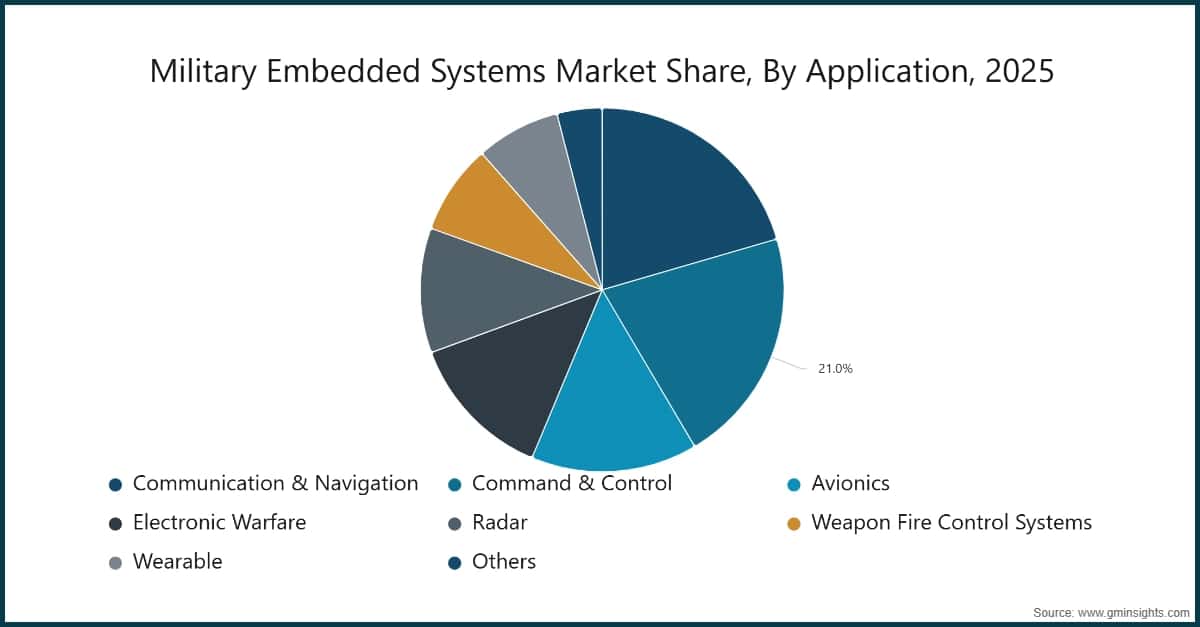
Based on the application, military embedded systems market is classified into communication & navigation, command & control, avionics, electronic warfare, radar, weapon, fire control systems, wearable, and others.
North America Military Embedded Systems Market
North America held a market share of 42.6% of market in 2025.
The U.S. military embedded systems market was valued at USD 623.7 million and USD 669.4 million in 2022 and 2023, respectively. The market size reached USD 769.5 million in 2025, growing from USD 716.7 million in 2024.
Europe Military Embedded Systems Market
Europe market accounted for USD 437 million in 2025 and is anticipated to show lucrative growth over the forecast period.
Russia dominates the Europe military embedded systems market, showcasing strong growth potential.
Asia Pacific Military Embedded Systems Market
The Asia Pacific market is anticipated to grow at the highest CAGR of 9.1% during the forecast period.
China military embedded systems market is estimated to grow with a significant CAGR, in the Asia Pacific market.
Middle East and Africa Military Embedded Systems Market
Israel market to experience substantial growth in the Middle East and Africa market.
Military Embedded Systems Market Share
The market is led by players such as Northrop Grumman Corporation, Lockheed Martin Corporation, BAE Systems plc, General Dynamics Corporation, Thales Group, and Renesas. These six companies cumulatively accounted for 32.4% share of the market in 2025. They have strong market positions due to their diversified business activities, advanced technology, and global reach and presence across all three defense sectors, land, air, and sea. They are able to provide a variety of products and solutions to the market including embedded systems, software, artificial intelligence-based computing, and autonomous systems.
These companies provide high-performance, rugged, and secure embedded systems, solutions that incorporate artificial intelligence and edge computing, and systems that meet multi-domain operational needs. Their investment in research and development autonomous systems, and advanced sensor systems enables them to meet the growing demand for mission-critical integrated defense systems and maintain their market leadership.
Military Embedded Systems Market Companies
Prominent players operating in the military embedded systems industry are as mentioned below:
Northrop Grumman builds advanced embedded systems for automated defense systems and command and control systems. The systems are combined with high performance computing, AI real time analytics, and secure real-time processing across land, air, sea, and naval operations to improve situational awareness and operational reliability for mission critical functions of the military.
Lockheed integrates embedded electronics and software systems in fighters, drones, in missile defense and naval systems. The company provides AI based solutions for avionics, secure fusion of communications and sensor fusion systems that promotes rapid situational awareness and mission effectiveness, and seamless integration across multiple defense systems and domains.
BAE Systems provides rugged embedded systems for the ground, air, and maritime defense systems. These systems feature Real-time Processing and Autonomous Navigation and Electronic Warfare (EW) support which offer improved resilience and mission success, as well as greater situational awareness in critical operations in military theater environments.
General Dynamics specializes in embedded computing systems for armored vehicles and naval ships and autonomous systems. The company focuses on integrating high reliability hardware and secure software and supports command and control functions for Real-time Processing, AI-based Threat Assessment, and mission-critical Decision Support for modern defense forces.
Thales Group integrates software and embedded electronics for radars, surveillance, and command-and-control systems. They incorporate AI, edge-processing, and cybersecurity for multi-domain operational command, threat detection, and secure communication in complex and contested battle spaces.
Renesas provides microcontrollers and embedded semiconductors for military use in autonomous vehicles, drones, and naval systems that support real-time processing and mission-critical secure operations in extreme environments.
10.2% market share
Collective market share in 2024 is 37.3%
Military Embedded Systems Market Industry News
The military embedded systems market research report includes in-depth coverage of the industry with estimates and forecast in terms of revenue (USD Million) from 2022 – 2035 for the following segments:
Click here to Buy Section of this Report
Market, By Component
Market, By Platform Type
Market, By Application
The above information is provided for the following regions and countries:
Table of Contents
Chapter 1 Methodology and Scope
Chapter 2 Executive Summary
Chapter 3 Industry Insights
Chapter 4 Competitive Landscape, 2025
Chapter 5 Market Estimates and Forecast, By Component, 2022 – 2035 (USD Million)
Chapter 6 Market Estimates and Forecast, By Platform Type, 2022 – 2035 (USD Million)
Chapter 7 Market Estimates and Forecast, By Application, 2022 – 2035 (USD Million)
Chapter 8 Market Estimates and Forecast, By Region, 2022 – 2035 (USD Million)
Chapter 9 Company Profiles
Don't see your key competitors?
The companies listed in this report are a curated selection - not the full competitive universe.
Our market revenue calculations use a bottom-up methodology that accounts for all players across all regions - including manufacturers, distributors, and specialists not individually profiled. The profiles section spotlights strategically significant players; it does not define the scope of our market sizing.
Your competitive landscape may also include
Free customization - up to 20% of report value
Need specific data? Request customization and get the insights tailored to your exact requirements.
Research methodology, data sources & validation process
This report draws on a structured research process built around direct industry conversations, proprietary modelling, and rigorous cross-validation and not just desk research.
Our 6-step research process
1. Research design & analyst oversight
At GMI, our research methodology is built on a foundation of human expertise, rigorous validation, and complete transparency. Every insight, trend analysis, and forecast in our reports is developed by experienced analysts who understand the nuances of your market.
Our approach integrates extensive primary research through direct engagement with industry participants and experts, complemented by comprehensive secondary research from verified global sources. We apply quantified impact analysis to deliver dependable forecasts, while maintaining complete traceability from original data sources to final insights.
2. Primary research
Primary research forms the backbone of our methodology, contributing nearly 80% to overall insights. It involves direct engagement with industry participants to ensure accuracy and depth in analysis. Our structured interview program covers regional and global markets, with inputs from C-suite executives, directors, and subject matter experts. These interactions provide strategic, operational, and technical perspectives, enabling well-rounded insights and reliable market forecasts.
3. Data mining & market analysis
Data mining is a key part of our research process, contributing nearly 20% to the overall methodology. It involves analysing market structure, identifying industry trends, and assessing macroeconomic factors through revenue share analysis of major players. Relevant data is collected from both paid and unpaid sources to build a reliable database. This information is then integrated to support primary research and market sizing, with validation from key stakeholders such as distributors, manufacturers, and associations.
4. Market sizing
Our market sizing is built on a bottom-up approach, starting with company revenue data gathered directly through primary interviews, alongside production volume figures from manufacturers and installation or deployment statistics. These inputs are then pieced together across regional markets to arrive at a global estimate that stays grounded in actual industry activity.
5. Forecast model & key assumptions
Every forecast includes explicit documentation of:
✓ Key growth drivers and their assumed impact
✓ Restraining factors and mitigation scenarios
✓ Regulatory assumptions and policy change risk
✓ Technology adoption curve parameter
✓ Macroeconomic assumptions (GDP growth, inflation, currency)
✓ Competitive dynamics and market entry/exit expectations
6. Validation & quality assurance
The final stages involve human validation, where domain experts manually review filtered data to identify nuances and contextual errors that automated systems might miss. This expert review adds a critical layer of quality assurance, ensuring data aligns with research objectives and domain-specific standards.
Our triple-layer validation process ensures maximum data reliability:
✓ Statistical Validation
✓ Expert Validation
✓ Market Reality Check
Trust & credibility
Verified data sources
Trade publications
Security & defense sector journals and trade press
Industry databases
Proprietary and third-party market databases
Regulatory filings
Government procurement records and policy documents
Academic research
University studies and specialist institution reports
Company reports
Annual reports, investor presentations, and filings
Expert interviews
C-suite, procurement leads, and technical specialists
GMI archive
13,000+ published studies across 30+ industry verticals
Trade data
Import/export volumes, HS codes, and customs records
Parameters studied & evaluated
Every data point in this report is validated through primary interviews, true bottom-up modelling, and rigorous cross-checks. Read about our research process →