
Authors:
Ankit Gupta, Shubham Chaudhary
Download free PDF
Industrial Heat Decarbonization Market Size & Share 2026-2035
Report ID: GMI16400
|
Published Date: July 2026
|
Report Format: PDF/Excel/Dashboard/Platform
Download Free PDF
Explore Our Licensing Options:
Jump to Content
Market Size
Market Trends
Market Analysis
Market Share
Market Companies
Industry News
Frequently Asked Questions
Research Methodology
Related Reports
Download Free PDF

Industrial Heat Decarbonization Market
Get a free sample of this report
What are you hoping to find?
Your PDF is on its way. Tell us little about your research goal, and we'll help you find the most relevant market insights.
Industrial Heat Decarbonization Market Size
The global industrial heat decarbonization market was estimated at USD 9.2 billion in 2025. The market is expected to grow from USD 10.1 billion in 2026 to USD 22.8 billion by 2035, at a CAGR of 9.4%, according to a recent study by Global Market Insights Inc.
Industrial Heat Decarbonization Market Key Takeaways
Market Leader: Alfa Laval led with over 9% market share in 2025.
Leading Players: Top 5 players in this market include Alfa Laval, Siemens Energy, Thermax Limited, Danfoss, NIBE Industrier, which collectively held a market share of 36% in 2025.
The estimate is based on a comprehensive bottom-up assessment of industrial heat decarbonization project deployments and capital investments across 28 countries, validated through analysis of industrial energy transition initiatives, facility modernization activities, end-user adoption trends, and company revenues.
The market is growing, with industries increasingly adopting sustainable production methods and long-term emission reduction plans. As green initiatives and worry over operational efficiency grow, manufacturers are turning to alternative, cleaner methods of heat management in their facilities.
The market includes the solutions and initiatives working to lower the carbon footprint of industrial heat generation in manufacturing industries. It covers projects that enhance energy efficiency, address industrial thermal processes, and promote sustainable manufacturing practices by reducing carbon-intensive heat generation, among others.
For illustration, the carbon price in the European Union Emissions Trading System (EU ETS), the world's largest carbon market, stayed above EUR 60 per ton of CO₂ in 2024 - 2025, providing robust financial incentives to industries to switch fossil-fuel-fired heating systems to low-carbon and compliant heating technologies.
Decarbonization is becoming a key part of long-term business strategies for industrial companies. With a focus on sustainable operation, while maximizing production, reliability and competitiveness, emissions due to heat have emerged as a key topic of interest.
The increasing demand for carbon footprint reduction in industries is driving businesses to modernize their heat-intensive processes. Businesses are looking at solutions that can help manage energy usage, use resources more efficiently and meet the changing environmental demands.
Manufacturers are increasingly focusing on the overall process efficiency to minimize fuel use and process emissions. Optimizing industrial heat is a key focus for improving environmental results and long-term business resilience, which in turn will foster the business potential.
Industrial sustainability projects are making a major impact on investment decisions. Businesses are making their production processes more environmentally friendly and increasing their focus on responsible manufacturing and reduction of lifecycle emissions.
Decarbonization of industry is increasingly regarded as a business transformation rather than a regulation. Incorporation of emission reduction measures in bigger operational improvement and sustainability programmes will positively sway the business scenario.
Increasing energy prices for industry are prompting companies to reconsider heat management. To achieve the decarbonization targets, and to ensure profitability, operational waste and energy productivity have become key targets.
Circular economy is becoming more popular among manufacturers to improve resource utilization and minimize environmental impacts. To help meet these goals, industrial heat optimization can play a role onsite by increasing production efficiency and reducing unnecessary energy losses.
For instance, the newly introduced full implementation of the Carbon Border Adjustment Mechanism (CBAM) by the European Union (EU) will impose equivalent carbon costs on imports of iron & steel, aluminum, cement and fertilizers, incentivizing manufacturers to invest in low carbon industrial heating technologies and remain competitive.
Industrial Heat Decarbonization Market Trends
Environmental, Social, and Governance (ESG) commitments are increasingly a major factor in industrial investment decisions. Companies are increasingly focusing on projects that enhance sustainability performance, while adding transparency and fulfilling investors' expectations.
Industrial customers are increasingly giving attention to sustainable supply chains and are asking manufacturers to minimize emissions across the supply chain. Decarbonized industrial heat enhances environmental performance and supply chain competitiveness.
There is a growing focus on the total lifecycle performance of industries when considering the upgrade of production facilities. Operational efficiency, environmental considerations and resource conservation are now relevant in determining investment priorities.
Cooperation between public and private sectors is speeding up industrial sustainability efforts. Collaborative initiatives by manufacturers, investors and industry groups are helping to expand the use of measures to lower emissions from the industrial sector caused by heat.
For citation, The U.S. Environmental Protection Agency's (EPA) Greenhouse Gas Reporting Program (GHGRP) reports emissions from over 8,000 industrial facilities, making it clear how much emissions from industrial heat usage contribute to the overall greenhouse gas footprint.
Industrial decarbonization is proving to be a key component in keeping global competitiveness. Companies with enhanced environmental performance will better be able to satisfy changing demands of customers and reinforce their market position.
The investments toward industrial sustainability are moving from short-term compliance to long-term value creation. There is growing awareness that reduced emissions and enhanced operational efficiencies lead to better financial and environmental results.
The rise in investor engagement on sustainable industry operations is driving businesses to speed up decarbonization efforts. There is a growing recognition that good environmental performance can be a competitive asset to business, and that it will contribute to the long-term growth and investment appeal of the business.
The market will continue to grow in a steady manner with sustainability being a major priority in industry. The focus on operational excellence, emission reduction and responsible manufacturing will remain a key strength to underpin market development over the long term.
IRENA estimates the global average cost of onshore wind electricity at around USD 0.033/kWh in 2024, making EHPs more cost competitive than boilers fired by natural gas in high-REP areas.
Businesses are increasing their efforts to be responsible producers by integrating measurable emissions reduction targets into their business strategies. Industrial heat decarbonization helps achieve these goals and enhances the operational resilience and corporate image.
Continual improvement programs aimed at minimizing environmental damage while maintaining production performance are increasingly being emphasized in industrial organizations. This trend is leading to increased attention for using resources efficiently and operating in a sustainable way.
Industrial Heat Decarbonization Market Analysis
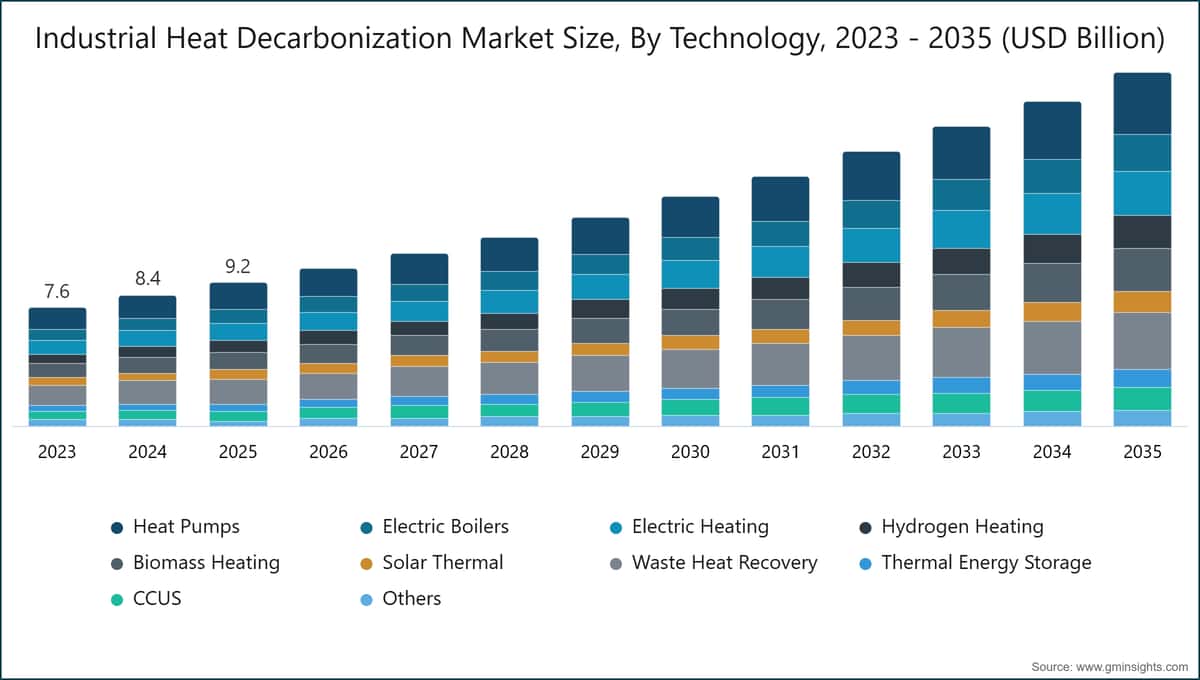
Based on technology, the industry is segmented into heat pumps, electric boilers, electric heating, hydrogen heating, biomass heating, solar thermal, waste heat recovery, thermal energy storage, CCUS and others. The heat pumps industrial heat decarbonization market holds a share of about 16% in 2025 and is projected to grow at a growth rate of over 9% through 2035.
Heat pumps are a fast-growing component of the industrial heat decarbonization sector, with growing demands for effective energy solutions. They allow for greater heat recovery and re-use, which can help to decrease operating costs, emissions and overall sustainability in various industrial manufacturing applications.
The adoption of heat pumps for industrial use is accelerating due to increased sustainability aspects and industrial modernization projects. This will support the long-term growth of this segment as investments are made in efficient thermal systems and emission reduction targets are tightened.
For instance, the Energy Efficiency Directive (EED) by the European Union (EU) was updated in 2023 with binding energy-saving targets for industry, and the U.S. Department of Energy (DOE) Industrial Heat Shot initiative seeks to cut energy intensity for heat use in the industrial sector by 50% by 2035.
The electric boiler segment is set to exceed USD 2 billion by 2035. These units are rapidly becoming popular in the market as the industries look for cleaner and efficient means of heat generation. Emission reduction projects are attracting growing uptake at manufacturing sites, where their ability to support these projects and to ease industrial heating operations are propelling their adoption.
The industry will see sustained development as per the targets of sustainability in industries and the modernization of the existing facilities. Production processes that are increasingly low carbon, as well as the shift from fossil fuel heating, are continuing to increase the market demand of the industries.
The electric heating industrial heat decarbonization industry was valued at USD 1.1 billion in 2025. It is becoming an important part of the market due to the increasing demand for minimizing the emission of industrial waste gases and increasing energy efficiency. Electric heating is being increasingly used by manufacturers as they strive to improve their production processes and sustainability goals.
Low carbon production and operation efficiency are becoming a priority for industries, which is set to drive significant growth. Long term market growth is anticipated as a result of continuous industrial modernization, supportive sustainability programs and growing investments in cleaner production facilities.
For reference, In an H2 2025 survey of 280 industrial energy managers from 12 countries in Europe and Asia Pacific, 58% had committed capital budgets for electric heating system retrofits for 2025 - 2027 as compared to 31% from a similar survey in 2022.
The market of industrial heat decarbonization is growing for hydrogen heating, because industries are looking for other ways to decrease carbon emissions from heat intensive processes. Its use is gaining momentum and further evidence of an agenda to make industry sustainable and produce consistent heat generation.
The segment is set to witness significant growth, supported by rising industrial decarbonization commitments and expanding investments in clean energy infrastructure. Its long-term market potential and commercial outlook continue to be enhanced by growing collaboration among the industrial value chain.
In addition to biomass electricity generation, biomass heating is still a significant part of the industrial heat decarbonization market, providing an industrial renewable option to fossil fuel heating. The use of it helps to reduce carbon footprint, increase resource efficiency, and better meet corporate sustainability and circular economy goals.
Renewable energy sources for industry are gaining attention, with biomass heat use gaining momentum in manufacturing industries. Sustainable feedstocks will continue to boost market growth, as will supportive decarbonization efforts and a desire to improve environmental performance.
Solar thermal is a potential area of the industrial heat decarbonisation market which allows industries to use renewable thermal energy for process heating. It promotes lower carbon emissions, less reliance on fuel and more sustainability in industrial processes.
For illustration, the international energy agency (IEA) estimated that in the world, industrial waste heat accounts for over 30 EJ per year, with only around 25% recovered, implying huge potential for waste heat recovery and industrial heat decarbonization technologies.
Growing industry interest in clean energy and sustainability will provide positive opportunities for the use of solar thermal. The business prospects will continue to improve as investment in renewable heat grows, and as the demand for low carbon manufacturing increases.
Waste heat recovery constitutes an important part of the industrial heat decarbonization market where the purpose is to recover and utilises excess heat generated during industrial processes. In doing so, energy efficiency is optimized, operating costs are reduced, and emission reduction targets for industry are met.
Emphasis on resource optimisation and energy efficiency within industry is gaining in significance, driving the market for waste heat recovery. The market segment is expected to grow further due to increased investments in sustainable manufacturing practices and operational cost reduction efforts.
Thermal energy storage is gaining recognition as an important industry segment, as it allows industries to store and use the heat more effectively. It helps industrial operations manage energy better, save operating costs, increase process flexibility, and decrease carbon emissions.
There is a rising demand for thermal energy storage solutions with the rise in energy resilience and efficient heat utilization. The industry has been expanding long term due to increased investments from industries in sustainable operations, and more cities than ever are committing to becoming decarbonized.
Carbon Capture, Utilization, and Storage (CCUS) is emerging as a key component of industrial heat decarbonization market, helping industries lower carbon emissions from the heat intensive processes. It promotes sustainability goals and enables manufacturers to continue running their businesses and meeting environmental requirements.
For instance, Germany is creating a Carbon Contracts for Difference (CCfD) scheme, which offers a fixed carbon price for 15 years, thereby mitigating uncertainty about carbon prices and incentivizing investments in low-carbon industrial process heating technologies in all industries.
The increasing focus on emission reduction for industry and net-zero goals is driving the interest in CCUS solutions. Rising investments in carbon management projects, policy frameworks and a growing number of industrial decarbonization projects will speed up the business potential.
Based on temperature, the industry is bifurcated into ≤ 200°C, > 200 – 1,000°C and > 1,000°C. The ≤ 200°C industrial heat decarbonization market holds a share of 46.6% in 2025 and is set to reach over USD 10 billion by 2035.
This temperature range also represents a large market share because it is used in many manufacturing processes. Increasing attention on energy efficiency and emissions reduction remains a driver for low-temperature industrial heating applications.
The growth in the ≤ 200°C is due to increasing industrial modernization and sustainability project. The industry will grow with the increased investments in cleaner production and increased awareness on operational efficiency and emission reduction.
> 200 – 1,000°C industrial heat decarbonization was estimated at USD 3.8 billion in 2025. It is a significant market for medium and high-temperature industrial heat decarbonization applications across various manufacturing processes. There is a greater interest in decarbonizing these heat intensive processes as there is a growing demand for lower emissions in industrial applications.
The segment has been driven by increasing investments in industrial modernization and increased sustainability goals. Long-term market development will be stimulated by expanding the use of low-carbon production methods and growing focus on optimizing the use of energy.
For reference, the UK's Industrial Energy Transformation Fund (IETF) has supported over 200 energy efficiency and fuel-switching projects in industry, and India's National Green Hydrogen Mission is driving forward the deployment of hydrogen infrastructure to industrial heating applications, with a total of ~USD 2.4 billion in government support.
The > 1,000°C industrial heat decarbonization industry is set to grow at a rate of 8.5% from 2026 to 2035. These system are a key area of interest for the market, as they are some of the most energy intensive industrial processes. It is important to continue efforts to cut emissions from these applications to meet long term industrial sustainability goals.
This is a segment that is witnessing tremendous opportunities due to decarbonization of heavy industrial processes. The market is anticipated to grow steadily during the forecast period owing to the growing investment in sustainable manufacturing, process modernization, and initiatives to reduce emissions from industrial processes.
The U.S. dominated the industrial heat decarbonization market in North America with around 78% share in 2025 and generated USD 2 billion in revenue. The industry is experiencing gradual growth with robust commitments for industrial sustainability, industrial modernization and growing investments in emission reduction action plans. Industries are focusing on cleaner production to be more competitive and meet changing environmental and corporate sustainability goals.
Market development is gaining momentum in the U.S. bolstered by increasing investments from government and industry, policy frameworks, and expanding decarbonizing industrial programs. Market demand is likely to continue to grow in the forecast period due to rising energy efficiency, operational resilience and carbon reduction efforts.
The North America market is projected to surge USD 4.5 billion by 2035. The industry is showing steady growth, driven by the growing emphasis on emission reduction from industry operations, company sustainability initiatives, and industrial modernization. Industries are implementing cleaner production practices to enhance their operational efficiencies and environmental performance.
The market is growing due to the rise in investments in industrial decarbonization projects, supportive regulatory policies, and the demand for sustainable manufacturing. The focus on energy efficiency, emission reduction and long-term industrial competitiveness will continue to generate good growth opportunities.
The Europe industry is poised to expand by more than 8% until 2035, including such bold climate goals, strict emission policies and industrial sustainability programs. market has a significant position. Manufacturers are also focusing on modernising their production facilities to enhance energy efficiency and reduce carbon emissions throughout the industry.
Requiring low-carbon industrial heat technologies such as hydrogen-based steel production, thyssenkrupp is investing around EUR 2 billion in green steel production at its Duisburg plant under Germany's National Hydrogen Strategy, with commercial-scale green steel production planned for 2026-2027.
Growing investments in industrial modernization, supportive policy measures, and increasing corporate commitment to net-zero goals are driving market expansion. Rising demand for sustainable manufacturing practices and improved resource efficiency is expected to sustain long-term market growth.
The Asia Pacific market accounts for about 28% of the industrial heat decarbonization market in 2025. The industry is growing at a fast pace, reflecting the growing industrialization and manufacturing activities, as well as the commitment to sustainability. Emissions reduction and energy efficiency are becoming key priorities for industries to meet competitiveness requirements and contribute to future environmental goals.
The industry is being driven by rising investments in industrial modernization, government support and a rising trend of sustainable manufacturing. With increased attention on the reduction of industrial emissions and efficiency improvement during operation, it is likely that this will bring great long-term growth opportunities.
To facilitate the replacement of coal fired industrial boilers, oil-fired industrial boilers with electric and biomass fired industrial boilers, China's National Development and Reform Commission (NDRC) is promoting this shift by releasing the energy efficiency standard GB 37479-2019, thereby accelerating the decarbonization of industrial heat in the manufacturing sector.
The Middle East & Africa market is seeing rising momentum as industries are looking to optimize energy usage, lower carbon emissions, and modernize production processes. Incentive programs in support of industrial sector sustainability initiatives are fostering investments in cleaner industrial heat management.
Industrial diversification programmes and increasing investments in sustainable industrial manufacturing are opening new potential for industrial heat decarbonization. Long term market potential is believed to be favourable, with increasing focus on resource optimisation and industrial resilience.
The Latin America market is continuously gaining traction as industries are shifting their attention towards optimizing their operations, cutting carbon emissions, and implementing sustainable manufacturing processes. Increasing industrial development and environmental awareness are encouraging investments in cleaner industrial heat management solutions.
Industrial competitiveness continues to drive changes in the market, as corporations increasingly look to sustainability as a key part of their initiatives. This enhanced focus on resource efficiency, lower environmental impact and operational resilience for longer service life provides good prospects for continued development of industrial heat decarbonization.
Industrial Heat Decarbonization Market Share
The top 5 players in market are Alfa Laval, Siemens Energy, Thermax Limited, Danfoss and NIBE Industrier contribute around 36% of the market share in 2025.
The industry is highly regulated, has long gestation periods and is more committed to sustainability. It is extremely capital-intensive owing to modernization movement, changing emission reduction standards and the increasing demand for better and efficient industrial operations with low carbon footprint in a wide range of end-use industries.
Building on its solid expertise in industrial heat decarbonization, Alfa Laval is a reliable partner for manufacturers seeking to achieve better energy efficiency, maximize heat utilization, minimize operational emissions, and advance their industrial sustainability goals.
In the field of industrial energy, Siemens Energy uses its wide range of solutions to support manufacturers in optimizing their operations, lowering carbon footprints, increasing process reliability, and speeding up industrial decarbonization efforts.
Through its range of integrated solutions for industrial energy and environment, Thermax is well-positioned to serve its clients with sustainable solutions to enhance process efficiency, optimize resource utilization, minimize emission generation, and support sustainable manufacturing initiatives across various industries.
Danfoss's ability to provide expertise in industrial energy optimization sets it apart, empowering manufacturers to optimize operations, reduce energy use and improve resource efficiency, and drive long-term industrial decarbonization and sustainability.
NIBE Industrier strengthens its position as a competitive company by delivering sustainable industrial heating solutions to manufacturers to help them reduce their daily emissions, increase energy efficiency, boost productivity and meet their long-term industrial decarbonization and sustainability targets.
Industrial Heat Decarbonization Market Companies
Major players operating in the industrial heat decarbonization industry are:
ABB
Alfa Laval
ANDRITZ
Antora Energy
Atlas Copco
Babcock & Wilcox Enterprises
Bosch Industriekessel GmbH
Coolbrook Oy
Copeland
Danfoss
Electrified Thermal Solutions (ETS)
ENGIE
Everllence
Fives Group
GE Vernova
GEA Group
Heaten AS
Honeywell International
Johnson Controls
Mitsubishi Heavy Industries
NIBE Industrier AB
Schneider Electric
Siemens Energy
Spirax Group
Thermax Limited
Topsoe A/S
Veolia
Yokogawa Electric Corporation
The focus of the employees' actions at Spirax Group is on continuous product innovation, strategic acquisitions, and customer-priority industrial solutions, offering manufacturers the chance to boost energy efficiency, cut emissions and meet long-term sustainability goals.
With a focus on portfolio expansion, strategic partnerships, and ongoing investments in heating solutions, Bosch Industriekessel continues to strengthen its market position, enabling manufacturers to optimize their processes, reduce their carbon footprint, and contribute to sustainable industrial modernization.
To strengthen its competitive position, GEA Group is looking for strategic partnerships, expanding the range of sustainable solutions for processes and investing in innovation to allow manufacturers to optimize the use of resources, reduce industrial emissions, and speed up long-term decarbonization efforts.
Market Share of 9%
Collective Market Share of 36%
Industrial Heat Decarbonization Industry News
In March 2026, Danfoss announced a strategic collaboration with GEA Group to create integrated heat pump and heat exchanger systems for the food and beverage sector, which will facilitate the energy-efficient heating of industrial processes, while simultaneously reducing carbon footprints for sub-150°C operations.
In November 2025, Alfa Laval introduced the next generation AlfaNova industrial heat exchanger series for operating pressures up to 100 bar, as a part of its product expansion for high-pressure industrial process applications and expanding its industry heat decarbonisation footprint.
In September 2025, Thermax Limited also installed a 12 MW waste heat recovery plant at an integrated steel plant in Odisha, making it the largest waste heat recovery project it has ever undertaken and further enhancing its capabilities in the industrial energy efficiency and decarbonization space.
In May 2025, ANDRITZ won a contract to install ORC-based waste heat recovery systems in four production plants for a major Scandinavian pulp and paper manufacturer, bringing its industrial decarbonization portfolio to 18 MW of thermal recovery.
The industrial heat decarbonization market research report includes in-depth coverage of the industry with estimates & forecast in terms of revenue (USD Million) from 2022 to 2035, for the following segments:
Click here to Buy Section of this Report
By Technology
Heat pumps
Electric boilers
Electric heating
Hydrogen heating
Biomass heating
Solar thermal
Waste heat recovery
Thermal energy storage
CCUS
Others
By Temperature
≤ 200°C
> 200 – 1,000°C
> 1,000°C
By End Use
Chemicals
Iron & steel
Cement
Food & beverage
Pulp & paper
Oil & gas
Glass
Mining & metals
Pharmaceuticals
Others
By Deployment
New
Retrofit
The above information has been provided for the following regions & countries:
North America
U.S.
Canada
Mexico
Europe
Germany
UK
France
Italy
Spain
Netherlands
Denmark
Finland
Austria
Asia Pacific
China
Japan
India
South Korea
Australia
New Zealand
Indonesia
Thailand
Malaysia
Middle East & Africa
Saudi Arabia
UAE
Egypt
South Africa
Latin America
Brazil
Argentina
Chile
Frequently Asked Question(FAQ) :
Research methodology, data sources & validation process
This report draws on a structured research process built around direct industry conversations, proprietary modelling, and rigorous cross-validation and not just desk research.
Our 6-step research process
1. Research design & analyst oversight
At GMI, our research methodology is built on a foundation of human expertise, rigorous validation, and complete transparency. Every insight, trend analysis, and forecast in our reports is developed by experienced analysts who understand the nuances of your market.
Our approach integrates extensive primary research through direct engagement with industry participants and experts, complemented by comprehensive secondary research from verified global sources. We apply quantified impact analysis to deliver dependable forecasts, while maintaining complete traceability from original data sources to final insights.
2. Primary research
Primary research forms the backbone of our methodology, contributing nearly 80% to overall insights. It involves direct engagement with industry participants to ensure accuracy and depth in analysis. Our structured interview program covers regional and global markets, with inputs from C-suite executives, directors, and subject matter experts. These interactions provide strategic, operational, and technical perspectives, enabling well-rounded insights and reliable market forecasts.
3. Data mining & market analysis
Data mining is a key part of our research process, contributing nearly 20% to the overall methodology. It involves analysing market structure, identifying industry trends, and assessing macroeconomic factors through revenue share analysis of major players. Relevant data is collected from both paid and unpaid sources to build a reliable database. This information is then integrated to support primary research and market sizing, with validation from key stakeholders such as distributors, manufacturers, and associations.
4. Market sizing
Our market sizing is built on a bottom-up approach, starting with company revenue data gathered directly through primary interviews, alongside production volume figures from manufacturers and installation or deployment statistics. These inputs are then pieced together across regional markets to arrive at a global estimate that stays grounded in actual industry activity.
5. Forecast model & key assumptions
Every forecast includes explicit documentation of:
✓ Key growth drivers and their assumed impact
✓ Restraining factors and mitigation scenarios
✓ Regulatory assumptions and policy change risk
✓ Technology adoption curve parameter
✓ Macroeconomic assumptions (GDP growth, inflation, currency)
✓ Competitive dynamics and market entry/exit expectations
6. Validation & quality assurance
The final stages involve human validation, where domain experts manually review filtered data to identify nuances and contextual errors that automated systems might miss. This expert review adds a critical layer of quality assurance, ensuring data aligns with research objectives and domain-specific standards.
Our triple-layer validation process ensures maximum data reliability:
✓ Statistical Validation
✓ Expert Validation
✓ Market Reality Check
Trust & credibility
Verified data sources
Trade publications
Industry journals, trade publications, and specialized media.
Industry databases
Proprietary and third-party market databases
Regulatory filings
Government procurement records and policy documents
Academic research
University studies and specialist institution reports
Company reports
Annual reports, investor presentations, and filings
Expert interviews
C-suite, procurement leads, and technical specialists
GMI archive
13,000+ published studies across 20+ industry verticals
Trade data
Import/export volumes, HS codes, and customs records
Parameters studied & evaluated
Every data point in this report is validated through primary interviews, true bottom-up modelling, and rigorous cross-checks. Read about our research process →