Summary
Table of Content

Indoor Electric Karting Operator Market
Get a free sample of this report
Form submitted successfully!
Error submitting form. Please try again.
Thank you!
Your inquiry has been received. Our team will reach out to you with the required details via email. To ensure that you don't miss their response, kindly remember to check your spam folder as well!
Request Sectional Data
Thank you!
Your inquiry has been received. Our team will reach out to you with the required details via email. To ensure that you don't miss their response, kindly remember to check your spam folder as well!
Form submitted successfully!
Error submitting form. Please try again.
Indoor Electric Karting Operator Market Size
The indoor electric karting industry is increasingly characterized by a shift toward eco-friendly and year-round entertainment experiences that are influenced by both urban leisure trends and consumer preferences. In developed markets such as those in North America and Europe, operators are either expanding their facilities or converting their entire fleet of karts from petrol to electric because of the implementation of noise regulations and emissions regulations, as well as the substantial reduction in maintenance costs of electric karts when compared with petrol karts.
Indoor Electric Karting Operator Market Key Takeaways
Market Size & Growth
- 2025 Market Size: USD 527.1 Million
- 2026 Market Size: USD 547.1 Million
- 2035 Forecast Market Size: USD 878 Million
- CAGR (2026–2035): 5.4%
Regional Dominance
- Largest Market: Europe
- Fastest Growing Region: Asia-Pacific
Key Market Drivers
- Shift toward electric powertrains.
- Rise of experience economy.
- Integration of F&B & entertainment.
- Corporate & group event demand.
Challenges
- High Capital Intensity.
- Escalating Insurance & Liability Costs.
Opportunity
- Gamification & Data Analytics.
- Fleet Management & Fast Charging.
Key Players
- Market Leader: K1 Speed led with over 5% market share in 2025.
- Leading Players: Top 5 players in this market include Andretti Indoor Karting & Games, Gravity Active Entertainment, K1 Speed, RPM Raceway, The Grid, which collectively held a market share of 15% in 2025.
Get Market Insights & Growth Opportunities
The number of electric karts represents an increasing share of new tracks being built, with the trend toward multi-level tracks with digital race management and immersive experience becoming standard attributes in major markets. For instance, in September 2025, K1 Speed has invested over USD12 million into building what will be the longest indoor electric karting track at the XSite complex located just outside of Glasgow. This facility will be enhanced by the addition of e-sports lounges and other entertainment features to help attract millions of customers each year.
The indoor electric karting market has been significantly affected by the COVID-19 pandemic, as mandatory lockdowns and social distancing guidelines resulted in the temporary closure of almost all indoor entertainment venues around the world. Additionally, this crisis has spurred innovation, as venues have begun to implement enhanced levels of hygiene using strict hygiene protocols and the implementation of new ticketing methods such as contactless ticketing and timed sessions, plus the use of online reservation systems to enhance customer confidence.
The growth of the North American indoor electric karting industry is largely driven by consumer demand for exciting family-oriented activity-based entertainment options, as well as for hosting corporate events. Operators are increasingly offering electric karting as part of multi-attraction sites. This means that operators and developers are combining electric karting with other attractions such as VR racing and arcade games, as well as with food & beverage amenities to extend visitor time spent at the facility and therefore increase the revenue produced per visitor. Andretti Indoor Karting & Games is one example of a company implementing this approach, expanding throughout the U.S. by developing electric kart racing venues equipped with high-speed electric karts.
In Europe, the trend in the indoor electric karting industry is toward more high-tech and environmentally sustainable venues, particularly those located in urban areas where space is at a premium. Operators of indoor electric kart facilities are emphasizing using environmentally friendly electric kart fleets, constructing multi-level racetracks, and developing high-tech digital race management systems designed to create a competitive racing environment. TeamSport Indoor Karting has modernized several of its UK venues with high-speed electric karts and multi-level circuits.
The global indoor electric karting operator market was estimated at USD 527.1 million in 2025. The market is expected to grow from USD 547.1 million in 2026 to USD 878 million in 2035, at a CAGR of 5.4% according to latest report published by Global Market Insights Inc.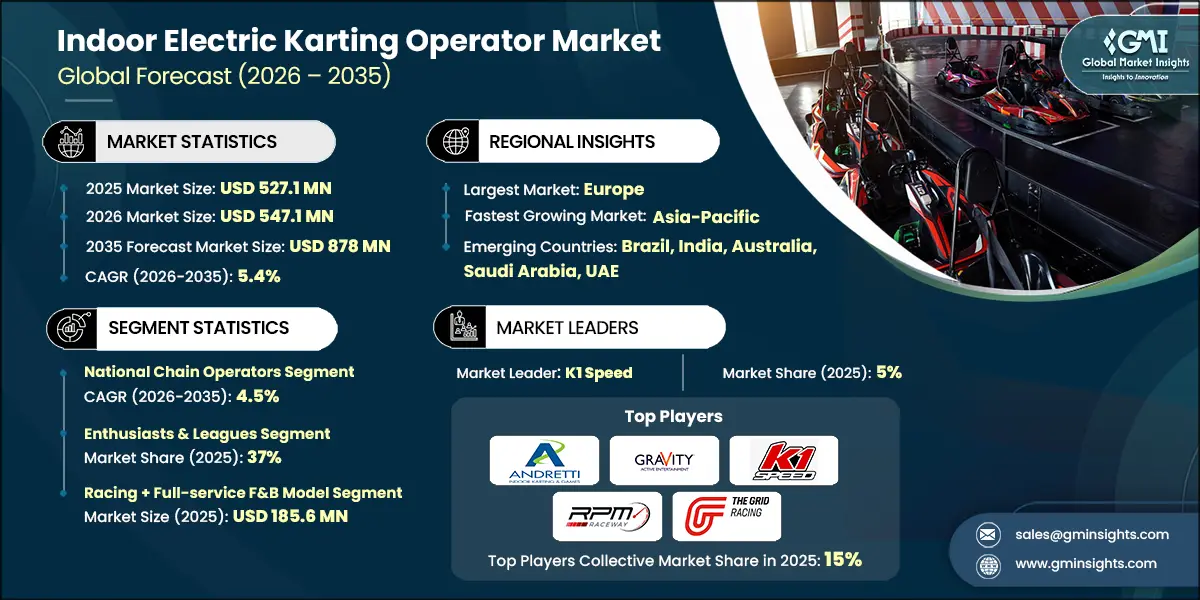
To get key market trends
Indoor Electric Karting Operator Market Trends
The electric karting industry has undergone an unprecedented shift in the way it operates over the past few years due to the incorporation of innovative methods for gaming (digital games), augmented reality (AR), and sophisticated platforms to analyse data. These advancements allow for truly immersive and competitive social experiences that result in customers returning to the facility repeatedly and being willing to pay higher than average prices. For example, RPM Raceway uses their own proprietary R-TECH platform to provide real-time analytics about each customer’s race on an LED display mounted on the steering wheel as they drive around the course.
The development of projection mapping technology is changing traditional go-karting is experienced by creating interactive gaming-type experiences for customers. The AR go-karting experience at Chaos Karts in UK & Dubai, which has been represented by the display of pictures using projectors mounted from the ceilings on tracks providing simulated virtual courses, bonuses, and obstacles. For example, BattleKart Dubai has ranked as one of the top seven indoor activities in the United Arab Emirates on LOVIN Dubai based on their AR-based electric karting experience.
There has been a global movement away from using gasoline-powered go-karts to electric go-karts due to the numerous properties associated with electric-powered go-karts and the response from customers desiring to participate in cleaner, quieter racing environments. For example, TeamSport UK has performed field testing that has indicated the EcoVolt NG karts produced by TeamSport UK have produced one second faster than the traditional gasoline-powered go-karts which demonstrates the immediate torque benefit of electric drive systems compared to gasoline (petrol) powered drive systems.
Franchising and partnering with other brands around the world are helping established indoor electric karting businesses grow quickly into new areas. Urbanization, the growth of the middle class, and the increase in government-provided entertainment facilities in urban areas all play a role in supporting this trend. For example, in July 2024, K1 Speed has partnered with Hollywood Kart to expand into ten countries and one hundred locations around the globe.
The shift from traditional noisy, gas-powered karting to the more environmentally friendly quieter electric karting reduces carbon emissions making indoor karting possible, reduces energy costs in the long term, and improves customer experience due to the instant power produced by electric motors. One company to support this growth is TeamSport, which has shown that electric karts use on average, one second less per lap than their equivalent gasoline counterparts.
Indoor Electric Karting Operator Market Analysis
Learn more about the key segments shaping this market
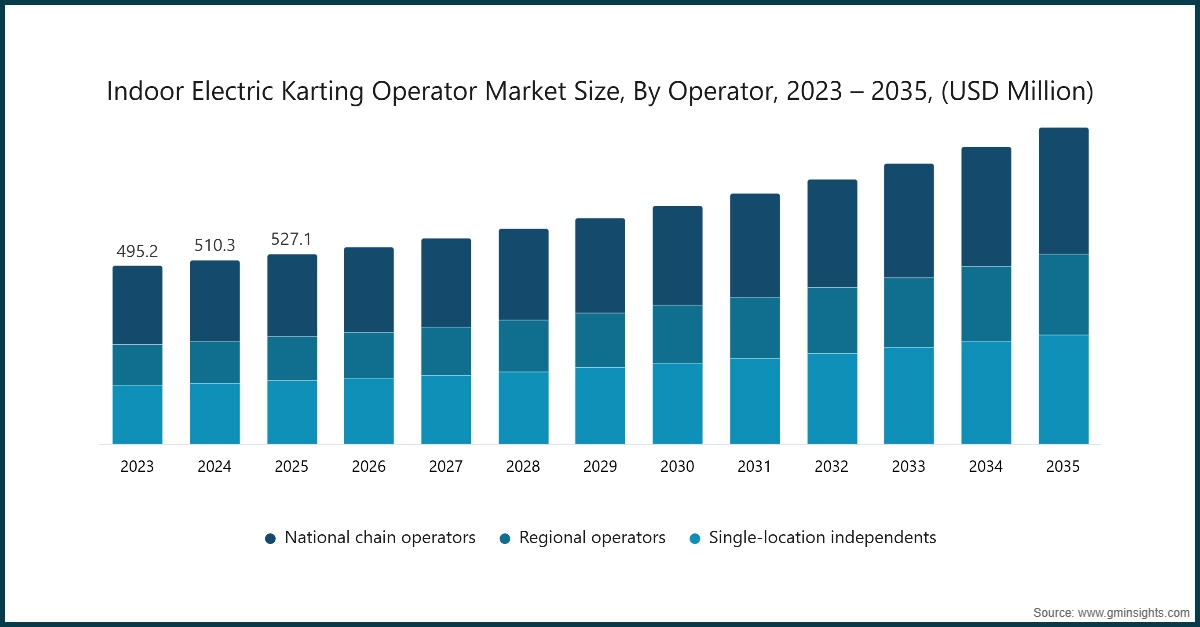
Based on operator, the market is divided into national chain operators, regional operators, and Single-location independents. National chain operators segment dominated the market accounting by 44% in 2025 and is expected to grow at a CAGR of 4.5% from 2026 to 2035.
- National chain operators are the largest sector of the indoor electric karting marketplace, accounting for most of the total business volume and having a large percentage of the total number of participating karting centres. National chain operators have the tactical advantage of providing the same experience for customers, due to the scale of the operation, and the ability to procure an entire fleet of karts at the same time directly from a single manufacturer.
- The operator’s own proprietary technology systems, and to be integrated into the competitive racing infrastructure of other chains. For example, with over 100 locations worldwide, K1 Speed is an example of how national operators can leverage their many locations to maximize capacity and provide a consistent experience for customers. This segment includes purpose-built facilities capitalizing on unique geographic opportunities, specialty concept venues such as BattleKart Dubai's AR karting, EVA Karting GP's VR integration, and converted industrial spaces.
- Regional Operators indicating effective penetration of underserved secondary markets and localized customer relationships. These operators typically manage 3-10 locations within a concentrated geographic region, enabling hands-on operational oversight while achieving modest scale efficiencies. Similarly, Single-Location represents a substantial portion of market fragmentation driven by local entrepreneurship and niche positioning.
Learn more about the key segments shaping this market
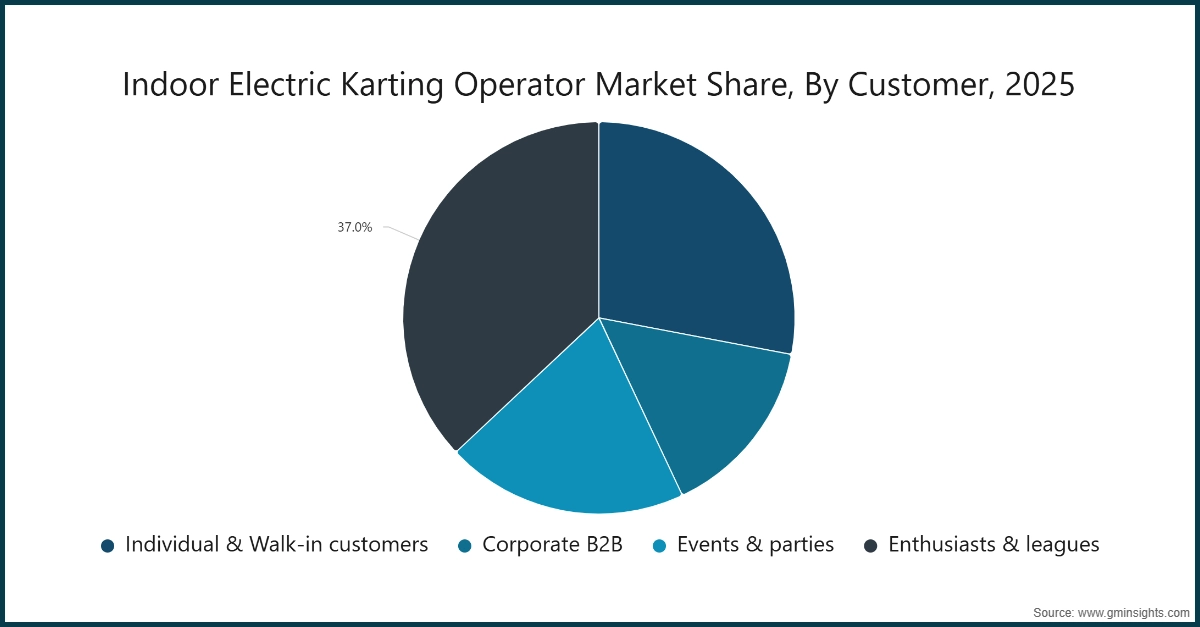
Based on customer, the indoor electric karting operator market is categorized Individual & Walk-in customers, Corporate B2B, Events & parties, and Enthusiasts & leagues. Enthusiasts & leagues segments dominated the market with 37% share in 2025, and the segment is expected to grow at a CAGR of 3.9% between 2026 to 2035.
- The Enthusiasts & Leagues segment is made up of serious karting hobbyists and racers who frequently participate and produce stable and recurring revenue for operators. Operators benefit from reliable scheduling, maximized premium fleet utilization, and self-generating member networks. In addition, structured league programs that are being implemented include the new Electric Go-Karting Championship being launched by the World Karting Association in September 2024 in the United States.
- The Events and parties’ segment benefit from bundled offerings that include racing, food and beverage (F&B), and other ancillary attractions. This allows for a higher margin of revenue generation during weekends and peak demand periods. Operators offer greater appeal to the consumer through Instagrammable Experiences, immersive multi-attraction environments and themed party packages, increasing both their visibility and repeat bookings.
Based on revenue model, the indoor electric karting operator market is divided into racing-dominant model, racing + full-service F&B model, and multi-entertainment complex model. Racing + full-service F&B model dominates the market and was valued at USD 185.6 million in 2025.
- The Multi-Entertainment Complex Model integrates karting with numerous complementary attractions and premium foods. Facilities greater than 50,000 square feet of space combine racing, virtual and augmented reality, arcades, bowling, laser tag, and themed eateries to provide the consumer with an opportunity to dwell and generate more revenue on a per-visitor basis. This has resulted in a trend towards entertainment destination choices and is changing how multi-hours are supported with increased complexity by the operators.
- Racing + Full-Service F&B model emphasizes premium racing and high-quality dining without extensive ancillary attractions. Operators allocate most space to tracks and fleets while elevating culinary offerings to extend dwell time and attract spectators. Growth is driven by consumers seeking curated experiences combining activity and dining, particularly in urban markets. This trend reflects the “eatertainment” shift, where F&B becomes a core revenue driver alongside high-quality karting experiences.
Looking for region specific data?
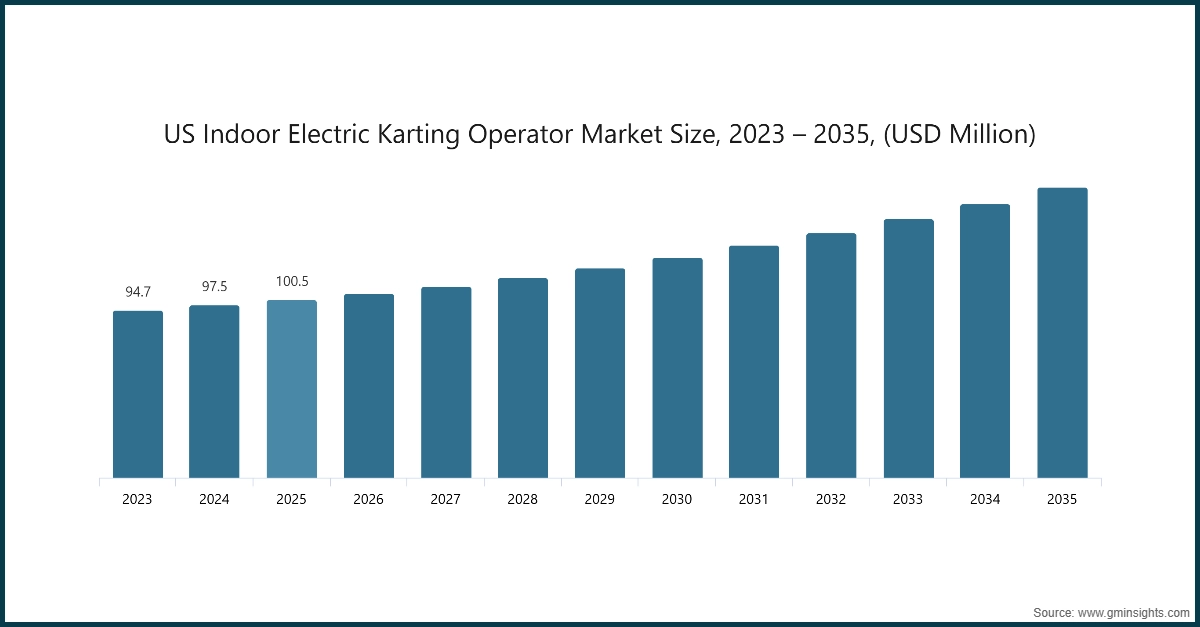
The US dominated North America indoor electric karting operator market with revenue of USD 100.5 million in 2025.
- In US the market is driven by high disposable incomes, a strong motorsports culture, and an established family entertainment ecosystem. The FAT Karting League launched on the West Coast in July 2025 and further expands on the structured competitive programs that are being developed within the karting industry. This event encourages repeat business from consumers, strengthens regional engagement, and therefore increases the revenue potential for the operators who integrate league-like models with their indoor electric karting facilities.
- Canada allows multi-city scaling while compact format venues provide accessibility within high-footfall retail hubs. Corporate team-building and experiential events contribute significant revenue, complementing the individual/walk-in segment. In July 2025, Brodie McDonell from Embrun, Canada, competed on the international karting stage representing Canada as part of the FAT Karting League. This event demonstrates that Canada can continue to develop talent and that indoor electric karting can be positioned as both leisure and competitive activities, while simultaneously creating member/league engagement and corporate sponsorship opportunities.
China indoor electric karting operator market will grow tremendously with CAGR of 9.5% between 2026 and 2035.
- The preference for indoor electric karting in urban areas with high population density, such as Beijing, Shanghai, Guangzhou, and Shenzhen, is due to the restrictions of noise and zoning. On August 2025, Geely introduced the Piggy Hero Edition of the Panda Karting EV, which is a limited edition designed for urban KK operators with unique pricing, as well as promoting electric mobility within the entertainment industry. In August 2025, Geely's introduction of this EV is a sign of the increased participation of OEMs in indoor karting, providing brand-based consumer involvement, and encouraging the adoption of electric fleets in the dense urban cities of the PRC.
- The key metropolitan cities of India, such as Mumbai, Delhi, Bengaluru, and Pune, are all experiencing high rates of development in multi-venue complexes combining KKs with arcade and F&B, as well as other attractions. The Pink Falcon opened India's first indoor Glo-Karting Arena in January 2026, which is in Delhi-NCR and is an example of how rapidly innovative formats of entertainment are being adopted throughout India. Multi-venue complexes are growing rapidly in number and show an increasing desire by consumers for additional and unique forms of entertainment.
The Europe indoor electric karting operator market in Germany will experience robust growth during 2026-2035.
- The European market had a 24% share of the global market and grew at a rate of 4.3%. Operators in the indoor electric karting industry in Germany are embracing the additions of youth programs and leagues to their business models. These programs will help create more traffic for operators during the week, while also building long-term loyalty to the operator base. An example of this is a partnership that was made in September 2025, between a major German operator and Motorsport Team Germany, in creating a program to cultivate young driving talent, which supports Germany's emphasis on cultivating competitive training and technical sophistication.
- In the UK, the karting market is made up of multi-attraction venues in high-footfall retail centres that offer karting combined with other attractions such as VR, bowling, and food/beverage, while utilizing competitive leagues and youth programs to generate revenue during weekdays. The UK has planned to launch the Champions of the Future Academy in 2026 to create structured pathways for karting talent. This will solidify again that the UK is at the forefront of competitive indoor karting.
The Brazil will experience robust growth of 4.6% between 2026 and 2035.
- Brazil’s leisure markets will see growth through increasing disposable incomes; the continued rise of experiential leisure; modular, all-weather tracks which allow for cost effective installation in secondary cities. Multi-attractions comprised of Karting, VR, and F&B will increase holiday and weekend usage, while corporate events will drive the use during the week.
- Mexico’s indoor electric karting business has an emerging middle class with disposable income, as well as development within the cities of Mexico and Monterrey. Using franchising to expand gives karting operators the ability to create multiple locations using less capital required for a modular or compact facility. One of the benefits of indoor electric karting is that they no longer have any noise or safety issues associated with other forms of karting, allowing for easier acceptance within the growing number of high-density commercial districts.
UAE indoor electric karting operator market will grow tremendously with CAGR of 6.3% between 2026 and 2035.
- Corporate/private sector rental opportunities provide a stable base for revenues, while infrastructure and incentives for sustainable transport from the UAE support adoption of electric fleets. Areas of concern are concentrations of demand in the primary cities, as well as the high costs associated with real estate in these areas; however, there are examples of mega-projects within the UAE and examples of successful venues that integrate AR technology into immersive entertainment experiences providing evidence for continued growth in this sector for many years to come.
- Saudi Arabia demonstrates high growth potential driven by Vision 2030’s SEVEN investment in 21 entertainment destinations across 14 cities. October 2025 marked the collaboration of Saudi Entertainment Ventures (Seven) and Mattel to launch a Hot Wheels Electric Karting experience. This event demonstrates Saudi Arabia’s strategic investment in themed, large-format indoor karting attractions as part of Vision 2030 initiatives, targeting both youth and corporate segments, while reinforcing the region’s push for premium experiential entertainment.
Indoor Electric Karting Operator Market Share
The top 7 companies in the market are K1 Speed, Andretti Indoor Karting & Games, Gravity Active Entertainment, The Grid, RPM Raceway, Urban Air Adventure Park, and R1 Indoor Karting. These companies hold around 19% of the market share in 2025.
- K1 Speed has reached a milestone of over 100 locations worldwide through organic growth and acquisitions such as Autobahn Indoor Speedway, Accelerate Indoor Speedway, Speed Raceway, Tampa Bay Grand Prix, Speed Circuit, and Freem. Its ongoing aggressive geographic expansion into the USA and Canada, Mexico, France, Italy, United Kingdom, and China have made it the largest commercial go-karting company in the world.
- Andretti Indoor Karting & Games operates with large-format facilities that feature a combination of kart racing, bowling, arcade, and restaurant amenities with significant physical capital expenditure required. The implementation of Microsoft Dynamics 365 Business Central demonstrates the operational sophistication of unified financial and operational management for the operator. The operator's primary market includes Georgia, Texas, Florida, and Arizona and positions itself as a premier entertainment destination for event-driven revenues.
- Gravity Active Entertainment functions as the market leader in the UK active entertainment category, with a total of 37 venues in the UK and five in mainland Europe. The operator's market share is generated based on a multi-activity Family Entertainment Centre (FEC) model, primarily integrating E-Karting with over 30 other activity experiences, including trampolining, urban climbing, augmented reality bowling, Digital Darts and Hologate VR Arena, as well as Immersive Gamebox.
- The GRID represents a unique niche of operators that focus primarily on go-karting, with specialized track designs, racers' competition programming and alignment with motorsport-based businesses. This segment serves go-karting enthusiasts, members and leagues, providing high frequency visits and skill development. As such, the company is emerging as a prominent brand in the North American domestic electric karting industry.
- RPM Raceway - RPM Raceway operates a high-performance indoor electric karting center in the southwestern United States. The facilities feature multi-level kart tracks, a variety of competitive leagues, plenty of quality food and beverage options. The tracks have been designed to provide the greatest speed possible and the most record-breaking races possible, such as the 3,515-foot multi-level track on Long Island. Other activities include arcades, virtual reality arenas, and corporate/event spaces throughout the RPM facilities.
- Urban Air Adventure Park is a family entertainment chain that provides a variety of activities for families, youth organizations, and corporations to enjoy. The activities at Urban Air Adventure Parks include indoor electric karting, trampoline parks, climbing walls, obstacle courses, and food and beverage services. Indoor electric karting is included throughout its adventure park locations, making it a multiple-entertainment destination for families, youth organizations, and corporate clients.
- R1 Indoor Karting is focused on providing a high-speed electronic karting experience with premium levels of entertainment across urban and suburban North America. The operator includes indoor electric cart tracks that have a modern multi-level design that offers a variety of competitive racing programs, advanced fleet management, and innovative food and beverage service.
Indoor Electric Karting Operator Market Companies
Major players operating in the indoor electric karting operator industry include:
- Andretti Indoor Karting & Games
- Gravity Active Entertainment
- K1 Speed
- Karting Genk
- MONZA Foxwoods
- Pole Position Raceway
- R1 Indoor Karting
- RPM Raceway
- The Grid
- Urban Air Adventure Park
- The market is dominated by the largest suppliers - United Rentals, Ashtead Rentals, and Herc Rentals are competing fiercely on fleet size, geographical reach, and reliability of service. United Rentals is the dominant player in the rental market with the most foot traffic at the branches along with unmatched fleet size and density and thus can provide exceptional service to the national accounts and large infrastructure projects.
- Sunbelt Rentals uses operational efficiencies and technology-driven solutions to differentiate itself from the competition including telematics and predictive maintenance, while Herc Rentals is taking a different approach by pursuing targeted acquisition opportunities and offering solutions customized to the unique needs of industrial and specialty construction projects.
- Loxam remains the industry's leader by focusing on regional dominance, and high-density branches while offering a fleet of sustainable equipment. With its growing number of acquisitions and strong local presence, Loxam has positioned itself as an effective competitor in highly regulated markets in major metropolitan areas. As equipment manufacturers, JLG give competition to the rental business by providing rental customers with rental-ready equipment, as well as providing OEM-backed fleet solutions that enable contractors to access high-quality equipment with dependable service and parts.
- John Deere has also established itself as a leader in the earthmoving and industrial machinery marketplaces by utilizing its brand reputation and nationally distributed dealer network to provide its customers with reliable and high-quality manufacturing products. Prior to being acquired, H&E Equipment was one of the leading regional operators in the United States, with well-established customer relationships and a dependable fleet, and highlights the continued importance of small, regional operators through providing quality operations and specialized services.
Indoor Electric Karting Operator Market Report Attributes
| Key Takeaway | Details |
|---|---|
| Market Size & Growth | |
| Base Year | 2025 |
| Market Size in 2025 | USD 527.1 Million |
| Market Size in 2026 | USD 547.1 Million |
| Forecast Period 2026-2035 CAGR | 5.4% |
| Market Size in 2035 | USD 878 Million |
| Key Market Trends | |
| Drivers | Impact |
| Shift toward electric powertrains | Transition from noisy, high-maintenance gas karts to electric fleets reduces emissions (allowing indoor operation), lowers long-term energy costs, and improves guest experience with instant torque. |
| Rise of experience economy | Consumer preference shifting from material goods to shareable experiences boosts demand for entertainment venues like indoor karting, corporate events, and social gatherings. |
| Integration of F&B & entertainment | Operators expanding beyond racing into full entertainment destinations (e.g., Andretti, RPM) with augmented reality (AR), axe throwing, and upscale dining to increase dwell time and revenue per customer. |
| Corporate & group event demand | High-margin revenue stream from corporate team-building, birthday parties, and bachelor/bachelorette groups provides steady weekday traffic and revenue stability. |
| Pitfalls & Challenges | Impact |
| High Capital Intensity | Significant upfront investment required for real estate (large warehouse space), track design, safety barriers, and electric fleet procurement creates high entry barriers. |
| Escalating Insurance & Liability Costs | Indoor racing involves inherent risks of injury; rising litigation costs and insurance premiums pressure profit margins, particularly in North America. |
| Opportunities: | Impact |
| Gamification & Data Analytics | Integration of live leaderboards, mobile apps, and performance telemetry (lap times, speed graphs) enhances competitive replay value and social media sharing. |
| Fleet Management & Fast Charging | Adoption of high-output charging infrastructure and battery-swapping systems (like TeamSport/K1) maximizes track utilization and minimizes downtime between races. |
| Market Leaders (2025) | |
| Market Leader |
5% market share |
| Top Players |
Collective market share in 2025 is 15% |
| Competitive Edge |
|
| Regional Insights | |
| Largest Market | Europe |
| Fastest growing market | Asia-Pacific |
| Emerging countries | Brazil, India, Australia, Saudi Arabia, UAE |
| Future outlook |
|
What are the growth opportunities in this market?
Indoor Electric Karting Operator Industry News
- In April 2025, RPM Raceway Long Island opened after an extensive renovation and offer the longest indoor kart track in the world, as well as over 150 arcade games and racing simulators, VIP rooms, and a complete service RPM Bar & Grill. The development illustrates a strong trend toward multi-pronged, fully experiential entertainment destinations that combine many different elements of entertainment including racing, dining, gaming, and event hosting.
- In November 2024CRG launched innovations in their award-winning E-Drenaline electric go-kart, positioning the brand to continue their long-standing reputation for high-performance and operator-focused engineering over the past decade. These developments focus on the importance of the quality of an operator's fleet, energy efficiency of the fleet, and the importance of advanced telemetry to provide a distinct experience to the customer.
- In November 2024, K1 Speed opened their 100th worldwide indoor electric karting facility in Turin, Italy, through a licensing agreement with Hollywood Kart to rebrand a total of six existing locations. The newly opened 3,700 m² facility features high-performance electric karts, racing simulators, and paddock lounges, which align with K1 Speed's ongoing commitment to providing customers with premium experiences, and expanding its international footprint.
- In October 2024, Saudi Entertainment Ventures (SEVEN) entered a partnership with Mattel to operate Hot Wheels Electric Karting across multi-level indoor tracks in Saudi Arabia, including the Al Hamra entertainment destination in Riyadh, which signals the rapid growth of the marketplace's demand for high-quality karting facilities integrated into large-scale entertainment centres.
The indoor electric karting operator market research report includes in-depth coverage of the industry with estimates & revenue ($Mn) from 2022 to 2035, for the following segments:
Market By Operator
- National chain operators
- Franchise-model chains
- Corporate-owned chains
- Regional operators
- Regional franchise clusters
- Regional independent chains
- Single-location independents
- Karting-focused
- Multi-entertainment independents
Market By Revenue Model
- Racing-dominant model
- Basic F&B offering
- Small arcade/limited add-ons
- Racing + full-service F&B model
- Sit-down restaurant/bar
- Commercial kitchen operations
- Multi-entertainment complex model
- Karting + arcade
- Karting + bowling
- Karting + laser tag
- Karting + VR/simulators
Market By Facility Scale
- Large format facilities
- Medium format facilities
- Compact format facilities
Market By Customer
- Individual & Walk-in customers
- Corporate B2B
- Events & parties
- Enthusiasts & leagues
The above information is provided for the following regions and countries:
- North America
- US
- Canada
- Europe
- UK
- Germany
- France
- Italy
- Spain
- Belgium
- Netherlands
- Sweden
- Russia
- Asia Pacific
- China
- India
- Japan
- Australia
- Singapore
- South Korea
- Vietnam
- Indonesia
- Latin America
- Brazil
- Mexico
- Argentina
- MEA
- South Africa
- Saudi Arabia
- UAE
Frequently Asked Question(FAQ) :
What is the indoor electric karting market size in 2025?
The market size for indoor electric karting is valued at USD 527.1 million in 2025. The shift toward electric powertrains, rising demand for entertainment venues, and integration of F&B with entertainment are driving market growth.
What is the market size of the indoor electric karting industry in 2026?
The market size for indoor electric karting reached USD 547.1 million in 2026, reflecting steady growth driven by consumer preference for shareable experiences and corporate event demand.
What is the projected value of the indoor electric karting market by 2035?
The market size for indoor electric karting is expected to reach USD 878 million by 2035, growing at a CAGR of 5.4%. This growth is fueled by advancements in fleet management, gamification, and the expansion of multi-entertainment complexes.
What was the market share of national chain operators in 2025?
National chain operators dominated the market with a 44% share in 2025. Their leadership is attributed to their extensive networks, strong brand presence, and ability to offer diverse entertainment options.
What is the growth outlook for the Enthusiasts & leagues segment from 2026 to 2035?
The Enthusiasts & leagues segment is projected to grow at a CAGR of 3.9% through 2035. Increasing interest in organized racing events and league memberships is driving sustained growth in this segment.
Which region leads the indoor electric karting market?
The U.S. led the North American market with USD 100.5 million in revenue in 2025, representing a significant share. Its dominance is driven by high consumer spending on entertainment and the presence of major operators.
What are the upcoming trends in the indoor electric karting industry?
Key trends include the adoption of gamification and data analytics, integration of fast-charging infrastructure, expansion into multi-entertainment complexes, and the rise of corporate and group event demand.
Who are the key players in the indoor electric karting market?
Key players include Andretti Indoor Karting & Games, Gravity Active Entertainment, K1 Speed, RPM Raceway, The Grid, Karting Genk, MONZA Foxwoods, Pole Position Raceway, and R1 Indoor Karting.
Indoor Electric Karting Operator Market Scope
Related Reports