Summary
Table of Content

Game Engine Market
Get a free sample of this report
Form submitted successfully!
Error submitting form. Please try again.
Thank you!
Your inquiry has been received. Our team will reach out to you with the required details via email. To ensure that you don't miss their response, kindly remember to check your spam folder as well!
Request Sectional Data
Thank you!
Your inquiry has been received. Our team will reach out to you with the required details via email. To ensure that you don't miss their response, kindly remember to check your spam folder as well!
Form submitted successfully!
Error submitting form. Please try again.
Game Engine Market Size
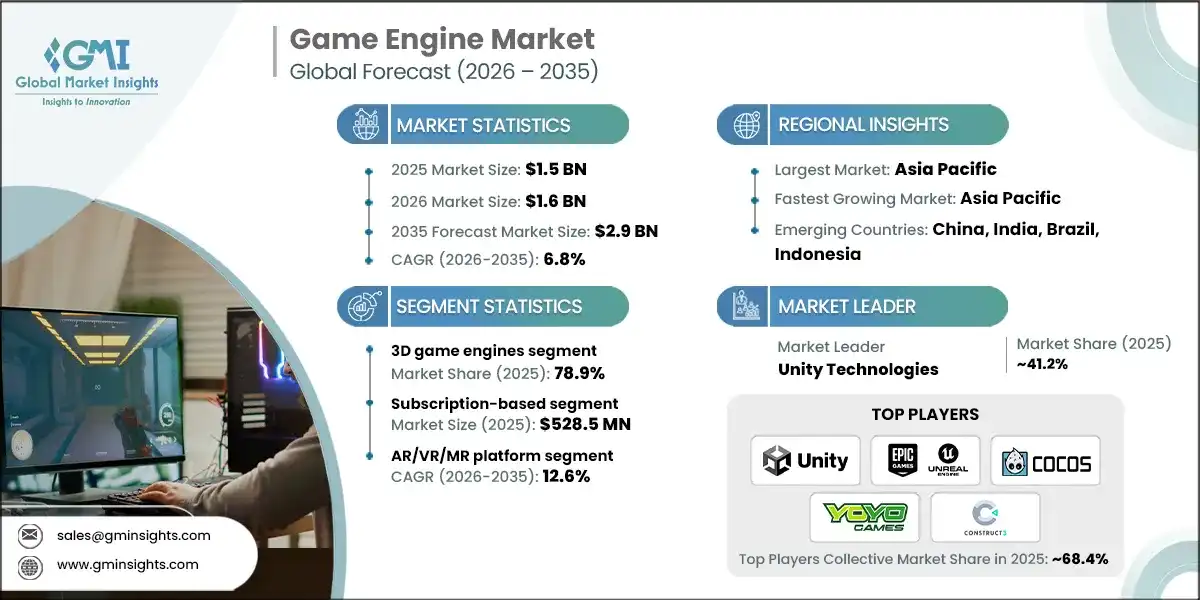
The global game engine market was valued at USD 1.5 billion in 2025. The market is expected to grow from USD 1.6 billion in 2026 to USD 2.3 billion in 2031 & USD 2.9 billion in 2035, growing at a CAGR of 6.8% during the forecast period according to the latest report published by Global Market Insights Inc.
To get key market trends
The market for game engines is growing because of mobile and cross-platform gaming is on the rise. There is also an increased use in non-gaming industries. Demand for immersive gaming experiences is increasing. Additionally, more people are adopting cloud-based game engines.
As developers increasingly concentrate on providing experiences across multiple devices, the growth of mobile and cross-platform gaming is a major factor driving the game engine market. Statista projects that by 2030, there will be 2.5 billion mobile game users globally, with user penetration increasing from 27.6% in 2026 to 30.7%. This trend increases the need for lightweight, adaptable engines that can effectively support mobile, console, PC, and web platforms, allowing for a larger audience reach and quicker game development.
The non-gaming industry, including films, architectural, engineering, automotive, and industrial simulation, is rapidly adopting game engines. For example, in November 2025, Tencent launched the global release of its Hunyuan 3D Engine, which adopts AI technology to achieve the rapid creation of 3D content based on text, image, and sketch descriptions, taking days to produce 3D content to just minutes. These developments show that the increasing use of real-time engines for visualization and virtual production is driving the market.
Between 2022 and 2025, the market witnessed considerable growth, increasing from USD 1 billion in 2022 to USD 1.5 billion in 2025. This growth is being driven by a rapid growth of mobile gaming, cross-platform gaming, the increasing adoption of real-time 3D engines for cinematic and virtual productions, and broader adoption in the enterprise arena of automotive, AEC, and simulation industries. Cloud development tools and AI-driven content tools seem to be catalyzing this adoption.
Game Engine Market Report Attributes
| Key Takeaway | Details |
|---|---|
| Market Size & Growth | |
| Base Year | 2025 |
| Market Size in 2025 | USD 1.5 Billion |
| Market Size in 2026 | USD 1.6 Billion |
| Forecast Period 2026 - 2035 CAGR | 6.8% |
| Market Size in 2035 | USD 2.9 Billion |
| Key Market Trends | |
| Drivers | Impact |
| Growing demand for immersive gaming experiences and AAA game development | Drives 23% growth as studios and indie developers adopt advanced 3D and hybrid engines for high-quality graphics, physics, and AI-driven gameplay. |
| Expansion of AR/VR/MR and metaverse applications | Supports 21% growth as real-time engines enable immersive virtual worlds, training simulations, and enterprise metaverse solutions. |
| Increasing adoption of cloud-based game engines | Contributes 20% growth by enabling collaboration, scalability, and remote development for multi-platform deployment. |
| Rising use in non-gaming industries (film, animation, AEC, automotive, aerospace) | Adds 18% growth as real-time visualization, digital twins, and virtual production demand robust engine platforms. |
| Growth of mobile and cross-platform gaming | Accounts for 19% growth as lightweight, optimized engines support multi-device deployment and rapid prototyping. |
| Pitfalls & Challenges | Impact |
| Intense competition and price pressure from freemium/open-source engines | Restrains market growth as licensing fees face downward pressure, affecting revenue expansion for commercial engine providers. |
| Complexity and high learning curve of advanced engines | Limits growth due to increased training, development time, and adoption barriers for smaller studios or non-gaming enterprises. |
| Opportunities: | Impact |
| Adoption of AI-powered engine features and procedural content generation | Contributes 17% growth by reducing development time, enabling smarter NPC behavior, and enhancing game realism. |
| Integration with cloud gaming, SaaS, and collaborative development platforms | Adds 16% growth as real-time engines enable multiplayer streaming, live updates, and global developer collaboration. |
| Market Leaders (2025) | |
| Market Leaders |
~41.2% market share. |
| Top Players |
|
| Competitive Edge |
|
| Regional Insights | |
| Largest Market | Asia Pacific |
| Fastest growing market | Asia Pacific |
| Emerging countries | China, India, Brazil, Indonesia |
| Future outlook |
|
What are the growth opportunities in this market?
Game Engine Market Trends
- Cloud-based platforms for game engine development are gaining popularity. They allow real-time development, easy asset sharing, and scalable build processes. This is possible even for teams that are spread out across different locations. In fact, this trend peaked in 2020 when remote work and the "live service" gaming model became more common. The situation has changed. There is now less need for infrastructure, and development times are faster, which leads to better subscription-based revenue.
- Game engines are increasingly being adopted for real-time visualization, simulation, and digital twin applications in film, AEC, automotive, aerospace, and defense sectors. This was initiated around 2019 with virtual production and immersive training gaining popularity. This has led to a broadened market for game engines, which was previously largely used for gaming purposes, and thereby created a requirement for high-quality image rendering and accurate physics for digital transformation in the real-time 3D platform.
- Tools powered by Artificial Intelligence, such as procedural content creation, are revolutionizing the process of game and 3D content creation. They do all the work associated with asset creation, animation, and NPC creation. This started to emerge around 2021 with the help of advancements in machine learning and generative AI. It offers reduced timelines, reduced costs, improved scalability for content, and increased productivity to allow small studios to produce high-quality content.
Game Engine Market Analysis
Learn more about the key segments shaping this market
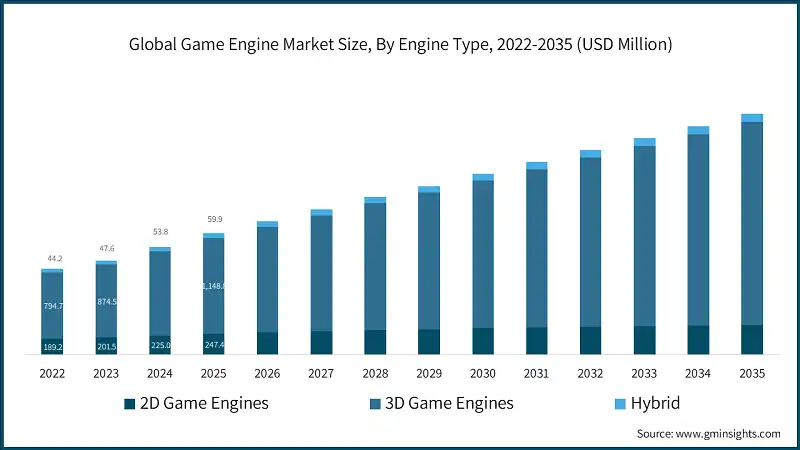
The global market for game engine was valued at USD 1 billion in 2022. The market size reached USD 1.5 billion in 2025.
Based on the engine type, the market is divided into 2D game engines, 3D game engines, and hybrid.
- The 3D game engines segment accounted for 78.9% of the market in 2025. The 3D game engines segment dominated due to the increasing demand for high-fidelity graphics, real-time rendering, physics simulation, and truly immersive gameplay on PC, console, mobile, and XR platforms. But further beyond those uses, their applications expand to encompass AAA titles, virtual production, automotive visualization, and digital twin uses, which have aided revenue boosts in that 3D engines deliver photorealism, scalability, and cross-industry deployment.
- The hybrid game engine segment is anticipated to grow at a CAGR of 5.1% over the forecast period owing to a growing trend among developers to be attracted to a single platform that can manage both 2D and 3D content. The demand comes from mobile and indie studios, the need for cross-platform deployment, and the desire for cost savings. Hybrid engines allow for quick prototyping, mixed-dimension gameplay, and better device compatibility, which encourages their use in gaming and enterprise visualization.
Based on the licensing model, the game engine market is segmented into freemium, subscription-based, perpetual license, and revenue-sharing / royalty-based.
- The subscription-based segment dominated the market in 2025 and was valued at USD 528.5 million due to the widespread shift toward SaaS delivery models, predictable recurring revenue structures, and inclusion of integrated development tools, cloud services, and continuous updates, which lower upfront costs for developers and support scalable, cross-platform, and collaborative game development.
- The revenue-sharing / royalty-based segment is expected to witness growth rate of 7.6% during the forecast period. This is owing to independent as well as medium-scale game development studios opting for it so as to save on up-front costs, as well as the benefit of high-performance engines offering high-end rendering, physics, as well as business capabilities as per performance-based monetization.
Learn more about the key segments shaping this market
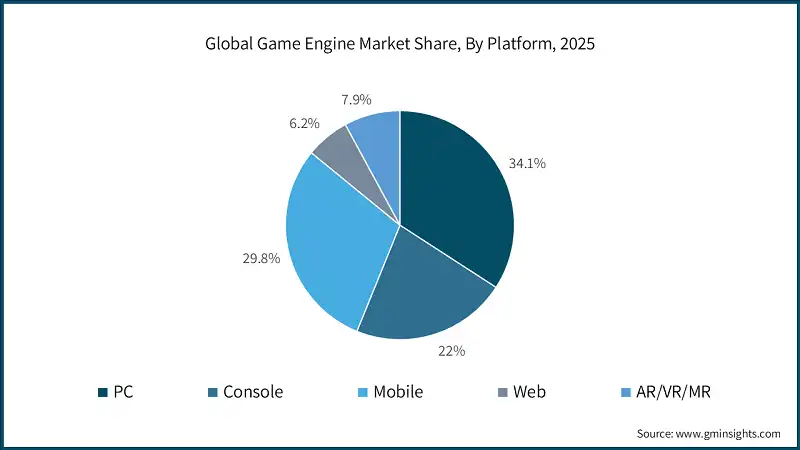
Based on the platform, game engine market is classified into PC, console, mobile, web, and AR/VR/MR.
- AR/VR/MR platform segment is expected to grow at a CAGR of 12.6% during the forecast period. This growth is fueled mainly due to broader adoption of immersive technologies in gaming, virtual production, training simulators, digital twin applications, as well as Metaverse initiatives. Advances in head-mounted devices, real-time rendering, and AI-driven content authoring are triggering a need for high-performance engines with extremely optimized performance for spatial computing.
- The PC segment held a market share of 34.1% in 2025 owing to the continuation of the dominance of the premium aspects of gaming, esports, and the pipeline of content development, requiring the best possible computing, advanced GPUs, and an open development environment. The development of AAA titles, game engine toolchains, mods, cross-platform build, and complex projects such as large-scale multiplayer development of PCs remain unchallenged.
Looking for region specific data?
North America Game Engine Market
North America held about 31.5% share of game engine industry in 2025.
- The market is influenced by major engine developers like Unity and Epic Games, strong AAA gaming studios, and the early use of AR/VR and cloud-based development. Growing enterprise applications in automotive, aerospace, and film production also increase the demand for high-quality 3D engines. This demand supports different revenue streams and fosters innovation in AI-powered tools.
- Cross-platform gaming, cloud collaboration, and subscription-based engine services are expanding the boundaries. Investment in esports, virtual production, and simulation-based training offers opportunities for engines to extend into areas adjacent to gaming. North America is a leader when it comes to engine adoption. Its mature development ecosystem, robust infrastructure, and willingness to invest in innovative engine technology contribute to this.
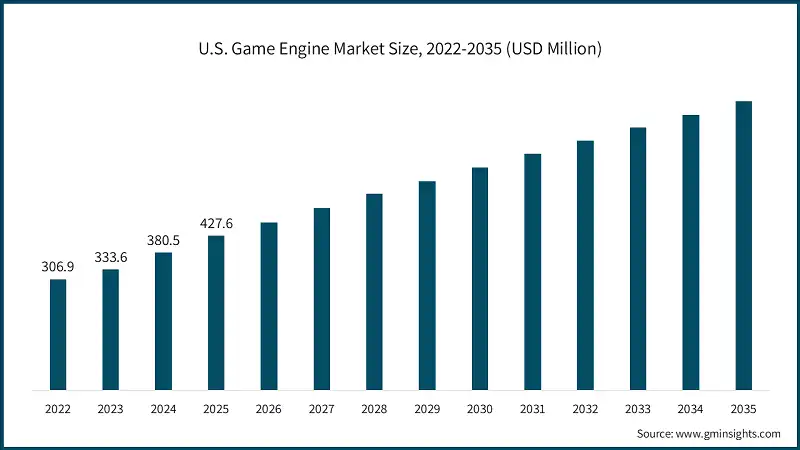
The U.S. game engine market was valued at USD 1 billion in 2022, market size reached USD 1.5 billion in 2025.
- The US leads North America’s game engine industry because of local companies and major gaming studios producing AAA titles. The growth in mobile and console gaming, along with cloud-based engine services, drives engine revenue. Businesses are using engines more for automotive design, virtual production, and XR simulation, expanding the market beyond gaming.
- US developers are using procedural content generation in game engines to cut down asset creation time and improve visual quality. More studios are adopting subscription and royalty-based licensing, which provides flexible cost options for indie and mid-sized studios, encouraging them to experiment with cross-platform releases.
Europe Game Engine Market
Europe game engine accounted for USD 347.4 million in 2025 and is anticipated to show lucrative growth over the forecast period.
- European studios are focusing on cross-platform mobile and cloud games. Encouragement from the government in the UK and other countries in Europe supports the development of local game engines and education.
- Germany's growth include the engines for digital twins, simulation in the self-driving car industry, and training simulations in manufacturing. The rising need for precise VR and AR simulations in engineering and design is increasing the demand for engines that provide accurate physics simulations and strong visualization capabilities.
Germany dominates the Europe game engine market, showcasing strong growth potential.
- Game engine adoption in Germany is growing in industrial simulation and engineering. High-accuracy physics, thermal modeling, and virtual prototyping are essential in these areas. Companies are increasingly incorporating engines into IoT and smart manufacturing workflows.
- The country also invests significantly in AR/VR for training and education, especially in the automotive and aerospace sectors. Engine providers are offering specialized tools to meet strict industry standards. This improves usability for corporate clients and increases market reach beyond traditional gaming applications.
Asia Pacific Game Engine Market
The Asia Pacific dominated with a market share of 36.4% in 2025.
- The Asia Pacific region is experiencing rapid growth due to mobile-first gaming, increasing cloud adoption, and expanding AR/VR initiatives. Countries like China, India, and Southeast Asia are driving engine demand through a growing base of indie and mobile developers, along with enterprise adoption in virtual production, education, and training.
- Emerging markets are also witnessing strong government support, studio investments, and partnerships between local developers and engine providers. Growth in mobile, cross-platform, and AI-powered engines enhances accessibility for smaller studios. The region is expected to capture a growing share of the global market due to scalability, innovation, and high user engagement in gaming and enterprise applications.
China market is estimated to grow with a significant CAGR, in the Asia Pacific market.
- The game engine market in China represents a strong growth in the Asia-Pacific region, driven by a large base of mobile and online gamers. China dominates the market, driven by the widespread use of game engines such as Unity, Unreal, and Cocos. Enterprises are leveraging game engines not only in games, but in other applications like virtual production, training, and AR/VR simulations.
- The industry is experiencing a move towards cloud-based and subscription-based engine models and share-based engine modes. As a result, indie developers are embarking on gaming projects with ease because the costs involved are significantly lower. China is emerging as a critical growth engine within the industry because it is supported by the government and is experiencing increased esports interest and engagement.
Latin American Game Engine Market
Brazil leads the Latin American market, exhibiting significant growth during the 2026-2034.
- Brazil’s game engine industry is expanding due to mobile-first gaming, indie studios, and increasing cross-platform adoption. Engines are used for educational tools, simulations, and casual gaming, broadening market penetration beyond traditional gaming.
- The country is experiencing a rise in subscription and freemium business models that are beneficial for smaller developers. Investment in cloud collaboration tools, AR/VR projects, and Esports programs is fueling engine adoption. As a result of a growing developer base and a rise in smartphone usage, Brazil is emerging as a nascent game engine deployment market in Latin America.
Middle East and Africa Game Engine Market
UAE market to experience substantial growth in the Middle East and Africa game engine industry.
- The UAE is emerging as a regional hub for game engine adoption in gaming, entertainment, and enterprise sectors, supported by investments in AR/VR, metaverse projects, and smart city initiatives. Engines are increasingly used for digital twins, simulations, and virtual production.
- Cloud-based platforms and subscription models are gaining traction, enabling scalable development and cross-platform deployment. Government incentives, technology parks, and partnerships with international studios accelerate engine adoption. Rising interest in immersive experiences, esports, and enterprise visualization projects positions the UAE as a strategic growth market in the Middle East.
Game Engine Market Share
Key players in the game engine industry are Unity Technologies, Epic Games (Unreal Engine), Cocos, YoYo Games Ltd., and Construct (Scirra Ltd.). These five key players comprised 68.4% of the overall industry in 2025. This popularity can be owed to their versatile game engine offerings, which extend to support 2D & 3D game development, AR/VR/MR development, as well as support in film, automotive, architecture, and industrial simulations.
These companies maintain a competitive edge by continuously investing in R&D, AI tools, and cloud services. They benefit from large developer communities and scalable platform technology. Their monetization strategies, which include subscription services and Split Revenue Shares, focus on developing markets. Their technological progress and wide range of usage segments place them far ahead in the commercial game engine industry.
Game Engine Market Companies
Prominent players operating in the game engine industry are as mentioned below:
- Cocos
- Construct (Scirra Ltd.)
- Crytek GmbH
- Epic Games, Inc. (Unreal Engine)
- GDevelop
- Godot Foundation
- Marmalade SDK
- MonoGame
- Open 3D Engine
- RPG Maker (ASCII Corporation)
- Solar2D LLC
- Stencyl LLC
- The Game Creators Ltd.
- Torque3D (GarageGames)
- Unity Technologies
- Ren'Py
- YoYo Games Ltd.
- Unity Technologies: Unity is a versatile engine that allows developers to easily develop real-time 2D and 3D experiences. The strength of Unity lies in its ability to deploy across multiple platforms easily. Additionally, the asset store is huge and has a significant set of cloud properties. Another major factor is the extensive community of developers associated with Unity.
- Epic Games, Inc. (Unreal Engine): Unreal Engine is known for its ability to create amazing 3D graphics and rendering for AAA games. It is appreciated for its realistic graphics capabilities, resourceful use of Epic Games' services, cloud functionality, and scalable business model that supports studios of all sizes.
- Cocos: It is an open-source engine which focuses on mobile and web. It is lightweight with flexible scripting, rapid iteration for both 2D and 3D, as well as a strong developer presence in the Asia-Pacific region.
- YoYo Games Ltd.: YoYo Games is a cross-platform game engine development company that provides GameMaker Studio. It is a 2D-based engine which supports both drag & drop and scripting. It is preferred for its ease of use and rapid prototyping capabilities.
- Construct (Scirra Ltd.): Construct offers a no-code, 2D game engine that can be developed without code, is the fact that games developed using it can be deployed right in the browser. This, along with the ease of development and the interface, attracts many individuals who are not programmers.
Game Engine Industry News
- In November 2025, Unity announced a partnership with 2K Games, to port PGA TOUR 2K25 to the Nintendo Switch 2, marking the first project in a multi-title collaboration. Unity's in-house studio is working with HB Studios to optimize the golf simulation using Unity 6 features like deferred lighting and screen space reflections for enhanced visuals on the new console.
- In August 2025, Globant and Unity announced a strategic global partnership, through Unity's Service Partner Program. This collaboration aims to bring real-time 3D technology to enterprise sectors beyond gaming, such as automotive, healthcare, manufacturing, and life sciences.
- In November 2025, Unity and Epic Games announced a collaboration which enables Unity developers to publish games directly into Fortnite, tapping into its massive ecosystem of over 500 million registered accounts and the Fortnite Creator Economy.
The game engine market research report includes in-depth coverage of the industry with estimates and forecast in terms of revenue (USD Million) from 2022 – 2035 for the following segments:
Market, By Engine Type
- 2D Game Engines
- 3D Game Engines
- Hybrid
Market, By Deployment Model
- On-premise
- Cloud-based
- Hybrid
Market, By Licensing Model
- Freemium
- Subscription-based
- Perpetual license
- Revenue-sharing / royalty-based
Market, By Platform
- PC
- Console
- Mobile
- Web
- AR/VR/MR
Market, By Application
- Gaming
- Console
- PC
- Mobile
- Online
- Film & animation / virtual production
- Architecture, engineering & construction (AEC)
- Automotive & transportation
- Aerospace & defense
- Others
The above information is provided for the following regions and countries:
- North America
- U.S.
- Canada
- Europe
- Germany
- UK
- France
- Spain
- Italy
- Netherlands
- Asia Pacific
- China
- India
- Japan
- Australia
- South Korea
- Latin America
- Brazil
- Mexico
- Argentina
- Middle East and Africa
- South Africa
- Saudi Arabia
- UAE
Frequently Asked Question(FAQ) :
Who are the key players in the game engine market?
Key players include Unity Technologies, Epic Games (Unreal Engine), Cocos, YoYo Games Ltd., Construct (Scirra Ltd.), Crytek GmbH, GDevelop, Godot Foundation, Marmalade SDK, MonoGame, Open 3D Engine, RPG Maker, Solar2D LLC, Stencyl LLC, The Game Creators Ltd., Torque3D, and Ren'Py.
What are the upcoming trends in the game engine market?
Key trends include adoption of cloud-based development platforms, AI-powered procedural content generation, and increasing use in non-gaming sectors like film, automotive, AEC, and aerospace for real-time visualization.
Which region leads the game engine market?
Asia Pacific held 36.4% share in 2025, leading the market. Mobile-first gaming, cloud adoption, and expanding AR/VR initiatives fuel the region's dominance.
What is the growth outlook for AR/VR/MR platforms from 2026 to 2035?
AR/VR/MR platforms are projected to grow at a 12.6% CAGR till 2035, due to immersive technology adoption, metaverse initiatives, and spatial computing advancements.
What was the valuation of subscription-based licensing segment in 2025?
Subscription-based licensing held the largest share and generated USD 528.5 million in 2025, driven by SaaS delivery models and recurring revenue structures.
How much revenue did the 3D game engines segment generate in 2025?
3D game engines accounted for 78.9% of the market in 2025, leading the segment with high-fidelity graphics and real-time rendering capabilities.
What is the current game engine market size in 2026?
The market size is projected to reach USD 1.6 billion in 2026.
What is the market size of the game engine in 2025?
The market size was USD 1.5 billion in 2025, with a CAGR of 6.8% expected through 2035 driven by rising mobile and cross-platform game development and increasing adoption in non-gaming industries.
What is the projected value of the game engine market by 2035?
The game engine industry is expected to reach USD 2.9 billion by 2035, propelled by immersive gaming experiences, AR/VR/MR expansion, and cloud-based engine adoption.
Game Engine Market Scope
Related Reports