Summary
Table of Content

Europe Plate Heat Exchanger Market
Get a free sample of this report
Form submitted successfully!
Error submitting form. Please try again.
Thank you!
Your inquiry has been received. Our team will reach out to you with the required details via email. To ensure that you don't miss their response, kindly remember to check your spam folder as well!
Request Sectional Data
Thank you!
Your inquiry has been received. Our team will reach out to you with the required details via email. To ensure that you don't miss their response, kindly remember to check your spam folder as well!
Form submitted successfully!
Error submitting form. Please try again.
Europe Plate Heat Exchanger Market Size
Flourishing investments in heavy‑duty industries, along with rising demand for advanced cooling & heating systems across various industrial processes, is contributing to industry growth. Accelerating adoption of highly efficient equipment that offers reduced energy consumption, integrated digital technologies coupled with stringent regulatory norms toward carbon emissions reduction and shifting focus on low‑emission energy solutions, will augment industry outlook.
Europe Plate Heat Exchanger Market Key Takeaways
Market Size & Growth
- 2025 Market Size: USD 1.9 Billion
- 2026 Market Size: USD 2.1 Billion
- 2035 Forecast Market Size: USD 4.1 Billion
- CAGR (2026–2035): 7.8%
Regional Dominance
- Largest Market: Germany
- Fastest Growing Country: Russia
Key Market Drivers
- Increasing emphasis on energy efficiency across various industries.
- Stringent environmental regulations aiming to reduce carbon emissions.
- Flourishing investments across industrial infrastructure.
Challenges
- Significant initial cost and availability of alternative technologies.
Opportunity
- Rapid industrial energy efficiency transition.
- Expansion of renewable & district heating projects.
- Technological advancements in materials & smart monitoring.
- Retrofitting and development of aging industrial infrastructure.
Key Players
- Market Leader: Alfa Laval led with over market share of: 14.5% in 2025.
- Leading Players: Top 5 players in this market include Alfa Laval, Xylem, Danfoss, Kelvion Holding, SPX Flow, which collectively held a market share of 42% in 2025.
Get Market Insights & Growth OpportunitiesFor instance, in July 2025, Germany government authorities launched the Made for Germany initiative, committing around USD 750 billion (EUR 631 billion) in investment over three years to support economic recovery. Sixty‑one major corporations, representing one‑third of the national economy, plan to direct funding toward factories and research efforts to enhance growth, competitiveness, and nation’s technological leadership.
Growing inclination on adoption of energy‑efficient technologies, coupled with increasing demand for space‑optimized and compact heat exchanger systems to enhance thermal management will complement industry landscape. Manufacturers are increasingly prioritizing lightweight, high‑efficiency designs, incorporating advanced materials, modular construction approaches, and smart, sensor‑based technologies to improve system performance, enhance operational reliability, and streamline maintenance, further accelerating product demand.
For instance, in July 2024, Alfa Laval introduced its Hygienic WideGap plate heat exchanger, a next‑generation solution designed for processing viscous liquids containing fibres and particles. The system offers significantly improved energy efficiency and heat recovery compared to conventional shell‑and‑tube designs. Its advanced plate geometry, asymmetrical or symmetrical channel configuration, and optimized port design enable smooth flow, high thermal performance, reduced clogging risk, and reliable operation across diverse food‑processing applications.
Implementation of stringent emission‑control policies, coupled with broader transition toward energy‑efficient industrial operations, are accelerating market expansion. The increasing emphasis on reducing power consumption, together with the deployment of low‑carbon technologies and wider adoption of heat‑recovery solutions for optimized thermal performance, is strengthening the industry outlook and supporting long‑term sustainability objectives.
For instance, in December 2025, the European Commission unveiled new measures designed to simplify environmental regulations across industrial emissions, circular‑economy activities, environmental impact assessments, and geospatial data management. The reforms aim to ease administrative burdens while preserving high standards of environmental and public‑health protection. The initiative is expected to generate annual savings of approximately USD 1.17 billion for businesses, contributing to wider cost‑reduction objectives for 2029.
Germany leads the Europe plate heat exchanger market owing to robust industrial ecosystem, ongoing upgradation to prevailing facilities, and supportive government initiatives aimed at improving energy efficiency and lowering carbon emissions. Increasing energy demand driven by expansion of key sectors including chemicals, HVAC, petrochemicals, power generation, and food processing coupled with focus on adopting effective heat transfer solutions further drive the industry growth.
For instance, in October 2025, the German government introduced a USD 7.1 billion (EUR 6 billion) industrial decarbonization program that incorporates carbon capture and storage into climate contracts for the first time. The scheme targets energy‑intensive industries and offers 15‑year subsidized contracts awarded through competitive auctions beginning in 2026.
Russia is one of the emerging markets in Europe plate heat exchanger market owing to rising industrialization, expanding urban infrastructure, and increased energy demand various diverse industrial processes. Robust petroleum refining, petrochemical, and power‑generation base require advanced heat‑transfer equipment for operational efficiency coupled with modernization of existing facilities, supportive investment programs by authorities toward expansion of industries will shape business dynamics.
For instance, in June 2024, Russia introduced a USD 25 billion (RUB 2.14 trillion) national programme aimed at establishing technological independence in the energy sector by reducing reliance on former Western suppliers. Funded through a mix of state and alternative sources, the initiative encompasses ten federal projects focused on advancing nuclear, oil and gas, LNG, power generation, renewable technologies and energy storage to strengthen long‑term sector development.
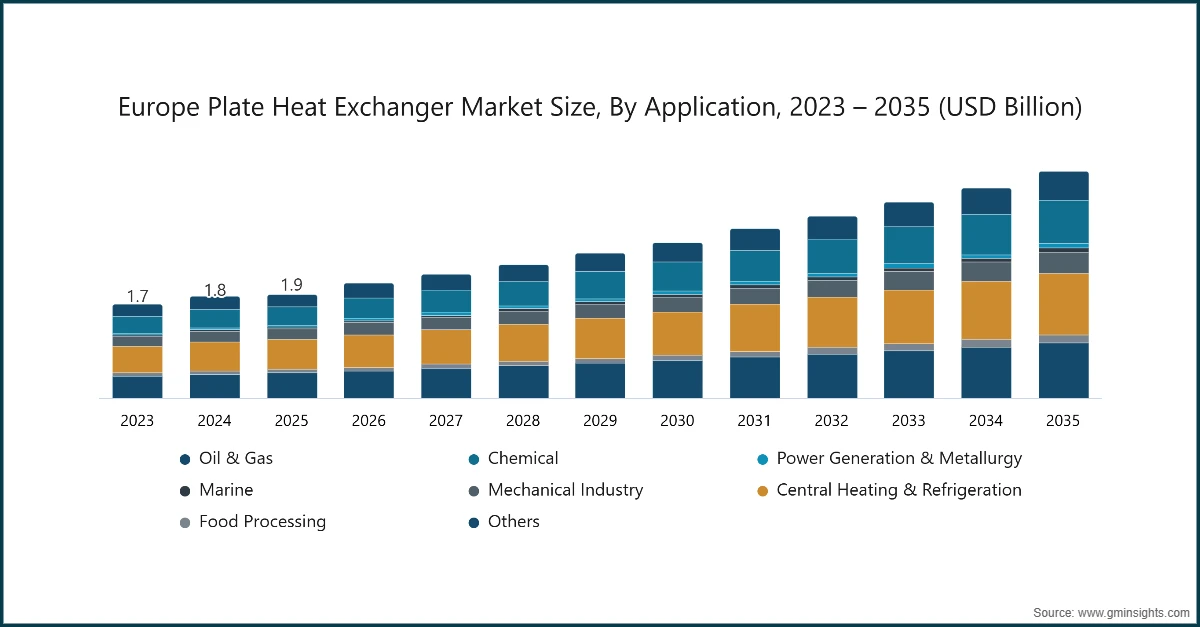
Europe plate heat exchanger market was estimated at USD 1.9 billion in 2025. The market is expected to grow from USD 2.1 billion in 2026 to USD 4.1 billion in 2035, at a CAGR of 7.8%, according to a recent study by Global Market Insights Inc.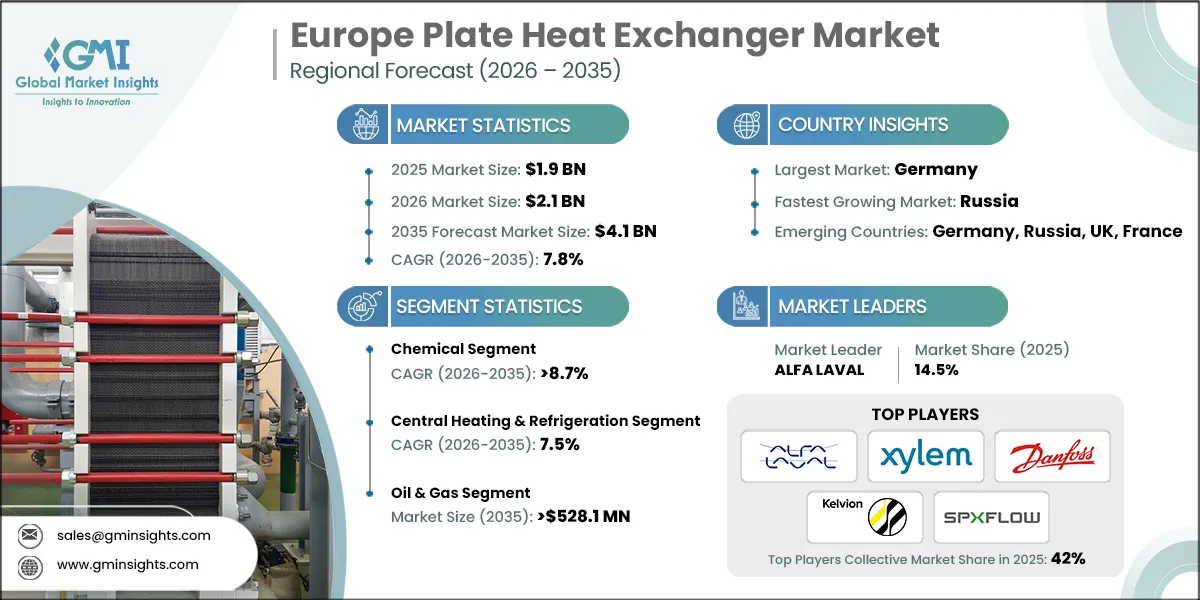
To get key market trends
Europe Plate Heat Exchanger Market Trends
Europe plate heat exchanger market is witnessing significant momentum driven by to grow owing to ongoing technological advancements to enhance energy efficiency, and system adaptability and increasing focus on energy conservation across multiple industrial sectors. In addition, introduction of advanced materials capable of withstanding extreme temperatures and corrosive operating environments across challenging applications including petrochemicals, chemicals and power generation will augment industry outlook.
For instance, in May 2025, the European Commission (EC) published its review of EU Member States’ National Energy and Climate Plans. While many countries increased their energy‑efficiency commitments, the analysis highlighted a remaining shortfall in meeting the 2030 objectives. To bridge this gap, require additional policy measures and strengthened national efforts to align with the EU’s long‑term climate and energy goals.
Introduction of stringent policies and mandates to reduce emissions from industrial operations and processes along with growing inclination on improving energy efficiency and focus on adhering to regulatory compliance will complement business landscape. Rising demand for advanced plate heat exchanger solutions driven by ability of operate at high temperatures, efficient operation and energy consumption will accelerate product deployment across various industrial applications.
For instance, in August 2024, the European Commission revised Directive regulating industrial and livestock‑rearing emissions came into force, replacing the previous framework. The updated legislation supports the EU’s Zero Pollution agenda by reducing emissions from major industrial facilities and livestock operations while fostering innovation and investment stability. By 2050, it is projected to significantly lower key air pollutants and introduce the EU’s first mechanism for compensation related to unlawful pollution‑linked health impacts.
Growing deployment of renewable energy systems, expansion of manufacturing capacities, increased focus on thermal waste‑heat recovery, and continued development of industrial infrastructure in emerging economies are collectively strengthening the plate heat exchanger market outlook. Moreover, rising R&D expenditure aimed at expanding application ranges and improving product durability through innovations including compact configurations, higher heat transfer efficiency, and thermal waste recovery is further accelerating product demand across diverse industrial sectors.
For instance, in September 2025, Danfoss introduced its new hygienic gasketed plate heat exchangers, engineered to meet strict sanitation standards using FDA‑compliant materials. Designed for food and beverage applications, the units support diverse processes such as dairy pasteurization, beverage cooling, brewery heating, and juice and egg processing. The range combines flexibility, efficiency, and reliable hygienic performance across demanding production environments.
Europe Plate Heat Exchanger Market Analysis
Learn more about the key segments shaping this market
Based on application, the industry is segmented into oil & gas, chemical, power generation & metallurgy, marine, mechanical industry, central heating & refrigeration, food processing and others. The central heating & refrigeration segment dominated the Europe plate heat exchanger market accounted for approximately 28.3% market share in 2025 and is anticipated to grow at a CAGR of 7.5% from 2026 to 2035.
Ongoing advancements in smart heating technologies that enable superior energy management, along with rising consumer demand for sustainable energy options, are shaping the industry dynamics. Stringent EU‑level policies targeting carbon‑emission reduction and enhanced energy efficiency coupled with adoption of heat exchanger that provide high energy efficiency, reliable heat transfer, enable temperature control and reduce energy consumption will complement business landscape.
For instance, in September 2024, Alfa Laval announced new energy‑efficient plate heat exchangers for industrial, commercial, residential heat pumps and refrigeration applications as part of its sustainable cities’ initiative. These climate‑smart solutions are developed with manufacturing partners, and were presented at Chillventa 2024, held in Germany.
Chemical application is set to grow is set to grow at a CAGR of over 8.7% from 2026 to 2035. Rising adoption of corrosion‑resistant materials, innovations in gasket and plate systems, integration of smart monitoring systems and expanding chemical facilities across the region is shaping business dynamics. Chemical processing involves heat‑intensive steps including distillation, catalytic reactions, and solvent recovery, which rely on advanced technologies offering superior heat‑transfer efficiency and reduced fouling, further augmenting product deployment.
For instance, in May 2025, Vitherm secured a new order to supply heat‑exchanger unit for a chemical facility in France operated by a global leader in specialty chemicals and advanced materials. The company’s robust mechanical design and plate configuration, enables complete cleaning and reliable performance, supported the selection. Leveraging extensive process‑technology expertise, the company continues to expand its WeldPack heat exchangers for diverse industrial applications.
The oil & gas application across Europe plate heat exchanger market is set to grow over USD 528.1 million by 2035. Increasing need for heat exchangers across oil and gas processing facilities to handle corrosive fluids and high pressures along with ongoing exploration activities and development of unconventional reservoirs will augment industry outlook. process Robust development of oil & gas infrastructure, growing focus on process optimization and operator’s aiming toward reducing operational costs will contribute to industry growth.
For instance, in July 2025, Kelvion secured a USD 10.7 million contract to supply advanced heat‑exchange systems for a major low‑carbon power project integrating commercial‑scale carbon capture and storage. The scope includes single‑tube and fully welded plate heat exchangers engineered for stringent CCS conditions. This award reflects company’s technical collaboration and its commitment to enabling large-scale, low‑emission power generation.
Learn more about the key segments shaping this market
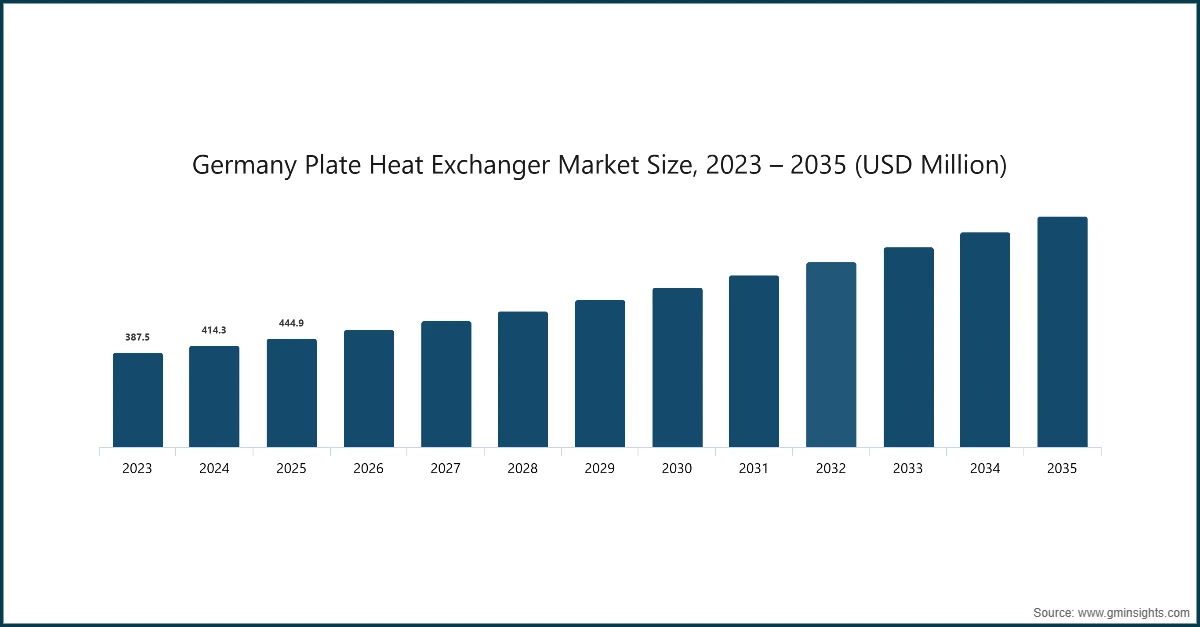
Germany dominated the plate heat exchanger industry in Europe with around 22.5% market share in 2025 and generated around USD 444.9 million in revenue. Germany heat exchanger market is set to grow owing to advanced industrial base, rapid electrification of the automotive sector, and the rising need for precision thermal‑management systems in high‑tech manufacturing. Ongoing Industry 4.0 integration, shifting focus toward industrial decarbonization, sectors requiring high‑performance heat exchangers for complex processing with temperature‑critical operations will augment industry outlook.
For instance, in March 2025, SonFlow participated in ISH Frankfurt, Germany and showcased its advanced HVAC technologies. The company presented high‑efficiency plate and brazed heat exchangers designed for reliable, low‑maintenance performance. These solutions offer strong thermal output, adaptable configurations, and durable operation for HVAC, industrial, and hygienic applications, enhancing company's presence, offering optimized system performance and energy‑efficient heat‑exchange technology.
Russia plate heat exchanger is set to grow over USD 661.9 million by 2025. Rising renewable energy deployment, rapid industrialization and accelerating investments in wate to energy, oil processing and biomass projects driving demand for efficient thermal‑transfer technologies. Rising demand for heat exchangers in HVAC, district‑heating, and large‑scale industrial facilities along with oil, gas, refining, and petrochemical sectors are focusing to maintain operational efficiency will accelerate product deployment.
For instance, in June 2025, the 28th St. Petersburg International Economic Forum concluded with more than 24,000 participants from 144 countries, highlighting global economic trends, investment priorities, and technological development. The Forum resulted in over 1,080 agreements worth USD 83.9 billion (RUB 6.48 trillion), including major commitments in infrastructure, energy, transportation, and industrial development across multiple Russian regions.
UK plate heat exchanger market is set to grow at a CAGR of over 7.6% by 2035. Accelerating transition toward low‑carbon energy systems and increasing investment in renewable technologies including biomass, and waste‑to‑energy facilities, and regulatory framework including net‑zero commitments for 2050 will complement business landscape. Rising demand from HVAC, data‑center cooling, and advanced manufacturing supported by ongoing infrastructure upgrades and modernization of power and process industries will encourage deployment of energy‑efficient thermal systems and heat‑recovery technologies.
For instance, in November 2025, Tranter secured a contract to deliver gasketed plate‑and‑frame heat exchangers for the Net Zero Teesside Power project, the first gas‑fired facility integrating carbon‑capture technology. The plant will supply over 740 MW of low‑carbon power while capturing up to two million tonnes of CO₂ annually. The order includes 40 stainless‑steel units with EPDM or NBR gaskets, awarded through Technip Energies and its EPC consortium.
France plate heat exchanger market is anticipated to grow at a CAGR of over 8% from 2026 to 2035. Growing inclination toward adoption of energy efficient systems across industries, favorable initiatives toward development of clean industrial processes and stringent mandates aimed at recuing carbon emissions will positively influence industry dynamics. Flourishing investments toward development of industrial processes and facilities, expanding manufacturing sector, focus on waste heat recovery and adoption of advance heat transfer equipment will further complement industry landscape.
For instance, in May 2024, the European Commission approved a USD 4.6 billion French initiative aimed at cutting GHG emissions in manufacturing and supporting country’s transition toward net‑zero industrial framework under Green Deal Industrial Plan. The program offers financial support amounting up to 30% of project expenditures for electrification of industries and energy‑efficiency upgrades, with eligibility tied to demonstrable reductions in emissions and overall energy consumption.
Italy plate heat exchanger market was evaluated at around USD 207.1 million in 2025. Shifting focus toward expansion of domestic manufacturing base, increased capital expenditure, and modernization of chemical, power, HVAC‑R, and food‑processing sectors are accelerating demand for advanced thermal‑management systems. Paradigm shift toward decarbonization, energy‑efficiency improvements, and compliance with EU climate targets have led industries adopt high‑efficiency, low‑emission thermal technologies and investment in waste‑heat recovery systems further supports industry growth.
For instance, in October 2025, Polidoro introduced the AB brazed plate heat exchanger, expanding its thermal solutions portfolio. The unit is designed for high efficiency, adaptability, and seamless integration, matches standard industry dimensions for basic installation. It offers symmetric or asymmetric plates and customizable internal distribution for varied refrigerants and loads. This launch reinforces Polidoro’s commitment to advanced, sustainable heat‑exchanger technologies produced in Italy.
Europe Plate Heat Exchanger Market Share
Major 5 players operating across the Europe plate heat exchanger market include Alfa Laval, Kelvion Holding, Danfoss, SPX Flow and Xylem contribute around 42% of the market share in 2025.
Key manufacturers operating across the industry are focus on improvement in product design, technological innovations, making strategic partnerships, collaborations, and are aiming for joint ventures for various projects to maintain a competitive edge. Continuous research and development initiatives along with major players are also engaged in mergers and acquisitions along with expanding their product and service portfolio to capture larger market share further shaping industry dynamics.
Xylem’s Bell & Gossett portfolio includes a comprehensive range of plate heat exchangers engineered to deliver high thermal efficiency within compact installation footprints. The product line features both gasketed plate and brazed plate heat exchanger units, available in multiple configurations to ensure consistent and optimized heat‑transfer performance across varied operating conditions. In addition, the company offers steam‑ and water‑driven heat exchanger solutions designed to provide rapid, dependable, and instantaneous thermal exchange for a wide spectrum of industrial applications.
Alfa Laval provides a comprehensive range of compact and durable fusion‑bonded plate and brazed plate heat exchangers, designed to deliver long‑lasting, maintenance‑free thermal performance through advanced engineering technologies. The company also offers high‑efficiency gasketed plate‑and‑frame units, developed to ensure superior energy optimization, dependable operation, and simplified servicing across a wide variety of industrial applications.
Danfoss provides brazed plate heat exchangers offering compact, versatile performance capable of handling high pressures and extreme temperature variations. The company’s broad range of SONDEX standard plate heat exchangers engineered to deliver efficient thermal management across a wide spectrum of industrial processes.
Kelvion Holding provides gasketed plate heat exchanger designs are suited for more demanding operating conditions, offering robust performance across processes involving fibre‑laden or highly viscous media. The company also offers brazed plate heat exchangers engineered to provide compact, customized thermal‑management solutions for a wide array of industrial applications. These units also support chemical‑cooling operations, water treatment, ensure reliable plant cooling using water sources, and deliver high‑efficiency climate‑control capabilities for data centres facilities.
SPX Flow offers APV ParaFlow industrial heat exchangers, designed to support a wide range of global process applications, delivering efficient heat‑transfer performance from compact duties to high‑flow operations reaching 4,500 m³/h. The company’s sanitary heat‑transfer line incorporates the FastFrame plate‑and‑frame design, which eliminates traditional tie bars to enhance accessibility, cleanability, and operational flexibility in hygienic processing environments.
Europe Plate Heat Exchanger Market Companies
Major players operating in the Europe plate heat exchanger industry are:
Alfa Laval
API Heat Transfer
Barriquand Group
Danfoss
Emmegi
Euro-Apex
Farad Heat Exchangers
Funke Warmeaustauscher Apparatebau
Hexonic
Hisaka Works
HRS Heat Exchangers
Kelvion Holding
Mersen
SonFlow
SPX Flow
SWEP International
Tenez
Thermowave
Tranter
VAU Thermotech
Wieland Onda
Xylem
Xylem’s GPX plate heat exchangers series employs a gasketed plate‑pack configuration engineered for compactness, low weight, and highly efficient heat transfer, regardless of whether process fluids exhibit wide or narrow temperature differentials. This configuration offers strong turbulence, resulting in elevated heat‑transfer coefficients, true counterflow between hot and cold streams, and reduced fouling, thereby minimizing required surface area. The company’s revenues for the first six months for the year 2025 were reported as USD 4.3 billion and revenues of USD 8.6 billion were reported for the complete year 2024.
ALFA LAVAL offers copper‑brazed plate heat exchangers offer a compact, efficient, and maintenance‑free solution suitable to heating, cooling, evaporation, and condensation across diverse applications. Designed for optimized performance, they ensure reliable thermal operation. The company’s gasketed plate heat exchangers provide energy‑efficient, space‑saving, and easily serviceable options for heating, cooling, heat‑recovery, and phase‑change processes, supporting broad industrial capacity requirements. The company’s half yearly revenues for the year 2025 were reported at around USD 3.6 billion.
Danfoss reported half yearly revenues for the year 2025 at around USD 5.5 billion and for the complete year 2024 revenues were reported at USD 11.37 billion. The company offers semi‑welded plate heat exchangers that are engineered for ammonia‑based refrigeration systems. Suitable for condensers, evaporators, sub‑coolers, desuperheaters, superheaters, economizers, and oil‑cooling applications, they support temperatures from –40°C to 120°C and 25 bar pressures, offering thermal performance with capacity for future model expansion.
Mersen offers graphite plate heat exchangers that are designed for efficient thermal management of highly corrosive chemical media. Their compact configuration provides exceptional heat‑transfer performance, which makes suitable for both heating and cooling demanding process streams. Designed with long‑term safety, durability, and operational reliability in mind, each unit is carefully sized, manufactured, and optimized to ensure consistent performance in ultra‑corrosive industrial environments. The company’s reported half yearly sales revenues of 2025 USD 713 million.
Europe Plate Heat Exchanger Market Report Attributes
| Key Takeaway | Details |
|---|---|
| Market Size & Growth | |
| Base Year | 2025 |
| Market Size in 2025 | USD 1.9 Billion |
| Market Size in 2026 | USD 2.1 Billion |
| Forecast Period 2026-2035 CAGR | 7.8% |
| Market Size in 2035 | USD 4.1 Billion |
| Key Market Trends | |
| Drivers | Impact |
| Increasing emphasis on energy efficiency across various industries | Growing inclination toward energy efficiency encourages widespread adoption of plate heat exchangers, enabling industries to lower operational costs, enhance thermal performance, and comply with evolving efficiency mandates. |
| Stringent environmental regulations aiming to reduce carbon emissions | Stringent EU environmental policies drive industries to modernize thermal systems with high performance plate heat exchangers, supporting emission reduction goals and accelerating transition toward cleaner, sustainable industrial operations. |
| Flourishing investments across industrial infrastructure | Flourishing investments in new and upgraded industrial facilities increases demand for reliable, scalable plate heat exchangers, strengthening market penetration and supporting improved process optimization across European industries. |
| Pitfalls & Challenges | Impact |
| Significant initial cost and availability of alternative technologies | Rising operational expenditures increase the overall costs and availability of alternative heat exchanger technologies may influence investment decisions, and adoption rates, further impacting industry growth. |
| Opportunities: | Impact |
| Rapid industrial energy efficiency transition | Rising EU regulations promoting energy‑efficient thermal systems will accelerate adoption of plate heat exchangers as industries upgrade to reduce emissions and operational costs. |
| Expansion of renewable & district heating projects | Growth in renewable integration and district heating infrastructure across Europe will increase demand for advanced plate units suited for heat recovery in solar, biomass, and urban heating networks. |
| Technological advancements in materials & smart monitoring | Development of corrosion resistant alloys and IoT enabled heat exchanger systems enhances durability, maintenance efficiency, and long term value for industrial users adopting predictive maintenance capabilities. |
| Retrofitting and development of aging industrial infrastructure | Modernization of older European chemical, HVAC, and power generation facilities drives replacement demand for high efficiency plate heat exchangers offering compact design and improved thermal performance. |
| Market Leaders (2025) | |
| Market Leader |
Market Share of: 14.5% |
| Top Players |
Collective Market Share of: 42% |
| Competitive Edge |
|
| Regional Insights | |
| Largest Market | Germany |
| Fastest growing market | Russia |
| Emerging countries | Germany, Russia, UK, France |
| Future outlook |
|
What are the growth opportunities in this market?
Europe Plate Heat Exchanger Industry News
In May 2025, Danfoss introduced its new H48T‑CH model of CO₂/water brazed heat exchanger, developed for trans critical CO₂ applications in supermarkets and hypermarkets. Featuring advanced Micro Plate technology, the unit delivers high thermal efficiency, reduced pressure loss, and compact installation without requiring a reinforced frame. Designed for heat‑recovery systems, it functions as a condenser, gas cooler, sub‑cooler, and economizer, offering strong resistance to thermal‑shock fatigue and pressure.
In May 2025, Moody Heat Exchangers, a division of Moody Direct, participated in ChemUK 2025 at the NEC Birmingham, UK, showcasing its advanced heat‑exchanger technologies and services for the chemical sector. The company supplies equipment from leading global manufacturers and displays high quality plates and complete units. Its team also highlighted maintenance, refurbishment, and testing solutions designed to enhance efficiency and reduce downtime for chemical processing operations.
In April 2025, Alfa Laval introduced the TS25 broadened its semi‑welded plate heat exchanger lineup engineered for applications requiring strict pressure‑drop control. The TS25 is suitable for electrolyzer cooling, sulfuric‑acid processing, industrial heat‑pump systems, and other demanding industrial sectors by leveraging proven semi‑welded technology. Its high‑capacity configuration and improved sealing system, along with unit’s reinforced durability enable efficient heat transfer, enhanced cooling performance, and reliable operation across energy and heavy processing industries.
In October 2024, Wieland acquired Onda S.p.A., a key HVAC&R supplier with facilities in Italy, Finland, and the U.S., enhancing its presence in the expanding heat‑exchanger and data‑center cooling sectors. The acquisition broadens capabilities across brazed plate, plate‑and‑frame, and air‑cooled heat exchangers, supporting demand for advanced, high‑capacity thermal technologies across wide range of industries.
In April 2024, Nexson acquired Thermowave, a German plate heat exchanger manufacturer based in Saxony‑Anhalt. The addition of Thermowave’s gasketed and semi‑welded technologies strengthens Nexson’s existing portfolio of welded heat exchangers and pressure vessels. Operating independently under its current name, Thermowave continues serving markets across the DACH region, France, Eastern Europe, Asia, and the Americas, particularly within refrigeration and industrial cooling applications.
The Europe plate heat exchanger market research report includes in-depth coverage of the industry with estimates & forecast in terms of revenue “USD Million” from 2026 to 2035, for the following segments:
Market, By Application
Oil & gas
Chemical
Power generation & metallurgy
Marine
Mechanical industry
Central heating & refrigeration
Food processing
Others
The above information has been provided for the following countries:
Germany
UK
France
Russia
Italy
Spain
Poland
Turkey
Frequently Asked Question(FAQ) :
What is the Europe plate heat exchanger market size in 2025?
The Europe market for plate heat exchanger is valued at USD 1.9 billion in 2025. Increasing emphasis on energy efficiency and stringent environmental regulations are driving market growth.
What is the market size of the Europe plate heat exchanger industry in 2026?
The market size for Europe plate heat exchangers is projected to reach USD 2.1 billion in 2026, reflecting steady growth driven by industrial infrastructure investments and energy-efficient solutions.
What is the projected value of the Europe plate heat exchanger market by 2035?
The market size for Europe plate heat exchangers is expected to reach USD 4.1 billion by 2035, growing at a CAGR of 7.8%. This growth is fueled by modernization of industrial infrastructure, renewable energy integration, and advancements in heat exchanger technologies.
What is the growth outlook for the central heating & refrigeration segment from 2026 to 2035?
The central heating & refrigeration segment is anticipated to grow at a CAGR of 7.5% from 2026 to 2035. Increasing adoption of district heating systems and energy-efficient refrigeration technologies is driving this growth.
Which country leads the Europe plate heat exchanger market?
Germany led the market in Europe with a 22.5% share in 2025, generating approximately USD 444.9 million in revenue. Its leadership is driven by a strong industrial base, rapid electrification in the automotive sector, and demand for precision thermal management systems.
What are the upcoming trends in the Europe plate heat exchanger industry?
Key trends include advancements in corrosion-resistant materials, IoT-enabled heat exchanger systems, modernization of aging industrial infrastructure, and increased adoption of plate heat exchangers in renewable energy and district heating projects.
Who are the key players in the Europe plate heat exchanger market?
Key players include Alfa Laval, API Heat Transfer, Barriquand Group, Danfoss, Emmegi, Euro-Apex, Farad Heat Exchangers, Funke Warmeaustauscher Apparatebau, Hexonic, Hisaka Works, HRS Heat Exchangers, Kelvion Holding, Mersen, SonFlow, SPX Flow, SWEP International, and Tenez.
Europe Plate Heat Exchanger Market Scope
Related Reports