Summary
Table of Content

Bike Computer Market
Get a free sample of this report
Form submitted successfully!
Error submitting form. Please try again.
Thank you!
Your inquiry has been received. Our team will reach out to you with the required details via email. To ensure that you don't miss their response, kindly remember to check your spam folder as well!
Request Sectional Data
Thank you!
Your inquiry has been received. Our team will reach out to you with the required details via email. To ensure that you don't miss their response, kindly remember to check your spam folder as well!
Form submitted successfully!
Error submitting form. Please try again.
Bike Computer Market Size
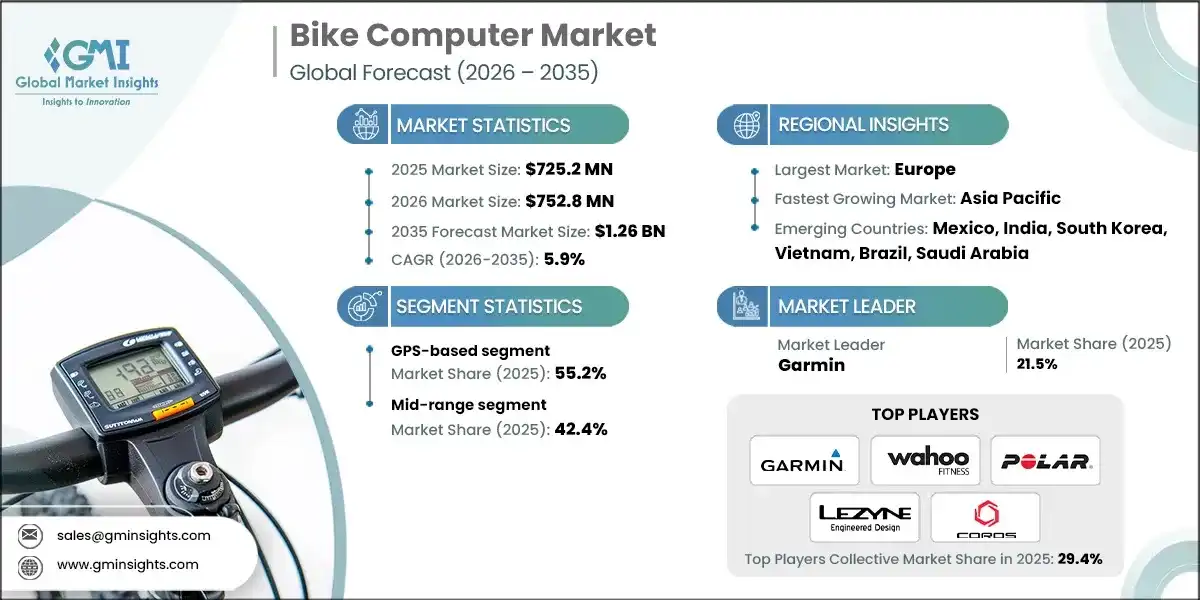
The global bike computer market was valued at USD 725.2 million in 2025. The market is expected to grow from USD 752.8 million in 2026 to USD 1.26 billion in 2035 at a CAGR of 5.9%, according to latest report published by Global Market Insights Inc.
Bike Computer Market Key Takeaways
Market Size & Growth
- 2025 Market Size: USD 725.2 Million
- 2026 Market Size: USD 752.8 Million
- 2035 Forecast Market Size: USD 1.26 Billion
- CAGR (2026–2035): 5.9%
Key Market Drivers
- Global Cycling Participation Growth & Health Consciousness Trends.
- E-Bike Market Expansion & Integrated Display Demand.
- Professional Cycling Influence & UCI WorldTour Technology Adoption.
- Smart City Infrastructure Development & Cycling Integration.
Challenges
- Smartphone Substitution Threat & Free App Alternatives.
- Theft Risk & Device Security Concerns in Urban Markets.
Opportunity
- Emerging Market Penetration.
- E-Bike Integration & OEM Partnership Expansion.
- Gravel & Adventure Cycling Segment Expansion.
- Smart City & Municipal Cycling Data Platform Integration.
Key Players
- Market Leader: Garmin led with over 21.5% market share in 2025.
- Leading Players: Top 5 players in this market include Garmin, Wahoo Fitness, Polar, Lezyne, COROS Wearables, which collectively held a market share of 29.4% in 2025.
Get Market Insights & Growth Opportunities
The global awareness for health monitoring and tech-adoption in day-to-day life has significantly improved the devices, such as bike computers that help in monitoring speed, cadence, heart rate and other fitness tracking.
People across the world are now adopting cycling as one of their main fitness activities. Diseases associated with obesity, diabetes and the heart, all of which are rampant lifestyle problems, have pushed the population in the globe to live a healthier life. As per the statistics provided by Statista, the United States has continuously suffered from an increase in the obesity rate.
Events like the cycle marathon support the bike computer market. For instance, in August 2025, USA Cycling announced the cross-country marathon, downhill, enduro, and E-MTB teams for the 2025 UCI Mountain Bike World Championships. Sixty-one riders round out the American roster for the Mountain Bike World Championships in Valais, Switzerland.
With the growing demand to reduce the pollution or carbon emission generated through the vehicles, there are so many countries and governments encouraging natives to adopt cycles, as it not just helps in short travelling but also helps in keeping the health stable.
Europe is at the forefront of this market, and the main reason behind this is EU's initiative on cycling. In Europe, the cycling declaration of 2024, which was signed by the European Parliament, the Council, and the Commission, acknowledges cycling as a legitimate transport mode. It lays down the rules for action on planning, infrastructure, inclusivity, multimodality, investments, safety, industry, and better data.
To get key market trends
Bike Computer Market Trends
The future of the bike computers will be enhanced and integrated with the new and advanced technologies. As AI & ML have been transforming the automotive industry for long years, it is expected that they will boost the bike computer demand if they are integrated with these technologies. The world is continuously seeing its benefits and positive impacts in health-related monitoring.
Governments and municipalities support the market by introducing cycling tournaments and marathons. For instance, the EuroVelo & Cycling Tourism Conference 2024 took place in Denmark. It was co-organized by Viborg Municipality and the European Cyclists’ Federation (ECF). A central topic of discussion was the European Declaration on Cycling and its significance for the continued development of cycling tourism across the continent.
Features are being advanced in these computers made for bikes. These computers have advanced tools such as live location tracking with an integrated GPS system, speed, wireless charging technology and weather resistance. These improved customer experiences further add value to the market.
Bike Computer Market Analysis
Learn more about the key segments shaping this market
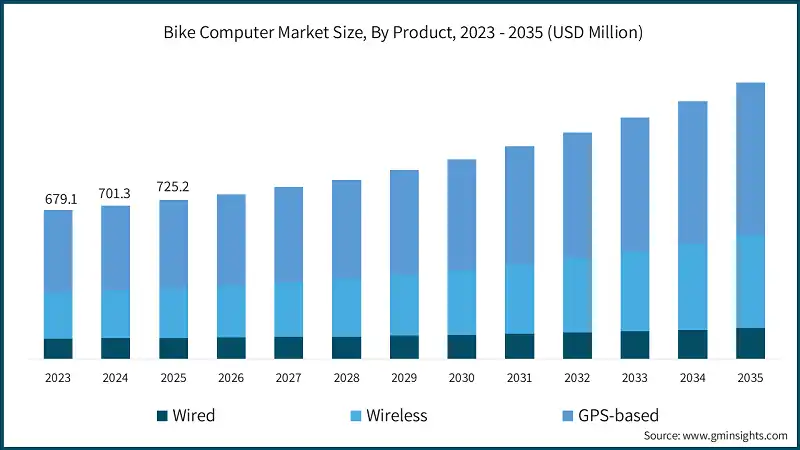
Based on product, the market is divided into wired, wireless and GPS-based. The GPS-based segment dominated the market with 55.2% share in 2024.
- These devices have transitioned from basic navigation instruments to sophisticated systems that give comprehensive cycling information. Consequently, GPS-equipped bike computers are now the choice of cyclists worldwide since they gave better navigation than other solutions such as wired or wireless ones.
- The world-wide popularity of cycling for both fitness and recreation has raised up the expectations of the cyclists in terms of getting the real-time data such as speed and distance among others. GPS gadgets have changed their role from simply showing the riders' locations to providing them with very useful and detailed information.
- GPS computers now show and record high-level information such as power output and heart rate variability, thus becoming indispensable to professional cyclists. They practically replace the need for different devices as they carry out the data collection on their own.
- GPS devices will mainly concentrate on connectivity and specialized features, particularly with the emergence of e-bikes in the future. The latest models are now capable of integrating with e-bike battery systems and displaying real-time data.
Learn more about the key segments shaping this market
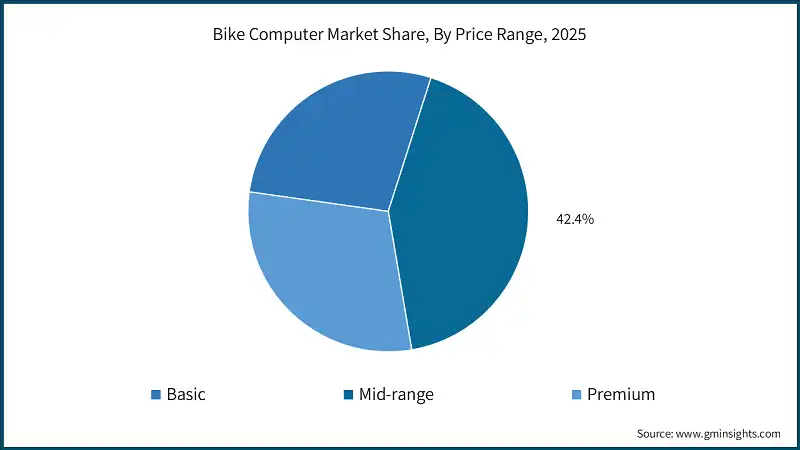
Based on price range, the market is segmented into basic, mid-range and premium. The mid-range segment substantially leads to the bike computer market with its 42.4% market share.
- Competition among bike-computer manufacturers has resulted in mid-priced bike computers with essential features that consumers need the most. As a result, the mid-range price segment has become the dominant price category, with a market value of USD 307.5 million in 2025 and expected to grow at a CAGR of 5.8% between 2026 and 2035.
- On the other hand, the premium category is attracting consumers with advanced features like AI integration, analytics, health monitoring, and battery management. With these advanced features, the price of a bike computer ranges above the mid-range category. Thus, the worldwide demand is increasing, resulting in the fastest-growing CAGR of 7.1% between 2026 and 2035.
- Manufacturers are more focused on buying behavior of consumers that helps them to build or advance their current offering by integrated features. The future of premium-priced bike computers is also supported by rising disposable income that enables buyers to shift towards the premium segment.
Looking for region specific data?
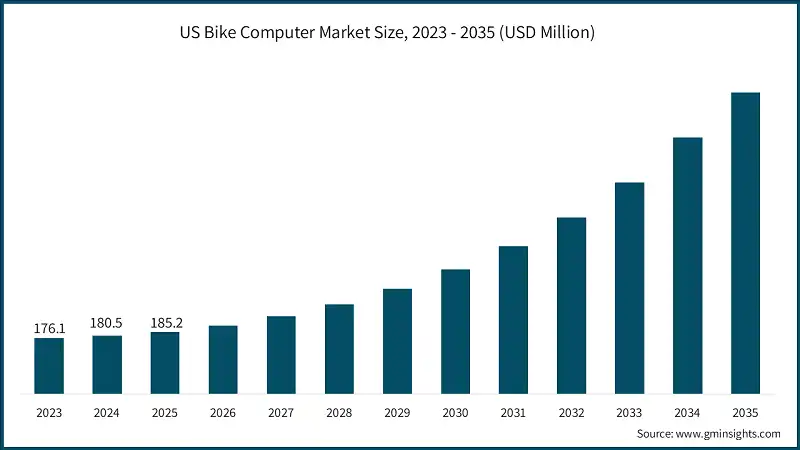
The US bike computer market reached USD 185.2 million in 2025, growing from USD 180.5 million in 2024.
- The growth of the connected technology and the rising bicycle user population are the two major factors, which together, boost the U.S. market. Every year, 15 to 20 million bicycles are sold in the U.S., creating a big and constantly renewing market for accessories like bike computers.
- Garmin is one of the major companies in the U.S. that is constantly innovating and setting the trend with its new technologies. The Edge 550 and 850, which were announced by Garmin in September 2025, have features like smart fueling alerts and real-time weather updates, which are the latest additions in the company’s line of products.
- The market is also growing due to cycling becoming an interest not only for leisure purposes but also for serious activities and for commuting in a practical way. Power-oriented cyclists demand seamless integration with such other devices as power meters, heart rate monitors, and fitness apps, which are their tools.
The North America region is valued at USD 209.4 million in 2025 and expected to grow at the CAGR of 5% in the forecasted period between 2026 and 2035.
- The North America bike computer market is on the rise mainly because of the support of government for active transportation and the rapid uptake of digital fitness technologies. The United States is at the forefront of this growth due to the extremely high number of cyclists. The different types of bicycles, such as traditional, performance, or electric, all together create a huge market for tech that enhances the cycling experience.
- Government funds have allocated bike infrastructure and health promotion campaigns, amongst other things, make cycling a safer and preferred mode of transport. Such activities result in cycling being accepted as a mode of transport and a source of entertainment which in turn calls for bicycle computers to be made available for the riders.
- Governments are working to ensure cyclist safety and the high-tech bike computers are doing exactly that with their features of accident detection, emergency live tracking, and safe route guidance. This makes bike computers a must-have item for all riders regardless of their purpose commuting, leisure, or professional. The combination of high demand from these consumer segments and the vast number of bicycles in the U.S. guarantees a market that is stable and growing at the same time.
The Europe bike computer market accounted for USD 259.3 million in 2025 and is anticipated to grow at the CAGR of 6.2% in the forecast period between 2026 and 2035.
- The bike computer industry is being propelled by Europe's strong emphasis on sustainable mobility backed by regulations and policies. The European Parliament, the Council, and the Commission were the signatories to the Declaration on Cycling in 2024, thereby recognizing cycling officially as a legitimate means of transport.
- Such acknowledgment has resulted in large-scale public investments in cycling infrastructure which have, in turn, made cycling safer and more convenient.
- Moreover, the European Cyclists' Federation (ECF) is co-hosting the EuroVelo & Cycling Tourism Conference 2024, which indicates the rising acceptance of cycling in Europe's transport and tourism plans.
- This support is a driving force for the acceptance of bicycles as the primary mode of transport and, as a result, the need for high-tech products such as bike computers for navigation and performance monitoring is increasing.
- In addition, almost 14% of all people interviewed mentioned that they use cycling as one of their primary modes of transport every day. The proportion is on the rise, and this will open up a new market for modern bike computers.
Germany's market is growing quickly in Europe, with a strong CAGR of 7.3% between 2026 and 2035.
- Germany sees a growing bike computer market as a result of two major factors, a powerful cycling culture and government backing for modern mobility solutions. Approximately 39% of the population in Germany between the ages of 14 and 69 rides bicycles or peddles regularly, thus forming a need for bike computers and other similar accessories that assist in navigation and performance tracking.
- High-tech bike computers are in demand due to the rise of e-bikes, which require advanced features like battery management and connectivity.
- An essential factor is the German government's National Cycling Plan (NCP) 3.0, whose goal is to make cycling a prevalent mode of transport and raise its share of short trips to 45% by 2035. The plan emphasizes digitalization and the use of smart and connected cycling tools.
- Germany’s focus on quality and safety also helps the market. Trade associations advocate for trustworthy and long-lasting products, while tax incentives for e-bike leasing foster the use of high-quality bikes and bike computer accessories for the employees of businesses that lease them.
The Asia Pacific bike computer market accounted for USD 173.7 million in 2025, and it is anticipated to grow the fastest at a CAGR of 7.1% during the analysis timeframe.
- The market in the Asia Pacific region is estimated to be valued at USD 338.5 million by 2035, with the fastest growth rate in the global market from 2026 to 2035. Health awareness and sometimes related to the mode of transport policies are the main drivers of this growth.
- In the Asia Pacific region, government policies and urban planning are the main factors in the bike computer market's growth. Rather than letting the market develop on its own, governments are steering it towards cycling by including it in the list of sustainable and environmentally-friendly urban practices.
- Infrastructures for cycling are receiving huge investments. For example, in Taiwan, the government of Taipei City is working on the expansion of cycling networks. Taipei is planning to have a cycling network of more than 500 km. Cycling has become a major means of transportation in urban areas, with 5% of total trips being made by bicycle.
- Another significant reason for market growth is a transformation in the socio-economic scenario and an overall concern for health. The middle class is getting bigger and their incomes are increasing, and people now regard cycling not only as a means of transport but also as a lifestyle and an exercise routine.
China is estimated to grow with a CAGR of 6.8% in the projected period between 2026 and 2035, in the Asia Pacific market.
- The government policies, cultural changes, and infrastructure developments are the mainstay of the bike computer market in China. The focus on low-carbon transport and environmental sustainability by the government has resulted in a favorable situation.
- The cycling infrastructure investments make bicycles along with their smart accessories an integral part of the future urban planning. According to the China Bicycle Association, there are more than 200 million bicycles in use which means a huge and constantly increasing population of possible bike computer users.
- Moreover, the event titled the 2025 China Cycle is one such instance that promotes cycling through a healthy lifestyle, thus, enhancing the demand for performance and monitoring devices.
- The market is influenced by the geographical and economic aspects of China, particularly the upsurge of smaller towns. These towns are now regarded as new growth areas. For instance, 36% of users of e-bike sharing are in third-tier towns and 34% in fourth-tier towns. This is an indication of robust demand for basic and mid-range bike computers that can assist in navigation and provide safety during commuting.
Latin America bike computer market accounted for USD 48.7 million in 2025 and is anticipated to show lucrative growth over the forecast period.
- The shift in public policies and the changing of societal priorities are responsible for the upsurge in the bike computer industry in Latin America. Not only have the Governments helped to bring about this new age of e-mobility by giving incentives but also by building up cycling infrastructure, which in turn makes cycling a lot safer and easier, thereby encouraging the growth of cities that are both environmentally friendly and less crowded.
- Cycle computers, which give out useful data and connection, are becoming the must-have gadgets for all urban commuters as well as delivery services in the cities that are implementing smarter transportation systems.
- People's habits and lifestyles are changing, and the market is reaping the benefits of that change. Many people nowadays are opting for health and fitness as a main focus in their lives, so cycling is becoming a very common source of recreation and fitness. As a result, this demand for tracking advanced devices that monitor performance, heart rate and training data is pushed by the rise of both competitive and leisure cycling.
Brazil is estimated to grow with a CAGR of 5.9% between 2026 and 2035, in the Latin America market.
- Brazil's bike computer market is booming as a result of both the country's digital development and the increasing demand for performance cycling. The government is taking measures to boost the digital economy of Brazil by making fiber-optic and 5G networks more widely available.
- The better technology is a reason for bike computers, which have features like GPS, real-time data, and Bluetooth as well as ANT+ connection to smartphones, to be marketed. Therefore, the market is mainly attracted by the end-users of Brazil who are more and more interested in fitness and mobility tools that are connected and data-driven.
- A different major factor is the concern about individual health, fitness, and environment-friendly modes of transport in the country. Usage of bicycles as a leisure pursuit besides being an eco-friendly commuting method is gaining ground and thus the need for gadgets that render performance statistics and trustworthy routing is rising.
The Middle East and Africa accounted for USD 34.2 million in 2025 and is anticipated to show lucrative growth over the forecast period.
- The government of the Gulf Cooperation Council (GCC) countries are incorporating sustainable transportation into their economic and development plans, which in turn is fueling the growth of the MEA Bike Computer Market. Not only UAE's and Saudi Arabia's Vision 2030 Programs symbolize economic growth plans, but they also stand as pledges to "smart" and "green" cities development.
- The cycling and e-bike options being acknowledged and promoted by these governments turn the regulations and the awareness into a scenario where bike computers become necessary and not just nice to have devices. The government support assures a long-term demand for tracking, navigation, and improving the cycling experience devices as a result of funding, planning, and public awareness directly increasing them.
- As a result of the national plans, huge amounts of money were spent on cycling infrastructure and cycling was made a part of the urban development plans. Cities like Dubai, Riyadh, and other significant African cities are preparing extensive bike routes.
UAE to experience substantial growth in the Middle East and Africa bike computer market in 2025.
- The UAE is known as the country of wealth, as the country has a high per capita income that increases the buying power of the people of the country. The premium segment of the bike computer will see the potential growth in the country.
- Additionally, the government of the UAE is taking measures to promote cycling as a means of transportation. The government aims to make cycling safer and more comfortable for everyone by constructing dedicated thoroughfares and leisure bike paths. These efforts support national goals for sustainable mobility and Smart City development.
- Moreover, the citizens of the nation have now given importance to their health as one of their main concerns. As a result, more residents of the UAE are using bicycles for health reasons and to combat lifestyle-related diseases. Consequently, the need for bike computers that monitor heart rate, distance, speed, and calories consumed has grown.
Bike Computer Market Share
The top 7 companies in the bike computer industry are Garmin, Wahoo Fitness, Polar, Lezyne, COROS Wearables, Bryton and CatEye, contributing 30.7% of the market in 2025.
- Garmin is recognized for its all-encompassing line of GPS cycling computers that come equipped with high-tech mapping, sophisticated physiological metrics, and complete integration with their entire ecosystem. They have products for everyone that range from basic data tracking to the most advanced models with exhaustive navigational and training analysis features.
- Wahoo Fitness concentrates on developing bike GPS devices that are best known for their easy setup, wind tunnel optimized design, and very simple use through a smartphone app.
- COROS Wearables enters the market with GPS devices that come with an ultra-long battery life, using solar power in some of their devices. Their products are mainly for athletes and adventurers who do multi-day trips, as they combine great navigation features with a specific training platform.
- Bryton offers a range of GPS cycling computers with different levels of performance and prices. Among their products are typically large color displays with long battery life, which can provide detailed training data and route navigation that are accessible to a large audience.
- Lezyne offers rugged GPS bike computers made for their exceptional battery endurance, making them popular among bikepackers and long-distance riders. Their devices provide core navigation and performance metrics while maintaining a focus on durability and reliable hardware.
- Polar is known for its heart rate monitoring technology but has now ventured into cycling computers, and they have come up with devices that are training-oriented and provide accurate physiological data. Their products are structured to give the users guidance and keep track of their performance reliably; they frequently come with the link to external sensors.
- CatEye offers cycling computers, including wired and wireless models. The basic metrics such as speed, distance and time are the main focus of their products, and the large and clear displays for the riders who prefer the simple and basic ride data to be presented in a technology-free way are often found in their devices.
Bike Computer Market Companies
Major players operating in the bike computer industry are:
- Bryton
- CatEye
- COROS Wearables
- Garmin
- Hammerhead
- Lezyne
- Magene
- Polar
- Sigma
- Wahoo Fitness
- Garmin has a strong ecosystem that links its bicycle computers with other devices such as smartwatches, power meters, and indoor trainers. This integration provides advanced training data and detailed maps. The brand is well-known and trusted worldwide.
- Wahoo focuses on simplicity and ease of use. Its ELEMNT series is popular for its easy setup and smooth connection with KICKR trainers, creating a complete training system.
- COROS stands out with long-lasting batteries and solar charging, which are great for endurance cyclists. It is known for durable sports watches and offers training analysis without subscription fees.
- Lezyne offers reliable GPS computers at lower prices compared to premium brands. Its simple and durable designs attract casual riders who want basic navigation and tracking features.
- Hammerhead uses an Android-based system that is modern and easy to use. It provides smartphone-like features, high-quality maps, and regular updates with new features.
- Bryton offers many features and strong GPS performance at affordable prices. Its products make advanced training and navigation tools available to more cyclists, including those on a budget.
- Sigma makes simple and durable cycle computers, including wired and wireless models. These are ideal for commuters and recreational riders who need basic metrics like speed and distance.
- CatEye is known for its reliable and durable cycle computers, especially non-GPS models. Its long history, wide availability, and accurate tracking make it a trusted choice for basic ride data.
- Magene focuses on affordable accessories and computers that work well with different sensors. It provides a low-cost way to enjoy connected cycling, competing with bigger brands on price.
- Polar is known for its expertise in heart rate monitoring and training analysis. Its bike computers work well with its tracking systems, giving cyclists detailed data on effort, recovery, and fitness.
Bike Computer Market Report Attributes
| Key Takeaway | Details |
|---|---|
| Market Size & Growth | |
| Base Year | 2025 |
| Market Size in 2025 | USD 725.2 Million |
| Market Size in 2026 | USD 752.8 Million |
| Forecast Period 2026-2035 CAGR | 5.9% |
| Market Size in 2035 | USD 1.26 Billion |
| Key Market Trends | |
| Drivers | Impact |
| Global Cycling Participation Growth & Health Consciousness Trends | Surging consumer focus on fitness drives strong demand for high-end data tracking computers. |
| E-Bike Market Expansion & Integrated Display Demand | Creates a new segment for specialized computers that integrate seamlessly with e-bike systems and batteries. |
| Professional Cycling Influence & UCI WorldTour Technology Adoption | Validates premium features, encouraging recreational riders to upgrade to pro-level performance devices. |
| Smart City Infrastructure Development & Cycling Integration | Increases the commuter segments reliance on integrated computers for safe, optimized urban navigation. |
| Pitfalls & Challenges | Impact |
| Smartphone Substitution Threat & Free App Alternatives | Limits entry-level sales as casual cyclists opt for free smartphone apps, compressing market margins. |
| Theft Risk & Device Security Concerns in Urban Markets | Requires manufacturers to invest in better anti-theft security and integrated mounting solutions to mitigate risk |
| Opportunities: | Impact |
| Emerging Market Penetration | Expands the addressable user base, creating high demand for durable, localized, and budget-friendly devices. |
| E-Bike Integration & OEM Partnership Expansion | Provides significant revenue growth through exclusive partnerships to supply integrated displays for new e-bikes. |
| Gravel & Adventure Cycling Segment Expansion | Drives innovation in devices that require enhanced durability, long battery life, and superior off-road mapping |
| Smart City & Municipal Cycling Data Platform Integration | Opens up new service revenue streams by selling aggregated, anonymized cycling data to city planners |
| Market Leaders (2025) | |
| Market Leaders |
21.5% market share |
| Top Players |
Collective market share in 2024 is Collective market share in 2025 is 29.4% |
| Competitive Edge |
|
| Regional Insights | |
| Largest Market | Europe |
| Fastest Growing Market | Asia Pacific |
| Emerging Country | Mexico, India, South Korea, Vietnam, Brazil, Saudi Arabia |
| Future Outlook |
|
What are the growth opportunities in this market?
Bike Computer Industry News
- In November 2025, iGPSPORT announced a new partnership with the Groupama-FDJ cycling team. iGPSPORT will provide Groupama-FDJ with a full range of advanced cycling equipment, including the BiNavi Bike Navigator, a new-generation cycling computer, the BSC300T, an ultra-slim touchscreen cycling computer, and upgraded accessories.
- In September 2025, Garmin announced the Edge 550 and 850, which are two new cycling computers that are both advanced and compact. The new devices have been designed to last for up to 36 hours in battery-saving mode and up to 12 hours in very intense usage, thus these cycling computers will be able to be of great support to bikers on their longest rides.
- In June 2025, Garmin announced the Edge MTB, a GPS cycle computer that is tough and small in size and is specially made for mountain bikers. Edge MTB comes with colored maps, the latest enduro and downhill ride profiles. It can last up to 14 hours in power-demand conditions and up to 26 hours in energy-saving mode.
- In April 2025, Wahoo announced their new Wahoo BOLT 3 and Wahoo ROAM 3 bike computers, which essentially is moving the BOLT & ROAM-sized devices onto the ACE software and display platform.
- In March 2025, Bryton has upgraded its Rider S810 bike computer with 50 hours of battery life. This will suit lovers of ultra-distance events.
The bike computer market research report includes in-depth coverage of the industry with estimates & forecasts in terms of revenue ($ Mn/Bn) and units from 2022 to 2035, for the following segments:
Market, By Product
- Wired
- Wireless
- GPS-based
- Solar-powered
- Others
Market, By Price Range
- Basic
- Mid-range
- Premium
Market, By Sensor
- Rear Wheel Sensor
- Speed/Cadence Sensor
- Gradient Sensor
- Heart Rate Sensor
Market, By Connectivity
- Bluetooth
- Wi-Fi
- ANT+
- Others
Market, By Bike
- Mountain bike
- Road bike
- Urban bike
- E-bike
- Gravel bike
Market, By Distribution Channel
- Online
- Offline
Market, By Application
- Athletics & sports
- Fitness & commuting
- Recreational/leisure
Market, By End Use
- Individual consumers
- Bike rental/fleet operators
- Professional teams/clubs
The above information is provided for the following regions and countries:
- North America
- US
- Canada
- Europe
- Germany
- UK
- France
- Italy
- Spain
- Russia
- Nordics
- Benelux
- Asia Pacific
- China
- India
- Japan
- South Korea
- ANZ
- Singapore
- Malysia
- Indonesia
- Vietnam
- Thailand
- Latin America
- Brazil
- Mexico
- Argentina
- Colombia
- MEA
- South Africa
- Saudi Arabia
- UAE
Frequently Asked Question(FAQ) :
What is the market size of the bike computer industry in 2025?
The market size for bike computer was valued at USD 725.2 million in 2025, with a CAGR of 5.9% expected through 2035, driven by smart city infrastructure development and rising global cycling participation.
What is the current bike computer market size in 2026?
The market size is projected to reach USD 752.8 million in 2026.
What is the projected value of the bike computer market by 2035?
The bike computer industry is expected to reach USD 1.26 billion by 2035, fueled by e-bike integration, digital fitness adoption, and demand for real-time performance analytics.
How much revenue did the mid-range price segment generate in 2025?
The mid-range segment generated USD 307.5 million in 2025, leading the market with a 42.4% share.
What was the valuation of the GPS-based product segment in 2024?
The GPS-based segment held 55.2% market share in 2024, the largest in the bike computer industry.
What is the growth outlook for the premium price segment from 2026 to 2035?
Premium bike computers are projected to grow at a 7.1% CAGR through 2035. Growth is driven by AI integration, advanced analytics, and rising consumer spending on premium fitness tech.
Which region leads the bike computer market?
The U.S. dominated the North America market with USD 185.2 million revenue in 2025. Growth is driven by a strong cycling population, rapid adoption of connected fitness devices, and high penetration of e-bikes.
What are the upcoming trends in the bike computer industry?
Key trends include AI-based performance analytics, e-bike system integration, long-battery-life devices, solar-assisted GPS units, and enhanced safety features such as crash detection and emergency tracking.
Who are the key players in the bike computer market?
Major players include Garmin, Wahoo Fitness, Polar, Lezyne, COROS Wearables, Bryton, CatEye, Hammerhead, Magene, and Sigma.
Bike Computer Market Scope
Related Reports