Summary
Table of Content

Asia Pacific Veterinary Orthopedic Implants Market
Get a free sample of this report
Form submitted successfully!
Error submitting form. Please try again.
Thank you!
Your inquiry has been received. Our team will reach out to you with the required details via email. To ensure that you don't miss their response, kindly remember to check your spam folder as well!
Request Sectional Data
Thank you!
Your inquiry has been received. Our team will reach out to you with the required details via email. To ensure that you don't miss their response, kindly remember to check your spam folder as well!
Form submitted successfully!
Error submitting form. Please try again.
Asia Pacific Veterinary Orthopedic Implants Market Size
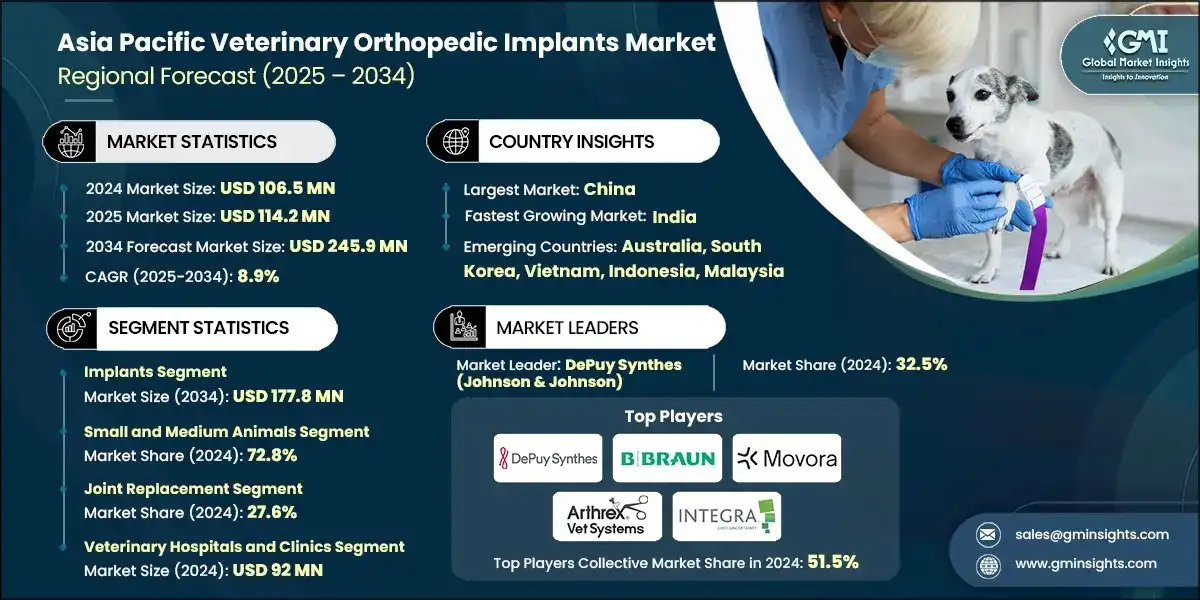
The Asia Pacific veterinary orthopedic implants market size was estimated at USD 106.5 million in 2024. The market is expected to from USD 114.2 million in 2025 to USD 245.9 million by 2034, growing at a CAGR of 8.9%, according to a latest report published by Global Market Insights Inc.
To get key market trends
The growth is spurred by a growing population of companion animals and livestock animals in the region, as well as by a growing incidence of musculoskeletal and joint disorders. Also, rapid development in veterinary infrastructure and growing disposable incomes in Asian countries such as India and China further contribute to increasing access to specialty veterinary care, thus supporting sustained market growth across the region.
According to the Food and Agriculture Organization (FAO), Asia-Pacific countries have seen a steady rise in livestock numbers, which increases the demand for veterinary care. Pet ownership is also growing rapidly. For instance, government data from Japan’s Ministry of Environment shows that as of 2023, Japan recorded around 15.9 million pets (including 7.1 million dogs and 8.9 million cats).
Similarly, as per a report published by the Chinese Pet Industry Association in 2023, over 60% of urban households now have pets, up from 48% in 2021. This cultural shift towards viewing pets as family members increases demand for advanced veterinary treatments, including orthopedic implants.
Veterinary orthopedic implants are medical devices used for correcting fractures, stabilizing joints, and assisting bone healing in animals. Such implants consist of bone plates, screws, pins, wires, and prosthetic joints customized to resist the biomechanical stresses of various species.
The Asia Pacific veterinary orthopedic implants market is influenced by the presence of major players such as DePuy Synthes (Johnson & Johnson), B. Braun VetCare, Movora (Vimian Group AB), Arthrex Vet Systems, and Integra LifeSciences. These players shape the market through innovation in implant materials and design, provision of training and surgical assistance to veterinarians, and growing distribution networks in the region.
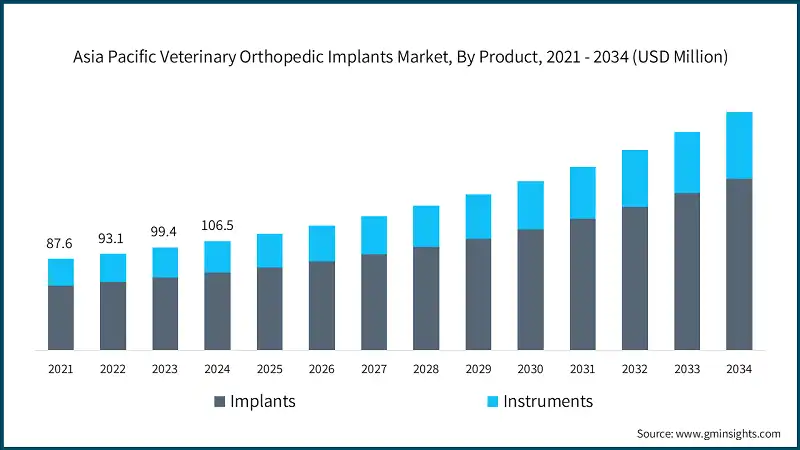
During 2021-2023, Asia Pacific veterinary orthopedic implants market witnessed steady growth, growing from USD 87.6 million to USD 99.4 million in 2023. Between 2021 and 2023, the market experienced significant growth and transformation, driven by several key trends. A key trend was the increasing adoption of pets in the region, fueled by COVID pandemic, which led to a higher demand for advanced veterinary care, including orthopedic treatments.
For example, the pet population in India has grown from 19 million in 2018 to an estimated 31 million in 2023, marking a 60% increase. Further, a UBS survey of more than 1,500 Chinese pet owners found that nearly 80% of respondents maintained or increased their pet-related consumption after the pandemic. This surge in pet ownership contributed to the market's expansion during this period.
Veterinary orthopedic implants are artificial components used in veterinary medicine to restore function to fractured bones or replace damaged joints, bones or cartilage. These implants are made of metals such as titanium or stainless steel. The implants serve to manage fractures, joint disorders, and other musculoskeletal afflictions in animals.
Asia Pacific Veterinary Orthopedic Implants Market Report Attributes
| Key Takeaway | Details |
|---|---|
| Market Size & Growth | |
| Base Year | 2024 |
| Market Size in 2024 | USD 106.5 Million |
| Market Size in 2025 | USD 114.2 Million |
| Forecast Period 2025 - 2034 CAGR | 8.9% |
| Market Size in 2034 | USD 245.9 Million |
| Key Market Trends | |
| Drivers | Impact |
| Increasing pet ownership and humanization | Rapid urbanization and rising disposable incomes in countries like China, India, and Japan have led to a surge in pet ownership. This trend is accompanied by a shift towards treating pets as family members, resulting in higher spending on advanced veterinary care. |
| Advancements in veterinary healthcare infrastructure | The expansion of veterinary clinics and hospitals, coupled with improved access to advanced surgical instruments and implants, is accelerating market growth. Investments by global veterinary companies and local manufacturers in emerging economies further enhanced affordability and accessibility. |
| Rising incidence of pet obesity and joint disorders | The increasing prevalence of obesity and arthritis among pets is driving demand for orthopedic implants. These conditions often lead to fractures and other bone and joint issues, necessitating surgical interventions. |
| Growth of pet insurance | The increasing adoption of pet insurance policies that cover medical treatments significantly reduces the financial burden of expensive orthopedic surgeries. This increased affordability is likely to drive the demand for advanced surgical treatments, including orthopedic implants. |
| Pitfalls & Challenges | Impact |
| Lack of trained veterinary professionals | In underdeveloped and developing countries, there is a shortage of trained veterinary professionals capable of performing complex orthopedic surgeries. This limitation hinders the adoption and success of advanced orthopedic treatments. |
| Risk of infections and implant failure | Surgical procedures involving orthopedic implants carry a risk of infections, which can lead to implant failure and further health issues for the animal. This concern may deter some pet owners from opting for surgical interventions. |
| Price sensitivity among pet owners | Despite the growing willingness to invest in pet health, many pet owners remain price-sensitive, especially in emerging economies. This sensitivity may limit the demand for high-end orthopedic implants and influence purchasing decisions. |
| Opportunities: | Impact |
| Adoption of 3D printing technology | The development of advanced materials and technologies, such as 3D printing and bioresorbable materials, is paving the way for personalized and more effective treatments. These advancements improve the efficacy of surgical procedures and reduce the risk of complications. |
| Expansion of veterinary education and training | Investing in veterinary education and training programs can address the shortage of skilled professionals. Enhanced training will improve the quality of orthopedic surgeries and increase the adoption of advanced treatments. |
| Market Leaders (2024) | |
| Market Leaders |
32.5% market share. |
| Top Players |
Collective market share in 2024 is 51.5% |
| Competitive Edge |
|
| Regional Insights | |
| Largest Market | China |
| Fastest Growing Market | India |
| Emerging Country | Australia, South Korea, Vietnam, Indonesia, Malaysia |
| Future Outlook |
|
What are the growth opportunities in this market?
Asia Pacific Veterinary Orthopedic Implants Market Trends
- A notable trend in the Asia Pacific veterinary orthopedic implants industry is increasing demand for sophisticated fixation systems, including locking plates and intramedullary nails. These products provide increased stability, minimize risks for complications, and facilitate quicker recovery than conventional implants.
- As veterinary practitioners deal with more complex fractures and joint injuries, hospitals and clinics are switching to these superior solutions, thereby supporting higher product adoption in the region.
- Additionally, the market is witnessing rapid growth due to the increasing incidence of bone fractures, ligament injuries, and joint diseases in pets.
- For example, osteoarthritis (OA) is the most common joint disorder in animals, affecting about 20% of pet dogs and 60% of cats, with the prevalence increasing with age in both species. Veterinary implants are used to treat or manage osteoarthritis (OA) in animals, with total joint replacement (TJR) for hips and elbows being a common option to alleviate pain and improve function. Thus, with the rise in the prevalence of such disorders, the demand for veterinary implants is anticipated to rise over the analysis period.
- Also, the rise of minimally invasive surgical techniques is also reshaping the market. Veterinarians are adopting implants compatible with smaller incisions, arthroscopic procedures, and faster post-operative recovery. This approach reduces animal discomfort and speeds up rehabilitation, making it more attractive to pet owners.
- The availability of implants specifically designed for minimally invasive use is therefore driving higher acceptance and supporting market expansion.
Asia Pacific Veterinary Orthopedic Implants Market Analysis
Learn more about the key segments shaping this market
Based on the product, the Asia Pacific veterinary orthopedic implants market is divided into implants and instruments. The implants segment is further sub-segmented into plates, joint implants, bone screws and anchors, pins and wires, and other implants. The implants segment dominated the market in 2024 with USD 75.9 million and is poised to capture a market size of USD 177.8 million by 2034. On the other hand, the instruments segment accounted for a share of 28.8% and was valued at USD 30.6 million in 2024 and is poised to witness growth over the coming years.
- High demand for veterinary implants is attributed to the increasing population of pets and rising awareness of sophisticated orthopedic implants. The surge in pet ownership, especially the growing population of pet dogs, is anticipated to propel the growth of the veterinary orthopedic implants market in the projected years.
- In addition, the growing incidence of orthopedic disorders in animals, such as fractures, hip dysplasia, CCL injuries, and osteoarthritis is further accelerating growth in the market.
- For example, osteoarthritis (OA) is the most common degenerative joint disease in dogs affecting up to 20% of the adult canine population.
- Lastly, the growing demand for total joint replacement (TJR) implants, with a specific focus on hip and knee replacements for older pets, further contributes to segmental growth.
Learn more about the key segments shaping this market
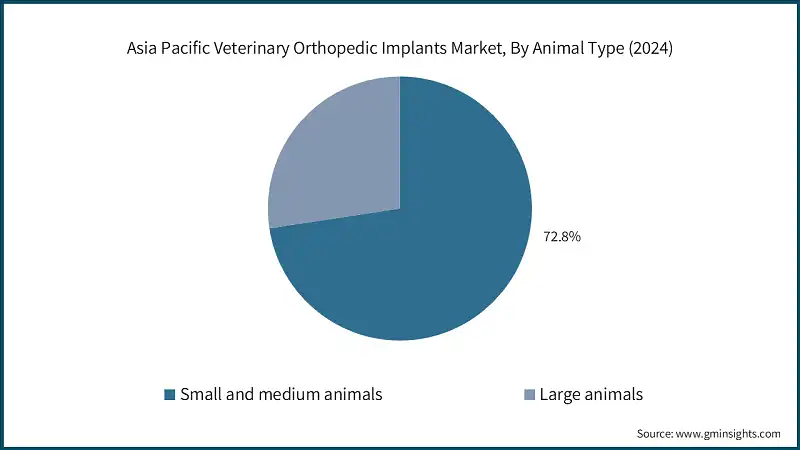
Based on animal type, the Asia Pacific veterinary orthopedic implants market is categorized into small and medium animals and large animals. The small and medium animals’ segment is further categorized into dogs, cats, and other small and medium animals. The small and medium animals segment dominated the market in 2024 with a market share of 72.8%.
- Small and medium animals such as dogs and cats account for a significant population among pets in the region.
- For instance, the population of pet dogs in Asia is about 110 million, out of which there are about 30 million in China. Cat ownership is also popular in China, where there are 53,100,000 cats.
- Thus, the region’s high rate of pet ownership and the growing tendency of owners to seek specialized treatment for joint disorders, fractures, and ligament injuries in their companion animals drives the segmental growth.
- Veterinary practices and referral hospitals are also more focused on canine and feline orthopedics, where procedures like fracture fixation and cruciate ligament repair are common.
- As a result, implant manufacturers design and market most of their product ranges around small-animal needs, which further strengthens this segment’s leading position in the market.
- The large animal’s segment, on the other hand, accounted for a share of 27.2% in the Asia Pacific veterinary orthopedic implants market.
- Livestock animals such as pigs, sheep, and goats play a crucial role in agriculture and the economy. The increasing demand for meat, dairy, and wool products has led to intensified livestock farming practices. This intensification can result in a higher incidence of orthopedic issues due to factors such as confined spaces and rapid growth rates, thereby driving the need for veterinary orthopedic interventions.
Based on the application, the Asia Pacific veterinary orthopedic implants market is categorized into Tibial Plateau Leveling Osteotomy (TPLO), Tibial Tuberosity Advancement (TTA), joint replacement, trauma, and other applications. The joint replacement segment is further sub-categorized into hip replacement, knee replacement, elbow replacement, and ankle replacement. The joint replacement segment held a share of 27.6% in 2024 and is poised to grow at considerable rate of 9.5% during the forecast year.
- The joint replacement segment holds a substantial share of the Asia Pacific veterinary orthopedic implants market, driven primarily by a rising incidence of joint disorders such as hip dysplasia and ligament injuries among companion animals, especially dogs.
- Technological advancements in implant materials and minimally invasive surgical techniques have further boost the adoption of these treatments in the region.
- Additionally, expanding veterinary infrastructure and higher disposable incomes in key markets like China, India, and Japan support the growth of this segment.
- On the other hand, the trauma segment is anticipated to witness high growth at a CAGR of 9.1% over the forecast period, driven by the increasing prevalence of fractures, dislocations, and musculoskeletal injuries in companion and livestock animals.
- Veterinary trauma cases often result from accidents, falls, or sports-related injuries, necessitating surgical interventions using specialized implants. These implants, including plates, screws, pins, and external fixators, play a critical role in stabilizing fractured bones, promoting healing, and restoring mobility.
Based on the end use, the Asia Pacific veterinary orthopedic implants market is categorized into veterinary hospitals and clinics and other end users. The veterinary hospitals and clinics segment accounted for revenue of USD 92 million in 2024 and is anticipated to grow at a CAGR of 9.1% over the analysis period.
- Veterinary hospitals and clinics serve as the primary channel for diagnosing, treating, and performing surgical interventions for musculoskeletal disorders in animals. These facilities are equipped with advanced diagnostic imaging technologies, surgical suites, and skilled veterinary surgeons, making them central to the adoption of orthopedic implants.
- The presence of specialized veterinary surgeons and access to advanced implant technologies improve surgical success rates and post-operative recovery, further contributing to the segment’s growth.
- Furthermore, the continuous increase in the number of veterinary clinics, hospitals, and professionals is significantly driving the expansion of the veterinary hospitals and clinics segment within the market.
Looking for region specific data?
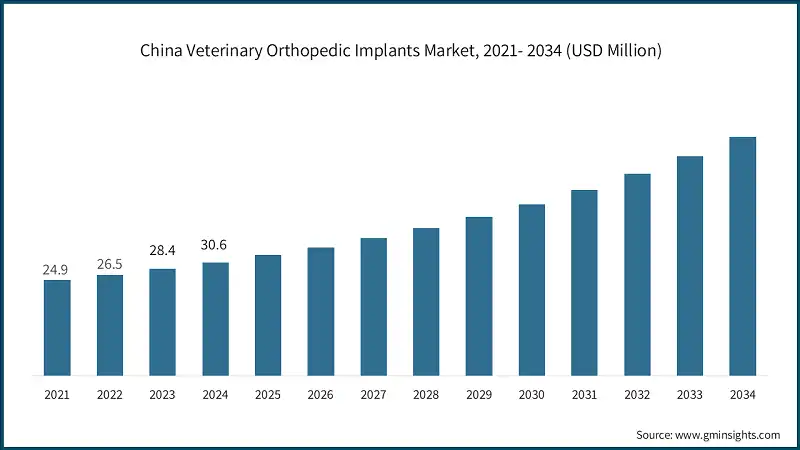
China veterinary orthopedic implants market was valued at USD 24.9 million and USD 26.5 million in 2021 and 2022, respectively. The market size reached USD 30.6 million in 2024, growing from USD 28.4 million in 2023.
- China commands a significant share of the Asia Pacific veterinary orthopedic implants industry, driven by a combination of economic, demographic, and healthcare infrastructure factors.
- The country's growing middle class and increasing disposable incomes have led to higher pet ownership rates and a greater willingness among pet owners to invest in advanced veterinary care, including orthopedic procedures. According to Statista, China’s cat and dog population exceeded 121.55 million in 2023.
- Additionally, China's expanding veterinary infrastructure and the adoption of Western veterinary practices have facilitated the availability and utilization of specialized orthopedic treatments for animals.
- The government's support for the pet industry and the presence of local manufacturing capabilities further bolster China's position in the regional market.
India is witnessing robust growth in the Asia Pacific veterinary orthopedic implants market and is anticipated to grow at a CAGR of 9.6% between 2025 and 2034.
- Increasing pet population and growing trend of humanization of pets are key factors driving market growth.
- For example, according to Statista, the number of households with pet dogs and cats in India accounted for approximately 23 million and 1.7 million respectively in 2023.
- Furthermore, rapidly developing networks of veterinary clinics and hospitals with modern surgery facilities creates a robust environment for the adoption of orthopedic implants.
Japan was valued at USD 24.2 million in 2024 in the Asia Pacific veterinary orthopedic implants market.
- Japan is a key market in Asia Pacific for veterinary orthopedic implants, supported by its well-developed veterinary healthcare infrastructure and strong adoption of medical technology.
- Its aging pet population has increased the prevalence of orthopedic diseases and hence demand for joint replacement and other implant-based treatments.
- Premium care is the priority among Japanese pet owners, supporting growth in this niche segment.
- In addition, continuous advancement in implant design and surgical method enhances Japan's market share. Coupled with rising pet ownership and growing concern about animal health, these considerations ensure Japan continues to be an important contributor in the market.
Asia Pacific Veterinary Orthopedic Implants Market Share
The Asia Pacific veterinary orthopedic implants industry is witnessing substantial growth, fueled by the increasing prevalence of orthopedic conditions in companion and farm animals, a surge in pet ownership, and the rising demand for advanced surgical procedures. This market encompasses leading global healthcare companies, medical device manufacturers, and veterinary-focused firms delivering innovative orthopedic solutions.
The top 5 market players in the Asia Pacific veterinary orthopedic implants market, including DePuy Synthes (Johnson & Johnson), B. Braun VetCare, Movora (Vimian Group AB), Arthrex Vet Systems, and Integra LifeSciences, account for 51.5% of the market. These industry players undertake strategic initiatives, such as product launches and approvals, assisting them in sustaining market competition.
Further, technological advancements such as 3D printing, customized implant design, and minimally invasive surgical techniques are revolutionizing veterinary orthopedics. Additionally, growing veterinary infrastructure, strategic collaborations with veterinary hospitals, and investments in research and development are driving market expansion. The focus on sustainability, affordability, and enhanced implant biocompatibility ensures continued innovation to meet the evolving needs of veterinary surgeons and animal healthcare providers.
Asia Pacific Veterinary Orthopedic Implants Market Companies
Few of the prominent players operating in the Asia Pacific veterinary orthopedic implants industry include:
- AmerisourceBergen Corporation (Cencora, Inc.)
- Arthrex Vet Systems
- Auxein Medical
- B. Braun
- BlueSAO
- DePuy Synthes (Johnson & Johnson)
- Fusion Implants
- GerVetUSA
- GPC Medical Ltd.
- Integra LifeSciences
- Movora (Vimian Group)
- Narang Medical Limited
- Ortho Max
- Orthomed
- Rita Leibinger
- Veterinary Instrumentation
DePuy Synthes, a subsidiary of Johnson & Johnson, is a key player in the Asia Pacific veterinary orthopedic implants market, accounting for ~32.5% of the market share. The company offers a wide range of implants and instruments designed to address fractures, joint issues, and musculoskeletal conditions in companion animals. Strategic partnerships with veterinary hospitals and continued investments in R&D solidify its leadership position, supporting the development of next-generation implants tailored to veterinary needs.
Movora, a subsidiary of Vimian Group AB, operates exclusively within the veterinary orthopedic implants market, offering a dedicated range of implants and surgical instruments. The company focuses on developing innovative orthopedic solutions, including advanced joint replacement systems, plates, and fixation devices tailored specifically for companion animals. Movora invests heavily in research, ensuring product quality, durability, and surgical precision.
B. Braun VetCare holds a strong position in the Asia Pacific veterinary orthopedic implants market by offering a wide range of high-quality plates, screws, and surgical instruments tailored for small and medium-sized animals. The company’s focus on precision-engineered implants and comprehensive surgical kits ensure reliable outcomes, which strengthens surgeon preference.
Asia Pacific Veterinary Orthopedic Implants Industry News:
- In June 2024, Movora collaborated with Viticus Group to expand veterinary orthopedic education. The partnership focuses on advanced fracture repair techniques, providing hands-on training at the Movora Education Center, strengthening expertise in the veterinary orthopedic implants market.
- In December 2021, DePuy Synthes acquired Israeli-based OrthoSpin, which develops automated strut systems used in bone deformity correction. This acquisition strengthens DePuy Synthes' orthopedic and veterinary orthopedic implant offerings with advanced, digitally enabled fixation solutions.
The Asia Pacific veterinary orthopedic implants market research report includes in-depth coverage of the industry with estimates and forecast in terms of revenue in USD Million from 2021 – 2034 for the following segments:
Market, By Product
- Implants
- Plates
- TPLO plates
- TTA plates
- Trauma plates
- Specialty plates
- Other plates
- Joint implants
- Bone screws and anchors
- Pins and wires
- Other implants
- Plates
- Instruments
Market, By Animal Type
- Small and medium animals
- Dogs
- Cats
- Other small and medium animals
- Large animals
Market, By Application
- Tibial Plateau Leveling Osteotomy (TPLO)
- Tibial Tuberosity Advancement (TTA)
- Joint replacement
- Hip replacement
- Knee replacement
- Elbow replacement
- Ankle replacement
- Trauma
- Other applications
Market, By End Use
- Veterinary hospitals and clinics
- Other end use
The above information is provided for the following countries:
- China
- Japan
- India
- Australia
- South Korea
- Singapore
- Malaysia
- Vietnam
- Thailand
- Indonesia
- Philippines
Frequently Asked Question(FAQ) :
What is the market size of the Asia Pacific veterinary orthopedic implants in 2024?
The market size was estimated at USD 106.5 million in 2024, with a CAGR of 8.9% expected through 2034. Growth is driven by the increasing population of companion and livestock animals, rising musculoskeletal disorders.
What is the projected value of the Asia Pacific veterinary orthopedic implants market by 2034?
The market is poised to reach USD 245.9 million by 2034, supported by rising disposable incomes, improved access to specialty veterinary care.
What is the expected size of the Asia Pacific veterinary orthopedic implants market in 2025?
The market size is projected to reach USD 114.2 million in 2025.
How much revenue did the implants segment generate in 2024?
The implants segment generated approximately USD 75.9 million in 2024 and is expected to grow significantly, reaching USD 177.8 million by 2034.
What was the valuation of the veterinary hospitals and clinics segment in 2024?
The veterinary hospitals and clinics segment accounted for USD 92 million in 2024 and is anticipated to expand at a CAGR of 9.1% till 2034.
What is the growth outlook for the joint replacement segment from 2024 to 2034?
The joint replacement segment held a 27.6% market share in 2024 and is set to witness over 9.5% CAGR during the forecast period.
Which country leads the Asia Pacific veterinary orthopedic implants sector?
China leads the market with a valuation of USD 30.6 million in 2024, led by economic growth, demographic factors, and advancements in healthcare infrastructure.
What are the key trends in the Asia Pacific veterinary orthopedic implants market?
Key trends include rising demand for advanced fixation systems, growing joint disorder cases, adoption of minimally invasive surgeries, and development of specialized implants.
Who are the key players in the Asia Pacific veterinary orthopedic implants industry?
Prominent players include AmerisourceBergen Corporation (Cencora, Inc.), Arthrex Vet Systems, Auxein Medical, B. Braun, BlueSAO, DePuy Synthes (Johnson & Johnson), Fusion Implants, GerVetUSA, GPC Medical Ltd., Integra LifeSciences, and Ortho Max.
Asia Pacific Veterinary Orthopedic Implants Market Scope
Related Reports