Summary
Table of Content

Asia Pacific Household Paper Market
Get a free sample of this report
Form submitted successfully!
Error submitting form. Please try again.
Thank you!
Your inquiry has been received. Our team will reach out to you with the required details via email. To ensure that you don't miss their response, kindly remember to check your spam folder as well!
Request Sectional Data
Thank you!
Your inquiry has been received. Our team will reach out to you with the required details via email. To ensure that you don't miss their response, kindly remember to check your spam folder as well!
Form submitted successfully!
Error submitting form. Please try again.
Asia Pacific Household Paper Market Size
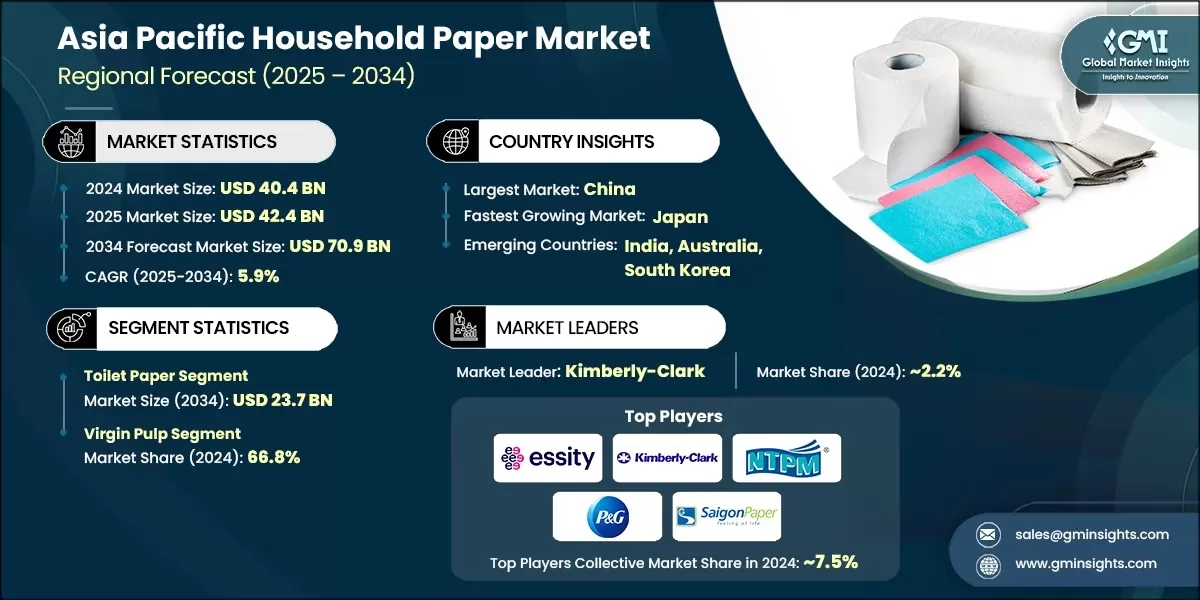
The Asia Pacific household paper market size was estimated at USD 40.4 billion in 2024. The market is expected to grow from USD 42.4 billion in 2025 to USD 70.9 billion in 2034 at a CAGR of 5.9%, according to latest report published by Global Market Insights Inc.
Asia Pacific Household Paper Market Key Takeaways
Market Size & Growth
- 2024 Market Size: USD 40.4 billion
- 2025 Market Size: USD 42.4 billion
- 2034 Forecast Market Size: USD 70.9 billion
- CAGR (2025–2034): 5.9%
Regional Dominance
- Largest Market: China
- Fastest Growing Country: Japan
Key Market Drivers
- Rising urbanization, increasing disposable incomes.
- Growing focus on health and hygiene standards.
- Technological advancements and product innovations.
Challenges
- Environmental concerns and regulations.
- Fluctuating raw material prices.
Opportunity
- Expansion of eco-friendly and sustainable product lines.
- Penetration into rural and tier-2/tier-3 cities.
Key Players
- Market Leader: Kimberly-ClarkEssity led with over 2.2% market share in 2024.
- Leading Players: Top 5 players in this market include Essity, Kimberly-Clark, NTPM HOLDINGS BERHAD, Procter & Gamble, Saigon Paper Corporation, which collectively held a market share of 7.5% in 2024.
Get Market Insights & Growth Opportunities
With a population exceeding 4.3 billion and rapid economic transformations, the Asia Pacific market stands as the world's largest and most dynamic regional market, as highlighted by the Asian Development Bank. China has solidified its position as the world's leading tissue consumer, commanding a 22.4% share of global consumption, while the broader Asia Far East region contributed an additional 6.2%, according to TAPPI. The market's vastness is underscored by notable consolidation activities, totaling over USD 6.7 billion in major transactions since late 2023. Such consolidations not only signify the market's maturity in developed segments but also underscore the strategic importance of harnessing growth in the region's emerging markets.
China is leading the charge in capacity expansion, adding around 1.36 million tonnes of household paper capacity in 2024, marking a 10% year-over-year growth, as noted by SunSirs. Southeast Asia is also witnessing strategic investments, exemplified by Nine Dragons Paper's establishment of a 600,000 tonnes/year facility in Malaysia, catering to a regional demand growth of about 4% annually, as reported by Nikkei Asia. Vietnam's paper packaging market is on an upward trajectory, projected to hit USD 3.5 billion by 2026, boasting a CAGR of 9.73%, more than double the global average of 4.7%. This surge is fueled by a shift from plastic to eco-friendly paper packaging and a booming e-commerce sector, as highlighted by Phu Vinh Phuc Paper. Supporting this growth, McKinsey's analysis predicts Asia Pacific will represent 61% of global online retail by 2025, amplifying the demand for packaging materials and household paper products, as noted by the Asian Development Bank.
Demographic trends are a cornerstone of the market's expansion. Over the next 25 years, Asia Pacific's urban population is set to swell to over 2.6 billion, adding around 44 million urban residents annually, according to the Asian Development Bank. This urbanization, paired with shrinking household sizes (from ~4.8 to <3.5 members) and rising per-capita incomes, is fueling a heightened demand for packaged household paper products.
Concurrently, the region grapples with a rapidly aging population. Projections indicate the elderly demographic (65+) will surge by 314%, from 206.8 million in 2000 to 857 million by 2050. This demographic shift is spurring demand for specialized household paper products, such as incontinence items and healthcare disposables, as noted by East-West Center. Furthermore, McKinsey research underscores that Asia's burgeoning consuming class, estimated at 3 billion by 2030, is steering premiumization trends, with a willingness to pay more for sustainable and high-quality household paper products.
Distribution channels in the market are undergoing significant transformation, with e-commerce gaining rapid traction across the region. Behavioral shifts post pandemic have shown resilience, evidenced by a 47% surge in online sales for toilet paper and a 34% rise for paper towels in key markets. At the same time, at-home consumption patterns have remained elevated. This digital evolution is reshaping product demands, emphasizing the need for ship-ready packaging and optimized sizes for e-commerce. The grocery retail landscape in the region presents a mixed bag, some markets report larger basket sizes but fewer shopping trips, while others note more frequent visits with smaller baskets. This variability underscores the necessity for flexible pack-size strategies among household paper manufacturers. Additionally, private label penetration is on the rise across various markets, with promotions accounting for about 29% of purchases in modern trade channels. This trend signals intensifying price competition and underscores the importance of value positioning strategies.
Sustainability and circular economic initiatives are increasingly shaping the market's trajectory. Asia Pulp & Paper has pledged an annual commitment of USD 30 million for forest restoration. Meanwhile, Japan's innovative approach to developing toilet paper from recycled diapers showcases the region's forefront position in sustainable product evolution, as reported by Business Times.
Over the forecasted period, the market is poised for robust growth, bolstered by urbanization, rising incomes, an aging populace, and e-commerce expansion. However, it also faces challenges from sustainability regulations and circular economy mandates. China's policy shifts in the recovered paper market are redirecting flows towards Southeast Asia and India, fostering more diversified and resilient supply chains, as noted by Rabobank.
Moreover, digital optimization technologies present an opportunity for a 5-17% boost in EBITDA through process digitalization and automation, giving technologically advanced manufacturers a competitive edge. Given these converging trends, the Asia Pacific market is set to remain a global growth powerhouse, with prime opportunities in premium products, sustainable innovations, and digitally driven distribution channels spanning both established and emerging markets.
To get key market trends
Asia Pacific Household Paper Market Trends
The Asia Pacific market is experiencing significant consolidation, with major transactions totaling over USD 6.7 billion since late 2023. Indonesian tycoon Sukanto Tanoto's USD 3.3 billion acquisition of Vinda International Holdings in December 2023 consolidated control over one of Asia's largest tissue manufacturers, which operates 13 production bases and generates 83% of sales from tissue products. This was followed by the USD 3.4 billion Suzano-Kimberly Clark joint venture announced in June 2025, creating a global tissue company with 22 manufacturing facilities across 14 countries, including Southeast Asia, and combined capacity of approximately 1 million tonnes annually. Additionally, Vinda's integration into Royal Golden Eagle (RGE) in 2024 created vertical integration spanning plantation, pulp, and end products, strengthening supply chain control across the region.
The region is witnessing substantial capacity additions, with China alone adding approximately 1.36 million tonnes of household paper capacity in 2024, representing 10% year-over-year growth in finished-paper capacity. Nine Dragons Paper completed a 600,000 tonnes/year base paper factory in Malaysia, targeting Southeast Asian demand growth of approximately 4% annually. However, this expansion occurs alongside significant supply chain disruptions, as China's paper consumption declined in 2022 for the first time in four years, with excess supply flowing into other Asian markets and creating regional oversupply pressures.
The market is experiencing a fundamental shift toward sustainable practices and circular economy models, driven by both regulatory pressure and consumer demand. Vietnam's paper packaging sector exemplifies this trend, with the market projected to reach USD 3.5 billion by 2026 at a 9.73% annual growth rate more than double the global average of 4.7%, primarily driven by the transition from plastic to eco-friendly paper packaging. Innovation in recycling is accelerating, with Japan developing toilet paper from recycled disposable diapers in January 2025, and Unicharm's RefF horizontal recycling system winning the Sustainable Japan Award 2025 for creating the world's first practical diaper recycling system. Asia Pulp & Paper's commitment of USD 30 million annually for forest restoration further demonstrates the industry's sustainability focus, with recovered paper markets restructuring as China's policy changes redirect flows toward Southeast Asia and India, creating more diversified fiber supply chains.
Asia Pacific Household Paper Market Analysis

Learn more about the key segments shaping this market
Based on the product type, the market is segmented into toilet paper, wet wipes, paper towels and kitchen rolls, facial tissues, and others. The toilet paper segment was valued at USD 15 billion in 2024 and is projected to reach USD 23.7 billion by 2034.
- The toilet paper segment has emerged as the largest category of the global household paper category due to its necessity and level of acceptance to consumers.
- It is a convenience product, with hygienic attributes, and changes in the segment's consumer demand towards soft, scent-friendly, and premium toilet paper have driven its position.
- Evidence suggests urbanization and rising disposable incomes have similarly created toilet paper as a staple in residences across developed and developing regions.
Learn more about the key segments shaping this market
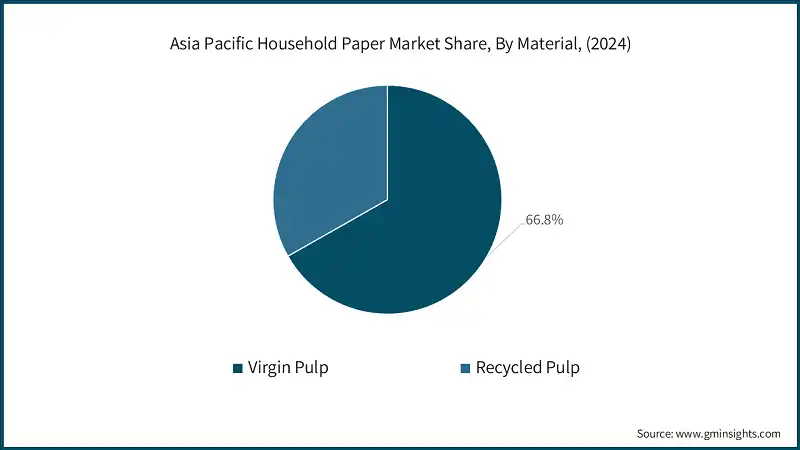
The household paper market by material is segmented into virgin pulp and recycled pulp. The virgin pulp segment was the leading segment in this market in 2024 with a revenue of USD 27 billion and has a market share of around 66.8%.
- Virgin pulp continues to dominate the Asia Pacific retail household paper segment due to its superior softness, strength, and perceived premium quality. Consumers in countries like Japan, South Korea, and Australia associate virgin pulp products with reliability and comfort, supported by a steady regional supply of high-grade pulp from domestic and imported sources.
- Environmental concerns and the rise of recycled alternatives are challenging virgin pulp’s dominance, especially in markets like China and India where sustainability awareness is growing. However, virgin pulp pricing remains volatile due to fluctuations in global pulp supply chains, forestry regulations, and environmental policies, making cost management a key issue for manufacturers.
- Manufacturers in Asia Pacific are balancing premium positioning with sustainability goals, exploring responsible sourcing and hybrid pulp blends to appeal to eco-conscious consumers. While virgin pulp products still command higher retail prices, companies are increasingly aligning product development with environmental standards to maintain competitiveness and brand trust.
Looking for region specific data?
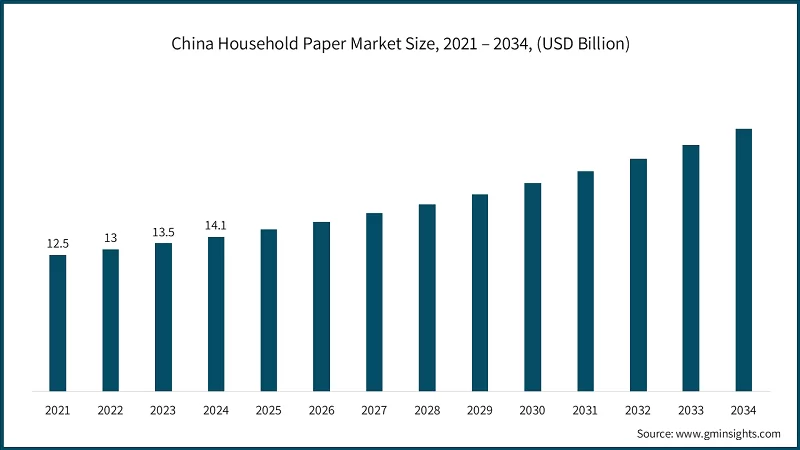
The Asia Pacific household paper market shows diverse dynamics across countries, shaped by economic development, consumer behavior, and sustainability trends. The China household paper market was valued at around USD 14.1 billion in 2024 and is anticipated to register a CAGR of 5.5% between 2025 and 2034.
- In China, the market is driven by urbanization and rising hygiene awareness, with strong demand for toilet paper and facial tissues. Local giants like Vinda dominate, though international players like Essity and Kimberly-Clark are active. The government’s push for environmental sustainability is also encouraging growth in recycled and bamboo-based products.
- In Japan and South Korea, the market is mature and highly saturated, with consumers favouring premium and ultra-soft products. Innovation and packaging aesthetics play a key role in consumer choice. Japanese brands like Daio Paper and South Korean firms such as Yuhan-Kimberly lead the market. Flushable wipes and eco-friendly tissues are gaining traction due to strong environmental consciousness and aging populations requiring personal care products.
- India, Indonesia, and Vietnam represent high-growth markets due to expanding middle-class populations and increasing hygiene awareness. In India, affordability and rural penetration are key challenges, with local brands competing against global players. Indonesia and Vietnam are seeing rising demand for baby wipes and kitchen rolls, driven by urbanization and changing lifestyles. Government initiatives promoting sanitation also support market expansion.
- In Australia and Malaysia, the market is stable but evolving toward sustainability. Australian consumers are increasingly opting for recycled and bamboo toilet paper, while Malaysia is seeing growth in household cleaning wipes and personal care products. E-commerce is a growing channel in both countries, offering convenience and access to a wider range of household paper products.
Asia Pacific Household Paper Market Share
- The top 5 companies in the household paper market, such as Essity, Kimberly-Clark, NTPM HOLDINGS BERHAD, Procter & Gamble, and Saigon Paper Corporation, hold a market share of 7.5%.
- Essity has reinforced its market position by focusing on sustainability-driven innovation and digital expansion. The company is actively launching eco-friendly tissue products and investing in recycled fiber technologies to meet rising consumer demand for green alternatives. Additionally, Essity is leveraging e-commerce platforms and mobile apps to expand its digital footprint, particularly in urban Asia Pacific markets where online shopping is surging. This dual focus on sustainability and digital accessibility allows Essity to differentiate its offerings and maintain resilience against price-based competition.
- Kimberly-Clark is navigating competitive pressures through strategic divestments and global partnerships, such as its USD 3.4 billion joint venture with Suzano. The company continues to invest in brand equity for household names like Kleenex and Scott, while expanding into emerging Asia Pacific markets with localized product lines. Its emphasis on supply chain optimization and sustainable sourcing further strengthens its cost efficiency and ESG credentials, helping it retain consumer trust and regulatory favor in a region increasingly focused on environmental compliance.
- NTPM is countering competition by expanding its distribution network across Malaysia, Thailand, and Vietnam, and diversifying its product portfolio to include personal care items. The company is also investing in eco-friendly manufacturing processes and promoting recycled-grade tissue products to align with shifting consumer preferences. With 50% unused production capacity, NTPM is well-positioned to scale operations quickly, enabling it to respond to demand spikes and explore export opportunities, particularly in Southeast Asia.
Asia Pacific Household Paper Market Companies
Major players operating in the Asia Pacific household paper industry are:
- Asia Pulp & Paper
- Eco Wipes Viet Nam Corporation
- Essity
- Gold Hongye
- Green Vietnam Paper
- Hengan International Group
- Kimberly-Clark
- Nano Tissue
- Nippon Paper Industries
- NTPM HOLDINGS BERHAD
- Procter & Gamble
- PT Sun Paper
- Saigon Paper Corporation
- Vinda International Holdings
- Xuan Mai Paper Co Ltd
P&G’s strategy hinges on product superiority and constructive disruption across its value chain. By continuously innovating in product performance, packaging, and retail execution, P&G ensures its household paper brands remain top-of-mind for consumers. The company also emphasizes agile organizational structures and digital transformation, allowing it to adapt swiftly to market changes. Its balanced approach to top- and bottom-line growth, coupled with strong brand loyalty, enables P&G to withstand competitive pressures and maintain leadership in both mature and emerging Asia Pacific markets.
Saigon Paper is leveraging brand partnerships notably with Disney to launch collectible and premium tissue products that appeal to younger demographics. The company has also expanded its production capacity and is actively growing its export footprint across Asia, Europe, and the Americas. With rising tissue consumption in Vietnam and a focus on rural market penetration, Saigon Paper is capitalizing on domestic growth while maintaining a competitive edge through product quality and sustainability initiatives, including recycled content and low-carbon manufacturing.
Asia Pacific Household Paper Market Report Attributes
| Key Takeaway | Details |
|---|---|
| Market Size & Growth | |
| Base Year | 2024 |
| Market Size in 2024 | USD 40.4 billion |
| Market Size in 2025 | USD 42.4 billion |
| Forecast Period 2025 - 2034 CAGR | 5.9% |
| Market Size in 2034 | USD 70.9 billion |
| Key Market Trends | |
| Drivers | Impact |
| Rising urbanization, increasing disposable incomes | Rising urbanization and increasing disposable incomes are expanding the consumer base for premium household paper products, especially in emerging economies. |
| Growing focus on health and hygiene standards | Growing focus on health and hygiene standards is driving consistent demand for tissue and sanitary paper, reinforcing the market’s resilience across both developed and developing regions. |
| Technological advancements and product innovations | Technological advancements and product innovations are enabling companies to differentiate through softness, strength, and sustainability, helping them capture niche segments and improve margins. |
| Pitfalls & Challenges | Impact |
| Environmental concerns and regulations | Environmental concerns and regulations are pressuring manufacturers to shift toward sustainable practices, increasing compliance costs and limiting product flexibility. |
| Fluctuating raw material prices | Fluctuating raw material prices are causing instability in production costs and retail pricing, making it harder for companies to maintain profitability and price competitiveness. |
| Opportunities: | Impact |
| Expansion of eco-friendly and sustainable product lines | Companies that lead in eco-friendly innovation can build strong brand loyalty and premium positioning. |
| Penetration into rural and tier-2/tier-3 cities | Even small increases in per capita usage across large populations can significantly boost overall sales. |
| Market Leaders (2024) | |
| Market Leaders |
Market share of ~2.2% |
| Top Players |
Collective market share in 2024 ~7.5% |
| Competitive Edge |
|
| Regional Insights | |
| Largest Market | China |
| Fastest growing market | Japan |
| Emerging countries | India, Australia, South Korea |
| Future outlook |
|
What are the growth opportunities in this market?
Asia Pacific Household Paper Industry News
- In September 2025, P&G Japan announced the launch of its globally renowned Charmin toilet paper brand in the Japanese market, marking a strategic expansion into Asia with a focus on premium softness and sustainability. The product, developed specifically for Japanese consumers, features a unique “cushioning wave” texture for enhanced comfort and is made from responsibly sourced materials certified by the Forest Stewardship Council (FSC). This move reflects P&G’s commitment to combining product performance with environmental responsibility, aiming to capture a larger share of Japan’s high-value household paper segment.
- In August 2025, a pioneering public-private partnership in Japan launched the world’s first toilet paper made from recycled diapers, marking a significant innovation in sustainable hygiene products. Spearheaded by the municipalities of Shibushi and Osaki in Kagoshima, in collaboration with Unicharm and Poppy Paper, the initiative repurposes sterilized and processed hygiene waste including diapers, urine pads, and wet wipes into pulp for toilet paper production. Within two months, approximately 30,000 rolls branded as the “Shibushi Osaki Roll” were produced and distributed across seven stores in Kagoshima and Miyazaki, offering a novel solution to raw material shortages amid declining paper usage and demographic shifts.
- In June 2025, Suzano and Kimberly-Clark announced the formation of a USD 3.4 billion global joint venture focused on tissue products, combining Suzano’s industrial expertise with Kimberly-Clark’s brand and marketing capabilities. The new company headquartered in the Netherlands will operate across more than 70 countries, managing 22 manufacturing facilities and employing around 9,000 people. Suzano will hold a 51% stake, acquired for USD 1.734 billion in cash, while Kimberly-Clark retains 49%. The venture will oversee international brands like Kleenex, Scott, and WypAll, with an annual production capacity of 1 million tonnes and 2024 net sales of approximately USD 3.3 billion.
- In November 2024, Jackson Wijaya, a member of the influential Widjaja family, completed the acquisition of Asia Pulp & Paper (APP), one of the world’s largest pulp and paper companies, marking a strategic shift in ownership and leadership. The move consolidates Wijaya’s position in the global paper industry and is expected to drive renewed focus on sustainability, innovation, and regional expansion across Asia Pacific and beyond.
The Asia Pacific household paper market research report includes in-depth coverage of the industry, with estimates & forecasts in terms of revenue (USD Billion) and volume (Tons) from 2021 to 2034, for the following segments:
Market, By Product Type
- Toilet paper
- Standard toilet paper
- Premium/ultra-soft toilet paper
- Recycled/eco-friendly toilet paper
- Bamboo toilet paper
- Wet wipes
- Baby wipes
- Personal care wipes
- Household cleaning wipes
- Flushable wipes
- Paper towels and kitchen rolls
- Facial tissues
- Others
Market, By Material
- Virgin pulp
- Recycled pulp
Market, By Price Range
- Low
- Medium
- High
Market, By Distribution Channel
- Traditional trade
- Independent retailers
- Local distributors
- Modern Trade
- Hypermarkets and supermarkets
- Convenience stores
- Cash & carry outlets
- E-commerce
- Online marketplaces
- Direct-to-consumer platforms
The above information is provided for the following countries:
- China
- Japan
- India
- South Korea
- Australia
- Malaysia
- Indonesia
- Vietnam
- Rest of APAC
Frequently Asked Question(FAQ) :
What is the market size of the Asia Pacific household paper market in 2024?
The market size was USD 40.4 billion in 2024, driven by urbanization, rising disposable incomes, and growing health and hygiene awareness.
What is the projected value of the Asia Pacific household paper market by 2034?
The market is expected to reach USD 70.9 billion by 2034, growing at a CAGR of 5.9% during 2025–2034.
What was the market valuation in 2025?
The Asia Pacific household paper industry is estimated at USD 42.4 billion in 2025.
How much revenue did the toilet paper segment generate in 2024?
The toilet paper segment generated USD 15 billion in 2024, maintaining its dominance in household paper consumption.
What was the valuation of the virgin pulp segment in 2024?
The virgin pulp segment accounted for USD 27 billion in 2024, representing a 66.8% market share.
Which country leads the Asia Pacific household paper market?
China led the regional market with USD 14.1 billion in 2024, driven by rising hygiene awareness, strong domestic manufacturers, and government support for sustainable products.
Who are the key players in the Asia Pacific household paper market?
Major players include Essity, Kimberly-Clark, NTPM Holdings Berhad, Procter & Gamble, Saigon Paper Corporation, Vinda International Holdings, Asia Pulp & Paper, and Nippon Paper Industries.
Asia Pacific Household Paper Market Scope
Related Reports