Summary
Table of Content

Aircraft Fuel System Market
Get a free sample of this report
Form submitted successfully!
Error submitting form. Please try again.
Thank you!
Your inquiry has been received. Our team will reach out to you with the required details via email. To ensure that you don't miss their response, kindly remember to check your spam folder as well!
Request Sectional Data
Thank you!
Your inquiry has been received. Our team will reach out to you with the required details via email. To ensure that you don't miss their response, kindly remember to check your spam folder as well!
Form submitted successfully!
Error submitting form. Please try again.
Aircraft Fuel System Market Size
The growth of the aircraft fuel system market is attributed to an increase in commercial aircraft production and order backlogs from major aircraft manufacturers, an increase in global air passenger traffic that translates to airline fleet expansion and replacement of aging aircraft, military aircraft fleet modernization programs, and an increase in lightweight and advanced fuel management technology usage to improve aircraft efficiency and safety.
Aircraft Fuel System Market Key Takeaways
Market Size & Growth
- 2025 Market Size: USD 8.8 Billion
- 2026 Market Size: USD 10.2 Billion
- 2035 Forecast Market Size: USD 34.2 Billion
- CAGR (2026–2035): 14.4%
Regional Dominance
- Largest Market: North America
- Fastest Growing Region: Asia Pacific
Key Market Drivers
- Rising commercial aircraft production and backlog deliveries.
- Increasing global air passenger traffic growth.
- Military aircraft fleet modernization programs.
- Demand for lightweight fuel system components.
- Growth in long-range and wide-body aircraft demand.
Challenges
- High maintenance and system integration costs.
- Strict aviation fuel safety certification regulations.
Opportunity
- Sustainable aviation fuel compatibility systems development.
- Next-generation unmanned aerial vehicle fuel systems.
Key Players
- Market Leader: Parker-Hannifin Corporation led with over 14.6% market share in 2025.
- Leading Players: Top 5 players in this market include Parker-Hannifin Corporation, Eaton Corporation, Honeywell International Inc., Safran S.A., RTX Corporation, which collectively held a market share of 53.1% in 2025.
Get Market Insights & Growth Opportunities
The aircraft fuel system industry is driven by an increase in commercial aircraft production and significant order backlogs from major aircraft manufacturers. Increasing air travel is causing airline fleet expansion and replacement of aging aircraft, which is causing an increase in demand for advanced fuel storage, transfer, and management systems integrated into these aircraft. For example, in January 2025, Airbus stated that it had an order backlog of more than 8,600 commercial aircraft. This indicates strong long-term production commitments with large volume that is likely to ensure consistent demand for fuel pumps, valves, fuel gauging systems, and inerting systems in future generations of narrow-body and wide-body aircraft.
The aircraft fuel system market is also further increasing due to military aircraft fleet modernization programs undertaken in major defense economies of the world. Governments of these economies are investing in next-generation fighter aircraft, aerial refueling aircraft, and long-range transport aircraft that have sophisticated fuel systems. For example, the U.S. Department of Defense is continuing to increase procurement of the F-35 Lightning II program, which will total more than 2,300 aircraft among allied forces. This modernization program will continue to fuel demand for advanced fuel pumps, fuel gauging solutions, and inerting solutions that meet the requirements of advanced military aircraft.
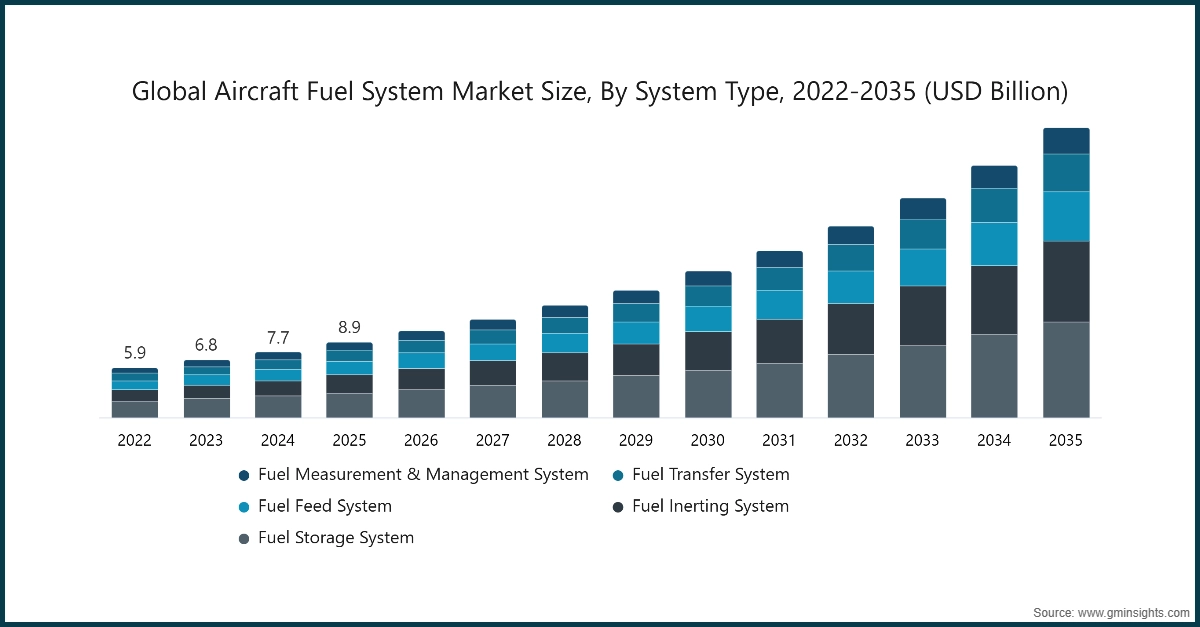
The aircraft fuel system market increased steadily from USD 5.8 billion in 2022 and reached USD 7.7 billion in 2024, supported by the recovery of global aviation activity and increasing aircraft manufacturing output. Rising passenger traffic, airline fleet renewal programs, and growing aircraft deliveries were key factors driving market growth during this period. Additional contributors included increasing defense aviation procurement and the integration of advanced fuel monitoring and safety systems in modern aircraft platforms.
The global aircraft fuel system market was valued at USD 8.8 billion in 2025. The market is expected to grow from USD 10.2 billion in 2026 to USD 34.2 billion in 2035, at a CAGR of 14.4% during the forecast period according to the latest report published by Global Market Insights Inc.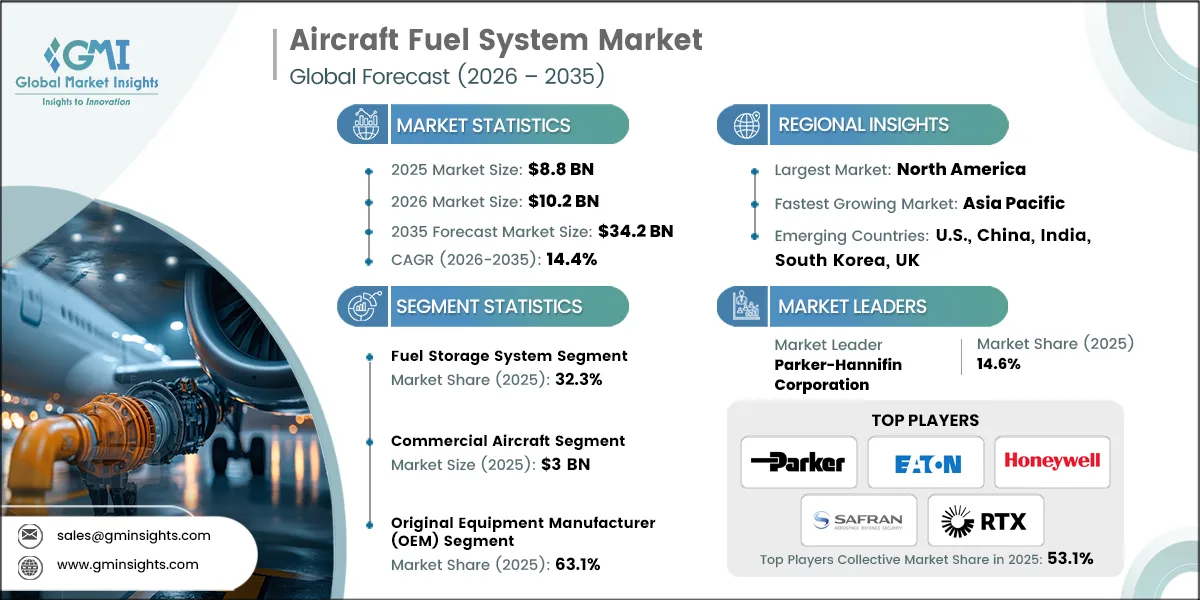
To get key market trends
Aircraft Fuel System Market Trends
- The combination of digital fuel management and health monitoring systems is changing the way aircraft fuel system operations are conducted. The use of the technology started gaining traction around 2022 as the airline and MRO industries sought to leverage the benefits of predictive maintenance to reduce the incidence of unplanned outages. This trend is likely to continue up to 2032 as the digitalization of aircraft increases. This shift enables real-time fuel system diagnostics, improving reliability, maintenance planning, and operational safety.
- The use of advanced fuel tank inerting systems is increasingly becoming an important safety trend in modern aircraft. Implementation of the technology started gaining traction around 2020 as aviation authorities sought to tighten safety requirements following past fuel tank explosions. The use of the technology is likely to continue growing through the year 2030 as aircraft manufacturers increasingly use inert gas generation systems in new aircraft.
- The development of modular and integrated fuel system architecture is transforming aircraft design and manufacturing. This concept started gaining momentum around 2021 as aircraft manufacturers were looking for quicker assembly and better maintenance access. This concept is likely to continue up to 2033 as new aircraft projects incorporate modular architecture in their fuel systems. This concept simplifies the fuel system architecture and minimizes the maintenance requirements of the aircraft.
- The growing electrification of aircraft subsystems that impact fuel system components is slowly transforming the design strategies of the fuel system. This concept started surfacing around 2023 as the development of hybrid electric aircraft and more electric aircraft progressed. This concept is likely to expand up to 2035 as new aircraft projects incorporate electric pump and control units in their fuel systems.
Aircraft Fuel System Market Analysis
Learn more about the key segments shaping this market
Based on system type, the market is divided into fuel storage systems, fuel feed systems, fuel transfer systems, fuel inerting systems, and fuel measurement & management systems.
- The fuel storage system segment led the market in 2025, holding a 32.3% share because of its important role in ensuring safe and reliable fuel supply for both commercial and military aircraft. Fuel storage systems are central to maintaining fuel integrity, preventing leaks, and enabling accurate monitoring of fuel levels. Their design and integration are essential for operational safety, compliance with aviation fuel regulations, and support of long-range and high-utilization aircraft fleets. The growing demand for larger and more efficient commercial and defense aircraft further reinforces the dominance of fuel storage systems within the market.
- The fuel inerting system segment is anticipated to grow at a CAGR of 16% over the forecast period. The growth is due to increased regulatory focus on ensuring safety within aircraft fuel tanks and the use of inert gas generation systems to prevent fuel vapor ignition. As new aircraft designs incorporate cutting-edge technologies for improved safety, the use of fuel inerting systems is witnessing rapid growth in both commercial and defense aircraft.
Based on aircraft type, the global aircraft fuel system market is divided into commercial aircraft, military aircraft, business & general aviation aircraft, helicopters, and unmanned aerial vehicles (UAVs).
- The commercial aircraft segment dominated the market in 2025 and valued at USD 3 billion due to the large size of the global fleet and ongoing expansion of commercial operations. Commercial aircraft require sophisticated fuel storage, transfer, and management systems to facilitate long-haul flights and/or high-frequency flight operations. The ongoing expansion of deliveries from manufacturers, airline fleets, and passenger traffic contributes to ongoing demand for advanced fuel system components for commercial aircraft.
- The unmanned aerial vehicles (UAVs) segment is expected to witness growth at a CAGR of 12.2% during the forecast period as UAVs have a growing demand in various applications, including military surveillance and border patrol. UAVs need fuel systems that are light in weight and capable of supporting long-range flight operations. As governments and commercial operators expand drone deployments, demand for specialized fuel delivery and management systems is accelerating.
Learn more about the key segments shaping this market
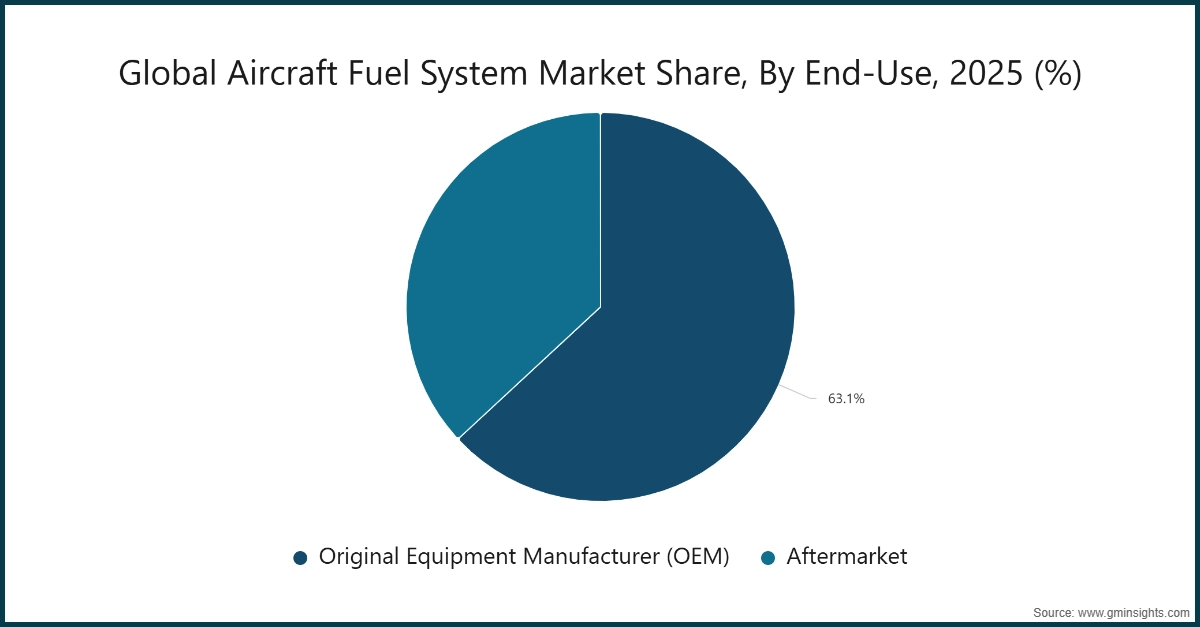
Based on end-use, the global aircraft fuel system market is divided into original equipment manufacturers (OEM) and aftermarket.
- The original equipment manufacturer (OEM) segment led the market in 2025 with a market share of 63.1%, owing to an increase in the rate of production of aircraft and a healthy order book of major aircraft manufacturers. Fuel system components are integral parts of an aircraft that are assembled during manufacturing. These components include pumps, tanks, and monitors. The constant launch of new aircraft models and expansion programs ensure a healthy demand for fuel system components from original equipment manufacturers.
- The aftermarket segment is expected to grow at a CAGR of 15% during the forecast period because of increasing demand for aircraft maintenance, repair and overhaul services. Fuel system parts need scheduled inspection, replacement and system upgrades to ensure they operate safely and effectively. Airlines and defense operators allocate increasing resources toward fuel system upkeep and part replacements because the worldwide aircraft fleet continues to age while flight operations become more frequent.
Looking for region specific data?
North America Aircraft Fuel System Market
North America held a share of 36.3% of aircraft fuel system industry in 2025.
- The North American market experiences growth because both aircraft manufacturing activities and defense aviation programs are increasing throughout the entire region. Advanced fuel pumps, valves, storage systems and fuel management technologies support operational reliability needs of major aircraft OEM production lines and airline fleets which require these systems.
- Additionally, continuous investments in next-generation aircraft development and modernization of military fleets are strengthening demand for advanced aircraft fuel systems. The region is expected to remain a technology leader through 2035 as aerospace companies integrate lightweight materials, digital fuel monitoring systems, and enhanced safety technologies into modern aircraft platforms.
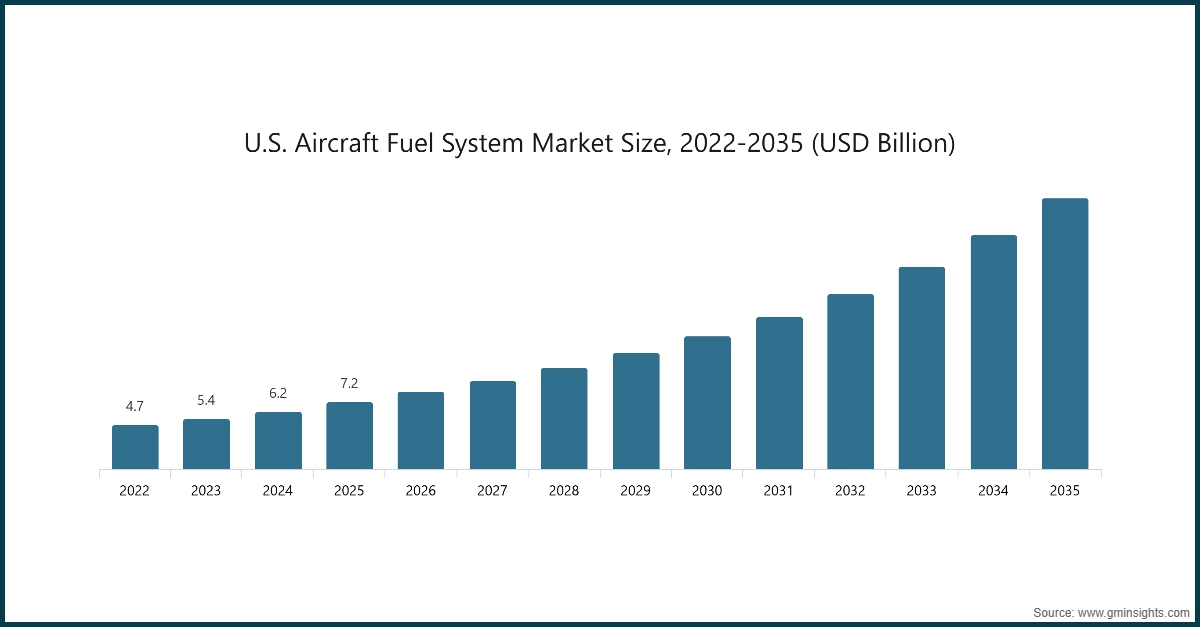
The U.S. market was valued at USD 4.7 billion and USD 5.4 billion in 2022 and 2023, respectively. The market size reached USD 7.2 billion in 2025, growing from USD 6.2 billion in 2024.
- The United States aircraft fuel system market is growing because the country possesses a robust aerospace manufacturing industry and a comprehensive network of aviation facilities. The industry maintains its growth through the establishment of major aircraft manufacturers, aerospace component suppliers and maintenance repair facilities which create new opportunities for developing and implementing cutting-edge fuel storage systems, fuel transfer systems and fuel management systems in contemporary aircraft designs.
- The United States operates one of the largest commercial and defense aviation fleets worldwide which creates an ongoing need for various fuel system components that include pumps, valves, fuel gauging systems and inerting technologies. Continuous aircraft production, fleet modernization programs, and technological advancements in aviation safety systems further position the United States as the leading market for aircraft fuel systems in North America.
Europe Aircraft Fuel System Market
Europe market accounted for USD 1.6 billion in 2025 and is anticipated to show lucrative growth over the forecast period.
- The Europe market is expanding due to the region’s strong aircraft manufacturing ecosystem and the presence of major aerospace system suppliers supporting commercial and defense aviation programs. European aerospace companies are actively developing advanced fuel storage, fuel transfer, and fuel monitoring technologies integrated into next-generation aircraft platforms.
- Additionally, the regional initiatives dedicated to sustainable aviation research are driving the creation of fuel systems that can use alternative aviation fuels while developing advanced fuel efficiency technologies. Various countries in the region are expanding their aerospace manufacturing capabilities through investments in advanced aircraft systems engineering which enables European aviation fleets to adopt high-performance fuel pumps and fuel management systems and fuel safety technologies.
Germany dominates the Europe aircraft fuel system market, showcasing strong growth potential.
- Germany plays a major role in the European aircraft fuel system industry due to its strong aerospace engineering and aircraft systems manufacturing capabilities. The country hosts several major aerospace component manufacturers and suppliers that develop aircraft propulsion components, fluid management systems, and fuel system technologies used in commercial and military aviation platforms.
- Germany's aerospace industry develops aircraft systems through specialized research institutes and advanced manufacturing clusters which work on improving aircraft efficiency, safety and building future aviation systems. Germany becomes a major European force in aircraft fuel system innovation and production because it contains large aerospace manufacturing sites and strong partnerships among aircraft makers and component producers and research institutions.
Asia Pacific Aircraft Fuel System Market
The Asia Pacific market is anticipated to grow at the highest CAGR of 16.3% during the forecast period.
- The Asia Pacific market is expanding rapidly due to the region’s accelerating aircraft fleet expansion and the growing presence of aerospace manufacturing facilities. Several countries in the region are strengthening domestic aircraft production capabilities and developing aerospace supply chains to support commercial aviation growth and defense modernization programs.
- Additionally, increasing aircraft assembly activities and component manufacturing partnerships with global aircraft OEMs are supporting demand for advanced fuel pumps, fuel storage systems, and fuel management technologies integrated into new aircraft platforms. The rapid expansion of airline networks, regional connectivity programs, and defense aviation procurement across Asia Pacific is expected to sustain strong adoption of aircraft fuel system technologies throughout the forecast period.
India aircraft fuel system market is estimated to grow with a significant CAGR, in the Asia Pacific market.
- India is emerging as a key growth market for aircraft fuel systems due to the rapid expansion of its aviation sector and increasing domestic aircraft maintenance and manufacturing activities. The country is strengthening its aerospace ecosystem through government-supported aviation development programs and the expansion of aircraft maintenance, repair, and overhaul (MRO) facilities.
- In addition, India is investing in indigenous defense aviation programs and aircraft component manufacturing, encouraging collaboration between domestic aerospace firms and global system suppliers. The development of new aviation infrastructure, along with growing airline fleet expansion and defense aviation modernization initiatives, is creating sustained demand for advanced aircraft fuel storage, fuel transfer, and fuel management systems in the country.
Middle East and Africa Aircraft Fuel System Market
UAE aircraft fuel system industry to experience substantial growth in the Middle East and Africa region.
- The aircraft fuel system market in the United Arab Emirates is supported by the country’s position as a major global aviation hub and its extensive airline fleet operations. Major carriers operating long-haul international routes require highly reliable aircraft fuel storage, transfer, and fuel management systems to support high aircraft utilization and long-distance flight operations.
- The UAE has also developed advanced aviation infrastructure, including large aircraft maintenance and engineering facilities that handle complex aircraft systems servicing, including fuel system inspection and component replacement. In addition, the country’s growing aerospace manufacturing initiatives and defense aviation modernization programs are encouraging collaboration with global aerospace suppliers, strengthening demand for advanced aircraft fuel pumps, fuel control units, and fuel safety technologies across the UAE aviation ecosystem.
Aircraft Fuel System Market Share
The aircraft fuel system industry is led by players such as Parker-Hannifin Corporation, Eaton Corporation, Honeywell International Inc., Safran S.A., and RTX Corporation. These five companies collectively accounted for 53.1% share of the market in 2025 due to their strong aerospace engineering skills, maintained extensive product lines and established relationships with major aircraft manufacturers and defense organizations. These companies provides its customers with advanced fuel pumps, valves, inerting systems, fuel gauging technologies and integrated fuel management solutions which operate in commercial and military and general aviation aircraft.
These companies sustain their market leadership through ongoing funding of aerospace research and development and their production of high-reliability components along with their worldwide network of aftermarket customer support services. Their participation in next-generation aircraft programs and defense aviation platforms gives them access to the increasing worldwide demand for advanced aircraft fuel systems.
Aircraft Fuel System Market Companies
Prominent players operating in the aircraft fuel system industry are as mentioned below:
- Crane Aerospace & Electronics
- Eaton Corporation
- GE Aerospace
- GKN Aerospace
- Honeywell International Inc.
- Marshall Aerospace and Defence Group
- Meggitt PLC
- Parker-Hannifin Corporation
- Robert Bosch GmbH
- RTX Corporation
- Safran S.A.
- Secondo Mona S.p.A.
- Trelleborg AB
- Triumph Group Inc.
- Woodward Inc.
- Parker-Hannifin Corporation
Parker-Hannifin provides advanced fuel systems which include fuel pumps, valves, filtration systems and fuel transport equipment to support both commercial and military aircraft operations. The company develops high-reliability fluid control systems which provide efficient fuel distribution and safeguard system safety for modern aircraft and upcoming aviation systems.
Eaton provides an extensive range of aerospace fuel system solutions that include fuel pumps and fuel conveyance assemblies. The company also provides fuel tank inerting solutions that are efficient and effective. The company’s fuel management solutions support commercial aviation and defense aircraft and advanced aerospace applications.
Honeywell provides advanced fuel measurement systems and fuel gauging systems together with inerting systems that enhance aircraft safety and improve fuel management systems. The company uses its technologies to create integrated systems that deliver dependable fuel system operations and anticipating maintenance functions to contemporary aircraft fleets through their avionics and digital monitoring systems.
Safran creates advanced aircraft fuel distribution systems which include pumping and filtration components for use in commercial and military aviation operations. The company develops advanced fuel delivery systems through its aerospace equipment division which enables aircraft propulsion systems to operate efficiently while maintaining strict aviation safety requirements.
RTX, through its aerospace businesses, supplies advanced engine fuel control systems, fuel pumps, and integrated fuel management technologies. The company supports a wide range of commercial and defense aircraft programs, emphasizing high-precision fuel regulation and system reliability for next-generation aviation propulsion platforms.
Aircraft Fuel System Market Report Attributes
| Key Takeaway | Details |
|---|---|
| Market Size & Growth | |
| Base Year | 2025 |
| Market Size in 2025 | USD 8.8 Billion |
| Market Size in 2026 | USD 10.2 Billion |
| Forecast Period 2026-2035 CAGR | 14.4% |
| Market Size in 2035 | USD 34.2 Billion |
| Key Market Trends | |
| Drivers | Impact |
| Rising commercial aircraft production and backlog deliveries | Drives 24% growth as rising commercial aircraft production and record OEM backlogs from major manufacturers require advanced fuel delivery, storage, and monitoring systems to support higher aircraft manufacturing volumes and ensure reliable fuel management across new aircraft platforms. |
| Increasing global air passenger traffic growth | Supports 21% growth as global air passenger traffic recovery and expansion encourage airlines to increase fleet capacity, accelerating procurement of new narrow-body and wide-body aircraft equipped with advanced fuel management and distribution systems. |
| Military aircraft fleet modernization programs | Contributes 19% growth as military aircraft fleet modernization programs across the U.S., Europe, and Asia-Pacific require upgraded fuel pumps, inerting systems, and fuel management technologies to support next-generation fighter jets, transport aircraft, and aerial refueling platforms. |
| Demand for lightweight fuel system components | Adds 18% growth as aircraft manufacturers increasingly adopt lightweight fuel system components, including composite fuel tanks and advanced fuel pumps, to reduce aircraft weight, improve fuel efficiency, and meet stricter aviation emission targets. |
| Growth in long-range and wide-body aircraft demand | Accounts for 18% growth as the growing deployment of long-range and wide-body aircraft increases the need for high-capacity fuel storage systems, advanced fuel transfer pumps, and precise fuel management technologies to ensure operational safety on extended flight routes. |
| Pitfalls & Challenges | Impact |
| High maintenance and system integration costs | Restrains market growth as aircraft fuel systems require complex integration with avionics, propulsion, and structural components, increasing maintenance complexity and lifecycle costs for airlines and maintenance, repair, and overhaul (MRO) providers. |
| Strict aviation fuel safety certification regulations | Limits growth due to stringent aviation safety certification requirements imposed by regulatory authorities, where fuel system components must undergo extensive testing, validation, and approval processes before deployment in commercial and military aircraft. |
| Opportunities: | Impact |
| Sustainable aviation fuel compatibility systems development | Creates strong growth opportunities as the aviation industry accelerates adoption of sustainable aviation fuels (SAF), driving the development of fuel systems compatible with alternative fuel blends, advanced sealing materials, and upgraded fuel pumps to support long-term decarbonization goals. |
| Next-generation unmanned aerial vehicle fuel systems | Opens new market potential as next-generation unmanned aerial vehicles require compact, lightweight, and highly efficient fuel systems designed for extended endurance missions in defense, surveillance, and cargo delivery applications. |
| Market Leaders (2025) | |
| Market Leader |
14.6% market share in 2025 |
| Top Players |
Collective market share in 2025 is 53.1% |
| Competitive Edge |
|
| Regional Insights | |
| Largest Market | North America |
| Fastest growing market | Asia Pacific |
| Emerging countries | U.S., China, India, South Korea, UK |
| Future outlook |
|
What are the growth opportunities in this market?
Aircraft Fuel System Industry News
- In November 2025, Parker-Hannifin Corporation announced the acquisition of Filtration Group for USD 9.25 billion to strengthen its filtration and engineered materials capabilities. The deal expands Parker’s presence in filtration and fluid management technologies that are critical for aerospace fuel filtration, fluid handling, and aftermarket component supply across aviation systems.
- In September 2025, Parker-Hannifin Corporation showcased its next-generation aviation fueling and fluid management technologies at the Inter Airport Europe exhibition. The systems include advanced aviation fueling equipment compliant with EI-1588 standards and designed to support safe fuel transfer and handling in modern aviation infrastructure. These technologies enhance fuel handling efficiency, safety, and reliability in airport fueling operations.
- In February 2025, Triumph Group Inc. finalized a USD 3 billion acquisition agreement with private equity investors, transitioning the company to private ownership. The deal is intended to strengthen investment in aerospace structures and aircraft system technologies, including components used in fuel distribution, engine control, and integrated aircraft system platforms.
The aircraft fuel system market research report includes in-depth coverage of the industry with estimates and forecast in terms of revenue (USD Million) from 2022 – 2035 for the following segments:
Market, By System Type
- Fuel storage system
- Fuel feed system
- Fuel transfer system
- Fuel inerting system
- Fuel measurement & management system
Market, By Component Type
- Fuel tanks
- Fuel pumps
- Fuel valves
- Fuel filters & strainers
- Fuel sensors & gauges
- Fuel control & monitoring units
- Others
Market, By Aircraft Type
- Commercial aircraft
- Military aircraft
- Business & general aviation aircraft
- Helicopters
- Unmanned aerial vehicles (UAVs)
Market, By End-Use
- Original equipment manufacturer (OEM)
- Aftermarket
The above information is provided for the following regions and countries:
- North America
- U.S.
- Canada
- Europe
- Germany
- UK
- France
- Spain
- Italy
- Asia Pacific
- China
- India
- Japan
- Australia
- South Korea
- Latin America
- Brazil
- Mexico
- Argentina
- Middle East and Africa
- South Africa
- Saudi Arabia
- UAE
Frequently Asked Question(FAQ) :
What is the market size of the aircraft fuel system market in 2025?
The global aircraft fuel system market was valued at USD 8.8 billion in 2025, driven by rising global air passenger traffic, military fleet modernization programs, and growing adoption of lightweight and advanced fuel management technologies.
What is the projected value of the aircraft fuel system industry by 2035?
The aircraft fuel system market is projected to reach USD 34.2 billion by 2035, growing at a CAGR of 14.4% from 2026 to 2035, supported by next-generation aircraft programs, sustainable aviation fuel (SAF) compatibility development, UAV expansion, and digital fuel monitoring advancements.
What is the aircraft fuel system industry size in 2026?
The aircraft fuel system market size is projected to reach USD 10.2 billion in 2026, fueled by increasing aircraft deliveries, fleet renewal programs, and continued defense aviation procurement across major economies.
Which system type segment dominated the aircraft fuel system market in 2025?
The fuel storage system segment holding a 32.3% share in 2025, driven by its critical role in ensuring safe and reliable fuel supply, maintaining fuel integrity, preventing leaks, and enabling accurate fuel level monitoring in commercial and military aircraft.
How much revenue did the commercial aircraft segment generate in 2025?
The commercial aircraft segment was valued at USD 3 billion, driven by the large size of the global commercial fleet, ongoing airline fleet expansion, and continuous deliveries from major aircraft manufacturers.
What was the market share of the OEM end-use segment in 2025?
The original equipment manufacturer (OEM) segment led the market in 2025 with a 63.1% share, driven by increasing aircraft production rates, healthy order backlogs from major manufacturers, and the integral role of fuel system components.
Which region leads the aircraft fuel system market?
North America leads the global aircraft fuel system market with a 36.3% share in 2025, supported by a robust aerospace manufacturing industry, major aircraft OEM production lines, and extensive military aviation programs.
What are the upcoming trends in the aircraft fuel system market?
Key trends include integration of digital fuel management and health monitoring systems for predictive maintenance, growing adoption of advanced fuel tank inerting systems for enhanced safety, and development of fuel systems compatible with sustainable aviation fuels (SAF) to support aviation decarbonization goals.
Who are the key players in the aircraft fuel system market?
Key players include Parker-Hannifin Corporation, Eaton Corporation, Honeywell International Inc., Safran S.A., RTX Corporation, GE Aerospace, GKN Aerospace, Meggitt PLC, Woodward Inc., Triumph Group Inc., Crane Aerospace & Electronics, and Trelleborg AB.
Aircraft Fuel System Market Scope
Related Reports