Summary
Table of Content

Advanced Semiconductor Packaging Market
Get a free sample of this report
Form submitted successfully!
Error submitting form. Please try again.
Thank you!
Your inquiry has been received. Our team will reach out to you with the required details via email. To ensure that you don't miss their response, kindly remember to check your spam folder as well!
Request Sectional Data
Thank you!
Your inquiry has been received. Our team will reach out to you with the required details via email. To ensure that you don't miss their response, kindly remember to check your spam folder as well!
Form submitted successfully!
Error submitting form. Please try again.
Advanced Semiconductor Packaging Market Size
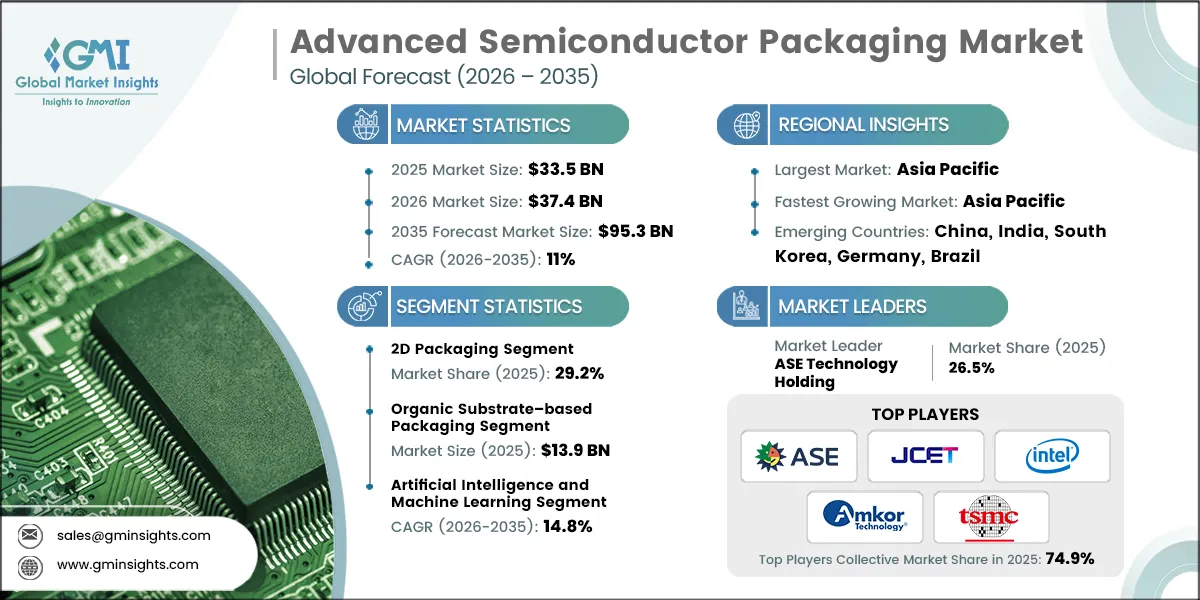
The global advanced semiconductor packaging market was valued at USD 33.5 billion in 2025. The market is expected to grow from USD 37.4 billion in 2026 to USD 62.0 billion in 2031 & USD 95.3 billion in 2035, at a CAGR of 11% during the forecast period according to the latest report published by Global Market Insights Inc.
Advanced Semiconductor Packaging Market Key Takeaways
Market Size & Growth
- 2025 Market Size: USD 33.5 Billion
- 2026 Market Size: USD 37.4 Billion
- 2035 Forecast Market Size: USD 95.3 Billion
- CAGR (2026–2035): 11%
Regional Dominance
- Largest Market: Asia Pacific
- Fastest Growing Region: Asia Pacific
Key Market Drivers
- AI accelerators demanding high-bandwidth memory integration.
- HPC and data centers adopting 2.5D and 3D ICs.
- Chiplet architectures replacing monolithic SoC designs.
- 5G base stations requiring high-density RF packaging.
- Advanced nodes cost pushing value toward packaging innovation.
Challenges
- High capital expenditure for advanced packaging fabs.
- Thermal management complexity in high-power packaged devices.
Opportunity
- Foundry-OSAT partnerships for advanced packaging capacity expansion.
- Co-packaged optics enabling next-generation data center interconnects.
Key Players
- Market Leader: ASE Technology Holding led with over 26.5% market share in 2025.
- Leading Players: Top 5 players in this market include ASE Technology Holding, Amkor Technology, Inc., Taiwan Semiconductor Manufacturing Company (TSMC), JCET Group Co., Ltd., Intel Corporation, which collectively held a market share of 74.9% in 2025.
Get Market Insights & Growth Opportunities
The market is growing due to the shift towards chip-based processor designs and the rollout of 5G infrastructure. This growth increases the demand for high-density RF and system-in-package solutions. Also, rising costs and yield challenges at advanced process nodes are pushing innovation and value creation toward advanced packaging technologies.
Rapid adoption of AI accelerators needing high-bandwidth memory (HBM) integration significantly drives this market. These memory stacks allow for multi-terabyte-per-second data throughput, which is essential for training large models. For instance, the U.S. Department of Commerce’s CHIPS and Science Act awarded SK hynix up to USD 458 million to develop HBM advanced packaging facilities. This demonstrates the government's commitment to supporting domestic memory packaging for AI workloads. This investment improves local packaging capacity, reduces supply-chain risks, and supports future AI computing platforms.
Growth in the advanced semiconductor packaging market is also supported by the expansion of high-performance computing (HPC) and hyperscale data centers that adopt 2.5D and 3D IC architectures. These architectures are vital for the performance of next-generation computing systems. The U.S. National Strategic Computing Initiative (NSCI) promotes federal cooperation to advance HPC technologies and maintain leadership through investments in exascale and future computing systems. This government focus increases demand for packaging solutions that enable heterogeneous integration, higher interconnect density, and better performance-per-watt in data centers and research platforms.
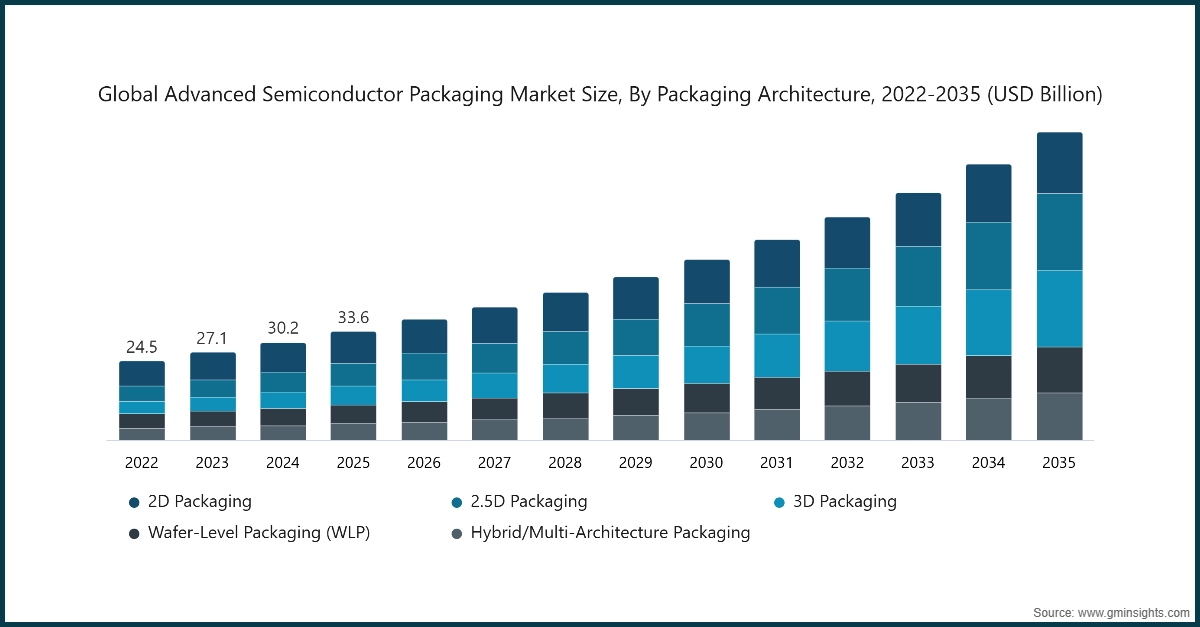
From 2022 to 2024, the market experienced significant growth, rising from USD 24.5 billion in 2022 to USD 30.1 billion in 2024. This increase is due to the rapid adoption of AI and data-center processors that require heterogeneous integration. Increased use of advanced packaging in high-performance computing, early commercialization of chiplet architectures, and growing deployment of 5G base stations supported market penetration during this period. Additional momentum came from rising investments in advanced packaging capacity by foundries and OSATs, alongside growing recognition of packaging as a performance-critical enabler rather than a backend manufacturing step.
To get key market trends
Advanced Semiconductor Packaging Market Trends
- The shift from wafer-level to panel-level advanced packaging is becoming a key trend. This shift began around 2022 as OSATs aimed for higher throughput and lower costs for fan-out and heterogeneous packages. It is expected to keep growing until 2030 as equipment improves and panel standards stabilize. This change reduces manufacturing costs and enhances scalability for high-volume applications.
- Co-optimization between chip, package, and system design is becoming standard. This trend started around 2021 when traditional EDA processes fell short for complex heterogeneous packages. Adoption will speed up through 2028 as package-aware design tools advance and cross-industry collaboration strengthens. This improves yield, shortens development times, and lowers costly late-stage design errors.
- Advancements in substrate innovations are, in turn, becoming an important bottleneck and differentiator. This has been accelerating since 2020, driven by substrate availability and increasing complexity in fine-line redistribution layers. This may extend beyond 2030, reflecting an increasing need for higher I/O density and interconnect pitches, which in turn has an impact on the strategic role of substrate suppliers, affecting the balance of power.
Advanced Semiconductor Packaging Market Analysis
Learn more about the key segments shaping this market
Based on packaging architecture, the advanced semiconductor packaging market is segmented into 2D packaging (single-die, single-plane), 2.5D packaging (multi-die, interposer-based, single vertical plane), 3D packaging (vertical die stacking), wafer-level packaging (WLP), and hybrid or multi-architecture packaging.
- The 2D packaging segment held the highest market share of 29.2% in the market in 2025, driven by its use in established node logic, analog devices, power management, and mixed-signal ICs. This packing style is preferred for high-volume use, where cost-effectiveness, yield, and reliability are critical factors. Industries such as consumer electronics, industrial automation, and automotive electronics depend on 2D packaging due to its compatibility with existing manufacturing processes and stable supply chains, reinforcing its leading position.
- The 3D packaging market is expected to rise with a CAGR of 14.9% in the forecast period. This is due to the benefits of higher performance, shorter interconnects, and higher density of bandwidth offered in 3D packaging. In addition, the demand for AI accelerators, processors, and memory remains consistent in this market. Ongoing advancements in hybrid bonding, TSV reliability, and thermal dissipation technologies are making 3D packaging scalable and essential for future computing architectures.
Based on packaging material, the global advanced semiconductor packaging market is segmented into organic substrate–based packaging, silicon interposer–based packaging, redistribution layer (RDL)–based reconstituted wafer packaging, 3D stack–dominant packaging using die-to-die material platforms, and glass interposer–based packaging.
- The organic substrate–based packaging segment dominated the market in 2025 and valued at USD 13.9 billion. Its wide application in flip-chip and advanced laminate packages for mobile processors, networking ICs, and automotive uses supports this growth. Organic substrates offer a favorable balance between cost, electrical performance, and design flexibility, making them suitable for high I/O density applications at scale. The well-established manufacturing infrastructure and constant development of new materials would sustain the demand for their products in the fields of consumer electronics, communication, and industrial applications.
- The glass interposer–based packaging segment is expected to witness growth at a CAGR of 15.7% during the forecast period, due to the rising performance limitations of conventional silicon-based interposers for advanced technologies. Glass-based interposers are known for their ultra-fine line resolution and lower signal losses. Therefore, they are best suited for AI, HPC processor technologies, and data center processor technologies. Rising R&D investment and pilot production projects are speeding-up in adoption as designers seek greater bandwidth density and improved power efficiency.
Learn more about the key segments shaping this market
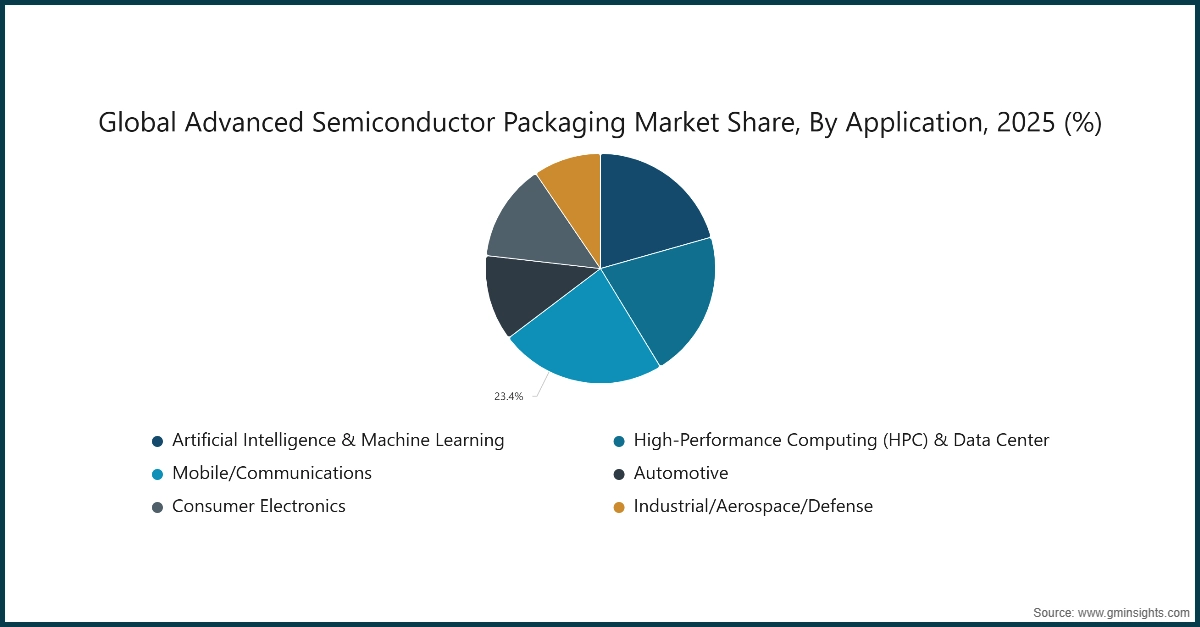
- The mobile and communications segment led the market in 2025 with a market share of 23.4%, as high-volume production continues to be witnessed in smartphones, networking equipment, and 5G infrastructure. Advanced packaging solutions, such as system-in-package and RF modules, are essential for meeting strict requirements for compactness, signal integrity, and power efficiency.
- The artificial intelligence and machine learning segment is expected to grow at a CAGR of 14.8% during the forecast period. This growth is fueled by the rapid increase in data-center AI workloads and edge computing deployments. AI and ML processors require advanced packaging to combine logic dies with high-bandwidth memory for optimal performance. This segment increasingly influences packaging strategies, encouraging innovation in heterogeneous integration, thermal management, and high-density interconnect technologies.
North America Advanced Semiconductor Packaging Market
Looking for region specific data?
North America held a revenue share of 22.8% in advanced semiconductor packaging market in 2025.
- In North America, the market for semiconductor packages is developing rapidly with a rise in the demand for computing devices using AI accelerators and data center processor chips. The region has a strong ecosystem of IDM and OSAT companies that are increasingly using 2.5D and 3D packaging architectures. These improvements help address performance, power, and bandwidth issues found in traditional planar designs.
- Government-backed programs like the U.S. CHIPS and Science Act are encouraging domestic investments in advanced packaging. Hyperscalers and fabless AI companies drive the demand for heterogeneous integration, chiplet designs, and advanced interposers. North America continues to lead in terms of innovation, with packaging technologies increasingly being seen as a strategic enabler for future AI, HPC, defense, and cloud infrastructure deployments through 2035.
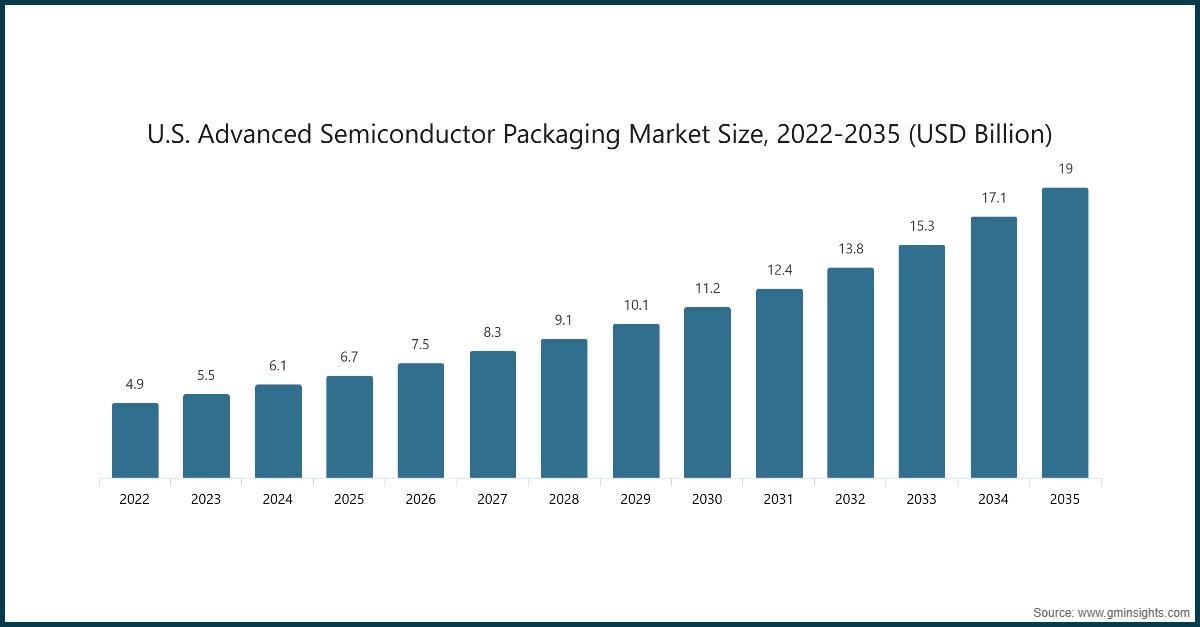
The U.S. advanced semiconductor packaging market was valued at USD 4.9 billion and USD 5.5 billion in 2022 and 2023, respectively. The market size reached USD 6.7 billion in 2025, growing from USD 6.1 billion in 2024.
- The U.S. is leading the market, and the major drivers here include high demand from AI accelerators, high-performance computing, and data centers. The U.S. has a robust semiconductor market. It comprises IDMs, OSATs, fabless chip companies, and cloud players. These companies are increasingly employing technology solutions such as 2.5D interposers, 3D stacking, and HI.
- Evidence of this growth is the notable investment, worth USD 2 billion, made by Amkor Technology to establish a new packaging and test facility in Arizona. The facility is intended to serve applications featuring AI and HPC. This is further indicative of the domestic requirement for advanced packaging and the significance of the U.S. acting as the center for future advanced packaging solutions in North America.
Europe Advanced Semiconductor Packaging Market
Europe advanced semiconductor packaging industry accounted for USD 4.9 billion in 2025 and is anticipated to show lucrative growth over the forecast period.
- Europe’s advanced semiconductor packaging industry is developing primarily due to its strategic push for semiconductor sovereignty and supply-chain resilience rather than volume manufacturing. The region is focusing on heterogeneous integration, chiplet-based designs, and advanced interconnect packaging to support automotive electronics, industrial automation, and aerospace systems.
- In Europe, the demand centers on high-reliability, long-lifecycle packaging solutions, mainly because of functional safety requirements in automotive and industrial applications. Initiatives under the EU Chips Act are promoting investment in advanced packaging research, development, and back-end manufacturing, especially for 2.5D, 3D, and wafer-level packaging. This focus on reliability and integration is turning Europe into a strategic center for advanced packaging technologies supporting critical semiconductor applications.
Germany dominates the Europe advanced semiconductor packaging market, showcasing strong growth potential.
- Germany has demonstrated high adoption for power-dense packaging, wafer-level packaging, and 3D integration for automotive ADAS, power electronics, and industrial control systems. German manufacturers have placed greater emphasis on chip-package co-design, advanced substrates, and reliable interconnects to fulfill the requirements of AEC-Q and functional safety.
- Furthermore, Germany's semiconductor strategy supports its advanced packaging capabilities with funding allocated for pilot production, packaging process development, and partnerships with local fabs and system integrators.
Asia Pacific Advanced Semiconductor Packaging Market
The Asia Pacific advanced semiconductor packaging industry is anticipated to grow at the highest CAGR of 11.6% during the forecast period.
- The Asia Pacific advanced semiconductor packaging industry is expanding rapidly due to the region’s dominance in electronics manufacturing, OSAT capacity, and foundry-led packaging innovation. The Asia-Pacific region has the greatest concentration of OSAT providers and advanced packaging fabs. This supports the widespread use of 2.5D, 3D ICs, wafer-level packaging, and fan-out technologies.
- Demand from consumer electronics, AI accelerators, high-performance computing, and 5G infrastructure is driving ongoing upgrades in interposer-based and heterogeneous integration solutions. Governments in this region are prioritizing semiconductor self-sufficiency, expanding back-end manufacturing, and localizing advanced packaging, which speeds up the commercialization of next-generation packaging architectures. This ecosystem depth positions Asia Pacific as the global production and innovation center for advanced semiconductor packaging.
India advanced semiconductor packaging market is estimated to grow with a significant CAGR, in the Asia Pacific market.
- India is becoming a key growth market for advanced semiconductor packaging. The country focuses on building domestic OSAT and back-end manufacturing capabilities instead of leading-edge wafer fabrication. India's electronics manufacturing ecosystem requires cost-efficient advanced packaging for mobile devices, automotive electronics, industrial systems, and data-center hardware. Government-supported semiconductor programs prioritize assembly, testing, and packaging infrastructure. They encourage investment in fan-out wafer-level packaging, substrate-based packaging, and heterogeneous integration.
- India’s expanding demand for AI-enabled devices, telecom equipment, and electric vehicle electronics is accelerating the need for thermally efficient and high-density packaging solutions. This policy-driven and demand-led approach is positioning India as a high-growth destination for advanced semiconductor packaging within Asia Pacific.
Middle East and Africa Advanced Semiconductor Packaging Market
Saudi Arabia advanced semiconductor packaging industry to experience substantial growth in the Middle East and Africa market.
- Saudi Arabia’s advanced semiconductor packaging industry is developing as The country is looking to advanced system integration, reliable electronics packaging, and electronics production as part of its defense electronics, industrial automation, energy infrastructure, and smart infrastructure roll-out needs.
- Demand for advanced packaging solutions that can work within extreme temperature and environmental conditions is pushing the market for advanced substrates, thermal packaging solutions, and system-in-package designs. Cooperation between global semiconductor companies and incentives for local manufacturing are helping to establish advanced testing facilities for advanced packaging solutions early on, which can serve as the base for a regional expertise center for specialized semiconductor solutions across the Middle East and Africa.
Advanced Semiconductor Packaging Market Share
The advanced semiconductor packaging industry is led by players such as ASE Technology Holding, Amkor Technology, Inc., Taiwan Semiconductor Manufacturing Company (TSMC), JCET Group Co., Ltd., and Intel Corporation. These five companies cumulatively accounted for 74.9% share of global advanced packaging services in 2025. They maintain a competitive edge through extensive technology portfolios, large-scale manufacturing capabilities, and global operations in North America, Asia Pacific, and Europe.
With expertise in heterogeneous integration, 2.5D-3D ICs, high-density interconnects, and the relationships with the main semiconductor designers, these companies fulfill the demand for AI, high-performance computing, mobile, and automotive markets. Investing in research, developing, automating, and employing advanced materials can enhance the contribution to growth in advanced packaging globally.
Advanced Semiconductor Packaging Market Companies
Prominent players operating in the advanced semiconductor packaging industry are as mentioned below:
- Amkor Technology, Inc.
- ASE Technology Holding
- ChipMOS Technologies Inc.
- China Wafer Level CSP Co., Ltd. (CWLP)
- GlobalFoundries Inc.
- HANA Micron Inc.
- Huatian Technology Co., Ltd.
- Intel Corporation
- JCET Group Co., Ltd.
- Micron Technology, Inc.
- Powertech Technology Inc. (PTI)
- Samsung Electronics
- SK hynix
- Taiwan Semiconductor Manufacturing Company (TSMC)
- Texas Instruments
- Tongfu Microelectronics Co., Ltd.
- UTAC Holdings Ltd.
ASE Technology specializes in advanced packaging and test services and delivers fan-out, 2.5D, and multi-die packaging solutions to support AI accelerators, high-performance computing, and communications processors. They leverage their global manufacturing network and integration expertise to serve major semiconductor design firms.
Amkor provides a wide range of outsourced advanced packaging and testing services. Their expertise encompasses flip-chip, wafer-level, and system-in-package technologies. For instance, it delivers solutions to support high-density interconnects and advanced heterogeneous integrations for Artificial Intelligence, automotive, and mobile applications.
Taiwan Semiconductor Manufacturing Company (TSMC)
TSMC provides advanced packaging services, such as CoWoS, InFO, and SoIC, in an integrated manner as a foundry service. This enables the potential for innovation in logic, memory, and interconnect technologies for next-generation computing solutions.
JCET Group offers competitive advanced OSAT services based on cost-effective packaging solutions. It also includes flip-chip and wafer-level packaging. Its massive presence in China and more partnerships worldwide makes it a major player in highly growing markets.
Intel is driving innovation in packaging solutions through the development of proprietary technologies such as EMIB and Foveros, which allow for heterogeneous integration. Intel’s IDM model is reflected in its approach to packaging solutions, which provides greater performance, flexibility, and modularity to CPUs, GPUs, as well as AI processors, for the data center and edge computing market.
Advanced Semiconductor Packaging Market Report Attributes
| Key Takeaway | Details |
|---|---|
| Market Size & Growth | |
| Base Year | 2025 |
| Market Size in 2025 | USD 33.5 Billion |
| Market Size in 2026 | USD 37.4 Billion |
| Forecast Period 2026-2035 CAGR | 11% |
| Market Size in 2035 | USD 95.3 Billion |
| Key Market Trends | |
| Drivers | Impact |
| AI accelerators demanding high-bandwidth memory integration | Drives 26% growth by pushing adoption of 2.5D interposers and advanced 3D stacking to meet bandwidth, latency, and power-efficiency requirements in AI training and inference workloads. |
| HPC and data centers adopting 2.5D and 3D ICs | Accounts for 24% growth as advanced packaging enables higher compute density, reduced interconnect bottlenecks, and improved energy efficiency per watt. |
| Chiplet architectures replacing monolithic SoC designs | Contributes 20% growth by increasing demand for advanced packaging technologies such as silicon interposers, advanced substrates, and high-density die-to-die interconnects to ensure performance scalability and yield optimization. |
| 5G base stations requiring high-density RF packaging | Adds 15% growth driven by 5G base station deployments requiring compact, high-density RF packaging solutions, to support higher frequencies, lower signal loss, and improved thermal stability. |
| Advanced nodes cost pushing value toward packaging innovation | Supports 15% growth as escalating costs and yield challenges at advanced process nodes shift value creation toward packaging innovation, encouraging semiconductor vendors to differentiate performance and cost through heterogeneous integration rather than pure node shrinks. |
| Pitfalls & Challenges | Impact |
| High capital expenditure for advanced packaging fabs | Restrains market growth as advanced semiconductor packaging fabs require substantial capital investment in specialized equipment, cleanroom upgrades, and process tooling. High upfront costs limit capacity expansion to a few large foundries and OSATs, slowing broader market penetration and regional diversification. |
| Thermal management complexity in high-power packaged devices | Limits growth due to increasing thermal management complexity in high-power packaged devices, particularly in AI and HPC applications. Inefficient heat dissipation in dense multi-die packages raises reliability risks, increases design cycles, and elevates packaging costs through advanced materials and cooling solutions. |
| Opportunities: | Impact |
| Foundry-OSAT partnerships for advanced packaging capacity expansion | Presents strong growth opportunity through expanding foundry–OSAT partnerships that accelerate advanced packaging capacity expansion. Collaborative models enable faster commercialization of 2.5D and 3D packaging platforms, reduce time-to-market for chiplet-based designs, and balance capital risk across the value chain. |
| Co-packaged optics enabling next-generation data center interconnects | Offers significant opportunity as co-packaged optics gain traction in next-generation data centers, addressing electrical interconnect limitations. Integrating optical components directly within advanced packages enables higher bandwidth density, lower power consumption, and scalable architectures for AI-driven data center networks. |
| Market Leaders (2025) | |
| Market Leader |
26.5% market share in 2025 |
| Top Players |
Collective market share is 74.9% in 2025 |
| Competitive Edge |
|
| Regional Insights | |
| Largest Market | Asia Pacific |
| Fastest growing market | Asia Pacific |
| Emerging countries | China, India, South Korea, Germany, Brazil |
| Future outlook |
|
What are the growth opportunities in this market?
Advanced Semiconductor Packaging Industry News
- In October 2025, Amkor Technology, Inc. continued expansion of its advanced packaging and test footprint in the United States, supporting flip-chip, wafer-level, and heterogeneous integration solutions. The expansion strengthens domestic advanced packaging capabilities for AI, automotive, and communications devices, improving supply-chain resilience and reducing dependency on overseas packaging capacity.
- In April 2025, Taiwan Semiconductor Manufacturing Company (TSMC) advanced commercial deployment of its CoWoS and SoIC packaging platforms, increasing capacity to support AI and high-performance computing customers. This expansion reinforces tight integration between leading-edge logic fabrication and advanced packaging, enabling higher memory bandwidth, improved power efficiency, and scalable chiplet-based system architecture.
- In March 2025, ASE Technology Holding expanded its advanced packaging capacity to support AI and HPC demand, scaling fan-out, 2.5D, and heterogeneous integration lines across its Taiwan operations. The expansion is aimed at meeting rising customer requirements for high-density interconnects and multi-die integration, strengthening ASE’s role as a primary OSAT partner for AI accelerators and data-center processors.
The advanced semiconductor packaging market research report includes in-depth coverage of the industry with estimates and forecast in terms of revenue (USD Million) from 2022 – 2035 for the following segments:
Market, By Packaging Architecture
- 2D Packaging (single-die, single-plane)
- 2.5D Packaging (multi-die, interposer-based, single vertical plane)
- 3D Packaging (Vertical Die Stacking)
- TSV-based 3D packaging
- Hybrid bonding–based 3D packaging
- Wafer-level packaging (WLP)
- Fan-in wafer-level packaging (FI-WLP)
- Fan-out wafer-level packaging (FO-WLP)
- Hybrid/multi-architecture packaging
Market, By Packaging Material
- Organic substrate–based packaging
- Silicon interposer–based packaging
- RDL-based (reconstituted wafer) packaging
- 3D stack–dominant packaging (die-to-die material platform)
- Glass interposer–based packaging
Market, By Application
- Artificial intelligence and machine learning
- High-performance computing (HPC) and data center
- Mobile and communications
- Automotive
- Consumer electronics
- Industrial, aerospace and defense
The above information is provided for the following regions and countries:
- North America
- U.S.
- Canada
- Europe
- Germany
- UK
- France
- Spain
- Italy
- Russia
- Asia Pacific
- China
- India
- Japan
- Australia
- South Korea
- Latin America
- Brazil
- Mexico
- Argentina
- Middle East and Africa
- South Africa
- Saudi Arabia
- UAE
Frequently Asked Question(FAQ) :
What was the market size of the advanced semiconductor packaging in 2025?
The market size was USD 33.5 billion in 2025, growing at a CAGR of 11% during the forecast period. The market is driven by the shift towards chip-based processor designs and the rollout of 5G infrastructure.
What is the projected value of the advanced semiconductor packaging market by 2035?
The market is poised to reach USD 95.3 billion by 2035, fueled by demand for high-density RF and system-in-package solutions.
What is the expected size of the advanced semiconductor packaging industry in 2026?
The market size is expected to reach USD 37.4 billion in 2026.
What was the market share of the 2D packaging segment in 2025?
The 2D packaging segment held the highest market share of 29.2% in 2025, led by its cost-effectiveness, yield, and reliability in high-volume applications.
What was the valuation of the organic substrate-based packaging segment in 2025?
The organic substrate-based packaging segment was valued at USD 13.9 billion in 2025, supported by its applications in flip-chip and advanced laminate packages.
Which region led the advanced semiconductor packaging sector in 2025?
North America led the market with a 22.8% share in 2025, propelled by demand for AI accelerators, data center processor chips, and advancements in 2.5D and 3D packaging architectures.
What are the upcoming trends in the advanced semiconductor packaging market?
Key trends include the transition to panel-level packaging, chip–system co-optimization, substrate innovations, and wider adoption of 2.5D and 3D architectures.
Who are the key players in the advanced semiconductor packaging industry?
Key players include Amkor Technology, Inc., ASE Technology Holding, ChipMOS Technologies Inc., China Wafer Level CSP Co., Ltd. (CWLP), GlobalFoundries Inc., HANA Micron Inc., Huatian Technology Co., Ltd., Intel Corporation, JCET Group Co., Ltd., and Micron Technology, Inc.
Advanced Semiconductor Packaging Market Scope
Related Reports