Summary
Table of Content

3D Food Printing Materials Market
Get a free sample of this report
Form submitted successfully!
Error submitting form. Please try again.
Thank you!
Your inquiry has been received. Our team will reach out to you with the required details via email. To ensure that you don't miss their response, kindly remember to check your spam folder as well!
Request Sectional Data
Thank you!
Your inquiry has been received. Our team will reach out to you with the required details via email. To ensure that you don't miss their response, kindly remember to check your spam folder as well!
Form submitted successfully!
Error submitting form. Please try again.
3D Food Printing Materials Market Size
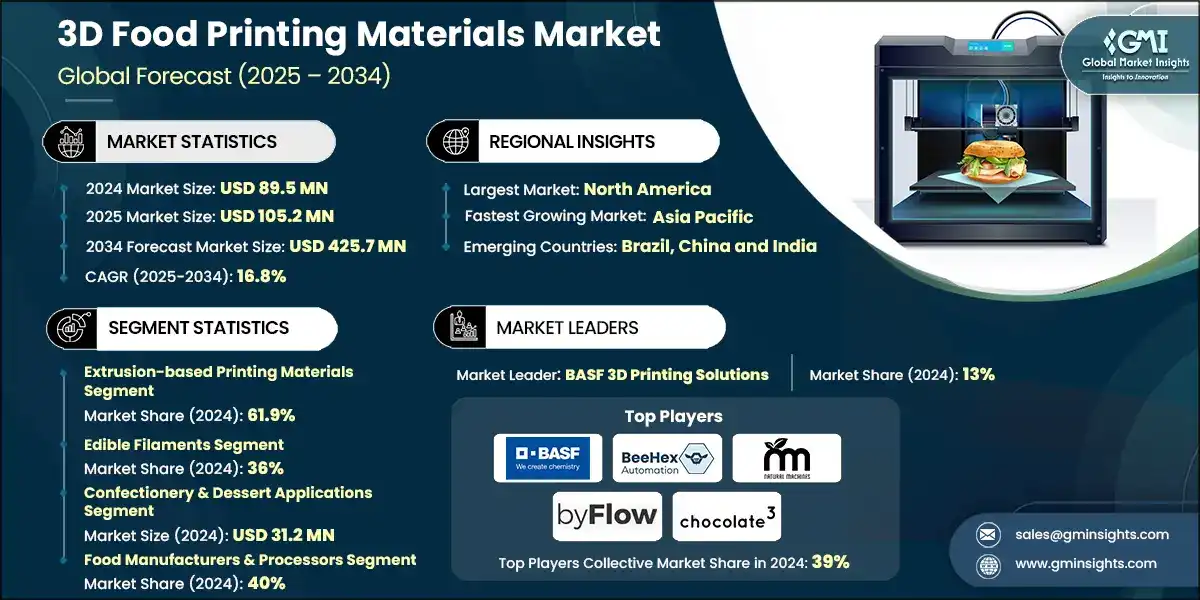
The global 3D food printing materials market size was estimated at USD 89.5 million in 2024. The market is expected to grow from USD 105.2 million in 2025 to USD 425.7 million in 2034, at a CAGR of 16.8%, according to latest report published by Global Market Insights Inc.
3D Food Printing Materials Market Key Takeaways
Market Size & Growth
- 2024 Market Size: USD 89.5 Million
- 2025 Market Size: USD 105.2 Million
- 2034 Forecast Market Size: USD 425.7 Million
- CAGR (2025–2034): 16.8%
Regional Dominance
- Largest Market: North America
- Fastest Growing Region: Asia-Pacific
Key Market Drivers
- Rising Demand for Personalized Nutrition Solutions.
- Growing Healthcare Applications for Dysphagia Treatment.
- Alternative Protein Market Convergence.
Challenges
- Limited Food Safety Certification & Standards.
- High Material Development & Certification Costs.
Opportunity
- Pharmaceutical & Nutraceutical Integration.
- Sustainable Food Production & Waste Reduction.
Key Players
- Market Leader: BASF 3D Printing Solutions led with over 13% market share in 2024.
- Leading Players: Top 5 players in this market include BASF 3D Printing Solutions, BeeHex (USA), Natural Machines (Foodini), ByFlow (Focus Systems), Chocolate³ (Germany), which collectively held a market share of 39% in 2024.
Get Market Insights & Growth Opportunities
- The 3D food printing materials market is witnessing acceleration due to enhanced food technology that coincides with the rising consumer awareness for personalized and functional nutrition. Therefore, the industry is shifting towards innovative, food-safe materials that can create printed, customized shapes, textures, and nutrient profiles. An expanded array of plant-based pastes, chocolate compounds, and hydrocolloid blends are designed for various types of 3D printers.
- Health-conscious consumers are increasingly attracted to clean-label ingredients free from foreign allergens and sustainably produced ingredients. To meet demands, companies are innovating formulations like vegan, fortification, and gluten-free under dietary preference & environment aligned materials. These trends are taking over the important areas of both young cohorts and flexitarian consumers that demand more transparency about how food is produced and to what extent they were concerned about ethical sourcing in production.
- North America dominates the regional market because of its mature food innovation ecosystem and early adoption of 3D printing technologies in culinary applications. On the other hand, the emerging region with the fastest growth is Asia-Pacific, driven by increasing urbanization, disposable incomes, and a move towards convenient, health-oriented food solutions. Localization and adaptation of portfolios have become critical strategies for the global players attempting to penetrate those dynamic markets.
To get key market trends
3D Food Printing Materials Market Trends
- The 3D food-printing materials industry is evolving to changes in consumer preferences, technology, and sustainability directives. One principal instance of a trend would be the proliferation or demand for plant-based, allergen-free, and clean-label printable ingredients. The rises betray a horizon where both the actual awareness for dietary concerns becomes higher and an ethical attitude toward consumption is both always actively fostered.
- This creates avenues for producers and suppliers to build marketable products within the vegan, gluten-free, and low-allergen domain. Another significant trend would relate to functional feeding whereby companies are starting to incorporate proteins, fibers, vitamins, and some other bioactive species into their materials. This is considered quite crucial in lean mass growth and energy increase towards probiotics, sports rehabilitation and general clinical diet needs. The infusion of functional ingredients into the material allows for specific food for various ages and health conditions.
- Materials for 3D food printing are not just used for normal meals, but also now snacks, supplements, and therapeutic food, the technological diversification used to support the multiplicity of application for printing technology that can thus be adapted to various formats and textures. Due to such vast differences, there is growing interest in printing food products in the nursing and in spacecrafts and in eateries.
3D Food Printing Materials Market Analysis
Learn more about the key segments shaping this market
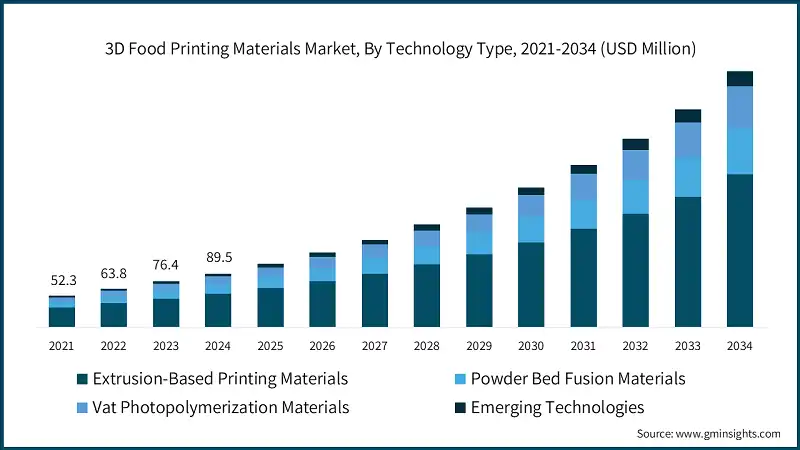
Based on technology type, the 3D food printing materials market is segmented into extrusion-based printing materials, powder bed fusion materials, vat photopolymerization materials, emerging technologies. Extrusion-based printing materials dominated the market with an approximate share of 61.9% in 2024 and is expected to grow with the CAGR of 16.4% through 2034.
- Extrusion-based printing will be developing more and more materials specifically designed for single-use cartridges and portion-controlled formats. These will allow accurate dosing and cut back on waste according to convenience and neatness demanded by consumers. The extrusion system's capability can accommodate many types of food paste, be it plant-based or fortified blends, catering for both home and commercial consumers.
- Powder bed fusion materials are in research for dry shelf-stable formulations that may get activated whenever they are exposed to moisture or heat during printing. This format allows good portability for long-term storage; hence it is in demand for healthcare-related applications while also covering travel and emergency nutrition.
- Materials for vat photopolymerization, albeit less widely adopted for food applications, are currently researched for high-precision edible structures based on food-safe gels and hydrocolloids. Emerging technologies are leading to hybrid materials with interrelated textures, tastes, and nutrition in compact formats. Such as- multi-layered ingredient packs and customizable kits for direct-to-consumer-used substances.
Learn more about the key segments shaping this market
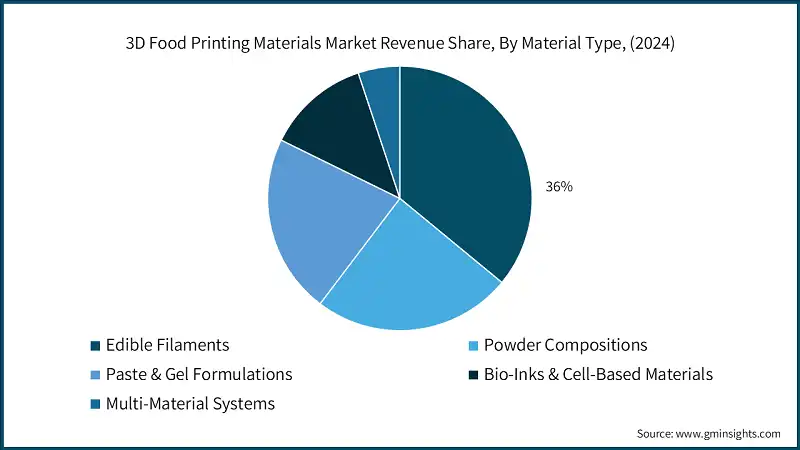
Based on material type, the 3D food printing materials market is segmented into edible filaments, powder compositions, paste & gel formulations, bio-inks & cell-based materials, multi-material systems. Edible filaments hold the largest market share of 36% in 2024 and are expected to grow at a CAGR of 16.8% up to 2034.
- Edible filaments supplement dominates the market with enhanced portability, ease of use, and compatibility with compact 3D food printers. These filaments are often fortified by proteins and fibers that support quick energy intake and the lowest possible preparation making them appropriate for dynamic daily routines.
- Among young consumer classes, such as students and young professionals, powder compositions are fast becoming popular due to their affordability and flexibility. These materials can be stored easily and mixed on demand, enabling convenient printing of snack or meal components.
- Bio-inks and cell-based formulations are being established in niche areas where functional foods and alternative proteins would be focused. They are being assessed concerning their future potential in clinical nutrition, sustainability, and food systems, contributing to a smaller piece of the market as of now.
- Multi-material systems appeal to consumers to have variety and customization in flavor, texture, or nutrition. The systems can therefore print different ingredients simultaneously, allowing tailored and wider food experiences and applications in 3D food.
Based on Application, the 3D food printing materials market is segmented into confectionery & dessert applications, healthcare & medical nutrition, personalized nutrition & supplements, alternative protein & meat analogs, fine dining & culinary arts, emergency & space food applications. Confectionery & dessert applications hold the largest market size of USD 31.2 million in 2024 and is expected to grow at a CAGR of 16.7% between 2025 and 2034.
- The custom-built 3D confectionery and dessert products are creating an increasing involvement of consumers through the internet. The online platforms present different designs and customized flavors to a possible audience. E-commerce channels offer straight purchasing of printables and kits for desserts, especially for avant-garde and personalized preferences of the young consumer segment.
- In personalized nutrition and supplements, digital platforms become core towards consumer interaction. The online configurators would allow a user to choose ingredient profiles, functional additive types, and also flavor preferences. Those would deliver materials into the ready-to-print format either for home or clinical use.
- Targeted digital campaigns joined by influencer content now elevate the profile of alternative proteins and meat analogs. Exploring various e-commerce channels, consumers engrossed in sustainability and plant-based lifestyles are finding print-on-demand protein materials along with trial kits and contextual education.
- Emergency and space food applications rely on secure digital supply chains for sourcing shelf-stable, printable materials. These channels support mission-specific customization and ensure traceability, particularly in institutional and government-led programs.
Based on end user, the 3D food printing materials market is segmented into food manufacturers & processors, healthcare facilities & hospitals, restaurants & culinary establishments, research institutions & universities, consumer & home applications. Food manufacturers & processors dominated the market with an approximate share of 40% in 2024 and is expected to grow with the CAGR of 16.8% by 2034.
- Food manufacturers and processors are adopting this material most promptly to develop customized, scalable product lines. These users focus on using printable ingredients integrated into the production workflow for personalized nutrition, functional foods, and special editions.
- Health facilities and hospitals use texture-modified and nutrient-appropriate materials to assist patients with dietary restrictions, whether due to dysphagia or some chronic condition.
- Restaurants and culinary businesses consider 3D food printing materials for innovative plating, personalized menus, and experiential dining. These users seek versatile, high-end ingredients capable of being printed into complex shapes and textures that will enhance aesthetics and taste. Research institutions and universities work on a range of materials for the purposes of experimentation, prototyping, and food innovation studies.
- The consumer and home application steadily grown by increasing interest in personalized nutrition and smart kitchen technology.
Looking for region specific data?
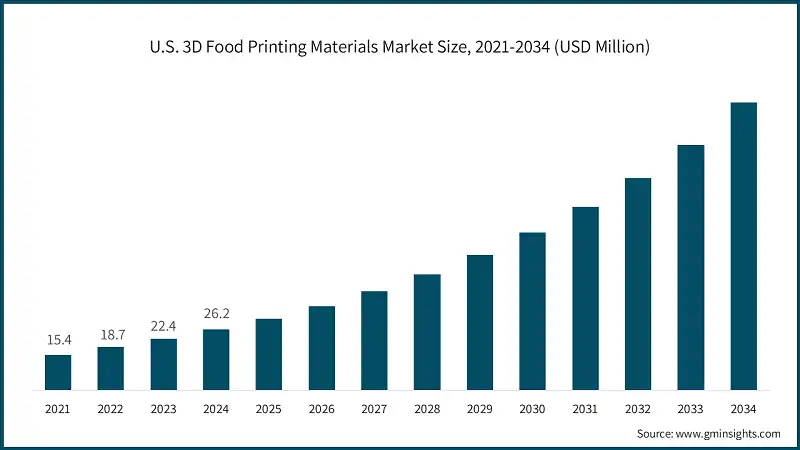
The North America 3D food printing materials market dominated the global market with a revenue share of 35.7% in 2024.
- The use of home 3D food printing materials is gradually spreading in North America since many consumers tend to look toward personalized nutrition, food innovation, and convenience-driven solutions. Commercial interest is growing with collaborations between food tech companies and ingredient suppliers where they make food-safe and scalable aspects of their formulations. Healthcare institutions explore texture-modified and nutrient-specific materials for their clinical nutrition. Simultaneously, restaurants and culinary institutes introduce the printing of ingredients in customizing their dining experience with creativity.
U.S. dominates the North America 3D food printing materials market, showcasing strong growth potential.
- The U.S. occupies the largest share of North America. The contribution of 3D printing is especially noteworthy in food manufacturing, combined with healthcare and consumer segments. The demand is growing mainly for plant-based, fortified, and clean-label printable materials as per the latest diverse dietary trends and wellness priorities.
Europe 3D food printing materials market accounted for USD 26 million in 2024 and is anticipated to show lucrative growth over the forecast period.
- Increasing awareness about health, urbanization, and the demand for innovative food technologies, Europe will steadily develop 3D food printing materials industry in the region. Digital platforms and e-commerce channels are increasingly becoming popular to provide consumers with direct access to ingredient kits, subscription services, and customization tools. The channels also enable customer engagement in the adoption of 3D food printing in both professional and home settings.
Germany dominates the European 3D food printing materials market, showcasing strong growth potential.
- Germany holds the most significant share of this market since it has a continuous research program comprising active industries and growing consumer interest in personalized nutrition and functional food. The food processors operating in Germany are using more plant-based and fortified printables into their operations to meet the ever-evolving diets. Health institutions are contemplating the use of texture-modified preparation in their clinical nutrition, while commercial kitchens and other edible establishments are adopting 3 D printing technologies for plating and offering experiential dining.
The Asia Pacific 3D food printing materials market is anticipated to grow at the CAGR of 17.7% during the analysis timeframe.
- Urbanization, higher disposable incomes, and food innovation opportunities drive Asia-Pacific market growth. Consumers in the region mostly do research for health-oriented personalized food solutions, which in turn encourages the food manufacturers to be developed for plant-based, fortified, and clean-label printable materials. With investments in food tech, consumption by a growing middle class, and awareness of nutrition and sustainability.
China 3D food printing materials market is estimated to grow with a significant CAGR, in the Asia Pacific 3D food printing materials.
- China is fast developing into a stronghold for growth. In China, food manufacturers and researchers are currently exploring paste-based and powder-based compositions in view of upscale applications for snacks, supplements, and functional foods. Digital platform and e-commerce make a considerable distribution path for the materials to be supplied to customers giving direct access to either ingredient kits or custom-made ingredient kits.
Latin America 3D food printing materials market accounted for 5.9% in 2024 and is anticipated to show lucrative growth over the forecast period.
- Latin America 3D food printing materials is growing due to increased urbanization, greater awareness of health, and accessibility to food technology.
- Brazil is ranked first among the regional markets due to increased interest in personalized nutrition, plant-based ingredients, and functional food applications.
Brazil leads the Latin American 3D food printing materials market, exhibiting remarkable growth during the analysis period.
- Food manufacturers in Brazil are currently exploring printable paste- and powder-based materials to create nutritionally dense and consumer-friendly offerings for the busy, health-conscious lifestyle. From snacks to supplements and fortified foods, these offer a full range of products tailored to meet these needs.
Middle East & Africa 3D food printing materials accounted for 5% in 2024 and is anticipated to show lucrative growth over the forecast period.
- The Middle East and Africa 3D food printing materials market has witnessing growth from the effects of urbanization, health awareness, and the growing interest in innovative food. The country showing strong promise as an emerging market in the region is Saudi Arabia, which is expected to adopt 3D food printing technologies in food processing, healthcare, and hospitality.
Saudi Arabia 3D food printing materials market to experience substantial growth in the Middle East and Africa market in 2024.
- Food industries in Saudi Arabia will use paste and powder-based printable materials for more convenient, nutrient-rich options based on improving dietary preferences. Examples include clean-label and fortified as well as plant protein formulations, for which personalized and functional food applications can be developed.
3D Food Printing Materials Market Share
The top 5 companies in 3D food printing materials industry include BASF 3D Printing Solutions, BeeHex (USA), Natural Machines (Foodini), ByFlow (Focus Systems), Chocolate³ (Germany). These are prominent companies operating in their respective regions covering 39% of the market share. These companies hold strong positions due to their extensive experience in 3D food printing materials market. Their diverse product portfolios, backed by robust production capabilities and distribution networks, enable them to meet the rising demand across various regions.
- BASF 3D Printing Solutions involves activities in developing food-safe printable compounds with the areas of material science and industrial scalability. Such activities include researching plant-based and functional formulations suitable for extrusion-based systems.
- BeeHex (USA) applies a combination of robotics with printable food materials for commercial and institutional applications. Their materials provide the basis for automatic production of nutrient-rich, customizable food formats.
- Natural Machines (Foodini) focus on multi-ingredient capability through paste formulations to go with applications in personalized nutrition and healthcare. Their materials are designed for versatility in texture and nutrient release.
- ByFlow (Focus Systems) works with ready-to-eat food cartridges and small-sized printer systems targeting hospitality and catering. Their materials are designed for user-friendliness and aesthetic appeal in the culinary environment.
- Chocolate³ (Germany) focuses on developing specialized chocolate-based printable materials tailored for confectionery and dessert applications. Their formulations are optimized for precision printing, maintaining texture and flavor integrity during the process.
3D Food Printing Materials Market Companies
Major players operating in the 3D food printing materials industry include:
- BASF 3D Printing Solutions
- BeeHex (USA)
- Natural Machines (Foodini)
- ByFlow (Focus Systems)
- Chocolate³ (Germany)
- FilaMunch Materials (USA)
- 3D Systems Corporation
- Stratasys Ltd.
- Print4Taste (Germany)
- Shiyintech (China)
- Wiiboox (China)
- Felix Printer (Netherlands)
- Novameat (Spain)
- Redefine Meat (Israel)
- Nourished (UK)
- Steakholder Foods (Israel)
3D Food Printing Materials Market Report Attributes
| Key Takeaway | Details |
|---|---|
| Market Size & Growth | |
| Base Year | 2024 |
| Market Size in 2024 | USD 89.5 Million |
| Market Size in 2025 | USD 105.2 Million |
| Forecast Period 2025 - 2034 CAGR | 16.8% |
| Market Size in 2034 | USD 425.7 Million |
| Key Market Trends | |
| Drivers | Impact |
| Rising Demand for Personalized Nutrition Solutions | Drives demand for customizable, nutrient-rich printable materials |
| Growing Healthcare Applications for Dysphagia Treatment | Expands use of texture-adapted materials in clinical nutrition |
| Alternative Protein Market Convergence | Encourages development of plant-based, sustainable printing inputs |
| Pitfalls & Challenges | Impact |
| Limited Food Safety Certification & Standards | Lack of regulation slows material approval and consumer trust |
| High Material Development & Certification Costs | R&D and certification expenses limit innovation and scalability |
| Opportunities: | Impact |
| Pharmaceutical & Nutraceutical Integration | Enables functional foods with targeted health benefits |
| Sustainable Food Production & Waste Reduction | Promotes eco-friendly materials and reduces food waste |
| Market Leaders (2024) | |
| Market Leaders |
13% market share |
| Top Players |
Collective Market Share of 39% in 2024 |
| Competitive Edge |
|
| Regional Insights | |
| Largest Market | North America |
| Fastest growing market | Asia-Pacific |
| Emerging countries | Brazil, China and India |
| Future outlook |
|
What are the growth opportunities in this market?
3D Food Printing Materials Industry News
- October 2024, Austrian startup Revo Foods has opened the world’s largest industrial 3D food-printing facility in Vienna.
- January 2024, Cocuus, a Spanish food tech company producing 3D-printed plant-based foods at scale, has produced 1,000 tonnes of 3D-printed plant-based bacon.
- January 2024, Steakholder Foods Ltd a significant company in cultivated meat and 3D bioprinting technology, is announced that it has expanded its 3D-printing capabilities with the world’s first plant-based, 3D-printed shrimps.
This 3D food printing materials market research report includes in-depth coverage of the industry, with estimates & forecasts in terms of revenue (USD Million) and volume from 2025 to 2034, for the following segments:
Market, By Technology Type
- Extrusion-based printing materials
- Powder bed fusion materials
- Vat photopolymerization materials
- Emerging technologies
Market, By Material Type
- Edible filaments
- Powder compositions
- Paste & gel formulations
- Bio-inks & cell-based materials
- Multi-material systems
Market, By Application
- Confectionery & dessert applications
- Healthcare & medical nutrition
- Personalized nutrition & supplements
- Alternative protein & meat analogs
- Fine dining & culinary arts
- Emergency & space food applications
Market, By End Use
- Food Manufacturers & Processors
- Healthcare Facilities & Hospitals
- Restaurants & Culinary Establishments
- Research Institutions & Universities
- Consumer & Home Applications
The above information is provided for the following regions and countries:
- North America
- U.S.
- Canada
- Europe
- Germany
- UK
- France
- Spain
- Italy
- Rest of Europe
- Asia Pacific
- China
- India
- Japan
- Australia
- South Korea
- Rest of Asia Pacific
- Latin America
- Brazil
- Mexico
- Argentina
- Rest of Latin America
- Middle East and Africa
- Saudi Arabia
- South Africa
- UAE
- Rest of Middle East and Africa
Frequently Asked Question(FAQ) :
What is the market size of the 3D food printing materials in 2024?
The market size was USD 89.5 million in 2024, with a CAGR of 16.8% expected through 2034. Advancements in food technology and rising consumer demand for personalized and functional nutrition are driving market growth.
What is the projected value of the 3D food printing materials market by 2034?
The market is poised to reach USD 425.7 million by 2034, driven by innovations in food-safe materials and increasing applications in personalized nutrition and functional foods.
What is the expected size of the 3D food printing materials market in 2025?
The market size is projected to reach USD 105.2 million in 2025.
What was the market share of extrusion-based printing materials in 2024?
Extrusion-based printing materials dominated the market with a share of approximately 61.9% in 2024 and are expected to witness over 16.4% CAGR through 2034.
What was the valuation of edible filaments in 2024?
Edible filaments held the largest market share of 36% in 2024 and are set to expand at a CAGR of 16.8% up to 2034.
What is the growth outlook for confectionery and dessert applications from 2025 to 2034?
Confectionery and dessert applications, valued at USD 31.2 million in 2024, are projected to showcase around 16.7% CAGR between 2025 and 2034.
Which region leads the 3D food printing materials sector?
North America leads the market with a 35.7% share in 2024, led by increasing adoption of home 3D food printing, personalized nutrition, and food innovation.
What are the upcoming trends in the 3D food printing materials market?
Trends include plant-based, allergen-free, and clean-label ingredients, functional feeding, expanding applications, and growing interest in food printing.
Who are the key players in the 3D food printing materials industry?
Key players include BASF 3D Printing Solutions, BeeHex, Natural Machines, ByFlow, Chocolate³, FilaMunch Materials, 3D Systems Corporation, Stratasys Ltd., Print4Taste, Shiyintech, and Wiiboox.
3D Food Printing Materials Market Scope
Related Reports