Summary
Table of Content

3D Chip Stacking Market
Get a free sample of this report
Form submitted successfully!
Error submitting form. Please try again.
Thank you!
Your inquiry has been received. Our team will reach out to you with the required details via email. To ensure that you don't miss their response, kindly remember to check your spam folder as well!
Request Sectional Data
Thank you!
Your inquiry has been received. Our team will reach out to you with the required details via email. To ensure that you don't miss their response, kindly remember to check your spam folder as well!
Form submitted successfully!
Error submitting form. Please try again.
3D Chip Stacking Market Size
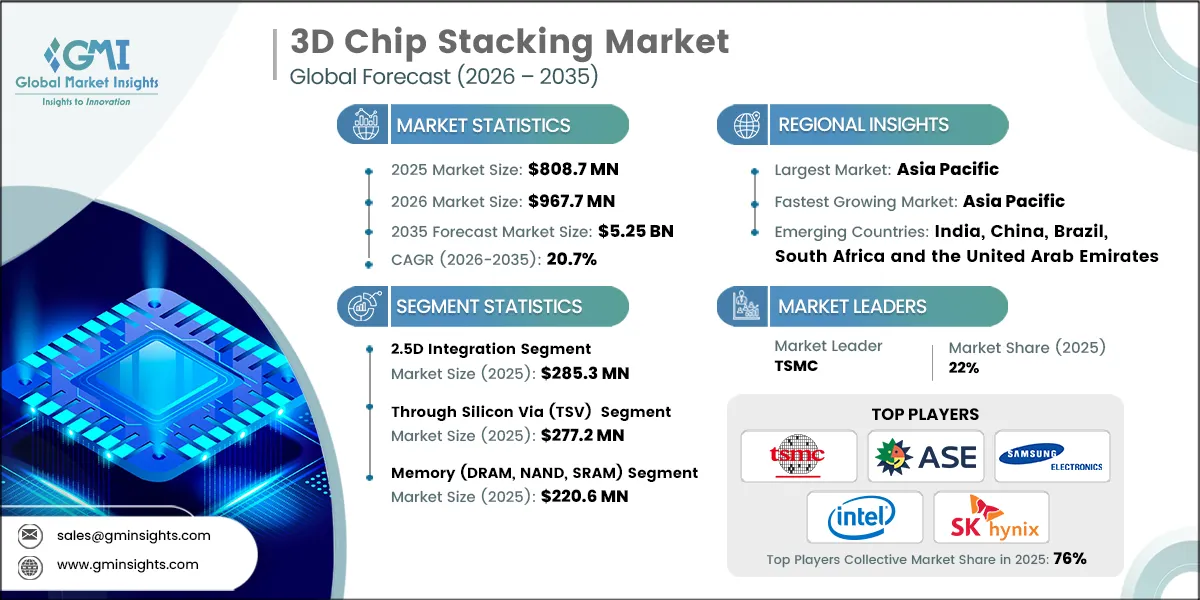
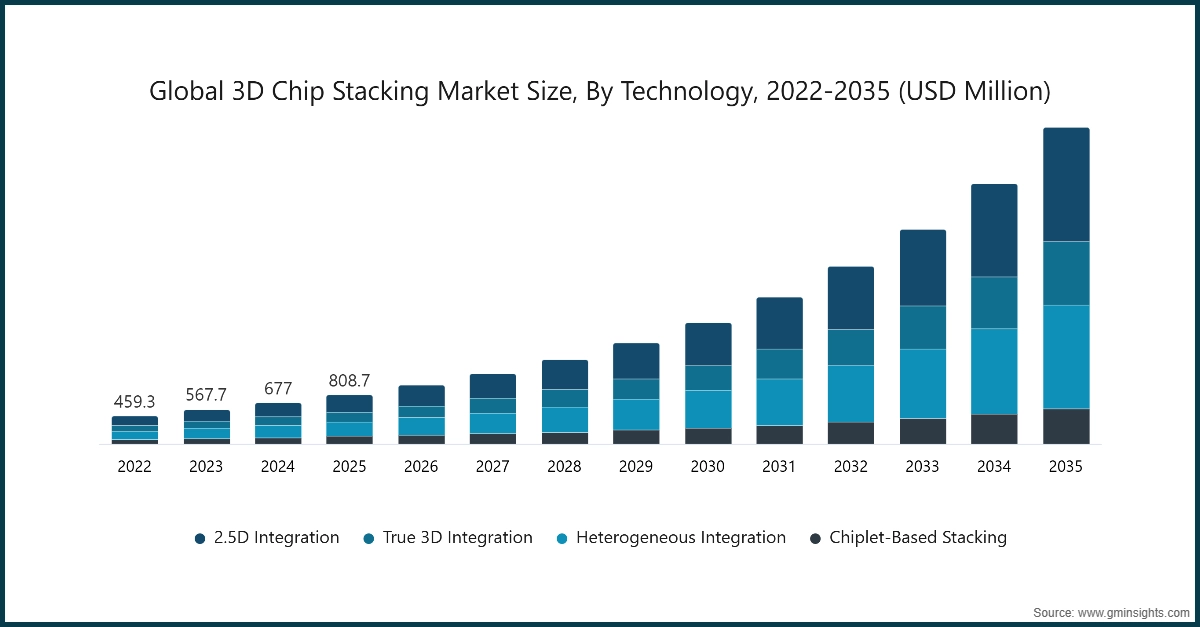
The global 3D chip stacking market was valued at USD 808.7 million in 2025. The market is expected to grow from USD 967.7 million in 2026 to USD 2.43 billion in 2031 and USD 5.25 billion in 2035, at a CAGR of 20.7% during the forecast period, according to the latest report published by Global Market Insights Inc.
To get key market trends
The market is expanding, owing to heterogeneous integration demand, advanced node cost optimization, AI and HPC workload scaling, yield improvement and design flexibility, and ecosystem standardization and open interconnects.
The semiconductor market is becoming innovative with the use of advanced packaging process (3D stacking), which is a vertically integrated strategy of numerous dies. This method improves performance and lowers physical footprint, thus it is a matter of high priority. This shift is being facilitated by governments around the world as a part of wider industrial policy to ensure technological dominance and build a robust supply chain. In the framework of the U.S. CHIPS for America program, the federal agencies declared funding opportunities at the end of 2024 to develop domestic competences in advanced packaging.
The focus of these efforts is on substrate, power delivery and interconnect density innovations needed in next-generation chips. Indicatively, in November 2024, the U.S government has announced funds of up to 300 million to strengthen advanced packaging technologies that are vital to the performance and competitiveness of semiconductor manufacturing.
The global government policies are favouring more towards growing the fabrication of semiconductor and advanced packaging to minimize the dependence on the foreign suppliers. Europe The European Chips Act, as well as other related projects, are supposed to enhance the value chain of semiconductor, which includes assembly, testing, and packaging. These are aimed at improving the industrial autonomy and innovation. European Chips Act which is enforced in the member states has provisions to promote research, production and packaging capacities to promote a robust semiconductor ecosystem. As an example, the European semiconductor regulation was implemented in September 2023, which strengthened the ability of the European Union to innovate and produce advanced semiconductor technologies, such as packaging processes.
3D chip stacking is a highly developed semiconductor packaging technology in which several integrated circuit (IC) dies are stacked on top of each other and bonded together in one package. This methodology can minimize the interconnect distances, increase signal speed as well as allow the ability to densely pack more transistors on a board, which saves board space. It is also compatible with enhanced power efficiency and thermal management that can adequately serve the needs of high-performance computing, AI, and IoT and next-generation electronics that demand compact, low-energy, and high-performance processing.
3D Chip Stacking Market Report Attributes
| Key Takeaway | Details |
|---|---|
| Market Size & Growth | |
| Base Year | 2025 |
| Market Size in 2025 | USD 808.7 Million |
| Market Size in 2026 | USD 967.7 Million |
| Forecast Period 2026-2035 CAGR | 20.7% |
| Market Size in 2035 | USD 5.25 Billion |
| Key Market Trends | |
| Drivers | Impact |
| High demand for miniaturized and high-performance electronics | Strengthens market demand as semiconductor and electronics manufacturers require compact, high-speed, and energy-efficient chips for AI, HPC, mobile, and edge computing applications. |
| Increasing adoption of advanced packaging technologies | Sustains deployment as packaging innovations such as TSV, WLP, and hybrid stacking improve interconnect density, thermal management, and signal integrity, enabling high-performance devices across data centers, automotive, and consumer electronics. |
| Rising use of 3D ICs in data centers and high-performance computing | Enhances market growth as data centers and HPC infrastructures demand higher bandwidth, reduced latency, and energy efficiency, driving adoption of vertically integrated 3D IC solutions. |
| Growth of AI, IoT, and automotive electronics applications | Expands market penetration as AI accelerators, IoT devices, and automotive systems integrate 3D-stacked logic and memory to meet high-speed, power-efficient, and reliable performance requirements. |
| Expansion of semiconductor fabrication and foundry services | Strengthens production capability as foundries and fabs invest in advanced 3D packaging infrastructure, improving accessibility, yield, and scalability for high-performance and heterogeneous chip integration. |
| Pitfalls & Challenges | Impact |
| High manufacturing complexity and cost | Limits adoption in cost-sensitive applications as 3D stacking requires specialized equipment, precise alignment, and multiple processing steps, increasing capital expenditure and overall production cost. |
| Thermal management and heat dissipation challenges | Reduces reliability and performance of stacked chips, as high power density in vertical integration requires advanced cooling solutions and thermal interface materials to maintain optimal operating conditions. |
| Opportunities: | Impact |
| Integration of Heterogeneous and Modular Chiplets | Enables manufacturers to design flexible, scalable, and customizable chip solutions combining logic, memory, and specialized dies, supporting diverse applications in AI, HPC, automotive, and IoT ecosystems. |
| Adoption of AI-Optimized 3D IC Architectures | Creates growth potential as AI and machine learning workloads demand high-bandwidth, low-latency, and energy-efficient 3D ICs, encouraging innovation in stacking architectures, packaging techniques, and advanced interconnects. |
| Market Leaders (2025) | |
| Market Leader |
Market share is 22% in 2025 |
| Top Players |
Collective market share in 2025 is 76% |
| Competitive Edge |
|
| Regional Insights | |
| Largest Market | Asia Pacific |
| Fastest Growing Market | Asia Pacific |
| Emerging Countries | India, China, Brazil, South Africa, and the United Arab Emirates |
| Future outlook |
|
What are the growth opportunities in this market?
3D Chip Stacking Market Trends
- Governments are now focusing more on building local advanced packaging and 3D assembly capabilities to increase the resilience of supply chains and provide semiconductor sovereignty. For instance, the U.S Department of Commerce in January 2025, the CHIPS National Advanced Packaging Manufacturing Program has granted USD 1.4 billion to broaden advanced packaging manufacturing capabilities, such as substrates and prototyping. Such technologies as 3D chip stacking, which are essential in both the high-performance computing and artificial intelligence ecosystems, are directly supported by this initiative.
- One of the major developments in 3D stacking is the growth of heterogeneous integration that integrates logic, memory and specialized dies into one 3D package to apply more functionality and efficiency. The modular architecture supports performance scaling and consumes less power and physical area, and stacked chiplets are especially applicable when artificial intelligence, the Internet of Things, and edge computing need to run. Other industry rules like Universal 3D Chip Stacking Express (UCIe) are also promoting interoperable chiplet ecosystems, which are hastening the uptake of 3D stacking throughout the chain of supply.
- Innovations in bonding technologies, especially hybrid bonding, are changing 3D stacking, allowing smaller interconnect pitches, and making electrical and mechanical connections between stacked dies stronger. Such developments lower latency and increase power efficiency that artificial intelligence accelerators, high-bandwidth memory, and high-performance computing chips need. With the governments and industries still investing in advanced packaging research and development and in the manufacturing, the hybrid bonding is being increasingly realized as a standard of next generation packaging maturity and competitiveness.
- The introduction of high-density memory technologies (3D NAND and high-bandwidth memory, HBM) is inextricably linked to it. These stacks of memory cater to increasing need of increased data throughput and increased power efficiency. They are important to artificial intelligence, data centres, and mobile computing by improving bandwidth and supporting compact architectures. The concern of stacked memory integration in the industry is indicative of the bigger plan of enhancing storage performance in addition to the computational capabilities of 3D integrated designs.
3D Chip Stacking Market Analysis
Learn more about the key segments shaping this market
Based on technology, the 3D chip stacking market is divided into 2.5D integration, True 3D integration, heterogeneous integration, and chiplet-based stacking.
- The 2.5D integration segment accounted for the largest market and was valued at USD 285.3 million in 2025. 2.5D integration enables multiple dies to be placed side-by-side on an interposer, improving bandwidth, reducing latency, and facilitating high-performance computing, networking, and graphics applications.
- Government initiatives supporting advanced semiconductor packaging and interposer development accelerate 2.5D adoption, providing energy-efficient, compact solutions for AI, data centres, and telecommunications infrastructure.
- Manufacturers should invest in 2.5D interposer-based solutions to enhance high-bandwidth and low-latency performance for AI and HPC markets while leveraging government-backed R&D programs.
- The heterogeneous integration segment was the fastest growing market during the forecast period, growing at a CAGR of 22.1% during the forecast period. Heterogeneous integration combines different chip types, memory, logic, and sensors in a single package, enabling high-performance multi-function devices while reducing board space and power consumption.
- Government-funded semiconductor research and industrial policies support heterogeneous integration to drive innovation, enhance supply chain security, and accelerate adoption in AI, automotive, and IoT sectors.
- Manufacturers should adopt heterogeneous integration to deliver modular, multi-function packages for AI, automotive, and IoT applications, leveraging policy incentives for domestic advanced packaging development.
Learn more about the key segments shaping this market
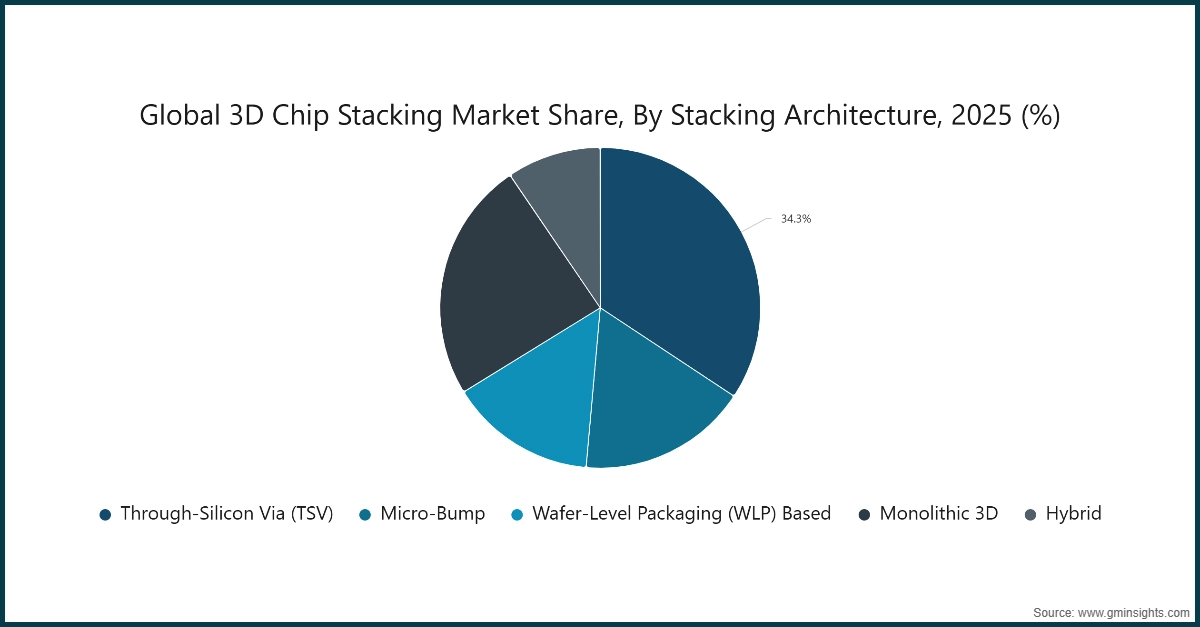
Based on stacking architecture, the 3D chip stacking market is divided into through-silicon via (TSV), micro-bump, wafer-level packaging (WLP) based, monolithic 3D, and hybrid/other.
- The through silicon via (TSV) segment accounted for the largest market and was valued at USD 277.2 million in 2025. TSV technology enables high-density vertical interconnects, reducing signal delay and improving performance in high-speed computing, AI accelerators, and data center applications, making it essential for next-generation high-performance electronic devices.
- Governments and enterprises prioritize energy-efficient and compact chip solutions, boosting TSV adoption in memory and logic stacking, supporting reduced footprint, lower power consumption, and enhanced thermal management in advanced semiconductor products.
- Manufacturers should focus on integrating TSV in high-performance computing and AI memory stacks to meet data center performance demands while leveraging government incentives for advanced packaging research.
- The monolithic 3D segment was the fastest growing market during the forecast period, growing at a CAGR of 22.4% during the forecast period. Monolithic 3D stacking enables integration of multiple layers of transistors on a single silicon wafer, offering superior performance, reduced power consumption, and ultra-compact designs for next-generation AI and edge computing applications.
- Rapid advancements in transistor scaling and semiconductor R&D favour monolithic 3D integration, supporting dense logic stacking for energy-efficient high-performance computing while reducing interconnect delays and enhancing device reliability.
- Manufacturers should invest in monolithic 3D process development to deliver ultra-compact, low-power chips optimized for AI, HPC, and edge computing applications, ensuring leadership in next-generation semiconductors.
On the basis of component, the 3D chip stacking market is divided into memory (DRAM, NAND, SRAM), logic/processor, interconnects, thermal interface materials, substrate & interposers, and others.
- The memory (DRAM, NAND, SRAM) segment accounted for the largest market and was valued at USD 220.6 million in 2025. Rising demand for high-capacity, high-speed memory in AI, data centres, and mobile devices drives memory segment growth, as 3D stacking enables denser DRAM, NAND, and SRAM integration while reducing latency.
- Government initiatives promoting domestic memory manufacturing and research enhance adoption of stacked memory solutions, ensuring energy efficiency, high bandwidth, and reduced footprint in high-performance computing applications.
- Manufacturers should focus on high-density memory integration using 3D stacking to meet AI and data center performance demands while aligning with government-supported R&D incentives.
- The logic / processor segment was the fastest growing market during the forecast period, growing at a CAGR of above 22% during the forecast period. Rapid growth in AI, HPC, and edge computing applications fuels demand for 3D-stacked logic and processor chips that deliver higher performance, reduced latency, and improved power efficiency.
- Advanced semiconductor research programs by governments support innovative processor stacking techniques, accelerating the deployment of energy-efficient, high-performance multi-core and heterogeneous processor designs.
- Manufacturers should invest in 3D-stacked logic processors to serve AI, HPC, and edge computing markets, leveraging government support to scale production and improve performance.
Looking for region specific data?
North America 3D Chip Stacking Market
North America 3D chip stacking industry held a market share of 27.3% in 2025 of the global market.
- The market in North America is growing rapidly due to its strong tech ecosystem, robust R&D infrastructure, and rising demand from data centres, AI, and automotive sectors.
- The presence of leading tech firms like Intel, AMD, and NVIDIA accelerates innovation in heterogeneous integration and high‑density packaging.
- Government support, notably the CHIPS and Science Act fuels domestic advanced packaging and 3D stacking capabilities, strengthening supply chains and reducing reliance on offshore production.
- North American manufacturers should scale 3D stacking and advanced packaging lines in partnership with federal programs to capture high‑performance computing and defense market segments.
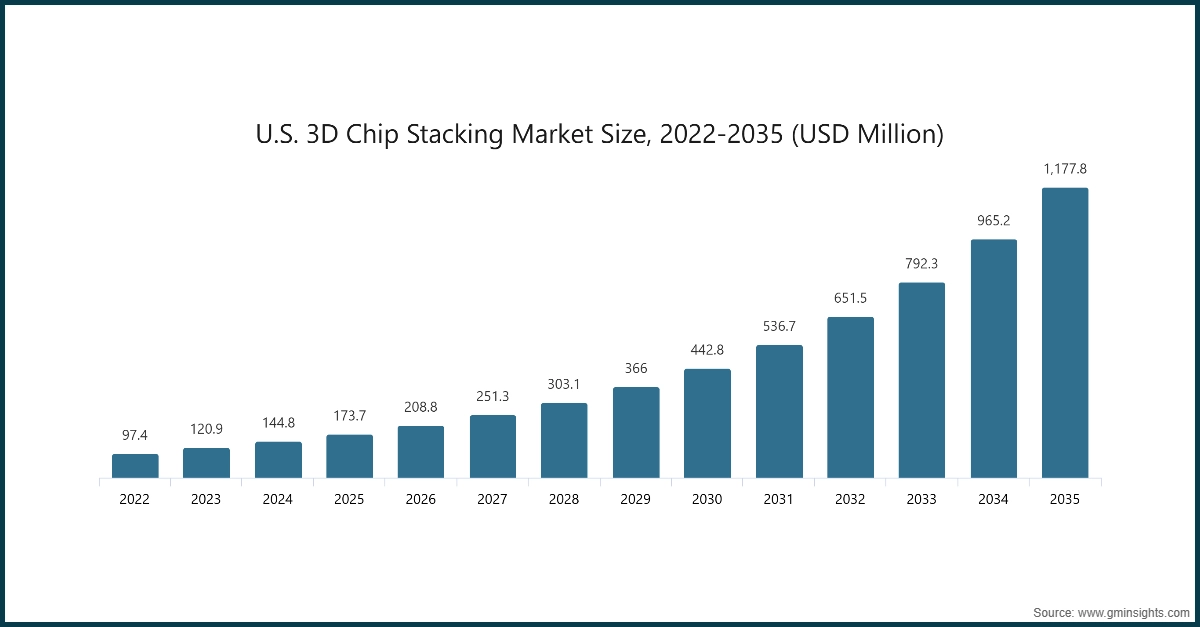
The U.S. 3D chip stacking market was valued at USD 97.4 million and USD 120.9 million in 2022 and 2023, respectively. The market size reached USD 173.7 million in 2025, growing from USD 144.8 million in 2024.
- In the United States, 3D chip stacking is underpinned by significant federal initiatives aimed at bolstering semiconductor sovereignty and advanced packaging leadership.
- The U.S. Department of Commerce announced final awards totalling $1.4 billion under the CHIPS National Advanced Packaging Manufacturing Program to enable domestic validation and scaling of advanced packaging technology where 3D integration plays a central role.
- For instance, in January 2025, news confirmed these finalized awards to strengthen U.S. advanced packaging capabilities essential for next‑generation semiconductor manufacturing and competitiveness.
- U.S. manufacturers should align 3D stacking development with CHIPS funding cycles to secure subsidies and accelerate commercial deployment.
Europe 3D Chip Stacking Market
Europe 3D chip stacking industry accounted for USD 167.3 million in 2025 and is anticipated to show lucrative growth over the forecast period.
- European adoption of 3D chip stacking is progressing as digitalization drives electronics demand across automotive, industrial, and communications sectors.
- The European Chips Act and member state strategies, such as Germany’s microelectronics roadmap, aim to strengthen chip manufacturing, skilled labour, and R&D collaboration across the region.
- Europe benefits from a diverse industrial base that leverages advanced packaging and stacking to enhance performance and energy efficiency in key end markets.
- European manufacturers should target automotive and IoT segments with 3D integrated solutions that align with regional innovation incentives.
Germany dominated the Europe 3D chip stacking market, showcasing strong growth potential.
- Germany aims to establish itself as a leading microelectronics hub in Europe by prioritizing research, production, and workforce development.
- The federal government has introduced a comprehensive microelectronics strategy that outlines targeted measures to strengthen domestic capabilities, including advanced packaging and 3D integration, while enhancing technological sovereignty.
- For instance, in October 2025, Germany's adoption of this strategy was highlighted, reflecting its dedication to reinforcing supply chains and expanding production capacities in critical technologies.
- German firms should leverage government microelectronics objectives to expand 3D stacking R&D and localized production partnerships.
Asia Pacific 3D Chip Stacking Market
The Asia Pacific 3D chip stacking industry is the largest and fastest growing market and is anticipated to grow at the CAGR of 22.1% during the analysis timeframe.
- Asia Pacific leads the global 3D chip stacking market, driven by strong semiconductor manufacturing ecosystems in China, Taiwan, South Korea, and Japan.
- Continuous government support, such as China’s industrial initiatives and Japan’s investments in advanced packaging, accelerates domestic capabilities and global competitiveness.
- The region’s dominance in contract manufacturing and foundry services enables rapid mass production of stacked chips for consumer electronics, AI, and networking applications.
- Asia Pacific manufacturers should deepen collaborations with local governments to expand wafer‑to‑stack integration and chiplet ecosystems.
China 3D chip stacking market is estimated to grow with a CAGR of 23.3% during the forecast period, in the Asia Pacific market.
- China’s 3D chip stacking industry is expanding rapidly through government‑led semiconductor initiatives that prioritize self‑sufficiency, domestic fabrication, and advanced packaging.
- Local production capabilities for memory and logic stacks are scaling under coordinated industrial plans, reducing import dependencies and stimulating innovation in high‑bandwidth memory and AI chips.
- China remains competitive through massive investments in manufacturing infrastructure and technology development.
- Chinese firms should exploit national incentives to scale 3D stacked memory and heterogeneous integration platforms for global and domestic demand.
Latin American 3D Chip Stacking Market
Brazil leads the Latin American 3D chip stacking industry, exhibiting remarkable growth during the analysis period.
- In Brazil, growth in 3D chip stacking is supported by expanding electronics manufacturing and telecommunications upgrades.
- Government incentives under local tech policies help attract investment in assembly, testing, and packaging operations, fostering domestic capacity for advanced semiconductor components.
- Rising smartphone penetration and 5G deployments also stimulate demand for compact, high‑performance stacked solutions.
- Brazilian manufacturers should integrate 3D stacking into local electronics and telecom supply chains to meet rising 5G and IoT product requirements.
Middle East and Africa 3D Chip Stacking Market
South Africa 3D chip stacking market to experience substantial growth in the Middle East and Africa market in 2025.
- South Africa’s 3D chip stacking market is emerging amid broader digital infrastructure expansion and telecom growth.
- While investment and fabrication base are modest relative to leading regions, increasing demand for compact, energy‑efficient devices in enterprise and consumer markets creates incremental opportunities for advanced packaging adoption.
- Government tech initiatives aim to enhance innovation and participation in the semiconductor value chain.
- South African manufacturers should explore partnerships with global packaging specialists to introduce 3D stacked solutions tailored to local digitalization priorities.
3D Chip Stacking Market Share
The 3D chip stacking industry exhibits a moderately consolidated structure, dominated by major multinational semiconductor and advanced packaging companies alongside specialized regional manufacturers. As of 2025, key players such as TSMC, Samsung Electronics, SK Hynix, Intel Corporation, and ASE Technology Holding collectively account for 76% of the total market share, reflecting their strong technological expertise, diverse 3D stacking solutions, and extensive global customer base.
Emerging regional and local players are expanding rapidly in Asia Pacific, Latin America, and Europe by offering cost-effective, energy-efficient 3D chip stacking solutions, targeting high-performance computing, AI, memory, and mobile applications. Regionally, North America and Asia Pacific lead the global market, fuelled by large-scale semiconductor R&D investments, advanced foundry capabilities, and government policies promoting domestic manufacturing and innovation in 3D IC integration.
3D Chip Stacking Market Companies
Prominent players operating in the 3D chip stacking industry are as mentioned below:
- TSMC
- Samsung Electronics
- Intel Corporation
- SK hynix
- Micron Technology
- ASE Technology Holding
- Amkor Technology
- JCET Group
- Powertech Technology Inc. (PTI)
- Sony Semiconductor Solutions
- Toshiba (Kioxia Holdings)
- Texas Instruments
- NVIDIA
- Broadcom
- Qualcomm
- TSMC leads the 3D chip stacking market with a 22.0% share, driven by its broad portfolio of advanced semiconductor fabrication and packaging capabilities. The company focuses on high-performance 3D ICs, wafer-level packaging, and chiplet-based solutions for AI, HPC, and mobile applications. TSMC collaborates closely with global technology firms, semiconductor foundries, and research institutions to expand deployments, ensuring cutting-edge performance, scalability, and compliance with advanced manufacturing standards.
- Samsung Electronics holds an 18.3% share, providing a diverse range of 3D chip stacking solutions, including TSV, heterogeneous integration, and memory stacking technologies. Its products emphasize high performance, energy efficiency, and scalability across consumer electronics, AI accelerators, and data centres. Samsung works with global OEMs, research consortia, and industrial partners to implement innovative 3D stacked solutions that optimize computing performance and power efficiency.
- SK Hynix controls 15.4% of the market, offering memory-focused 3D stacking solutions, including high-density DRAM, NAND, and HBM stacks. Its offerings are designed for high-bandwidth, low-latency applications in data centres, AI, and networking systems. SK Hynix collaborates with system integrators, cloud service providers, and semiconductor partners to deliver reliable, energy-efficient memory solutions that meet global performance and sustainability requirements.
- Intel Corporation accounts for 11.0% of the market, delivering 3D-stacked processors, logic, and interconnect solutions for high-performance computing, AI, and server applications. Its solutions emphasize performance, modularity, and energy efficiency. Intel partners with leading technology companies, research labs, and government programs to deploy advanced 3D stacking technologies that ensure scalability, reliability, and compliance with industry standards.
- ASE Technology Holding holds a 9.3% share, specializing in 3D IC packaging, wafer-level packaging, and heterogeneous integration. Its solutions target high-performance, low-power applications in AI, networking, and mobile devices. ASE works with global semiconductor designers, foundries, and industrial clients to implement cost-effective, scalable, and energy-efficient 3D stacking solutions while maintaining manufacturing precision and operational reliability.
3D Chip Stacking Industry News
- In February 2026, TDK Corporation launched a new line of stackable µPOL DC-DC converters specifically engineered for high-density 3D chip environments. These modules allow for vertical power delivery to AI processors, handling up to 200 A in a footprint that is 30% smaller than previous generations.
- In December 2025, Broadcom Inc. announced the availability of its 3.5D eXtreme Dimension System in Package (XDSiP) platform technology, enabling consumer AI customers to develop next-generation custom accelerators (XPUs). The 3.5D XDSiP integrates more than 6000 mm2 of silicon and up to 12 high bandwidth memory (HBM) stacks in one packaged device to enable high-efficiency, low-power computing for AI at scale.
The 3D chip stacking market research report includes in-depth coverage of the industry with estimates & forecasts in terms of revenue (USD Million) from 2022 to 2035, for the following segments:
Market, By Stacking Architecture
- Through-silicon via (TSV)
- Micro-bump
- Wafer-level packaging (WLP) based
- Monolithic 3D
- Hybrid
Market, By Component
- Memory (DRAM, NAND, SRAM)
- Logic/processor
- Interconnects
- Thermal interface materials
- Substrate & interposers
- Others
Market, By Technology
- 2.5D integration
- True 3D integration
- Heterogeneous integration
- Chiplet-based stacking
Market, By Form Factor
- System-in-package (SiP)
- Package-on-package (PoP)
- 3D die stack
- Fan-out wafer level package (FOWLP)
- Others
Market, By Application
- High-performance computing (HPC)
- Mobile & wearable devices
- AI/ML accelerators
- Storage systems
- Baseband & RF systems
- Sensors & MEMS
- Others
Market, By End-use Industry
- Consumer electronics
- Telecommunications & networking
- Automotive & transportation
- Industrial & automation
- Healthcare & medical devices
- Aerospace & defense
- Data centers & enterprise computing
- Others
The above information is provided for the following regions and countries:
- North America
- U.S.
- Canada
- Europe
- Germany
- UK
- France
- Spain
- Italy
- Netherlands
- Asia Pacific
- China
- India
- Japan
- Australia
- South Korea
- Latin America
- Brazil
- Mexico
- Argentina
- Middle East and Africa
- Saudi Arabia
- South Africa
- UAE
Frequently Asked Question(FAQ) :
Who are the key players in the 3D chip stacking industry?
Key players include TSMC, Samsung Electronics, Intel Corporation, SK hynix, Micron Technology, ASE Technology Holding, Amkor Technology, JCET Group, Powertech Technology Inc. (PTI), and Sony Semiconductor Solutions.
What are the upcoming trends in the 3D chip stacking market?
Trends include the rise of heterogeneous integration, advances in hybrid bonding, adoption of high-density memory such as 3D NAND and HBM, and growing interoperable chiplet ecosystems supported by UCIe standards.
Which region leads the 3D chip stacking sector?
North America leads the market with a 27.3% share in 2025, propelled by a strong tech ecosystem, robust R&D infrastructure, and rising demand from data centers, AI, and automotive sectors.
How much revenue did the 2.5D integration segment generate in 2025?
The 2.5D integration segment generated USD 285.3 million in 2025, by enabling improved bandwidth, reduced latency, and high-performance computing applications.
What was the valuation of the through silicon via (TSV) segment in 2025?
The TSV segment was valued at USD 277.2 million in 2025, led by its ability to enable high-density vertical interconnects, reduce signal delay, and enhance performance in high-speed computing and AI accelerators.
What is the expected size of the 3D chip stacking industry in 2026?
The market size is projected to reach USD 967.7 million in 2026.
What is the projected value of the 3D chip stacking market by 2035?
The market is poised to reach USD 5.25 billion by 2035, fueled by advancements in bonding technologies, high-density memory adoption, and increasing investments in advanced packaging capabilities.
What was the market size of the 3D chip stacking in 2025?
The market size was USD 808.7 million in 2025, with a CAGR of 20.7% expected during the forecast period. Growth is driven by heterogeneous integration demand, advanced node cost optimization, AI and HPC workload scaling, yield improvement, and ecosystem standardization.
3D Chip Stacking Market Scope
Related Reports