
Soundbars Market Size & Share 2026-2035
Download Free PDF
Report Content
Chapter 1. Research Methodology
1.1 Research approach
1.2 Quality Commitments
1.2.1 GMI AI policy & data integrity commitment
1.2.1.1 Source consistency protocol
1.3 Research Trail & Confidence Scoring
1.3.1 Research Trail Components
1.3.2 Scoring Components
1.4 Data Collection
1.4.1 Partial list of primary sources
1.5 Data mining sources
1.5.1 Paid sources
1.5.1.1 Sources, by region
1.6 Base estimates and calculations
1.6.1 Base year calculation
1.7 Forecast model
1.7.1 Quantified market impact analysis
1.7.1.1 Mathematical impact of growth parameters on forecast
1.8 Research transparency addendum
1.8.1 Source attribution framework
1.8.2 Quality assurance metrics
1.8.3 Our commitment to trust
Chapter 2. Executive Summary
2.1 Industry 360° synopsis
2.2 Key market trends
2.2.1 Channel configuration trends
2.2.2 Audio technology trends
2.2.3 Installation method trends
2.2.4 Installation type trends
2.2.5 Connectivity trends
2.2.6 Price range trends
2.2.7 Application industry trends
2.2.8 Distribution channel trends
2.2.9 Regional trends
Chapter 3. Industry Insights
3.1 Industry ecosystem analysis
3.1.1 Supplier Landscape
3.1.2 Profit Margin
3.1.3 Cost structure
3.1.4 Value addition at each stage
3.1.5 Factor affecting the value chain
3.1.6 Disruptions
3.2 Industry impact forces
3.2.1 Growth drivers
3.2.1.1 Rising Smart TV Penetration & Streaming Platform Adoption Elevating Consumer Demand for Audio Accessories
3.2.1.2 Growing Consumer Expenditure on Home Entertainment Ecosystems
3.2.2 Industry pitfalls and challenges
3.2.2.1 Tariff Volatility on Imported Consumer Electronics Components Pressuring Manufacturer Margins
3.2.2.2 Supply Chain Concentration in Asia Pacific for Key Audio Semiconductor Components
3.2.3 Market opportunities
3.2.3.1 Surge in Console & PC Gaming Driving Demand for Low-Latency Spatial Audio Soundbars
3.2.3.2 Expansion of Commercial AV Installations Across Hospitality, Corporate & Education Sectors
3.3 Growth potential analysis
3.4 Pricing Analysis (Driven by Primary Research)
3.4.1 Historical Price Trend Analysis
3.4.2 Pricing Strategy by Player Type (Premium / Value / Cost-plus)
3.5 Regulatory landscape
3.5.1 North America
3.5.2 Europe
3.5.3 Asia-Pacific
3.5.4 Latin America
3.5.5 Middle East and Africa
3.6 Porter’s analysis
3.7 PESTEL analysis
3.8 Trade Data Analysis (Based on Paid Database)
3.8.1 Import/Export Volume & Value Trends
3.8.2 Key Trade Corridors & Tariff Impact
3.9 Impact of AI & Generative AI on the Market (Driven by Primary Research)
3.9.1 AI-Driven Disruption of Existing Business Models
3.9.2 GenAI Use Cases & Adoption Roadmap by Segment
3.9.3 Risks, Limitations & Regulatory Considerations
3.10 Distribution Infrastructure & Channel Penetration Landscape (Driven by Primary Research)
3.10.1 Channel Coverage by Region & Format (Modern vs. Traditional Trade)
3.10.2 Last-Mile Infrastructure Gaps & Emerging Channel Shifts
Chapter 4. Competitive Landscape, 2025
4.1 Introduction
4.2 Company market share analysis
4.2.1 By Region
4.2.1.1 North America
4.2.1.2 Europe
4.2.1.3 Asia-Pacific
4.2.1.4 Latin America
4.2.1.5 Middle East and Africa
4.2.2 Market Concentration Analysis
4.3 Competitive analysis of major market players
4.4 Competitive positioning matrix
4.5 Key developments
4.5.1 Mergers & acquisitions
4.5.2 Partnerships & collaborations
4.5.3 New product launches
4.5.4 Expansion plans and funding
4.6 Company tier benchmarking
4.6.1 Tier classification criteria & qualifying thresholds
4.6.2 Tier positioning matrix by revenue, geography & innovation
Chapter 5. Market Estimates and Forecast, By Channel Configuration, 2022 – 2035 ($ Billion, Million Units)
5.1 Key trends
5.2 2 Channel
5.3 3 Channel
5.4 5 Channel
5.5 7 Channel
5.6 Others (9+ Channel / Specialized Configurations)
Chapter 6. Market Estimates and Forecast, By Audio Technology, 2022 – 2035 ($ Billion, Million Units)
6.1 Key trends
6.2 Standard Stereo / Virtual Surround
6.3 Dolby Atmos / DTS:X (3D Spatial Audio)
6.4 AI-Powered Adaptive Audio
Chapter 7. Market Estimates and Forecast, By Installation Method, 2022 – 2035 ($ Billion, Million Units)
7.1 Key trends
7.2 Active Soundbar
7.3 Passive Soundbar
Chapter 8. Market Estimates and Forecast, By Installation Type, 2022 – 2035 ($ Billion, Million Units)
8.1 Key trends
8.2 Tabletop
8.3 Wall-Mounted
8.4 Portable (Battery-Powered / Outdoor-Capable)
Chapter 9. Market Estimates and Forecast, By Connectivity, 2022 – 2035 ($ Billion, Million Units)
9.1 Key trends
9.2 Wireless
9.2.1 Bluetooth
9.2.2 Wi-Fi
9.3 Wired
9.3.1 HDMI ARC/eARC
9.3.2 Optical (TosLink)
9.3.3 Auxiliary (3.5mm)
9.4 Hybrid
Chapter 10. Market Estimates and Forecast, By Price Range, 2022 – 2035 ($ Billion, Million Units)
10.1 Key trends
10.2 Economy (Below USD 100)
10.3 Mid-Range (USD 100–500)
10.4 Premium (Above USD 500)
Chapter 11. Market Estimates and Forecast, By Application, 2022 – 2035 ($ Billion, Million Units)
11.1 Key trends
11.2 Home Theater / TV Audio
11.3 Gaming
11.4 Music Streaming & Multi-Room Audio
11.5 Commercial
11.5.1 Hospitality (Hotels & Restaurants)
11.5.2 Corporate & Conferencing
11.5.3 Retail & Public Spaces
11.5.4 Education Institutions
Chapter 12. Market Estimates and Forecast, By Distribution Channel, 2022 – 2035 ($ Billion, Million Units)
12.1 Key trends
12.2 Online
12.2.1 E-Commerce Marketplaces
12.2.2 Brand Direct-to-Consumer Websites
12.3 Offline
12.3.1 Consumer Electronics Retailers
12.3.2 Specialty Audio & Video Stores
12.3.3 Hypermarkets & Department Stores
Chapter 13. Market Estimates and Forecast, By Region, 2022 – 2035 ($ Billion, Million Units)
13.1 Key trends
13.2 North America
13.2.1 US
13.2.2 Canada
13.3 Europe
13.3.1 Germany
13.3.2 UK
13.3.3 France
13.3.4 Italy
13.3.5 Spain
13.3.6 Netherlands
13.3.7 Rest of Europe
13.4 Asia Pacific
13.4.1 China
13.4.2 India
13.4.3 Japan
13.4.4 Australia
13.4.5 South Korea
13.4.6 Rest of Asia-Pacific
13.5 Latin America
13.5.1 Brazil
13.5.2 Mexico
13.5.3 Argentina
13.5.4 Rest of Latin America
13.6 Middle East and Africa
13.6.1 South Africa
13.6.2 Saudi Arabia
13.6.3 UAE
13.6.4 Rest of Middle East and Africa
Chapter 14. Company Profiles
Don't see your key competitors?
The companies listed in this report are a curated selection - not the full competitive universe.
Our market revenue calculations use a bottom-up methodology that accounts for all players across all regions - including manufacturers, distributors, and specialists not individually profiled. The profiles section spotlights strategically significant players; it does not define the scope of our market sizing.
Your competitive landscape may also include
Free customization - up to 20% of report value
Need specific data? Request customization and get the insights tailored to your exact requirements.
For inquiries regarding discounts, bulk purchases, or customization requests, please contact us at [email protected]
Share Content
Add Citations
Avinash Singh. 2026, September. Soundbars Market - By Product Type, By Connectivity, By Installation, By Speaker Wattage, By Price Range, By Size, By Application, By Distribution Channel Forecast 2026 - 2035 (Report ID: GMI4638). Global Market Insights Inc. Retrieved November 27, 2026, from https://www.gminsights.com/toc/details/soundbar-market

Soundbars Market
Get a free sample of this report
Soundbars Market Size
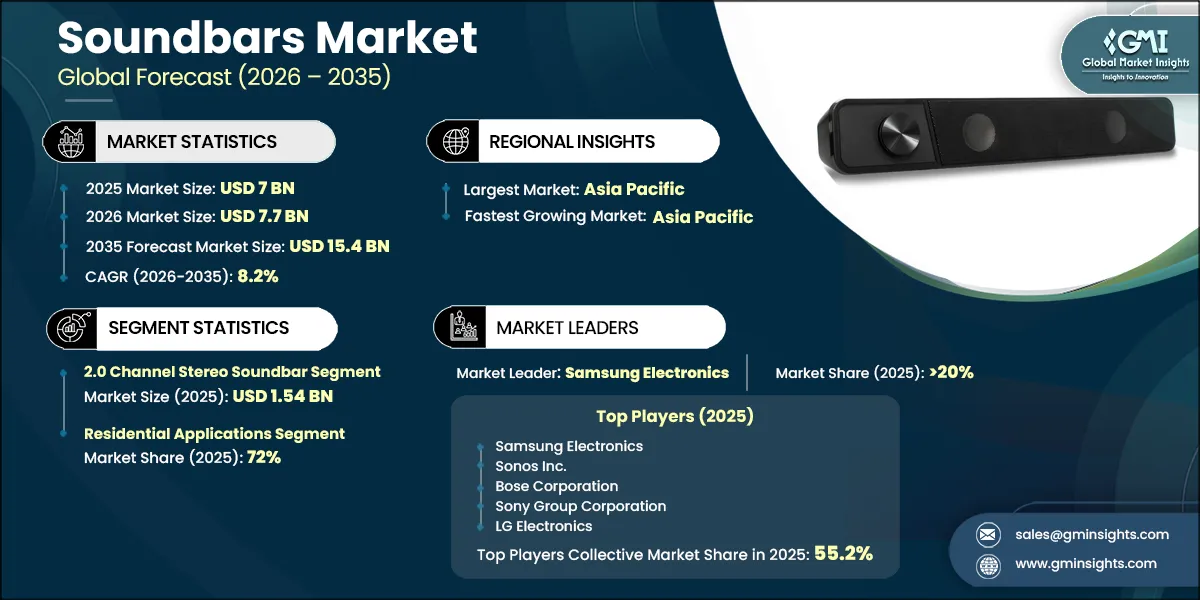
The soundbars market was valued at USD 7 billion in 2025 and is expected to reach USD 7.7 billion in 2026, advancing at a CAGR of 8.2% from 2026 to 2035 to reach USD 15.4 billion by 2035.
The market is being reshaped by the widening gap between increasingly capable displays and the limited acoustic performance of integrated television speakers. Replacement purchases are increasingly tied to streaming-led viewing, gaming, and home-theater upgrades, while connected features and spatial-audio compatibility are strengthening the category's role within the broader home-entertainment purchase cycle.
GMI Analyst View
Based on our research engagement with global soundbar manufacturers and retail distributors, the Soundbars Market recorded a 9.1% CAGR (CY2022–CY2025). That historical performance indicates that demand for upgraded television audio remained resilient through changing consumer-electronics conditions, providing a durable base for the current forecast outlook.
Soundbars Market Trends, Growth Drivers & GMI Forecast Outlook
Soundbar demand is moving beyond a simple television accessory purchase toward an audio-system decision shaped by content formats, interoperability, room constraints, and retail price architecture. The outlook depends on whether premium spatial-audio adoption can continue to offset cost pressure in the high-volume middle of the category.
Key Drivers
*Evidence anchors use cited external data; demand implications and forecast conditions represent GMI analysis.*
Smart television adoption has repositioned soundbars from a discretionary upgrade toward a complementary purchase for households dissatisfied with thin-display speaker performance. More than four-fifths of global television shipments were smart TVs in 2024, enlarging the addressable installed base for audio accessories and increasing exposure to streaming environments where sound quality is more visible to consumers. [1]
Spatial-audio delivery is changing the basis on which consumers compare products. Rather than selecting solely for louder output or added bass, buyers are increasingly evaluating dialogue clarity, perceived immersion, room calibration, and compatibility with encoded content. This favors manufacturers that can convert format support into a credible listening experience rather than treating it as a checklist feature.
Connected-home compatibility further broadens the addressable market by making soundbars easier to discover, install, and control within an existing device ecosystem. Integration with voice assistants, multi-room platforms, and television connectivity standards can reduce setup concerns for less technical buyers while giving retailers a clearer cross-selling proposition.
Key Restraints
*Evidence anchors use cited external data; demand implications and forecast conditions represent GMI analysis.*
Consumer-electronics deflation in mature markets intensifies the need for deliberate product-mix management. Brands with European exposure must differentiate through acoustic performance, software features, and format compatibility if they are to avoid competing principally on price. Regulatory compliance requirements also increase the relative advantage of suppliers with established product-certification capabilities and local channel relationships.
Tariff uncertainty is especially consequential in the middle of the soundbar price ladder, where shoppers have numerous substitutes and a modest retail increase can encourage postponement or a move to a lower-specification model. Suppliers therefore face a difficult trade-off between preserving margin, redesigning sourcing, and maintaining price points that remain credible alongside television promotions.
Component concentration creates an operational constraint separate from consumer demand. Advanced configurations depend on coordinated availability of audio-processing, connectivity, and interface components; disruptions can compress launch windows and limit the ability of manufacturers to match inventory with seasonal retail demand. The risk is most pronounced for suppliers whose product plans rely on tightly timed upgrades rather than more flexible platform architectures.
GMI Analyst View
We see the central forecast tension in the contrast between premiumization and affordability. Spatial-audio content gives consumers a stronger reason to upgrade, but the largest transaction pool remains sensitive to retail price changes. Manufacturers that can create visible acoustic differentiation without allowing configuration complexity to overwhelm the mid-range buyer should be best placed to convert interest into revenue.
Soundbars Market Segment Analysis
By Channel Configuration
The 2.0 channel stereo soundbar generated USD 1.54 billion in revenue in 2025 and is projected to represent 18.0% of the global soundbars market by 2035. The Soundbars Market continues to require an entry-level tier for first-time purchasers, commercial installations, and value-conscious households. However, stereo-only products face increasing pressure where buyers can access subwoofer-equipped or spatial-audio-capable alternatives with a manageable step-up in retail price.
The 2.1 channel configuration accounted for 34.0% of global revenue in 2025 and is expected to generate USD 4.62 billion by 2035. Its commercial strength rests on a practical balance of bass reinforcement, ease of installation, and mass-market affordability. The configuration remains an important entry point in developing markets and provides a volume base for manufacturers even as repeat purchasers in mature markets trade into more elaborate systems.
The 3.1 channel configuration generated USD 910 million in 2025 and is forecast to grow at an 8.2% CAGR (2026–2035). A dedicated center channel addresses a highly visible consumer pain point: unclear dialogue from integrated television speakers. That functional benefit gives 3.1 channel products relevance across both residential viewing and smaller commercial settings where speech intelligibility matters as much as cinematic impact.
The 5.1 channel segment is expected to account for 12.0% of global revenue by 2035 and is projected to expand at a 9.1% CAGR (2026–2035). This configuration occupies a valuable step-up position for buyers seeking surround immersion without the installation burden of a more complex system. Gaming and high-engagement video content are likely to support its appeal because directional sound can be perceived as a tangible upgrade rather than an abstract specification.
Multi-Channel and Dolby Atmos (7.1.2+) products represented 20.0% of global revenue in 2025 and are expected to generate USD 4.16 billion by 2035. The segment is positioned to capture disproportionate value as content availability, beam-forming capability, room calibration, and premium television ownership converge. Its growth also gives manufacturers a path to protect average selling prices, although performance claims must be credible in real rooms rather than relying solely on format branding.
By Application
Residential applications accounted for 72.0% of global revenue in 2025 and are projected to represent 68.0% by 2035. Home entertainment remains the category's anchor, but the changing revenue mix indicates that soundbars are extending beyond the living room. Household demand will continue to depend on television replacement cycles, streaming habits, and the degree to which consumers view audio as integral to a premium screen purchase.
Commercial applications generated USD 1.96 billion in 2025 and are forecast to grow at a 9.7% CAGR (2026–2035). Hotels, offices, restaurants, healthcare facilities, and education settings value soundbars for their compact format, installation efficiency, and ability to improve audio without extensive speaker-array infrastructure. Procurement decisions in these settings are increasingly shaped by integration requirements, repeatability across sites, and the economics of maintenance rather than retail-oriented feature comparisons.
GMI Analyst View
We believe the segment opportunity is less about a wholesale replacement of entry-tier products than a widening spread between value and premium propositions. Suppliers need efficient platforms at the accessible end of the market while reserving genuine acoustic, software, and connectivity differentiation for higher configurations. The ability to manage that spread will matter more than a narrow focus on any single product tier.
Soundbars Market Regional Analysis
North America Soundbars Market Analysis
North America generated USD 2.09 billion revenue in soundbars market in 2025 and is projected to reach USD 4.09 billion by 2035. Regional demand is shaped primarily by replacement and upgrade behavior rather than first-time category formation. Premium television ownership, streaming intensity, gaming, and established retail channels support higher-configuration products, while pricing pressure in the mid-range makes supplier discipline around assortment, promotions, and sourcing particularly important.
United States
The United States accounted for 26.5% of global soundbar revenue in 2025 and is projected to generate USD 3.62 billion by 2035. The market's scale reflects a mature streaming culture, broad device connectivity, and a consumer base accustomed to upgrading home-entertainment hardware. Demand is likely to favor brands that can pair premium audio capabilities with a simple setup experience and visible compatibility with major television platforms.
Canada
Canada represented 3.4% of global soundbar revenue in 2025 and is forecast to expand at a 7.0% CAGR (2026–2035). Canadian demand broadly follows the North American upgrade pattern, with urban households more receptive to multi-channel systems and suburban buyers sustaining demand for mainstream configurations. Retail assortment and cross-border brand availability remain important determinants of category access.
Europe Soundbars Market Analysis
Europe accounted for 24.0% of global soundbar revenue in 2025 and is expected to grow at a 6.5% CAGR (2026–2035). The region combines a sophisticated consumer-electronics base with persistent price competition and extensive product-compliance requirements. Growth is therefore likely to favor companies that can defend premium positioning through recognized audio credentials, strong retailer execution, and products that deliver clear value beyond incremental feature additions.
United Kingdom
The United Kingdom accounted for 5.3% of global soundbar revenue in 2025 and is projected to reach USD 690 million by 2035. A mature streaming environment and relatively premium consumer mix support demand for connected and multi-channel products. The market is also well suited to direct-to-consumer propositions, although brands must balance online convenience with the role of demonstration and advice in premium audio purchases.
Germany
Germany represented 4.3% of global soundbar revenue in 2025 and is forecast to grow at a 6.6% CAGR (2026–2035). Brand heritage, specialist retail, and consumer attention to product engineering support opportunities for established audio suppliers. Smart-home adoption and e-commerce growth are broadening the route to market, but product credibility and long-term service expectations remain influential in purchase decisions.
France
France generated USD 269 million in soundbar revenue in 2025 and is expected to account for 3.3% of global revenue by 2035. Online retail is increasingly central to the French market, creating opportunities for manufacturers that can present technical benefits clearly and manage product reviews, delivery, and after-sales support effectively. Premium demand is likely to depend on how well brands simplify configuration choices for non-specialist consumers.
Italy
Italy accounted for 2.9% of global soundbar revenue in 2025. Demand remains weighted toward products that improve television audio without introducing a substantial price or installation barrier. Streaming adoption and smart-TV replacement provide a foundation for category growth, although value perceptions will remain central to configuration choice.
Spain
Spain accounted for 2.6% of global soundbar revenue in 2025. The market offers a meaningful opportunity for accessible configurations that improve day-to-day streaming and television viewing. Suppliers that align promotional activity with television retail cycles and offer straightforward connected features are likely to be better positioned than brands relying on specialist-audio positioning alone.
Asia Pacific Soundbars Market Analysis
Asia Pacific represented 34.0% of global soundbar revenue in 2025 and is projected to generate USD 6.15 billion by 2035. The region is the principal engine of category expansion because it combines large-scale first-time adoption with premiumization in advanced consumer-electronics markets. Its importance also reflects proximity to manufacturing capacity, broad online retail reach, and increasingly localized content and product ecosystems.
China
China generated USD 1.0 billion in soundbar revenue in 2025 and is projected to reach USD 2.65 billion by 2035. Rising interest in higher-quality home entertainment is creating room for both mid-range upgrades and premium spatial-audio systems. Domestic platform ecosystems and intense competition among television brands are likely to make integrated retail bundles, platform compatibility, and local channel execution especially consequential.
India
India accounted for 4.1% of global soundbar revenue in 2025 and is forecast to grow at an 11.1% CAGR (2026–2035). The market combines expanding discretionary spending with a large base of consumers entering the category for the first time. Competitive price points, broad e-commerce distribution, and localized brand strategies will be essential, while domestic electronics manufacturing policy may continue to shape supplier economics and product availability.
Japan
Japan generated USD 333 million in soundbar revenue in 2025 and is projected to reach USD 741 million by 2035. Demand is supported by consumers who value technical performance but also by urban housing conditions that favor compact audio solutions. The category can gain share from legacy component systems when manufacturers demonstrate that a simplified form factor does not require a material compromise in sound quality.
South Korea
South Korea accounted for 3.4% of global soundbar revenue in 2025 and is forecast to grow at an 8.7% CAGR (2026–2035). The influence of leading domestic television and audio manufacturers supports rapid feature diffusion and ecosystem-led purchases. Strong broadband, gaming, and streaming usage provide favorable conditions for spatial-audio products, although competition will remain intense as local brands defend their home-market presence.
Australia
Australia represented 2.7% of global soundbar revenue in 2025 and is projected to generate USD 433 million by 2035. High household consumer-electronics spending and established streaming behavior make the market primarily an upgrade opportunity. Products that combine premium-format support with uncomplicated installation are well placed to appeal to households seeking a meaningful improvement without a dedicated theater-room buildout.
Latin America Soundbars Market Analysis
Latin America generated USD 420 million in soundbar revenue in 2025 and is forecast to grow at a 9.5% CAGR (2026–2035). The region's opportunity stems from rising access to connected televisions, expanding streaming consumption, and a growing willingness to invest in home entertainment. Price architecture remains decisive, making 2.0 and 2.1 channel systems important volume products even as premium demand develops in major urban markets.
Brazil
Brazil accounted for 2.9% of global soundbar revenue in 2025 and is projected to reach USD 512 million by 2035. The country has the scale, retail infrastructure, and streaming penetration to serve as the regional demand anchor. Manufacturers need to balance premium storytelling in major cities with accessible entry points that fit the broader market's purchasing power and channel structure.
Mexico
Mexico generated USD 118 million in soundbar revenue in 2025 and is forecast to grow at a 9.1% CAGR (2026–2035). Proximity to North American supply and brands shapes product availability and consumer aspirations, while improving broadband access supports home-entertainment spending. The strongest propositions are likely to combine familiar brands, credible feature sets, and price points suitable for first-time buyers.
Argentina
Argentina is a developing contributor to regional soundbar demand, supported by consumer interest in improving television and streaming audio within compact residential settings. Economic volatility and purchasing-power constraints make affordability, channel financing, and product durability particularly important. Suppliers that can maintain availability without overextending premium price positioning are likely to have the most resilient opportunity.
Middle East & Africa Soundbars Market Analysis
Middle East & Africa accounted for 6.0% of global soundbar revenue in 2025 and is projected to generate USD 990 million by 2035. Demand is divided between premium residential and hospitality deployments in Gulf markets and broader entry-level consumer-electronics growth elsewhere in the region. This calls for differentiated channel strategies: specification-led selling in luxury developments and accessible retail propositions in volume-oriented markets.
Saudi Arabia
Saudi Arabia represented 1.9% of global soundbar revenue in 2025 and is forecast to grow at a 9.2% CAGR (2026–2035). Entertainment investment, hotel development, and a young consumer base with high media engagement support the market's outlook. Premium residential demand and commercial projects create scope for suppliers that can work across consumer retail and professional installation channels.
UAE
The UAE generated USD 118 million in soundbar revenue in 2025 and is projected to reach USD 280 million by 2035. Luxury residential developments and a concentrated hospitality base support demand for higher-value audio solutions. International brands with established distributor relationships and project-specification capabilities have an advantage in serving both premium homes and commercial venues.
South Africa
South Africa accounted for 1.0% of global soundbar revenue in 2025 and is projected to generate USD 157 million by 2035. Urban broadband growth, smart-TV ownership, and an established consumer-electronics retail network provide a foundation for wider adoption. Value, reliability, and local distribution reach will remain more important than niche feature leadership for much of the addressable market.
GMI Analyst View
We expect Asia Pacific to define the industry's next phase of scale, but the opportunity will not be uniform. China and South Korea reward premium capability and ecosystem integration, while India and other emerging markets demand disciplined affordability. The most durable global strategies will combine common platforms with region-specific product tiers, channel models, and retail narratives.
Soundbars Market Share & Competitive Landscape
The Soundbars Market share structure is moderately concentrated, with the top five players collectively accounting for 55.2% of global revenue in 2025. Scale matters because leading suppliers can coordinate television ecosystems, audio engineering, retail presence, product certification, and global sourcing, yet the category remains open to specialists that establish a credible position in premium acoustics, smart-home software, or value-led distribution.
Samsung Electronics held a 20.0% market share in 2025. Samsung's advantage extends beyond standalone audio hardware: its television installed base creates opportunities for bundled merchandising and ecosystem-oriented purchasing. The company's higher-end soundbar strategy emphasizes multi-channel formats, wireless rear-speaker configurations, and close integration with premium television lines, making the retail proposition difficult for independent audio brands to replicate at equivalent scale.
Sonos Inc. accounted for 10.0% of the global market in 2025. Sonos differentiates through software, room calibration, multi-room control, and a tightly managed premium ecosystem. Its ability to sustain price realization is strategically important in a deflationary category, although confirmed price increases tied to tariff exposure test the limits of premium consumer tolerance and place greater emphasis on product value communication. [4]
Bose Corporation represented 9.5% of global market revenue in 2025. Bose retains a strong position through brand recognition, proprietary audio processing, direct digital sales, and broad premium-retail distribution. Its competitive challenge is to preserve the association between the Bose brand and perceptible performance advantages as television manufacturers and specialist competitors expand their own premium soundbar portfolios.
Sony and LG bring broader audio-visual ecosystems to the market, while Hisense and TCL use television scale and Asian distribution reach to compete at more accessible price points. Yamaha, Panasonic, Sharp, Vizio, Bang & Olufsen, KEF, Devialet, and regional challengers occupy differentiated positions across specialist audio, ultra-premium design, and value-led retail. This diversity keeps the category competitive despite the concentration at the top.
Yamaha's True X Surround 90A illustrates the continued importance of format differentiation in the premium segment, pairing support for Dolby Atmos and DTS:X with AURO-3D capability. [7] Such products reinforce that premium competition will depend not only on additional channels, but also on the quality of processing, calibration, and content-format support.
Recent Industry Developments
HARMAN International completed its acquisition of Sound United on September 23, 2025, adding brands including Bowers & Wilkins, Denon, Marantz, Definitive Technology, Polk Audio, HEOS, Classe, and Boston Acoustics to its portfolio. [5] The transaction expands the group's premium home-audio reach and creates scope for cross-brand technology, distribution, and product-positioning initiatives within a broader Samsung-owned ecosystem.
LG Electronics announced LG Sound Suite in December 2025, centered on the H7 soundbar and Dolby Atmos FlexConnect capability. [6] The launch signals a move toward modular, adaptable home-audio architectures that narrow the historic distinction between an all-in-one soundbar and a more extensive speaker system.
Need a specific section of this report?
Purchase regional analysis, country-level analysis, company profiles, or any other segment-level insights separately
based on your research needs.