
Security Control Room Market Size & Share 2026-2035
Download Free PDF
Report Content
Chapter 1. Methodology and Scope
1.1 Market scope and definition
1.2 Research design
1.2.1 Research approach
1.2.2 Data collection methods
1.3 Data mining sources
1.3.1 Global
1.3.2 Regional/Country
1.4 Base estimates and calculations
1.4.1 Base year calculation
1.4.2 Key trends for market estimation
1.5 Primary research and validation
1.5.1 Primary sources
1.6 Forecast model
1.7 Research assumptions and limitations
Chapter 2. Executive Summary
2.1 Industry 360° synopsis
2.2 Key market trends
2.2.1 Offering trends
2.2.2 Deployment mode trends
2.2.3 Application trends
2.2.4 End use trends
2.2.5 Regional trends
2.3 TAM Analysis, 2027–2035 (USD Million)
2.4 CXO perspectives: Strategic imperatives
2.4.1 Executive decision points
2.4.2 Critical success factors
2.5 Future outlook and strategic recommendations
Chapter 3. Industry Insights
3.1 Industry ecosystem analysis
3.1.1 Supplier landscape
3.1.2 Profit margin
3.1.3 Cost structure
3.1.4 Value addition at each stage
3.1.5 Factor affecting the value chain
3.1.6 Disruptions
3.2 Industry impact forces
3.2.1 Growth drivers
3.2.1.1 Rising urbanization and smart city investments
3.2.1.2 Increasing public safety and homeland security concerns
3.2.1.3 Expansion of critical infrastructure and transportation networks
3.2.1.4 Growing adoption of integrated command and control systems
3.2.1.5 Rising corporate demand for centralized security operations
3.2.2 Pitfalls and challenges
3.2.2.1 High initial capital and system integration costs
3.2.2.2 Cybersecurity risks and data privacy concerns
3.3 Growth potential analysis
3.4 Regulatory landscape
3.4.1 North America
3.4.2 Europe
3.4.3 Asia Pacific
3.4.4 Latin America
3.4.5 Middle East & Africa
3.5 Porter’s analysis
3.6 PESTEL analysis
3.7 Technology and Innovation landscape
3.7.1 Current technological trends
3.7.2 Emerging technologies
3.8 Emerging Business Models
3.9 Compliance Requirements
3.10 Sustainability Initiatives
3.11 Supply Chain Resilience
3.12 Geopolitical Analysis
3.13 Digital Transformation
Chapter 4. Competitive Landscape, 2025
4.1 Introduction
4.2 Company market share analysis
4.2.1 By region
4.2.1.1 North America
4.2.1.2 Europe
4.2.1.3 Asia Pacific
4.2.1.4 Latin America
4.2.1.5 Middle East & Africa
4.2.2 Market concentration analysis
4.3 Competitive benchmarking of key players
4.3.1 Product portfolio comparison
4.3.1.1 Product range breadth
4.3.1.2 Technology
4.3.1.3 Innovation
4.3.2 Geographic presence comparison
4.3.2.1 Global footprint analysis
4.3.2.2 Service network coverage
4.3.2.3 Market penetration by region
4.3.3 Competitive positioning matrix
4.3.3.1 Leaders
4.3.3.2 Challengers
4.3.3.3 Followers
4.3.3.4 Niche players
4.3.4 Strategic outlook matrix
4.4 Key developments, 2022-2025
4.4.1 Mergers and acquisitions
4.4.2 Partnerships and collaborations
4.4.3 Technological advancements
4.4.4 Expansion and investment strategies
4.4.5 Sustainability initiatives
4.4.6 Digital transformation initiatives
4.5 Emerging/ startup competitors landscape
Chapter 5. Market Estimates and Forecast, By Offering, 2022 - 2035 (USD Million)
5.1 Key trends
5.2 Hardware
5.2.1 Display systems
5.2.2 Projectors
5.2.3 KVM switches & control equipment
5.2.4 Operator workstations & consoles
5.2.5 Network infrastructure equipment
5.2.6 Servers & storage systems
5.2.7 Others
5.3 Software
5.3.1 Video Management Systems (VMS)
5.3.2 Physical Security Information Management (PSIM)
5.3.3 Access control management software
5.3.4 Analytics & AI/ML platforms
5.3.5 Incident management systems
5.3.6 Command & control platforms
5.3.7 Visualization & dashboard software
5.3.8 Others
5.4 Services
5.4.1 System integration & installation services
5.4.2 Maintenance & technical support
5.4.3 Consulting & design services
5.4.4 Training & operator development
5.4.5 Others
Chapter 6. Market Estimates and Forecast, By Deployment Mode, 2022 - 2035 (USD Million)
6.1 Key trends
6.2 On-premises
6.3 Cloud-based
6.4 Hybrid
Chapter 7. Market Estimates and Forecast, By Application, 2022 - 2035 (USD Million)
7.1 Key trends
7.2 Public safety
7.3 Corporate safety
7.4 Industrial safety
Chapter 8. Market Estimates and Forecast, By End Use, 2022 - 2035 (USD Million)
8.1 Key trends
8.2 Government & defense
8.2.1 Law enforcement & police operations
8.2.2 Military & defense
8.2.3 Border security & immigration control
8.2.4 Intelligence & national security agencies
8.2.5 Others
8.3 Transportation
8.3.1 Airports & aviation security
8.3.2 Seaports & maritime security
8.3.3 Railways & mass transit systems
8.3.4 Logistics & distribution centers
8.3.5 Others
8.4 BFSI
8.4.1 Bank branches & atm networks
8.4.2 Data centers
8.4.3 Others
8.5 Manufacturing
8.5.1 Automotive
8.5.2 Electronics & semiconductor
8.5.3 Aerospace & defense
8.5.4 Chemicals & petrochemicals
8.5.5 Food & beverage
8.5.6 Others
8.6 Utilities
8.6.1 Power generation & distribution
8.6.2 Water & wastewater treatment
8.6.3 Oil & gas infrastructure
8.6.4 Others
8.7 Healthcare
8.7.1 Hospitals & medical centers
8.7.2 Pharmaceutical manufacturing
8.7.3 Patient safety & access control
8.7.4 Others
8.8 Retail & commercial real estate
8.8.1 Shopping malls & retail chains
8.8.2 Corporate office buildings
8.8.3 Commercial complexes
8.8.4 Others
8.9 Others
Chapter 9. Market Estimates and Forecast, By Region, 2022 - 2035 (USD Million)
9.1 Key trends
9.2 North America
9.2.1 U.S.
9.2.2 Canada
9.3 Europe
9.3.1 Germany
9.3.2 UK
9.3.3 France
9.3.4 Spain
9.3.5 Italy
9.3.6 Netherlands
9.4 Asia Pacific
9.4.1 China
9.4.2 India
9.4.3 Japan
9.4.4 Australia
9.4.5 South Korea
9.5 Latin America
9.5.1 Brazil
9.5.2 Mexico
9.5.3 Argentina
9.6 Middle East and Africa
9.6.1 Saudi Arabia
9.6.2 South Africa
9.6.3 UAE
Chapter 10. Company Profiles
Don't see your key competitors?
The companies listed in this report are a curated selection - not the full competitive universe.
Our market revenue calculations use a bottom-up methodology that accounts for all players across all regions - including manufacturers, distributors, and specialists not individually profiled. The profiles section spotlights strategically significant players; it does not define the scope of our market sizing.
Your competitive landscape may also include
Free customization - up to 20% of report value
Need specific data? Request customization and get the insights tailored to your exact requirements.
For inquiries regarding discounts, bulk purchases, or customization requests, please contact us at [email protected]
Share Content
Add Citations
Suraj Gujar. 2026, September. Security Control Room Market (Report ID: GMI5208). Global Market Insights Inc. Retrieved November 13, 2026, from https://www.gminsights.com/toc/details/security-control-room-market

Security Control Room Market
Get a free sample of this report
Security Control Room Market Size
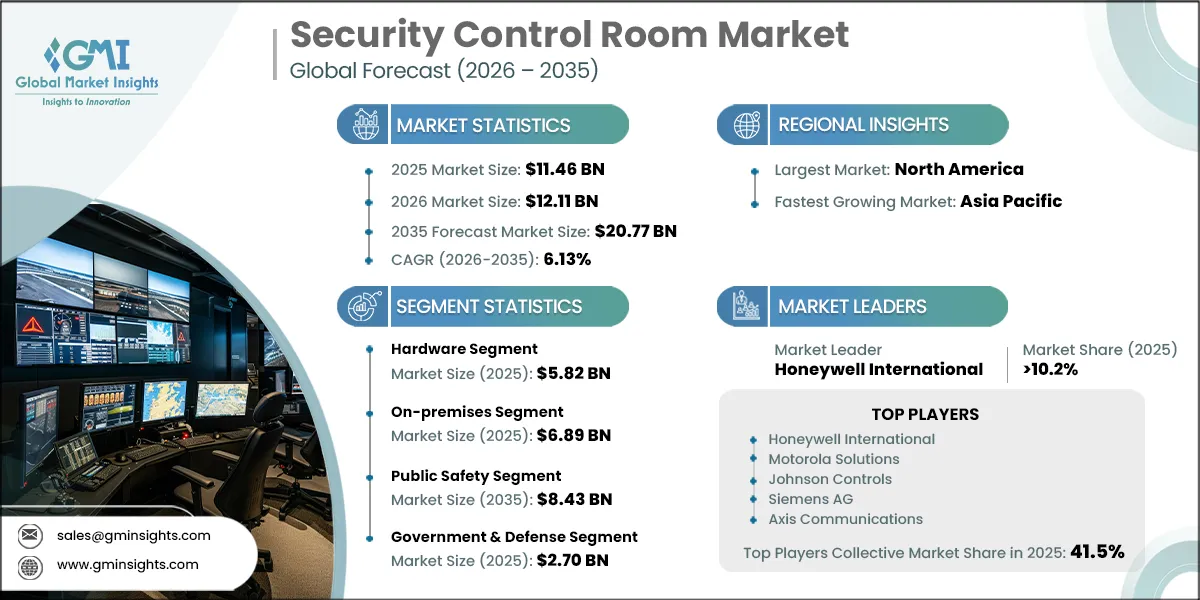
The Security Control Room Market was valued at USD 11.46 billion in 2025, is projected to reach USD 12.11 billion in 2026, is expected to expand at a 6.13% CAGR (2026–2035), and is forecast to reach USD 20.77 billion by 2035.
The market comprises integrated hardware, software, and services used to centralize physical-security monitoring, incident management, command visualization, access control, video management, analytics, and related operational workflows.
Demand is moving beyond standalone surveillance rooms toward coordinated environments that connect video, access events, alarms, operator workflows, and operational technology signals. This shift changes the buying decision from equipment replacement to platform modernization, increasing the importance of interoperability, lifecycle support, cybersecurity architecture, and the ability to manage dispersed facilities from a shared operating picture.
GMI Analyst View
Based on our assessment of annual revenue trends tracked across the competitive landscape, the Security Control Room Market generated approximately USD 10.87 billion in 2024, representing a fifth consecutive year of growth and confirming that demand for integrated command-and-control platforms has remained resilient through a period of elevated capital cost conditions. This trajectory positions the market to sustain its forward momentum as AI-native software upgrades and cloud-based managed service models lower the adoption threshold for mid-market and emerging-economy buyers.
Security Control Room Market Trends, Growth Drivers & GMI Forecast Outlook
Security control room demand is being shaped by the convergence of urban-security investment, distributed infrastructure monitoring, and compliance-led modernization. Buyers increasingly require platforms that connect physical security and operational workflows, although integration complexity, cyber-risk review, and constrained capital budgets continue to lengthen decision cycles in legacy estates.
Key Drivers
*Evidence anchors use cited external data; demand implications and forecast conditions represent GMI analysis.*
Urban-security programs require operators to interpret activity across transport networks, public spaces, emergency communications, and municipal facilities without fragmenting decisions across separate consoles. As deployments extend beyond flagship city centers, buyers place greater value on configurable interfaces, open integration frameworks, and analytics that can prioritize incidents before they overwhelm already constrained operator teams.
Grid modernization also expands the number and geographic spread of assets requiring physical oversight. Renewable generation sites, storage facilities, substations, and transmission nodes introduce security needs that sit alongside, rather than replace, conventional operational monitoring. This creates a distinct opportunity for platforms that join video, alarms, access data, and OT context while preserving the reliability expectations of utility control environments.
NIS2 has made security governance and incident readiness more operationally visible for essential entities. Procurement conversations increasingly include auditability, incident documentation, access governance, and ongoing service support, favoring vendors and integrators that can translate regulatory requirements into deployable command-room architectures rather than offering disconnected point products.
Key Restraints
*Evidence anchors use cited external data; demand implications and forecast conditions represent GMI analysis.*
Compliance obligations can accelerate demand while also narrowing available project budgets. In regulated organizations, funds may first be directed toward controls, documentation, network hardening, and assurance work before broader command-room transformation is approved. Vendors must therefore demonstrate how a deployment supports both operational performance and defensible governance outcomes.
Centralization creates a difficult trade-off for buyers with fragmented estates. A unified platform can reduce blind spots, but connecting legacy cameras, access-control systems, alarm panels, and OT assets also broadens the architecture that must be assessed, secured, and maintained. This is particularly challenging for public agencies and mid-market operators that lack dedicated modernization teams.
Brownfield projects face the most persistent delivery friction because installed systems often span multiple technology generations and vendor standards. Phased replacement can preserve continuity, but it also extends commissioning and sustains reliance on middleware. Integrators with proven interoperability and migration expertise are therefore influential in determining whether modernization plans become funded deployments.
GMI Analyst View
We see the market separating into two procurement tracks: compliance-sensitive operators are consolidating platforms to improve accountability and coordinated response, while commercial and industrial buyers are testing hybrid architectures that reduce infrastructure exposure without surrendering operational control. The decisive issue will be whether cloud-oriented platforms can meet the assurance, residency, and resilience expectations of high-security environments.
Security Control Room Market Segment Analysis
By Offering
The Security Control Room Market hardware segment generated USD 5.82 billion in 2025 and represented 50.8% of global revenue; its share is projected to reach 45.8% by 2035. Video walls, operator workstations, KVM infrastructure, servers, and network equipment remain indispensable in high-availability command environments. However, the economic center of deployments is moving toward the software layers that integrate, interpret, and operationalize data, placing pressure on hardware suppliers to differentiate through reliability, visualization quality, interoperability, and lifecycle services.
Software revenue is projected to reach USD 7.16 billion by 2035, expanding at a 7.65% CAGR (2026–2035). Software is increasingly the control room's decision layer: it correlates events, manages workflows, governs access, and converts camera and sensor inputs into actionable priorities. Subscription models can also shift purchasing from periodic infrastructure refreshes toward recurring platform expenditure, although deployment success still depends on integration quality and buyer confidence in data governance.
Services accounted for 19.2% of global revenue in 2025 and are projected to reach USD 4.09 billion by 2035. Integration, maintenance, training, consulting, and managed operations are becoming more strategically important as control rooms connect more systems and require continuous compliance support. Service providers that can manage migration, configuration, and long-term optimization are positioned to capture value that cannot be addressed through product supply alone.
By Deployment Mode
The on-premises segment generated USD 6.89 billion in 2025 and represented 60.1% of the market; its share is projected to decline to 49.1% by 2035. On-premises architecture remains central where buyers require direct control over systems, stringent data handling, local processing resilience, or restricted network environments. Its continued relevance in government, defense, utilities, and high-assurance financial settings means that cloud adoption is more likely to be additive and phased than an immediate wholesale replacement.
Cloud-based deployments are projected to reach USD 6.27 billion by 2035, growing at a 9.87% CAGR (2026–2035). Cloud delivery broadens access to centralized monitoring, remote video management, and shared analytics for organizations that cannot justify a fully infrastructure-heavy model. Adoption is strongest where multi-site operators value rapid scaling and distributed access, while regulatory, latency, and cyber-resilience concerns continue to limit use cases requiring uninterrupted local control.
Hybrid deployments represented 18.5% of market revenue in 2025 and are projected to reach USD 4.31 billion by 2035. Hybrid configurations provide a practical bridge for organizations modernizing without abandoning mission-critical local systems. They allow operators to retain onsite processing for urgent events while using cloud resources for analytics, storage, and cross-site visibility, making the model particularly relevant for transportation networks and industrial estates.
By Application
The public safety segment generated USD 5.02 billion in 2025 and is projected to reach USD 8.43 billion by 2035. Public safety agencies require coordinated awareness across emergency dispatch, surveillance, traffic systems, and field response. Their procurement tends to favor platforms that support multi-agency coordination and maintain continuity during major incidents, making integration capability and operator usability as important as individual device performance.
Corporate safety represented 28.9% of global revenue in 2025 and is projected to grow at a 5.86% CAGR (2026–2035). Enterprise buyers are consolidating campus, visitor, access, and asset-protection workflows into common operating environments. Demand is supported by the need to standardize security across dispersed facilities, but project velocity depends on alignment between corporate security teams, IT departments, facilities leaders, and budget owners.
Industrial safety is projected to reach USD 6.50 billion by 2035 and expand at a 7.66% CAGR (2026–2035). Industrial facilities increasingly need a unified view of physical risk and operational context. Control rooms that combine perimeter security, worker-safety signals, process alarms, and video analytics can reduce handoffs between teams, although requirements for uptime, system isolation, and equipment compatibility make implementation more complex than in conventional enterprise settings.
By End Use
Government & defense generated USD 2.70 billion in 2025 and represented 23.5% of market demand; its share is projected to reach 20.3% by 2035. Government and defense deployments prioritize resilience, auditability, secure communications, and the ability to coordinate events across agencies or sites. Long procurement cycles and high qualification thresholds can slow awards, yet they also create durable positions for suppliers with established credentials, implementation capacity, and secure-system experience.
Transportation is projected to reach USD 4.18 billion by 2035, growing at a 6.76% CAGR (2026–2035). Airports, rail systems, ports, and highway networks require simultaneous visibility into passenger movement, access events, vehicle activity, and perimeter conditions. The value proposition is strongest where a shared platform improves response coordination across assets that are geographically distributed but operationally interdependent.
BFSI represented 15.4% of market revenue in 2025 and is projected to reach USD 2.95 billion by 2035. Financial institutions use integrated control environments to protect facilities, monitor access, support business continuity, and document security events. The sector's stringent governance expectations create a premium for tightly managed platforms, but systems must also integrate with established building, identity, and enterprise-risk processes.
Manufacturing is projected to reach USD 3.59 billion by 2035 and expand at a 7.75% CAGR (2026–2035). Manufacturers are adopting converged environments that give plant-security, safety, and operations personnel greater shared visibility. The strongest demand arises where physical incidents can affect production continuity, worker protection, asset integrity, or regulatory reporting, making a fragmented monitoring model increasingly difficult to sustain.
Utilities generated USD 1.25 billion in 2025 and are projected to grow at a 7.31% CAGR (2026–2035). Distributed generation and grid assets increase the need for centralized remote oversight of facilities that may not be continuously staffed. Utilities require command systems that can connect physical surveillance with operational context while retaining dependable local response capability for critical infrastructure.
Healthcare represented 8.3% of global revenue in 2025 and is projected to reach USD 1.68 billion by 2035. Healthcare buyers are using centralized security operations to coordinate campus access, visitor activity, incident response, and asset protection across growing facility networks. Adoption is shaped by the need to preserve care continuity while managing environments that have diverse user groups, sensitive areas, and demanding privacy expectations.
Retail & Commercial Real Estate represented a 6.3% share of market revenue in 2035 and generated USD 695.7 million in 2025. Large property portfolios benefit from centralized oversight because remote monitoring can improve consistency across stores, malls, offices, and mixed-use sites. Analytics and managed services are widening access to control-room capability, especially where buyers seek loss prevention and incident-response coverage without maintaining extensive onsite security infrastructure.
Others represented 1.9% of global revenue in 2025. Education and other institutional buyers typically face more heterogeneous requirements, decentralized budgets, and irregular procurement schedules. Their demand is often project-led, with investment focused on specific campus, facility, or safeguarding priorities rather than broad platform standardization.
GMI Analyst View
We believe segment performance will increasingly reflect the buyer's ability to convert operational complexity into a platform case. Software and services benefit when customers need integration, analytics, and sustained governance, while hardware remains essential where visual reliability and local resilience are non-negotiable. Industrial, transportation, and distributed-enterprise use cases should reward vendors that can combine technical depth with practical deployment discipline.
Security Control Room Market Regional Analysis
North America Security Control Room Market Analysis
The Security Control Room Market in North America generated USD 3.97 billion in 2025, representing 34.6% of global demand, and is projected to reach USD 6.77 billion and 32.6% of global demand by 2035. The region benefits from an established physical-security integration ecosystem and deep demand from public safety, critical infrastructure, corporate campuses, and transportation operators. Mature installed bases favor modernization and replacement projects, with buyers placing particular weight on cyber-resilience, service continuity, and integration with existing operational systems.
United States
The United States generated USD 3.29 billion in 2025, representing 82.7% of North American demand, and is projected to reach USD 5.70 billion and 84.1% of North American demand by 2035. Federal, state, and local agencies, alongside critical-infrastructure operators and large enterprises, sustain demand for advanced command environments. The market combines high-assurance requirements with a growing need to modernize fragmented installations, supporting opportunities for suppliers that can meet security standards while managing complex multi-site transitions.
Canada
Canada represented 17.3% of North American demand in 2025 and is projected to grow at a 4.71% CAGR (2026–2035). Demand is concentrated in resource extraction, energy infrastructure, transportation, and provincial public-sector programs. Remote operating conditions and uneven connectivity raise the value of dependable architectures that can maintain situational awareness across widely dispersed facilities and field assets.
Europe Security Control Room Market Analysis
Europe generated USD 3.05 billion in 2025, representing 26.6% of global demand, and is projected to reach USD 5.12 billion by 2035. NIS2-related security modernization is increasing attention to incident readiness, documentation, and integrated oversight across regulated sectors. Europe's opportunity is substantial, but conversion from compliance intent to deployment varies by country because procurement rules, legacy estates, public budgets, and national implementation priorities remain uneven.
Germany
Germany generated USD 791.8 million in 2025, representing 25.9% of European demand, and is projected to reach USD 1.43 billion and 28.0% of European demand by 2035. Germany's industrial base supports demand for control-room architectures that connect physical security with plant, logistics, and operational risk management. Manufacturers and infrastructure operators are likely to prioritize systems that can modernize established estates without interrupting critical processes or creating unmanaged cyber exposure.
United Kingdom
The United Kingdom represented 22.5% of European revenue in 2025 and is projected to grow at a 5.77% CAGR (2026–2035). Financial services, transport infrastructure, public safety, and corporate estates provide a broad base of demand. Buyers are increasingly evaluating managed and cloud-connected capabilities, although adoption remains dependent on confidence in service assurance, data handling, and integration with mature installed systems.
France
France is projected to reach USD 844.8 million by 2035 and represented 17.0% of European revenue in 2025. Public safety, transportation, and energy infrastructure create a demanding environment for integrated command platforms. The country's critical-infrastructure profile favors systems capable of maintaining rigorous operational control, supporting coordinated response, and meeting long-cycle procurement requirements.
Italy
Italy represented 12.3% of European revenue in 2025 and is projected to reach USD 614.9 million by 2035. Demand is supported by urban-security initiatives, transportation infrastructure, logistics facilities, and manufacturing sites. Multi-location deployments create a case for centralized operations, but implementation will often depend on integrators that can navigate fragmented infrastructure and varying local security requirements.
Spain
Spain is projected to grow at a 4.62% CAGR (2026–2035) and generated USD 293.0 million in 2025. Public-sector security, transport modernization, and urban monitoring programs are the principal demand sources. The market's measured growth profile indicates a continuing shift toward integrated monitoring, with project cadence influenced by public investment cycles and the pace of broader infrastructure digitization.
Asia Pacific Security Control Room Market Analysis
Asia Pacific generated USD 3.43 billion in 2025, representing 29.9% of global demand, and is projected to reach USD 7.02 billion and 33.8% of global demand by 2035. The region combines greenfield urban development, large transport programs, industrial expansion, and improving domestic security-technology supply. These conditions create opportunities for full-stack deployments rather than solely replacement projects, although local procurement practices, regulatory expectations, and price sensitivity differ substantially across markets.
China
China generated USD 1.34 billion in 2025, representing 38.9% of Asia Pacific demand, and is projected to reach USD 2.82 billion and 40.2% of Asia Pacific demand by 2035. Large-scale public-security and smart-city programs, combined with extensive domestic manufacturing capability, support broad deployment across municipal and industrial environments. The market's scale favors suppliers that can support high-volume installations, local integration requirements, and cost-sensitive expansion beyond top-tier cities.
South Korea
South Korea is projected to reach USD 844.5 million by 2035 and grow at a 7.20% CAGR (2026–2035). The country's sophisticated transport networks, industrial campuses, and smart-building initiatives support adoption of advanced analytics and integrated security management. Technology expectations are high, creating demand for platforms that can demonstrate both automation value and dependable interoperability across connected facilities.
Japan
Japan generated USD 380.0 million in 2025 and is projected to represent 10.2% of Asia Pacific revenue by 2035. The market is shaped by transportation security, government facilities, and the monitoring needs of manufacturing and utility operations. Replacement cycles remain important, but large public events and infrastructure programs can create focused demand for modernization where existing command environments require more integrated visibility.
India
India is projected to grow at an 8.10% CAGR (2026–2035) and reach USD 699.5 million by 2035. Smart-city programs, airport and metro expansion, industrial development, and corporate-campus investment are broadening the market beyond major metropolitan deployments. Growth depends on whether solutions can be scaled across diverse city and facility environments while balancing capability requirements with budget sensitivity.
Australia
Australia represented 7.0% of Asia Pacific demand in 2025 and is projected to reach USD 464.9 million by 2035. Government and defense facilities, resources operations, transportation infrastructure, and commercial properties provide the principal demand base. Remote sites and critical-infrastructure obligations favor managed monitoring and resilient connectivity models that can extend operational visibility without requiring a large onsite workforce.
Latin America Security Control Room Market Analysis
Latin America generated USD 587.3 million in 2025, representing 5.1% of global demand, and is projected to reach USD 1.07 billion and 5.2% of global demand by 2035. Public-safety programs, metropolitan transport networks, and expanding enterprise-security requirements support regional demand. The commercial opportunity is strongest where platforms can address high incident-management needs while accommodating uneven infrastructure quality, capital constraints, and local integration capabilities.
Middle East & Africa Security Control Room Market Analysis
Middle East & Africa generated USD 419.7 million in 2025, representing 3.7% of global demand, and is projected to grow at a 6.50% CAGR (2026–2035). Gulf infrastructure projects, government-security programs, urban development, and critical-asset protection support demand for high-specification command environments. Across Africa, modernization is more uneven, but remote-site monitoring needs in extractive industries and growing urban-security priorities create selective opportunities for scalable, service-supported deployments.
GMI Analyst View
We interpret Asia Pacific's momentum as a consequence of procurement conditions as much as demand intensity: greenfield urban and infrastructure programs can support more complete platform deployments than mature markets dominated by replacement cycles. North America retains strategic depth, while Europe's compliance-led opportunity will depend on how effectively buyers move from regulatory preparation to funded modernization.
Security Control Room Market Share & Competitive Landscape
The Security Control Room Market share structure is moderately concentrated, with Honeywell International, Motorola Solutions, Johnson Controls, Siemens AG, and Axis Communications collectively accounting for 41.5% of global revenue in 2025.
Competition is shaped by the ability to assemble credible end-to-end solutions across video, access control, incident management, visualization, analytics, integration, and lifecycle support. Global platform providers compete with specialist software firms, visualization suppliers, regional integrators, and surveillance-hardware vendors; local implementation expertise remains influential because projects often require customization around installed infrastructure and sector-specific assurance requirements.
Honeywell International held a 10.2% global revenue share in 2025. Its position is supported by a broad building-automation and security portfolio that can connect access, video, command software, and building operations within complex enterprise and critical-infrastructure environments.
Honeywell's competitive advantage rests on installed-base access and its ability to deliver coordinated modernization across multiple security domains. Its acquisition of Carrier's Global Access Solutions business expanded the company's access-control capability, strengthening its ability to address customers seeking integrated physical-security architecture rather than isolated subsystems.
Motorola Solutions held a 9.6% global revenue share in 2025. The company combines command-center software, video security, access control, incident-management capability, and cloud-oriented enterprise security offerings.
Motorola Solutions is particularly well positioned where public-safety and enterprise buyers want common operating workflows across dispatch, video, and physical security. Its strategy places emphasis on extending the platform through cloud-connected capabilities and adjacent workflow tools, raising competitive pressure on suppliers that remain concentrated in a single product category.
Johnson Controls held an 8.8% global revenue share in 2025. Its portfolio spans security systems, access management, video management, and building-security integration for commercial real estate, healthcare, industrial, and data-center customers.
Johnson Controls benefits from a global service footprint and deep customer relationships in built environments where security is increasingly assessed alongside building performance and resilience. This creates a meaningful upgrade opportunity as customers seek to consolidate multiple facilities into more centrally managed operating models.
Siemens AG competes through its smart-infrastructure and digital-building capabilities, positioning physical security management within a broader enterprise environment. Its cloud-oriented security offerings are relevant to buyers that want to connect video, access, intrusion management, and building systems across distributed properties.
Siemens' strategic relevance is strongest in environments where physical security and OT or facility operations increasingly intersect. The company's ability to address both security management and connected-device governance provides an important differentiation in industrial and infrastructure-oriented control-room projects.
Axis Communications remains a leading specialist in network-based surveillance hardware, including cameras, video encoders, and edge analytics devices. Its installed base gives it significant influence over the video-acquisition layer of control-room deployments.
Axis competes by extending the usefulness of its surveillance ecosystem through partnerships and integrations with video-management and access-control platforms. This approach allows it to participate in broader command-room workflows while preserving its specialist position in imaging, edge devices, and network video technology.
Genetec and Milestone Systems are important open-platform software participants, while Hikvision, Barco, Convergint Technologies, Securitas Technology, AxxonSoft, RGB Spectrum, Eizo Corporation, ATEN INTERNATIONAL Co. Ltd., Hexagon AB, and other regional specialists contribute differentiated capabilities across integration, visualization, monitoring, video management, and sector-specific delivery. Competitive success increasingly depends on proving secure interoperability and dependable execution rather than simply expanding device portfolios.
Recent Industry Developments
Axis Communications introduced AXIS Secure Entry for XProtect in September 2025, extending access-control and video-surveillance integration within the XProtect Smart Client environment [6]. The development illustrates the growing commercial value of reducing operator handoffs between credential management, door events, and video verification in high-traffic facilities.
Siemens Smart Infrastructure announced a collaboration with Viakoo in March 2026 to provide OT and IoT device-security management capabilities for connected enterprise environments [7]. The arrangement addresses a key operational issue for control-room operators: maintaining device hygiene across expanding fleets of cameras, readers, intercoms, and connected sensors.
Need a specific section of this report?
Purchase regional analysis, country-level analysis, company profiles, or any other segment-level insights separately
based on your research needs.