
Refrigerator Market Size & Share 2026-2035
Download Free PDF
Report Content
Chapter 1. Methodology & Scope
1.1 Research approach
1.2 Quality Commitments
1.2.1 GMI AI policy & data integrity commitment
1.2.1.1 Source consistency protocol
1.3 Research Trail & Confidence Scoring
1.3.1 Research Trail Components
1.3.2 Scoring Components
1.4 Data Collection
1.4.1 Partial list of primary sources
1.5 Data mining sources
1.5.1 Paid sources
1.5.1.1 Sources, by region
1.6 Base estimates and calculations
1.6.1 Base year calculation for any one approach
1.7 Forecast model
1.7.1 Quantified market impact analysis
1.7.1.1 Mathematical impact of growth parameters on forecast
1.8 Research transparency addendum
1.8.1 Source attribution framework
1.8.2 Quality assurance metrics
1.8.3 Our commitment to trust
Chapter 2. Executive Summary
2.1 Industry 360° synopsis
2.2 Key market trends
2.2.1 Regional
2.2.2 Product Type
2.2.3 Capacity
2.2.4 End User
2.2.5 Distribution channel
2.3 TAM analysis, 2027-2035
2.4 CXO perspectives: strategic imperatives
Chapter 3. Industry Insights
3.1 Industry ecosystem analysis
3.1.1 Supplier Landscape
3.1.2 Profit Margin
3.1.3 Cost structure
3.1.4 Value addition at each stage
3.1.5 Factor affecting the value chain
3.1.6 Disruptions
3.2 Industry impact forces
3.2.1 Growth drivers
3.2.1.1 Rising global urbanization & household formation driving residential refrigerator demand
3.2.1.2 Rapid expansion of food service & organized retail fueling commercial refrigerator demand
3.2.1.3 Energy efficiency mandates accelerating frost-free & inverter-enabled unit adoption
3.2.2 Industry pitfalls & challenges
3.2.2.1 Supply chain volatility in semiconductor & compressor availability disrupting production
3.2.2.2 Extended product replacement cycles suppressing volume growth in mature markets
3.2.3 Market opportunities
3.3 Growth potential analysis
3.4 Pricing Analysis (Driven by Primary Research)
3.4.1 Historical Price Trend Analysis
3.4.2 Pricing Strategy by Player Type (Premium / Value / Cost-plus)
3.5 Regulatory landscape
3.5.1 North America
3.5.2 Europe
3.5.3 Asia-Pacific
3.5.4 Latin America
3.5.5 Middle East and Africa
3.6 Porter’s analysis
3.7 PESTEL analysis
3.8 Trade Data Analysis (Based on Paid Database) (8418)
3.8.1 Import/Export Volume & Value Trends
3.8.2 Key Trade Corridors & Tariff Impact
3.9 Impact of AI & Generative AI on the Market (Driven by Primary Research)
3.9.1 AI-Driven Disruption of Existing Business Models
3.9.2 GenAI Use Cases & Adoption Roadmap by Segment
3.9.3 Risks, Limitations & Regulatory Considerations
3.10 Distribution infrastructure & channel penetration landscape (driven by primary research)
3.10.1 Channel coverage by region & format (modern vs. traditional trade) (driven by primary research)
3.10.2 Last-mile infrastructure gaps & emerging channel shifts (driven by primary Research).
3.11 Consumer behaviour analysis
3.11.1 Purchasing patterns
3.11.2 Preference analysis
3.11.3 Regional variations in consumer behaviour
3.11.4 Impact of e-commerce on buying decisions
Chapter 4. Competitive landscape, 2025
4.1 Introduction
4.2 Company market share analysis
4.2.1 By Region
4.2.1.1 North America
4.2.1.2 Europe
4.2.1.3 Asia-Pacific
4.2.1.4 Latin America
4.2.1.5 Middle East and Africa
4.2.2 Market Concentration Analysis
4.3 Competitive analysis of major market players
4.4 Competitive positioning matrix
4.5 Key developments
4.5.1 Mergers & acquisitions
4.5.2 Partnerships & collaborations
4.5.3 New product launches
4.5.4 Expansion plans and funding
4.6 Company tier benchmarking
4.6.1 Tier classification criteria & qualifying thresholds
4.6.2 Tier positioning matrix by revenue, geography & innovation
Chapter 5. Market Estimates & Forecast, By Product Type, 2026-2035, (USD Billion) (Thousand Units)
5.1 Key trends
5.2 Single-Door
5.3 Double-Door
5.3.1 Top-Freezer
5.3.2 Bottom-Freezer
5.4 Side-by-Side
5.5 French-Door
5.5.1 3 Door French-Door
5.5.2 4 Door French-Door
5.6 Compact and Mini Refrigerators
5.7 Commercial Reach-In Refrigerators
Chapter 6. Market Estimates & Forecast, By Capacity, 2026-2035, (USD Billion) (Thousand Units)
6.1 Key trends
6.2 Less than 150 Liters
6.3 150-300 Liters
6.4 300-500 Liters
6.5 Above 500 Liters
Chapter 7. Market Estimates & Forecast, By End User, 2026-2035, (USD Billion) (Thousand Units)
7.1 Key trends
7.2 Residential/Household
7.3 Commercial
Chapter 8. Market Estimates & Forecast, By Distribution Channel, 2026-2035, (USD Billion) (Thousand Units)
8.1 Key trends
8.2 Hypermarkets and Supermarkets
8.3 Specialty Appliance Stores and Exclusive Brand Outlets
8.4 Online Channels
8.4.1 Brand-Owned Direct-to-Consumer (D2C) Websites
8.4.2 Third-Party E-Commerce Platforms (Amazon, Flipkart, JD.com, etc.)
8.5 Direct Business-to-Business (B2B)/Institutional Sales
Chapter 9. Market Estimates & Forecast, By Region, 2026-2035 (USD Billion) (Thousand Units)
9.1 Key trends
9.2 North America
9.2.1 U.S.
9.2.2 Canada
9.3 Europe
9.3.1 Germany
9.3.2 UK
9.3.3 France
9.3.4 Spain
9.3.5 Italy
9.4 Asia Pacific
9.4.1 China
9.4.2 Japan
9.4.3 India
9.4.4 Australia
9.4.5 South Korea
9.5 Latin America
9.5.1 Brazil
9.5.2 Mexico
9.5.3 Argentina
9.6 MEA
9.6.1 South Africa
9.6.2 Saudi Arabia
9.6.3 UAE
Chapter 10. Company Profiles
Don't see your key competitors?
The companies listed in this report are a curated selection - not the full competitive universe.
Our market revenue calculations use a bottom-up methodology that accounts for all players across all regions - including manufacturers, distributors, and specialists not individually profiled. The profiles section spotlights strategically significant players; it does not define the scope of our market sizing.
Your competitive landscape may also include
Free customization - up to 20% of report value
Need specific data? Request customization and get the insights tailored to your exact requirements.
For inquiries regarding discounts, bulk purchases, or customization requests, please contact us at [email protected]
Share Content
Add Citations
Avinash Singh. 2026, September. Refrigerator Market – By Door Type, By Door Handle Type, By Sheet Type, By Door Opening Type, By Product, By Refrigerant, By Technology, By Volume, By Display Type, By Control Type, By Application– Global Forecast, 2025 – 2034 (Report ID: GMI5111). Global Market Insights Inc. Retrieved November 13, 2026, from https://www.gminsights.com/toc/details/refrigerator-market

Refrigerator Market
Get a free sample of this report
Refrigerator Market Size
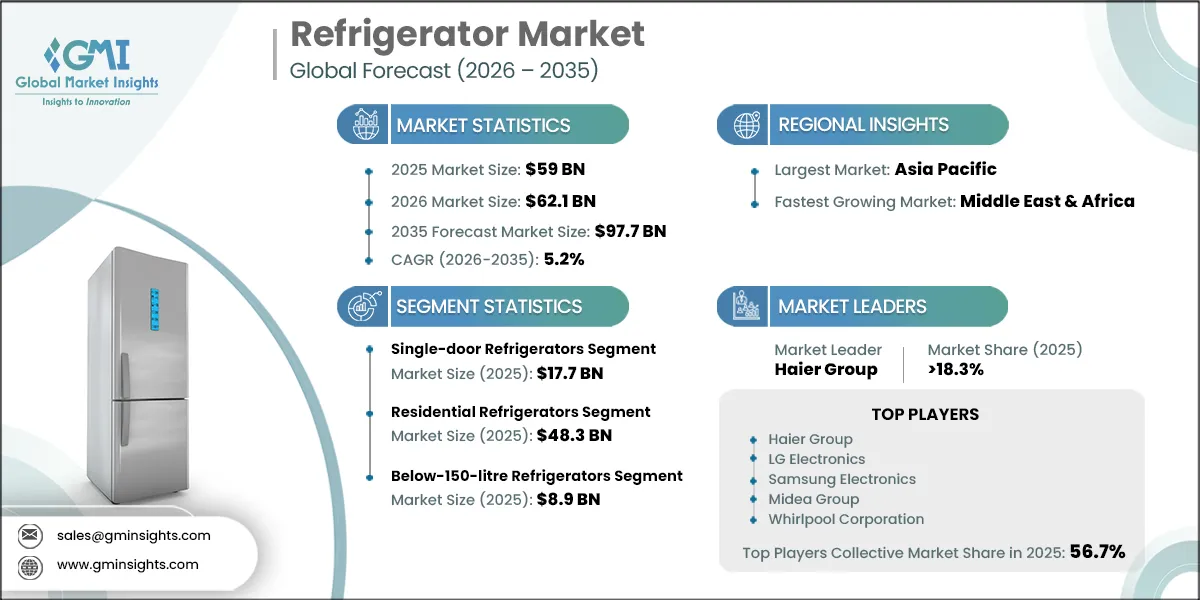
The Global Refrigerator Market was valued at USD 59.0 billion in 2025, is projected to reach USD 62.1 billion in 2026, and is expected to expand at a 5.2% CAGR from 2026 to 2035 to reach USD 97.7 billion by 2035.
The Global Refrigerator Market is shaped by two complementary demand cycles: first-purchase adoption in urbanizing, lower-penetration economies and replacement-led premiumization in mature appliance markets. Higher-efficiency platforms, connected features, and larger multi-door configurations are shifting revenue growth toward higher-value products even where unit shipments remain tied to established replacement rhythms.
GMI Analyst View
Our discussions with manufacturing leadership and supply-chain contacts across the global appliance industry indicate that the market is tracking toward USD 75.9 billion by 2030, suggesting the structural acceleration from emerging-market urbanization and regulation-led replacement demand is materializing ahead of several early-cycle expectations.
Refrigerator Market Trends, Growth Drivers & GMI Forecast Outlook
Urban household formation is expanding the addressable base for affordable refrigeration in emerging economies, while standards-led replacement, feature upgrades, and high-capacity formats support value growth in mature markets. Forecast performance depends on manufacturers converting regulatory compliance investment into differentiated products without eroding entry-level affordability.
Key Drivers
Urban migration is especially consequential for refrigeration because a newly established household often creates an immediate need for food preservation rather than an incremental discretionary purchase. South Asia, Southeast Asia, and Sub-Saharan Africa combine household formation with progressively broader appliance distribution, making affordability, electricity resilience, and compact footprints central to product strategy. The geographic pattern identified by UN DESA supports the view that first-purchase demand will remain an important counterweight to mature-market replacement cycles[1].
Efficiency policy produces a different form of demand: it changes the economics of retaining older stock and raises the technical threshold for new products. The IEA identifies appliance standards and labelling as tools that narrow the gap between installed equipment and current efficiency benchmarks[2]. Manufacturers able to align compressors, insulation systems, controls, and product platforms with changing standards can turn compliance into a replacement proposition rather than a purely defensive cost.
Premiumization further changes the market's revenue composition. Connected food-management functions, adaptive cooling, flexible compartments, and larger formats support a product ladder that is particularly relevant in affluent urban households and organized commercial channels. These features do not displace price-sensitive formats; instead, they create parallel growth paths across income tiers and geographies.
Key Restraints
The refrigerant transition is a manufacturing and service-system challenge rather than a simple component substitution. Lower-global-warming-potential alternatives require changes across compressor design, heat exchange, safety protocols, technician capability, and end-of-life handling. The Kigali Amendment establishes a durable international direction of travel, increasing the importance of platform scale and engineering depth for manufacturers serving cost-sensitive product categories [3].
Compliance timing may also concentrate capital demands across product portfolios. The U.S. federal standard establishes a defined compliance milestone for covered refrigerators, refrigerator-freezers, and freezers. Manufacturers that coordinate efficiency upgrades with refrigerant and platform transitions can preserve product continuity; those that respond in isolated cycles face greater risk of range rationalization, delayed launches, and compressed margins.
Mature-market saturation remains a structural constraint on unit growth. In North America and Western Europe, demand is predominantly replacement-led, which makes housing conditions, consumer confidence, financing availability, and the appeal of feature upgrades more influential than household formation. The resulting sensitivity reinforces the importance of product mix and aftermarket positioning.
*Evidence anchors use cited external data; demand implications and forecast conditions represent GMI analysis.*
GMI Analyst View
We see the market increasingly separating into two commercial models: accessible first-purchase refrigeration for emerging households and feature-led replacement demand in mature economies. The manufacturers best placed to serve both will pair scalable entry platforms with premium technologies that create a compelling reason to replace functional installed units.
Refrigerator Market Segment Analysis
By Product Type
The Global Refrigerator Market spans high-volume entry formats, mid-market household models, premium multi-door appliances, and purpose-built commercial refrigeration. Product positioning increasingly depends on the relationship between household income, kitchen space, energy performance, connected features, and the service requirements of organized foodservice and retail customers.
Single-door refrigerators generated USD 17.7 billion in 2025 and are projected to account for 25.0% of global revenue by 2035. This format remains foundational in first-purchase markets because it combines lower acquisition cost, compact dimensions, and accessible servicing. Its declining revenue mix reflects consumer progression toward larger and multi-door appliances as incomes, household size, and retail availability improve.
Double-door refrigerators generated USD 21.2 billion in 2025 and are projected to expand at a ~4.0% CAGR (2026-2035). The category retains broad relevance because it occupies the practical middle of the residential market. Top-freezer and bottom-freezer configurations serve distinct ergonomic and budget preferences, allowing manufacturers to defend volume while using feature, finish, and energy-performance differences to protect pricing.
Side-by-side refrigerators represented 10.0% of global revenue in 2025 and are projected to generate USD 8.8 billion by 2035. Demand is concentrated in households with larger kitchen footprints and a willingness to pay for convenience features, visible storage organization, and premium exterior design. The category is therefore sensitive to housing quality, consumer confidence, and the availability of higher-value retail financing.
French-door refrigerators are projected to reach USD 15.6 billion by 2035 and expand at a ~8.2% CAGR (2026-2035). French-door models are benefiting from a convergence of premium kitchen design, higher storage expectations, and technology integration. Their configuration accommodates differentiated cooling zones, connected interfaces, and flexible compartments, making them a principal vehicle for manufacturers seeking to monetize premiumization.
Compact and mini refrigerators are projected to generate USD 9.8 billion by 2035 and represented a 7.0% global revenue share in 2025. Their demand base is unusually diversified, spanning smaller urban homes, student accommodation, hospitality, and foodservice applications. This diversity provides resilience, although pricing remains disciplined because compact units frequently compete in highly transparent retail channels.
Commercial reach-in refrigerators are projected to reach USD 7.8 billion by 2035 and expand at a ~10.0% CAGR (2026-2035). Organized retail, convenience formats, foodservice chains, and hospitality investment are expanding the installed base for professional refrigeration. Buyers prioritize reliability, energy consumption, temperature consistency, and service responsiveness, creating a competitive environment that favors established commercial equipment capabilities.
By End Use
Residential refrigerators generated USD 48.3 billion in 2025 and are projected to account for 80.0% of global revenue by 2035. Residential demand remains the market's core because refrigeration is a basic household appliance across both developed and developing economies. Growth conditions differ materially by geography: mature markets depend on replacement and feature upgrades, while underpenetrated markets continue to add first-time owners.
Commercial-HoReCa refrigeration is projected to reach USD 10.7 billion by 2035 and expand at a ~6.0% CAGR (2026-2035). Hotels, restaurants, cafés, quick-service concepts, and institutional kitchens require equipment designed for intensive use and short service windows. Investment in these settings is linked to tourism, urban consumption, formal foodservice development, and the operational need to control waste and preserve product quality.
Commercial-Retail refrigeration represented 5.0% of global revenue in 2025 and is projected to generate USD 5.9 billion by 2035. The expansion of supermarkets, convenience stores, and organized grocery outlets raises equipment demand beyond the household market. Store operators increasingly evaluate refrigeration through total operating cost, merchandising visibility, equipment uptime, and maintenance coverage.
Light institutional refrigeration represented 3.0% of global revenue in 2025 and is projected to reach USD 2.9 billion by 2035. Clinics, schools, offices, and comparable facilities create a steadier, procurement-led demand stream. The segment is less exposed to discretionary household replacement cycles, though purchasing decisions often remain tied to public budgets and institutional construction activity.
By Capacity
Below-150-litre refrigerators generated USD 8.9 billion in 2025 and are projected to expand at a ~2.8% CAGR (2026-2035). The band serves small households, dormitories, compact urban housing, and entry-level buyers. Its more modest expansion reflects mature replacement patterns in developed markets, partly offset by first-purchase opportunities in lower-income urban and semi-urban households.
The 150-300-litre band generated USD 23.6 billion in 2025 and is projected to account for 37.0% of global revenue by 2035. This range remains the mainstream residential choice because it balances family storage needs with apartment-compatible dimensions. It is exposed to both replacement demand in mature markets and the income-led shift from basic appliances to larger household units in emerging economies.
The 300-500-litre band is projected to reach USD 37.2 billion by 2035 and expand at a ~6.1% CAGR (2026-2035). This capacity range captures the trade-up cycle toward larger double-door and French-door products. Its momentum reflects rising fresh-food consumption, larger household storage requirements, and consumers' willingness to pay for format flexibility and connected functionality.
Above-500-litre refrigerators are projected to reach USD 12.7 billion by 2035 and represented a 10.0% global revenue share in 2025. The category combines premium residential formats with high-capacity commercial equipment. Growth depends on affluent household demand, hospitality development, and the ability of manufacturers to justify higher pricing through performance, energy efficiency, and advanced temperature management.
GMI Analyst View
We expect the most consequential mix shift to occur between practical mid-capacity appliances and premium, feature-rich formats rather than through the disappearance of entry-level products. Commercial refrigeration should also become more strategically important as organized retail and foodservice investment broadens across developing markets.
Refrigerator Market Regional Analysis
Asia Pacific Refrigerator Market Analysis
Asia Pacific is the largest regional contributor to the Global Refrigerator Market, generating USD 27.5 billion in 2025 and projected to account for 53.6% of global revenue by 2035. Asia Pacific combines the world's most extensive appliance manufacturing ecosystem with large populations still moving through the first-purchase and early upgrade stages. The region's market is not homogeneous: China is increasingly premium and replacement-led, while India and Southeast Asia offer broader household-formation opportunities.
China
China generated USD 12.1 billion in 2025 and is projected to reach ~USD 20.5 billion by 2035. China's large installed base shifts competitive emphasis toward premium multi-door models, food-management functions, and differentiated design. Domestic scale manufacturers remain influential because they can serve value, mass, and premium tiers while supporting export-oriented production.
India
India generated USD 3.8 billion in 2025 and is projected to expand at a ~7.7% CAGR (2026-2035). India's opportunity is rooted in penetration expansion outside the most developed metropolitan markets. Distribution reach, dependable electricity access, price-point architecture, and appliance financing will determine how rapidly latent household demand converts into purchases.
Japan
Japan is projected to generate ~USD 4.0 billion by 2035 and represented a ~5.4% global revenue share in 2025. Japan remains a mature, quality-led market where replacement decisions prioritize freshness preservation, space-efficient engineering, quiet operation, and energy performance. Product innovation is therefore directed less toward basic ownership and more toward functional refinement.
South Korea
South Korea represented a ~3.1% global revenue share in 2025 and is projected to reach ~USD 2.4 billion by 2035. The country is both a premium consumer market and an innovation base for globally marketed connected appliances. Its importance exceeds its domestic size because design, interface, and cooling innovations developed there can be scaled through international brand portfolios.
ASEAN & Rest of APAC
ASEAN & Rest of APAC is projected to reach ~USD 17.5 billion by 2035 and expand at a ~10.2% CAGR (2026-2035). The subregion contains a diverse group of markets at different stages of appliance adoption, but urbanization and the development of formal retail are common catalysts. Manufacturers must balance affordable first-purchase products with formats that capture growing middle-income upgrade demand.
North America Refrigerator Market Analysis
North America generated USD 13.0 billion in 2025 and is projected to reach USD 17.1 billion by 2035. The North American Refrigerator Market is fundamentally replacement-driven, with growth dependent on premium formats, efficiency upgrades, connected functions, and design differentiation rather than widespread new-household penetration. Large-capacity appliances and advanced feature sets have particular relevance in this market.
United States
The United States generated USD 10.6 billion in 2025 and is projected to reach ~USD 13.8 billion by 2035. The market's replacement cycle increasingly centers on French-door, side-by-side, and connected kitchen products. Federal efficiency requirements add a compliance-related replacement dimension, while manufacturers must balance feature-led premiumization against consumer sensitivity to housing and discretionary spending conditions [4].
Canada
Canada is projected to reach ~USD 1.8 billion by 2035 and represented a ~2.4% global revenue share in 2025. Canadian demand follows a mature-market pattern shaped by replacement purchases, urban household growth, and preference for high-quality, energy-efficient configurations. Premium upgrades are most relevant in major metropolitan areas with established appliance retail networks.
Mexico
Mexico generated ~USD 1.0 billion in 2025 and is projected to expand at a ~4.1% CAGR (2026-2035). Mexico combines replacement demand with continuing movement from basic configurations into larger household formats. Domestic manufacturing linkages and proximity to North American supply chains also support the availability of a broad price and feature range.
Europe Refrigerator Market Analysis
Europe generated USD 9.5 billion in 2025 and is projected to account for 11.6% of global revenue by 2035. European demand is constrained by high household penetration but supported by energy-efficiency requirements, integrated-kitchen preferences, and consumers' willingness to pay for quality, durability, and refined food-preservation performance. Competition is particularly active in the premium built-in and high-efficiency segments.
Germany
Germany generated USD 2.2 billion in 2025 and is projected to reach ~USD 2.7 billion by 2035. Germany's market reflects a strong preference for engineering quality, energy performance, and integrated kitchen design. Regulatory pressure and an established premium appliance culture support replacement demand for higher-rated products, although household saturation limits volume expansion.
United Kingdom
The United Kingdom represented a ~2.2% global revenue share in 2025 and is projected to expand at a ~1.4% CAGR (2026-2035). The United Kingdom's more moderate outlook reflects a mature installed base and sensitivity to housing-market conditions. Product differentiation remains focused on efficiency, capacity, and kitchen aesthetics rather than broad first-purchase demand.
France
France is projected to generate ~USD 1.3 billion by 2035 and represented a ~1.9% global revenue share in 2025. French buyers maintain strong interest in fresh-food storage, compartment flexibility, and premium household appliances. These preferences support a trade-up cycle, particularly for products that combine practical storage design with lower operating costs.
Italy
Italy generated ~USD 1.0 billion in 2025 and is projected to account for ~1.2% of global revenue by 2035. Italian demand is influenced by design expectations, domestic appliance manufacturing heritage, and preference for integrated and freestanding configurations suited to varied home layouts. Replacement purchases remain the principal volume source.
Latin America Refrigerator Market Analysis
Latin America is projected to reach USD 9.4 billion by 2035 and expand at a ~5.5% CAGR (2026-2035). The region's Refrigerator Market combines mature replacement demand in its larger economies with ongoing first-purchase opportunity among lower-income households. Macroeconomic conditions and consumer credit availability remain important determinants of annual purchasing behavior.
Brazil
Brazil generated USD 3.9 billion in 2025 and is projected to reach ~USD 6.3 billion by 2035. Brazil's tropical climate reinforces the functional necessity of refrigeration, while its large population creates both replacement and penetration opportunities. Organized retail expansion and broader distribution beyond major urban centers are important to sustaining appliance access.
Argentina
Argentina represented a ~0.8% global revenue share in 2025 and is projected to expand at a ~4.8% CAGR (2026-2035). Argentina's underlying replacement need is meaningful, but market realization remains exposed to macroeconomic volatility and household purchasing power. Manufacturers and retailers must manage pricing, inventory, and finance availability carefully in this environment.
Middle East & Africa Refrigerator Market Analysis
Middle East & Africa is projected to reach USD 7.5 billion by 2035 and expand at a ~7.9% CAGR (2026-2035). The Middle East & Africa Refrigerator Market pairs premium, high-capacity demand in GCC economies with early-stage household adoption across parts of Sub-Saharan Africa. This dual structure creates opportunities at both the value and premium ends of the market, but requires distinct pricing, service, and distribution models.
UAE
The UAE generated USD 800 million in 2025 and is projected to reach ~USD 1.8 billion by 2035. The UAE's demand profile is supported by premium residential development, hospitality investment, and consumers accustomed to high-capacity, feature-rich appliances. Commercial refrigeration demand also benefits from a large foodservice and tourism ecosystem.
Saudi Arabia
Saudi Arabia represented a ~1.2% global revenue share in 2025 and is projected to expand at a ~8.6% CAGR (2026-2035). Residential construction, hospitality development, and rising household expenditure are increasing demand for larger and internationally branded refrigerator models. The country offers a strong premiumization opportunity, particularly where product capacity and heat-performance expectations are high.
South Africa
South Africa generated ~USD 400 million in 2025 and is projected to reach ~USD 700 million by 2035. South Africa's comparatively developed retail infrastructure supports more efficient product distribution than in many other African markets. Demand remains linked to household incomes, urbanization, and the availability of affordable appliances through formal retail channels.
Refrigerator Market Share & Competitive Landscape
The Global Refrigerator Market share structure is moderately concentrated, with the five largest manufacturers collectively accounting for ~56.7% of global first-sale revenue in 2025. Scale matters because regulatory engineering, compressor technology, product-platform investment, and service coverage require sustained capital commitment, yet regional specialists remain competitive where price points, retail networks, and localized product design are decisive.
Haier Group accounted for an 18.3% share of global revenue in 2025. Haier's leadership is supported by a broad multi-brand portfolio, major manufacturing scale, a strong position in China, and global market access across residential price tiers. Its ability to commercialize both affordable household products and connected multi-door appliances gives it breadth across first-purchase and replacement demand cycles.
LG Electronics accounted for an 11.2% share of global revenue in 2025. LG competes most visibly in premium residential refrigeration, where energy-performance positioning, French-door and side-by-side formats, and connected freshness-management features support differentiated pricing. Its innovation focus aligns with markets where standards, premium design, and consumer expectations for smart-home functionality are converging.[6]
Samsung Electronics accounted for an 11.0% share of global revenue in 2025. Samsung's competitive position is rooted in customization, connected-kitchen integration, display technology, and AI-enabled food-management features. The company is especially positioned to compete where consumers value appliance aesthetics, digital integration, and advanced user interfaces alongside cooling performance.
Midea Group and Whirlpool Corporation remain major global participants, with competitive positioning shaped by different regional strengths and portfolio priorities. Midea benefits from vertically integrated manufacturing and broad export capability, while Whirlpool retains substantial relevance in North American and Latin American appliance channels.
BSH Hausgeräte, Electrolux, Panasonic, Hisense, Godrej Appliances, Liebherr, Miele, Mabe, Changhong Meiling, Galanz, TCL, SMEG, Sub-Zero, True Manufacturing, Hoshizaki, and IFB Refrigeration reinforce the importance of specialized regional, premium, commercial, and value-oriented propositions. Competitive advantage increasingly depends on balancing compliance investment with clear product segmentation, channel execution, and service capability.
Recent Industry Developments
Samsung Electronics launched its 2025 refrigerator lineup on March 24, 2025, introducing AI Hybrid Cooling across selected multi-door and side-by-side models. The lineup incorporates a 9-inch AI Home screen and enhanced AI Vision Inside capabilities and was positioned for rollout across North America, Europe, Latin America, Southeast Asia, and the Middle East [5].
Reliance Retail Ventures Limited acquired the Kelvinator brand in India from Electrolux on July 18, 2025. The transaction adds an established appliance brand to Reliance Retail's consumer durables portfolio and strengthens its route-to-market options in Indian branded refrigeration [6].
LG Electronics introduced its Fit & Max refrigerator lineup for Europe on August 19, 2025 at IFA 2025. The range emphasizes compact-kitchen fit, AI-based cooling functions, and energy-efficient bottom-freezer and French-door configurations designed for the European market [7].
Need a specific section of this report?
Purchase regional analysis, country-level analysis, company profiles, or any other segment-level insights separately
based on your research needs.