
Facial Recognition Market Size & Share 2026-2035
Download Free PDF
Report Content
Chapter 1. Research Methodology
1.1 Research approach
1.2 Quality Commitments
1.2.1 GMI AI policy & data integrity commitment
1.3 Research Trail & Confidence Scoring
1.3.1 Research Trail Components
1.3.2 Scoring Components
1.4 Data Collection
1.5 Data mining sources
1.5.1 Paid sources
1.6 Base estimates and calculations
1.6.1 Base year calculation
1.7 Forecast model
1.7.1 Quantified market impact analysis
1.8 Research transparency addendum
1.8.1 Source attribution framework
1.8.2 Quality assurance metrics
1.8.3 Our commitment to trust
Chapter 2. Executive Summary
2.1 Industry 360° synopsis, 2022–2035
2.2 Key market trends
2.2.1 Regional
2.2.2 Component
2.2.3 Technology
2.2.4 Application
2.2.5 Deployment Mode
2.2.6 End-Use
2.3 TAM analysis, 2027–2035
2.4 CXO perspectives: Strategic imperatives
Chapter 3. Industry Insights
3.1 Industry ecosystem analysis
3.1.1 Supplier landscape
3.1.2 Profit margin
3.1.3 Cost structure
3.1.4 Value addition at each stage
3.1.5 Factors affecting the value chain
3.1.6 Disruptions
3.2 Industry impact forces
3.2.1 Growth drivers
3.2.1.1 Rising Demand for Contactless Biometric Authentication Across Industries
3.2.1.2 Growing Government Investments in Smart City & Public Safety Infrastructure
3.2.1.3 Increasing Adoption of AI-Powered Identity Verification in BFSI & Fintech
3.2.1.4 Proliferation of Edge AI Enabling Low-Latency & Offline FR Deployments
3.2.2 Industry pitfalls and challenges
3.2.2.1 Algorithmic Bias & Demographic Accuracy Disparities Across Ethnic Groups
3.2.2.2 High System Integration Complexity & Total Cost of Ownership
3.2.3 Market opportunities
3.2.3.1 Expanding Use Cases in Digital Onboarding, eKYC & Remote Authentication
3.2.3.2 Growing Adoption in Aerospace & Automotive for Passenger & Driver Safety
3.2.3.3 Integration with Multimodal Biometrics & Liveness Detection Technologies
3.2.3.4 Emerging Markets Rollout of Smart City & National ID Programmes
3.3 Pricing analysis (Driven by Primary Research), 2022–2034
3.3.1 Historical price trend analysis by region
3.3.2 Pricing strategy by player (Premium / Value / Cost-plus)
3.4 Technology and innovation landscape
3.4.1 Current technological trends
3.4.2 Emerging technologies
3.5 Regulatory landscape
3.5.1 North America
3.5.1.1 US — Illinois Biometric Information Privacy Act (BIPA)
3.5.1.2 US — FTC Biometric Data Guidelines & CBP Traveler Verification Programme
3.5.1.3 US — NIST Face Recognition Vendor Test (FRVT) Framework
3.5.1.4 Canada — PIPEDA & Quebec Law 25 Biometric Data Obligations
3.5.2 Europe
3.5.2.1 EU — AI Act (Facial Recognition Classified as High-Risk AI System)
3.5.2.2 EU — GDPR Article 9 (Biometric Data as Special Category Personal Data)
3.5.2.3 UK — ICO Guidance on Biometric Data & Live Facial Recognition
3.5.3 Asia Pacific
3.5.3.1 China — PIPL (Personal Information Protection Law) & GB/T FR Standards
3.5.3.2 India — Digital Personal Data Protection Act (DPDPA) & Aadhaar Framework
3.5.3.3 South Korea — PIPA (Personal Information Protection Act)
3.5.4 Latin America
3.5.4.1 Brazil — LGPD (Lei Geral de Proteção de Dados)
3.5.4.2 Argentina — Personal Data Protection Act
3.5.5 MEA
3.5.5.1 Saudi Arabia — PDPL (Personal Data Protection Law)
3.5.5.2 UAE — Federal Decree-Law No. 45 of 2021 on Personal Data Protection
3.6 Porter's Five Forces
3.7 PESTEL Analysis
3.8 Patent analysis (Driven by Primary Research)
3.9 Infrastructure & Deployment Landscape (Driven by Primary Research)
3.9.1 Deployment Penetration by Region & Buyer Segment
3.9.2 Scalability Constraints & Infrastructure Investment Trends
3.10 Impact of AI & generative AI on the market
3.10.1 AI-driven disruption of existing business models
3.10.2 GenAI use cases & adoption roadmap by segment
3.10.3 Risks, limitations & regulatory considerations
Chapter 4. Competitive Landscape, 2022–2026
4.1 Introduction
4.2 Company market share analysis (value), 2022–2026
4.2.1 North America
4.2.2 Europe
4.2.3 Asia Pacific
4.2.4 Latin America
4.2.5 MEA
4.3 Competitive analysis of major market players
4.4 Competitive positioning matrix
4.5 Key developments
4.5.1 Mergers & acquisitions
4.5.2 Partnerships & collaborations
4.5.3 New product launches
4.5.4 Expansion plans and funding
4.6 Company Tier Benchmarking
4.6.1 Tier Classification Criteria & Qualifying Thresholds
4.6.2 Tier Positioning Matrix by Revenue (USD Mn) & Innovation
Chapter 5. Market Estimates & Forecast, By Component, 2022–2035 (USD Mn)
5.1 Key trends
5.2 Hardware
5.3 Software
5.4 Services
5.4.1 Professional Services
5.4.1.1 Consulting Services
5.4.1.2 Design, Implementation & Integration Services
5.4.1.3 Deployment & Installation Services
5.4.1.4 Support & Maintenance
5.4.2 Managed Services
Chapter 6. Market Estimates & Forecast, By Technology, 2022–2035 (USD Mn)
6.1 Key trends
6.2 2D Facial Recognition
6.3 3D Facial Recognition
6.4 Thermal/Infrared Facial Recognition
6.5 Facial Analytics
Chapter 7. Market Estimates & Forecast, By Application, 2022–2035 (USD Mn)
7.1 Key trends
7.2 Security & Surveillance
7.3 Access Control
7.4 Identity Verification & KYC
7.5 Emotion Recognition
7.6 Attendance Tracking & Monitoring
7.7 Others
Chapter 8. Market Estimates & Forecast, By Deployment Mode, 2022–2035 (USD Mn)
8.1 Key trends
8.2 On-Premise
8.3 Cloud-Based
8.4 Edge/On-Device
Chapter 9. Market Estimates & Forecast, By End-Use, 2022–2035 (USD Mn)
9.1 Key trends
9.2 Government & Defense
9.3 BFSI
9.3.1 Retail Banking & Branch Authentication
9.3.2 Digital Onboarding & eKYC
9.3.3 Insurance Claims Verification
9.3.4 Fraud Detection & Prevention
9.3.5 Others
9.4 Retail & E-commerce
9.5 Healthcare
9.6 IT & Telecom
9.7 Aerospace & Transportation
9.8 Automotive
9.9 Media & Entertainment
9.10 Education
9.11 Others
Chapter 10. Market Estimates & Forecast, By Region, 2022–2035 (USD Mn)
10.1 Key trends
10.2 North America
10.2.1 US
10.2.2 Canada
10.3 Europe
10.3.1 Germany
10.3.2 UK
10.3.3 France
10.3.4 Italy
10.3.5 Spain
10.3.6 Netherlands
10.3.7 Russia
10.3.8 Belgium
10.4 Asia Pacific
10.4.1 China
10.4.2 India
10.4.3 Japan
10.4.4 South Korea
10.4.5 Australia
10.4.6 Malaysia
10.4.7 Singapore
10.4.8 Thailand
10.5 Latin America
10.5.1 Brazil
10.5.2 Mexico
10.5.3 Chile
10.6 Middle East and Africa
10.6.1 Saudi Arabia
10.6.2 UAE
10.6.3 South Africa
Chapter 11. Company Profiles
Don't see your key competitors?
The companies listed in this report are a curated selection - not the full competitive universe.
Our market revenue calculations use a bottom-up methodology that accounts for all players across all regions - including manufacturers, distributors, and specialists not individually profiled. The profiles section spotlights strategically significant players; it does not define the scope of our market sizing.
Your competitive landscape may also include
Free customization - up to 20% of report value
Need specific data? Request customization and get the insights tailored to your exact requirements.
For inquiries regarding discounts, bulk purchases, or customization requests, please contact us at [email protected]
Share Content
Add Citations
Preeti Wadhwani. 2026, September. Facial Recognition Market Size & Share 2026-2035 (Report ID: GMI2593). Global Market Insights Inc. Retrieved October 30, 2026, from https://www.gminsights.com/toc/details/facial-recognition-market

Facial Recognition Market
Get a free sample of this report
Facial Recognition Market Size
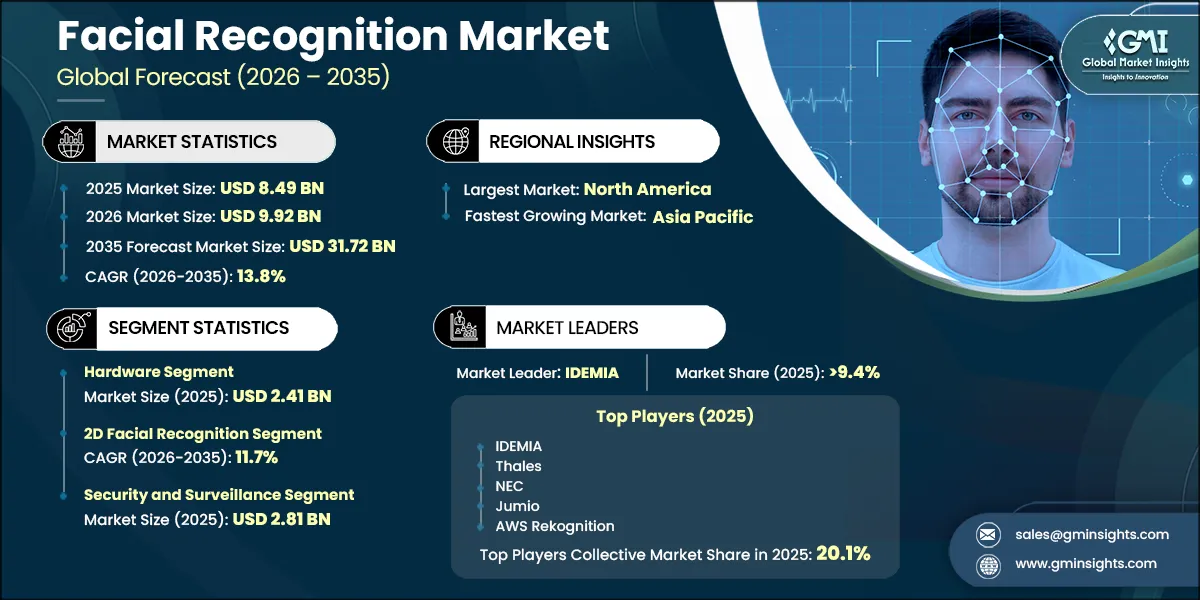
The Facial Recognition Market was valued at USD 8.49 billion in 2025, is projected to reach USD 9.92 billion in 2026, is expected to expand at a 13.8% CAGR (2026–2035), and is forecast to reach USD 31.72 billion by 2035.
The market is moving from stand-alone security procurement toward identity infrastructure that supports regulated onboarding, controlled access, border processing, and analytical workflows. Demand increasingly favors implementations that combine reliable matching with liveness assurance, auditability, and integration into existing enterprise or public-sector systems.
GMI Analyst View
Based on input from industry leaders, the global facial recognition market registered 17.4% year-on-year growth in 2025, indicating that actual market momentum heading into the forecast period is running ahead of the long-run CAGR curve and provides the forecasted trajectory with a stronger base than headline CAGR figures convey. This above-trend entry rate, combined with deepening regulatory compliance obligations across BFSI and government sectors, supports sustained double-digit expansion through the near-term forecast years.
Global Facial Recognition Market Trends, Growth Drivers & GMI Forecast Outlook
Government checkpoint modernization and compliance-led digital identity programs are broadening demand beyond conventional surveillance. Growth depends on vendors' ability to meet liveness, spoof-resistance, privacy, and audit requirements while reducing deployment friction across cloud, edge, and controlled-access environments.
Key Drivers
*Evidence anchors use cited external data; demand implications and forecast conditions represent GMI analysis.*
Transportation checkpoints are an important demand channel because biometric deployment is tied to physical infrastructure renewal, operating throughput, and government identity-security objectives. TSA's airport rollout creates a reference architecture for biometric capture, matching, device management, and integration services; its broader expansion objective reinforces the durability of public-sector demand. [1] The TSA and CLEAR biometric eGate pilot at Atlanta, Reagan National, and Seattle-Tacoma airports further illustrates how aviation operators are testing faster passenger processing ahead of the 2026 FIFA World Cup. [4]
In financial services, facial KYC is becoming embedded in customer-lifecycle controls rather than remaining a discrete onboarding feature. Institutions require reliable identity proofing at account creation, periodic customer review, transaction step-up, and fraud investigation. That need shifts competition toward vendors able to combine document verification, liveness detection, device intelligence, and workflow integration while meeting financial institutions' governance requirements. [2]
Key Restraints
*Evidence anchors use cited external data; demand implications and forecast conditions represent GMI analysis.*
The EU AI Act is reshaping European facial recognition demand by making legal permissibility, documentation, authorization, and governance integral to procurement. Real-time remote biometric identification is restricted to tightly defined law-enforcement circumstances, while high-risk use cases require more extensive compliance evidence. [3] Suppliers therefore face a market in which private access control, financial verification, and controlled enterprise applications may offer clearer commercial pathways than public-space surveillance.
Deepfake-enabled attacks create a separate but related restraint: buyers increasingly expect models to be refreshed, independently tested, and operationally monitored after implementation. The resulting burden can slow approvals and extend implementation timelines, but it also favors vendors that treat liveness, fraud intelligence, and model maintenance as recurring capabilities rather than one-time product features. [2]
GMI Analyst View
We see the market's center of gravity broadening from government-led deployments toward a more balanced mix of public security, financial identity, healthcare access, and enterprise authentication. Vendors that can support differentiated regulatory requirements without fragmenting their platforms should be better positioned than suppliers dependent on a single surveillance-led demand model.
Facial Recognition Market Segment Analysis
By Component
Hardware generated USD 2.41 billion in 2025 and is projected to account for 21.2% of 2035 revenue. Hardware demand remains tied to checkpoint cameras, edge processors, biometric terminals, e-gates, and specialized sensor configurations. Although camera and processing components are becoming more widely available, government security, industrial access control, and high-throughput transportation environments continue to require validated physical infrastructure and installation expertise.
Software is projected to reach USD 19.89 billion by 2035 and represented 55.1% of 2025 revenue. Software captures a growing share of market value because matching algorithms, orchestration layers, analytics, cloud APIs, and model updates can scale across installed hardware estates. Enterprise buyers increasingly prioritize interoperability with cameras, identity systems, access-control platforms, and compliance workflows over ownership of proprietary devices.
Services generated USD 1.40 billion in 2025 and are forecast to grow at a 13.4% CAGR (2026–2035). Services remain essential where facial recognition projects require integration with legacy security platforms, identity databases, audit systems, and physical-entry infrastructure. Consulting, configuration, testing, deployment support, and managed operations are particularly important in public-sector, BFSI, and critical-infrastructure environments.
By Technology
2D facial recognition represented 32.7% of 2025 revenue and is forecast to grow at an 11.7% CAGR (2026–2035). 2D systems retain relevance because of their compatibility with extensive installed camera networks and their relatively low deployment cost. However, mature algorithms, heightened bias scrutiny, and increasing demand for reliable liveness detection are limiting their attractiveness in higher-risk identity-verification and controlled-access use cases.
3D facial recognition is projected to reach USD 13.29 billion by 2035 and represented 38.9% of 2025 revenue. 3D architectures offer stronger depth sensing and can improve resistance to presentation attacks, making them increasingly relevant in premium access control, border management, and device authentication. Broader availability of structured-light and time-of-flight sensing is also expanding their addressable commercial use cases.
Thermal and infrared facial recognition generated USD 934.2 million in 2025 and is projected to account for 9.8% of 2035 revenue. Thermal and infrared systems serve specialized environments where visible-light recognition can be unreliable, including nighttime perimeter monitoring, industrial facilities, and harsh operating settings. Their value proposition rests on resilient performance rather than mass-market deployment, supporting a differentiated hardware and systems-integration opportunity.
Facial analytics is projected to account for 21.1% of 2035 revenue and is forecast to grow at a 15.9% CAGR (2026–2035). Facial analytics is expanding in retail intelligence, crowd management, media measurement, and operational safety applications where organizations seek behavioral or aggregate insights rather than identity matching alone. Regulatory acceptability remains highly dependent on context, purpose, data handling, and whether analytics can identify an individual.
By Application
Security and surveillance generated USD 2.81 billion in 2025 and is projected to account for 32.2% of 2035 revenue. Security and surveillance remains the principal application because public safety, perimeter protection, border screening, and smart-city investments create recurring demand for facial matching systems. The segment is shifting toward platforms that combine detection, recognition, alert prioritization, and operational analytics rather than relying solely on basic image matching.
Access control represented 27.5% of 2025 revenue and is projected to reach USD 7.83 billion by 2035. Organizations are replacing cards, PINs, and manually administered credentials with biometric access systems that can improve convenience, traceability, and enforcement. Data centers, corporate campuses, healthcare facilities, manufacturing sites, and transportation hubs are particularly important use cases because access records carry operational and compliance value.
Identity verification and KYC is projected to reach USD 6.72 billion by 2035 and is forecast to grow at a 15.2% CAGR (2026–2035). Identity verification and KYC demand is supported by digital financial onboarding, fraud prevention, government-benefit authentication, telecom registration, and platform-worker verification. The most durable opportunities are likely to accrue to suppliers that integrate facial verification with document analysis, liveness checks, fraud signals, and decisioning workflows.
Emotion recognition generated USD 396.4 million in 2025 and is projected to account for 5.9% of 2035 revenue. Emotion-recognition deployments are concentrated in selected retail, automotive, clinical, and experience-management applications. Its commercial development is constrained by the sensitivity of inferred personal attributes and by restrictions in settings such as workplaces and educational institutions, increasing the importance of consent, purpose limitation, and governance.
Attendance tracking and monitoring represented 9.2% of 2025 revenue and is projected to reach USD 3.01 billion by 2035. Attendance systems offer a practical entry point for organizations digitizing workforce, campus, and event-access processes. Adoption depends on local privacy requirements and labor practices, but integration with workforce-management software and physical-security platforms can make facial attendance systems more operationally useful than stand-alone timekeeping tools.
By Deployment Mode
On-premise deployment generated USD 3.44 billion in 2025 and is projected to account for 35.2% of 2035 revenue. On-premise architectures remain important where biometric data sovereignty, classified operations, low-latency requirements, or disconnected environments restrict cloud routing. Government, defense, critical infrastructure, and high-security facilities continue to value direct control over infrastructure, data stores, and operating environments.
Cloud-based deployment is projected to reach USD 16.43 billion by 2035 and represented 46.6% of 2025 revenue. Cloud platforms allow organizations to access continuously updated algorithms, scale processing capacity, and integrate facial recognition through APIs without building dedicated infrastructure. This delivery model is especially relevant for financial institutions, retailers, and developers that require rapid deployment but still need clear contractual controls over biometric-data handling.
Edge and on-device deployment generated USD 1.09 billion in 2025 and is forecast to grow at a 13.9% CAGR (2026–2035). Edge processing supports applications requiring rapid response, reduced bandwidth dependence, and local handling of sensitive biometric data. It is gaining relevance in access control, transportation, manufacturing, and privacy-sensitive applications where sending facial data to a central cloud platform may create operational or regulatory complications.
By End Use
Government and defense generated USD 2.55 billion in 2025 and is projected to account for 27.4% of 2035 revenue. Government and defense procurement spans national identity programs, border control, public safety, military access control, and investigative systems. Contract opportunities are substantial but frequently require rigorous certification, interoperability, data-residency safeguards, and long-term implementation support.
BFSI is projected to reach USD 8.31 billion by 2035 and represented 23.3% of 2025 revenue. BFSI adoption is shaped by customer due diligence, fraud prevention, digital onboarding, and authentication requirements. The vertical increasingly evaluates facial recognition as part of an integrated identity stack that must defend against synthetic identities while preserving a low-friction customer experience.
Retail and e-commerce represented 14.7% of 2025 revenue and is projected to reach USD 5.04 billion by 2035. Retail demand is tied to frictionless checkout, loyalty authentication, age verification, loss prevention, and customer-experience analytics. Consumer acceptance and regulatory permission remain decisive variables, favoring deployments with transparent consent models and clear value exchange.
Healthcare is forecast to grow at a 15.5% CAGR (2026–2035) from USD 671.9 million in 2025. Healthcare providers use facial recognition for patient identity verification, restricted-area access, and selected patient-monitoring workflows. The sector's high cost of identity error can support investment, but suppliers must meet demanding expectations around privacy, clinical workflow integration, and data governance.
IT and telecom generated USD 595.1 million in 2025 and is projected to account for 6.2% of 2035 revenue. IT and telecom applications include workforce authentication, subscriber verification, data-center access, and identity controls for digital service ecosystems. Operators are likely to favor platforms that can work across device types, manage authentication at scale, and integrate with broader cybersecurity and identity-management environments.
Aerospace and transportation is projected to reach USD 2.00 billion by 2035 and represented 6.5% of 2025 revenue. Aerospace and transportation demand is led by biometric passenger journeys, secure employee access, logistics-gate management, and passenger-processing modernization. Adoption depends on proving that facial recognition improves throughput and security without imposing unacceptable operational complexity or traveler friction.
GMI Analyst View
We believe future segment leadership will depend less on the presence of a facial-matching engine and more on the ability to package that capability within a trusted operating model. Suppliers that combine liveness assurance, flexible deployment, integration capability, and industry-specific workflow expertise should capture the most defensible opportunities across identity verification and controlled-access applications.
Facial Recognition Market Regional Analysis
North America Facial Recognition Market
North America generated USD 3.27 billion in 2025 and is projected to reach USD 10.37 billion by 2035. The Global Facial Recognition Market in North America is supported by federal biometric infrastructure, mature financial-services compliance programs, and a large enterprise technology base. Long procurement cycles can create dependable revenue visibility, although buyers increasingly require stronger assurance on privacy, liveness performance, and use-case governance.
U.S.
The U.S. generated USD 2.79 billion in 2025 and is projected to reach USD 8.94 billion by 2035. Federal airport and border-security programs provide a major demand foundation, while banks, airlines, healthcare networks, and digital platforms extend biometric deployment into commercial settings. TSA's airport modernization program remains a prominent reference point for the national market, particularly because it establishes operational expectations for integrated biometric screening. [1]
Canada
Canada represented 14.8% of North American revenue in 2025 and is forecast to grow at an 11.1% CAGR (2026–2035). Canadian demand is shaped by border modernization, airport-security initiatives, and digital identity programs within financial services. Provincial privacy requirements can constrain consumer-facing deployment models, encouraging suppliers to emphasize consent-driven use cases, security controls, and transparent data-management practices.
Europe
Europe represented 20.3% of 2025 global revenue and is projected to reach USD 6.35 billion by 2035. European demand is concentrated in financial identity verification, private access control, healthcare, and other controlled environments where compliance expectations can be addressed more clearly than in public-space surveillance. The EU AI Act and GDPR increase procurement complexity but also elevate the commercial value of auditable, privacy-conscious, and certified deployments. [3]
Germany
Germany generated USD 423.8 million in 2025 and is forecast to grow at a 14.3% CAGR (2026–2035). German adoption is centered on airport programs, financial-services digitization, and secure industrial access control. Strict interpretation of data-protection obligations directs the market toward consent-based and controlled applications, creating an advantage for suppliers that can demonstrate rigorous governance and integration with established enterprise systems.
UK
The UK is projected to reach USD 1.44 billion by 2035 and represented 19.8% of European revenue in 2025.The UK's legal environment offers a distinct operating context from EU member states, with demand supported by law-enforcement use cases, aviation biometrics, and financial-services identity verification. Commercial opportunity depends on suppliers' ability to address public acceptance and legal scrutiny while demonstrating clear operational outcomes.
Asia Pacific Facial Recognition Market
Asia Pacific represented 28.1% of 2025 global revenue and is forecast to grow at a 15.8% CAGR (2026–2035).
Asia Pacific combines large-scale public identity infrastructure, extensive smart-city investment, strong domestic vendor ecosystems, and rapid commercial digitalization. The region contains markets at different stages of adoption, allowing suppliers to address mature deployment environments alongside fast-scaling public and private identity programs.
China
China generated USD 1.09 billion in 2025 and is projected to reach USD 5.23 billion by 2035.
China's demand is supported by deployments across public transportation, government services, retail payment, and security applications. Domestic suppliers benefit from hardware scale and local systems-integration capacity, though compliance procedures for entities handling large biometric-template databases add a more formal governance burden to the operating environment.
India
India is forecast to grow at a 17.0% CAGR (2026–2035) and represented 14.4% of Asia Pacific revenue in 2025.
India's growth is tied to digital identity infrastructure, airport passenger-processing programs, police modernization, and financial-services KYC. Cost-sensitive procurement is accelerating interest in cloud-delivered and API-based offerings that can build on existing identity ecosystems without requiring an equivalent expansion of dedicated hardware.
Japan
Japan generated USD 288.7 million in 2025 and is projected to represent 11.3% of Asia Pacific revenue by 2035.
Japan combines advanced technology infrastructure with a privacy-conscious deployment environment. Airport biometrics, government identity initiatives, manufacturing-site access control, and enterprise attendance systems create a stable demand base, while buyers continue to favor well-governed and operationally reliable solutions.
Latin America Facial Recognition Market
Latin America represented 6.1% of 2025 global revenue and is projected to reach USD 1.88 billion by 2035. Demand is supported by biometric voter registration, public-security systems, digital banking, and fintech onboarding. Cloud delivery is particularly relevant because it can expand identity-verification access without requiring the same level of local infrastructure investment as extensive on-premise deployments.
Brazil
Brazil generated USD 236.4 million in 2025 and is projected to reach USD 906.3 million by 2035. Brazil is the region's primary market, with public-security deployments, transportation-hub programs, and digital-bank onboarding supporting demand. The country's large digital-financial-services ecosystem creates a practical commercial pathway for facial liveness and identity-verification tools integrated into account-opening and fraud-control workflows.
MEA Facial Recognition Market
MEA generated USD 586.0 million in 2025 and is forecast to grow at a 14.8% CAGR (2026–2035). MEA demand is led by national digital identity programs, smart-city development, aviation security, and tourism-oriented transport modernization in Gulf markets. Financial-inclusion initiatives also support mobile identity verification across African markets, creating a mix of government-led and commercially delivered opportunities.
UAE
The UAE generated USD 197.2 million in 2025 and is forecast to grow at a 15.3% CAGR (2026–2035). The UAE's smart-city agenda and role as a regional travel and commerce hub support deployment across airports, border services, law enforcement, banking, hospitality, and retail. The market favors solutions capable of operating across high-volume public infrastructure while meeting government requirements for security and service quality.
Saudi Arabia
Saudi Arabia is projected to reach USD 710.3 million by 2035 and represented 27.7% of MEA revenue in 2025. Saudi Arabia's demand is connected to national identity systems, airport modernization, pilgrim-flow management, and large-scale urban development. New-build projects create opportunities to integrate facial recognition into access, transport, security, and visitor-management systems from the outset rather than through later retrofit programs.
GMI Analyst View
We expect regional opportunity to become increasingly defined by the interaction of infrastructure readiness, legal permissions, and local vendor ecosystems. Asia Pacific and the Gulf offer expansive deployment settings, while Europe will reward compliance depth and North America will continue to depend heavily on sustained public-sector program momentum.
Facial Recognition Market Share & Competitive Landscape
Top 5 players in this market include IDEMIA, Thales, NEC, AWS Rekognition, Jumio, which collectively held a market share of 20.1% in 2025. The remainder of the market is fragmented across domestic specialists, systems integrators, application-focused software providers, and hardware suppliers with local certifications, channels, or public-sector relationships.
IDEMIA held a 9.4% market share in 2025.
The company's position is reinforced by its government identity, border-control, secure-document, and biometric-platform capabilities. Its opportunity extends from public-sector programs into financial-services identity verification, where established liveness, enrollment, and credentialing expertise can support enterprise deployments. TSA-related biometric infrastructure activity also provides a relevant route to aviation demand. [1]
Thales Group held a 6.5% market share in 2025.
Thales benefits from an integrated portfolio spanning secure documents, identity systems, biometric software, and authentication technologies. This breadth is particularly valuable for border, aviation, and government projects where buyers seek a single supplier capable of delivering interoperable hardware, software, credentialing, and lifecycle support.
NEC Corporation held a 2.4% market share in 2025.
NEC retains strength in public safety, immigration, and government identity applications, supported by its facial-recognition platform and public-sector implementation experience. Its strategic alliance with HID integrates NEC SmartScan biometric capture software with HID hardware for public-safety, criminal-booking, and civil-enrollment applications, strengthening its position in multimodal government identity workflows. [5]
Cognitec Systems GmbH competes as an algorithm-focused supplier serving law enforcement, border control, and enterprise access applications. Its role within multi-vendor deployments positions the company to benefit where integrators seek specialized matching technology rather than an end-to-end proprietary platform.
Microsoft Corporation addresses enterprise and developer demand through Azure Face API capabilities. More restrictive access policies have moved its positioning toward documented and permissible use cases, aligning its cloud offering with a market in which customer eligibility, governance, and compliance controls are increasingly part of the product proposition.
Amazon Web Services supports cloud-delivered facial analysis and recognition through Amazon Rekognition. Its competitive advantage lies in integration with existing cloud workloads and developer tools, allowing customers to embed facial-analysis functions into broader application environments without separately maintaining biometric-processing infrastructure.
NtechLab, Panasonic, Dahua Technology, Hanwang Technology, Megvii Technology Limited, SenseTime Group Limited, Suprema, and Aware Inc. serve a combination of surveillance, access control, government identity, enterprise authentication, and biometric-capture requirements. Their competitive positioning varies by domestic-market access, hardware scale, technology specialization, and ability to satisfy local procurement and regulatory standards.
Paravision, Facephi Biometria, BioID GmbH, Corsight AI, Kairos AR, and Innovatrics address differentiated opportunities in areas such as deep-learning performance, banking KYC, privacy-oriented liveness detection, challenging-image recognition, API delivery, and national identity programs. These specialists can compete effectively where buyers prioritize a focused technical capability, but scale, certification, channel reach, and integration capacity remain important barriers to broader market leadership.
Recent Industry Developments
October 2025 - Ping Identity announced an agreement to acquire Keyless. The transaction would add privacy-preserving biometric authentication capabilities to Ping Identity's platform. Keyless uses a cryptographic approach intended to authenticate users without retaining recoverable biometric data, reflecting growing enterprise interest in privacy-conscious biometric architectures. [6]
September 2025 - NEC Corporation of America and HID announced a strategic alliance. The companies are integrating NEC SmartScan biometric capture software with HID biometric hardware for public safety and identity-program use cases, including criminal booking, civil enrollment, and rapid identity verification. [5]
August 2026 - 819 Capital Partners invested in 20face. The investment supports the Dutch company's commercial expansion in facial-recognition access-control applications, with its platform designed to process facial data as encrypted vectors under customer control. [7]
Need a specific section of this report?
Purchase regional analysis, country-level analysis, company profiles, or any other segment-level insights separately
based on your research needs.