Summary
Table of Content

Virtual Power Plant Market
Get a free sample of this report
Form submitted successfully!
Error submitting form. Please try again.
Thank you!
Your inquiry has been received. Our team will reach out to you with the required details via email. To ensure that you don't miss their response, kindly remember to check your spam folder as well!
Request Sectional Data
Thank you!
Your inquiry has been received. Our team will reach out to you with the required details via email. To ensure that you don't miss their response, kindly remember to check your spam folder as well!
Form submitted successfully!
Error submitting form. Please try again.
Virtual Power Plant Market Size
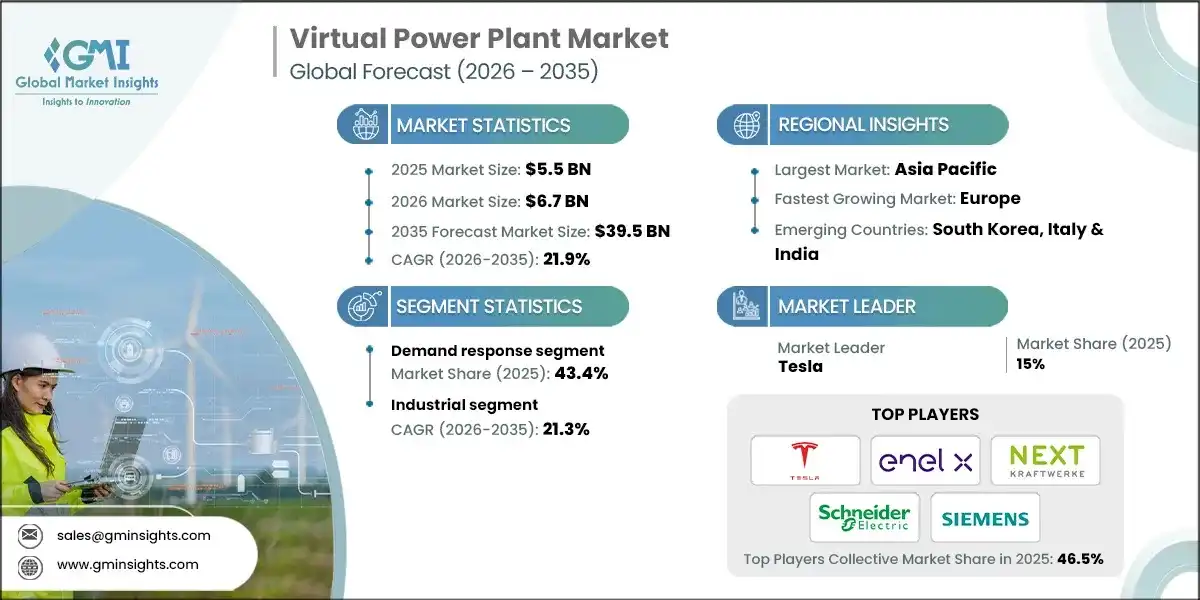
The global virtual power plant market was estimated at USD 5.5 billion in 2025. The market is expected to grow from USD 6.7 billion in 2026 to USD 39.5 billion in 2035, at a CAGR of 21.9% according to Global Market Insights Inc.
Virtual Power Plant Market Key Takeaways
Market Size & Growth
- 2025 Market Size: USD 5.5 Billion
- 2026 Market Size: USD 6.7 Billion
- 2035 Forecast Market Size: USD 39.5 Billion
- CAGR (2026–2035): 21.9%
Key Market Drivers
- Increasing renewable energy integration.
- Rising demand for grid flexibility.
Challenges
- High initial investment.
- Complex regulatory frameworks.
Opportunity
- Integration of electric vehicles.
- Advancements in AI and IoT.
Key Players
- Market Leader: Tesla led with over 15% market share in 2025.
- Leading Players: Top 5 players in this market include Tesla, Enel X, Next Kraftwerke, Schneider Electric, Siemens, which collectively held a market share of 46.5% in 2025.
Get Market Insights & Growth Opportunities
- Increasing deployment of advanced energy storage systems, particularly lithium-ion batteries, is significantly driving VPP adoption. These systems store surplus energy during low-demand periods and discharge it during peak demand, ensuring grid stability and reducing reliance on conventional generation. This flexibility supports renewable integration, enhances energy efficiency, and enables decentralized power management. As renewable penetration grows, energy storage becomes essential for balancing intermittent supply, making VPPs a critical solution for modern grids focused on sustainability and resilience.
- A virtual power plant (VPP) is an integrated network of decentralized energy resources such as solar panels, wind turbines, batteries, and demand-response systems, managed through advanced software. It aggregates these assets to operate as a single power plant, optimizing generation, storage, and consumption. VPPs enhance grid flexibility, reliability, and efficiency while supporting renewable energy integration and reducing carbon emissions.
- Rising government regulations and incentives promoting virtual power plants as part of clean energy transition strategies are accelerating market growth. For instance, in September 2023, the U.S. DOE approved a USD 3 billion loan guarantee for the nation’s first VPP project, aiming to prevent 7.1 million tons of CO2 emissions and generate 568 MW of clean energy over 25 years. Such initiatives highlight global efforts to decarbonize power systems, strengthen grid reliability, and encourage widespread adoption of VPPs as a sustainable energy solution.
- Ongoing advancements in communication technologies, machine learning, and data analytics are transforming VPP efficiency and reliability. These innovations enable real-time monitoring, predictive maintenance, and optimized energy dispatch, ensuring better performance and cost-effectiveness. Coupled with growing renewable penetration and decentralized energy systems, these technologies enhance self-consumption and grid flexibility. By integrating AI-driven solutions, VPPs can forecast demand, manage distributed resources intelligently, and support dynamic energy markets, positioning them as a cornerstone of future smart energy ecosystems.
- Asia Pacific is among the dominant regions on account of increasing renewable energy deployment. Countries including China, India, and Japan are expanding solar and wind capacity, creating a need for flexible energy management. VPPs aggregate distributed resources, optimize power flow, and balance intermittent generation, ensuring grid stability while supporting regional decarbonization and sustainability goals.
- Moreover, ongoing efforts by developed countries to escalate VPP deployment will complement the industry growth. For instance, in April 2024, China is deploying “invisible” virtual power plants to integrate distributed generators, energy storage, and flexible demand for sustainable energy transition. A smart control platform in Yantai manages a 242 MW adjustable-load pool, with plans to scale to 500 MW, enabling real-time balancing and trading. Supported by national standards and local pilots, VPPs are enhancing grid efficiency and reducing operating costs.
- Europe is the fastest-growing region in the virtual power plant market. Increasing renewable energy targets under EU climate policies are accelerating VPP adoption. Europe’s push for carbon neutrality by 2050 requires integrating intermittent sources such as wind and solar. VPPs aggregate distributed resources, optimize energy flow, and enhance grid flexibility, ensuring a reliable supply while meeting stringent sustainability and decarbonization goals across member states, leading to strengthening its market position.
To get key market trends
Virtual Power Plant Market Trends
- Increasing demand for energy independence among industries, businesses, and homeowners is accelerating VPP adoption. VPPs allow participants to generate, store, and consume electricity efficiently, reducing reliance on centralized grids and volatile energy markets. This ensures cost savings, resilience against outages, and greater control over energy use, making VPPs a vital solution for decentralized power management and renewable integration.
- Growing frequency of natural disasters worldwide is creating strong potential for VPP adoption as emergency backup solutions. In 2024, the U.S. reported 27 confirmed weather and climate disasters, each averaging over USD 1 billion in losses, including severe storms, cyclones, floods, and wildfires. These rising events highlight the need for resilient energy systems, positioning VPPs as a critical solution for disaster preparedness and grid reliability.
- Rising use of electric heat pumps and smart HVAC systems is increasing electricity demand, requiring advanced load management. VPPs optimize heating and cooling loads, shift consumption to off-peak hours, and reduce costs while improving grid efficiency. This capability supports demand-side programs and strengthens energy sustainability across residential and commercial sectors, making VPPs essential for managing growing electrification trends.
- Increasing investments in green hydrogen are making VPPs more attractive for energy storage and flexibility. In July 2024, the European Commission approved over USD 417.1 million for hydrogen projects in Italy, Finland, and Lithuania. VPPs can store excess renewable energy as hydrogen for later electricity generation, supporting industrial decarbonization and aligning with Europe’s clean energy transition goals.
- Growing renewable energy commitments by corporations through initiatives such as RE100 are boosting VPP uptake. Businesses use VPPs to manage renewable procurement, reduce carbon emissions, and participate in demand-side programs, improving sustainability and meeting global climate targets. VPPs provide flexibility and cost optimization, aligning with ESG objectives and strengthening corporate energy strategies worldwide.
- Increasing programs by companies to help customers generate, store, and share solar energy are driving VPP demand. In February 2025, Sunrun announced its VPP portfolio reached a peak capacity of nearly 80 MW in 2024, surpassing many fossil-fuel plants. Using residential solar and battery networks, Sunrun enables customers to produce, retain, and trade solar energy, enhancing grid resilience and consumer empowerment.
Virtual Power Plant Market Analysis
Learn more about the key segments shaping this market
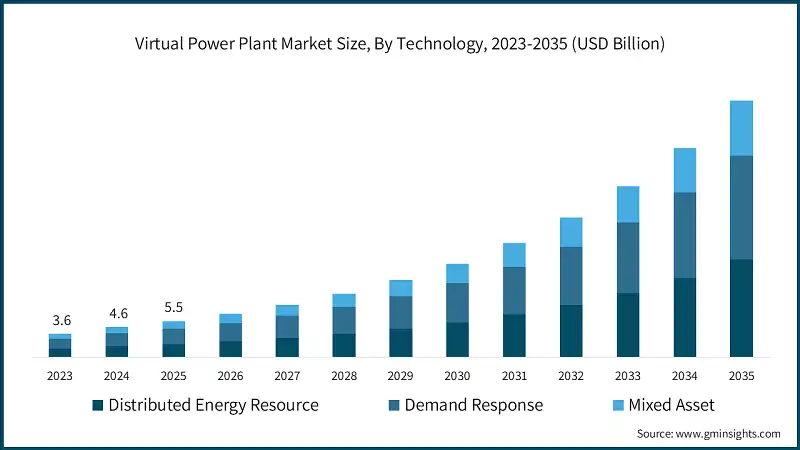
Based on technology, the industry is segmented into distributed energy resources, demand response and mixed assets. Demand response dominated the virtual power plant market, accounting for 43.4% in 2025 and is expected to grow at a CAGR of 21.1% through 2035.
- Increasing demand for grid reliability is prompting virtual power plants (VPPs) to adopt demand response solutions. By alleviating pressure on the grid, curbing outages, and reducing the necessity for extra generation capacity, demand response not only guarantees efficient energy distribution but also bolsters system resilience. This makes it an indispensable element of today's decentralized energy landscape.
- The distributed energy resource segment will grow at a CAGR of 12.4% by 2035. Increasing global renewable energy capacity is accelerating DER adoption in VPPs. Solar and wind power growth, projected to surge by over 5,520 GW between 2024 and 2030, drives the need for flexible resources. Utility-scale and distributed solar PV now account for nearly 80% of renewable expansion, making DER integration essential for managing variability and ensuring grid stability.
- Additionally, rising affordability of solar and battery storage is boosting DER adoption in VPPs. Lithium-ion battery prices have fallen by 89% since 2010, making storage solutions cost-effective. Coupled with strong policy incentives, such as the U.S. Inflation Reduction Act and European feed-in tariffs, these factors enhance accessibility and accelerate the integration of distributed resources for sustainable energy systems.
- The mixed assets will grow at a CAGR of 22.1% by 2035. Increasing global renewable energy capacity is accelerating DER adoption in VPPs. Increasing demand for grid flexibility is driving the technology adoption in VPPs. By integrating diverse resources such as solar, wind, batteries, and controllable loads, operators can balance intermittent generation and fluctuating demand. This approach enhances reliability, optimizes energy dispatch, and supports grid stability under dynamic market conditions.
Learn more about the key segments shaping this market
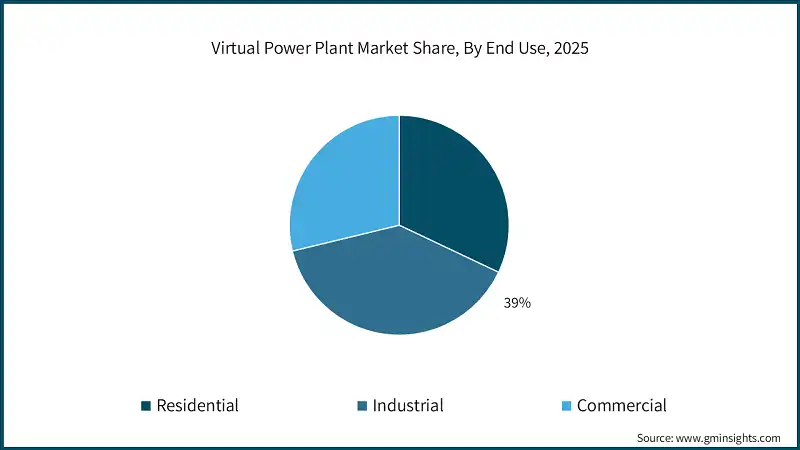
Based on end use, the virtual power plant market is segmented into residential, industrial and commercial. Industrial application dominates the market with a 39% share in 2025, and the segment is expected to grow at a CAGR of 21.3% from 2026 to 2035.
- Increasing energy consumption across industrial facilities is driving the need for advanced solutions that optimize power usage and reduce costs. Virtual Power Plants enable load shifting, real-time energy management, and peak demand reduction, helping industries manage rising electricity expenses while improving operational efficiency. These capabilities make VPPs a strategic choice for energy-intensive sectors seeking cost control and resilience.
- Growing demand for uninterrupted energy supply in industrial environments, coupled with mounting pressure to meet sustainability goals, is accelerating VPP adoption. Industries are striving to reduce carbon emissions while maintaining continuous operations. With the industrial sector accounting for 40% of global energy use in 2024, VPPs offer a scalable solution to balance reliability, efficiency, and environmental compliance.
- The residential segment is set to grow at a CAGR of 22.5% by 2035. Rising installation of rooftop solar panels, home battery systems, and EV chargers is creating a strong foundation for Virtual Power Plant growth in residential markets. Homeowners aim to cut electricity costs by optimizing energy use and selling surplus power to the grid, improving flexibility and accelerating sustainable VPP integration.
- Increasing collaboration among major players to tackle rising electricity demand in residential sectors is accelerating VPP adoption. In May 2024, Renew Home, in collaboration with Google's Nest Renew and OhmConnect, emerged as North America's largest residential Virtual Power Plant (VPP). Currently overseeing a load of 3 GW, Renew Home aims to escalate this to 50 GW by 2030, aligning with the Department of Energy's objectives for cost savings and peak demand reduction.
- The commercial segment is set to grow at a CAGR of 22% by 2035. Rising demand for reliable and continuous power in commercial establishments such as data centers, hospitals, and manufacturing plants is accelerating VPP growth. VPPs ensure grid stability and cost efficiency while supporting critical operations. Their ability to integrate distributed energy resources makes them essential for businesses seeking resilience against outages and peak demand fluctuations.
Looking for region specific data?
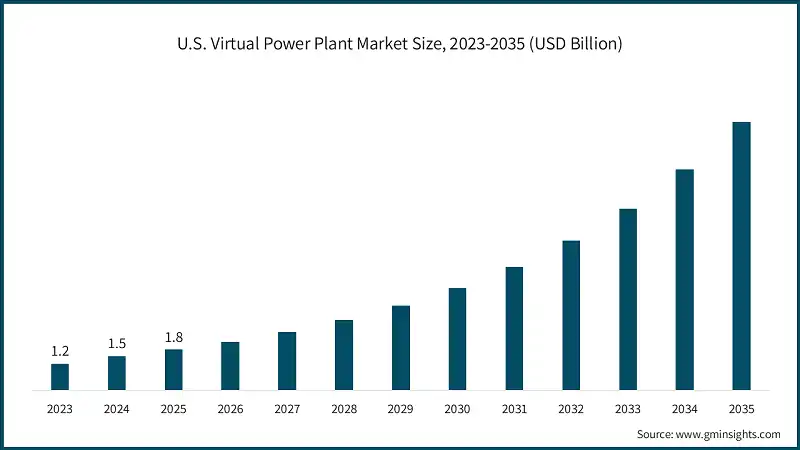
- The U.S. dominated the virtual power plant market in North America with around 87.9% share in 2025 and is expected to generate over USD 11.5 billion in revenue by 2035.
- Increasing grid reliability challenges caused by extreme weather, aging infrastructure, and surging electricity demand are driving virtual power plant adoption. VPPs stabilize the grid during peak loads while leveraging distributed resources. Additionally, supportive measures such as Investment Tax Credit (ITC) and federal grants for energy storage and renewables are accelerating deployment, strengthening the market outlook.
- Ongoing efforts by government bodies to escalate VPP deployment in the region. For instance, in September 2025, California launched its Demand Side Grid Support (DSGS) program, enrolling over 720 MW of customer-sited batteries since August 2023. The state aims to expand to 1,300 MW, positioning DSGS as the world’s largest Virtual Power Plant. Moreover,
- The North America virtual power plant market accounted for a market value of USD 17.8 billion in 2025. Rising integration of solar, wind, and battery storage across North America is creating a strong need for virtual power plants. VPPs enable efficient coordination of distributed resources, improving grid flexibility and reducing reliance on fossil fuels. This trend supports decarbonization goals while ensuring cost-effective energy management for utilities and commercial users.
- Asia Pacific virtual power plant market is anticipated to grow at a CAGR of 9.2% by 2035. Increasing urbanization and surging electricity consumption are driving market growth. The region accounts for 45% of global energy supply and over 50% of electricity generation. VPPs help manage rising demand by integrating distributed resources and optimizing energy use across cities, ensuring grid stability and supporting sustainable urban development.
- Moreover, growing acceptance of advanced energy technologies is boosting VPP deployment in China. In 2024, CHN Energy Guangdong Integrated Energy inaugurated its first VPP in Guangdong province by connecting its VPP control platform to the management center of Shenzhen Power Plant. The debut phase oversees a load of 9.9 MW, boasting an adjustable capacity of 1.41 MW, underscoring robust regional expansion.
Virtual Power Plant Market Share
- The top 5 companies, including Tesla, Enel X, Next Kraftwerke, Schneider Electric and Siemens, account for around 46.5% of the market share. Companies are focusing on integrating rooftop solar, battery storage, and EV chargers into VPP platforms. This strategy enhances grid flexibility, optimizes energy use, and supports decarbonization goals, making VPPs attractive for residential, commercial, and industrial customers seeking cost savings and sustainability.
- Key players are deploying AI-driven analytics, IoT connectivity, and real-time monitoring to improve VPP efficiency. These technologies enable predictive load management, dynamic pricing, and automated demand response, ensuring better grid stability and customer engagement while reducing operational costs.
- Collaborations with utilities, technology providers, and renewable energy developers are accelerating VPP adoption. Partnerships help expand resource aggregation, share infrastructure, and access new markets, creating scalable solutions that meet growing energy demands and regulatory compliance requirements.
- Companies are aligning strategies with government incentives such as tax credits and grants for energy storage and renewables. By leveraging these programs, they reduce deployment costs, encourage customer participation, and strengthen their competitive position in the evolving energy landscape.
Virtual Power Plant Market Companies
Eminent players operating in the virtual power plant industry are:
- AGL Energy
- Bosch Global
- Enbala Power Networks
- Enel X
- EnergyHub
- ENGIE
- Flexitricity
- Hitachi
- Lumenaza
- Next Kraftwerke
- Schneider Electric
- Shell
- Siemens
- Statkraft
- Sunrun
- Sunnova Energy International
- Tesla
- Tiko Energy Solutions
- Toshiba Corporation
- Virtual Peaker
- Tesla, a major player in the virtual power plant industry, posted USD 25.7 billion in Q4 2024 revenue and USD 4.9 billion EBITA. Its VPP solution uses excess solar energy stored in Powerwall batteries to supply electricity during peak demand, improving grid reliability and promoting cleaner energy for residential communities.
- Enel X is a growing VPP solutions provider, focusing on demand response and distributed energy resource aggregation. Its VPP platforms optimize energy use, enhance grid flexibility, and integrate renewables, supporting decarbonization goals while delivering cost savings and reliability for commercial and industrial customers worldwide.
- Next Kraftwerke operates one of Europe’s largest Virtual Power Plants, connecting thousands of decentralized energy units. Its platform enables real-time energy trading, demand-side management, and renewable integration. By leveraging advanced digital technologies, the company improves grid stability and supports the transition toward a sustainable, decentralized energy system.
- Schneider Electric reported revenues of USD 44.6 billion in 2024 with an EBITA of 18.6%. The company offers advanced VPP solutions through its energy management and automation expertise. Its platforms integrate distributed resources such as solar, storage, and EV infrastructure, enabling dynamic load balancing and demand response. These solutions help businesses achieve sustainability targets, reduce costs, and enhance resilience against grid disruptions.
- Siemens started the new fiscal year with solid growth, reporting a 3% increase in comparable revenue to USD 79.1 billion in fiscal 2024, up from USD 78.1 billion in 2023. It is advancing virtual power plant platforms, grid management solutions, and AI-driven optimization tools to improve integration and performance of distributed energy resources (DERs).
Virtual Power Plant Market Report Attributes
| Key Takeaway | Details |
|---|---|
| Market Size & Growth | |
| Base Year | 2025 |
| Market Size in 2025 | USD 5.5 Billion |
| Market Size in 2026 | USD 6.7 Billion |
| Forecast Period 2026-2035 CAGR | 21.9% |
| Market Size in 2035 | USD 39.5 Billion |
| Key Market Trends | |
| Drivers | Impact |
| Increasing renewable energy integration | Increasing renewable energy adoption requires flexible grid solutions. VPPs aggregate distributed resources, optimize energy flow, and ensure stability, making them essential for managing intermittent solar and wind generation effectively. |
| Rising demand for grid flexibility | Rising need for grid flexibility amid growing electrification and decentralized power systems drives VPP adoption. They enable real-time balancing, reduce reliance on conventional plants, and support sustainable energy transitions. |
| Pitfalls & Challenges | Impact |
| High initial investment | High upfront costs for advanced communication systems, software platforms, and storage technologies hinders VPP deployment, especially in regions with limited funding or underdeveloped energy infrastructure. |
| Complex regulatory frameworks | Complex and varying regulations across countries create challenges for VPP implementation. Compliance with grid codes, market rules, and cybersecurity standards can delay projects and increase operational costs. |
| Opportunities: | Impact |
| Integration of electric vehicles | Integration of EVs into VPPs offers significant potential. EV batteries act as mobile storage units, enhancing grid flexibility, supporting demand response, and creating new revenue streams for operators. |
| Advancements in AI and IoT | Advancements in AI and IoT present opportunities to optimize VPP operations. Predictive analytics and real-time monitoring improve efficiency, reliability, and enable dynamic energy trading in smart grids. |
| Market Leaders (2025) | |
| Market Leaders |
15% market share |
| Top Players |
|
| Competitive Edge |
|
| Regional Insights | |
| Largest Market | Asia Pacific |
| Fastest Growing Market | Europe |
| Emerging Country | South Korea, Italy & India |
| Future Outlook |
|
What are the growth opportunities in this market?
Virtual Power Plant Industry News:
- In June 2025, Enel X launched the first Virtual Power Plant under New South Wales’ Electricity Infrastructure Roadmap. The state-backed VPP taps flexible demand from factories, offering capacity during peak periods to prevent blackouts and reduce energy costs.
- In September 2024, Tesla announced plans to sell its first Virtual Power Plant in South Australia, a region facing grid reliability challenges and high electricity costs. This initiative leverages Tesla’s solar and battery storage technologies to improve energy management and aligns with its broader clean energy objectives.
This virtual power plant market research report includes an in-depth coverage of the industry with estimates & forecast in terms of revenue in “USD Billion” from 2022 to 2035, for the following segments:
Market, By Technology
- Distributed energy resource
- Demand response
- Mixed asset
Market, By End Use
- Residential
- Industrial
- Commercial
The above information has been provided for the following regions and countries:
- North America
- U.S.
- Canada
- Europe
- Germany
- France
- UK
- Italy
- Asia Pacific
- China
- Japan
- South Korea
- India
- Rest of World
Frequently Asked Question(FAQ) :
What is the market size of the virtual power plant in 2025?
The market size was USD 5.5 billion in 2025, with a CAGR of 21.9% expected through 2035, driven by increasing renewable energy integration and demand for grid flexibility.
What is the projected value of the virtual power plant market by 2035?
The virtual power plant market is expected to reach USD 39.5 billion by 2035.
What is the current virtual power plant market size in 2026?
The market size is projected to reach USD 6.7 billion in 2026, supported by rising adoption of distributed energy resources and advanced energy management software.
Which technology segment leads the virtual power plant market?
Demand response technology dominated the market with a 43.4% share in 2025, owing to its ability to balance grid load and reduce peak electricity demand.
What is the growth outlook for the mixed asset segment?
The mixed asset segment is expected to grow at a CAGR of 22.1% through 2035, driven by integration of solar, wind, batteries, and controllable loads for enhanced grid stability.
Which end-use segment holds the largest share in the virtual power plant market?
The industrial segment led the market with a 39% share in 2025, driven by high energy consumption and demand for uninterrupted power supply.
What is the fastest-growing end-use segment in the virtual power plant market?
The residential segment is projected to grow at a CAGR of 22.5% through 2035, supported by rising rooftop solar installations, home batteries, and EV charging infrastructure.
Which region dominates the virtual power plant market?
The U.S. led the North American virtual power plant market with an 87.9% share in 2025 and is projected to hit USD 11.5 billion by 2035.
Who are the key players in the virtual power plant market?
Key players include Tesla, Enel X, Next Kraftwerke, Schneider Electric, Siemens, Sunrun, ENGIE, Shell, EnergyHub, and Toshiba Corporation.
Virtual Power Plant Market Scope
Related Reports