Summary
Table of Content

Utility Terrain Vehicle (UTV) Market
Get a free sample of this report
Form submitted successfully!
Error submitting form. Please try again.
Thank you!
Your inquiry has been received. Our team will reach out to you with the required details via email. To ensure that you don't miss their response, kindly remember to check your spam folder as well!
Request Sectional Data
Thank you!
Your inquiry has been received. Our team will reach out to you with the required details via email. To ensure that you don't miss their response, kindly remember to check your spam folder as well!
Form submitted successfully!
Error submitting form. Please try again.
Utility Terrain Vehicle Market Size
Technological advancements in utility terrain vehicles are making it easier for businesses to meet their operational needs while being environmentally responsible. For example, agricultural and utility applications have always been drivers of demand for UTVs; however, as more farms and rural areas adopt more compact vehicles for transporting materials and moving around in the field, they will continue to drive demand for utility vehicles.
Utility Terrain Vehicle (UTV) Market Key Takeaways
Market Size & Growth
- 2025 Market Size: USD 9.6 Million
- 2026 Market Size: USD 10.2 Billion
- 2035 Forecast Market Size: USD 16.1 Billion
- CAGR (2026–2035): 5.3%
Regional Dominance
- Largest Market: North America
- Fastest Growing Region: Asia Pacific
Key Market Drivers
- Rising demand for off road recreational activities.
- Growing adoption in agriculture and farming operations.
- Expansion of construction and infrastructure projects.
- Technological improvements in vehicle performance.
Challenges
- High vehicle purchase and maintenance costs.
- Safety concerns and accident risks.
Opportunity
- Expansion of electric and hybrid utility terrain vehicles.
- Growing demand from tourism and recreational parks.
- Increasing adoption in defense and public safety operations.
Key Players
- Market Leader: Polaris led with over 33% market share in 2025.
- Leading Players: Top 5 players in this market include BRP/Can-Am, Honda, John Deere, Kawasaki, Polaris, which collectively held a market share of 76% in 2025.
Get Market Insights & Growth Opportunities
According to The United States Department of Agriculture (USDA), there are at least 2 million farms in the US, providing stability and reliability in supply for utility vehicles used in farming operations.
With the continued growth of infrastructure development and construction, the demand for UTVs to be used to move workers and/or equipment on job sites will continue to grow. The United States Census Bureau recently reported that construction spending in the US exceeded $2 Trillion in 2023 and thus utility vehicle sales and procurement will continue to rise.
UTV product capabilities will continue to be enhanced by technology improvements such as higher engine efficiency, electric powertrains, and improved suspension systems. Manufacturers are also introducing electric UTVs to address new environmental emissions regulations and/or to reduce operating costs, thereby increasing demand for electric UTVs across industrial facilities, resorts, and municipalities.
The Global utility terrain vehicle market was estimated at USD 9.6 billion in 2025. The market is expected to grow from USD 10.2 billion in 2026 to USD 16.1 billion in 2035, at a CAGR of 5.3% according to latest report published by Global Market Insights Inc.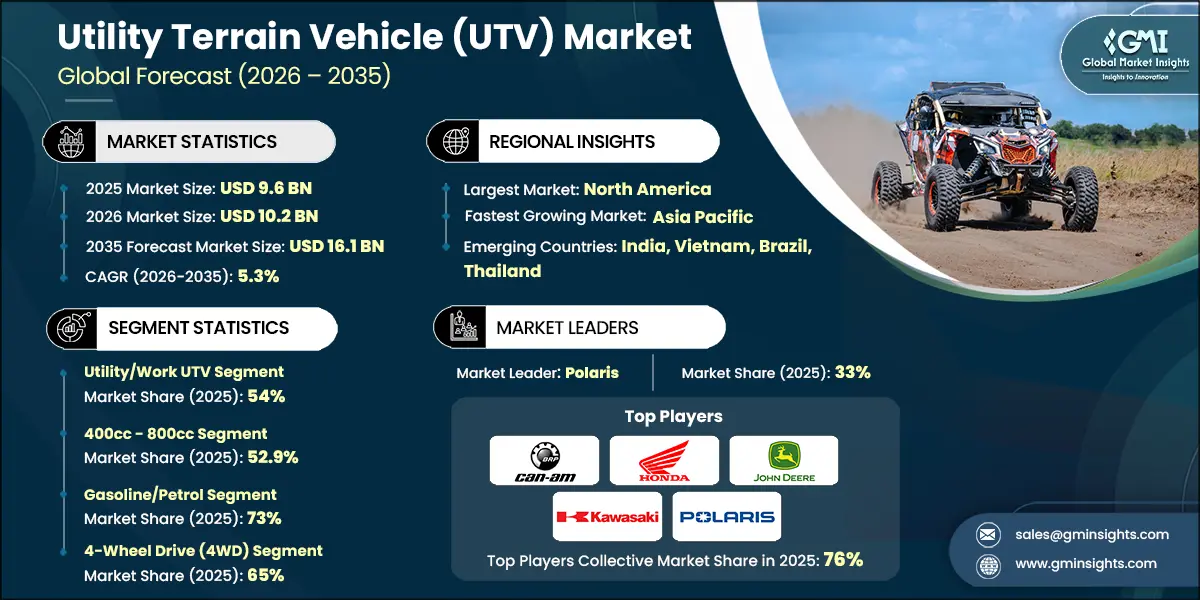
To get key market trends
Utility Terrain Vehicle Market Trends
As industries look to reduce emissions, more companies are using electric utility terrain vehicles. Because of this, many manufacturers are developing both battery-powered and electric utility terrain vehicles for farms and industrial sites. According to the International Energy Agency, the global number of electric vehicles (EVs) grew by 14 million in 2023.
High-performance utility terrain vehicles (UTVs) are in demand as recreational off-road activities grow. In 2023, the Outdoor Industry Association reported that 168 million people participated in outdoor recreation across the United States, which has driven demand for UTVs capable of travelling over rough ground.
Advanced vehicle technologies, such as electronic power steering and GPS-based vehicle navigation, are being integrated into UTVs, increasing safety and improving operations. Smart-connectivity systems will soon be standard in UTVs to help manage fleets.
For example, UTVs are being used widely in agriculture for moving and processing materials on large farms. According to the United States Department of Agriculture, there are 880 million acres of farmland within the United States, demonstrating the need for compact UTVs that can operate in forests, fields, and other locations.
The growth of the tourism and adventure recreation industries has resulted in greater use of UTVs (Utility Terrain Vehicles) in guided off-road tours and recreational parks. The Adventure Travel Trade Association reports that the global adventure tourism market for 2022 was worth USD 366 billion, which will continue to support recreational off-road vehicle fleets.
Utility Terrain Vehicle Market Analysis
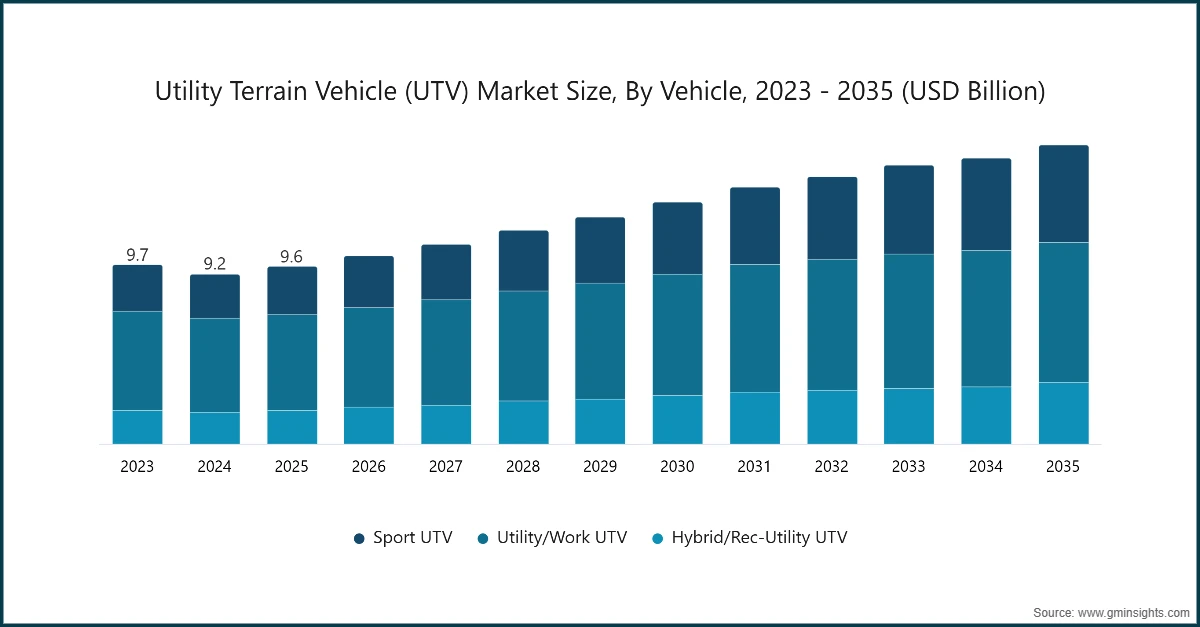
Learn more about the key segments shaping this market
Based on vehicle, the market s segmented into sport UTV, utility/ Work UTV, and hybrid/recreational utility UTV. The utility/ work UTV segment dominates the market with 54% share in 2025, and the segment is expected to grow at a CAGR of 3.8% from 2026 to 2035.
- Utility Work UTVs are used by people in many industries such as the agricultural, construction, forestry, and industrial sectors to transport materials and employees from one area to another. These vehicles are able to carry large loads and tow heavy objects while also being built well enough to withstand tough working environments.
- These UTVs are typically present in locations like farms, ranches, warehouses, and mines where having a vehicle small enough to drive off of a road makes it easier for the driver to be productive and maintain operational efficiency. Additionally, they can operate well in rough terrain and on narrow roads, which is one reason why many people choose to use them for all types of tasks.
- The majority of manufacturers/companies make their work focused UTVs out of durable materials and have large cargo areas and have been designed in such a way to be dependable when working in very difficult environments.
- Sport UTVs are used by many individuals who participate in off-road outdoor and competition racing. They feature powerful engines, superior suspensions, and a good amount of stability so they can perform at high speeds while going over tough terrain or while being used on recreational trails.
- Many people who ride recreationally like to use sport UTV's for things such as trail rides, driving in deserts, and competing in off-road races. The majority of manufacturers promote the performance of their sport UTV's, with a lot of emphasis being placed on the acceleration, performance, and turning capabilities of the units so that all users really have a great experience while driving off-road.
Learn more about the key segments shaping this market
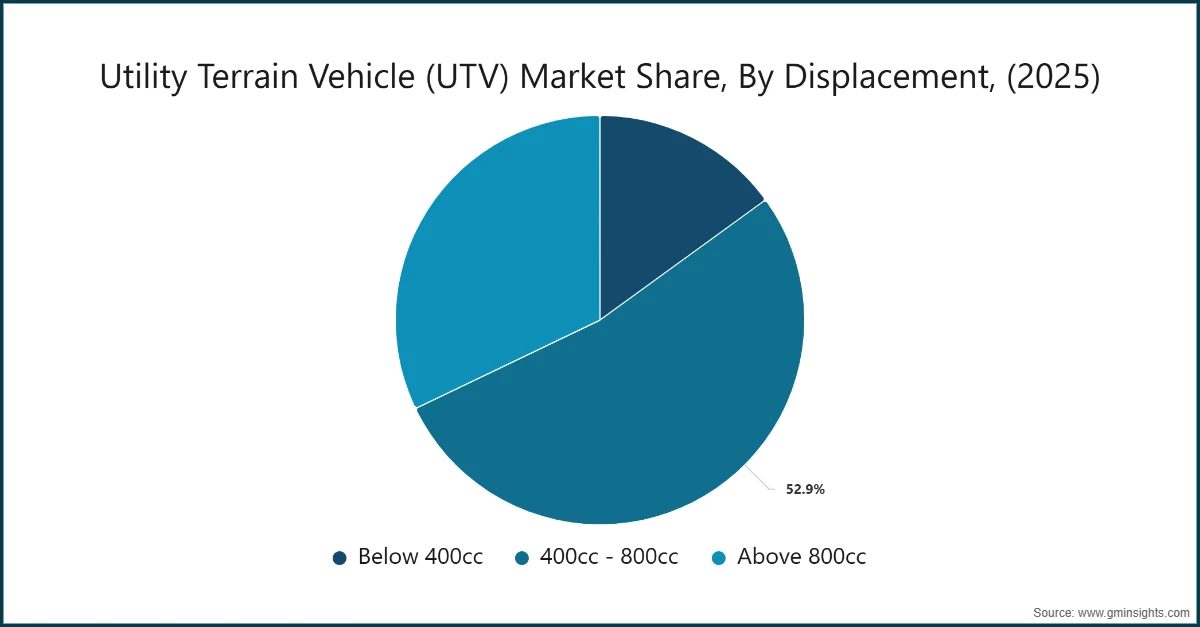
Based on displacement, the utility terrain vehicle market is divided into Below 400cc, 400cc - 800cc, above 800cc. The 400cc - 800cc segment dominates with 52.9% market share in 2025 and is growing at a CAGR of 5.4% from 2026 to 2035.
- Vehicles within the range of 400cc-800cc provide a good balance between performance, fuel economy, and towing ability, allowing appropriate use for both recreational and utility purposes. They are commonly used in agriculture, property management, and light industrial settings.
- For example, companies such as Polaris, Yamaha Motor, and Kawasaki Motors produce mid-displacement utility terrain vehicles (UTVs) that are designed to operate efficiently while still being capable of traversing difficult terrain conditions. The versatility of these vehicles allows them to be used for many different applications, including farms, construction sites, and recreational trails.
- Utility terrain vehicles (UTVs) in the 400cc and under range are usually utilized for light-duty work and entry-level recreation. UTVs in this range have lower engine capacities, lower weights, and increased maneuverability, which makes them great for use on small farms, private property, and recreational riding.
- New users and younger recreational riders often prefer to purchase entry-level models in this category because of their simplified operation and lower initial investment compared to higher-end, performance-oriented UTVs. Additionally, these vehicles are used frequently to do light maintenance work and move around on the property.
- For UTVs over 800cc, performance capability is the primary differentiating factor. Vehicles within this category are designed to support heavy-duty operations and utilize powerful engines, advanced suspension and braking systems, and increased towing capabilities to enable operation in demanding off-road environments.
Based on fuel, the utility terrain vehicle market is segmented into Gasoline/Petrol, Diesel and electric. The Gasoline/Petrol segment dominates with 73% market share in 2025.
- Gasoline-powered utility vehicles (UTVs) are widely used for both recreational and utility applications because of their high engine responsiveness and ease of refueling. People tend to prefer gasoline-powered UTVs for activities like sport riding, trail riding, and general off-road use.
- Because manufacturers like Polaris, Yamaha, and Honda produce gasoline-powered UTVs with great power and established engine technologies, there is greater availability of both fuel and maintenance support than there is for diesel-powered vehicles.
- Diesel-powered UTVs are typically utilized for agricultural, construction, and industrial applications that require higher torque and fuel efficiency. Diesel engines are better suited for heavy-duty tasks such as hauling materials, towing, and operating in rough environments.
- Diesel UTVs are also commonly used for long-term operations or in demanding utilization applications where maximizing fuel efficiency is critical. Diesel UTVs deliver consistent power at low rpm, making them ideal for work-intensive environments such as farms, mines, and other industrial sites.
- Electric UTVs are growing in popularity due to increasing demand for low-emission modes of transportation and quieter operation. Electric UTVs are often used in settings such as campuses, resorts, industrial facilities, and environmentally sensitive locations, where noise and emissions must be minimized.
Based on drive, the utility terrain vehicle market is divided into 2-Wheel Drive (2WD), 4-Wheel Drive (4WD), and All-Wheel Drive (AWD). 4-Wheel Drive (4WD) dominates with 65% market share in 2025.
- Utility terrain vehicles (UTVs) equipped with 4-Wheel Drive (4WD) are commonly used in agricultural, construction, and off-road recreational activities because these types of vehicles provide better traction & stability while driving across rough & uneven surfaces. UTVs with 4WD can handle a wide variety of terrain including mud, sand, snow and rocky surfaces.
- Several manufacturers (e.g. Polaris, Yamaha Motor, Kawasaki Motors) produce multiple models of UTVs with 4WD for use in extreme off-road conditions. The drivetrain's power management system splits the engine's power to all four wheels as needed, which provides better vehicle control and higher operational efficiency.
- 2-Wheel Drive (2WD) UTVs are typically used for light-duty work and recreational riding on relatively stable ground. They have much simpler mechanical systems, lower weight and better gas mileage compared to UTVs with more complex drivetrains.
- The majority of users prefer to use 2WD UTVs for property maintenance, light farming jobs, and leisurely driving on well-maintained trails. Their lower initial cost of purchase, as well as easier maintenance, make them attractive choices for first-time users and private property owners.
- All-Wheel Drive (AWD) UTVs send power to all four wheels simultaneously and provide constant traction without having the driver have to manually control the amount of power that is sent to each wheel. AWD UTVs offer improved vehicle stability and handling when driving over various types of terrains.
Looking for region specific data?
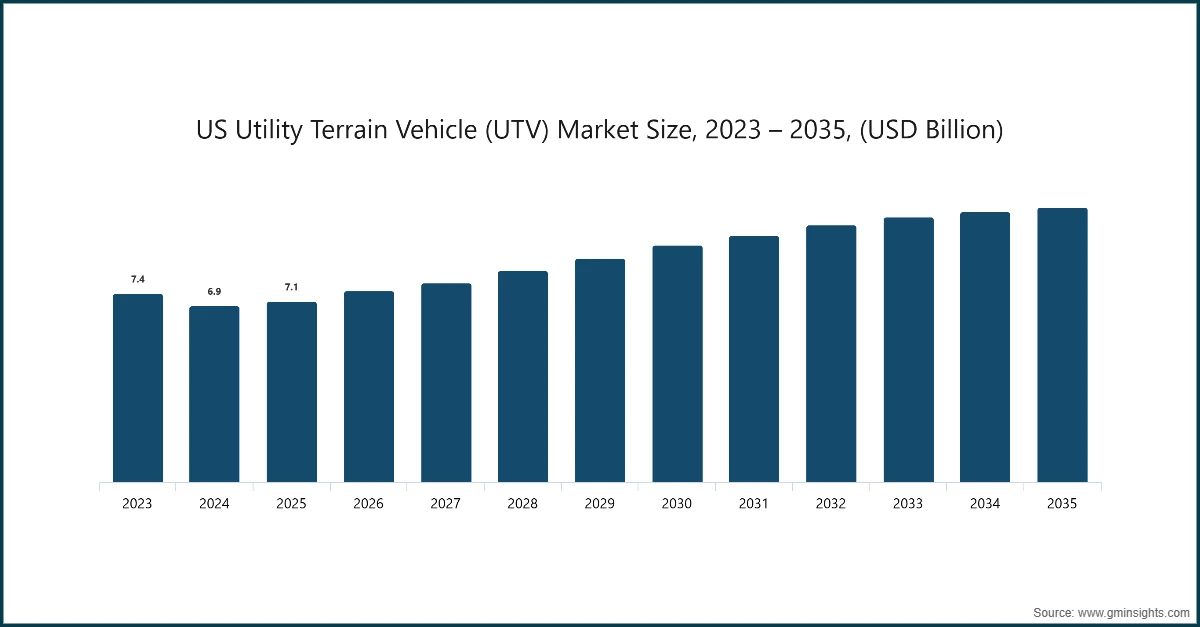
U.S. dominates the North America utility terrain vehicle market accounting for 85% and generating USD 7.1 billion in 2025.
- Demand for utility terrain vehicles (UTVs) in the United States is driven by demand for UTVs for recreational purposes, agricultural use, and property management on rural properties. Off-road vehicles are used extensively on farms, ranches, forests and other private properties that require mobility across rough terrain for daily operational functions.
- Utility terrain vehicles are used by agricultural workers for a number of applications. Farmers use UTVs for crop monitoring, equipment transport, and livestock management. Their ability to travel over rough land and remote locations makes them an ideal option for supporting routine operating and maintenance functions on farms.
- The presence of major manufacturers such as Polaris, John Deere and Textron in the United States creates strength within the domestic utility terrain vehicle market as they continually develop new products and develop their off-road vehicle line. Companies concentrate on vehicles ‘durability, performance and safety.
- Demand from recreational activities for UTVs has grown in recent years. The recreational use of UTVs includes trail riding, outdoor adventure tourism and motorsport activities have all contributed to the increasing use of sport utility terrain vehicles in National Parks, on recreational trails and in private off-road parks.
Germany dominates Europe utility terrain vehicle market growing with a CAGR of 9.6% from 2026 to 2035.
- The market for utility terrain vehicles in Germany is expanding because of the growth of the use of Off-Road Vehicles in the Agriculture, Forestry, and Industrial industries. Utility terrain vehicles are commonly used as a means of transporting tools and people over rough terrain that traditional forms of transportation cannot travel over.
- The Agriculture and Forestry industries are two of the major users of utility terrain vehicles due to the fact that they allow for the transportation of tools and equipment over uneven or unpaved surfaces and provide a way for workers to move easily from one area of land to another.
- Utility terrain vehicles are also now being used by Industrial Facilities and Logistics Centers as a method of transporting products and supplies throughout these facilities. Because they are compact and operate well in an unsteady environment, they can be used as a means of transportation in large warehouses or facilities.
- The continued increase in recreational Off Road activities and outdoor tourism is supporting the growth of the market for utility terrain vehicles. Sport utility terrain vehicles are used for trail riding or other types of outdoor recreational activities in Off Road Areas or in Rural Recreation Areas.
China dominates the Asia Pacific utility terrain vehicle market, showcasing strong growth potential, with a CAGR of 14.3% from 2026 to 2035.
- The expansion of the China utility terrain vehicle industry is a result of the need for UTVs in agricultural and rural development activities, industrial operations, and outdoor recreation activities. UTVs are widely used in rural areas for transporting tools, materials, and personnel across rough ground where regular vehicles cannot access.
- Agricultural and rural development activities are fostering the increased use of UTVs for managing farms and maintaining properties. UTVs are used by farmers to inspect fields, move equipment, and monitor livestock over vast quantities of agricultural land.
- Many industrial facilities and construction sites also are using UTVs to improve their internal transportation, logistics, and operational efficiency. UTVs are capable of traversing rugged terrain and operating in tight quarters making them the ideal choice for transporting goods through large industrial sites.
- Recreational activities and outdoor tourism are gradually increasing UTV demand. UTVs are utilized in adventure parks and locations where outdoor recreational tourism is enjoyed by visitors riding with a guide on designated trails and exploring the surrounding environment.
Brazil leads the Latin American utility terrain vehicle industry, exhibiting remarkable growth of 10.6% during the forecast period of 2026 to 2035.
- The Brazil utility terrain vehicle marketplace is driven by the growing utilization of off-road vehicles in agricultural, forestry, and mining operations. These types of vehicles provide an alternative method to transport tools and personnel in rugged country where standard transportation options do not work very well.
- Market demand will primarily continue to come from agriculture. Farmers and ranchers utilize UTVs for various work-related activities such as inspecting fields, managing livestock, and transporting products between locations. In addition to their versatility for many applications, UTVs are capable of traversing uneven and remote farmland, thus improving efficiency in rural areas.
- Mining and construction companies are starting to use UTVs as a means of optimizing mobility at job sites and for transporting materials. By utilizing UTVs, construction and mining employees can move quickly around large job sites across rough terrain.
- Recreational tourism and outdoor activities are gradually creating demand for sport-oriented UTVs. Adventure-themed parks and other tourist destinations are creating off-road adventure driving experiences; therefore, there is an increasing presence of these vehicles around the nation.
UAE witnessed substantial growth in the Middle East and Africa utility terrain vehicle market in 2025.
- The growth of the UAE utility terrain vehicle Industry relies heavily on the need for towable vehicles for tourism, desert-based recreation, and industrial/office-based work. As a result of having great off-road abilities, utility terrain vehicles are often used in the vast desert and allow for moving over sand dunes as well as traversing through extremely remote locations.
- Adventure tourism and desert safari tours use utility terrain vehicles as a part of their core product/service mix. Tour operators utilise sport/utility terrain vehicles for guided tour operations on an off-road basis, thus helping to grow, boost and support the overall market for off-road tourism.
- Utility terrain vehicles can also be used in many areas of Industry, such as construction, oil and gas and facility/property management, to move personnel as well as equipment around. Because they can be operated in a sandy and uneven terrain environment, utility terrain vehicles are suited for being deployed to remote project locations to perform operational activities.
- Many large hotels, private estates and recreational facilities have now also started to utilise utility terrain vehicles for internal transportation and property management. These vehicles provide service and mobility for maintenance and improve the efficiency of large outdoor areas and hospitality developments.
Utility Terrain Vehicle Market Share
- The top 7 companies in the utility terrain vehicle industry are Polaris, BRP or Can Am, Kawasaki, Honda, John Deere, Kubota, and CFMOTO, contributed around 84% of the market in 2025.
- Polaris is one of the largest manufacturers in the utility terrain vehicle market, offering a complete line of sport and utility UTVs that can be used for recreational or work-related purposes. Their focus on performance engineering, innovative suspension systems, and ongoing product development results in UTVs that are built for high speed and performance.
- BRP manufactures side by side vehicles intended for both recreational and hard-use applications. Can-Am offers side by side vehicles that have high-performance engines, advanced vehicle control technologies, and a wide variety of features that distinguish them from competing brands.
- Kawasaki manufactures UTVs that have both high performance and long-lasting durability. Kawasaki's UTVs have a reputation for reliability, superior off-road capabilities, and the ability to meet the needs of customers in the agriculture, recreation, and industrial sectors.
- Honda's UTVs are made to last and to provide good fuel economy and consistent performance. They are widely used in agricultural, construction, and facility management operations where dependability and ease of maintenance are essential.
- John Deere is a leading manufacturer of work-oriented UTVs for agricultural and rural property management. John Deere uses its strong position as a manufacturer of agricultural equipment to create UTVs that can be used in agricultural, land management, and maintenance operations.
- Kubota makes utility terrain vehicles with diesel engines that are built for use within agriculture, construction and other industries that require heavy-duty equipment. The focus of Kubota is to build strong and reliable traction to be able to use these vehicles in many different operational settings.
- CFMOTO continues to expand its footprint in the utility terrain vehicle segment of the market through lower pricing and an expanded product line. CFMOTO’s goal is to develop and manufacture sport utility tractors that are designed for recreation and property management purposes.
Utility Terrain Vehicle Market Companies
Major players operating in the utility terrain vehicle industry are:
- BRP/Can-Am
- CFMOTO
- Club Car
- EZGO/Cushman
- Honda
- John Deere
- Kawasaki
- Kubota
- Polaris
- Yamaha
- The market for utility terrain vehicles continues to grow with the demand resulting from agriculture, construction, industrial operations, and recreation. Utility terrain vehicles offer a high level of mobility across rough and rugged terrain; therefore, they can be used in a variety of applications such as Farms, Mining Locations, Forests, and Large Outdoor Facilities where traditional vehicles may not operate.
- Manufacturers are working to improve vehicle durability, performance, and safety features to meet the needs of expanding application markets. Electric Powered utility terrain vehicles, Better Suspension Systems, and Advanced Vehicle Control Technologies are helping to improve product capabilities and will likely lead to expanded uses of UTVs in recreational as well as utility applications.
Utility Terrain Vehicle (UTV) Market Report Attributes
| Key Takeaway | Details |
|---|---|
| Market Size & Growth | |
| Base Year | 2025 |
| Market Size in 2025 | USD 9.6 Million |
| Market Size in 2026 | USD 10.2 Billion |
| Forecast Period 2026-2035 CAGR | 5.3% |
| Market Size in 2035 | USD 16.1 Billion |
| Key Market Trends | |
| Drivers | Impact |
| Rising demand for off road recreational activities | Increasing participation in outdoor recreation and adventure sports is driving demand for sport utility terrain vehicles across North America and Europe. |
| Growing adoption in agriculture and farming operations | Farmers use utility terrain vehicles for field mobility, crop inspection, and equipment transport which supports consistent demand from agricultural sectors. |
| Expansion of construction and infrastructure projects | Construction sites require compact vehicles for personnel mobility and material transport, increasing the use of utility terrain vehicles in infrastructure development projects. |
| Technological improvements in vehicle performance | Advancements in engine efficiency, suspension systems, and vehicle control technologies are improving durability, safety, and operational efficiency. |
| Pitfalls & Challenges | Impact |
| High vehicle purchase and maintenance costs | High upfront cost of utility terrain vehicles can limit adoption among small farms and recreational users in price sensitive markets. |
| Safety concerns and accident risks | Lack of proper training and safety compliance in off-road driving can increase accident risks and lead to stricter regulatory oversight. |
| Opportunities: | Impact |
| Expansion of electric and hybrid utility terrain vehicles | Development of electric powertrain technologies creates opportunities for manufacturers to introduce low emission vehicles for commercial and recreational applications. |
| Growing demand from tourism and recreational parks | Increasing development of adventure tourism destinations and off-road parks is supporting higher demand for sport utility terrain vehicles. |
| Increasing adoption in defense and public safety operations | Military units, forest departments, and rescue agencies are using utility terrain vehicles for rapid mobility in remote and difficult terrains. |
| Market Leaders (2025) | |
| Market Leader |
33% Market Share |
| Top Players |
Collective Market Share is 76% |
| Competitive Edge |
|
| Regional Insights | |
| Largest Market | North America |
| Fastest growing market | Asia Pacific |
| Emerging countries | India, Vietnam, Brazil, Thailand |
| Future outlook |
|
What are the growth opportunities in this market?
Utility Terrain Vehicle Industry News
- In March 2026, Polaris Government and Defense expanded its mission-capable lineup with the launch of the new RANGER XP 1000 configurations, featuring high-clearance arched A-arms, specialized siren/PA systems, and a factory-installed Pro Shield cab system to provide public safety and military operators with extreme durability in technical off-road environments.
- In February 2026, American Honda confirmed the return of its Talon 1000 sport side-by-side lineup for the 2026 model year, featuring six purpose-built configurations where the "R" trim levels now come factory-equipped with 30-inch tires to increase ground clearance and improve obstacle-rolling capability across desert and technical trail terrains.
- In February 2026, BRP (Can-Am) celebrated a significant manufacturing milestone by reaching 2 million vehicles produced at its Juárez, Mexico campus, while simultaneously highlighting the Maverick R’s competitive dominance following a podium-contesting finish at the 2026 Dakar Rally which showcased the platform’s high-performance 240-hp Rotax drivetrain.
- In January 2026, Kawasaki Motors, USA significantly expanded its 2026 off-road vehicle strategy with the introduction of the all-new Teryx 4 H2 and Teryx 5 H2 Deluxe eS, powered by a 999cc supercharged in-line four-cylinder engine designed to lead the high-performance sport segment with 250 horsepower and FOX Live Valve semi-active suspension.
- In October 2025, John Deere launched the all-electric Gator GX and GX Crew utility vehicles, featuring a maintenance-free 51V lithium-ion battery system that delivers instant torque and whisper-quiet, zero-emission operation, designed specifically for property managers and agricultural operators requiring quiet productivity and onboard 120V charging.
- In November 2025, CFMOTO debuted the UFORCE U10 Pro Highland at EICMA, introducing premium automotive-inspired features to the utility segment including a fully sealed climate-controlled cab, an 8-inch RideSync touchscreen with Apple CarPlay, and an electric-hydraulic tilting cargo box with a 1,000-lb. capacity.
The utility terrain vehicle market research report includes in-depth coverage of the industry with estimates & forecasts in terms of revenue (USD Mn) and volume (Units) from 2022 to 2035, for the following segments:
Market, By Vehicle
- Sport UTV
- Utility/Work UTV
- Hybrid/Rec-Utility UTV
Market, By Displacement
- Below 400cc
- 400cc - 800cc
- Above 800cc
Market, By Fuel
- Gasoline/Petrol
- Diesel
- Electric
Market, By Drive
- 2-Wheel Drive (2WD)
- 4-Wheel Drive (4WD)
- All-Wheel Drive (AWD)
Market, By Application
- Agriculture & Farming
- Construction & Mining
- Forestry
- Military & Defense
- Sports & Racing
- Recreation & Tourism
- Industrial & Utility Services
- Others
The above information is provided for the following regions and countries:
- North America
- US
- Canada
- Europe
- Germany
- UK
- France
- Italy
- Spain
- Russia
- Norway
- Netherlands
- Sweden
- Asia Pacific
- China
- India
- Japan
- Australia
- South Korea
- Singapore
- Thailand
- Indonesia
- Vietnam
- Latin America
- Brazil
- Mexico
- Argentina
- MEA
- South Africa
- Saudi Arabia
- UAE
- Turkey
Frequently Asked Question(FAQ) :
What is the market size of the utility terrain vehicle in 2025?
The global utility terrain vehicle (UTV) market was valued at USD 9.6 billion in 2025, driven by increasing agricultural and rural operational needs, expanding construction and infrastructure development.
What is the projected value of the utility terrain vehicle industry by 2035?
The UTV market is projected to reach USD 16.1 billion by 2035, growing at a CAGR of 5.3% from 2026 to 2035, supported by rising demand for electric UTVs to address emission regulations.
What is the utility terrain vehicle industry size in 2026?
The UTV market size is projected to reach USD 10.2 billion in 2026, fueled by rising recreational participation, and increasing adoption of advanced technologies including electronic power steering and integrated GPS navigation systems.
Which vehicle segment dominated the utility terrain vehicle market in 2025?
The Utility/Work UTV segment dominates with a 54% market share in 2025 and is expected to grow at a CAGR of 3.8% from 2026 to 2035, driven by widespread use in agriculture, construction, forestry, and industrial sectors for transporting materials.
Which displacement segment led the utility terrain vehicle market in 2025?
The 400cc–800cc segment dominates with a 52.9% market share in 2025, growing at a CAGR of 5.4% through 2035, driven by its optimal balance between performance, fuel economy, and towing capability for recreational and utility purposes in agriculture.
Which fuel type and drive type segments dominated the UTV market in 2025?
The gasoline/petrol segment dominates with a 73% market share in 2025, driven by high engine responsiveness, ease of refueling, and wide product availability from manufacturers like Polaris, Yamaha, and Honda.
Which region leads the utility terrain vehicle market?
North America leads the global UTV market, with the U.S. dominating at 85% of the regional share and generating USD 7.1 billion in 2025, driven by extensive farm and ranch use.
What are the upcoming trends in the utility terrain vehicle market?
Key trends include growing demand from adventure tourism and outdoor recreation industries, increasing use in industrial facilities and logistics centers for internal transportation, and manufacturer focus on improving suspension systems and performance engineering for extreme off-road applications.
Who are the key players in the utility terrain vehicle market?
Key players include Polaris, BRP/Can-Am, Kawasaki, Honda, John Deere, Kubota, CFMOTO, Yamaha, Club Car, and EZGO/Cushman. The top 7 players — Polaris, BRP/Can-Am, Kawasaki, Honda, John Deere.
Utility Terrain Vehicle (UTV) Market Scope
Related Reports