Summary
Table of Content

U.S. Dental Implants and Abutment Systems Market
Get a free sample of this report
Form submitted successfully!
Error submitting form. Please try again.
Thank you!
Your inquiry has been received. Our team will reach out to you with the required details via email. To ensure that you don't miss their response, kindly remember to check your spam folder as well!
Request Sectional Data
Thank you!
Your inquiry has been received. Our team will reach out to you with the required details via email. To ensure that you don't miss their response, kindly remember to check your spam folder as well!
Form submitted successfully!
Error submitting form. Please try again.
U.S. Dental Implants and Abutment Systems Market Size
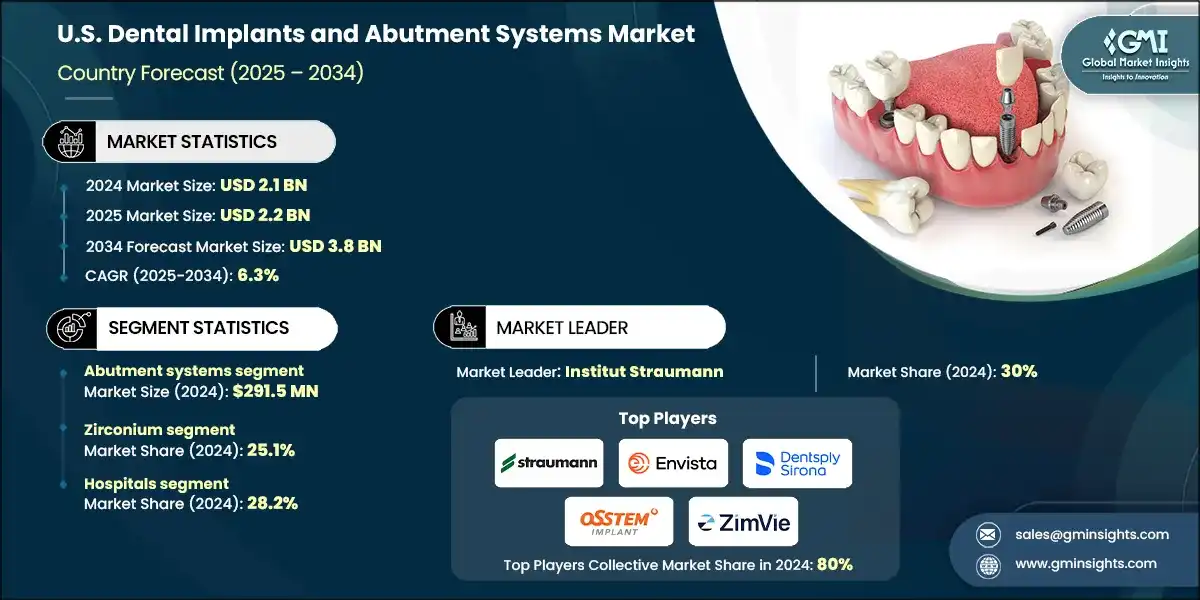
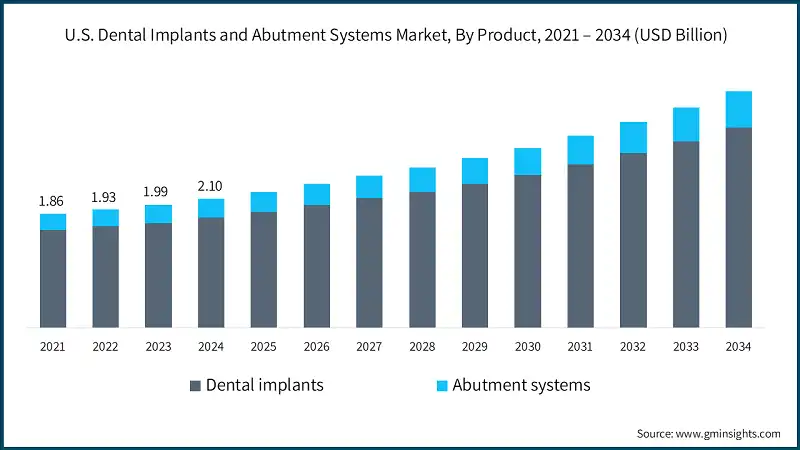
The U.S. dental implants and abutment systems market was valued at USD 2.1 billion in 2024 and is projected to grow from USD 2.2 billion in 2025 to USD 3.8 billion by 2034, expanding at a CAGR of 6.3%, according to the latest report published by Global Market Insights Inc. The growth of this market is significantly driven by the rising prevalence of tooth loss and oral diseases, rising disposable income, increasing dental insurance coverage, and advancements in implant technologies.
U.S. Dental Implants and Abutment Systems Market Key Takeaways
Market Size & Growth
- 2024 Market Size: USD 2.1 Billion
- 2025 Market Size: USD 2.2 Billion
- 2034 Forecast Market Size: USD 3.8 Billion
- CAGR (2025–2034): 6.3%
Key Market Drivers
- Rising prevalence of tooth loss and oral diseases.
- Rising disposable income.
- Increasing dental insurance coverage.
- Advancements in implant technologies.
Challenges
- Regulatory compliance challenges.
- High cost of dental implant treatment.
Opportunity
- Shift towards minimally invasive procedures.
- Integration of 3D printing for implant and abutment manufacturing.
Key Players
- Market Leader: Institut Straumann led with over 30% market share in 2024.
- Leading Players: Top 5 players in this market include Institut Straumann, Envista Holdings Corporation, Dentsply Sirona, Osstem Implant, ZimVie, which collectively held a market share of 80% in 2024.
Get Market Insights & Growth Opportunities
Some of the industry's key players are Institut Straumann, Envista Holdings Corporation, Dentsply Sirona, Osstem Implant, and ZimVie. Several leading players in the U.S. dental implants and abutment systems market are prioritizing innovation and investing in solutions that deliver precision, durability, and patient-centric outcomes. These companies are transforming treatment planning and clinical workflows through advanced digital technologies such as high-resolution dental imaging, CAD/CAM systems, and 3D modeling. Additionally, many are adopting minimally invasive surgical techniques and leveraging regenerative biomaterials to improve clinical results and enhance operational efficiency across dental practices nationwide.
The market increased from USD 1.9 billion in 2021 to USD 2 billion in 2023. Rising disposable income is a significant driver of growth in the U.S. dental implants and abutment systems market. As consumers have more financial flexibility, they are increasingly willing to invest in advanced dental solutions that offer long-term benefits and aesthetic appeal. Higher income levels enable patients to opt for premium implant systems and customized abutments rather than traditional dentures. According to the U.S. Bureau of Economic Analysis (BEA), total disposable personal income (DPI) in the U.S. reached USD 23,033.5 billion in August 2025 with monthly increase of 0.1% in August 2025, following 0.2% in July 2025. This upward trend in disposable income is expected to continue fueling demand for dental implants, as affordability and preference for high-quality oral care solutions become more widespread across the population.
The increasing prevalence of dental disorders across U.S. is a key factor driving growth in the dental implants and abutment systems market. In 2019, the prevalence of oral diseases in the U.S., as reported by the World Health Organization (WHO), highlighted significant public health concerns. Among children aged 1 to 9, 42.6% had untreated caries in their deciduous teeth, while 24.3% of individuals aged 5 and older experienced untreated caries in their permanent teeth.
Severe periodontal disease affected 15.7% of people aged 15 and above, and 10.2% of adults aged 20 and older suffered from edentulism, or complete tooth loss. These alarming statistics highlight the growing need for effective restorative solutions, positioning dental implants as a preferred treatment option to improve oral health and quality of life across the U.S. market.
Additionally, robust adoption of dental insurance across U.S. is a significant factor fueling growth in the dental implants and abutment systems market. According to data from the American Dental Association (ADA), 61% of U.S. adults are covered by private dental insurance, while 38% of children benefit from public dental programs such as Medicaid and CHIP. Notably, only 9% of children were uninsured for dental care as of 2021, reflecting strong coverage across key age groups.
Dental implants and abutment systems are parts that are used in restorative dentistry to replace missing teeth and restore oral function and aesthetic appearance. A dental implant is an artificial tooth root, usually made from either titanium or zirconia, that is surgically placed in the jawbone to hold a dental prosthesis, such as a crown, bridge, or denture. The abutment is a connector placed on top of the implant that connects the tooth to the implant. Implants and abutment systems provide a long-term, stable, and natural-looking solution to tooth loss that is commonly used in both functional and esthetic dental treatment.
To get key market trends
U.S. Dental Implants and Abutment Systems Market Trends
- The market is changing rapidly due to advancements in implant technologies.
- Artificial intelligence is transforming implant dentistry in the U.S. by enabling precise treatment planning and real-time surgical guidance. AI-powered platforms such as Dentsply Sirona’s Implant Studio and Simplant computer-guided implant system integrate CBCT imaging and intraoral scans to create highly accurate virtual models for guided surgery. These systems allow clinicians to simulate implant placement, optimize angulation, and minimize complications, resulting in improved predictability and patient outcomes.
- Companies like ZimVie are advancing immediate loading protocols through their Tapered Screw-Vent Implant System, which supports same-day restorations when combined with digital workflows. This approach reduces treatment time, enhances patient satisfaction, and drives adoption among practices seeking efficiency and convenience. The integration of chairside CAD/CAM systems further streamlines the process, making full-arch restorations faster and more accessible.
- The implementation of customized abutments and patient-specific implants using 3D printing is slowly becoming mainstream. Companies have begun to use additive manufacturing to produce customized individualized components to fit individual anatomical structures. This customization of materials is improving patient comfort, aesthetics, and function lines, while improving acceptance of materials and systems by the clinician.
- Overall, these advances in technology improve clinical accuracy, decrease the time required for treatment, and improve patient outcomes. This is all resulting in the rapid growth and adoption of dental implants and abutment systems throughout the U.S. market.
U.S. Dental Implants and Abutment Systems Market Analysis
Learn more about the key segments shaping this market
Based on products, the U.S. dental implants and abutment systems market is segmented into dental implants and abutment systems. The abutment systems segment is growing steadily in this market in 2024, accounting for the market share of 13.9%. This segment was valued at USD 291.5 million in 2024.
- Abutment systems are important parts of dental implantology and serve as a connection between the implant fixture and prosthetic restoration. They provide the needed alignment and stability of the dental prosthetics and aesthetic integration with the dental prosthesis.
- The U.S. market is witnessing growing demand for abutment systems due to the surge in dental implant procedures, heightened oral health awareness, and the trend toward personalized treatment solutions.
- For instance, Nobel Biocare Multi-Unit Abutments offers Xeal surface for improved soft-tissue integration and a short cone design for limited interocclusal space., while BioHorizons’ Custom Laser-Lok abutments provide enhanced tissue attachment and stability. These solutions support screw-retained or cement-retained restorations, offering flexibility and improved esthetic outcomes.
- The integration of digital dentistry with advanced surface treatments has significantly boosted the biomechanical performance and esthetic appeal of abutment systems. These innovations are driving adoption across U.S. dental practices, contributing to the market growth.
Based on the material, the U.S. dental implants and abutment systems market is segmented into titanium, zirconium, and other materials. The zirconium segment accounted for the market share of 25.1% in 2024.
- Zirconia is a strong ceramic material that is biocompatible and resembles a natural tooth. In dental implants and abutments, zirconia offers metal-free options that are strong and have esthetic advantages that make it a popular choice for anterior restorations.
- The growing adoption of CAD/CAM technology enables highly precise, custom-designed zirconia abutments that enhance soft tissue integration and ensure an optimal prosthetic fit. For example, Straumann’s PURE Ceramic Abutments leverage zirconia’s translucency and strength to deliver natural-looking outcomes while maintaining secure implant connections.
- As patient preferences increasingly favor metal-free and highly aesthetic options, zirconia’s compatibility with digital workflows and advanced prosthetic systems continues to drive its demand in the U.S. dental implant and abutment market.
Learn more about the key segments shaping this market
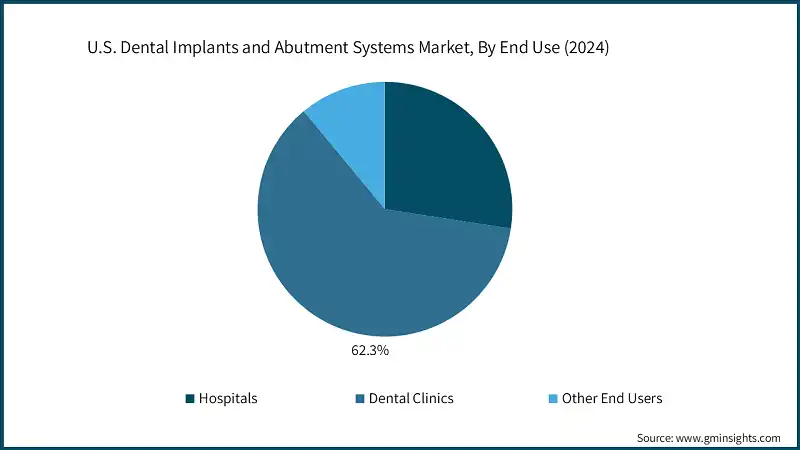
Based on the end use, the U.S. dental implants and abutment systems market is segmented into hospitals, dental clinics, and other end users. The hospitals segment accounted for the market share of 28.2% in 2024.
- Hospitals are emerging as a significant growth driver in the U.S. dental implant and abutment systems market due to their ability to handle complex cases and provide comprehensive care. Unlike standalone dental clinics, hospitals offer advanced surgical infrastructure, anesthesia support, and multidisciplinary teams, making them the preferred choice for patients with systemic conditions, trauma-related tooth loss, or full-mouth rehabilitation needs.
- Hospitals are also accelerating market growth through the adoption of cutting-edge technologies and digital workflows. Many hospitals integrate CAD/CAM systems, 3D printing for surgical guides, and advanced imaging tools such as cone-beam CT to ensure precision in implant placement and custom abutment design.
- As patient expectations rise and digital dentistry becomes mainstream, hospitals will continue to play a pivotal role in shaping the future of implant-based restorations in the U.S. dental implant and abutment systems market.
U.S. Dental Implants and Abutment Systems Market Share
- The top 5 players, such as Institut Straumann, Envista Holdings Corporation, Dentsply Sirona, Osstem Implant, and ZimVie, collectively held 80% of the total market share.
- Digital transformation is redefining the dental implant landscape in U.S. Manufacturers are increasingly adopting AI-driven planning tools, intraoral scanners, and CAD/CAM workflows to improve precision, shorten treatment times, and enhance patient outcomes. These technologies are now integral to both premium and cost-effective implant solutions, making advanced care more accessible.
- Material advancements are also fueling product innovation. While titanium remains the leading choice, zirconia implants are gaining popularity for their superior esthetics and suitability for patients with metal sensitivities. Additionally, companies are exploring biomimetic bone graft substitutes to promote better osseointegration and faster healing.
- Leading players such as Straumann, Envista, and Dentsply Sirona are expanding their portfolios to include both high-end and value-based solutions, while firms like Osstem Implant and ZimVie are strengthening their presence in outpatient and community clinics through affordable systems and educational initiatives.
- With growing consumer awareness of oral health and a preference for durable, aesthetic alternatives to traditional dentures, dental implants are expected to see sustained demand, driving overall market growth in the U.S.
U.S. Dental Implants and Abutment Systems Market Companies
Few of the prominent players operating in the U.S. dental implants and abutment systems industry include:
- A.B. Dental Devices
- Adin Dental Implant Systems
- Bicon
- BioHorizons
- BioThread Dental Implant Systems
- Cortex
- Dentium USA
- Dentsply Sirona
- Dynamic Abutment Solutions
- Envista Holdings Corporation
- Glidewell
- Henry Schein
- Institut Straumann
- Keystone Dental Group
- National Dentex Labs
- Osstem Implant
- ZimVie
Dentsply Sirona stands out in the U.S. dental implants and abutment systems market for its integration of digital innovation with clinical precision. Its key strength lies in offering a fully connected digital workflow from diagnostics and implant planning to surgery and restoration. A notable example is the Astra Tech Implant System, which incorporates a conical connection and advanced surface technology to support bone preservation and long-term stability. When paired with tools like CEREC for chairside restorations, Dentsply Sirona enables clinicians to deliver efficient and predictable implant treatments.
Envista Holdings Corporation brings together several leading dental brands to offer a broad spectrum of implant solutions tailored to diverse clinical and economic needs. Its unique value lies in serving both premium and value segments through a unified digital ecosystem that enhances precision and workflow efficiency. The Nobel Biocare N1 implant system exemplifies this approach, featuring a biologically inspired design and digitally integrated workflow that simplifies surgery and improves patient outcomes. Envista also invests heavily in clinician education, ensuring users are well-equipped to maximize treatment success.
ZimVie is a leading player in the U.S. dental implants and abutment systems market, recognized for its strong focus on digital dentistry and innovative workflows. Solutions like the Encode Emergence Impression System simplify restorative procedures by eliminating traditional impression copings, reducing patient visits, and improving comfort. ZimVie’s portfolio includes advanced implant systems and GenTek restorative components designed for CAD/CAM-driven workflows, supporting personalized and predictable restorations. By combining cutting-edge technology with cost-effective milling options and educational programs, ZimVie is driving adoption of digital implantology and reinforcing its position as a key innovator in the U.S. market.
U.S. Dental Implants and Abutment Systems Market Report Attributes
| Key Takeaway | Details |
|---|---|
| Market Size & Growth | |
| Base Year | 2024 |
| Market Size in 2024 | USD 2.1 Billion |
| Market Size in 2025 | USD 2.2 Billion |
| Forecast Period 2025 - 2034 CAGR | 6.3% |
| Market Size in 2034 | USD 3.8 Billion |
| Key Market Trends | |
| Drivers | Impact |
| Rising prevalence of tooth loss and oral diseases | Fuels demand for dental implants due to increasing cases of edentulism, periodontal disease, and oral trauma. |
| Rising disposable income | Encourages patients to opt for premium implant solutions and esthetic restorations, boosting overall market revenue. |
| Increasing dental insurance coverage | Expands accessibility to implant treatments by reducing out-of-pocket costs, driving adoption among a broader patient base. |
| Advancements in implant technologies | Improves treatment outcomes through innovations like surface modifications, digital workflows, and immediate-load implants, accelerating market penetration. |
| Pitfalls & Challenges | Impact |
| Regulatory compliance challenges | Slows product launches and increases operational costs due to stringent FDA approval processes and quality standards. |
| High cost of dental implant treatment | Limits adoption among uninsured or low-income patients, creating affordability barriers despite growing demand. |
| Opportunities: | Impact |
| Shift towards minimally invasive procedures | Drives adoption of advanced implant systems and guided surgery tools that reduce recovery time and improve patient comfort. |
| Integration of 3D printing for implant and abutment manufacturing | Enables cost-effective, customized solutions, enhancing precision and supporting the trend toward personalized treatment plans. |
| Market Leaders (2024) | |
| Market Leaders |
30% market share |
| Top Players |
Collective market share in 2024 is 80% |
| Competitive Edge |
|
| Future outlook |
|
What are the growth opportunities in this market?
U.S. Dental Implants and Abutment Systems Industry News:
- In February 2025, Dentsply Sirona officially launched its latest innovation, the MIS LYNX Implant System, in the U.S. The system featured sterile single-use drills and a wet implant surface, aimed at enhancing procedural hygiene and promoting superior osseointegration. Designed as an all-in-one solution, it supported immediate implant placement and catered to a wide range of clinical scenarios, streamlining workflows for dental professionals. This launch reflected Dentsply Sirona’s commitment to delivering high-performance, patient-centric solutions and was expected to strengthen its position in the North American dental implant market.
The U.S. dental implants and abutment systems market research report includes an in-depth coverage of the industry with estimates and forecast in terms of revenue in USD Million and from 2021 – 2034 for the following segments:
Market, By Product
- Dental implants
- Tapered implants
- Parallel-walled implants
- Abutment systems
- Stock abutments
- Custom abutments
- Abutments fixation screws
Market, By Material
- Titanium
- Zirconium
- Other materials
Market, By End Use
- Hospitals
- Dental Clinics
- Other end use
Frequently Asked Question(FAQ) :
What was the market size of the U.S. dental implants and abutment systems market in 2024?
The market size was USD 2.1 billion in 2024, driven by the rising prevalence of tooth loss, oral diseases, increasing disposable income, broader dental insurance coverage, and advancements in implant technologies.
What is the projected value of the U.S. dental implants and abutment systems market by 2034?
The market is expected to reach USD 3.8 billion by 2034, growing at a CAGR of 6.3% during the forecast period.
What is the projected size of the U.S. dental implants and abutment systems market in 2025?
The market is projected to reach USD 2.2 billion in 2025.
What was the market share of the zirconium segment in 2024?
The zirconium segment accounted for 25.1% of the market share in 2024.
What was the market share of the hospitals segment in 2024?
The hospitals segment held a 28.2% market share in 2024.
What are the key trends in the U.S. dental implants and abutment systems market?
Key trends include advancements in implant technologies, the adoption of artificial intelligence for precise treatment planning and real-time surgical guidance, the use of immediate loading protocols for same-day restorations, and the growing implementation of 3D printing for customized abutments and patient-specific implants.
Who are the key players in the U.S. dental implants and abutment systems market?
Key players include A.B. Dental Devices, Adin Dental Implant Systems, Bicon, BioHorizons, BioThread Dental Implant Systems, Cortex, Dentium USA, Dentsply Sirona, Dynamic Abutment Solutions, and Envista Holdings Corporation.
U.S. Dental Implants and Abutment Systems Market Scope
Related Reports