Summary
Table of Content

Ultrasonic Food Processing Technology Market
Get a free sample of this report
Thank you!
Your inquiry has been received. Our team will reach out to you with the required details via email. To ensure that you don't miss their response, kindly remember to check your spam folder as well!
Form submitted successfully!
Error submitting form. Please try again.
Request Sectional Data
Thank you!
Your inquiry has been received. Our team will reach out to you with the required details via email. To ensure that you don't miss their response, kindly remember to check your spam folder as well!
Form submitted successfully!
Error submitting form. Please try again.
Ultrasonic Food Processing Technology Market Size
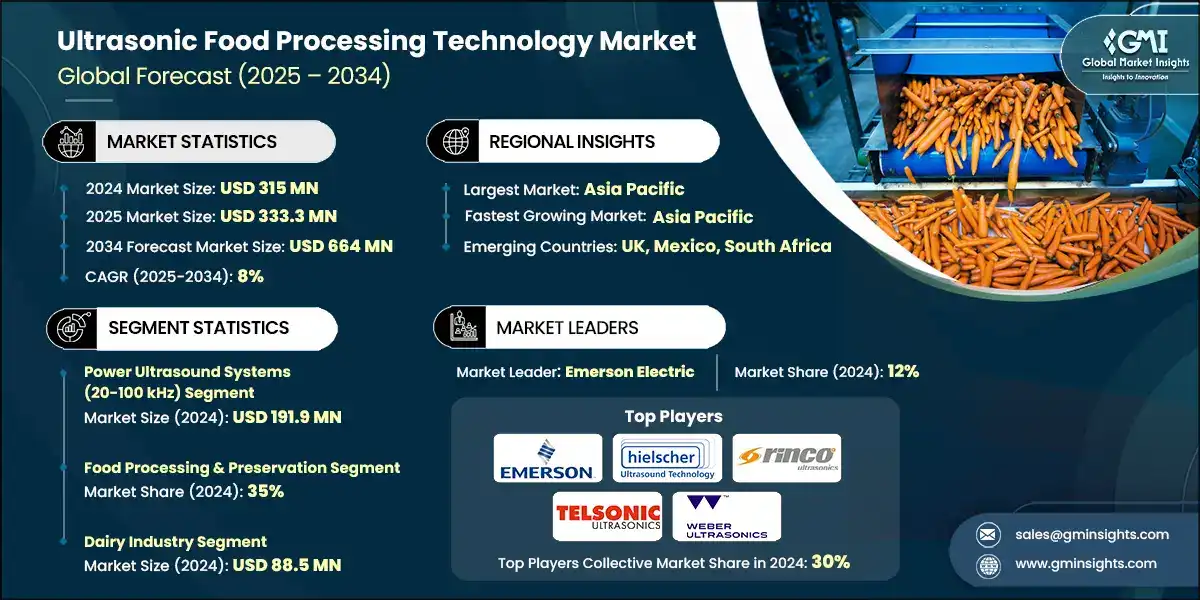
The global ultrasonic food processing technology market size was estimated at USD 315 million in 2024. The market is expected to grow from USD 333.3 million in 2025 to USD 664 million in 2034, at a CAGR of 8% according to latest report published by Global Market Insights Inc.
To get key market trends
Non-thermal food processing methods such as high-pressure processing (HPP), pulsed electric fields (PEF), and ultraviolet (UV) treatment are gaining traction with customers because of their ability to preserve food quality without sacrificing safety and/or shelf-life. These methods eliminate nutrient loss and texture degradation characteristic of traditional thermal food processing methods.
Food safety authorities and regulatory bodies are not only endorsing the application of these technologies to ensure microbial inactivation, but combined with other consumer preference experiences, will drive the growth of food and beverage products processed using non-thermal methods, thereby becoming a growth driver in the food and beverage sector in the global economy.
The stringent food safety and hygiene regulations across worldwide food markets are leading manufacturers to invest in new processing, monitoring and sanitation technologies. With foodborne illness and contamination risks on consumers' minds, consumers are demanding more cleanliness and traceability throughout the supply chain, while regulatory agencies are imposing higher standards.
To compete in food markets, manufacturers hoping to export their products must ensure that their products are compliant with these standards to gain access and consumer confidence. Consequently, food safety and hygiene have become vital regulatory elements to protect public trust but have also become leading strategic elements that drive research, innovation and investment to differentiate and compete in the food market.
Ultrasonic Food Processing Technology Market Report Attributes
| Key Takeaway | Details |
|---|---|
| Market Size & Growth | |
| Base Year | 2024 |
| Market Size in 2024 | USD 315 Million |
| Market Size in 2025 | USD 333.3 Million |
| Forecast Period 2025 - 2034 CAGR | 8% |
| Market Size in 2034 | USD 664 Million |
| Key Market Trends | |
| Drivers | Impact |
| Rising demand for non-thermal processing | Ultrasonic processing improves the extraction of beneficial bioactive compounds from raw materials such as legume, seeds, and algae. |
| Food safety & hygiene requirements | Ultrasonic systems are clean and contactless process. The control process is of high accuracy which minimizes risk of contamination in clean environments as mainstream food manufacturing moves to strict hygiene rules. |
| Growth in plant-based & functional foods | Consumers and regulators demand lower crude foods with fresher flavour and nutritional properties, ultrasonic processing provides nonthermal alternative that notably preserves flavour texture and vitamin. |
| Pitfalls & Challenges | Impact |
| High initial investment costs | Ultrasonic systems generally have high initial capital cost for required industrial machinery, which can dissuade small and mid-size food processors from adopting the technology. |
| Scalability issues | Ultrasonic processing uniformly across large volume presents technical challenges regarding energy distribution and equipment design. |
| Opportunities: | Impact |
| Integration with automation & smart manufacturing | Ultrasonic system can be readily integrated into an industry 4.0 context so that the processing parameters can be monitored in real time, controlled with precision, and data can be used for further optimization. |
| Expansion into plant-based and functional foods | Ultrasonic technology has the potential to generate a competitive advantage and responding to increased demand when it comes to extracting modifying and stabilising ingredients derived from plants. |
| Market Leaders (2024) | |
| Market Leaders |
12% market share |
| Top Players |
The collective market share in 2024 is 30% |
| Competitive Edge |
|
| Regional Insights | |
What are the growth opportunities in this market?
Ultrasonic Food Processing Technology Market Trends
The global food processing sector is experiencing massive changes because of shifting consumer expectations, regulatory pressures, and advances in technology. Increasing effort is being placed on sustainability, clean-label products, and advanced processing methods that ensure safety while nutritional value is preserved. Digitalization and automation are changing the way food processors achieve operational efficiency, while demand for traceability and transparency is also shifting supply chain practices.
- Consumers are increasingly demanding products with fewer artificial ingredients, and any or very few processing steps, and sustainable packaging. The manufacturers are being compelled to change and reformulate products to address clean label consumer demands/expectations and reduce their environmental footprint.
- Techniques such as non-thermal processing, high-pressure processing, and cold plasma are becoming increasingly favored in the food industry to achieve improvement in food attributes or shelf-life without compromising safety.
- The use of IoT, AI, and robotics in the food processing industry is improving efficiency, waste reduction, and predictive maintenance. Additionally, these technologies enable real-time monitoring to improve their quality control systems.
- As consumers grow increasingly concerned about food safety and ethical sourcing, companies are exploring solutions like blockchain as well as other traceability solutions that can provide end-to-end visibility in the supply chain to build consumer confidence.
Ultrasonic Food Processing Technology Market Analysis
Learn more about the key segments shaping this market
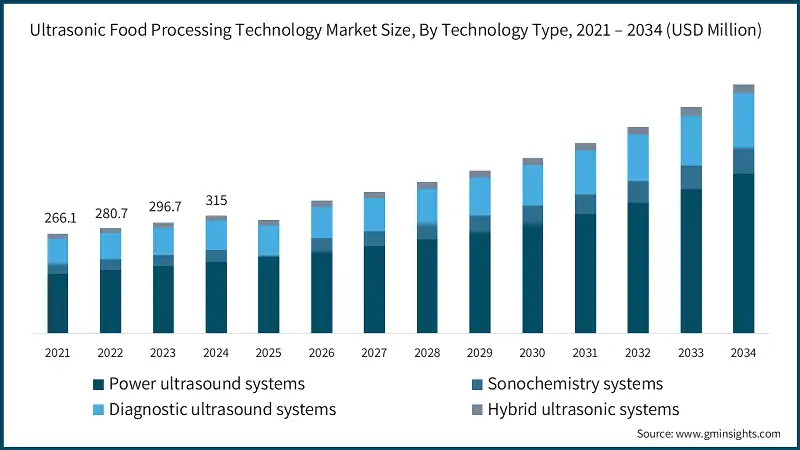
Based on technology type, the ultrasonic food processing technology market is divided into power ultrasound systems (20-100 kHz), sonochemistry systems (100 kHz-1MHz), Diagnostic ultrasound systems (1-10 MHz) and hybrid ultrasonic systems. In 2024, power ultrasound systems (20-100 kHz) held the major market share, generating a revenue of USD 191.9 million.
- There are effective ultrasound systems that operate in the frequency range of 20-100 kHz which were effective at enhancing mass transfer processes such as extraction or homogenization. The cavitation generated from ultrasound systems disrupt cell membranes to allow for further release of bioactive compounds, flavors, and nutrients from plant and animal matter and the benefit of this application is evident in emulsified products including juices, oils, or functional ingredients, where increased yield and maintained quality is desired.
- Ultrasound emulsification is becoming more used in food formulations and is mainly found in products such as sauces, dressings, and dairy emulsions. As mentioned, the cavitation generation will apply very high shear forces to reduce droplet size and aid more uniform disperse systems contributing to improved texture, mouthfeel and shelf stability. It is a more energy and scale efficient process compared to conventional mechanical methods.
- The mechanical effects from cavitation can lead to cellular membrane damage in microbes, which means they can also enhance the efficacy of preservation techniques. Therefore, ultrasound represents a potential element for incorporation into non-thermal preservation strategies, allowing sensory and nutritional attributes, and extending products' shelf life.

Learn more about the key segments shaping this market
Based on application, the ultrasonic food processing technology market is segmented into food processing & preservation, extraction & separation, homogenization & emulsification, cutting & sealing, cleaning & sanitization and quality control & analysis. The food processing & preservation segment held the largest share, accounting for 35% of the global ultrasonic food processing technology market in 2024.
- The modern food processing and preservation paradigm seeks to retain as much of the nutritional value and sensory attributes and physical characteristics of food products. Freeze-drying, vacuum packaging, and non-thermal technologies (high-pressure processing, pulsed electric fields, etc.) are ways to achieve this by minimizing nutrient loss and optimizing shelf life. The targeting of these approaches is engendered by the health-conscious consumer that demands minimally processed foods of high functional value.
- Food processing and preservation are essential to the safety of food products, while also meeting global regulatory framework requirements. For safety, the solution to prevent contamination is killing pathogens using thermal treatments, pasteurization, and/or chemical preservatives. Also, advanced systems to monitor and trace products are integrated to comply with food safety administration rules e.g. HACCP, FSMA, ISO, for protection of consumers, and to ensure credibility of brands.
- The importance of the preservation of perishables is important to manage their shelf life to reduce food waste in the supply chain. Applications such as modified atmosphere packaging (MAP), irradiation coating, or antimicrobials can help inhibit microbial growth and oxidation, which not only benefits the retailer and consumer, but also contributes to sustainability objectives to improve spoilage management and operational efficiency.
Based on end user industry, the ultrasonic food processing technology market is segmented into dairy industry, meat & seafood processing, beverage industry, bakery & confectionery, packaging industry and food ingredients & additives. In 2024, dairy industry held a major market share, generating a revenue of USD 88.5 million.
- The dairy industry depends upon processes that can hold the fragile nutrition and sensory qualities (texture and flavor) of milk, yogurt, and cheese. The rise of non-thermal technologies including high-pressure processing (HPP) and ultrasound allow retail products to give fresh, textural and flavor qualities without any compromise to safety. These treatments exhibit the most potential for items with probiotics or fortified body, where heat can destroy friendly active components.
- Preservation technologies are imperative to shelf-stable dairy products, as they are highly perishable. Using methods such as aseptic packages, modified atmosphere packaging (MAP), or antimicrobial coatings will inhibit spoilage and microbial growth. This is advantageous for both exceptionally longer distribution periods as well as improved efficiency of the cold chain enabling dairy producers to expand into new markets while reducing product loss.
- Dairy processing plants need to be hygienic and safe, as the risk of contamination is high. Advanced processing systems consist of the technology for Clean-in-Place (CIP) processing, real-time microbial monitoring, and traceability for compliance with national and international regulations like FSSAI, ISO 22000, and Codex Alimentarius. These systems are necessary for maintaining consumer trust and ensuring exported products meet safety standards.
Looking for region specific data?
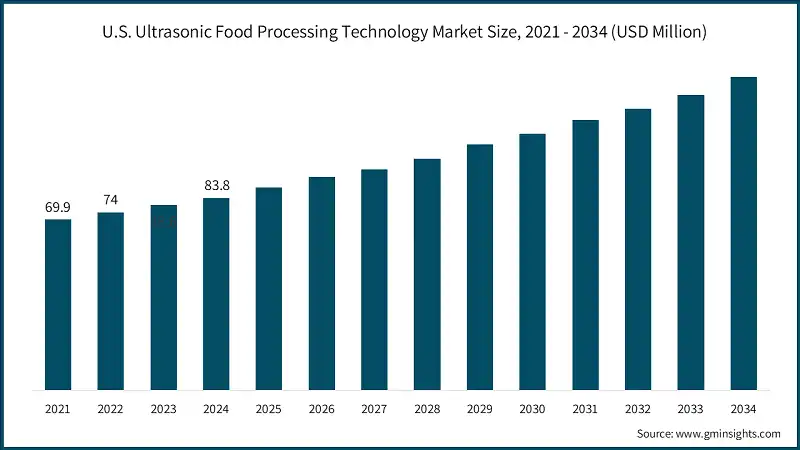
In 2024, the U.S. dominated the North America ultrasonic food processing technology market, accounting for around 75.6% and generating around USD 83.8 million revenue in the same year.
- North America is home to the largest and most technologically developed food processing and preservation market in the world, largely due to strong consumer trends towards convenience products, clean-label ingredients, and longer shelf life. As a result, food manufacturers in the U.S. are quickly implementing new technologies, including high-pressure processing (HPP), pulsed electric fields (PEF), and more sustainable packaging options. The food industry in the U.S. is also relying on the statutory provisions of the Food Safety Modernization Act (FSMA) to escalate safety and traceability factors, which is influencing food manufacturers to pursue automation and digital tracking systems.
- Collectively, North America has a high degree of established food industry infrastructure and consumer awareness, and corresponding levels of regulatory oversight, allowing North America to take the lead on the global market for food processing and preservation technologies. In addition to the U.S. market ability, Canadian and Mexican markets are also growing regionally through investments in modern, state-of-the-art food processing facilities that embrace sustainable and non-thermal preservation methods. In particular, North America’s highly integrated supply chains, enhanced cold chain logistics, and commitment to food safety and food quality assurance in food preservation, commoditizes new food preservation and processing methods.
Europe ultrasonic food processing technology market, Germany leads the market with 30.2% share in 2024 and is expected to grow at 8% during the forecast period.
- European food manufacturers are capitalizing on the ultrasonic technology across various food categories. In the dairy segment, ultrasounds are utilized for homogenization and, more importantly, for microbial control without the loss of probiotics. In bakery products, they enhance the mixing and fermentation of dough, which improves quality and consistency.
- Beverage producers rely on ultrasound to improve extraction and emulsion efficiency in juices and plant-based drinks. The degree of ultrasound technology versatility, in intersecting with advanced European manufacturing environments with strong dimensions of product development, leads to its high uptake and growth in the market.
The Asia Pacific leads the ultrasonic food processing technology market; China holds a market share of around 40.7% in 2024 and is anticipated to grow with a CAGR of around 5.4% from 2025 to 2034.
- Ultrasonic food processing is growing rapidly in the Asia Pacific market because of quick industrialization and modernization of many food processing facilities, particularly in China, India, and Southeast Asia. Due to an increasing demand for processed and packaged foods spurred by urbanization and shifts in consumer lifestyles in Asia Pacific, manufacturers are learning how to use ultrasonics to create a more efficient food processing system and to improve the nutritional quality, sensory quality, and shelf stability.
- Ultrasonics have been shown to efficiently extract desirable bioactive components from functional foods, improve emulsification rates in dairy, provide microbial inhibition in beverages, and allow for flavoring of plant-based foods. The use of ultrasound for processing also supports greater sustainability for sourcing to produce local or export available food products, which facilitates the region's movement toward more health-conscious and environmentally aware food production practices.
Latin America ultrasonic food processing technology market is growing at a CAGR of 5.5% during the forecast period.
- Latin America is slowly adopting ultrasonic food processing and modernization of food manufacturing overall. Countries such as Brazil, Argentina, and Chile are making investments into high-tech processing technologies to improve food quality, lower waste, and meet international standards for exporting food. The introduction of the ultrasonic systems throughout the food sector in processes such as juice extraction and liquid homogenization (dairy), or microbial control, is due to their increased cost effectiveness and energy savings over traditional ways of doing things.
- The demand for processed and functional foods in Latin America is due to urbanization, changing dietary habits, and increased health awareness. The interest among consumers is for products with better nutritional benefits, longer shelf life, and fewer additives requirements that ultrasonic processing of food can meet. Furthermore, the ability of ultrasonic processing to enhance extraction of bioactive compounds and emulsification is well suited to the growing sectors of fortified beverages; plant-based foods and dairy alternatives.
Ultrasonic Food Processing Technology Market Share
Emerson Electric is leading with 12% market share. Emerson Electric, Hielscher Ultrasonics, RINCO Ultrasonics, Telsonic, and Weber Ultrasonics collectively hold around 30%, indicating moderately fragmented market concentration. These prominent players are proactively involved in strategic endeavors, such as mergers & acquisitions, facility expansions & collaborations, to expand their product portfolios, extend their reach to a broad customer base, and strengthen their market position.
With its Branson brand, Emerson Electric is a global leader in ultrasonic cutting and portioning technologies for the food industry. Their systems employ high-frequency vibrating blades to make clean, precise cuts in various food items, from sticky confections to frozen products. This results in less waste and increased production efficiency. Emerson's products are highly regarded and widely used in bakery, dairy, and protein applications.
RINCO Ultrasonics specializes in ultrasonic welding and cutting machines for plastic, textiles and food. Its food processing machinery is marketed as residue-free, hygienic cutting systems for baked goods or plastic packaging for food products. RINCO's modular machines, designed specifically for use on automated production lines, continue to focus on precision and sustainability.
Ultrasonic Food Processing Technology Market Companies
Major players operating in the ultrasonic food processing technology industry are:
- AERZEN
- Cavitus
- Dukane
- Emerson Electric
- FoodTools
- Herrmann ultrasonics
- Hielscher Ultrasonics
- Innovative Ultrasonics
- Marchant Schmidt
- MS Ultrasonic Technology Group
- RINCO ULTRASONICS
- Sonics & Materials
- Sonimat
- Telsonic
- Ultrasonic Power
- Weber Ultrasonics
Dukane Corporation supplies state-of-the-art ultrasonic food cutting systems, which are used by leading global food producers. With melamine composite and titanium blades and customizable gantry systems, Dukane's food cutters allow products, such as cheese, snack bars, and frozen meats to be sliced smoothly and without friction. Dukane's technologies are aimed at less downtime, reduced scrap, and allow for retrofitting to existing production lines with ease.
Innovative Ultrasonics indicates a cluster of companies, including MPI Ultrasonics and Active Ultrasonics, that sell novel ultrasonic solutions in food processing. These food processing applications may include sonochemistry, emulsification and extraction, and ultrasonic cutting. Like Dukane, Innovative Ultrasonics systems can also be customized and designed for exploratory applications and special industrial processes and provide flexibility across product forms of powders, solids and liquids.
Ultrasonic Food Processing Technology Market News
- In April 2025, Emerson Electric’s Branson brand announced a new generation of ultrasonic cutting systems for confectionery and bakery products. These systems cut through a myriad of difficult food textures such as sticky, frozen, and multi-layered products while utilizing elongated blades that vibrate at a high frequency to allow the blade to cut through the food product with minimal friction and maximum fluidity of motion. The technology was developed to ultimately provide a more efficient production process as well as provide the customer with benefits such as less product waste, increased production speed, and longer life cycles for tooling.
- In March 2025, Marchant Schmidt launched the UC23 Ultrasonic Two-Stage Cutting System designed to handle high-volume sheet cake, brownie and frozen meal portioning. The system provides clear smudge-free cuts, is adjustable to different food densities and lowers sanitation downtime by its design perfect for industrial bakery and frozen food productions. The development is in line with general industry progress, as other non-packaging companies have recently launched ultrasonic cutting for confectionery and bakery such as Emerson Electric under its Branson brand.
- In January 2025, Hielscher Ultrasonics launched its Stepped Plate Sonicator. The unique airborne non-contact ultrasonic thawing system is proposed, which can allow uniform and rapid thawing of frozen foods such as seafood and meat using high-intensity airborne ultrasound. Through improved heat and mass transfer properties at the food surface, this conserved texture, which lowers microbiological risk and cuts down thawing time which is necessary for any hygienic and effective food processing lines.
- In January 2024, Innovative Ultrasonics (XFurth) introduced a new ultrasonic food cutting technology that delivers accurate, clean slicing through many types of foods. The technology is applicable for soft, as well as hard foods like baked goods, cheeses, refrigerated/frozen products, and those with inclusions, delivering improved slicing precision and sanitation for high-speed use with industrial and specialty food processing needs.
The ultrasonic food processing technology market research report includes in-depth coverage of the industry with estimates & forecasts in terms of revenue (USD Million) and volume (Thousand Units) from 2021 to 2034, for the following segments:
Market, By Technology Type
- Power ultrasound systems (20-100 kHz)
- Sonochemistry systems (100 khz-1 MHz)
- Diagnostic ultrasound systems (1-10 MHz)
- Hybrid ultrasonic systems
Market, By Application
- Food processing & preservation
- Extraction & separation
- Homogenization & emulsification
- Cutting & sealing
- Cleaning & sanitization
- Quality control & analysis
Market, By End Use Industry
- Dairy industry
- Meat & seafood processing
- Beverage industry
- Bakery & confectionery
- Packaging industry
- Food ingredients & additives
The above information is provided for the following regions and countries:
- North America
- U.S.
- Canada
- Europe
- Germany
- UK
- France
- Italy
- Spain
- Asia Pacific
- China
- India
- Japan
- Australia
- South Korea
- Latin America
- Brazil
- Mexico
- Argentina
- Middle East and Africa
- South Africa
- Saudi Arabia
- UAE
Frequently Asked Question(FAQ) :
How much revenue did power ultrasound systems generate in 2024?
Power ultrasound systems (20-100 kHz) generated approximately USD 191.9 million in 2024, due to their effectiveness in enhancing mass transfer processes like extraction and homogenization.
What was the market share of the food processing and preservation segment in 2024?
The food processing and preservation segment accounted for 35% of the market in 2024.
Which region dominated the ultrasonic food processing technology sector?
The U.S. dominated the North American market, accounting for 75.6% of the regional share and generating USD 83.8 million in revenue in 2024.
What are the upcoming trends in the ultrasonic food processing technology market?
Trends include non-thermal processing, IoT/AI/robotics integration, blockchain-based transparency, and rising demand for sustainable packaging and clean-label products.
Who are the key players in the ultrasonic food processing technology industry?
Key players include AERZEN, Cavitus, Dukane, Emerson Electric, FoodTools, Herrmann Ultrasonics, Hielscher Ultrasonics, Innovative Ultrasonics, Marchant Schmidt, MS Ultrasonic Technology Group, RINCO ULTRASONICS, and Sonics & Materials.
What is the expected size of the ultrasonic food processing technology industry in 2025?
The market size is projected to reach USD 333.3 million in 2025.
What is the projected value of the ultrasonic food processing technology market by 2034?
The market is poised to reach USD 664 million by 2034, driven by advancements in non-thermal processing technologies and increasing demand for clean-label and minimally processed foods.
What is the market size of the ultrasonic food processing technology in 2024?
The market size was USD 315 million in 2024, with a CAGR of 8% expected through 2034. The growing adoption of non-thermal food processing methods is driving market growth.
Ultrasonic Food Processing Technology Market Scope
Related Reports