Summary
Table of Content

Tumble Dryer Market
Get a free sample of this report
Form submitted successfully!
Error submitting form. Please try again.
Thank you!
Your inquiry has been received. Our team will reach out to you with the required details via email. To ensure that you don't miss their response, kindly remember to check your spam folder as well!
Request Sectional Data
Thank you!
Your inquiry has been received. Our team will reach out to you with the required details via email. To ensure that you don't miss their response, kindly remember to check your spam folder as well!
Form submitted successfully!
Error submitting form. Please try again.
Tumble Dryer Market Size
- In developed markets, tumble dryers have evolved from being luxury items to becoming indispensable household appliances, with replacement cycles now firmly established. In regions such as North America and Europe, where penetration rates are exceptionally high, market growth is primarily driven by the replacement of older units that have reached the end of their operational lifespan. Consumers are increasingly upgrading to advanced models that deliver superior performance, enhanced fabric care, and compliance with stringent energy efficiency regulations. These factors ensure a consistent and predictable demand, even in markets that are considered saturated. Additionally, the availability of diverse product ranges, including compact and ventless models, caters to varying consumer needs, further supporting market stability.
- In emerging and urbanizing economies, the rise in disposable incomes is significantly boosting the demand for convenience-oriented appliances. As household incomes grow and dual-income lifestyles become more prevalent, consumers are prioritizing time-saving solutions that simplify daily routines. Tumble dryers effectively address this need by providing fast, reliable, and efficient laundry drying, regardless of weather conditions. This is particularly advantageous in densely populated urban areas and apartment complexes, where outdoor drying spaces are either limited or non-existent. Furthermore, the increasing adoption of compact tumble dryers and portable models in these regions highlights the growing preference for space-efficient and user-friendly appliances.
- Technological advancements in energy efficiency and smart features are also playing a pivotal role in accelerating market growth, reshaping consumer preferences toward premium and feature-rich models. Innovations such as heat pump technology, which significantly reduces energy consumption, and moisture-sensing systems, which optimize drying cycles, are becoming key selling points.
- Additionally, low-temperature drying technology ensures better fabric protection, while smart connectivity features, including remote operation and integration with smart-home ecosystems, enhance user convenience and control. These advancements not only lower operating costs and minimize environmental impact but also encourage replacement purchases, as consumers increasingly seek modern tumble dryers that align with sustainability goals and technological trends. The introduction of models with advanced noise reduction, self-cleaning mechanisms, and customizable drying programs further underscores the industry's commitment to meeting evolving consumer demands and preferences.
The tumble dryer market was estimated at USD 22 billion in 2025. The market is expected to grow from USD 23 billion in 2026 to USD 39.9 billion in 2035, at a CAGR of 6.3% according to latest report published by Global Market Insights Inc.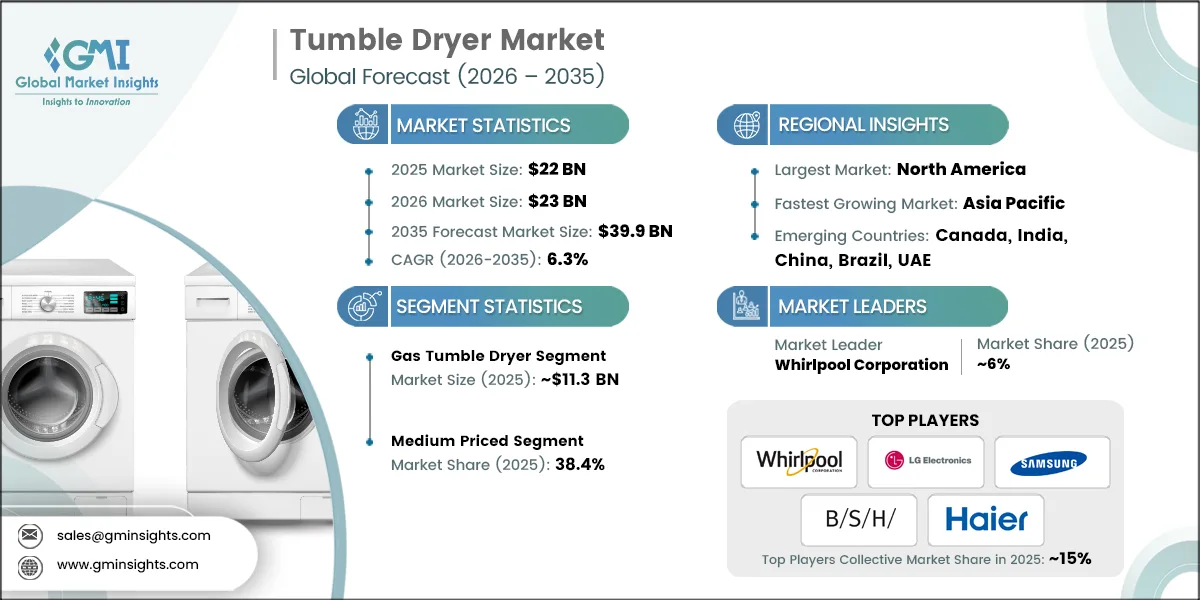
Tumble Dryer Market Key Takeaways
Market Size & Growth
- 2025 Market Size: USD 22 Billion
- 2026 Market Size: USD 23 Billion
- 2035 Forecast Market Size: USD 39.9 Billion
- CAGR (2026–2035): 6.3%
Regional Dominance
- Largest Market: North America
- Fastest Growing Region: Asia Pacific
Key Market Drivers
- Replacement cycles are firmly established in mature markets.
- Rising disposable incomes fuel a growing demand for convenience.
- Advancements in energy efficiency and smart technology are on the rise.
Challenges
- Energy consumption and running costs remain high.
- Efficient models come with a steep initial purchase price.
Opportunity
- Next-generation drying technologies are in development.
- There's an intensified focus on health and hygiene features.
Key Players
- Market Leader: Whirlpool Corporation led with over 6% market share in 2025.
- Leading Players: Top 5 players in this market include Whirlpool Corporation, LG Electronics, Samsung Electronics, BSH Hausgeräte (Bosch), Haier Group, which collectively held a market share of 15% in 2025.
Get Market Insights & Growth Opportunities
To get key market trends
Tumble Dryer Market Trends
- The tumble dryer industry is undergoing a significant transformation, driven by the dual forces of stricter energy regulations and growing consumer awareness regarding operational costs and environmental impact. Energy-efficient and sustainability-focused solutions are becoming the cornerstone of this market shift.
- Heat pump tumble dryers, in particular, are gaining widespread adoption as governments in Europe and other developed markets actively phase out inefficient vented and conventional condenser models. These heat pump models are recognized for their ability to significantly reduce energy consumption by recycling heat during the drying process, making them a preferred choice for environmentally conscious consumers. Manufacturers are responding to these changes by overhauling their product portfolios to prioritize features such as lower energy consumption, reduced carbon emissions, and extended product lifecycles.
- Additionally, advancements in fabric care technologies, including low-temperature drying and sophisticated moisture-sensing systems, are being integrated to enhance user satisfaction and product performance. This trend is further reinforced by a growing wave of replacement demand, as consumers increasingly upgrade outdated appliances to comply with new regulatory standards and benefit from reduced long-term energy expenses, which are becoming a critical factor in purchasing decisions.
- Concurrently, the market is witnessing a surge in demand for smart, high-capacity, and space-efficient tumble dryers, driven by evolving consumer lifestyles and the challenges posed by urban living. Smart connectivity features, such as remote monitoring, cycle optimization, and predictive maintenance, are becoming essential differentiators, particularly among tech-savvy and premium consumer segments. These features not only enhance convenience but also allow users to optimize energy usage and extend the lifespan of their appliances.
- Urbanization and the trend toward smaller living spaces are further propelling the demand for condenser, heat pump, and compact tumble dryer models that eliminate the need for external venting, making them ideal for apartments and other space-constrained environments. Meanwhile, large-capacity dryers are gaining traction among households with substantial laundry needs and in light-commercial applications, including the hospitality and healthcare sectors, where efficiency and reliability are paramount. These dryers are designed to handle higher laundry volumes while maintaining energy efficiency and delivering consistent performance.
- These evolving trends are reshaping the competitive landscape of the tumble dryer market, compelling manufacturers to innovate and adapt. Companies are increasingly focusing on balancing energy efficiency, digital innovation, and user convenience to maintain their competitive edge and market relevance. The integration of advanced technologies, such as artificial intelligence for predictive maintenance and machine learning for cycle optimization, is becoming a key strategy for differentiation.
- Additionally, manufacturers are exploring sustainable materials and production processes to align with the growing consumer demand for eco-friendly products. As the market continues to evolve, the ability to deliver a comprehensive value proposition that addresses energy performance, technological advancements, and user-centric design will be critical for success in this dynamic and competitive market.
Tumble Dryer Market Analysis
Learn more about the key segments shaping this market
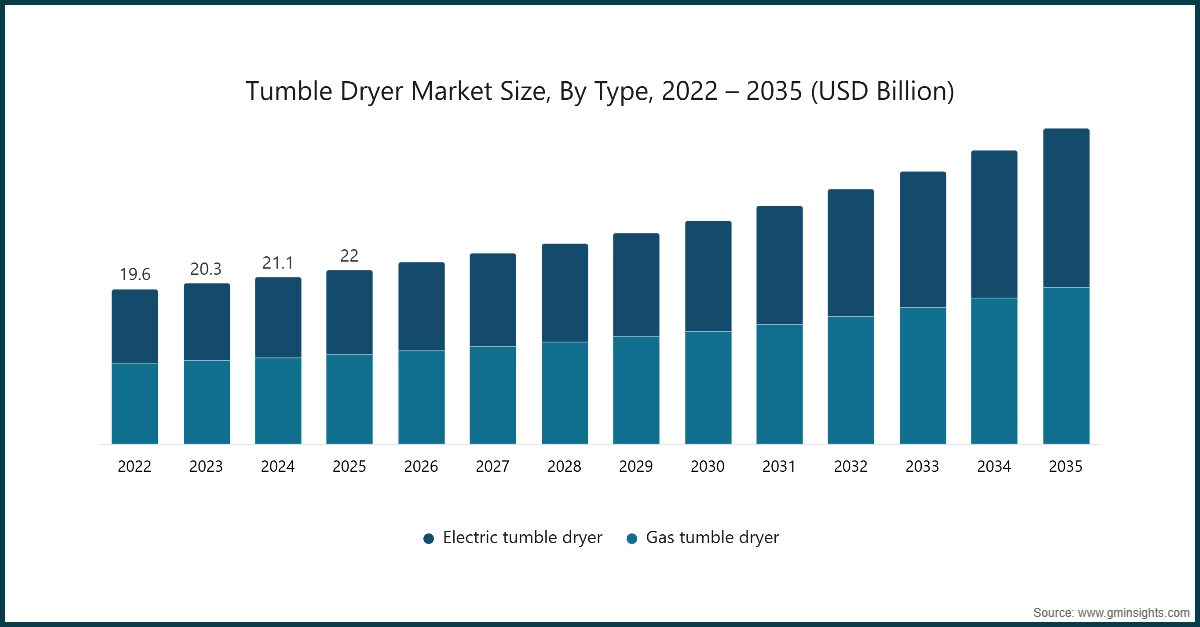
Based on type, the tumble dryer market is categorized into electric tumble dryer and gas tumble dryer. The gas tumble dryer accounted for revenue of around USD 11.3 billion in 2025 and is anticipated to grow at a CAGR of 6% from 2026 to 2035.
- Gas tumble dryers typically offer shorter drying cycles and lower operating costs compared to electric models, making them highly attractive for large households and light‑commercial users such as laundromats, hospitality, and multi‑family housing facilities where throughput and energy expenses are critical considerations. In mature markets such as North America, existing gas infrastructure in residential properties supports continued adoption and replacement demand, while consumers upgrading older electric or inefficient dryers increasingly view gas models as a long‑term cost‑saving alternative.
- Additionally, improving gas dryer efficiency, enhanced moisture‑sensing technologies, and better heat control have narrowed the perceived sustainability gap with electric dryers, further supporting segment expansion.
Learn more about the key segments shaping this market
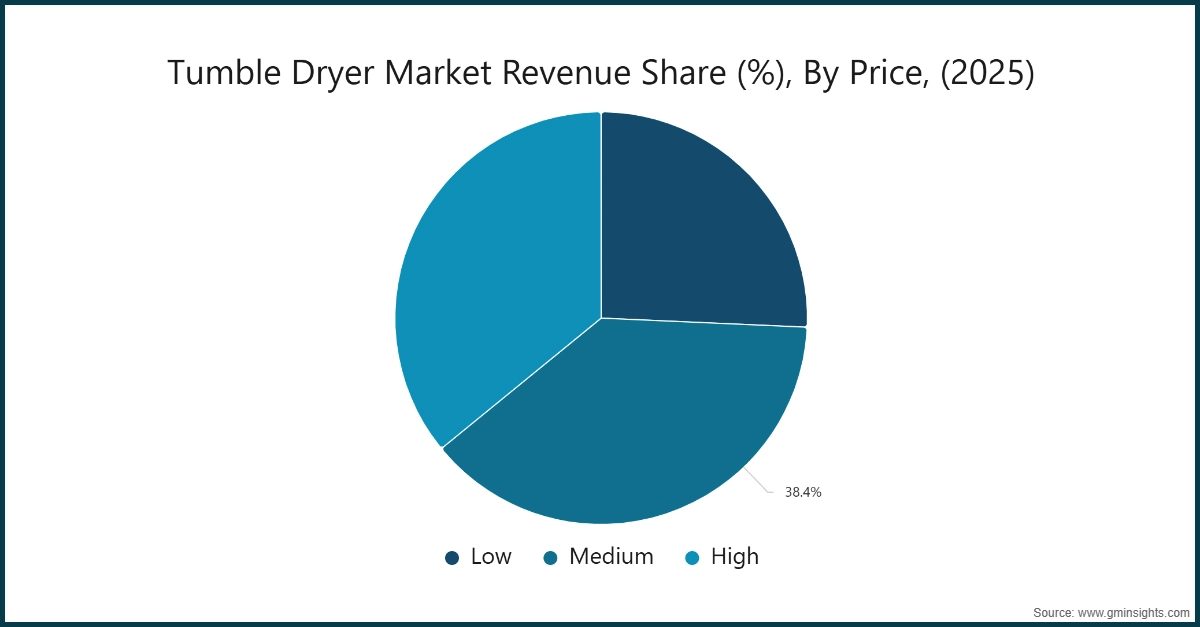
Based on price of tumble dryer market consists of low, medium and high. The medium priced emerged as leader and held 38.4% of the total market share in 2025 and is anticipated to grow at a CAGR of 6.5% from 2026 to 2035.
- Medium‑priced tumble dryers typically offer key value‑added features such as energy‑efficient drying programs, moisture sensors, multiple fabric‑care settings, larger capacity options, and basic smart connectivity, without the high upfront cost associated with premium models. This positioning resonates particularly well with middle‑income households, which form the largest consumer group across both mature and emerging markets.
- Additionally, replacement demand in developed regions is largely concentrated in this price band, as consumers upgrading from older entry‑level dryers seek better performance and lower operating costs without moving into the premium price tier. In developing markets, rising disposable incomes are enabling consumers to bypass low‑end models in favor of mid‑range dryers that deliver durability, reliability, and modern design.
Looking for region specific data?
North America Tumble Dryer Market
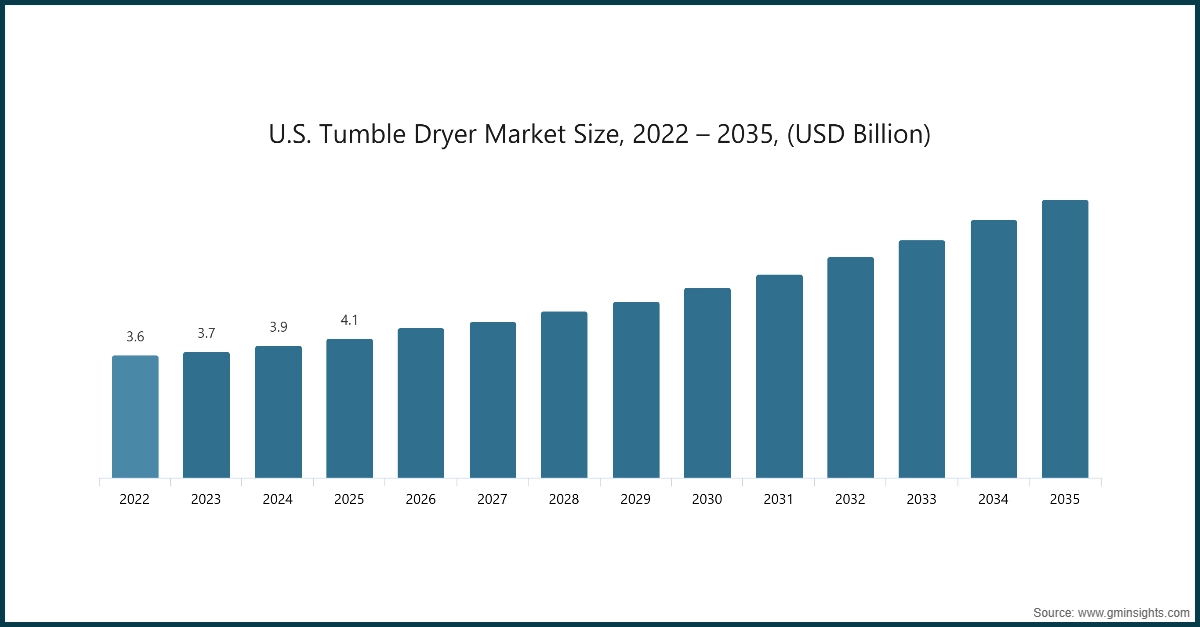
The U.S. dominates an overall North America tumble dryer industry and valued at USD 4.1 billion in 2025 and is estimated to grow at a CAGR of 7.3% from 2026 to 2035.
- A large proportion of U.S. households have dedicated laundry rooms and access to both electric and gas infrastructure, supporting widespread adoption of tumble dryers across income groups. Replacement demand plays a critical role, as consumers periodically upgrade older dryers to newer models offering improved energy efficiency, larger capacities, and advanced fabric‑care features.
- Additionally, the popularity of gas tumble dryers in the U.S. owing to lower operating costs and faster drying times continues to support market value growth. Rising adoption of energy‑efficient and smart tumble dryers, influenced by energy‑cost awareness and smart‑home integration trends, is further strengthening demand.
Europe Tumble Dryer Market
In the European tumble dryer industry, Germany is expected to experience significant and promising growth from 2026 to 2035.
- Germany has one of the largest installed bases of home appliances in Europe, making replacement cycles a key growth driver as older vented and condenser dryers are phased out in favor of modern heat‑pump models that comply with tightened EU ecodesign and energy‑labeling regulations. German consumers are highly cost‑ and energy‑conscious, which accelerates the shift toward premium and mid‑range heat pump tumble dryers offering lower electricity consumption, long‑term savings, and enhanced fabric care.
- Additionally, high urbanization levels and widespread apartment living increase demand for condenser and ventless dryers that can be installed without external ventilation. The country’s strong purchasing power, well‑established retail infrastructure, and emphasis on sustainability and circular‑economy practices further support adoption of advanced, repairable, and long‑life tumble dryers, positioning Germany as a key growth engine within the European market over the forecast period.
Asia Pacific Tumble Dryer Market
In the Asia Pacific tumble dryer industry, the China held 30.1% market share in 2025 and is anticipated to grow at a CAGR of 7.1% from 2026 to 2035.
- As more consumers migrate to urban apartments with limited outdoor drying space, tumble dryers are gaining acceptance as a practical and time‑saving solution, particularly in densely populated cities. Rising disposable incomes are enabling households to invest in convenience‑oriented appliances, while younger, dual‑income families place greater emphasis on efficiency and indoor laundry solutions.
- Additionally, China’s large replacement market is beginning to emerge as earlier adopters upgrade basic or imported models to newer, energy‑efficient versions with higher capacity and improved fabric care. Government policies supporting energy efficiency and domestic manufacturing, along with the strong presence of local appliance brands offering competitively priced mid‑range and premium models, further support market expansion.
Middle East and Africa Tumble Dryer Market
In the Middle East and Africa tumble dryer industry, Saudi Arabia held 33% market share in 2025 promising growth from 2026 to 2035.
- A growing young and expatriate population, along with the high prevalence of apartment living in major cities, supports adoption of tumble dryers as outdoor air‑drying is often impractical due to heat, dust, and limited space. The country’s strong purchasing power enables consumers to invest in mid‑ to premium‑priced dryers that offer enhanced convenience, energy efficiency, and fabric care.
- In addition, expansion of the hospitality sector including hotels, serviced apartments, and healthcare facilities creates sustained demand for high‑capacity and reliable tumble dryers. Government‑led housing development projects, ongoing modernization of retail infrastructure, and rapid growth of organized retail and e‑commerce platforms further improve product accessibility and awareness.
Tumble Dryer Market Share
- In 2025, the prominent manufacturers in tumble dryer industry are Whirlpool Corporation, LG Electronics, Samsung Electronics, BSH Hausgeräte (Bosch) and Haier Group collectively held the market share of ~15%.
- Whirlpool Corporation, leveraging its Maytag and Amana brands, has firmly established itself as a dominant player in the North American market. The company benefits from an extensive and well-structured distribution network, along with strategic partnerships with home builders, which have enabled it to maintain a stronghold in the market for large-capacity gas and conventional electric dryers. Whirlpool's strategy revolves around delivering reliable, high-performance products that cater to the specific needs of American households. The company focuses on producing durable appliances designed to handle the demands of modern families, ensuring consistent quality and customer satisfaction.
- LG Electronics has positioned itself as a global leader in technological innovation, particularly in the premium segment of the market. The company targets tech-savvy and environmentally conscious consumers with its advanced product offerings, such as the DUAL Inverter Heat Pump and AI-enabled smart dryers. These dryers are equipped with intelligent sensors for optimized drying, energy-saving mechanisms, and seamless integration with LG's ThinQ(R) Smart Home platform, which allows users to control and monitor their appliances remotely.
- BSH Hausgeräte, primarily through its Bosch brand, continues to lead the European market by offering high-efficiency, long-lasting appliances tailored to the needs of energy-conscious families. The company's products are engineered to deliver exceptional performance, featuring advanced technologies such as noise reduction systems, energy-saving modes, and extended life cycles. BSH's commitment to quality and innovation has earned it a loyal customer base across Europe and other luxury markets.
Tumble Dryer Market Companies
Major players operating in the tumble dryer industry include:
- American Dryer
- ASKO Appliances
- Danube
- Dexter Laundry
- Electrolux
- GIRBAU
- Haier
- LG
- Little Swan
- Maytag
- Miele
- Pellerin Milnor
- Renzacci
- Samsung
- Schulthess
Samsung Electronics leverages its extensive experience in the consumer electronics industry to create a seamless connected home ecosystem. The company's strategy focuses on integrating its dryers into the SmartThings platform, enabling AI-driven and automation-based laundry care solutions. Samsung's dryers feature advanced technologies such as intelligent drying algorithms, energy-efficient heat pumps, and user-friendly interfaces designed to simplify the laundry process.
The Haier Group has established itself as a global leader through its multi-brand business model, which focuses on acquiring established regional players to expand its market presence. Notable acquisitions include GE Appliances in the United States and Candy Hoover in Europe. Haier offers a diverse product portfolio, catering to a wide range of consumers from budget-conscious buyers to high-end customers. The company's products are designed to meet varying regional preferences, incorporating features such as energy efficiency, advanced drying technologies, and user-friendly controls.
Miele specializes in premium tumble dryers that prioritize durability, energy efficiency, and fabric care. The company's products are equipped with innovative features such as patented honeycomb drums, which gently handle fabrics to prevent wear and tear, and maintenance-free heat exchangers for long-term reliability. Miele's dryers also include enhanced sensor-volume drying systems, ensuring optimal drying performance while minimizing energy consumption.
Tumble Dryer Market Report Attributes
| Key Takeaway | Details |
|---|---|
| Market Size & Growth | |
| Base Year | 2025 |
| Market Size in 2025 | USD 22 Billion |
| Market Size in 2026 | USD 23 Billion |
| Forecast Period 2026-2035 CAGR | 6.3% |
| Market Size in 2035 | USD 39.9 Billion |
| Key Market Trends | |
| Drivers | Impact |
| Replacement cycles are firmly established in mature markets | This ensures steady, predictable demand, as consumers regularly upgrade older dryers for improved efficiency, performance, and regulatory compliance. |
| Rising disposable incomes fuel a growing demand for convenience | Higher purchasing power drives adoption of tumble dryers as essential time saving appliances, especially among urban and dual income households. |
| Advancements in energy efficiency and smart technology are on the rise | Innovation boosts market value by encouraging consumers to shift toward feature rich, premium, and connected tumble dryers. |
| Pitfalls & Challenges | Impact |
| Energy consumption and running costs remain high | Concerns over electricity and gas expenses restrain adoption among cost sensitive consumers and slow uptake in emerging markets. |
| Efficient models come with a steep initial purchase price | High upfront costs limit penetration of advanced heat pump and smart dryers, particularly in price conscious segments. |
| Opportunities: | Impact |
| Next-generation drying technologies are in development | Continued R&D in low energy, fast drying, and fabric care technologies opens avenues for differentiation and long term growth. |
| There's an intensified focus on health and hygiene features | Rising awareness of cleanliness and fabric hygiene creates demand for dryers with sanitization, allergen reduction, and anti bacterial functions. |
| Market Leaders (2025) | |
| Market Leader |
Market share of ~6% |
| Top Players |
Collective market share of ~15% |
| Competitive Edge |
|
| Regional Insights | |
| Largest Market | North America |
| Fastest growing market | Asia Pacific |
| Emerging countries | Canada, India, China, Brazil, UAE |
| Future outlook |
|
What are the growth opportunities in this market?
Tumble Dryer Industry News
- In 2025, Haier Appliances introduced its Haier X Series 11, a cutting-edge range of washing machines and tumble dryers designed to enhance laundry care. This series features advanced Ultra Fresh Air technology, which ensures optimal freshness by eliminating odors and maintaining hygiene. Additionally, the Ultra Reverse Drum technology provides superior cleaning performance by reversing drum rotation, reducing fabric wear, and improving washing efficiency. These innovations position the Haier X Series 11 as a premium choice for modern households seeking high-performance laundry solutions.
- In 2025, Electrolux, a global leader in sustainable home appliances, launched its comprehensive smart laundry product range. This lineup includes the 600-900 series washers, which offer advanced stain removal programs and energy-efficient washing cycles, and the 700-800 series washer-dryers, designed to combine washing and drying in a single compact unit. The 600-900 series tumble dryers feature heat pump technology, ensuring energy savings and gentle drying for delicate fabrics. Electrolux's smart laundry range integrates intelligent sensors and app connectivity, enabling users to monitor and control their appliances remotely, further enhancing convenience and sustainability.
- In March 2025, Samsung Electronics unveiled a pre-release model of its next-generation dryer, equipped with the innovative "AI OptiDry" system. This advanced system uses an infrared sensor to analyze the fabric composition of clothes in real time, ensuring precise temperature adjustments for mixed loads. The "AI OptiDry" system addresses the common issue of overheating delicate textiles by maintaining optimal heat levels, delivering high temperatures for cotton while providing gentle care for synthetic fabrics. This dryer also incorporates a large-capacity drum, a noise-reduction mechanism, and an eco-friendly drying mode to minimize energy consumption.
The tumble dryer market research report includes in-depth coverage of the industry, with estimates & forecast in terms of revenue (USD Billion) and volume (Thousand Units) from 2022 to 2035, for the following segments:
Market, by Type
- Electric tumble dryer
- Gas tumble dryer
Market, by Technology Type
- Vented tumble dryers
- Condenser tumble dryers
- Heat pump tumble dryers
Market, by Capacity
- Small Capacity (<7 kg)
- Medium Capacity (7-9 kg)
- Large Capacity (>9 kg)
Market, by Price
- Low
- Medium
- High
Market, by Application
- Household
- Textile industry
- clothing or laundry industry
- Hospitality industry
- Others (spa, Healthcare, etc.)
Market, by Distribution Channel
- Online
- E-commerce
- Company website
- Offline
- Mega retail stores
- Specialty stores
- Others (individual stores, departmental stores, etc.)
The above information is provided for the following regions and countries:
- North America
- U.S.
- Canada
- Europe
- Germany
- UK
- France
- Italy
- Spain
- Asia Pacific
- China
- Japan
- India
- South Korea
- Australia
- Indonesia
- Malaysia
- Latin America
- Brazil
- Mexico
- Argentina
- MEA
- Saudi Arabia
- UAE
- South Africa
Frequently Asked Question(FAQ) :
What is the market size of the tumble dryer in 2025?
The market size was USD 22 billion in 2025, with a CAGR of 6.3% expected through 2035. Increasing replacement demand, energy efficiency regulations, and advancements in fabric care technologies are driving market growth.
What is the projected value of the tumble dryer market by 2035?
The market is poised to reach USD 39.9 billion by 2035, driven by the adoption of smart features, heat pump technology, and sustainable product innovations.
What is the expected size of the tumble dryer industry in 2026?
The market size is projected to reach USD 23 billion in 2026.
How much revenue did the gas tumble dryer segment generate in 2025?
The gas tumble dryer segment generated approximately USD 11.3 billion in 2025 and is anticipated to grow at a CAGR of 6% till 2035.
What was the market share of medium-priced tumble dryers in 2025?
Medium-priced tumble dryers held a 38.4% market share in 2025 and is set to expand at a CAGR of 6.5% through 2035.
What is the growth outlook for the U.S. tumble dryer sector?
The U.S. market, valued at USD 4.1 billion in 2025, is anticipated to showcase around 7.3% CAGR up to 2035.
What are the upcoming trends in the tumble dryer market?
Key trends include heat pump adoption, smart connectivity, advanced fabric care, compact ventless designs, sustainability innovations, and AI-driven predictive maintenance.
Who are the key players in the tumble dryer industry?
Key players include American Dryer, ASKO Appliances, Danube, Dexter Laundry, Electrolux, GIRBAU, Haier, LG, Little Swan, Maytag, and Miele.
Tumble Dryer Market Scope
Related Reports