Summary
Table of Content

Thin Wafer Market
Get a free sample of this report
Form submitted successfully!
Error submitting form. Please try again.
Thank you!
Your inquiry has been received. Our team will reach out to you with the required details via email. To ensure that you don't miss their response, kindly remember to check your spam folder as well!
Request Sectional Data
Thank you!
Your inquiry has been received. Our team will reach out to you with the required details via email. To ensure that you don't miss their response, kindly remember to check your spam folder as well!
Form submitted successfully!
Error submitting form. Please try again.
Thin Wafer Market Size
A thin wafer is a semiconductor substrate which uses back grinding, polishing, and etching methods to achieve a thickness of 200μm or less with a typical range between 50 and 100μm after front-side processing. The power devices and compact electronics of 3D stacking applications require thin wafers because they allow high-density packaging without exceeding 1μm total thickness variation and enabling users to handle products without warping.
Thin Wafer Market Key Takeaways
Market Size & Growth
- 2025 Market Size: USD 15.1 Billion
- 2026 Market Size: USD 17 Billion
- 2035 Forecast Market Size: USD 56 Billion
- CAGR (2026–2035): 14.2%
Regional Dominance
- Largest Market: Asia Pacific
- Fastest Growing Region: North America
Key Market Drivers
- Advanced Semiconductor Packaging Demand.
- Proliferation of 5G and AI Chip.
- Expansion of IoT Device.
- Increase adoption of electric vehicles.
- Growth of CMOS Image Sensor.
Challenges
- High Defect Density and Yield Loss.
Opportunity
- Rising innovation in advanced packaging.
- Shift towards power semiconductor shift.
Key Players
- Market Leader: SK Siltron Co., Ltd. led with over 15.6% market share in 2025.
- Leading Players: Top 5 players in this market include SK Siltron Co., Ltd., Siltronic AG, Shin-Etsu Chemical Co., Ltd., SUMCO CORPORATION, GlobalWafers Co. Ltd., which collectively held a market share of 44% in 2025.
Get Market Insights & Growth Opportunities
The increasing penetration of electrification and automation technologies in the automotive industry to reduce emissions and improve the efficiency of the vehicle is expected to increase the demand for the thin wafer in this sector. In addition, the growing adoption of electric vehicles across developing nations due to the reduction of fossil fuels also supports market growth. Furthermore, the development of the charging infrastructure of electric vehicles and features such as anti-lock braking, advanced driving assistance systems, and many more require a thin wafer as a semiconductor, boosting market growth.
Moreover, government entities of many developing and developed nations are heavily investing in producing thin wafer semiconductors. The rising R&D investment and collaboration of key players have also contributed to the development of semiconductors. For instance, in October 2025, the government of Germany has invested around USD 3 billion in reclaiming the semiconductor production sites. This investment is due to the rising demand for semiconductors by industry 4.0 and IoTs, and the production units enhance the access to sufficient microchips to cope with the emerging trends; such factors drive market growth.
The global thin wafer market was estimated at USD 15.1 billion in 2025. The market is expected to grow from USD 17 billion in 2026 to USD 56 billion by 2035, at a CAGR of 14.2% during the forecast period of 2026–2035, according to latest report published by Global Market Insights Inc.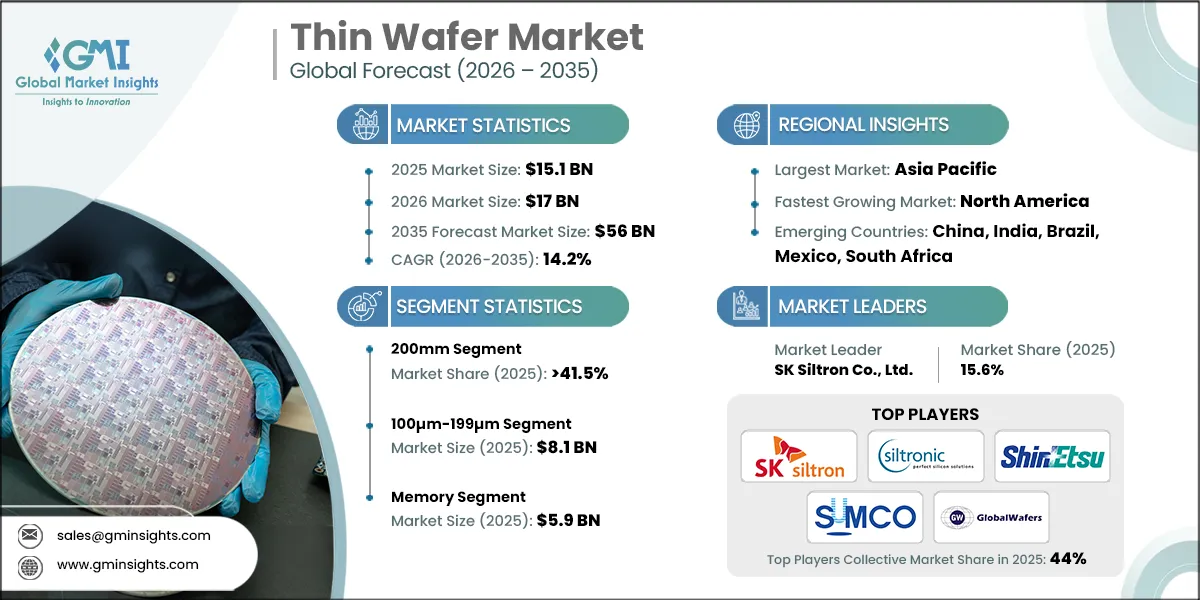
To get key market trends
Thin Wafer Market Trends
- The increasing adoption of ultra-thin wafers which measure less than 50 micrometers is changing semiconductor manufacturing processes used for advanced 3D packaging and chiplet designs. These technologies allow different systems to work together by connecting artificial intelligence accelerators with HBM4 memory stacks and 5G/6G radio frequency modules to create more compact data center and edge device systems that consume less energy.
- The semiconductor industry needs 300mm thin wafer technology to meet rising demand for SiC and GaN power devices in EV fast charging and renewable energy. The implementation of temporary bonding and debonding methods enables processing operations to achieve reliable outcomes which result in high production yields and major cost reductions while delivering double the power capacity through the use of thinner and more efficient wafers designed for high-volume manufacturing.
- For Instance, Infineon established its 300mm thin wafer facility in Malaysia as an expansion of its existing operation to produce automotive grade SiC devices which support 800V electric vehicle systems. The facility increases production capacity by 30% which enables faster qualification cycles and cost-efficient supply for global OEMs who require 40 million electric vehicle units annually.
- The increasing use of AI-powered automation together with edge computing technology creates a need for accurate thin wafer processing equipment. AI-optimized grinding and laser dicing and metrology tools reduce defects which leads to the production of sub-20μm wafers required for quantum ICs and photonic integration in next-gen AR/VR and hyperscale computing.
Thin Wafer Market Analysis
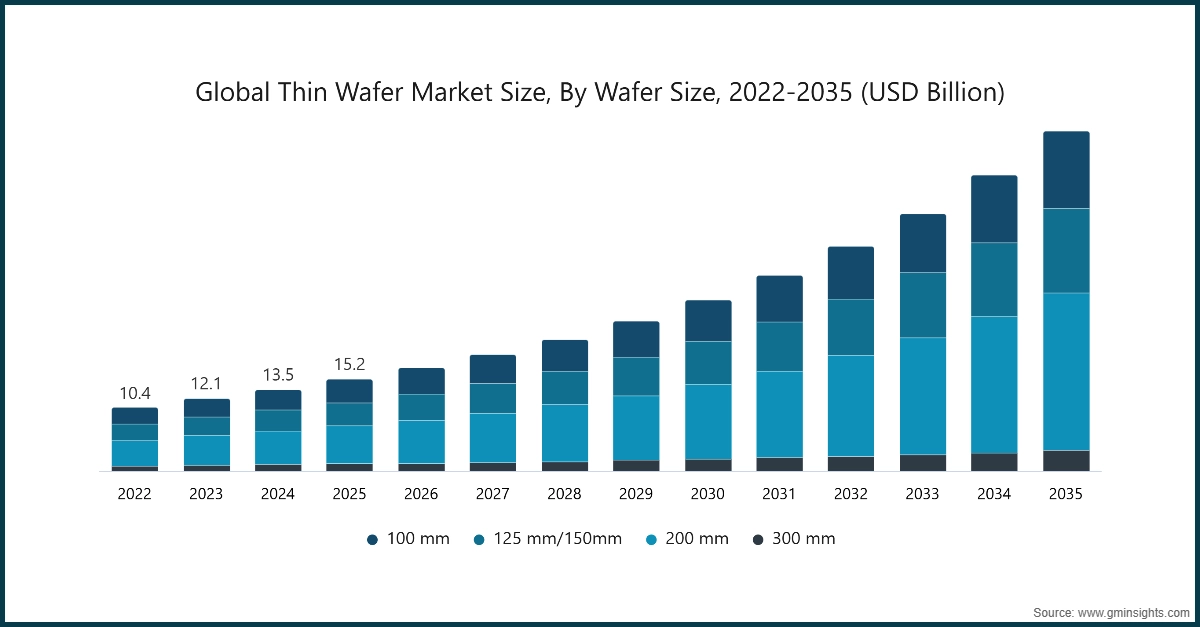
Learn more about the key segments shaping this market
Based on wafer size, the market is segmented into 100 mm, 125 mm/150mm,200 mm and 300 mm. The 200mm segment is estimated to register a significant growth rate of over 41.5% of the market in 2025.
- The 200mm segment dominates the thin wafer market because industrial-grade switches and routers and network interface cards have increased demand for this wafer size. The components establish dependable high-speed secure industrial communication which manufacturers and energy and transportation and process automation industries use to transfer data in real time across their industrial networks.
- According to the US Department of Commerce the CHIPS Act funding needs to become the primary focus for manufacturers because it provides financial support for 300mm thin wafer production facilities which will operate in Arizona and Texas while they aim to decrease import tariffs by 25 percent and boost SiC and electric vehicle output. The company will use laser thinning and temporary bonding to achieve more than 95 percent yield results for <20μm wafers which they will use in automotive sensors and medical devices. The partnership will develop AI metrology systems which protect supply chains while achieving a 30% reduction in defects.
- The 125 mm/150mm segment in the market is anticipated to witness significant growth, projected to expand to a CAGR of 13.8% during the forecast period. This growth is driven by increasing demand from the automotive industry which needs compact and high-efficient power integrated circuits and sensors for electric vehicles and advanced driver assistance systems. The adoption of Internet of Things devices and 5G infrastructure and consumer electronics products increases because they use less expensive mature-node production methods to manufacture their products from smaller wafer sizes.
- The manufacturing process of 125mm/150mm thin wafers needs advanced temporary bonding and laser thinning technologies to produce automotive ADAS and electric vehicle power integrated circuits. The company needs to prioritize three areas which include achieving high-yield miniaturization and using cost-efficient mature-node processes and developing IoT/5G sensor integration systems.
Based on the thickness, the thin wafer market is segmented into >200μm, 100μm-199μm, 50μm-99μm, 30μm-49μm, 10μm-29μm and <10μmothers. The 100μm-199μm segment dominated the market in 2025 with a revenue of USD 8.1 billion.
- The 100μm-199μm segment holds the largest share of the market, driven by surging adoption in power semiconductors for EVs and renewables, where 100μm-199μm thin wafers enable optimal balance of mechanical strength and electrical efficiency in SiC/GaN devices. This thickness supports high-volume automotive sensors, power management ICs, and 3D stacking for AI chips, improving yield rates and cost-effectiveness in advanced packaging applications.
- Manufacturers prioritize advanced temporary bonding methods and carrier wafer technologies for superior results in SiC/GaN power devices and EV sensors. Key improvements include warpage control for stability, high-throughput dicing for efficiency, and seamless 3D heterogeneous packaging integration, ensuring mechanical reliability across production.
- The >200μm segment in the market is expected to witness significant growth, projected to expand at a CAGR of 11.6% and reach USD 12.3 billion by 2035. The growth is due to consumer electronics and industrial controls, and discrete power devices show increasing demand for legacy semiconductor nodes. The thickness provides better stability for handling and protects against defects during the high-volume dicing and packaging process which enables support of cost-sensitive applications that include displays and MEMS sensors and RF modules used in IoT expansion and supply chain localization.
- Manufacturers should focus on high-throughput dicing and handling innovations for >200μm wafers to minimize breakage in legacy nodes for consumer electronics and industrial controls. The combination of cost-effective polishing methods and packaging solutions without defects together with local supply chain operations will enable CAGR growth that provides both stability and scalability for Io display products and discrete power systems.
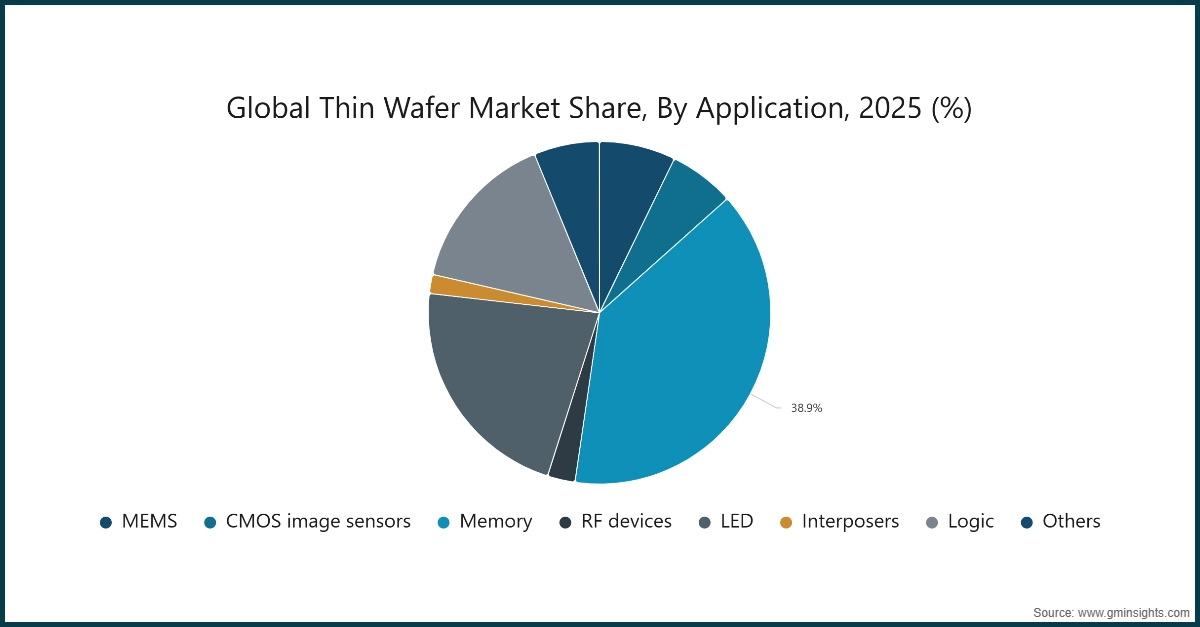
Learn more about the key segments shaping this market
Based on the application, the thin wafer market is segmented into MEMS, CMOS image sensors, memory, RF devices, LED, interposers, logics, and others. The memory segment dominated the market in 2025 with a revenue of USD 5.9 billion.
- The growth is driven due to the increasing need for HBM4 and DRAM stacking technologies which enable AI GPUs and hyperscale data centers. The use of thin wafers which measure less than 100 micrometers results in 50 percent higher density because 3D through-silicon vias (TSV) technology reduces latency by 30 percent while meeting bandwidth needs of NVIDIA/AMD next-generation accelerators and 5G edge servers.
- Manufacturers need to use advanced TSV etching combined with thermal compression bonding techniques for their manufacturing processes which require handling sub-100μm thin wafers in order to achieve successful stacking of HBM4 and DRAM components used in AI GPU applications. The combination of Cu-Cu hybrid bonding with low-CTE carrier warpage reduction and high-throughput plasma cleaning technology results in decreased latency while providing support for NVIDIA and AMD accelerators in hyperscale data center environments.
- The LED segment in the market is expected to experience major expansion which will reach a market value of USD 12.7 billion through a compound annual growth rate of 14.4% until the year 2035. The demand for microLED displays in AR/VR glasses and automotive headlamps and miniLED backlights which are used in premium TVs drives the expansion of the market. Thin wafers enable 70% higher luminous efficiency through GaN-on-Si epitaxy which decreases costs by 40% while providing 8K resolution and adaptive lighting support for both EVs and consumer electronics.
- Manufacturers should target GaN-on-Si epitaxy optimization and laser lift-off for thin wafer LEDs to boost luminous efficiency in microLED/microdisplays. Pairing vertical chip architectures with phosphor conversion for miniLED backlights and high-throughput wafer bonding lowers costs while fueling AR/VR, automotive headlamps, and 8K TV expansion.
North America Thin Wafer Market
North America dominated with a market share of 15.7% in 2025.
- The North American market is rapidly expanding due to the automotive industry shifted toward electric vehicles which required more thin wafers for their sensor and ABS and airbag and engine control systems. The advanced automotive technology implementation and the medical equipment market growth driven by the aging population and CHIPS Act semiconductor fab investments created the fastest regional growth rate which will continue until 2035.
- According to National institute of Standards and Technology, manufacturers should focus their attention on CHIPS Act funding which supports 300mm thin wafer fabrication facilities located in Arizona and Texas to achieve 25 percent reduction in import tariffs while increasing production of SiC and electric vehicles. Invest in laser thinning and temporary bonding for <20μm wafers at 95%+ yields targeting automotive sensors and medical devices. The partnership will establish supply chain protection while developing AI metrology systems that will reduce defects by 30%.
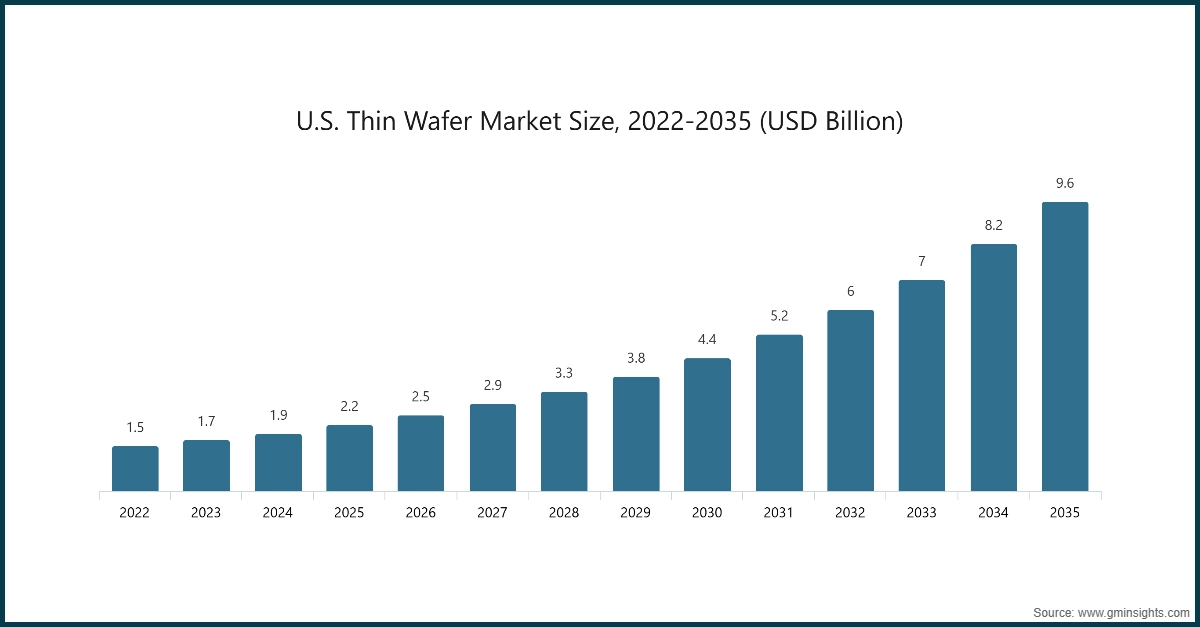
The U.S. thin wafer market was valued at USD 1.5 billion in 2022 and USD 1.7 billion in 2023, reaching USD 2.2 Billion in 2025, up from USD 1.9 Billion in 2024.
- The growth is driven by CHIPS Act investments exceeding $50B in domestic semiconductor fabs, which lead to more electric vehicles on the road and increased need for automotive sensors. The market experienced 15%+ compound annual growth rate because of rising demands for AI chip packaging, 5G infrastructure development, and medical device miniaturization that supports an aging population, with North America obtaining 28% of worldwide market share.
- According to the CHIPS and Science Act, manufacturers should focus on leveraging CHIPS Act grants and 25% advanced manufacturing tax credits to construct domestic thin wafer fabs in Arizona and Ohio, targeting EV sensors and AI packaging. The company will achieve funding success through three main elements which include their commitment to 10-year China expansion ban compliance, their dedication to workforce upskilling for 5G and medical miniaturization, and their focus on supporting domestic supply chains.
 Looking for region specific data?
Europe Thin Wafer Market
Looking for region specific data?
Europe accounts for USD 879.2 million in 2025 and is anticipated to witness strong growth over the forecast period.
- The market in Europe shows substantial market share because EU Chips Act investments support semiconductor sovereignty development across Germany France and the Netherlands. The demand for automotive electronics which support electric vehicle powertrains and advanced driver-assistance systems, industrial Internet of Things sensors, and power devices exists because research and development activities proceed in advanced thinning technologies.
- Manufacturers should focus on using EU Chips Act subsidies to establish "first-of-a-kind" thin wafer fabrication facilities in Germany, France, and the Netherlands which will serve the automotive electric vehicle and advanced driver assistance systems markets and the industrial Internet of Things sensor market. As per the European Act, the implementation of advanced temporary bonding and sustainability-compliant thinning processes and international research and development partnerships will enable the company to secure around 40 billion in funding and build robust supply chain systems and achieve substantial growth until 2035.
Germany dominates the Europe thin wafer market, showcasing strong growth potential.
- The growth is due to its automotive powerhouse status, with EV/ADAS demanding 300mm thin wafer adoption for SiC power devices and sensors by Volkswagen/BMW. EU Chips Act funding bolsters Infineon's expansions, while precision manufacturing expertise in power electronics and industrial automation fuels 12% growth through advanced thinning R&D.
- Manufacturers should expand 300mm thin wafer capacity using EU Chips Act funding for SiC/GaN automotive power devices at Infineon and similar hubs. Germany uses its automotive industry strength to obtain contracts with Volkswagen and BMW through automated research and development processes that include EV sensor thinning and ADAS development and Industrial IoT and power electronics management.
Asia-Pacific Thin Wafer Market
Asia-Pacific is anticipated to grow at the highest CAGR of 14.7% during the analysis period.
- The region is experiencing rapid growth, driven by explosive semiconductor manufacturing in China, Taiwan, South Korea, and Japan. The demand for 300mm thin wafers used in AI chiplets and HBM4 memory stacking and 5G/6G RF modules and SiC/GaN power devices in automotive EVs and data centers and consumer electronics has created a need for advanced packaging solutions which improve operational efficiency in the area.
- Manufacturers should scale 300mm thin wafer production using temporary bonding/debonding and AI-precision grinding in China, Taiwan, Japan, and South Korea. This drives growth via high-yield HBM4 stacking and SiC/GaN for EVs/5G RF integration, leveraging regional fabs for AI chiplets, data centers, and consumer electronics.
The Taiwan thin wafer market is estimated to grow at a significant market share of 14% from 2026 to 2035.
- Taiwan leads the global market with over 28% share in advanced packaging applications in 2025, driven by TSMC's dominance in CoWoS and InFO technologies for HBM4 and AI chiplets. Massive investments in 300mm thin wafer capacity for NVIDIA/AMD GPUs, SiC power devices, and 5G mmWave modules fuel market growth. Taiwan maintains technological superiority through hybrid bonding innovations, while government R&D tax credits support its leadership position in hyperscale data centers, high-performance computing, and consumer electronics production.
- Manufacturers need to focus on CoWoS/InFO thin wafer technologies and hybrid bonding solutions for TSMC's 300mm capacity expansions which will enable HBM4 and AI chiplet support. The combination of economies of scale with premium node yields above 98% and R&D tax credits for NVIDIA and AMD GPUs will drive 16% CAGR growth in hyperscale data centers and high-performance computing and global consumer electronics supply chains.
Latin America Thin Wafer Market
Latin America is valued at USD 1.1 billion in 2025, and the growth is driven by Brazil's expanding automotive electronics for flex-fuel EVs and Mexico's maquiladora surge in consumer device sensors and power ICs.
Middle East & Africa Thin Wafer Market
The Middle East and Africa market, projected to reach USD 1.1 billion by 2035, is driven by UAE/Saudi investments in semiconductor ecosystems, telecom/5G infrastructure, smart city sensors, and automotive electronics diversification. Rising oil-funded tech diversification and localized power device production fuel regional growth amid import reduction strategies.
Thin Wafer Market Share
The market currently experiences rapid growth because the demand for advanced 3D packaging and HBM4 memory stacking and SiC/GaN power devices and thin wafer solutions keeps increasing in automotive electric vehicles and AI data centers and consumer electronics and 5G infrastructure sectors.
The main industry players SK Siltron Co. Ltd and Siltronic AG and Shin-Etsu Chemical Co. Ltd. and Sumco Corporation and GlobalWafers Co. Ltd. together control 44% of the market share while their partnerships with foundries and equipment providers and research institutions drive technological advances. The partnerships enable semiconductor devices to achieve enhanced wafer yield and improved thinning accuracy and increased production capacity throughout multiple semiconductor technology fields.
Emerging startups and niche providers are introducing high-performance, ultra-thin (<50μm), and energy-efficient thin wafer solutions for mission-critical AI, EV, and photonics applications. The new technologies enable R&D and strategic partnerships to develop advanced thin wafer processing methods which increase stacking density and reduce costs and promote global adoption.
Thin Wafer Market Companies
Some of the prominent market participants operating in the thin wafer industry include:
- 3M
- Applied Materials
- Brewer Science
- Disco Corporation
- EV Group
- GlobalWafers Co. Ltd.
- IceMOS Technology Ltd.
- Mechatronic Systemtechnik GmbH
- Okmetic
- Polishing Corporation of America
- Shanghai Simgui Technology Co. Ltd.
- Shin-Etsu Chemical Co., Ltd.
- Silicon Valley Microelectronics, Inc
- Siltronic AG
- Sil'tronix Silicon Technologies
- SK Siltron Co., Ltd.
- Skynova SA
- SOITEC
- SUMCO CORPORATION
- SUSS MicroTec
- UniversityWafer, Inc
- Virginia Semiconductor Inc.
- Wafer Works Corporation
- Wafer World Inc.
- WaferPro
SK Siltron Co. Ltd. operates as a dominant force in the thin wafer industry because it controls approximately 15.6% of the market. The company provides silicon thin wafers which perform at high levels for use in power semiconductor devices and advanced packaging applications. The company maintains its competitive advantage through its extensive research and development capabilities and its wide range of products which cover automotive electric vehicles, AI chips and industrial applications.
Siltronic AG has captured 11.2% of the market through its production of 300mm thin wafers which are used in logic applications and memory storage and SiC/GaN technologies. Siltronic uses its technological advancements and research development capacity and pure silicon production to deliver solutions to foundries and IDMs while expanding its markets in data centers and automotive industry.
Shin-Etsu Chemical Co., Ltd. operates its business in the thin wafer sector where it maintains a 7.8% market share by supplying its customers with silicon epitaxial wafers and thin wafer solutions that fulfill advanced technology specifications. The company uses its research and development capabilities and worldwide production network and high-purity material knowledge to help semiconductor manufacturers achieve better yields and lower operating costs while adopting new technologies.
Thin Wafer Market Report Attributes
| Key Takeaway | Details |
|---|---|
| Market Size & Growth | |
| Base Year | 2025 |
| Market Size in 2025 | USD 15.1 Billion |
| Market Size in 2026 | USD 17 Billion |
| Forecast Period 2026-2035 CAGR | 14.2% |
| Market Size in 2035 | USD 56 Billion |
| Key Market Trends | |
| Drivers | Impact |
| Advanced Semiconductor Packaging Demand | The demand for advanced semiconductor packaging solutions requires companies to develop packaging solutions that accommodate increasing design complexities of 3D stacking and fan-out wafer-level packaging and system-in-package technologies through the use of ultra-thin wafers which measure less than 50 micrometers to create smaller products while preserving the structural strength needed to support high-density smartphone and wearable interconnections. |
| Proliferation of 5G and AI Chip | 5G base station installation together with AI accelerator implementation requires the use of thin wafers to produce compact RF/mmWave modules and high-performance computing dies which help develop smaller systems that provide better thermal management essential for edge computing and data center operations. |
| Expansion of IoT Device | The increasing number of sensors together with smart home devices and industrial IoT endpoints creates a requirement for affordable 200mm thin wafers which enable the development of miniaturized low-power System-on-Chips that power battery-operated connected environments. |
| Increase adoption of electric vehicles | Electric vehicles use thin silicon carbide and gallium nitride wafers in their traction inverters and onboard chargers to achieve higher power density and efficiency which results in lighter vehicles that fulfill automotive reliability standards. |
| Growth of CMOS Image Sensor | The automotive sector together with security cameras and medical imaging applications drive demand for thin wafer production which supports backside-illuminated sensors that deliver high light sensitivity and quantum efficiency in compact designs. |
| Pitfalls & Challenges | Impact |
| High Defect Density and Yield Loss | Surface defects multiply exponentially as wafer thickness drops below 100μm, with micro-cracks from grinding/polishing reducing prime die yield to 70-80%. Edge chipping during transport demands costly cleanroom handling equipment, inflating production costs 15-20% versus standard wafers. |
| Opportunities: | Impact |
| Rising innovation in advanced packaging | Next-generation 3D heterogeneous integration for chiplets and HBM4 memory stacks becomes technically feasible through thin wafers which enable support for AI supercomputers and AR/VR devices that operate at 50% smaller footprint. The process costs decrease through temporary bonding innovations which enable the company to achieve 30% market share growth through a 20% cost reduction. |
| Shift towards power semiconductor shift | The SiC and GaN thin wafer transition for EV fast chargers and renewable inverters enables customers to achieve double the power density compared to traditional silicon. |
| Market Leaders (2025) | |
| Market Leader |
15.6% market share in 2025 |
| Top Players |
Collective market share is 44% in 2025 |
| Competitive Edge |
|
| Regional Insights | |
| Largest Market | Asia Pacific |
| Fastest growing market | North America |
| Emerging countries | China, India, Brazil, Mexico, South Africa |
| Future outlook |
|
What are the growth opportunities in this market?
Thin Wafer Industry News
- In September 2023- Shin-Etsu Chemical expanded its QST substrate business, which focuses on producing high-quality semiconductor substrates. This expansion is aimed at supporting the development of GaN (Gallium Nitride) power devices.
- In January 2024- Infineon Technologies, a leading semiconductor manufacturer, signed a long-term supply agreement with SK Siltron CSS for Silicon Carbide (SiC) wafers. This agreement ensures Infineon has a stable, long-term supply of SiC wafers to support its production and technological growth.
- In August 2023- EV Group (EVG) which supplies wafer bonding and lithography equipment to the MEMS nanotechnology and semiconductor markets announced that its advanced bonding and metrology and nanoimprint lithography solutions enable new developments in 3D/heterogeneous integration and augmented reality (AR) waveguide manufacturing.
The thin wafer market research report includes in-depth coverage of the industry, with estimates & forecast in terms of revenue (USD million) from 2022 to 2035, for the following segments:
Market, By Thickness
- >200μm
- 100μm-199μm
- 50μm-99μm
- 30μm-49μm
- 10μm-29μm
- <10μm
Market, By Wafer Size
- 100 mm
- 125 mm/150mm
- 200 mm
- 300 mm
Market, By Process
- Temporary bonding & debonding
- UV-release adhesives
- Thermal-release adhesives
- Solvent-release adhesives
- Carrier-less approach/Taiko process
Market, By Application
- MEMS
- CMOS image sensors
- Memory
- RF devices
- LED
- Interposers
- Logic
- Others
The above information is provided for the following regions and countries:
- North America
- U.S.
- Canada
- Europe
- Germany
- UK
- France
- Italy
- Spain
- Netherlands
- Asia-Pacific
- China
- Japan
- India
- South Korea
- Australia
- Latin America
- Brazil
- Mexico
- Argentina
- MEA
- Saudi Arabia
- UAE
- South Africa
Frequently Asked Question(FAQ) :
What is the market size of the thin wafer market in 2025?
The global market for thin wafer was valued at USD 15.1 billion in 2025, driven by growing demand for advanced 3D packaging, and SiC/GaN-based power devices.
What is the projected value of the thin wafer market by 2035?
The market is expected to reach USD 56 billion by 2035, growing at a CAGR of 14.2% from 2026 to 2035, supported by expansion in AI data centers, EV adoption, and 300mm wafer production.
What will be the thin wafer industry size in 2026?
The market is projected to reach USD 17 billion in 2026, reflecting accelerating investments in semiconductor fabs, and rising automotive electrification demand.
Which wafer size segment dominates the thin wafer industry?
The 200 mm wafer segment accounted for approximately 41.5% of the market share in 2025, driven by strong demand from industrial networking equipment, and power semiconductor applications.
Which thickness segment held the largest share in 2025?
The 100μm–199μm segment dominated the market in 2025 with USD 8.1 billion in revenue, supported by widespread use in SiC/GaN power devices, and advanced packaging applications balancing mechanical strength and efficiency.
Which application segment leads the thin wafer industry?
The memory segment led the market in 2025 with USD 5.9 billion in revenue, fueled by rising adoption of HBM4 and DRAM stacking technologies for AI GPUs, and 5G infrastructure.
Which region dominates the thin wafer market?
North America held a market share of 15.7% in 2025, supported by CHIPS Act investments, EV manufacturing expansion, AI chip packaging growth, and domestic semiconductor fabrication initiatives.
Who are the key players in the thin wafer market?
Leading companies include SK Siltron Co., Ltd. (15.6% share), Siltronic AG (11.2%), Shin-Etsu Chemical Co., Ltd. (7.8%), SUMCO Corporation, and GlobalWafers Co., Ltd., collectively accounting for approximately 44% of the global market share.
Thin Wafer Market Scope
Related Reports