Summary
Table of Content

Thermal Imaging Market
Get a free sample of this report
Form submitted successfully!
Error submitting form. Please try again.
Thank you!
Your inquiry has been received. Our team will reach out to you with the required details via email. To ensure that you don't miss their response, kindly remember to check your spam folder as well!
Request Sectional Data
Thank you!
Your inquiry has been received. Our team will reach out to you with the required details via email. To ensure that you don't miss their response, kindly remember to check your spam folder as well!
Form submitted successfully!
Error submitting form. Please try again.
Thermal Imaging Market Size
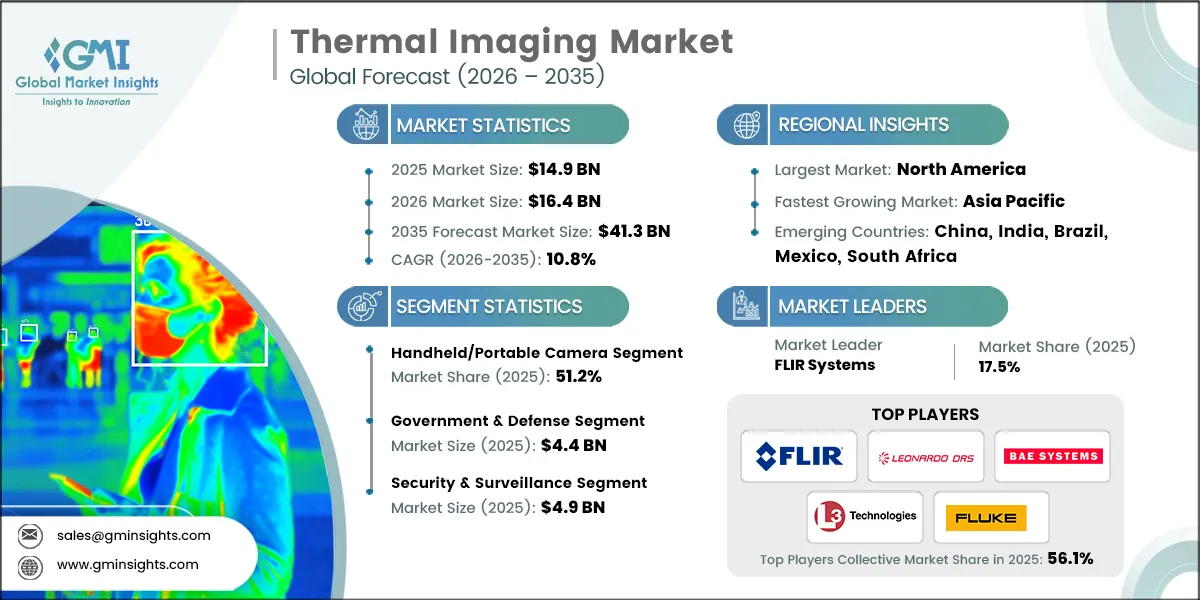
The global thermal imaging market was estimated at USD 14.9 billion in 2025. The market is expected to grow from USD 16.4 billion in 2026 to USD 41.3 billion by 2035, at a CAGR of 10.8% during the forecast period of 2026–2035, according to latest report published by Global Market Insights Inc.
Thermal Imaging Market Key Takeaways
Market Size & Growth
- 2025 Market Size: USD 14.9 Billion
- 2026 Market Size: USD 16.4 Billion
- 2035 Forecast Market Size: USD 41.3 Billion
- CAGR (2026–2035): 10.8%
Regional Dominance
- Largest Market: North America
- Fastest Growing Region: Asia-Pacific
Key Market Drivers
- Rising Defense Modernization Programs.
- Border Security & Maritime Surveillance Expansion.
- Counter-Drone & UAV Threat Detection.
- Night Vision Integration in Autonomous Systems.
- Public Safety & First Responder Demand.
Challenges
- High Cost of Cooled MWIR/LWIR Sensors.
- SWaP-C Constraints in Portable Applications.
Opportunity
- AI-Enhanced Thermal Analytics Proliferation.
- Hyperspectral & Multi-Spectral Fusion.
Key Players
- Market Leader: FLIR Systems led with over 17.5% market share in 2025.
- Leading Players: Top 5 players in this market include FLIR Systems, Fluke Corporation, Bae Systems Imaging Solutions, Leonardo DRS, L3 Technologies, which collectively held a market share of 56.1% in 2025.
Get Market Insights & Growth Opportunities
Thermal imaging technology functions by detecting infrared radiation which objects emit and transform heat signatures into visible images through its specialized cameras. The system operates without any need for visible light to detect temperature differences which it uses for defense surveillance border security industrial inspections and medical diagnostics in total darkness and fog and smoke conditions.
The military and defense sectors have increased their usage of modern thermal imaging cameras which has led to market expansion because these systems provide necessary support for combat operations and nighttime patrolling. The cameras can detect targets at extremely long distances under conditions of poor visibility. In border surveillance operations, border personnel use binoculars and monocular and military vehicles to perform perimeter surveillance while remotely operated turrets provide additional surveillance capabilities.
The thermal imaging industry experiences its greatest growth through defense and security modernization efforts. The armed forces and border agencies use thermal imaging systems to maintain continuous monitoring which helps them identify targets and detect threats despite difficult weather conditions. Ongoing investments in border security and maritime protection and counter-drone systems create continuous demand for thermal sensors that operate at high performance levels. For instance, in 2025, the U.S. Customs and Border Protection (CBP) expanded FLIR Ranger HDC thermal imaging towers along the U.S.-Mexico border in Texas and Arizona, integrating AI analytics for autonomous threat detection. These systems detected over 1,200 unauthorized crossings and 450 smuggling attempts in the first six months, identifying heat signatures through fog and darkness up to 5 km away, per CBP operational reports.
The need for industrial safety and maintenance requirements increases the adoption of thermal imaging technology. Thermal imaging technology permits users to identify overheating components and electrical faults and mechanical stress issues at an early stage. Thermal cameras help utilities and manufacturing plants and energy operators reduce unplanned outages while creating safer work environments. Organizations continue to spend capital on this preventative value proposition because it remains valuable despite heightened economic uncertainty.
The automotive industry creates a new economic driver which drives business growth. Thermal imaging technology enables night-vision systems to detect pedestrians when used in premium and autonomous vehicle platforms. The use of advanced safety systems becomes mandatory through regulatory frameworks which require the implementation of thermal sensors.
To get key market trends
Thermal Imaging Market Trends
- Thermal imaging solutions have become essential for different sectors which include healthcare and life sciences and transportation due to the COVID-19 pandemic. Organizations and facilities across different sectors have started to implement temperature screening systems to help them control infectious disease transmission.
- Chinese police agencies use thermal cameras and goggles to detect pedestrians who have elevated body temperatures. Dubai police use artificial intelligence-powered thermal smart helmets to scan and detect people who have elevated body temperatures. Businesses are adopting products as a fever screening solution because multiple countries have started to lift their COVID-19 lockdown restrictions.
- Uncooled thermal technology continues to gain share due to declining costs and improving resolution. The development of smaller and lighter and more power-efficient devices results from advances in microbolometer fabrication which enables their use in handheld and automotive environments.
- The current trend of sensor fusion combines thermal imaging systems with visible cameras and radar and artificial intelligence-based analytics. This fusion process between two systems enables better object classification and situational awareness abilities for autonomous systems and surveillance systems. The industry requires software-driven differentiation as its vital asset. The combination of image processing and analytics and edge computing technologies allows systems to detect targets more accurately while decreasing the workload of operators. Companies that allocate resources to develop embedded software platforms will enhance their ability to compete in their respective markets.
- The market currently experiences a trend toward miniaturization. Compact thermal modules enable integration into drones and vehicles and portable medical devices. The trend allows users to access additional use cases while maintaining their existing performance. Buyers across different applications now prefer integrated sensing solutions instead of standalone hardware. Thermal imaging has become a basic element of perception and monitoring systems which operate in larger detection frameworks.
Thermal Imaging Market Analysis
Learn more about the key segments shaping this market
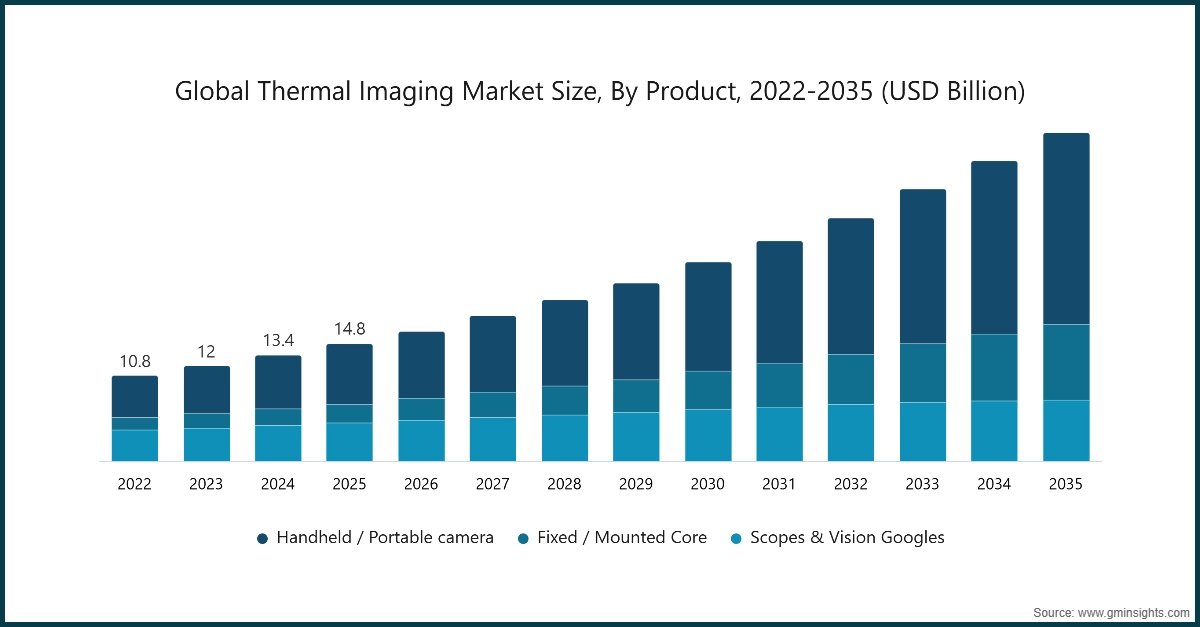
Based on product, the market is segmented into handheld/portable camera, fixed/mounted core, and scopes & vision Goggles. The handheld/portable camera segment holds a market share of 51.2% in 2025.
- The handheld/portable camera segment holds the largest share in the thermal imaging market, driven due to its unmatched field deployment flexibility for electrical inspections, HVAC diagnostics, firefighting, and emergency rescue operations. Technologically matured uncooled sensors deliver 640x512 resolution at <20mK sensitivity in <500g packages, enabling first responders and maintenance technicians to perform rapid, non-contact hot-spot detection across industrial, public safety, and building assessment applications.
- Manufacturers should focus on developing AI-integrated handheld thermal cameras with <500g SWaP 640x512+ uncooled sensors which have <20mK NETD and rugged IP67 designs for field inspections. The combination of real-time analytics and 8+ hour battery life and multi-spectral fusion capabilities will help industrial/public safety requirements and boost product adoption while establishing market dominance for portable applications.
- The fixed/mounted core segment in the market is anticipated to witness significant growth, projected to expand to a CAGR of 14.6% during the forecast period. The growth is due to rising need for nonstop unmanned perimeter monitoring at critical infrastructure sites and border security towers and smart factories. High-resolution cooled MWIR sensors (640x512+, <25mK NETD) enable 24/7 AI-powered threat detection which operates in fog and darkness up to 10 kilometers, while the system integrates with C2 platforms to maintain continuous surveillance across defense borders and oil refineries and airport runways.
- Manufacturers should focus on developing high-resolution cooled MWIR cores (640x512+, <25mK NETD) which include complete C2 integration and AI threat classification capabilities for fixed/mounted applications. The implementation of 10km fog/darkness detection systems together with ruggedized border tower and oil refinery designs and smart factory analytics will enable organizations to meet their unmanned surveillance needs while providing round-the-clock monitoring and establishing a competitive edge in essential infrastructure industries.
Based on the application, the thermal imaging market is segmented into detection & measurement, monitoring & inspection, personal vision systems, search & rescue, security & surveillance and others. The security & surveillance segment dominated the market in 2025 with a revenue of USD 4.9 billion.
- The growth is due to smart city deployments, perimeter protection at critical infrastructure, and 24/7 border monitoring. LWIR cameras provide unmatched fog/darkness penetration for theft prevention, facility protection, and counter-drone operations, capturing largest market share amid rising global security threats.
- Manufacturers need to create AI-powered LWIR cameras which operate continuously for perimeter security while detecting fog and darkness as well as countering drone threats in smart city systems. Security requirements increase for which organizations need to develop three specific solutions: VMS systems that operate without interruption, border tower protection systems, and security systems that can expand to protect entire facilities.
- The search & rescue segment is valued at 3.5 billion in 2025. The growth is due to thermal cameras' unmatched ability to detect human heat signatures through smoke, fog, dense vegetation, and complete darkness during disaster response, maritime emergencies, and wilderness operations.
- Manufacturers must develop handheld LWIR cameras which meet SWaP requirements through their lightweight design and extended battery life and ruggedized construction for search and rescue operations. The first responder requirements can be satisfied through smoke and fog penetration capabilities which enable fast heat signature detection and drone compatible configurations.
Learn more about the key segments shaping this market
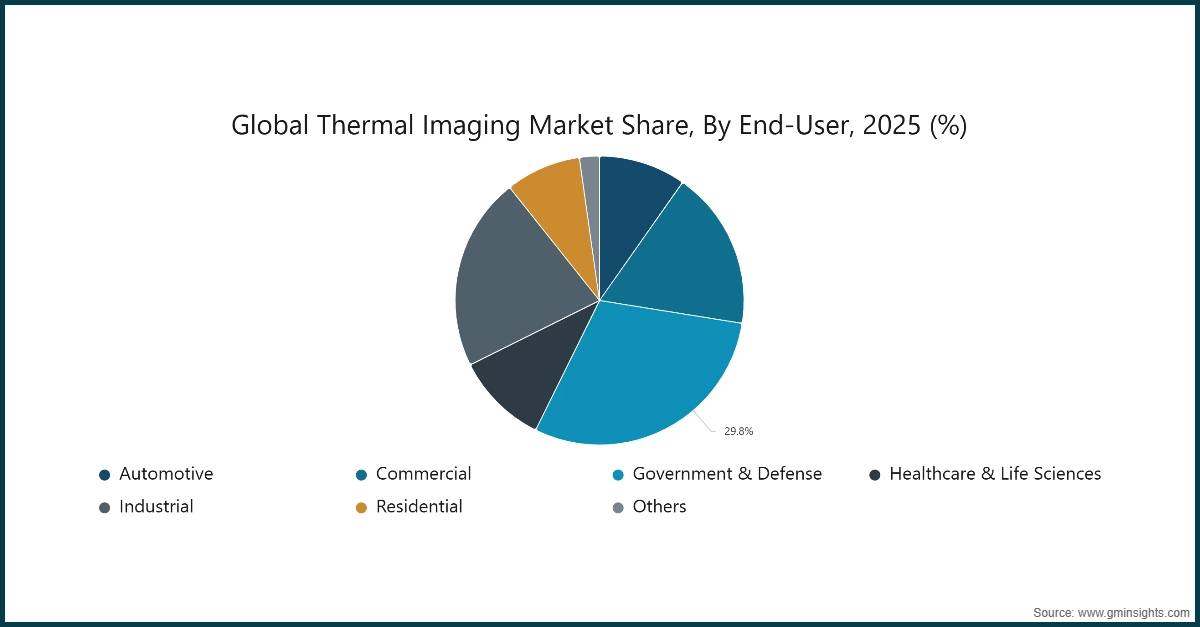
Based on the end-user industry, the thermal imaging market is segmented into automotive, commercial, government & defense, healthcare & life sciences, industrial, residential and others. The government & defense segment dominated the market in 2025 with a revenue of USD 4.4 billion.
- The government & defense segment holds the largest share of the market. The growth is due to escalating global defense budgets, UAV/drone integration requiring compact LWIR sights, and border security mandates. Cooled MWIR systems deliver long-range targeting through fog/darkness, while AI analytics enable autonomous threat detection amid rising geopolitical tensions and counter-drone requirements.
- Manufacturers should focus on developing compact cooled MWIR/LWIR cores with AI edge analytics and ruggedized designs for UAV/drone platforms. The implementation of long-range targeting systems together with autonomous counter-drone detection systems and NATO-compliant border surveillance systems will satisfy increasing defense requirements while improving threat response capabilities and enhancing global security operational effectiveness.
- The automotive segment in the thermal imaging market is anticipated to witness significant growth, projected to expand at a CAGR of 14.4% and reach USD 5.6 billion by 2035. The growth is driven due to mandatory ADAS integration in Level 2+ vehicles, providing pedestrian/animal detection in zero-visibility conditions (fog, darkness, rain). LWIR cameras enable 300m+ night vision, reducing accidents by 40%, with 25%+ CAGR driven by EV adoption and regulatory mandates (EU NCAP, NHTSA 5-star ratings).
- Manufacturers need to develop compact LWIR thermal cameras which meet automotive ADAS requirements forLevel 3+ autonomous driving and zero-visibility pedestrian detection and radar/LiDAR sensor fusion. The automotive OEMs will achieve regulatory safety requirements and decrease nighttime collision hazards through their focus on AEC-Q100 certification and 300m fog-penetrating range and EU NCAP 5-star compliance.
North America Thermal Imaging Market
North America dominated with a market share of 32.4% in 2025.
- North America is expected to dominate the market in terms of share during the forecast period. This growth is attributable to the presence of a considerable number of device manufacturers and providers. The growing investment by the government in the military and defense sector has also contributed to the growth of the market.
- Manufacturers need to focus on AEC-Q100 certified LWIR sensors which enable UAV/drone integration with AI edge analytics that achieves 95% accuracy in autonomous target identification. The US Army FWS-I contracts worth over $500 million together with the Raytheon/FLIR supply chains and CHIPS Act fabs will create a strong foundation for domestic production resilience.
Looking for region specific data?
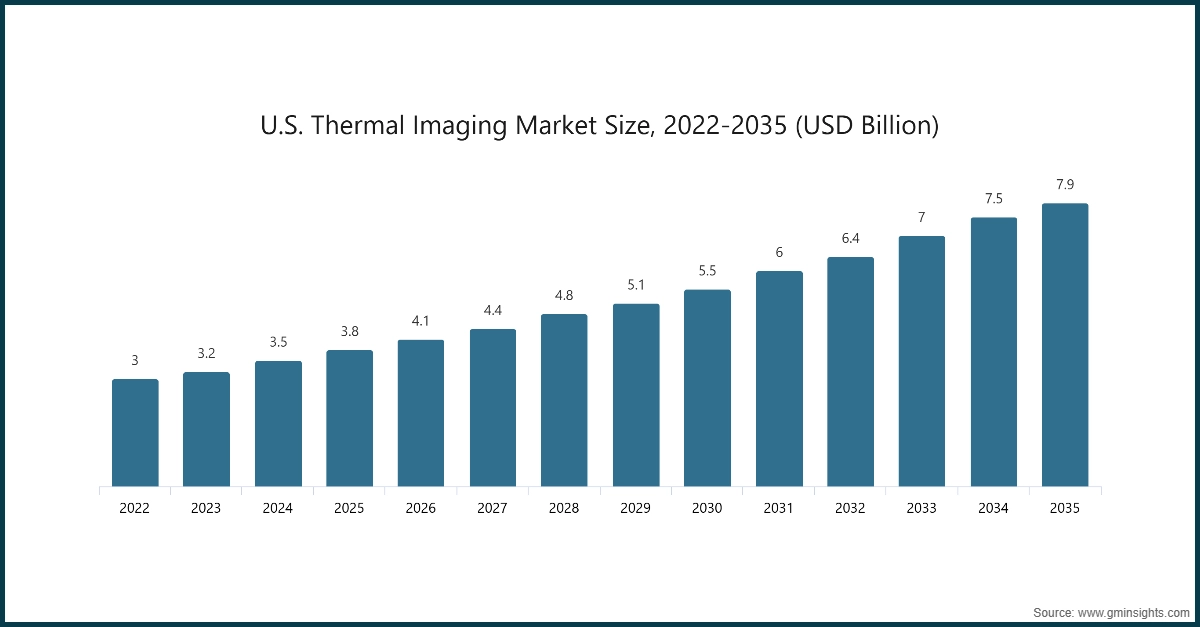
- The U.S. continues to lead the market, The growth is driven due to demand through defense modernization, public safety investments, and industrial automation adoption. Military programs emphasize cooled and mid-wave infrared systems for targeting and surveillance. Civil applications extend their reach to utility sectors and automotive safety systems and healthcare screening procedures. The government funding system maintains its stability while organized acquisition methods enable organizations to execute extended operational periods. The domestic manufacturing sector gains advantages through its ability to integrate systems and maintain existing partnerships with suppliers.
- Manufacturers should prioritize AI-integrated LWIR sensors for FWS-I/Next Gen programs, SWaP-optimized GaN detectors for soldier systems, and domestic CHIPS Act fabs. They should also secure over $2 billion in Department of Defense contracts between now and 2030 through work on Raytheon supply chains and 640x512+ cooled MWIR systems, which support long-range targeting, as well as dual-use platforms for automotive and public safety applications.
Europe Thermal Imaging Market
Europe accounted for USD 3.7 billion in 2025 and is anticipated to witness strong growth over the forecast period.
- Europe holds a significant share of the market, driven due to surging defense spending (Germany/UK/France NATO commitments), stringent EU predictive maintenance mandates in automotive/aerospace, and autonomous vehicle ADAS integration requiring fog-penetrating LWIR sensors. Border security upgrades and industrial automation further drive 12.3% CAGR through miniaturized, AI-enhanced systems.
- Manufacturers should develop LWIR/MWIR sensors which meet EU Green Deal requirements and include AI edge analytics and automotive ADAS integration and NATO-standard defense capabilities for the European market. The implementation of SWaP-optimized drone designs together with predictive maintenance for Industry 4.0 and Horizon Europe R&D partnerships will fulfill increasing defense and border security requirements while improving operational resilience and enabling digital surveillance transformation and establishing a competitive advantage in essential industries.
Germany dominates the Europe thermal imaging market, showcasing strong growth potential.
- The market in Germany experiences growth due to industrial manufacturing base and its status as an automotive engineering hub and its defense procurement practices. The commercial market receives its primary demand from industrial inspection work and the use of automotive night-vision systems. Defense organizations allocate their resources to border defense operations and vehicle-based monitoring systems. German buyers focus on three main criteria which include product reliability and calibration precision and adherence to strict technical requirements. The demand for high-quality thermal imaging systems and modular components remains constant because of this particular focus.
- Manufacturers should focus on delivering precision-calibrated LWIR/MWIR sensors with modular, ruggedized designs and automotive-grade reliability for the German market. Emphasizing DIN-compliant night vision for ADAS vehicles, Industry 4.0 predictive maintenance modules, and Bundeswehr-compatible border surveillance systems will meet stringent technical demands, enhance operational precision, support defense modernization, and strengthen competitive positioning across key industrial and security sectors.
Asia-Pacific Thermal Imaging Market
Asia-Pacific is anticipated to grow at the highest CAGR of 13.9% during the analysis period.
- The growth is due to rising defense budgets, infrastructure expansion, and industrial automation fuel adoption. Governments allocate funds to establish border control systems and maritime protection efforts. The manufacturing expansion in the area results in decreased costs for sensors. Regional demand grows as commercial applications develop in automotive safety and smart cities and utility inspection.
- Manufacturers should develop cost-effective uncooled LWIR sensors which include AI analytics and durable designs for their Asia-Pacific market production. The defense and infrastructure demand will be satisfied through the development of automotive ADAS systems and smart city surveillance systems and industrial inspection systems which can be expanded to meet the requirements of various industrial sectors.
The China thermal imaging market is estimated to grow at a significant CAGR of 12.9% from 2026 to 2035.
- China's market grows through defense modernization and public safety applications and industrial digital transformation. Domestic manufacturers increase their production capacity for uncooled sensors which results in lower product costs.
- The government funds border security systems and smart surveillance technologies and infrastructure monitoring projects. China's export-driven manufacturing expansion establishes the country as a key player in global thermal imaging supply chains which serve budget-conscious business needs.
- Manufacturers should focus on high-volume uncooled LWIR sensor production with AI analytics and cost-competitive designs for China's market. The combination of border surveillance modules and smart city systems and industrial inspection systems for export will enable the defense and commercial sectors to use government funding while developing domestic supply chains and improving public safety and international competitiveness.
Latin America Thermal Imaging Market
Latin America is valued at USD 631.2 million in 2025. The growth in this region is driven by border security and infrastructure monitoring and utility inspection activities. Budget constraints influence purchasing decisions which lead to the selection of uncooled systems that have lower lifecycle costs. The public safety agencies use thermal imaging technology for their search and rescue missions. Economic volatility restricts defense procurement at large scales while it enables specific application-based growth.
Middle East and Africa (MEA) Thermal Imaging Market
The Middle East and Africa market, projected to reach USD 3.5 billion by 2035, is driven by security requirements, energy infrastructure protection, and border surveillance needs. Defense and oil, and gas sectors dominate demand. Harsh environmental conditions favor ruggedized thermal systems. Government-led procurement drives adoption, while commercial usage remains selective but expanding across utilities and critical infrastructure monitoring.
In Saudi Arabia, the market is set to experience substantial growth in 2025.
- Saudi Arabia has developed into a major growth center for the market because of its Vision 2030 defense modernization efforts and its increasing funding for border protection and intelligent urban security systems and its adoption of AI-powered long-wave infrared sensors and its thermal system development in the oil and gas and public safety and desert patrol industries.
- Manufacturers should focus on delivering SWaP-optimized LWIR sensors with AI threat detection for Saudi Arabia's market. Emphasizing Vision 2030-compliant border patrol systems, desert-ruggedized oil & gas inspection modules, and smart city surveillance integration will capture defense modernization demand, enhance operational resilience, support infrastructure expansion, and strengthen competitive positioning across key security sectors.
Thermal Imaging Market Share
The market experiences substantial growth because defense and border security and automotive ADAS and industrial inspection sectors require advanced LWIR and MWIR sensors and AI-driven analytics and rugged surveillance systems.
The major market players, FLIR Systems, Fluke Corporation, BAE Systems Imaging Solutions, Leonardo DRS, and L3 Technologies, establish a 56% market share which is used to develop new products through their partnerships with defense contractors and automotive manufacturers and government organizations. These partnerships enhance sensor resolution, target detection accuracy, and SWaP-optimized performance across diverse thermal applications from soldier systems to smart factories.
Emerging startups and niche providers are launching advanced thermal imaging solutions which combine high-performance capabilities with miniaturized design and artificial intelligence features for defense missions and public safety operations and autonomous vehicle systems. The company improves its thermal system capabilities through GaN detector advancements and edge computing and partnership development which enhances its ability to identify threats and perform predictive maintenance and implement next-generation thermal systems worldwide.
Thermal Imaging Market Companies
Some of the prominent market participants operating in the thermal imaging industry include:
- 3M Scott
- Allied Vision
- American Technologies Network (ATN) Corp.
- Avon Protection Systems Inc.
- Axis Communications
- Bae Systems Imaging Solutions
- COX
- Dali Technology
- Draeger Safety Inc.
- FLIR Systems
- Fluke Corporation (Fortive subsidiary)
- General Starlight Company Inc. (GSCI)
- L3 Technologies
- Leonardo DRS
- Magnity Electronics
- Opgal Optronic Industries Limited
- Palmer Wahl Instrumentation Group
- Raytheon
- Seek Thermal
- Testo SE
- Thermoteknix Systems
- Tonbo Imaging
- ULIS (Sofradir subsidiary)
- Wuhan Guide Infrared Co., Ltd.
- Xenics NV
FLIR Systems is a leading player in the market, holding an estimated market share of 17.5%. The company offers high-performance LWIR/MWIR cameras for defense surveillance, border security, and industrial inspections. Strong R&D capabilities and a broad portfolio reinforce its competitive position across military, automotive ADAS, and public safety sectors.
Fluke Corporation holds a significant share of 13.2% in the market, providing ruggedized thermal cameras for industrial predictive maintenance, electrical inspections, and building diagnostics. Leveraging precision calibration, robust R&D, and scalable handheld solutions, Fluke effectively serves manufacturing, energy, and commercial applications across multiple sectors.
BAE Systems Imaging Solutions is a key player in the market, delivering advanced cooled MWIR/LWIR systems for military targeting, vehicle-mounted surveillance, and aerospace applications. Supported by extensive defense R&D, global reach, and expertise in high-resolution sensors, BAE enhances operational superiority, threat detection, and mission readiness across defense sectors.
Thermal Imaging Market Report Attributes
| Key Takeaway | Details |
|---|---|
| Market Size & Growth | |
| Base Year | 2025 |
| Market Size in 2025 | USD 14.9 Billion |
| Market Size in 2026 | USD 16.4 Billion |
| Forecast Period 2026-2035 CAGR | 10.8% |
| Market Size in 2035 | USD 41.3 Billion |
| Key Market Trends | |
| Drivers | Impact |
| Rising Defense Modernization Programs | Thermal imaging market receives its 38% demand from defense modernization programs which proceed through their current phase of implementation. The armed forces throughout the world invest in next-generation surveillance systems which lead to the use of high-resolution uncooled LWIR sensors that provide 24-hour perimeter protection and battlefield operational monitoring. |
| Border Security & Maritime Surveillance Expansion | Growth of border security and maritime surveillance operations creates 22% of market expansion. Government agencies use thermal imaging technology to see through fog and darkness which enables them to continuously guard across international borders and coastal areas. |
| Counter-Drone & UAV Threat Detection | The 18% market growth originates from businesses which develop systems to detect and combat drone and UAV threats. Military bases use thermal analytics systems to identify micro-drones which operate within a 5-kilometer radius while they fight against asymmetric threats through automatic heat-signature detection and fast-response systems. |
| Night Vision Integration in Autonomous Systems | The implementation of night vision technology in autonomous systems leads to a 12% market expansion. The thermal cameras enable autonomous vehicles and unmanned ground vehicles to function in full darkness because they assist military logistics convoys and urban combat robots with their navigation tasks. |
| Public Safety & First Responder Demand | Public safety and first responder demand adds approximately 10% of total revenue. Fire and rescue teams use handheld thermal monocular to search for victims in smoke-filled spaces which results in increased civilian purchases during urban disaster response operations. |
| Pitfalls & Challenges | Impact |
| High Cost of Cooled MWIR/LWIR Sensors | The expenses for cooled MWIR/LWIR sensors making it difficult for budget-limited agencies to acquire this technology and results in decreased utilization throughout developing regions despite its ability to deliver better range and resolution than uncooled sensors. |
| SWaP-C Constraints in Portable Applications | Portable applications face difficulties because of size, weight, power, and cost restrictions which control their development process. |
| Opportunities: | Impact |
| AI-Enhanced Thermal Analytics Proliferation | AI integration transforms thermal imaging through its ability to autonomously classify targets which include humans and vehicles and drones with 95% accuracy at the edge. The system calculates border tower and UAV gimbal and perimeter system activities which helps operators become less fatigued while decreasing false alarms by 80% and speeding up threat response. |
| Hyperspectral & Multi-Spectral Fusion | The combination of LWIR and SWIR/VIS spectra enables material identification which can penetrate camouflage and fog, thus creating a new approach to counter-insurgency and maritime interdiction operations. Fusion cores identify explosives, monitor hidden dangers, and provide specialized alerts for different materials, thus generating major advancements in defense targeting and industrial quality control systems. |
| Market Leaders (2025) | |
| Market Leader |
17.5% market share in 2025 |
| Top Players |
Collective market share is 56.1% in 2025 |
| Competitive Edge |
|
| Regional Insights | |
| Largest Market | North America |
| Fastest growing market | Asia-Pacific |
| Emerging countries | China, India, Brazil, Mexico, South Africa |
| Future outlook |
|
What are the growth opportunities in this market?
Thermal Imaging Industry News
- In January 2025, Leonardo S.p.A. developed an improved mid-wave infrared sensor system for airborne surveillance platforms, which uses advanced cryogenic cooling and image stabilization technologies to enhance its long-range target detection capabilities.
- In September 2024, L3Harris Technologies received a defense contract to produce vehicle-mounted thermal imaging systems, which will enhance situational awareness through high-resolution sensors that connect to fire-control and command systems.
- In April 2024, Rheinmetall AG collaborated with a European optics company to create future thermal imaging systems, which will feature enhanced detector performance and durable optical components designed for today's modern infantry equipment.
The thermal imaging market research report includes in-depth coverage of the industry, with estimates & forecast in terms of revenue (USD billion) from 2022 to 2035, for the following segments:
Market, By Product
- Handheld/Portable camera
- Fixed/Mounted Core
- Scopes & Vision Googles
Market, By Technology
- Cooled
- Uncooled
Market, By End-user Industry
- Automotive
- Commercial
- Government & Defense
- Healthcare & Life Sciences
- Industrial
- Residential
- Others
Market, By Application
- Detection & measurement
- Monitoring & inspection
- Personal vision systems
- Search & rescue
- Security & surveillance
- Others
The above information is provided for the following regions and countries:
- North America
- U.S.
- Canada
- Europe
- Germany
- UK
- France
- Italy
- Spain
- Netherlands
- Asia-Pacific
- China
- Japan
- India
- South Korea
- Australia
- Latin America
- Brazil
- Mexico
- Argentina
- MEA
- Saudi Arabia
- UAE
- South Africa
Frequently Asked Question(FAQ) :
What was the market size of the thermal imaging market in 2025?
The global market size for thermal imaging was valued at USD 14.9 billion in 2025, driven by strong demand from defense modernization programs.
What is the projected value of the thermal imaging market by 2035?
The market is projected to reach USD 41.3 billion by 2035, growing at a CAGR of 10.8% from 2026 to 2035, supported by increasing adoption of LWIR/MWIR sensors.
Which product segment holds the largest share in the thermal imaging industry?
The handheld/portable camera segment holds the largest market share at 51.2% in 2025, owing to its flexibility in field deployment for electrical inspections.
Which application dominated the thermal imaging industry in 2025?
The security & surveillance segment dominated the market in 2025, generating USD 4.9 billion in revenue.
Which region dominates the thermal imaging market?
North America dominated the market with a 32.4% share in 2025, attributed to strong defense investments, presence of key manufacturers, military modernization programs, and industrial automation adoption.
Who are the leading companies in the thermal imaging market?
Major players include FLIR Systems (17.5% market share), Fluke Corporation (13.2%), BAE Systems Imaging Solutions, Leonardo DRS, and L3 Technologies, collectively accounting for approximately 56% of the global market share.
Thermal Imaging Market Scope
Related Reports