Summary
Table of Content

Tall Oil Fatty Acid Market
Get a free sample of this report
Form submitted successfully!
Error submitting form. Please try again.
Thank you!
Your inquiry has been received. Our team will reach out to you with the required details via email. To ensure that you don't miss their response, kindly remember to check your spam folder as well!
Request Sectional Data
Thank you!
Your inquiry has been received. Our team will reach out to you with the required details via email. To ensure that you don't miss their response, kindly remember to check your spam folder as well!
Form submitted successfully!
Error submitting form. Please try again.
Tall Oil Fatty Acid Market Size
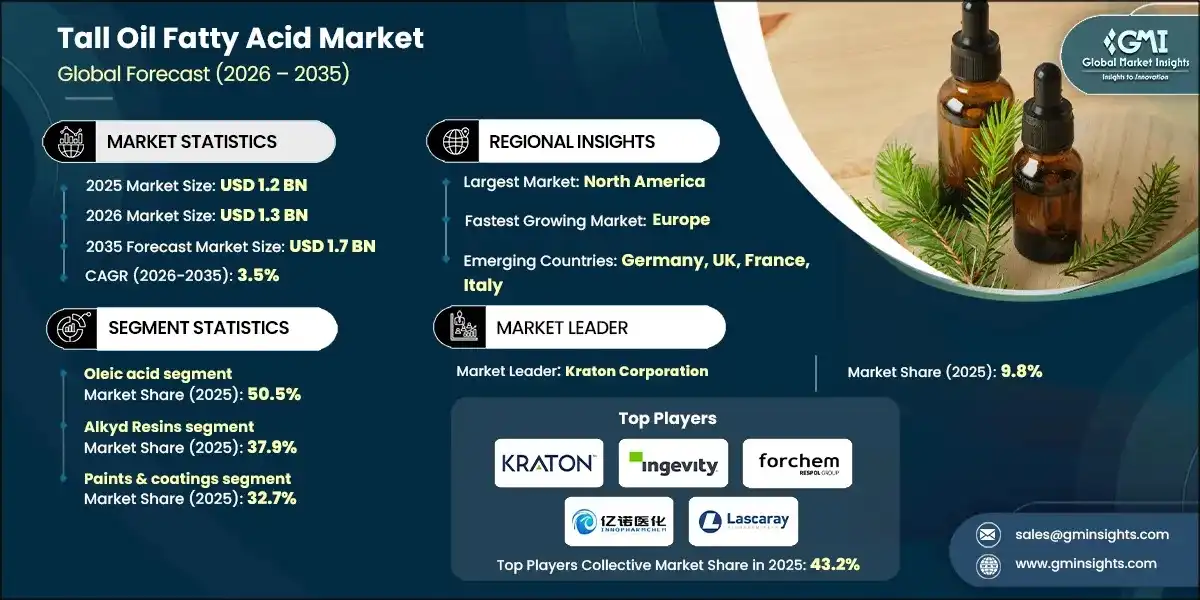
The global tall oil fatty acid market was valued at USD 1.2 billion in 2025. The market is expected to grow from USD 1.3 billion in 2026 to USD 1.7 billion in 2035, at a CAGR of 3.5%, according to latest report published by Global Market Insights Inc.
Tall Oil Fatty Acid Market Key Takeaways
Market Size & Growth
- 2025 Market Size: USD 1.2 Billion
- 2026 Market Size: USD 1.3 Billion
- 2035 Forecast Market Size: USD 1.7 Billion
- CAGR (2026–2035): 3.5%
Key Market Drivers
- Shift towards sustainable and bio-based products.
- Growth in end-use industries like paper, pulp, and packaging.
- Technological advancements in extraction and processing.
Challenges
- Price volatility of raw materials.
- Environmental and regulatory challenges.
Opportunity
- Growing demand in bio-based plastics and polymers.
- Expanding use in personal care and cosmetics.
Key Players
- Market Leader: Kraton Corporation led with over 9.8% market share in 2025.
- Leading Players: Top 5 players in this market include Kraton Corporation, Ingevity, Forchem Oyj, NINGBO INNO PHARMCHEM CO.,LTD., Lascaray S.A., which collectively held a market share of 43.2% in 2025.
Get Market Insights & Growth Opportunities
- The market for tall oil fatty acid is booming because of increased demand for sustainable and bio-based chemicals in various industries. Tall oil fatty acid is very much sought because of its renewable origin, which is derived from the kraft pulping process of wood, specifically pine trees, as consumers and regulators push for environmentally friendly alternatives.
- Tall oil fatty acid, as a versatile raw material, can be used for manufacturing a large variety of products such as soaps, surfactants, lubricants, and plastics. The ability to biodegrade coupled with its low toxicity makes this an attractive choice for eco-conscious manufacturers. It has excellent chemical stability, high resistance to oxidation, and good compatibility with other chemicals to give it more functionality across several formulations.
- Tall oil fatty acid finds its primary applications in a few key industries. It finds its application in paints as well as varnishes and coatings as a raw material for eco-friendly paints and coatings which reduce volatile organic compounds. It is also used in lubricants and grease, which offer alternatives to traditional petroleum-based products and safety to the environment. Moreover, its application as a process chemical in the paper and pulp industry adds to the growing demand of this chemical.
To get key market trends
Tall Oil Fatty Acid Market Trends
- The tall oil fatty acid industry is likely to keep its upward momentum, with expanding demand for sustainable bio-based chemicals from multiple industries. Continued advances in technologies that improve extraction and refining processes are fueling this trend. Examples of innovations include membrane separations and enzymatic processes that reduce costs in producing TOFA and improve its purity-increasing its scope of application. Such technological improvements allow manufacturers to comply with the increasing quality standards that end-use industries such as personal care, paints, and lubricants require.
- In addition, rules and regulations also play a big role in shaping the market scenario. Governments across the globe are enforcing stricter regulations regarding VOC emissions and green safety for the environment. Also, 'sustainable forestry' was added to the definitions of regulations to promote renewable and biodegradable chemicals, influencing many industries to use TOFA as naturally derived and friendly to the environment. Such regulations encourage growing demand for TOFA while providing impetus for innovations in products to be in accordance with ever-changing regulations.
- Another important market major is product innovation. Companies are producing modified derivatives from TOFA that have higher performance specifications, such as better emulsification, greater stability, and higher bioavailability. TOFA also appears to be included in multifunctional products such as environmentally friendly safe lubricants and coatings, which further signify an industry trend toward sustainability.
Tall Oil Fatty Acid Market Analysis
Learn more about the key segments shaping this market
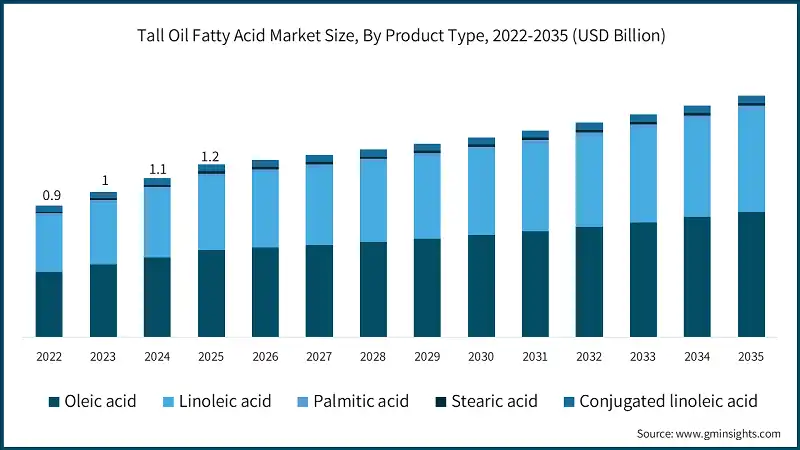
Based on product type, the market is segmented into oleic acid, linoleic acid, palmitic acid, stearic acid, and conjugated linoleic acid. Oleic acid dominated the market with an approximate market share of 50.5% in 2025 and is expected to grow with a CAGR of 3.8% by 2035.
- Demand for oleic acid is increasing in cosmetics, lubricants, and bio-based products. Its natural and moisturizing property, which is environment-friendly, drives growth in the market and is supported by innovations in extraction to stabilize supply. The increasing market for oleic acid would ensure that they include ingredients that remain eco-friendly in all aspects.
- Linoleic acid finds rising demand in health supplements, beauty care, and biodegradable plastics. Demand from the growing awareness of omega-6 fatty acids valued in sustainable sourcing from plant oils is creating prospects for market growth. Innovative developments in extraction methods augment the green trends garnering future demand.
- Palmitic acid is vastly used in cosmetics, food, and bio-lubricants. Heightening awareness of the demand for natural ingredients as well as a sustainable supply from tall oil boosts its market. Technological advancements in refining improve quality while reducing costs thus sustaining a steady growth trend across industries.
- The booming demand for stearic acid is propelled by cosmetics, candles, and rubber industries. There is an increased emphasis on plant-based and biodegradable products, and this will increase demand. Production and sustainability innovations ensure that the expansion happens steadily, making stearic acid one of the key ingredients in green formulations.
Learn more about the key segments shaping this market
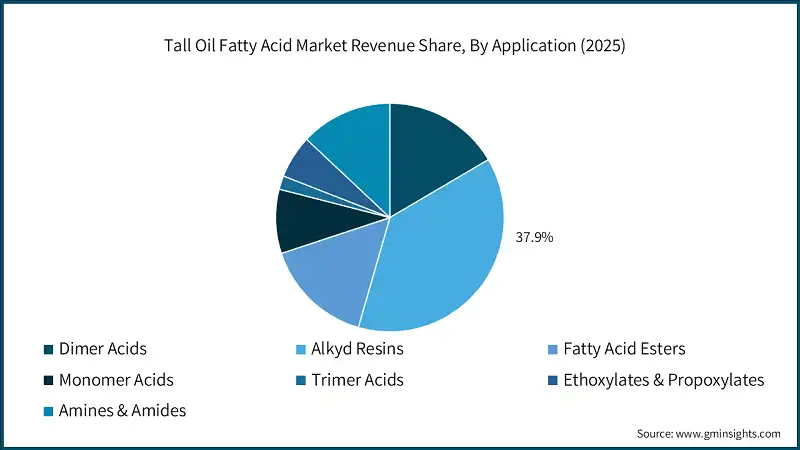
Based on application, the tall oil fatty acid market is segmented into dimer acids, alkyd resins, fatty acid esters, monomer acids, trimer acids, ethoxylates & propoxylates, and amines & amides. Alkyd Resins held the largest market share of 37.9% in 2025 and is expected to grow at a CAGR of 3.6% during 2026-2035.
- The demand for dimer acids in tall oil fatty acids is increasing due to their use in high-performance polyamides, epoxy resins, and adhesives. They have excellent chemical resistance and durability and are thus being used in industrial applications. Advancements in production processes for coating and sealants also boost their market. Eco-friendliness and sustainability of production processes helped the dimer acids extremely in market growth.
- Alkyds resin made from tall oil fatty acids are subjected to a steady growth trend, which is attributed increasingly to their visibility in the paint and coatings industry nowadays. The shift towards water-based and low-VOC formulations will subsequently convince manufacturers to use bio-based alkyds. Continuous advancements in technology support this very much, as well as sustainable tall-oil sourcing.
- Increasing demand in the fatty acid esters segment is coming from cosmetics and lubricants, as well as their industrial application. Their characteristics of excellent solvency, biodegradability, and compatibility with various formulations make them really appealing. Rising environmental regulations and consumer preference for natural ingredients are increasing innovation as well as growth in this domain.
- Monomer acids have applications in making polyamides, polyester, and various other polymers. Therefore, the increasing applications of monomer acids into the production chains of bio-based and sustainable monomers trigger greener chemical manufacturing. This also affects improvements in extraction and purification technologies, which strengthens supply and quality alike.
- Trimer acids find most of their applications in the manufacture of corrosion inhibitors, epoxy resins, and plasticizers. Their good properties in adhesion and chemical resistivity are their key drivers. The emphasis placed on sustainable, bio-based raw materials and improvements in production technologies will further drive the anticipated growth of demand for trimer acid.
- Increasingly, ethoxylates and propoxylates of tall oil fatty acids are applied to surfactants and detergents and emulsifiers. Their biodegradability and eco-friendliness are in line with global trends toward sustainability. Growing demand in personal care and cleaning products is supporting a positive market outlook.
Based on end use industry, the tall oil fatty acid market is segmented into paints & coatings, adhesives & sealants, oil & gas, soaps & detergents, automotive, rubber & tire, textiles, construction, mining, biofuels & energy, personal care & cosmetics, pharmaceuticals, agriculture, others. Paints & coatings segment dominated the market with an approximate market share of 32.7% in 2025 and is expected to grow with a CAGR of 3.6% by 2035.
- The paint and coating sector is a major consumer of tall oil fatty acids. Rising demand for eco-friendly and low-VOC sustainable coatings has become a driving factor for the use of bio-based raw materials such as tall oil fatty acids. Innovations in solvent-free and water-based formulations are thus increasing market growth corresponding with strict environmental regulations across the globe.
- The adhesives and sealants industry has been increasingly including tall oil fatty acids for their excellent adhesion, flexibility, and chemical resistance. Sustainable, green, and biodegradable products are therefore in higher demand especially in constructions, packaging and automotive applications. Innovations now make it possible to produce tall oil derivatives into high-performance adhesives which are more eco-friendly.
- In the oil and gas sector, tall oil fatty acids are surfactants and corrosion inhibitors. Their usage is being driven by the focus on enhanced oil recovery and the demand for nonpolluting chemicals. The recent shift of the industry towards greener chemicals, with the development of bio-based additives could ensure sustainable growth of this application. The increase in interest in natural and sustainable derivative products in pharmaceutical formulations supports the utilization of tall oil fatty acids especially in topical and dermatological formulations.
- Tall oil fatty acids are very important for producing biodegradable surfactants utilized in soaps and detergents. Unevenly strict regulations toward chemical safety and sustainability standards on the other hand force companies into the use of tall oil-based ingredients.
Looking for region specific data?
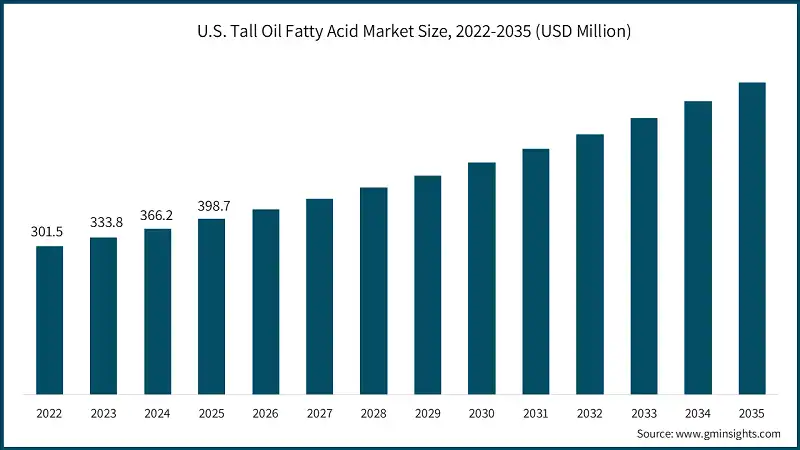
The North America tall oil fatty acid industry is growing rapidly on the global level with a market share of 40.2% in 2025.
- The North American tall oil fatty acid market is experiencing robust and steady growth by increasing demands for sustainable and bio-based chemicals across different industries including paints, coatings, adhesives, and the personal care market. Tough environmental regulations and escalating consumer awareness towards eco-friendly products are pushing manufacturers to use tall oil derivatives. The region's huge presence of key chemical and bio-based companies has further improved innovations and adoptions of tall oil fatty acids.
Europe market leads the industry with revenue of USD 444.5 million in 2025 and is anticipated to show lucrative growth over the forecast period.
- Europe is leading in adopting sustainable chemicals, which is one of the major reasons that helps the market to flourish; in addition, VOC emission control and high standards of environmental specifications have encouraged the adoption of tall oil fatty acids in the region. Another aspect that speeding tall oil fatty acid growth is the concept of green chemistry, new raw materials, and circular economic initiatives. Germany, France, and the UK spend much on bio-based products to be used in coating, adhesive, and personal care applications.
The Asia Pacific tall oil fatty acid market is anticipated to grow at a CAGR of 3.6% during the analysis timeframe.
- The market is showing fast growth in the Asia Pacific region. This is due largely to heightened industrialization and urbanization, which has given rise to an increasingly successful middle class: one that demands eco-friendly products. Major countries of tall oil consumption include China, India, and Japan, where demand is expected to be increased in paints, coatings, adhesives, and personal care. Environmental concerns and government encouragement on bio-based industries fuel investments in tall oil derivatives. Demand for bio-based and environmentally friendlier chemicals is also significantly augmented by the growing automotive and construction industries.
Latin America tall oil fatty acid accounted for 5.9% market share in 2025 and is anticipated to show steady growth over the forecast period.
- The tall oil fatty acid market in Latin America is developing and growing moderately because of increasing industrial activity and the transition toward sustainable products. Countries such as Brazil and Argentina have been pushing towards bio-based markets, trying to fulfill the requirements for climatized export demands as well as to comply with international environmental standards. Growing construction and agricultural sectors; increased consumer awareness regarding eco-friendly products are some major factors driving this market.
Middle East & Africa tall oil fatty acid accounted for 4% market share in 2025 and is anticipated to show lucrative growth over the forecast period.
- The MEA region is emerging but very promising markets for tall oil fatty acids as it stands to be driven by the increasing uptake of bio-based chemicals in the oil & gas, construction, and manufacturing sectors. With steady speed, sustainable development and rising environmental consciousness would gradually affect practices in the industry. Countries like South Africa, the UAE are researching bio-based alternatives because of increasing regulatory pressure and an industry push to greener standards.
Tall Oil Fatty Acid Market Share
The top 5 companies in tall oil fatty acid industry include Kraton Corporation, Ingevity, Forchem Oyj, NINGBO INNO PHARMCHEM CO., LTD, Lascaray S.A. These are prominent companies operating in their respective regions covering approximately 43.2% of the market share in 2025. These companies hold strong positions due to their extensive experience in market. Their diverse product portfolios, backed by robust production capabilities and distribution networks, enable them to meet the rising demand across various regions.
- Kraton Corporation, a major global producer of specialty polymers and bio-based chemicals including tall oil derivatives, benefits from a strong research and development capability and the focus on sustainable materials which provide it with a strong position in the market.
- Ingevity is recognized for specialty chemicals & engineered materials from renewable resources emphasizing sustainability and innovation. The company offers tall oil-based products primarily used in adhesives, coatings and rubber applications. With its smart partnerships and investments in sustainable technology, it further boosts its standing in the tall oil fatty acid industry.
- Forchem is a producer of tall oil rosin and derivatives like tall oil fatty acids. The real strength of the company lies in its fully integrated production process, emphasizing high-quality, sustainable products. Forchem has developed a prime position in the European market with a strong customer-oriented approach toward developing solutions to specific industrial needs.
- NINGBO INNO PHARMCHEM CO.,LTD. is a Chinese player that manufactures bio-based chemicals, including tall oil fatty acids. Its capacity to deliver a large volume of products at low prices poses an invitation to regional and international buyers interested in relatively cheap bio-based chemicals.
- Lascaray S.A. is a producer primarily known for high quality tall oil fatty acids. The company's strategic focus on bio-based solutions and renewable resources coincides with a growing market for sustainable chemicals. Its specialization and regional focus enable it to compete effectively notably for customers seeking eco-friendly and renewable raw materials.
Tall Oil Fatty Acid Market Companies
Major players operating in the tall oil fatty acid industry include:
- Forchem Oyj
- Harima Chemicals Group, Inc.
- Imperial Industrial Minerals Company
- Ingevity
- Kraton Corporation
- Lascaray S.A.
- NINGBO INNO PHARMCHEM CO.,LTD.
- Pasand Speciality Chemicals
- Pine Chemical Group
- Segezha Group
- SunPine AB
Tall Oil Fatty Acid Market Report Attributes
| Key Takeaway | Details |
|---|---|
| Market Size & Growth | |
| Base Year | 2025 |
| Market Size in 2025 | USD 1.2 Billion |
| Market Size in 2026 | USD 1.3 Billion |
| Forecast Period 2026-2035 CAGR | 3.5% |
| Market Size in 2035 | USD 1.7 Billion |
| Key Market Trends | |
| Drivers | Impact |
| Shift towards sustainable and bio-based products | The global shift to renewable resources and green chemicals is accelerating the adoption of tall oil fatty acid as an eco-friendly alternative to petroleum-based chemicals. |
| Growth in end-use industries like paper, pulp, and packaging | The expansion of these industries, especially in emerging markets, is fueling demand for tall oil fatty acid as a process chemical and additive. |
| Technological advancements in extraction and processing | Innovations in extraction and refining processes are improving the quality and cost-effectiveness of tall oil fatty acid, boosting its market penetration. |
| Pitfalls & Challenges | Impact |
| Price volatility of raw materials | Fluctuations in raw material prices can impact profit margins and stability of the tall oil fatty acid supply chain. |
| Environmental and regulatory challenges | Stringent regulations concerning forestry practices and chemical emissions may pose hurdles to production and market expansion. |
| Opportunities: | Impact |
| Growing demand in bio-based plastics and polymers | Increasing consumer and regulatory push for sustainable materials is driving the use of TOFA in bio-based plastics and polymers. |
| Expanding use in personal care and cosmetics | Rising awareness around natural and eco-friendly ingredients is boosting demand for TOFA in skincare, haircare, and cosmetic formulations. |
| Market Leaders (2025) | |
| Market Leaders |
9.8% |
| Top Players |
|
| Competitive Edge |
|
| Regional Insights | |
| Largest Market | North America |
| Fastest Growing Market | Europe |
| Emerging Country | Germany, UK, France, Italy |
| Future Outlook |
|
What are the growth opportunities in this market?
Tall Oil Fatty Acid Industry News
- In May 2025, Resinall a subsidiary of Ergon, Inc., entered a strategic partnership with Azelis to introduce R-6000 a soy-based alternative to tall oil fatty acid. Designed for metalworking fluid formulations, R-6000 offers a sustainable domestically sourced solution without compromising lubrication corrosion protection and fluid stability.
- In February 2024, Kraton Corporation introduced Sylvasolv, a new line of biobased oils manufactured from Crude Tall Oil (CTO), a by-product of the Kraft pulp industry. Sourced from responsibly managed forests, Sylvasolv aims to provide sustainable alternatives for industrial applications, running parallel to global objectives of drastically cutting down on fossil fuel consumption.
This tall oil fatty acid market research report includes in-depth coverage of the industry, with estimates & forecasts in terms of revenue (USD Billion) and volume (Kilo Tons) from 2022 to 2035, for the following segments:
Market, By Product Type
- Oleic acid
- Linoleic acid
- Palmitic acid
- Stearic acid
- Conjugated linoleic acid
Market, By Application
- Dimer acids
- Alkyd resins
- Fatty acid esters
- Monomer acids
- Trimer acids
- Ethoxylates & propoxylates
- Amines & amides
Market, By End Use Industry
- Paints & coatings
- Architectural & decorative coatings
- Automotive & transportation coatings
- Industrial coatings
- Marine & yacht coatings
- Adhesives & sealants
- Oil & gas
- Soaps & detergents
- Industrial cleaning products
- Household cleaning products
- Automotive
- Automotive lubricants
- Automotive coatings
- Automotive adhesives & sealants
- Rubber & tire
- Textiles
- Construction
- Building materials
- Road construction
- Mining
- Biofuels & energy
- Biodiesel production
- Renewable fuel additives
- Personal care & cosmetics
- Hair care
- Skin care
- Pharmaceuticals
- Agriculture
- Others
The above information is provided for the following regions and countries:
- North America
- U.S.
- Canada
- Europe
- Germany
- UK
- France
- Spain
- Italy
- Rest of Europe
- Asia Pacific
- China
- India
- Japan
- Australia
- South Korea
- Rest of Asia Pacific
- Latin America
- Brazil
- Mexico
- Argentina
- Rest of Latin America
- Middle East and Africa
- Saudi Arabia
- South Africa
- UAE
- Rest of Middle East and Africa
Frequently Asked Question(FAQ) :
What is the market size of the tall oil fatty acid market in 2025?
The market size was USD 1.2 billion in 2025, supported by rising adoption of bio-based and sustainable chemicals across industries.
What is the current tall oil fatty acid market size in 2026?
The market size is projected to reach USD 1.3 billion in 2026, reflecting steady demand from paints, coatings, lubricants, and personal care applications.
What is the projected value of the tall oil fatty acid market by 2035?
The tall oil fatty acid market is expected to reach USD 1.7 billion by 2035, driven by the shift toward green chemistry, VOC-free formulations, and bio-based raw materials.
How much revenue did the oleic acid segment generate in 2025?
The oleic acid segment held 50.5% market share in 2025, making it the largest product type in the industry. Its growth is driven by increasing use in cosmetics, lubricants, and eco-friendly chemical formulations.
What was the valuation of the alkyd resins application segment in 2025?
Alkyd resins accounted for 37.9% market share in 2025, leading all application categories. The segment benefits from rising demand for low-VOC, sustainable coatings and water-based formulations.
What is the growth outlook for the oleic acid segment from 2026 to 2035?
Oleic acid is projected to grow at a CAGR of 3.8% through 2035, supported by demand for renewable, biodegradable chemical ingredients.
Which region leads the tall oil fatty acid market?
North America leads with a 40.2% share in 2025, supported by strong presence of bio-based chemical manufacturers and adoption of sustainable products across coatings, adhesives, and personal care industries.
What are the upcoming trends in the tall oil fatty acid industry?
Key trends include technological advancements in extraction and refining, rising demand for bio-based polymers, stricter VOC emission regulations, and the development of high-purity TOFA derivatives for specialty applications.
Who are the key players in the tall oil fatty acid market?
Major players include Kraton Corporation, Ingevity, Forchem Oyj, NINGBO INNO PHARMCHEM CO., LTD., and Lascaray S.A., together holding about 43.2% market share in 2025.
Tall Oil Fatty Acid Market Scope
Related Reports