Summary
Table of Content

Synthetic Biology Food Ingredients Market
Get a free sample of this report
Form submitted successfully!
Error submitting form. Please try again.
Thank you!
Your inquiry has been received. Our team will reach out to you with the required details via email. To ensure that you don't miss their response, kindly remember to check your spam folder as well!
Request Sectional Data
Thank you!
Your inquiry has been received. Our team will reach out to you with the required details via email. To ensure that you don't miss their response, kindly remember to check your spam folder as well!
Form submitted successfully!
Error submitting form. Please try again.
Synthetic Biology Food Ingredients Market Size
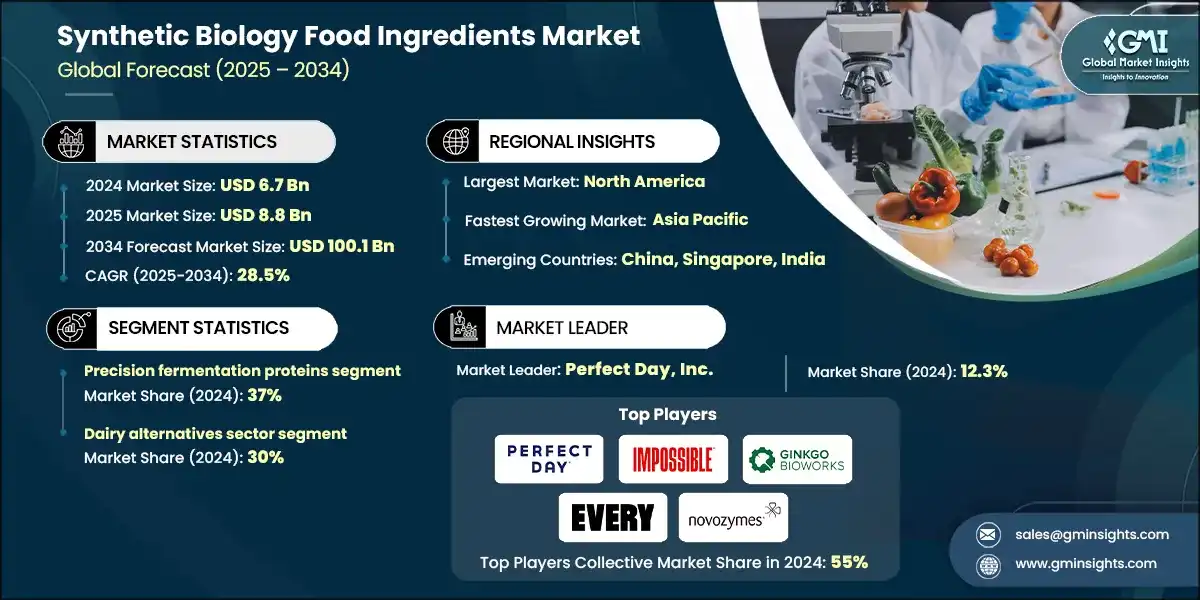
The global synthetic biology food ingredients market was estimated at USD 6.7 billion in 2024. The market is expected to grow from USD 8.8 billion in 2025 to USD 100.1 billion in 2034, at a CAGR of 28.5% according to latest report published by Global Market Insights Inc.
Synthetic Biology Food Ingredients Market Key Takeaways
Market Size & Growth
- 2024 Market Size: USD 6.7 Billion
- 2025 Market Size: USD 8.8 Billion
- 2034 Forecast Market Size: USD 100.1 Billion
- CAGR (2025–2034): 28.5%
Regional Dominance
- Largest Market: North America
- Fastest Growing Region: Asia Pacific
Key Market Drivers
- Breakthrough advances in precision fermentation technology.
- Rising consumer demand for sustainable and ethical food alternatives.
- Technological advancement in synthetic biology platforms.
Challenges
- Complex regulatory approval pathways and high capital requirements.
Opportunity
- Growing alternative protein market and sustainability mandates.
Key Players
- Market Leader: Perfect Day, Inc. led with over 12.3% market share in 2024.
- Leading Players: Top 5 players in this market include Perfect Day, Inc., Impossible Foods Inc., Ginkgo Bioworks Holdings, Inc., The EVERY Company, Novozymes, which collectively held a market share of 55% in 2024.
Get Market Insights & Growth Opportunities
- The market's rapid growth compared to traditional food ingredient markets demonstrates the promise of change in food production through synthetic biology technologies. Advances in technology in alignment with sustainability demands, a very strong shift among consumers toward increasingly functional and environmentally responsible food and food ingredients is propelling the market forward.
- Investment momentum for companies already affirms the projections for market growth since between 2013 and 2023, the total over USD 4.1 billion was invested in fermentation companies, USD 515 million of which was in 2023. Food giants such as Nestlé, Unilever and Danone are actually bringing these products closer to consumers in production contracts with biotechnology companies by synthetic biology-derived ingredients. At the same time, government support is significantly boosted through initiatives such as, positive investment across China in biotechnology as proclaimed within its 14th Five-Year Plan.
- Market penetration in terms of product categories usually differs from one another depending on applications. Current markets are mainly dominated by enzyme and vitamin categories, which have established regulatory frameworks and proven consumer acceptance. Other rapidly emerging categories include protein ingredients like dairy alternatives and egg replacers, while new fats and complex functional ingredients are just emerging as yet relatively new and growing sectors. Gradually, price competitiveness continues to improve, with precision fermentation protein price estimates pegging towards USD 10/kg by 2025 comparable to prices of conventional alternatives.
To get key market trends
Synthetic Biology Food Ingredients Market Trends
- Precision Fermentation Technology Advancement and Scale-Up: Precision fermentation technology, arguably the most advanced commercially in the production of synthetic biological food ingredients, has highly developed genetic engineering and bioprocess optimization tools that propel better yields and cost savings. CRISPR-Cas systems, advanced metabolic engineering, and synthetic biology platforms would allow precise programming of microorganisms to produce food ingredients such as proteins, enzymes, vitamins, and specialty compounds. The technological realities here relate to advances in continuous fermentation processes, improved downstream purification methods, and engineering of GRAS microorganisms for food applications.
- Cellular Agriculture and Novel Protein Production Systems - New foods will come to life in this new paradigm of using animal cells and even new microorganisms to create entirely new categories of food ingredients produced by cellular agriculture. This includes precision fermentation that results in producing animal-identical proteins and biomass fermentation of innovative protein sources like fungi and algae or engineered microorganisms. Applications include dairy protein production (casein and whey), egg proteins (ovalbumin), meat proteins (myoglobin), and novel functional proteins with new nutritional profiles.
- Regulatory Framework Development and Market Access Expansion - The general regulatory frameworks specifically tailored to cover synthetic biology food ingredients will form a very critical trend for market expansion and consumer confidence. It is clear that such agencies like the FDA, EFSA, and CFSA are paving the way for safety assessment and market approval for novel ingredients made using synthetic biology. Among key developments are the new GRAS notification processes by the FDA, novel food regulations under EFSA, and China's "Three New Foods" initiative.
Synthetic Biology Food Ingredients Market Analysis
Learn more about the key segments shaping this market
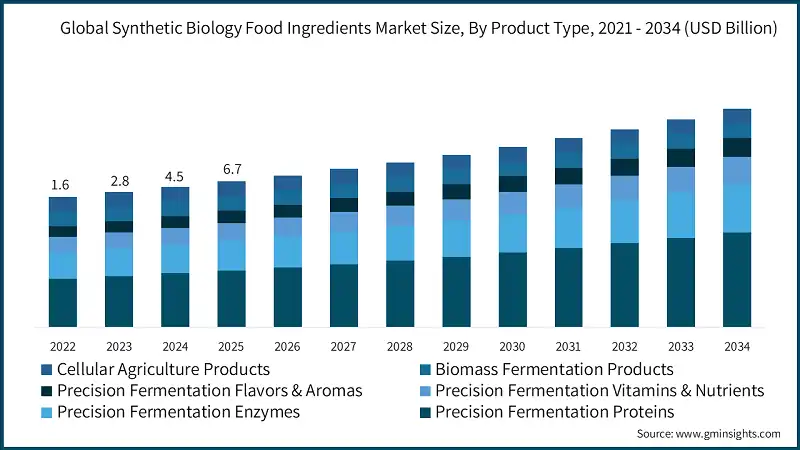
Precision fermentation proteins constitute 37% of the total market share in 2024, with 27.8% CAGR driven through the successful commercialization of dairy alternatives, egg replacers, and functional proteins, and whey and casein proteins show exceptional attractiveness in the market within this segment through partnerships including DSM-Fonterra's Vivici joint venture and Perfect Day's collaborations with major food manufacturers. Consumer acceptance, sound value propositions, effective and scalable manufacturing all offer clear advantages to the protein category.
Precision fermentation enzymes hold about 12% of the synthetic biology food ingredients market share in 2024 with a projected 25.4% CAGR from 2025-2034, which includes the older-style chymosin for cheesemaking and some new enzymes for processing plant proteins and for functional foods. This category has been built over decades of regulatory precedent and existing supply chains whereby innovation has concentrated on increased functionality and reduced costs of production. Vitamins and nutrients, which account for about 10% market share, are posting strong growth through applications in infant nutrition, dietary supplements, and functional foods. The segment stands to benefit from clearly established regulation pathways and build consumer demand for more naturally-derived vitamins.
Learn more about the key segments shaping this market
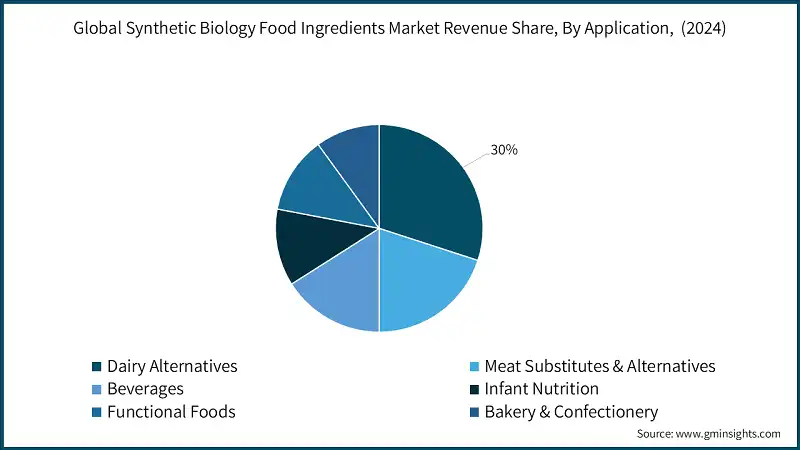
The dairy alternatives sector leads market penetration with a 30% revenue share in 2024 and is set to register at a CAGR of 27.8% through 2034, symbolizing a successful commercialization effort of precision fermentation dairy proteins in a market characterized by high consumer-trends demand for plant-based alternatives. The dairy alternatives benefit from the presence of a market where infrastructure is already in place, acceptance of alternative dairy is there in consumers, and bio-identical proteins hold advantageous functional properties. Taste and texture parity with conventional dairy, pricing competitiveness, and nutritional equivalence or enhancement are the winning ingredients.
Meat substitutes and alternatives command a 20% of synthetic biology food ingredients market share in 2024 with a 27.8% CAGR from 2025-2034, sustained by precision fermentation proteins, novel protein ingredients, and cellular agriculture applications. The segment exhibits vigorous commercial growth prospects leveraging technological advancements, resulting in the evolution of taste, texture, and nutritional profile for both plant-based and cultivated meat products. Innovation in this segment focuses on ingredients that mimic key sensory attributes of meat while providing sustainability and health benefits.
The beverages segment accounts for 16% market share in 2024 with 25.4% CAGR from 2025-2034 and includes functional beverages, protein drinks, and specialty beverages including alcoholic beverages. Major growth drivers are the demand for functional nutrition, convenience, and innovative flavor profiles enabled by synthetic biology ingredients. The segment can leverage comparatively lower regulatory hurdles for many applications and established distribution channels via beverage industry partnerships.
Food and beverage manufacturing accounts for a 60% market share in 2024 with a 27.8% CAGR from 2025-2034 and is the broadest area of applications, ranging from ingredient suppliers to finished product manufacturers. This segment benefits from existing supply chains, manufacturing know-how, and distribution networks. Growth drivers are ingredient cost reductions due to cheaper substitutes, functional advantage, and sustainability. Challenges faced are formulation complexity, regulatory compliance critical for consumer acceptance of newer ingredients.
Dietary supplements with 16% market share in 2024 and 25.4% CAGR in the forecasted period are driven by the consumer demand for functional nutrition and naturally derived ingredients. The synthetic biology production of complex bioactive compounds, vitamins, and proteins is typically difficult and expensive by conventional means. This segment enjoys better pricing power, established regulatory pathways, and greater consumer awareness in recent years regarding personalized nutrition.
Looking for region specific data?
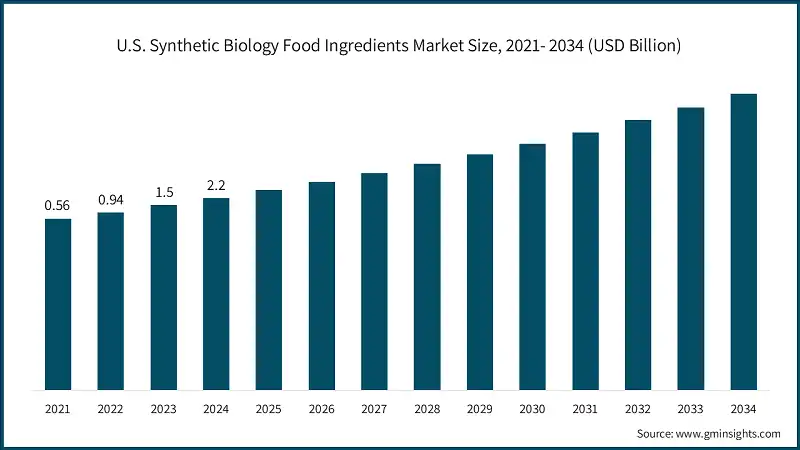
- The U.S. synthetic biology food ingredients market was valued at USD 2.2 billion in 2024 and is likely to expand to almost USD 3 billion by 2034. North America is accounting for 42% of the market share in 2024 with a 27.8% CAGR in the forecasted period. This stronghold is attributed to the superior biotechnology infrastructure that is supported by robust regulatory, as well as a strong venture capital ecosystem in the U.S. It therefore also benefits from existing biotechnology companies, academic research institutes, as well as early consumer adoption of alternative proteins. Also affected positively is the growth of the market through governments in provision by way of USDA funding, FDA regulatory paths, and state initiatives to further drive growth. The major drivers of the market are consumer health concerns, sustainability, and capabilities to innovate technologies.
- Europe synthetic biology food ingredients market accounts for 30 % of the market share in 2024 with a 27.8% CAGR in the forecasted period characterized by strong regulatory frameworks, sustainability focus, and established food industry infrastructure. This has led co-beneficial EU policies such as biotechnology research funding and novel food regulations which provide clear market access pathways for the region. High consumers in Europe would take up sustainable-alternatives to food due to the support of environmental consciousness and premium product positioning. The key markets include Germany, Netherlands, and U.K., all of which boast strong government support for biotechnology innovation.
- The fastest-growing region in Asia-Pacific accounts for over 20% of the current market share in 2024, with 32.5% CAGR in the forecasted period. Rapid economic development, urbanization, and growing middle-class populations in China, India, and Southeast Asia drive this growth. The region is also benefiting from tremendous government investments in biotechnology with China's 14th Five-Year Plan supporting synthetic biology development. Among other advantages are low production costs, established fermentation infrastructure, and closeness to feedstock sources. Challenges that face this sector include regulatory complexities, consumer acceptance of novel ingredients, and varying food safety standards across countries.
- Latin America and Middle East & Africa make up the minor market share, which stands at 6% and 2%, in 2024 respectively, but shows prospects for growth as these countries gradually start developing food processing industries and raise public knowledge about it. Improvement will come as strong government sustains the support for biotechnology development. These regions are cost-effective production ground for local feedstock and increasingly growing domestic markets for functional food ingredients.
Synthetic Biology Food Ingredients Market Share
Global synthetic biology food ingredients industry possesses a moderate concentration where the top five players commanded a combined market share of 55% in 2024. Perfect Day, Inc. has a market leadership position with 12.3% market share. This concentration indicates the specialized nature of synthetic biology technologies and the quite substantial technical know-how for successful commercialization. The market structure is one comprising established biotechnology companies having proven platforms and newly-created startups developing novel applications where both scale and innovation-driven approaches are created.
To maintain its leadership within the market, Perfect Day, Inc. first pioneered precision fermentation of dairy proteins then formed successful commercial partnerships and finally established their manufacture capabilities. The whey and casein proteins of the company can be found in consumer products through partnerships with major food manufacturers, to showcase successful execution of the business model and market validation. Impossible Foods Inc. commands a considerable market share of the market via its proprietary heme protein technology and presence in the meat alternatives portfolio combined with brand strength and distribution partnerships to counter competitive forces.
Ginkgo Bioworks Holdings, Inc. represents an entirely unique platform approach in that synthetic biology services and technologies are offered to several industry partners as opposed to a one-dedicated-solution-for one-single-ingredient formula. With this business model, participation possible across application space while reducing market risk at the same time. The EVERY Company wins well in precision fermentation proteins, to be specific egg alternatives through achieving the requisite approvals from regulators, in addition to commercial partnerships with food manufacturers.
Synthetic Biology Food Ingredients Market Companies
Major players operating in the synthetic biology food ingredients industry are:
- Perfect Day
- Impossible Foods
- Ginkgo Bioworks Holdings
- The EVERY Company
- Novozymes
- DSM-Firmenich
- Nature's Fynd
Perfect Day, Inc. is the leading pioneer in the market for precision fermentation of dairy proteins, including whey and casein, by genetically engineered microorganisms. Its successful B2B business model sells animal-free dairy proteins to food manufacturers for developing consumer products. Among its strategic partnerships are those with big name brands and development of commercial production facilities. Recent headlines for the company include expanding capability and new lines of protein variants with improved functional properties being developed.
Impossible Foods Inc. keeps up a large part of its presence in the market through its own patented soy leghemoglobin (heme) protein technology-a substance that brings meat flavor and form to plant-based products. The integrated value chain runs the whole length, from ingredient development through finished-product manufacturing and marketing. The newly strategic measures focus on increasing heme production, adding new heme technology applications, or even moving into regulatory approvals from overseas markets. Its success indicates that synthetic biology ingredients are relevant for introducing a new product category to the market.
Ginkgo Bioworks Holdings, Inc's platform model is unique, offering the whole world of synthetic biology services, technologies, and manufacturing capabilities to partners spanning numerous industries, food ingredients inclusive. By this, participation in different application areas is ensured while minimizing risks to direct market exposure. Strain engineering, bioprocess development, and manufacturing partnerships comprise service provision. Strategic initiatives include enhancing platform capabilities, developing new alliances, and expanding manufacturing capacities for partner products.
THE EVERY COMPANY specializes in precision fermentation of egg proteins, particularly ovalbumin and other functional egg components. The company has achieved noteworthy regulatory milestones inclusive of FDA GRAS status for the products and successful commercial launches into consumer applications. Strategic initiatives include broadening protein portfolio, scaling up production capabilities and developing new applications of egg protein functionality in food formulations. The success of the company shows acceptance of the market towards alternatives to conventional animal proteins.
The century-old industrial expertise of Novozymes A/S renders them capable of developing synthetic biology-derived food ingredients, including novel enzymes for food processing and functional ingredients. The company's established market position, regulatory expertise, and global distribution network provide competitive advantages for commercialization of synthetic biology technologies. Strategic initiatives include expansion of enzyme application, development of new biotechnology platforms, and partnerships with food manufacturers for ingredient incorporation.
Synthetic Biology Food Ingredients Market Report Attributes
| Key Takeaway | Details |
|---|---|
| Market Size & Growth | |
| Base Year | 2024 |
| Market Size in 2024 | USD 6.7 Billion |
| Market Size in 2025 | USD 8.8 Billion |
| Forecast Period 2025 - 2034 CAGR | 28.5% |
| Market Size in 2034 | USD 100.1 Billion |
| Key Market Trends | |
| Drivers | Impact |
| Breakthrough advances in precision fermentation technology | Enabling scalable production of complex proteins, enzymes, and nutrients with 70-90% lower environmental footprint than traditional methods |
| Rising consumer demand for sustainable and ethical food alternatives | Driving adoption of cellular agriculture products and plant-based alternatives, particularly in dairy and meat substitute segments |
| Technological advancement in synthetic biology platforms | Enhanced bioengineering capabilities enabling custom-designed ingredients with improved functionality and cost-effectiveness |
| Pitfalls & Challenges | Impact |
| Complex regulatory approval pathways and high capital requirements | Lengthy food safety assessments and specialized biomanufacturing infrastructure limiting rapid market penetration and increasing time-to-market |
| Opportunities: | Impact |
| Growing alternative protein market and sustainability mandates | Increasing investment in food tech innovation and corporate sustainability commitments driving adoption across major food manufacturers. |
| Market Leaders (2024) | |
| Market Leaders |
12.3% market share |
| Top Players |
Collective market share is 55% in 2024 |
| Competitive Edge |
|
| Regional Insights | |
| Largest Market | North America |
| Fastest growing market | Asia Pacific |
| Emerging country | China, Singapore, India |
| Future outlook |
|
What are the growth opportunities in this market?
Synthetic Biology Food Ingredients Industry News
- In March 2025, the Vivici joint venture between DSM-Firmenich and Fonterra started commercial-scale animal-free beta-lactoglobulin production in the U.S., significantly enhancing the profile of precision fermentation dairy protein commercialization.
- In April 2025, Formo Foods launched animal-free cheese employing precision fermentation technology, thereby demonstrating the commercial viability of synthetic biology dairy alternatives in European markets.
The synthetic biology food ingredients market research report includes in-depth coverage of the industry, with estimates & forecast in terms of revenue (USD Million) and volume (Kilo Tons) from 2021 to 2034, for the following segments:
Market, By Product Type
- Precision fermentation proteins
- Dairy proteins
- Egg proteins
- Collagen & gelatin alternatives
- Novel functional proteins
- Precision fermentation enzymes
- Food processing enzymes
- Texture modification enzymes
- Flavor enhancement enzymes
- Precision fermentation vitamins & nutrients
- B-complex vitamins
- Amino acids & peptides
- Omega-3 fatty acids
- Human milk oligosaccharides
- Precision fermentation flavors & aromas
- Natural flavoring compounds
- Aroma molecules
- Taste modulators
- Biomass fermentation products
- Microbial protein concentrates
- Mycelium-based ingredients
- Algae-derived components
- Cellular agriculture products
- Cultivated meat components
- Cell-based dairy ingredients
- Cellular seafood components
Market, By Application
- Dairy alternatives
- Plant-based milk applications
- Cheese & yogurt alternatives
- Ice cream & frozen desserts
- Meat substitutes & alternatives
- Plant-based meat products
- Hybrid meat products
- Cultivated meat applications
- Beverages
- Protein beverages
- Functional drinks
- Flavored beverages
- Infant nutrition
- Infant formula enhancement
- Specialized pediatric nutrition
- Breast milk fortifiers
- Functional foods
- Fortified food products
- Nutraceutical applications
- Medical food products
- Bakery & confectionery
- Egg replacement applications
- Texture enhancement
- Flavor & aroma enhancement
Market, By End Use
- Food & beverage manufacturing
- Large-scale food processors
- Specialty food manufacturers
- Contract manufacturing organizations
- Dietary supplement industry
- Nutraceutical companies
- Sports nutrition manufacturers
- Functional supplement producers
- Infant formula manufacturing
- Premium infant nutrition brands
- Specialized medical nutrition
- Organic baby food manufacturers
- Food service industry
- Quick service restaurants
- Institutional catering
- Food delivery platforms
- Pet food industry
- Premium pet nutrition
- Veterinary therapeutic diets
- Specialty pet treats
The above information is provided for the following regions and countries:
- North America
- U.S.
- Canada
- Europe
- UK
- Germany
- France
- Italy
- Spain
- Asia Pacific
- China
- India
- Japan
- South Korea
- Australia
- Latin America
- Brazil
- Mexico
- Argentina
- Middle East & Africa
- UAE
- Saudi Arabia
- South Africa
Frequently Asked Question(FAQ) :
What is the market size of the synthetic biology food ingredients in 2024?
The market size was USD 6.7 billion in 2024, with a CAGR of 28.5% expected through 2034 driven by transformative advances in precision fermentation technology and rising consumer demand for sustainable food alternatives.
What is the projected value of the synthetic biology food ingredients market by 2034?
The synthetic biology food ingredients market is expected to reach USD 100.1 billion by 2034, propelled by breakthrough fermentation technologies, cellular agriculture adoption, and sustainability mandates across major food manufacturers.
What is the current synthetic biology food ingredients market size in 2025?
The market size is projected to reach USD 8.8 billion in 2025.
How much revenue did the precision fermentation proteins segment generate in 2024?
Precision fermentation proteins held 37% market share in 2024, leading the market through successful commercialization of dairy alternatives, egg replacers, and functional proteins.
What was the valuation of the food & beverage manufacturing segment in 2024?
Food & beverage manufacturing held 60% market share in 2024, representing the broadest application area with a 27.8% CAGR projected through 2034.
What is the growth outlook for the Asia Pacific region from 2025 to 2034?
Asia Pacific is projected to grow at a 32.5% CAGR till 2034, fueled by rapid economic development, government investments in biotechnology, and growing middle-class populations in China, India, and Southeast Asia.
Which region leads the synthetic biology food ingredients market?
North America held 42% share with USD 2.2 billion in the U.S. alone in 2024. Superior biotechnology infrastructure, robust regulatory frameworks, and strong venture capital ecosystems fuel the region's dominance.
What are the upcoming trends in the synthetic biology food ingredients market?
Key trends include advancement of precision fermentation technology with 70-90% lower environmental footprint, expansion of cellular agriculture for novel protein production, and development of tailored regulatory frameworks for market access.
Who are the key players in the synthetic biology food ingredients market?
Key players include Perfect Day, Impossible Foods, Ginkgo Bioworks Holdings, The EVERY Company, Novozymes, Cauldron Ferm, Ajinomoto, DSM-Firmenich, Spiber, Nature's Fynd, Remilk, Onego Bio, Superbrewed Food, Imagindairy, and The Better Meat.
Synthetic Biology Food Ingredients Market Scope
Related Reports